Lifestyle
The European Heir Restoring Forgotten American Cars to Glory


A giant screen still towers over the site of the former Boulevard Drive-In Theater, a sprawling complex ringed by low-rise buildings in an industrial section of Allentown, Pa. For several decades in the middle of last century, it and other drive-ins showcased the might of America’s auto industry. The theaters — along with drive-through banks, pharmacies, groceries, liquor stores and dry cleaners — were both symbols of how cars were shaping popular culture and places to see all varieties of domestic vehicles.
The Boulevard Drive-in closed in the 1980s, after about 40 years in operation. But visitors to the site today will notice signs of automotive life. Its hilly landscape has been paved with miles of narrow, curving roads and there is now an old-timey Sinclair Oil gas station on the premises, complete with a glass-tank pump and a sign that flashes the company’s dinosaur logo.
The infrastructure supports what the old drive-in has become: a temple to American cars from the early to mid 1900s.
Called the NB Center for American Automotive Heritage, the private museum was founded about a decade ago by Nicola Bulgari, the 84-year-old vice chairman of Bulgari, the Italian luxury brand that his grandfather started in Rome in 1884. (In 2011, the Louis Vuitton Moet Hennessy conglomerate took control of Bulgari in a multi-billion-dollar deal; in 2023, Mr. Bulgari was convicted of insider trading with LVMH stock in France and fined about $1.4 million.)
The NB Center, in which Mr. Bulgari has invested at least $10 million, has about 200 vintage cars from his collection (another 100 are in storage in Italy). Nearly all of the vehicles were built between the 1920s and the mid-1950s, in the middle of America, for the middle of the market. There are Chryslers, Chevrolets, Nashes, Oldsmobiles, Studebakers and, most abundantly, Buicks.
Mr. Bulgari knows each of the vehicles by make, year, specification — and often by purchase date and location, too. He rattled off the bona fides of several cars on a recent tour of the center: They included a 1934 Buick 96S with “a smooth reliable engine that is unparalleled,” as he put it; a 1941 Nash with a rear seat that converts into a bed; a 1948 Buick “woody” station wagon with an ash-and-mahogany body.
There was also a 1934 Chrysler Airflow Coupe, a model emblematic of the aviation-inspired trend toward streamlined automobile design. (Its developers included Orville Wright.) “From 1930 to 1934, a huge change occurred in design, when cars went from being a box, to smoothing down,” Mr. Bulgari said.
He has purchased most of the cars from sellers around the world. But Mr. Bulgari has also received some from donors who share his passion for a genre of automobiles that is prized less by collectors than cars from luxury European brands like Bugatti or Rolls-Royce.
“People ask me, ‘Why don’t you collect Ferraris?’” Mr. Bulgari said, noting that his older brother Gianni used to race a Ferrari 250 GTO in the mid 1960s. “My answer is there are too many Ferrari collectors already. They don’t need me.”
He feels that the cars he collects do. Mr. Bulgari sees his automotive center as preserving what he calls “the history of the greatest era of the American automobile.”
While not currently open to the public, the center has hosted car clubs, philanthropic organizations, researchers and students for tours and events. Like other museums, it will loan out its contents. A 1934 Nash Ambassador from Mr. Bulgari’s collection recently appeared in the Pebble Beach Concours d’Elegance auto show, where the car won a second-in-class ribbon. Other cars or components have been borrowed by the Museum of Modern Art and the Frick Collection.
Though the types of vehicles Mr. Bulgari collects are from a time when automakers in the United States made significant design and engineering advancements, they have little material value today. They generally sell for mid-five-figure prices (about the average cost of a new car) and restoring one can easily cost five times as much.
That’s largely why “the survivability of those cars is very low” compared with that of blue-chip models preferred by collectors, said Jonathan Klinger, 43, a vintage automobile specialist who spent years working with classic cars at the insurance company Hagerty before becoming the NB Center’s executive director last year.
Mr. Bulgari’s car collection may be less famous than Jay Leno’s and less rarefied than Ralph Lauren’s, but it has a distinct theme, something that Ken Gross, an automotive historian, author and curator, said is essential to any good collection.
“I personally think what Bulgari has done is wonderful because many of those cars were, if not neglected by collectors, just not paid much attention to,” Mr. Gross added. “Their restoration gives you a glimpse into some cars that you might not necessarily see anywhere else.”
Mr. Bulgari’s fascination with American cars started in childhood, around the time the Boulevard Drive-In opened in Allentown. “I first saw American cars in 1946 in Lugano, Switzerland,” he said. He was five years old and World War II had just ended. “I don’t have to describe what Rome was like in 1946, after the war,” Mr. Bulgari continued. “It was scary. So it was a bit of a shock to see these magnificent cars.”
He purchased his first Buick — a toy car — that same year. Not long after, in 1953, he went to watch the Mille Miglia, a 1,000-mile semiregular road race in Italy that first took place in 1927. He was 12, and although the race featured Porsches, Jaguars, Mercedes-Benzes, Aston Martins, Ferraris and Maseratis, Mr. Bulgari recalled dreaming only of seeing a 1953 Chrysler, one of the few American cars in the race.
“American cars had something style-wise that European cars never had,” he said. “And because of strong competition and a growing market, their engines, transmissions and suspensions were so advanced,” he continued, almost breathlessly. “And the metallurgy — they were constantly working on finding better materials, higher quality, longer lasting.”
To maintain his cars, Mr. Bulgari has brought a handful of small car-restoration businesses to the center, acquiring them in deals that included their equipment and employees (no jobs were lost in the process). The businesses include the former Hyde Villa Machine Shop, which operated in Reading, Pa., for more than 50 years before its owner, Rich Olsen, sold it to Mr. Bulgari two years ago. “We brought in everything — boring machine, crankshaft grinder, milling machine,” Mr. Olsen, 72, said.
Keith Flickinger, the NB Center’s curator and chief operating officer, sold his business, Precision Motor Cars in Allentown, to Mr. Bulgari in 2015, after years of working on various restoration jobs for him. “I used to have dozens of projects from dozens of clients,” Mr. Flickinger, 62, said. “Now I have dozens of projects, but just one client.”
Mr. Flickinger saw folding his business into the NB Center as a way to preserve it, he added, while “preserving American automotive history and mentoring younger craftspeople” like the center’s student interns. They have come from the Pennsylvania College of Technology, Lehigh University in Bethlehem, Pa., and McPherson College in McPherson, Kan., the rare American university to offer a four-year degree in car restoration. Amanda Gutierrez, McPherson College’s vice president for automotive restoration, said the center “has become a valuable educational partner, applying and expanding skills students have developed.”
Jon Haring, 48, the center’s automotive restoration manager, started working with cars as a teenage apprentice to Mr. Flickinger. Now he spends his days getting Mr. Bulgari’s vehicles in perfect running order — a process that can take as long as two-and-a-half years for a single car, partly because the period-correct parts they can require often have to be made from scratch.
Charts tracking the progress of restoration work are posted near the entrances to the center’s workshops. The projects are myriad and often arcane: Creating handmade wooden wheels in the style of a 1920s Studebaker with the help of local Amish wheelwrights, for instance, or producing floor mats like those in a 1930s Nash by cobbling together ribbed rubber, casting a silicone mold and pouring in urethane. “It took about 40 hours to make the mats,” Mr. Haring said.
Brad Danish, an upholstery technician, started working full-time at the center in 2015. He had previously spent much of his career working out of the garage of his home in Pennsylvania’s Lehigh Valley. Using a range of industrial sewing machines and custom-made components, Mr. Danish, 66, has stitched seats, door panels, headliners and carpets.
His craft is exemplified in the restoration of the leather seats in Mr. Bulgari’s 1939 Lincoln Zephyr convertible, which was believed to be the only model of its kind in original condition when Mr. Bulgari bought it for $60,000 in 2016. By then, the leather upholstery had petrified and the stitching had decomposed. Mr. Danish removed, soaked and softened the hides before reupholstering the seats by sewing through their existing stitching holes. That level of reverence to original details, he said, sets “a standard for future restorations of similar vehicles.”
Mr. Bulgari said that another goal of the NB Center and its work is to ignite in others the same passion he has for the cars he collects. “What I’m trying to create is something that is contagious, that people understand, and then, on their own, they’re trying to save the cars of this time as well,” as he put it. “What is important is that people get inspiration. Even if they do one car in a lifetime, they save a piece of history.”
Some who have been to the site have taken up Mr. Bulgari’s cause. Johnathan Trumbo, 25, and Anthony Maguschak, 23, two mechanics at the center, now each own early 20th-century American cars. Mr. Maguschak, who lives in the Lehigh Valley, bought and has been rebuilding a 1939 Buick Special. “I absolutely credit Mr. Bulgari and this place with my interest in old Buicks,” he said.
As for Mr. Trumbo, who also lives in eastern Pennsylvania, he bought a 1931 Ford Model A pickup truck. “My friends all have their things — they’re into computers or electronics,” he said. “This is my thing. And they think it’s cool.”



The scoreboard shows the results of the women’s singles final match between Iga Swiatek of Poland and Amanda Anisimova of the U.S. at the Wimbledon Tennis Championships in London, Saturday, July 12, 2025.
Kirsty Wigglesworth/AP
hide caption
toggle caption
Kirsty Wigglesworth/AP
Fifteen points in tennis? Nice. Thirty, 40 — even better. Advantage — that sounds good. “Love” — that also must be great, right? Well, not quite.
As the French Open rolls on and Serena Williams has announced her return to the sport, maybe you’ve been paying a little more attention to tennis. The sport’s scoring system is notably distinct, and can sometimes be hard to grasp for newcomers. But even tennis aficionados might not know why, or how, “love” became the unmistakable callout for zero points. For this installment of NPR’s Word of the Week, we’re exploring how a word that signifies trailing behind got such a sweet name.
“Love” comes from the heart — or an egg?
It’s hard to pinpoint when the first tennis ball went over the net. Tennis is a derivative of lots of other sports, such as “jeu de paume,” a handball game played in France, said JT Buzanga, the collections manager at the International Tennis Hall of Fame museum.
But tennis became a patented, official sport in 1874, said Steve Flink, a journalist whose tennis coverage got him inducted into the International Tennis Hall of Fame. It has retained its unique, mysterious scoring system ever since.
“By and large, the original system has held up almost entirely,” Flink said.
The use of “love” goes back to the late 18th century, said Jesse Sheidlower, a lexicographer. But it was used earlier than that in card games such as whist and bridge. Before the term made its way to tennis, the sport favored plain old “nothing,” or “nil,” he said.
Why love in the first place, though? Historians don’t really know for sure, but there are a few theories.
The French could have something to do with it. Some historians believe “love” derives from “l’oeuf,” which means “the egg” in French. Because eggs are shaped like zeros, terms such as “goose egg” and “duck’s egg” have been used in other contexts to mean zero, Sheidlower said.
It’s also possible English speakers mispronounced l’oeuf as “love.” But Sheidlower isn’t convinced that’s the answer.
“It’s the French equivalent of an English expression. But since that expression doesn’t appear in French, the French word wouldn’t have been used,” he said.
To be sure, France has had a lot of influence on tennis culture, Buzanga said. For example, “deuce” or a game tied at 40 points, comes from the French word for “two”: “deux.” But he prefers another prominent theory: that “love” comes from the idiom “for the love of the game.” Even if a player hasn’t scored, it doesn’t matter, because their heart is in it. It’s the theory Sheidlower said is the most plausible, because the idiom was used by the English before tennis was popularized.

Another variation of the “love of the game” theory is that the word could have come from the Dutch “lof,” or “honor” — or the Latin “amare,” meaning “to love,” Flink said.
But if tennis’ “love” doesn’t come from a French word, the theory at least has a French sensibility.
“I think the ‘for the love of the game’ is kind of romantic,” Buzanga said.
“Love” probably isn’t going anywhere
Tennis used to be a sport of leisure. The style of play has changed a lot over the years; players are more athletic and competitive, for instance, Flink said. But the rules of the sport are more steadfast, he said.
“There’s this incredible, enduring respect for tradition in tennis,” he said. “Changes are not made easily.”
There has been one major change in modern history: the tie-break. Matches can go on and on because players have to score two consecutive points to break a deuce, or by two games to break a tied set. But the onset of television meant matches would have to get shorter if the sport wanted to capture a larger audience, Flink said.

Change even came for “love.” An alternative sprouted up in the 1970s, and is still used today: “bagel,” named for its zero shape, Sheidlower said. Novices may say “zero,” and insiders will understand what they mean, but they “will needle them about it,” Flink said.
But “love” still prevails.
“People kind of like it,” Flink said. “It’s different. Why say zero when you can say love?”

On a 75-mile cliff-hugging stretch of highway in California, traffic is way up, despite soaring gas prices. And locals expect the busiest summer in years.
The road is Highway 1 in Big Sur, which reopened in January after three years of repair and reconstruction following a pair of landslides. Drivers can once again embark on the state’s most famous road trip, covering the 100 miles between Cambria to the south and Carmel to the north without leaving the two-lane coastal highway. And they’re heading out in big numbers.
Caltrans estimates that as of May, Big Sur restaurant and retailer guest counts are up 40% from last year, and that northbound traffic at Ragged Point, the southern gateway to Big Sur, has risen 900% year-over-year.
People pose for photos near Bixby Bridge. Monterey County’s Board of Supervisors voted to explore a 12-month ban on parking around the bridge.

Safety cones prevent parking along Coast Road near the Bixby Bridge.
“Take your time,” said Kirk Gafill, co-owner of the popular Nepenthe restaurant and president of the Big Sur Chamber of Commerce, offering advice to travelers. “You’re going to be sharing the road with a number of people.”
As travelers rediscover the road, the cost of driving has been shooting skyward. California’s average gas price ($6.11 per gallon as of May 26) is up 26% from the year before. In early April, rates hit $9.99 at the isolated gas station in the Big Sur community of Gorda.
For spring and summer travelers, these numbers would seem to pose a stark question: Stay home and save money, or head for the coast because the road is finally open and it’s still cheaper than flying?
So far, the latter answer is winning big.

Fog lingers off the coast of Highway 1.
“We are definitely seeing a huge uptick in our reservations,” said Megan Handy, assistant general manager at the upscale Treebones resort. She estimated that bookings are 30% or more ahead of last year, and rates are unchanged since then. But “it’s still not feeling super crowded, which is nice. Everything still feels kind of calm.”
But added traffic has raised some anxiety. On May 19, Monterey County’s Board of Supervisors voted to explore a 12-month ban on parking at Bixby Bridge, one of the region’s top photo spots.
Over the years, the number of cars parking near the bridge — often illegally, sometimes impeding emergency vehicles — has risen. The proposed parking moratorium won’t take effect until the supervisors discuss it further.

-
Share via
Busy as things are, several business owners pointed out that many international travelers have not yet returned — perhaps because most make their plans more than six months ahead, perhaps because of global politics, perhaps a little of each.
The biggest challenge for businesses during this resurgence? “Restaffing and retaining,” said Handy at Treetops.
At Nepenthe, Gafill said his business has seen a 45% boost in guest volume since the road’s reopening. Gafill said he would have expected a 35% pickup, “simply by virtue of reopening the highway.” The additional 10%, he said, might be “all that pent-up demand,” aided by “a very beautiful and very dry winter,” followed by a mild spring.

A lunch crowd dines at popular restaurant Nepenthe.
Another possible factor: Nobody can be sure how long the road will remain open.
To cope with the influx of people, Gafill said, “everybody is trying to recruit and retain their existing staff.”
At the Ragged Point Inn, where rates dropped as low as $149 nightly last fall, rates are back over $200 and staffers are suggesting that customers book at least six months ahead. The inn has reopened its snack bar for the first time since early 2023, and management is investing in capital upgrades and staging live music on weekends throughout the summer.
Business “is up over 100%,” said Diane Ramey, whose family owns the inn. “I know not all of our neighbors are having the same lift, but everybody is doing better.”
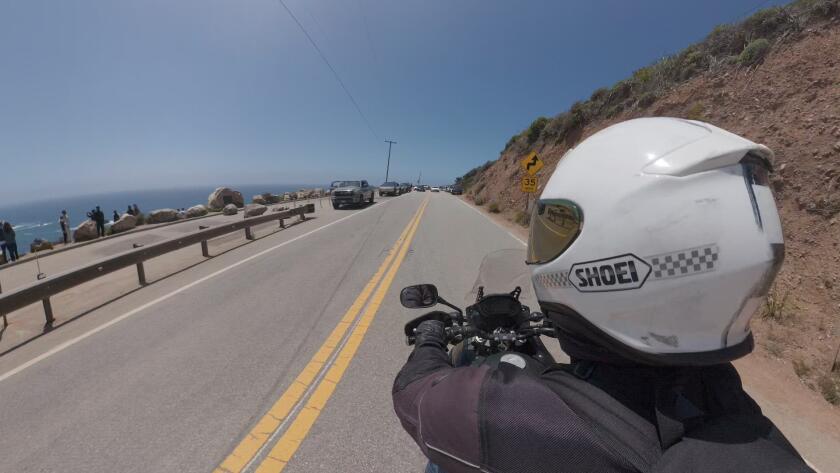
Traffic approaching Bixby Bridge.

A visitor poses in an oversized chair at Big Sur River Inn.
Even at the New Camaldoli Hermitage, a Benedictine monastery above Lucia, the road’s reopening and coming summer season have made a difference. Bookings are up an estimated 30% at the hermitage, which rent rooms and cottages (for two nights or more) to visitors who agree to its requirement of silence.
Big Sur business owners advise visitors to travel on weekdays for less traffic and the best hotel rates, and to get on the road as early as possible.
Since its opening in 1937, the highway has been vulnerable to landslides and shifting ground, operating on a longstanding cycle of landslide, closure, repair, reopening and then another landslide, or sometimes a fire. The U.S. Geological Survey has identified the Big Sur coastline as one of the most landslide-prone areas in the western United States. The 2023-2026 closure was the longest in the highway’s history.
Over time, road crews have used increasingly sophisticated strategies. In the most recent efforts, Caltrans said, it used drones to help survey the slopes and remotely operated bulldozers and excavators to reduce risks to workers.
During the closure, no traffic was allowed on 6.8-mile span from just north of Lucia until about a mile south of the Esalen Institute. Drivers detoured inland by way of U.S. 101.

Correspondents of CBS’ 60 Minutes pose for a portrait in 2023. From left to right, they are Sharyn Alfonsi, L. Jon Wertheim, Bill Whitaker, Lesley Stahl, Scott Pelley, Cecilia Vega, and Anderson Cooper. Former Executive Producer Bill Owens sits on the far right. Only Wertheim, Whitaker and Stahl remain at the program.
CBS Photo Archive/CBS via Getty Images/CBS
hide caption
toggle caption
CBS Photo Archive/CBS via Getty Images/CBS
Stay up to date with our Up First newsletter sent every weekday morning.
When CBS fired Scott Pelley on Tuesday night, the new 60 Minutes executive producer, Nick Bilton, told Pelley it was for insubordination at a staff meeting the day before.
The veteran correspondent argues he was defending the DNA of 60 Minutes and the integrity of its journalism.
The battle royale over the network’s most prestigious and profitable news program is part of a broader fight over the direction of CBS News.
And given CBS’s acquisition by a billionaire family whose business interests have become intertwined with the political interests of President Trump, it reflects a larger war over control of the media in the current moment.

That father and son, Larry and David Ellison, bought CBS’ parent company, Paramount, last summer. In January, they became co-owners of TikTok’s U.S. operations. Now they’re seeking approval from Trump’s regulators to buy Warner Bros. Discovery, the parent company of CNN.
A glamorous show shorn, for now, of most its stars

CBS fired Cecilia Vega, a correspondent, and Tanya Simon, the executive producer, from 60 Minutes last week. They are shown in this photo at the 2026 White House Correspondents’ Association Dinner on April 25, 2026 in Washington, D.C.
Kristina Bumphrey/Variety via Getty Images/Variety
hide caption
toggle caption
Kristina Bumphrey/Variety via Getty Images/Variety
But the specifics of this individual episode matter — for 60 Minutes, CBS, its audience of millions, and even the news business itself.
The program has been the most glamorous post in broadcast news. The correspondents are the stars of the show. And now, there are just three of them.
Anderson Cooper left last month, concerned over the direction of the network’s coverage. Last week was a virtual bloodbath: correspondents Cecilia Vega and Sharyn Alfonsi were fired. So were a producer and two show executives — including Tanya Simon, a longtime staffer who had stepped up as executive producer when her predecessor resigned in protest before the Ellisons’ takeover.

With Pelley’s ouster, only correspondents Lesley Stahl, Bill Whitaker, and Jon Wertheim remain. Now they are considering whether to resign, according to two associates with knowledge.
Their brand-new boss, Bilton, was previously a tech reporter for The New York Times and an investigative reporter for Vanity Fair. He executive-produced a documentary for Netflix about a couple accused of laundering Bitcoin and has been a producer on several other films.
Notably, he has no experience in television news.
Neither does Bari Weiss, whom David Ellison installed as the network’s editor in chief last October. The Ellisons also bought her center-right views-and-news site, The Free Press.
She has maintained that the network of Walter Cronkite needs a makeover for the digital moment. She has also contended for years that CBS, along with the rest of mainstream media, is too reflexively anti-Trump, anti-Israel, and too woke.
A rejection of CBS News executives’ overtures

The new executive producer of 60 Minutes, Nick Bilton, has been a tech journalist and documentary filmmaker, but lacks experience in broadcast news.
Matt Winkelmeyer/Getty Images/Getty Images North America
hide caption
toggle caption
Matt Winkelmeyer/Getty Images/Getty Images North America
Bilton attempted to set a conciliatory tone at Monday’s meeting — his first with the show. Pelley, a formidable veteran correspondent and former CBS Evening News anchor, wasn’t having it.
Pelley called Bilton unwelcome and unqualified. And Pelley said that Weiss was attempting to “murder” the program.
In firing Pelley on Tuesday, Bilton said the journalist had hijacked the meeting and rejected overtures to work constructively through their differences. (NPR obtained a copy of the firing notice.) Bilton wrote that Pelley’s “antipathy to the future of the show came through loud and clear.”
In his own statement late Tuesday evening, shared with NPR, Pelley accused CBS’s new news leadership of killing 60 Minutes‘ DNA and pushing him “to inject falsehoods and bias into a politically sensitive story” and “to include assertions that are unverified.”
The accusations, to which CBS has not yet responded, echo those made by Alfonsi and Vega, the two correspondents fired last week.
Earlier this year, Alfonsi publicly complained after Weiss held one of her stories at the last minute, and kept it frozen for weeks, demanding an on-camera interview with a Trump White House official that never played out. It ran, unchanged from the intended version, with additional statements from the administration tacked on to the end.
After being fired, Vega said in a statement obtained by NPR that her team had “experienced efforts to insert political bias into our stories.”
“Let’s call this what it is: censorship, both censorship and self-driven” Vega continued. “It is dangerous for the show and dangerous for democracy.”
Weiss previously rejected Alfonsi’s and Vega’s allegations. (CBS said Vega’s claims, for example, were “not based in reality” while expressing appreciation for her work.)
Weiss and Bilton say digital threat requires a 60 Minutes overhaul now
In a meeting this morning, Weiss said that Pelley chose his own path — that is, to be fired rather than to find a way to work through his concerns, according to attendees. The network and Weiss have not yet publicly addressed Pelley’s accusations of interference.
Bilton and Weiss say they respect the show’s traditions, its accomplishments and its legacy of enterprise reporting, extended interviews and visual storytelling. It rose in the ratings 9% over the past season under Simon.
The two news leaders say, however, 60 Minutes needs to be overhauled before it becomes increasingly irrelevant in the era of streamers and other sources of news, information and entertainment in the digital age.
Interviews with 12 current and former CBS News staffers, from producers to executives, suggest great reservations and suspicions remain about Weiss’ judgment and her ability to handle the prominent and even famous journalists on whom her division relies.
Weiss had initially sought to reinvent the CBS Evening News, dropping a two-anchor format that had sagged in the ratings. Cooper turned down Weiss’ overtures to anchor it and left the network altogether, concerned about her approach, according to associates. (They spoke on condition of anonymity because Cooper has not chosen to speak publicly on the matter.)

David Ellison became chairman and CEO of CBS’ parent company, Paramount, after buying it last year.
Noam Galai/Getty Images for Paramount/Getty Images North America
hide caption
toggle caption
Noam Galai/Getty Images for Paramount/Getty Images North America
The ratings have continued to sag under new anchor Tony Dokoupil. And some CBS journalists, including producers who have left the Evening News, have publicly accused Weiss of making editorial decisions driven by politics. She has rejected those claims.
The decision to take on overhauling two key shows — one listing, one highly profitable, both high profile — carries significant risks for Weiss and the network, even apart from other considerations.
But the Ellisons’ presence cannot be ignored.

When Shari Redstone was negotiating the sale of CBS’s parent company, Paramount, to the Ellisons’ Skydance Media last year, the network announced the end of Stephen Colbert’s late night show. He had been one of the president’s most biting and acerbic critics.
David Ellison also made a series of concessions directly to Trump’s chief broadcast regulator, Federal Communications Commission Chair Brendan Carr, gutting CBS’s diversity, equity and inclusion initiatives and appointing a conservative ombudsman to field complaints of bias against its news reporting.
Carr and other regulators approved the Paramount deal last summer.
The accommodations echo those made by other media titans.
Amazon and Blue Origin founder Jeff Bezos remade the editorial pages of the Washington Post, which he owns, into a far more hospitable zone for Trump at the outset of his second term. So did Los Angeles Times owner Dr. Patrick Soon-Shiong, a noted medical device inventor. Amazon and Blue Origin have multi-billion dollar contracts with the federal government. Soon-Shiong’s medical research firm routinely has patent applications up for review with federal regulators. One was approved Tuesday.
The Ellisons are hoping to win approval from federal regulators next month for their purchase of Warner Bros. Discovery in a deal valued at more than $110 billion. It would include Warner Bros. Studio, HBO and CNN, among other properties.
As Weiss routs CBS News’ old guard, the question of what role she might play at CNN — and what changes that portends at CBS — hangs over journalists at the two networks. The fate of 60 Minutes serves as a high-stakes case study for both.
-

 Ohio3 minutes ago
Ohio auditor describes how widespread Medicaid fraud affects taxpayers | Fox News Video
-

 Oklahoma6 minutes ago
One injured in auto-pedestrian crash in northwest Oklahoma City
-

 Oregon11 minutes ago
Woman dies after falling into Devil’s Punchbowl on Oregon coast
-

 Pennsylvania18 minutes ago
Half of child deaths left unreviewed in Pennsylvania since 2020 as counties struggle with ‘unfunded mandate’
-

 Rhode Island21 minutes ago
He grew up in the kitchen. Then he rewrote the menu, and the future of his parents’ restaurant – The Boston Globe
-

 South-Carolina26 minutes ago
Here’s when, where you can vote in South Carolina 2026 primary election
-

 South Dakota33 minutes ago
Schedule, prediction for 2026 South Dakota softball state tournament
-

 Tennessee36 minutes ago
Tennessee AMC theater worker, 85, receives $146K from strangers for retirement after viral video

