Lifestyle
'Prepare to be enthralled': How to see Yosemite's enchanting rainbows that form at night

We met Brian Hawkins, a Redondo Beach mechanical engineer-turned-videographer, in the near-empty lobby of the Yosemite Valley Lodge. It was just after 9 on a Tuesday night in late April. Our hunt was about to begin, but the weather augured poorly.
“It’s cloudy, clearing later,” he said. “I would not expect to see anything yet.”
This was no chance meeting. A couple of years before I had discovered Hawkins’ website, where he posts photos, videos and very precise predictions of the phenomenon that had lured us to this place, at exactly this time: moonbows.
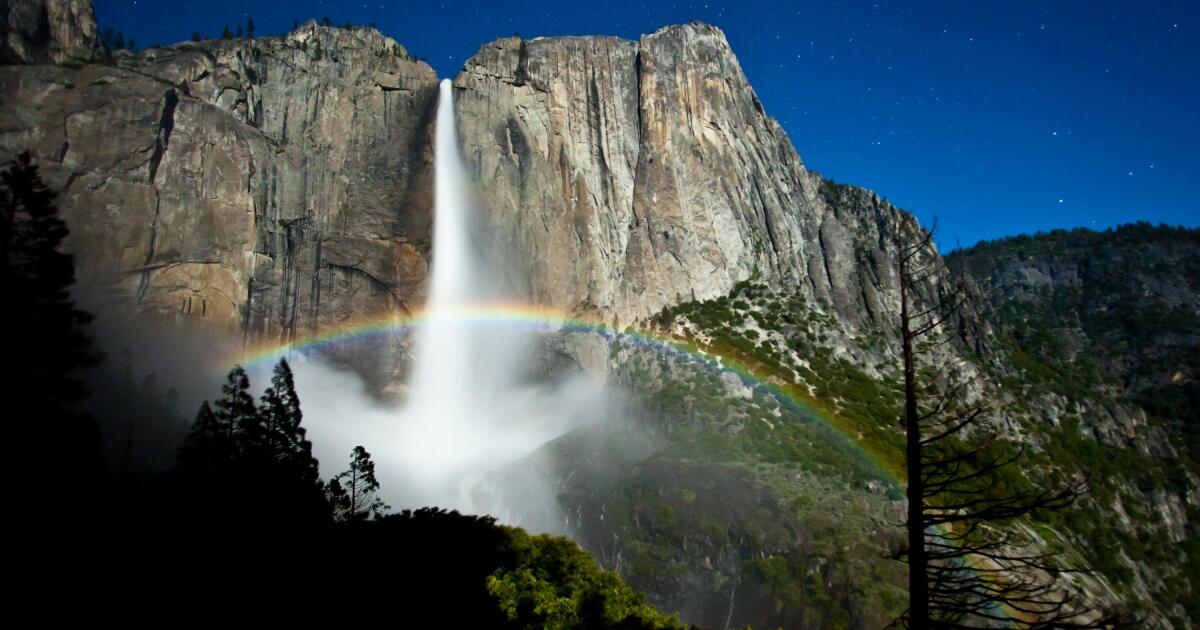
Naturalist John Muir called them lunar rainbows, or spraybows, revealed by a full moon’s light. Roaring spring and early summer waterfalls in Yosemite National Park make the central California destination one of the few spots on Earth to see them. The next viewing opportunity is May 21 to 25.
Moonbows haven’t realized the popularity of the park’s firefall each February, but visitors are gaining awareness. As we navigated the paved trail in darkness to Lower Yosemite Fall , we passed clumps of walkers going in the other direction, evidently discouraged by persistent clouds. At the base, some 25 were gathered in small groups, many behind a bend sheltering onlookers from the falls’ jet-loud spray.
Muir described the Yosemite Falls’ roar as “fine, savage music,” and Hawkins spoke movingly of how the falls, especially in the upper stretch, maintained a voice, even a presence. Having seen spectacular photos by him and others, my wife, Mica, and I impatiently waited for the moon to reflect the sun’s light on the falls. As did others.
Brian Hawkins, left, ran into Richard and Sally Brewer and Anne Johnston-Fera of Buffalo, N.Y., looking for moonbows in April at Yosemite’s Cook’s Meadow.
(Alex Pulaski)
One photographer showed me a quarter-moonbow image he had captured 20 minutes before during a cloud break. Another, Eric Krapil, 28, from Laurel, Md., shared a full-arc moonbow photo from the night before, captured on his cellular phone.
“We got lucky,” he said. “Some guy walking past us at the lodge said, ‘Do you want to see a moonbow?’”
We certainly did on this night. And a few minutes later, as the yellowish moon briefly shouldered through the haze, Hawkins pointed to a rock. There, he said, a corner of the moonbow begins.
And I saw it: A quarter arc at best, ghostly white in the moon’s faint light. Not everything I had hoped for, but as we walked back later I thanked Hawkins for helping us see that glimmer — a hint of what might come the following nights.
Yeah, he said. A thoughtful pause ensued.
“That was,” he continued, “the most pathetic moonbow I’ve ever seen.”
Before 2007, nobody was precisely sure when and where moonbows would appear at Yosemite. But a team of researchers from Texas State University harnessed computers to meld topography, geometry and astronomy to accurately predict the moonbows’ appearance and published their findings.
Hawkins first visited the park that same year and became mesmerized by its beauty — particularly after seeing a moonbow in 2011. He started doing his own modeling, and his website debuted in 2018. It’s a labor of love — there are no ads, and he doesn’t do tours or hawk T-shirts.
What he does do is help other seekers. Anna Smits, who lives and works in the Yosemite Valley, saw her first moonbow during the pandemic. The park was closed to visitors, but Hawkins still shared his calculations. Now, Smits — both an avid photographer and outdoorswoman — occasionally pushes the envelope to find more elusive moonbow shots.
What does that entail? One night, that involved setting an anchor and rappelling about 15 feet to a ledge near Upper Yosemite Fall. Another time, she set her alarm for 1:30 a.m. for a hike in bright moonlight to Vernal Fall. It was so cold that the condensed spray solidly froze her tripod.
“It’s such a rewarding experience,” she said. “It really lights me up just thinking about sitting in the spray and watching this moonbow cross in front of you.”
That visual reward eluded us on the subsequent two nights of our visit last month. Daytime blue skies surrendered to clouds at night. Hawkins had warned me that first night that nothing was guaranteed.
“Prepare to be enthralled by the scene before you but also frustrated by how difficult it is to shoot,” he said. “A lot of things are working against you — it’s cold, it’s wet, the lens has to be dried off, you can’t use auto focus. You just have to be patient and work through solving all the problems.”
And when the moon is hidden by a curtain of clouds, you comfort yourself with the memory of the falls’ voice and a glimmer of the show waiting when you return.
What is a moonbow?
Simply put, it’s a rainbow seen at night, produced by the light of a full moon reflecting off droplets of water suspended in the air. But humans struggle to detect color at night, so — as with the northern lights — they usually appear white to the naked eye. Photographs, especially with timed exposures to allow more light, render them in full color, just like a rainbow.
Is Yosemite the only place to see moonbows?
No, but there are very few waterfall sites where they can consistently be seen. They include Cumberland Falls in Kentucky and Africa’s Victoria Falls, at the Zambia-Zimbabwe border.
When are the best dates, times and locations to see Yosemite moonbows?
They are best observed on the five nights around the full moon. Hawkins has calculated peak 2024 viewing dates and specific hours by location (Upper and Lower Yosemite falls and Glacier Point) for the next viewing window of May 21 to 25 at his website. Best dates for the following full moon, with his time calculations to follow later, are June 19 to 23.
Is any special gear needed?
Useful items include comfortable walking shoes, a rain poncho if viewing near a fall’s base, cloths to dry lenses and cameras, a tripod for longer camera or smartphone exposures and a headlamp or flashlight (red-light settings are preferable for not disrupting night vision). Weather apps such as Clear Outside predict hourly cloud cover. For the super-advanced, apps such as Photo Ephemeris and Planit Pro will help precisely calculate moon positions (and much more).
Are Yosemite National Park reservations required?
Sometimes. Until June 30, daytime (5 a.m. to 4 p.m.) park entry reservations are required on weekends and holidays. From July 1 to Aug. 16, they are required daily for the same time periods. Those with in-park camping or lodging reservations will be granted park entry. Full rules and a reservation link can be found at the National Park Service’s website.
Is it risky looking for Yosemite moonbows at night?
We didn’t find it daunting. Lower Yosemite Fall is just a 10-minute walk from Yosemite Valley Lodge, where we stayed. Cook’s Meadow, with its broad view of Yosemite Falls, is also nearby, but we decided to drive, largely because dense cloud cover obscured the moonlight. Both Hawkins and Smits counseled using common sense in seeking more remote locations. It’s worth noting that the intrepid Muir, who never shrank from a challenge, almost died one night while chasing moonbows behind Yosemite Falls near Fern Ledge; he escaped drenched and numb from a “wild bath in moonlit spray.”



The Kennedy Center, the facade of which remains covered with a tarp, is seen in Washington, DC, on June 28, 2026. A US federal judge asked on June 24 for an explanation for why a tarpaulin continues to cover the facade of the Kennedy Center where President Donald Trump’s name was recently removed. District Judge Christopher Cooper gave the board of trustees of the performing arts venue until the end of July to explain “the purpose for and status of the tarp and scaffolding that Defendants have erected on the front portico of the Center.”
ALEX WROBLEWSKI/AFP via Getty Images
hide caption
toggle caption
ALEX WROBLEWSKI/AFP via Getty Images
More than two weeks ago, President Trump’s name was removed from the Kennedy Center facade though it is still covered by a tarp and the legal battle continues.
On Monday, a U.S. Department of Justice filing on behalf of the Kennedy Center included some surprises. The document was submitted in response to issues raised by lawyers for ex-officio board member Rep. Joyce Beatty of Ohio who is suing to remove President Trump’s name from the center and stop its closure for renovations.
Among the revelations, the Kennedy Center admitted that, during a board meeting on December 18, 2025, Beatty had been “muted and prevented from speaking.” It was at that meeting that the board voted to add President Trump’s name to the center. The filing later acknowledges the congresswoman was “prevented from voicing her opposition.”
The John F. Kennedy Center for the Performing Arts is a living memorial to its namesake. The guidelines for how the theatre complex spends federal dollars are very specific. Among other rules, it states that “no additional memorials or plaques shall be designated or installed.” Beatty argues adding Trump’s name runs afoul of those rules and that any change requires approval from Congress.
According to one of Beatty’s filings, “There was no advance notice in the agenda that the Board would be considering a name change,” a statement the Kennedy Center now does not deny. The center admits that, prior to voting, there was “no discussion about potential risks or downsides of the vote to adopt a secondary name for the Center.” Nor was there a board discussion “about any potential conflict of interest that might result from the vote.”
The center’s lawyers previously contended that if Trump’s name were to be removed, it would “lose money from donors who support” him and “impede the Center’s fundraising efforts.”
Closing for renovations
Earlier this year, Trump announced on social media that the Kennedy Center would close for two years for renovations. He wrote that he made the decision after “a one year review” with “Contractors, Musical Experts, Art Institutions, and other Advisors and Consultants.”
But, according to the center’s lawyers, Trump’s announcement “was made without presenting any plans, analyses, timelines, or funding information to his cotrustees and without any Board vote.”
The Kennedy Center has long denied reporting by The Washington Post that ticket sales plummeted after President Trump became the Center’s board chair. In Monday’s legal filing, the Center admits that, by October 2025, “nearly half of the Center’s tickets were going unsold.”


Paul Tremblay has made a career of pushing the horror genre – and the novel format – in strange and exciting new directions.
In his latest, Dead but Dreaming of Electric Sheep, the author offers an amalgamation of genre elements that can be best described as psychological-dystopian-science-fiction horror. It’s a mouthful, but the narrative does all of that and more in a way that defies categorization.
Julia Flang is a former semiprofessional gamer working two mediocre jobs she dislikes and living in a modest ranch house in a San Fernando Valley suburb with her retired uncle, whom she calls Uncle Fun. Julia likes movies and gaming but there’s little else going on in her life, so when her estranged mother, the CFO of a large tech company, contacts her with a possible job offer – a “once-in-a-lifetime thing” that pays handsomely just for doing the interview – she hesitantly agrees.

The job is relatively simple and perfect for someone with gaming skills: using a controller built into a phone to get a man, who is stuck in a vegetative state, from California to the East Coast. It will require her to learn how to control his body – walking, moving, sitting, standing, using his arms – so she can maneuver him out of the facility where he is located and into cars and planes and through crowded airports. A fan of movies, Julia decides to call the man Bernie – after the movie Weekend at Bernie’s. When the ethics of the job start to bother her, Julia realizes it’s too late and she must go through with it. However, she’s soon contacted by people interested in sabotaging the whole thing, people who, like her, don’t align with the shady interests of conglomerates and those set to make “gobs of money” from this new, somewhat inhuman technology.

As with every Tremblay novel, any synopsis barely scratches the surface. The novel’s chapters alternate between Julia and you (yes, you). Julia’s chapters are “normal” in the sense that they obey a chronological order and have action, basic descriptions of movement and places, and dialogue. The chapters in second person are like fever dreams from a shadow world; the desperate experiences of a man trapped inside his own body with no control of it, no clue what’s happening to him, and only a few fragmented memories of his life. Also, Tremblay uses a similarly fragmented style of storytelling (including words and sentences trapped in boxes and/or “moving” on the page) to keep things interesting but also confusing and creepy.
This novel operates on several different levels and – planes of existence? Bernie has a head full of AI that controls his body, but his consciousness is still there and struggling to regain control, struggling to remember things. There are monsters, leeches, mysterious rabbits, and eerie shadows in his world, but the true horror comes from the lack of control, from being moved around against his will and having no clue what comes next. Bernie is the embodiment of losing control to AI, and when taken together with the commentary of creativity and AI and the meta interludes in which the author takes a wrecking ball to the fourth wall and addresses readers, this is the best anti-Generative AI story horror has produced so far.
Despite the horror of it, this is a very funny novel. Julia is sarcastic and struggles to keep her comebacks in line, but the conversations she has and messages she writes are always entertaining. However, the humor is far from the crown jewel here. That title belongs to a plethora of big ideas Tremblay juggles. The nature of life, death, and consciousness, the evils of conglomerates, inhuman practices in the name of capitalism, and AI, and even what it means to be human are all explored here: “Is Bernie alive? Is he feeling pain? Is he experiencing everything as a prisoner looking through the bars of his body? Has his consciousness been winnowed to a metaphysical keyhole? Where does consciousness begin or end?” There are no definite answers here, but the way Tremblay infuses humanity, love, the importance of relationships, and humor throughout the narrative provides the kind of answers that can’t and don’t need to be spelled out.
A genre-bender full of big ideas that constantly switches between a world full of real or uncomfortably plausible nightmares and a bizarre hellscape in which loss of self, memory, and autonomy are only the tip of the proverbial iceberg, Dead but Dreaming of Electric Sheep is a horrific and terrifyingly disorienting novel that invites readers to consider a future that already started. Tremblay has always been an innovator, but this beautifully written collection of real and imagined grotesqueries cements him not only as one of the most original and exciting voices in horror but also as one of the smartest, most engaging authors in contemporary fiction.
Gabino Iglesias is an author, book reviewer and professor living in Austin, Texas. Find him on X, formerly Twitter, at @Gabino_Iglesias.

-

 Boston, MA6 minutes ago
Looking for a lodging adventure? Beat the heat at a floating B&B. – The Boston Globe
-

 Denver, CO9 minutes ago
Lavender festival, Tennyson Street Fair and more free and cheap things to do in July
-

 Seattle, WA21 minutes ago
Seattle’s solution for the middle-class housing squeeze: government housing | CNN Business
-

 San Diego, CA24 minutes ago
An Apprentice Program for Commercial Fishing
-
Milwaukee, WI29 minutes ago
Connecting Milwaukee teens to summer work
-

 Atlanta, GA36 minutes ago
Conference offers safe space for gay men to unpack the stigmas, challenges of adoption and surrogacy
-

 Minneapolis, MN39 minutes ago
Westbound I-94 reopens in Minneapolis after fatal crash
-

 Indianapolis, IN44 minutes ago
Edwards Checks Out At Indianapolis – SPEED SPORT

