Lifestyle
Poet Rachel Eliza Griffiths says she won’t let pain be ‘the engine that drives the ship’


Rachel Eliza Griffiths is a poet, novelist and visual artist.
Andres Kudacki/AP
hide caption
toggle caption
Andres Kudacki/AP
When poet Rachel Eliza Griffiths married writer Salman Rushdie in 2021, she expected the day to be joyful. Their friends and family had gathered and Griffiths’ best friend, poet Kamilah Aisha Moon, was set to speak.
But Moon never showed up. Griffiths was still in her wedding dress when she learned that her friend had died. She says Moon’s death put her in a dissociative state; it was as though she were standing outside her own body.
“There was a moment literally where I felt I was looking down at this woman who was this gorgeous bride and the agony and anguish in her body,” Griffiths says. “She was screaming, people were holding her down so she wouldn’t hurt herself. And then I just left.”
Even now, Griffiths says, “Many parts of my wedding day are blacked out in my memory and are not available to me. … It’s very hard for me even to look at photographs or anything from my wedding day and feel connected to it.”

Eleven months after their wedding, Griffiths was home in New York City when she learned that Rushdie had been stabbed onstage at the Chautauqua Institution while being interviewed at a literary event. As she was rushing to be with him, Griffiths fell down a flight of stairs. It was a clarifying moment.
“When I got up and realized I hadn’t broken my neck or broken a bone, I just really was like, ‘That’s the last time you fall down. You cannot risk your safety. You cannot be running around with your head off your shoulders. You need to focus now,’” she says.
In the new memoir The Flower Bearers, Griffiths looks back on her wedding day and her marriage, and writes about her experience with dissociative identity disorder. She also reflects on her friendship with Moon, and how they initially connected over their shared identity as Black female poets.

Interview highlights
On caring for Rushdie in the immediate aftermath of the attack
I didn’t cry in the hospital room because I just didn’t think that would be helpful. And really, I didn’t have the energy. I had to conserve energy for all of these different balls that were all in the air. And when you’ve just married someone and now you’re responsible for their survival … you don’t really have time to tally up how strong you are, how brave you are, how courageous you are you have to keep going. And I was in survivor mode. …
There were moments where I cried in a lot of corners and stairwells. And yeah, I threw up a lot. I was really sick. My whole body was in shock. … I don’t know how to explain it, I don’t know if it’s innate or learned, but when there is a lot pressure and things are kind of going to hell, I will focus and bear down.
On the strength of her marriage
It’s hard to watch the love of your life struggle with blindness, with impaired mobility, to feel exhausted, but I’m also trying to really look at what is there. The knife didn’t take away the mind inside of my husband. It has not taken away his curiosity. It hasn’t taken away how romantic he is and how he loves to plan date nights for us and watching movies and traveling and trying to spend as much quality time together as we can.

I think this experience makes you think about time. And I think because I am married to someone who is much older than me, there is a sense of time, time passing, being present, and really filling the time up with love. … There’s a kind of indescribable bridge and bond we have having survived such an experience that has reinforced the most wondrous and beautiful and incandescent spaces of this marriage and this friendship. This friendship is beautiful. And I’m grateful for it. And that gives me a lot of strength and courage to just keep going.
On experiencing dissociation
It’s a part of my mind and my body that attempts to protect and cope in moments where I feel flight or fight and I’m trying to get away from something, often externally. Or it can be a memory that might cause me a pain or a kind of mental assault that I will not be able to withstand. … I’ve learned to see my dissociative identity disorder as a protector. I’ve befriended it. I’ve learned so much about it so that I don’t feel like I’m out of control or I don’t know what’s happening.
On her alter egos
One of the things I write about is how, if you picture maybe the same version of yourself in a car, there are different people driving it at different times, but you’re all in the same car. … My alter as an artist is connected to my alter who was a young child and my alter who in my 20s as a young woman struggling to be an artist and becoming the person I’m still becoming. That’s a different set of memories and a different kind of character. But they all kind of visit me. I have a future alter, who is a really lovely, kind of bold, dazzling older woman. And her name is June. And so she helps me not sweat the small stuff. And she has a lot of humor and style and is chic. And she takes care of me.
On pushing back against the cliché of the “tortured” artist
When you glamorize tortured poets or tortured artists, there’s an injustice that they become silhouettes and cutouts, their humanity is removed from them. They’re not seen as three-dimensional. … You know, Virginia Woolf, Sylvia Plath, or even Amy Winehouse … [and] Whitney Houston. There’s so many names of people … [whose] pain becomes the engine that drives the ship. …
What has now happened by writing this book is I don’t have shame. I don’t feel shame. I am using my voice to say this is my journey and I hope it can help someone else. When I was younger, having no money, being broke, being defeated, being depressed, that didn’t lead me to write my best work. I was in survivor mode. Once I was able to get stabilized and start to do the inner work and start to heal, I’ll always be healing, you know? I’ll be healing. But this feels like one of the first steps for me in a new life. And I’m really grateful for that.
Anna Bauman and Susan Nyakundi produced and edited this interview for broadcast. Bridget Bentz, Molly Seavy-Nesper and Beth Novey adapted it for the web.


Can you say no to a friend’s wedding?
Getty Images/Getty images
hide caption
toggle caption
Getty Images/Getty images
Are we spending too much on other people’s weddings?
Going to a friend’s weddings can be so fun and meaningful… but it can also really hurt your wallet. A survey by LendingTree found that 31% of people who had been to a wedding in the past five years had accrued debt to attend. So what’s driving up the cost of weddings for guests? And what makes it so hard to say no to these expenses?
Brittany breaks it down with Allyson Rees, senior analyst at trend forecasting firm WGSN, and Annie Joy Williams, assistant editor at The Atlantic.
This episode was produced by Liam McBain, with additional support from Corey Antonio Rose. It was edited by Neena Pathak. Our Supervising Producer is Cher Vincent. Our Executive Producer is Barton Girdwood. Our VP of Programming is Yolanda Sangweni.
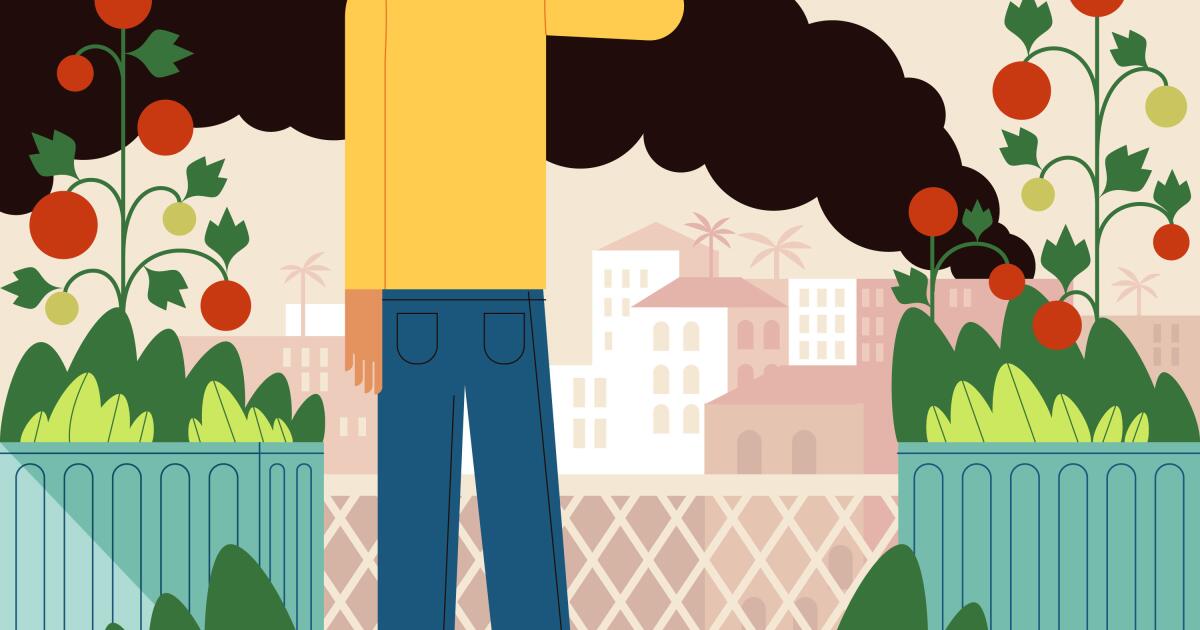
After the eight-day-long fire in a 500,000-square-foot Boyle Heights warehouse, eastern Los Angeles residents are contending with putrid smells, soot and potentially hazardous airborne chemicals after heavy plumes of smoke spread throughout the city. But those who grow food in nearby neighborhoods may also be wondering: How will the fires affect the plants and produce in my garden?
The Boyle Heights warehouse, owned by Lineage — a global temperature-controlled storage facility operator — housed 85 million pounds of frozen food and other products. In the days since the fire, local emergency visits for smoke inhalation and throat pain spiked while agencies still scramble to measure the amount of PM 2.5 — harmful fine particles — and heavy metals, like lead and arsenic, in the air.
According to researchers, any toxic airborne chemicals would likely stem from the charred foam insulation, metal exterior, burned solar panels and any lithium batteries that might have been present inside the warehouse.
After a fire, heavy metal particles can spread through ash and smoke over gardens and inhibit growth, said Olukayode Jegede, an agricultural toxicologist and assistant professor at UC Davis. Since the warehouse fire is so recent and cleanup has just begun, Jegede said the precise impact on gardens can’t be measured until comprehensive soil tests are conducted in the area.
While the L.A. city government hasn’t announced plans for soil testing, the Contaminant Level Evaluation and Analysis for Neighborhoods project at USC is offering free contaminant testing for Boyle Heights and East L.A. residents. Residents can collect soil samples and deliver them to Boyle Heights City Hall and other locations for an evaluation of lead, arsenic, chromium and mercury levels.
The good news is produce, plants and roots can still be preserved. According to Jegede, many of the soil tests conducted last year in the Altadena area after the Eaton fire showed that gardens and poultry were not as contaminated as one might expect.
“Quite a number of the soils we tested [in Altadena] were not really contaminated,” Jegede said. “We weren’t seeing many soils with concerning elevated levels of metal, so gardeners should not be too alarmed when these things happen.”
Nevertheless, there are several measures that gardeners can take to keep themselves, their children, plants and produce safe from potentially harmful contaminants stemming from the fire. Researchers, gardening experts and horticulturists offered some guidance on the handling, recultivation and cleanup that can keep you and your garden in good health.
How do I remove ash and contaminants from my garden?
Altadena horticulturist Leigh Adams said Boyle Heights plants and produce already live in a difficult environment, surrounded by industrial warehouses that spread contaminants daily.
“That area has been used industrially for 100 years, and the soil is impacted by many, many, many things,” Adams said. “Low-income neighborhoods and gardens usually don’t have a lot of resistance against dominant manufacturing.”
This means that the contamination of gardens in eastern L.A. won’t be as catastrophic as compared with those in Altadena, a more suburban environment, Adams said. But fallen ash still poses major health risks if ingested or inhaled.
An advisory from University of California Agricultural and Natural Resources last year recommended suiting up in an N95/KN95 mask, long sleeves, pants, close-toed shoes and gloves before attempting to deal with ash in the garden to limit exposure to potentially toxic contaminants. The advisory added that individuals should make sure all of this gear is cleaned thoroughly before bringing it back inside.
Once in the proper gear, Adams recommends removing the top two inches of topsoil from gardens, where the highest concentration of contaminants will settle after a fire. Using a plastic bag to collect the soil and disposing of it in the garbage — not green yard waste bins — will help to reduce the spread of airborne chemicals.
Gardeners with raised beds are advised to remove approximately six inches of soil, because excess ash can raise the pH level and prevent nutrients from soaking into the soil bed.
After this, watering the garden gently but plentifully will help to promote soil health and get rid of most of the ash present on plant leaves and stems. Adams said replacing the top two inches of soil with store-bought mulch or straw will help to contain any remaining ash and prevent it from spreading any further.
Experts say to avoid using leaf blowers if ash is present in the garden because they can send particles airborne. Doing so will increase the likelihood of heavy metal particles, which can carry lung irritants and carcinogens, being spread and inhaled.
A Boyle Heights resident keep a watchful eye on the fire at the 5,000-square-foot commercial building, which stores 85 million pounds of frozen food.
(Genaro Molina / Los Angeles Times)
Is it safe for me to eat produce from my garden?
Several studies, including one from the UC Cooperative Extension of Sonoma County, have shown that consuming produce in a fire-affected area poses minimal health risks.
Jegede said most root vegetables like potatoes and carrots, along with any fruit that has an outer layer, can be washed to remove potential contaminants, even if they were covered in ash. Peeling the outer layer of your produce can also help to reduce potential risks, he said.
Lettuce and other leafy foods with multiple layers pose a higher risk of contamination, but with a vigorous wash and peeling the outer layers, even the greens can be saved. The County of Los Angeles Department of Public Health recommends soaking leafy produce and fuzzy fruits like peaches in a 10% white vinegar and 90% water mixture.
Jegede said if the leaves or fruit are too delicate to wash or ash is still visible, it would be best to dispose of the produce.
How can I tell if my soil is contaminated?
After ridding your garden of visible ash, you might wonder how to tell if your plants will still thrive in the soil.
At-home soil tests that measure for alkaline, fertility and pH levels are widely available and can be purchased for $15 to $100 (for more detailed results) online. But Jegede said these tests can’t tell the full story of soil health.
Comprehensive soil testing is “something you can’t do properly at home,” Jegede said. “In labs, we are testing for metals like lithium and zinc, stuff that an at-home test will not show … If it comes to the point that you’re worried about your soil, I would just send it out to a lab.”
Wallace Laboratories in El Segundo, Babcock Laboratories in Riverside, Waypoint Analytical in Anaheim and other labs offer more detailed soil tests that measure heavy metal particles in addition to other fertility factors. Prices at Wallace Laboratories can range from $115 to $295 for a complete compost test.
The soil below two inches should be unharmed, Adams said, so long as new compost is set and plants are watered plentifully, which will promote natural biological cycles.
“What you’re doing is capping the soil, so that moisture stays in there, and instead of being dirt, it’s a living system called soil,” Adams said. “The more carbon we can get into our soil, the better.”
What can I do to help my soil recover?
For the last 12 years, Adams has been working with Metabolic Studio, a Los Angeles-based art and research hub focused on environmentalism, on methods for bioremediation, the practice of using additional fungi, plants and compost to decontaminate ash and break down contaminants.
Adams said straw, mushrooms, corn, rye and sunflowers are great bioremediators that can help to repair damage to soils. She said certain samples she’s worked on with Metabolic Studio have gone from testing at high heavy metal levels to nearly contaminant-free.
But for a more immediate fix, wash your produce, water your plants and have a little patience during ash cleanups. Your garden should look better in no time, Adams and Jegede said.

Inde Navarrette and Michael Johnston in Obsession.
Focus Features
hide caption
toggle caption
Focus Features
Two big horror films, Obsession and Backrooms, just smashed all box office expectations. So much of their success has been driven by Gen Z, which is now the biggest moviegoing demographic. But what makes a movie a Gen Z movie? Today we’re bringing you an episode of NPR’s It’s Been a Minute. Host Brittany Luse talks about this trend with Sam Adams and Reanna Cruz.
If you want to hear more about these movies, check out these episodes:
In ‘Obsession,’ love hurts. It really, really, really hurts.
‘Backrooms’ brings YouTube horror to the big screen
Zendaya brings ‘The Drama,’ we bring the spoilers
Connect with Pop Culture Happy Hour:
Letterboxd / Facebook
Our weekly newsletter
Support Pop Culture Happy Hour+
-

 Crypto5 minutes ago
Residents question proposed crypto mining center
-

 Finance7 minutes ago
How Natura &Co Is Transforming Finance with Generative AI on SAP S/4HANA
-

 Fitness12 minutes ago
This 30-second walking habit can make every walk more effective and boost your fitness in less time
-

 Movie Reviews23 minutes ago
Film Review: ‘Gail Daughtry and the Celebrity Sex Pass’ Throws a Ton of Jokes at the Wall (and Enough Stick) – Awards Radar
-

 World38 minutes ago
‘The Kitchen’ Director Alonso Ruizpalacios at BAM: ‘We Need More Trojan Horses’
-

 News43 minutes ago
Manhattan Building’s Columns Buckled Beneath New Addition, Images Show
-
Lifestyle1 hour ago
Can you say no to a friend’s wedding? : It’s Been a Minute
-

 Technology1 hour ago
The robotaxi law that could ban Tesla

