Lifestyle
PHOTOS: Your car has a lot to say about who you are


Abdul’s vehicle promotes his work as a carpet repair man in Mumbai, India.
Martin Roemers
hide caption
toggle caption
Martin Roemers
Homo Mobilis is not just a photography book about cool cars.
The phrase is Latin for “mobile human.” This project by Dutch photographer Martin Roemers depicts all kinds of vehicles: cars the likes of which you’ve probably never seen before, including one with a garden sprouting from its roof, along with animal-drawn transport and bicycles.
And Roemers is not just looking for visual details. He uses vehicles as a vehicle for philosophical questions: How do our methods of transportation represent our identities, reflect global inequalities and illustrate the changing nature of mobility as we drive forward in the 21st century.
Roemers spent nearly five years on this project, visiting eight countries in four continents and photographing around 200 cars and other vehicles. 160 of these found their way into the book. He identifies the owners by first name only.
In an interview over a zoom call from his home in the Netherlands, he shares his thoughts on the project with NPR — his ninth book of photography. This interview has been edited for length and clarity.
Tell us about the car you chose for the cover of the book.
In 2019, on a trip to Mumbai, India, my wife and I passed by a carpet shop as we made our way from our hotel to a café for breakfast. In front of this shop was an old black car. We often forget how cars aren’t just to get us from point A to point B. In many countries like India and China, they’re precious real-estate space. This particular car was riveting, because it was more than a car. It was a statement, like a billboard. It had “Afghan Carpets” emblazoned on it, advertising the store. It made me think about the many ingenious ways in which people used their vehicles.
I strongly believe that the spirit of the car reflects that of its owner or its driver. It says something about the culture they come from, their world view, identity and even about society itself.

Suresh, a climate activist, believes all cars should have rooftop gardens to counteract pollution. He lives in Bengaluru, India.
Martin Roemers
hide caption
toggle caption
Martin Roemers
Can you give us an example of what you mean?
In Bangalore [now called Bengaluru], I saw a car parked on the street. It had a little garden on its roof. It was filled with sprouting grass and wild plants. When we located the owner, we learnt that he was a lawyer, but he was also a climate activist, who believed that people should reduce their carbon footprint. So he wanted to convey that message through his car. He told me you can grow plants on any kind of vehicle and that he waters his “garden” everyday!
What inspired the idea?
This particular project explores the relationship between vehicles and their owners.
The idea for the book came to me in 2015, when I was working on a project called Metropolis — documenting life in the world’s largest cities. My aim was to capture the energy and life in bustling urban environments.
I saw cars everywhere, including some truly unusual vehicles I’d never seen before. They were an integral part of an urban environment, but I wondered, if I isolated them, plucked them off of the roads so that you could focus solely on the vehicle as an object, what stories would that tell?
That must have required extensive preparation.
There was a lot to organize. I needed permission from the car owners to be able to photograph their vehicles in a studio-like setting. We asked the owners to bring their cars to the spot we picked, and [we] rented [a] van to lug around the 12-meter-long steel poles over which we could hang the white backdrop. And we needed people to help set this all up.
Why was this style of photography important to you?
In its natural setting — on a road with traffic — the background can be chaotic. When you place the car against a white backdrop, there are no distractions. You can focus solely on the vehicle and the people who own it.
Which countries did the project cover?
I included Germany, because it’s the biggest car producer in Europe. The Netherlands, because that’s home for me. I chose Senegal, because like other West African countries, they import a lot of old cars from Europe — cars that wouldn’t pass inspection there anymore but are now on the streets. Senegal has a growing middle-class as well, and that is represented in the sheer diversity of cars you see on the roads.

Mor drives this minibus in Séguel Thioune, Senegal.
Martin Roemers
hide caption
toggle caption
Martin Roemers
I loved the shot of the newspaper vendor [and the bicycle he uses to sell papers] in Senegal. What’s his story?
He’s really amazing! He’s an artist and you can tell, because he’s really making a fashion statement. He also has to make a living — and so that’s where the newspaper cart hitched to a bicycle comes in. In Senegal, especially in urban areas like Dakar, newspapers are often sold by street vendors who may use small, mobile kiosks, stands, or simply carry them by hand to offer to drivers and pedestrians.

Mbaye, standing by his bicycle, is an artist and newspaper vendor in Ngaparou, Senegal.
Martin Roemers
hide caption
toggle caption
Martin Roemers
You also photographed in North America.
I spent a lot of time in the U.S., especially in Los Angeles. There are people from the unhoused [homeless] community for whom the car doubles up as a home. These are people from all walks of life. I met an artist who lives in a camper van, an immigrant from Mexico, a retired construction worker who was living in his car for three years.

Juan, an immigrant from Mexico, lives in a camper in Santa Monica, Calif.
Martin Roemers
hide caption
toggle caption
Martin Roemers
There are a couple of unusual images that you took in China of men on motorized cargo bikes — they look like tricycles that are hitched to carriers and piled high with stuff. Can you tell me about those vehicles and their owners?

Qinfang and grandson in a Fuju electric vehicle, Shanghai, China.
Martin Roemers
hide caption
toggle caption
Martin Roemers
Those are electrical vehicles by the way. China is much more advanced in terms of EVs and much further along in electrification than any other part of the world. And these were vehicles I’d never seen before. They’re both the same type of vehicle, but I was struck by how they were used for very different purposes. In one, we see a guy selling children’s toys on a street in a park. It looked lovely — so full of color and life. And in a stark contrast, in the second image, another man uses the same kind of vehicle, but this time, it’s piled high with all kinds of recycling junk.
It reminds me of how vehicles can often be ingenuously repurposed — like Sunny, a chicken vendor in the city of Nashik, Maharashtra [a western Indian state], who transformed his auto into a cage-holding mobile market stand. If someone wants a chicken, he will slaughter it afresh right there.

Sunny’s vehicle enables him to earn money as a chicken vendor. He lives in Bajaj Nashik, Maharashtra, India.
Martin Roemers
hide caption
toggle caption
Martin Roemers
In China, you’ve taken images of electric autos and their drivers.
Yes, I found them interesting. These taxi drivers cannot afford big cars. They use these inexpensive vehicles that were originally designed for people with disabilities and for wheelchair users, but today, anyone can hop on. It’s interesting how vehicles adapt to social and economic needs.
You mention how cars are often associated with new beginnings and spirituality in some parts of the world.
It struck me how cars are tied to sentiment and spirituality, especially in India.
I spent some time at a BMW dealership in Bengaluru. The car salesman told me that some clients hire a priest to do pujas [Hindu prayers that involve chanting] right in the showroom, when the client comes to pick up a new car. It’s not something I’ve seen anywhere else in the world. In China, when you pick up a new car, it can be decked out in flowers. To celebrate a new car is like a rite of passage.

The priest Nagabushna chants prayers to protect a new car from misfortune and accidents in Bengaluru, India.
Martin Roemers
hide caption
toggle caption
Martin Roemers
You have pictures of big families lining up in front of their cars in India.
Yes, I like to portray the human element in car portraits. I’ve photographed a family of four, and another with six members along with their cars. In one picture, there are 12 people. To me, I definitely felt that cars in this context represented a sense of community, of family bonding. Sometimes, it’s about friendship too. When I was taking a picture of a truck and its driver in Malegoan in the western Indian state of Maharashtra, I spotted some kids laughing and returning home from school on bicycles. They agreed to be photographed alongside the truck — I invited them to join because they add another layer of mobility to the portrait.
You have photographed the hand-pulled carts, many of which are banned in some Indian cities.

Dinu pulls a rickshaw in Kolkata, India
Martin Roemers
hide caption
toggle caption
Martin Roemers
I noticed it the last time I was in Kolkata in 2008. There were many more of these hand-pulled rickshaws and now there are less. The city wanted to get rid of it, it was controversial, a relic from colonial times. It also represented India’s caste system — the people who pulled these carts to make a living were from a lower caste, but the people they ferried around were from a higher caste. It made me think about how these systems resist change. And that says something about society. That’s why I focused on these vehicles. To me, it represented a unique part of the city’s heritage and a livelihood for many, though they are gradually being phased out for modern alternatives like auto-rickshaws and e-rickshaws.
And there are plenty of modern cars, too.
I photographed students at a university in the Netherlands who had developed a hydrogen car. We may have invented the wheel, but I wanted my book to show how transport is constantly evolving — it’s rich, layered with culture and meaning — an entire spectrum.
The book concludes with images of scrapped vehicles — why was it important to depict the end of life of a car?

Shredded cars in the Netherlands.
Martin Roemers
hide caption
toggle caption
Martin Roemers
A car can be a big deal for some people. It can play a huge role in their lives, it can mean a lot to them personally and culturally, but at the end of the day, in spite of its significance, I wanted to show how it’s just a hunk of metal.
Kamala Thiagarajan is a freelance journalist based in Madurai, Southern India. She reports on global health, science and development and has been published in The New York Times, The British Medical Journal, the BBC, The Guardian and other outlets. You can find her on X @kamal_t
Your turn: Readers! Is there a vehicle in your life, present or past, with a meaningful connection to your place in the world, to your identity? Send a photo and your story to globalhealth@npr.org and we may use it in a follow-up post.


Unpacking my third suitcase in our new West Hollywood home, a sharp pain shot through my chest. I felt dizzy and short of breath before sprawling out on our mattress, which was still covered in plastic.
“What’s wrong?” David asked.
An hour later, on a gurney in the emergency room at Cedars-Sinai, I waited to be admitted overnight. What a great start to our new life — back in L.A. after seven years in New York City — David sleeping alone at our apartment while I was to keep close to the paddles and operating room in case what had just happened was a heart attack.
I was 33, practicing yoga and exercising almost daily. A few months earlier, my New York doctor noticed I had high blood pressure, and I was feeling terrible, so something clearly was going on. Was an artery blocked? Nope, the tests revealed; physically, I was fine. What had happened was a panic attack.
“Your health will be better in L.A.,” David had promised before returning to L.A.
Now I took no pleasure in his being wrong.
After growing up in Temple City (hardly L.A.), I went on a high school trip to the Big Apple and knew it was where I needed to be.
Exactly five years later, the time to escape California arrived after a miserable breakup from a three-year relationship with a guy that I hid entirely from my family. I was desperate and depressed, down 15 pounds from not eating much, my diet consisting largely of cigarettes and red wine. At the Archstone, my Studio City apartment, I did ecstasy alone on a Wednesday. One has to take a good look at himself when he’s in his bedroom, by himself, rolling, and so I decided it was time to start over in New York.
On the other side of the country, I thought it was normal to hook up with a new guy every third night. Which I suppose, for a gay man who’d spent the first 27 years of his life denying his sexuality to a family he feared wouldn’t understand, it was. My self-esteem was in the gutter, though you wouldn’t have known it from the outside.
After a three-digit number of hookups on Grindr, I met David, a guy who lived on the same Manhattan corner as I did. We did what people do on Grindr and hooked up a couple of times.
But one morning, we bumped into each other on 9th Avenue. I left our short chat feeling uplifted by how smiley and polite he was in daylight and while we were sober. That night, we went on our first date, and the rest is history. But I hid what I assumed wouldn’t be well-received.
“Let’s move back to L.A.,” he said after four years of life together in New York.
“I’m really not ready,” I said. I loved living in New York and never, ever expected to leave. He understood, but he wanted to return to “the coast.” I knew that in a healthy relationship, it couldn’t be just what I wanted. So eventually, we packed up and moved to an apartment on North Flores Street in West Hollywood.
And now, I was in the hospital.
After having to cancel the welcome home party our L.A. friends had planned for us, and being released from Cedars, my life fell apart. But being the one who kept everything together, I kept it together better than most would, at least in the presence of others.
I’m fine, I told myself, but I worried my heart was broken, and there was something medically wrong with it. To heal it, I’d need to accept truths that I didn’t want to.
Growing up was devastatingly hard for me. Being gay and misunderstood, with the unacknowledged pain of it kept inside, was quite literally eating me alive. Being back in L.A. meant being near my past. I told my mom I was gay before leaving for New York. She said she still loved and accepted me, but to this day, the struggle has never been discussed or acknowledged. I knew I was a disappointment to my family.
I went to Westwood what felt like 70 times, and after visiting a bunch of UCLA’s specialists, I found myself in the office of a neurosurgeon who took one look at me and said, “You don’t belong here. What you’re suffering from is plain old anxiety, and you’re going to have to work with your therapist on this.”
“I have been,” I said, “and it’s not helping.” But before I finished, he had walked out the door.
Before long, the panic attacks got so bad, I could hardly drive. David chauffeured me, under the palm trees and bright sun, around as much as his schedule allowed, and when he couldn’t, I made the best of it, lugging my laptop with me for the hour-long trek to yoga-teacher training at Equinox in the South Bay, using that extra time in the back of an Uber to write.
For almost my entire adult life, I’d been in therapy, but it was couples therapy with David where I felt supported enough to admit, first to myself, that I’d been terrified of being fully myself. I was afraid he’d leave me if he saw the real me. Secretly I had been keeping a lifetime of pain bottled up inside because of fear — I didn’t want to risk losing him by being too emotional or having too many feelings.
Three months after that therapy session, the pandemic arrived, and being together 100% of the time for the next year, I let him in fully. He didn’t run — instead, he proposed.
It’s been eight years since that neurologist, and six since I’ve been able to fully drive again. And here in L.A., in a city characterized by its distance, I have, with David, built a close chosen family that supports and fully understands me.
Now, I feel “at home” at our Spanish-style Hancock Park house, the one we bought because we wanted to start a family of our own, only after L.A. allowed me to heal and live peacefully, and now, anxiety free.
Had David not dragged me back, I wouldn’t have learned what I did about myself, my story of origin and living a life that’s so beautiful and that’s so true to me.
And certainly, we wouldn’t be bringing our baby daughter, Lucy, named after Lucille Ball (who’s more Hollywood?), home in mid-July by way of surrogacy.
The author is a writer and coach who helps established business owners build lives that feel as good as they look. He lives in Hancock Park. He’s on Instagram: @iammattgerlach.
L.A. Affairs chronicles the search for romantic love in all its glorious expressions in the L.A. area, and we want to hear your true story. We pay $400 for a published essay. Email LAAffairs@latimes.com. You can find submission guidelines here. You can find past columns here.

Could you see your life just as easily with children as without?
What if you’re not cut out for parenthood? What if you grow lonely in your old age? Or what if you have a loving partner, but you disagree on this choice? Deciding between parenthood and a child-free life requires clarity about your fears and deepest desires — no easy task. This episode, psychotherapist and author of the book, The Baby Decision, Merle Bombardieri, helps us get clear. She discusses minimizing regret, normalizing feeling ‘stuck’ and why waiting to have a baby at 38 may be best.
Want more about the decision to have kids?
Many women don’t want kids. And for good reason.
Why are people freaking out about the birth rate?
Support Public Media. Join NPR Plus.
Follow Brittany on Instagram: @bmluse
For handpicked podcast recommendations every week, subscribe to NPR’s Pod Club newsletter at npr.org/podclub.
Additional support for this episode came from Alexis Williams. It was edited by Neena Pathak. Our Supervising Producer is Cher Vincent. Our Executive Producer is Barton Girdwood. Our VP of Programming is Yolanda Sangweni.

“E Pluribus Unum,” or “Out of many, one.”
That phrase, engraved on some quarters photographer Blaise Hayward was counting in his New York City kitchen in July 2023, intrigued him. They were marks of the 50 State Quarters, a series of coins issued by the U.S. Mint from 1999 to 2008 for which each coin featured a symbol representing one of the 50 states.
With Hayward’s growing concern about the vitriolic condition of American politics, the phrase felt resonant.
Blaise Hayward looks over printed works of his “Quarters of Confederation” series, highlighting Canadian coins.
(Blake Ogden)
That moment sparked his photo series, “America ~ The Statehood Quarters,” and sent him on a quest to the bank to find every coin. Now a collection of 50 images, one for each state’s quarter, the series explores American unity, shared history and constant exchange.
“My goal was to gather these coins and present them in a cohesive, inclusive manner. Every state is represented,” Hayward said. “Everybody’s equal. It’s about equality, representation.”
Those interested can find his photos on his website, where he sells editioned images of the coins, ranging from $1,200 to $5,000.
Ahead of the United States’ 250th anniversary on Saturday, Hayward reflects on the series and its relevance today.
This interview has been edited and condensed for clarity.
Your photographs remind me of portraits. As large close-ups, each quarter has a unique character. Tell me about your approach to capturing them.
I started my career in the 1980s, and I was an analog photographer. I was late to digital. These are all captured digitally, as is most of my work now, but the most important aspect to my work is that it has an analog feel to it.
My goal was to present it as realistically and honestly as possible. I photographed them as they are, and I also do that with my portraiture. I’m a portrait photographer at heart, and portraiture is my first love. But I’ve found with my fine art career that unless they’re famous people, people aren’t drawn to buying portraits and hanging them in their house. But they are drawn to still life, so a lot of my artwork now is centered on still life. My portrait background probably played a subconscious role in how I presented the quarters.

The California state quarter.
(Blaise Hayward)
In your photographs, the quarters are old and tarnished, not shiny and new. Why?
That was important to me. If you go onto Wikipedia and type in “Statehood Quarters,” they photographed all 50 of them. They’re bright, shiny, right out of the Mint. I made a conscious decision to photograph them in circulation. I wanted them to emulate the hands they’ve passed through and illustrate the history of the country and the state.
How do you think about the people who held these quarters in relation to the project as a whole?
I think it tells the story of commerce and the story of exchange. I imagine there are a couple in there where people saved up some quarters and bought something personal. Some of these quarters could’ve been collected by children, and then they could’ve gone out and bought their first candy bar. Or they could’ve put the quarters in the soda fountain machine and got a Coca-Cola and been so excited.
I’m very attached to coins and bills. I see the artistry in it. It’s unfortunate that we’re going toward a society where we won’t have that tactile feeling anymore. There’s a difference between holding a handful of money and paying for a good than pulling your phone out and tapping.

The Delaware state quarter.
(Blaise Hayward)
You’re originally from Toronto, and have lived in New York for the last 30 years. How has living in the U.S. as an immigrant shaped the way you perceive America and represent it in this series?
It allows me to be an outsider looking in. I love the fact that I’m Canadian. It’s a badge of honor for me. It allows me to have a more sympathetic, wider and different understanding of what it’s like to live in the States.
With the “Statehood Quarters,” I don’t know if it influenced me when I photographed the project. I was just in awe of the history. If you start reading about the States and how the whole country came together, all of the people that made that journey were immigrants. Unless you’re Native American, we’re all immigrants here. I thought about that a couple of times because I was reading about the people that started it all.
Your series centers unity in a time of extreme divisiveness in American politics, whether it’s surrounding the federal crackdown on immigration or LGBTQ+ rights, among other issues. What does “unity” look like to you in this context? What do you feel Americans should be united on?
Americans could stand to be united on what a great country this is, even though at this present moment it’s not feeling like that for everybody. America is a great country. It’s been a beacon of democracy since its founding, and countries all over the world have held it in such high esteem.
Without giving away my political leanings — I don’t even mean to go there — sadly, in this present moment, I don’t think the country is showing its best self. We could stand to take a step back and reflect on the history and unity of the country. We could stand some compassion. We could stand some understanding. We could stand to be better listeners.
We don’t always have to agree. It’s just vitriol out there. It’s tearing the country apart. I think it will be a collective effort on both sides of the aisle for us to come together and dial the heat down.
I’m hoping that on this 250th anniversary, people put their political leanings aside and celebrate America. It’s got so much potential to be that beacon again, that leader in the world. At the end of the day, why can’t we just embrace “E Pluribus Unum”? Out of many, we are one. We are one nation.
For many people, America’s 250th anniversary will be a time of celebration and patriotism. For many others, it will be a time of criticism and protest. How do you feel your series engages each of these attitudes?
I hope that people look at the series and look at the country in a broader stroke, and say, “Wow. What an amazing collection. This ‘Statehood Quarters’ collection is so inclusive and symbolic of this great nation. Look at all these beautiful coins from these beautiful states.”
Kansas is one of my favorite coins. I’ve never been to Kansas, but the coin in the collection made me appreciate the state. It has gotten me thinking I’d like to visit every state and meet the people and have a meal and see what they’re like and see the landscape. I hope this collection inspires people to celebrate the country as a whole rather than looking at it state to state.

The Kansas Statehood Quarter.
(Blaise Hayward)
What does it mean to “celebrate the country”?
I’m an outdoor person and a nature person. For me, it means celebrating the land, and with that, celebrating the people in that land.
I was listening to somebody on the radio who was here for the World Cup. They were from Morocco, and they said every person they’ve met in New York has been so nice.
It’s time for this country to start being nicer to each other. I hope this project helps people be a little bit more kind to each other, a little bit more tolerant, a little bit more understanding, a little bit more loving and a little bit more hospitable.
-
 Entertainment4 minutes ago
Who is on Elle Woods’ playlist? ’90s bands like No Doubt and Sleater-Kinney
-
Lifestyle11 minutes ago
L.A. Affairs: He wanted L.A. I wanted New York. A panic attack changed everything
-
 Politics14 minutes ago
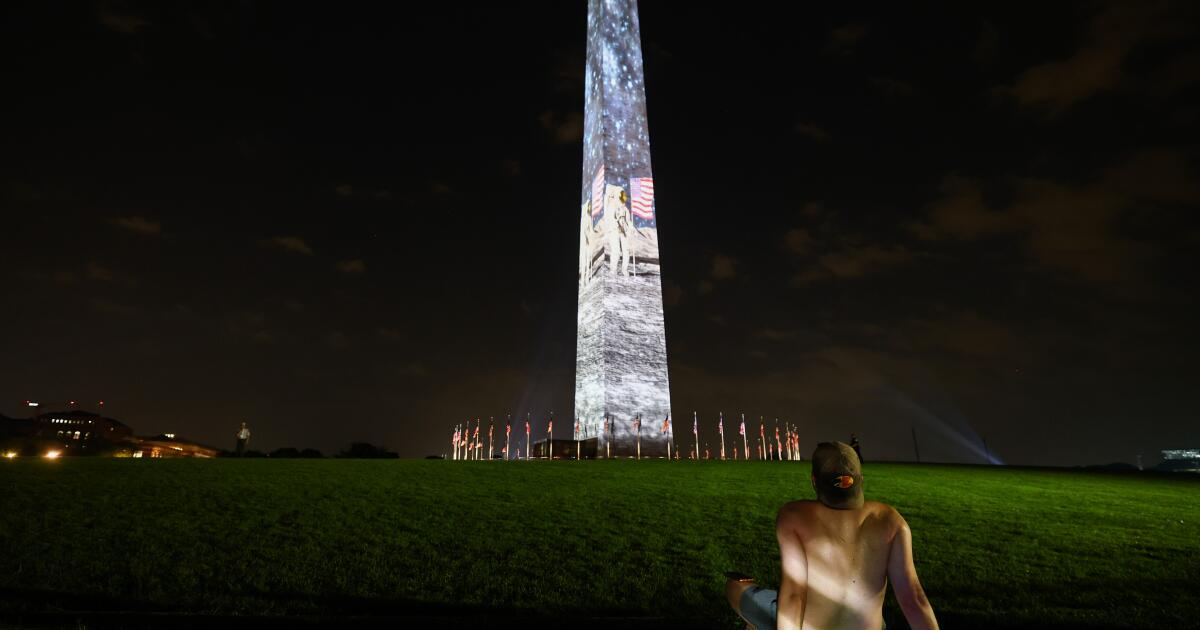
Trump refashions America’s 250th as a celebration of himself
-
 Sports29 minutes ago
How Dodgers’ Max Muncy, vying for his third All-Star selection, continues to evolve
-

 World41 minutes ago
Germany’s Merz defends NATO spending after Trump calls it ‘ridiculous’
-
 News1 hour ago
Oregon ER doctors win a ‘David and Goliath’ battle against a national company
-

 Videos2 hours ago
Iran gets ready for Khamenei’s funeral • FRANCE 24 English
-

 Los Angeles, Ca2 hours ago
2 arrested after 3 LASD deputies injured during East L.A. World Cup celebration

