Lifestyle
PHOTOS: How 9 families cope when they can't afford 3 healthy meals a day for the kids


Toyin Salami of Lagos, Nigeria, with her 4-year-old daughter, Kudirat. Her husband, Saheed, tends to two of their other children. “It’s hard to get food, let alone nutritious food,” she says.
Sope Adelaja for NPR
hide caption
toggle caption
Sope Adelaja for NPR
A mother in Nigeria pretends to cook food in a pot of water to calm her hungry children. In Houston, another mom can’t get to the food bank because the family’s car was flooded by Hurricane Beryl in July. A dad in India says, “Every day, from dawn to dusk, the one thought that floods my heart and mind is that the kids shouldn’t ever go to sleep hungry. I’m painfully aware of how we’re falling short.”
One in four children under age 5 worldwide is unable to access a nutritious diet, according to a report by UNICEF. That adds up to 181 million young children in a state of what the U.N. agency calls “severe child food poverty.”
Rising food prices are part of the problem, found the report, which compiled data from 137 low- and middle-income countries. So are conflicts, climate crises, harmful food-marketing strategies and disruptions in food supply.
Low-income countries have a hard time regulating aggressive advertising of processed snack foods, experts told NPR. As a result, even when families have the opportunity to eat well, many children end up eating unhealthy foods that are cheaper than nutrient-rich options.
Child food poverty is particularly harmful in early childhood — threatening survival, physical growth and cognitive development, according to UNICEF.
“We know that these children don’t do well at school,” says Harriet Torlesse, the report’s lead author and a nutrition specialist at UNICEF, who spoke to NPR after the report came out earlier this year. “They earn less income as adults, and they struggle to escape from income poverty. So not only do they suffer throughout the course of their life — their children, too, are likely to suffer from malnutrition.”
Adding to the urgency, the Bill & Melinda Gates Foundation (which is a sponsor of NPR and this blog) issued a report in September called “The Race to Nourish a Warming World,” urging world leaders to increase global health spending to boost children’s health and nutrition.
What’s it like to raise young children when there’s not enough nutritious food to eat? NPR enlisted photographers in nine cities around the globe, most of them from The Everyday Projects, to capture images and reflections from families struggling to get three healthy meals on the table each day.

Toyin Salami works as a house cleaner, sweeping compounds. Her husband, Saheed, is a bricklayer. When they have food, a typical breakfast for their four children is pap (a fermented cereal pudding made from corn).
Sope Adelaja for NPR
hide caption
toggle caption
Sope Adelaja for NPR
LAGOS, NIGERIA
“They’re not growing properly because they’re not eating well”
When there’s no food to eat and no money or credit to buy groceries, Toyin Salami puts a pot of water on the stove and pretends to cook. The activity distracts her four children — ages 15, 12, 7 and 4 — and calms them with the hope that food is coming. Eventually, they fall asleep.
“It’s hard to get food, let alone nutritious food,” says Salami, 41, who lives with her family in Alimosho, a community in Lagos, Nigeria’s largest city. “Things are really tough. People even tell me that my kids should be bigger by now, but they’re not growing properly because they’re not eating well.”
Toyin works as a house cleaner, sweeping compounds. Her husband, Saheed, is a bricklayer. When they have food, a typical breakfast is pap (a fermented cereal pudding made from corn). In the afternoon, they drink garri (a beverage made with fried grated-cassava flour and water). In the evening, they have eba (a stiff dough made by soaking garri flour in hot water and kneading it with a wooden spoon) — or just a serving of the liquid form of garri again. An uncle used to bring them occasional treats, but he died.
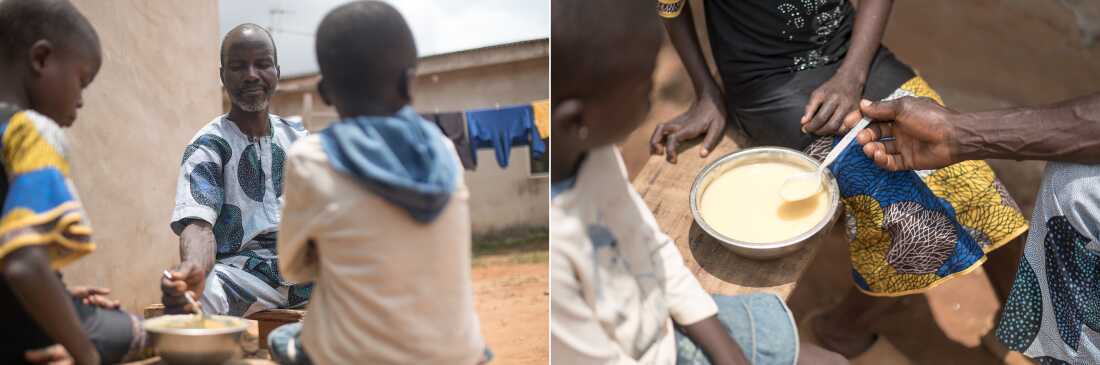
Saheed Salami serves pap to two of his four children for a meal.
Sope Adelaja for NPR
hide caption
toggle caption
Sope Adelaja for NPR
When money runs out, the family buys food on credit. But if they haven’t repaid their previous debt, they go to bed hungry. Toyin hopes that one day she and her husband can find better jobs or find people to help them so that their children can grow well and have the foods they ask for.
Photos and text by Sope Adelaja
HOUSTON, TEXAS
“Enough for rent but not for food”

Emilia Lopez hands her 2-year-old son, Jose, a bowl of eggs while he plays on the living room couch of their apartment in Houston. A caretaker to seven children — five of her own, plus two from other family members — Lopez relies on donations from churches and food banks to feed them all.
Danielle Villasana for NPR/
hide caption
toggle caption
Danielle Villasana for NPR/
Although Emilia Lopez’s husband has worked in construction continuously since the day they arrived in the United States from Honduras six years ago, it’s not enough to cover their monthly expenses for a family of nine.
“There are times when we have enough for rent but not for food,” says Lopez, who relies on government programs that provide funds to purchase food and also on donations from food banks and churches to supply most of the groceries for her family, which includes five of her own children (two of whom are under age 5), a 17-year-old cousin from Honduras and another child she’s taking care of for a family member.
Lopez lives in Houston, where having a car makes it a lot easier to get food. But the family’s car was flooded by Hurricane Beryl, a Category 5 storm that struck in July. “If you don’t have someone you know or transportation, you can’t get around,” Lopez says. “The churches and food banks are far.”

Left: Emilia Lopez (left), 30, and her cousin Angie Ferrera, 17, cook in the kitchen of their Houston apartment. Lopez says she cooks meals like stir-fried rice to stretch meat and vegetables. Right: A bowl of rice with cheese that Ferrera prepared. Lopez told her cousin that she shouldn’t eat just rice and cheese.
Danielle Villasana for NPR
hide caption
toggle caption
Danielle Villasana for NPR
The hurricane also left Lopez’s family without power for days. What little food they had spoiled. In her home country of Honduras, Lopez says there are neighbors everywhere willing to lend a helping hand. “There are doors” in the United States, she says, “but no neighbors, no friends.”
When she has transportation, Lopez visits donation centers once or twice a week to get food. She also buys food using the government aid she receives. But even when she gets two dozen eggs, she says, they’re soon gone.

Emilia Lopez’s 12-year-old daughter looks into the family’s refrigerator. For occasional treats, Lopez uses the government aid she receives to buy ice cream and chips. Most of the time, however, she makes it a priority to purchase essential items.
Danielle Villasana for NPR/
hide caption
toggle caption
Danielle Villasana for NPR/
With the food they have, Lopez cooks dishes that stretch, such as stir-fried rice with shrimp and canned peas. Her youngest children — Jose, 2, and Aaron, 4 — love instant noodle soup, formula (which they still like) and baleadas, a traditional Honduran food consisting of a large flour tortilla filled with ingredients such as beans, cheese and meat.
For occasional treats, Lopez uses the government aid she receives to buy ice cream and chips. Most of the time, however, she makes it a priority to purchase essential items. “The most important thing,” she says, “is what they need.”
Photos and reporting by Danielle Villasana
VELLORE, INDIA
“The kids shouldn’t ever go to sleep hungry”
Srinivasan, 30, works in a juice shop on the sprawling campus of the Vellore Institute of Technology, one of the city’s largest universities. For a full day of work, he earns a wage of 300 rupees ($3.58), typical for laborers in India.

Lakshmi feeds lunch to her 4-year-old daughter, Sakshi: a flatbread made with millet, beans and curry leaves, along with a serving of coconut chutney.
Viraj Nayar for NPR
hide caption
toggle caption
Viraj Nayar for NPR
Although he makes juice for students all day, Srinivasan says, he can rarely afford to buy fresh juice or fruit for his own kids — 5-year-old son Darshan and daughter Sakshi, 4.
“Every day, from dawn to dusk, the one thought that floods my heart and mind is that the kids shouldn’t ever go to sleep hungry,” says Srinivasan. “No matter what happens to us, their nutrition and their education have been our priority. They have dictated all our choices. And even then, I’m painfully aware of how we’re falling short.”
Inflation has risen in India in recent years, and food prices have gone up at an even faster rate, with food inflation at 9.55% in June, double the 4.55% rate from a year before.
Srinivasan and his wife, Lakshmi, 27, who go by only one name, have rearranged their lives to feed their children. In August, they moved into a smaller home to save money on rent. To supplement their diet, they — along with 9 million other families in Tamil Nadu state — are taking part in the government’s free rations program, where monthly supplies of rice, beans and sugar are free for low-income families.
Even with help from the government subsidy, Srinivasan uses a third of his salary to pay for food. On some days, like during heavy rainfalls in the monsoon season, he cannot make it to work, and the family can’t buy food. Lakshmi tries to get odd jobs cleaning people’s homes for 100 rupees ($1.19) a day when the children are at school, but that’s not regular work.

Lakshmi buys bananas for her daughter from a roadside vendor — a once-a-month treat. All fruits are expensive and beyond the family’s reach on most days. But bananas, which are plentiful in India, are more affordable than the rest.
Viraj Nayar for NPR
hide caption
toggle caption
Viraj Nayar for NPR
They don’t own a refrigerator, so Lakshmi buys produce in nearby stores early in the mornings and tries to cook enough for the day. She can afford vegetables about once every three days.
Typical meals for the family include idlis (fermented rice cakes) with sambar (a thin lentil gravy); roti (flatbread) made of ragi (millet) mixed with green beans; or green moong dal (a mung bean dish) with chutney. Chicken is a once-a-month treat. So are fruits, like apples, grapes and bananas, which they buy from roadside vendors depending on what’s cheapest.
On school days, the children take a packed lunch. For dinner, they eat what is left over from the food cooked in the morning. Sometimes it’s not enough for all of them, so Lakshmi and Srinivasan feed the kids and go to bed hungry.
When they go shopping as a family every Sunday, the kids beg for chocolates and cookies. “In school, they see their friends bring in those treats, but we just can’t afford to buy them,” says Lakshmi. It’s heartbreaking to keep saying no, she says, so sometimes they buy a chocolate that costs 1 rupee — less than 1 cent.

Srinivasan, Lakshmi and their children, Darshan, 5, and Sakshi, 4, eat a lunch of millet, a nutritious grain, and a serving of coconut chutney. In their tiny home, they sit on the floor of a room that serves as a bedroom, living room and dining room.
Viraj Nayar for NPR
hide caption
toggle caption
Viraj Nayar for NPR
Srinivasan goes to work even on Sundays to make ends meet, and sometimes, he skips meals. He gets stomach pains as a result and he loses wages if he can’t go to work when he’s sick, says Lakshmi. That’s why she took on part-time work.
“We’ve learned that putting food on our plates for a growing family isn’t easy,” she says. “It involves skimping, saving and sacrifice.”
Text by Kamala Thiagarajan. Photos by Viraj Nayar.
QUITO, ECUADOR
“The hardest question: ‘Mom, where’s the ham?’”
On tough days, Karen Sanabria’s family skips breakfast and eats a lunch of rice with egg around 3 or 4 p.m. For dinner, it’s just a little bread or tea.
Sanabria, 25, always tries to save some flour to make arepas for her son, Joshua, who is 3 and still breastfeeding. “I make a few, and if he’s still hungry, I only have the option of giving him juice to fill him up,” she says.
Originally from Venezuela, Sanabria lives in Quito, Ecuador, with her husband, Édgar Fustacaras, 38, their son and Sanabria’s father, sister and brother-in-law.
Édgar, who currently drives for Uber, has held sporadic jobs that don’t always pay enough or on time. Rent for the family’s apartment costs $120 a month, and if wages haven’t arrived when rent is due, that can leave them short on money for groceries. If they buy groceries first, they can end up struggling to cover their other expenses.

Karen Sanabria and her son, Joshua Kaed, at the patio entrance of their apartment. She always strives to play with her son.
Yolanda Escobar Jiménez for NPR
hide caption
toggle caption
Yolanda Escobar Jiménez for NPR
Sanabria works odd jobs when she can to pay for chicken and other meats. The family buys food to last a week, but by the end of the week they start worrying about where they’ll find the money for the next grocery purchase.
Providing three healthy meals every day is a challenge, and they end up going without shampoo and other toiletries. “Sometimes I need deodorant,” Sanabria says, “but if that money can buy us a pound of potatoes, I’ll buy the potatoes instead.”
When supplies are scarce, Joshua’s cravings peak. “‘Mom, I want an arepa. Mom, I want chicken. Mom, I want meat. Mom, I want chicken and rice. Mom, where’s the ham?’” Sanabria says. “I think that’s the hardest question I’ve ever been asked in my life: ‘Mom, where’s the ham?’”
It’s hard to tell Joshua there’s nothing to eat, Sanabria says. In response to his complaints for food, she sometimes changes the subject or stays quiet. Sometimes she goes to the bathroom to cry. Other times, she gets creative, especially with arepas, a staple food made from flour.

Sanabria and Joshua in their kitchen. She knows that a diet based on flour isn’t healthy, but that’s what they can mainly afford: arepas (a flatbread made from ground corn) in the morning, for lunch and at night.
Yolanda Escobar Jiménez for NPR
hide caption
toggle caption
Yolanda Escobar Jiménez for NPR
“I make heart-shaped arepas, star-shaped ones, doll-shaped ones, different shapes, and he forgets all he’s been asking for,” she says. “He says, ‘Mom, you saved the day.’ At that moment, I feel like a superhero mom who works miracles.”
All that flour has a downside: The family has experienced weight gain, anemia and infection from an unbalanced diet. “I know it’s not healthy to eat flour all the time, but it’s what we have,” Sanabria says. “The doctor always tells me, ‘Give him more chicken. Give him more meat.’ And I say, ‘Oh my God, I don’t have that.’”
Photos and text by Yolanda Escobar Jiménez
ORANG ASLI SG BULOH, MALAYSIA
“The worry of not being able to feed your children properly is something that never leaves you”
To feed her family, Rosnah has always depended on foraging for fiddlehead ferns and other wild plants in the jungle near her home in the state of Selangor, Malaysia. With increasing deforestation, however, finding edible plants has become difficult.

Rosnah, 48, eats with her son, Daniel, 5, after she has cooked an afternoon meal for her family in Orang Asli Sg Buloh, in Malaysia’s Selangor state. “As a mother, I always try to put my children first, even if it means I have to go without,” she says.
Annice Lyn for NPR
hide caption
toggle caption
Annice Lyn for NPR
“I use to be able to gather enough for my family,” says Rosnah, 48. “But now, sometimes we come back with almost nothing.” She and her husband asked that their last names not be used so they could freely discuss their economic struggles.
Rosnah lives with her husband, Roslan, 39, and their children, Daniel, 5, and Hellizriana, 14. Two older children from Rosnah’s previous marriage and a 5-year-old grandson, Qayyum, live nearby.
Roslan is a plantation worker and Rosnah works at a plant nursery, but their wages don’t go far. Food prices have risen and transportation costs are high, making it hard to get from their isolated village to markets to buy fresh food. What’s available and affordable is usually not very nutritious.
Most days, the family’s meals are simple. On a typical morning, breakfast is bread or biscuits and black tea. For lunch and dinner, they eat rice with some greens and salt. Maybe once a week or on special occasions, they cook one of their chickens, usually on a Sunday. Sometimes, there is an egg or small piece of fish. When the family has extra money, they buy something special, such as chocolate, candy, bubble milk tea or KFC.

A view of the family’s open fridge as Rosnah’s grandson, Qayyum, 5, eats his chocolate waffle biscuit treat. When the family has extra money, they buy something special, such as chocolate, candy, bubble milk tea or KFC.
Annice Lyn for NPR
hide caption
toggle caption
Annice Lyn for NPR
It’s never enough, especially for Daniel. Rosnah says she often skips meals or takes a smaller portion so that the children can eat. When she can’t sleep from the hunger, she makes plain rice porridge with a little salt.
“As a mother, I always try to put my children first, even if it means I have to go without,” she says. “The worry of not being able to feed your children properly is something that never leaves you.”
Photos and text by Annice Lyn
GREENVILLE, MISSISSIPPI
“They harvest the crops, and they’re taken to other places”
Caitlyn Kelly’s three kids like to eat watermelon, strawberries, mangoes and avocados. But she can only afford to serve fresh fruits and vegetables as treats because they cost too much to have every day.

Caitlyn Kelly serves spaghetti and meat sauce to her children, Logan White (center), 6, and Annadale Norris, 10, in Greenville, Mississippi. Fruits and vegetables are hard to afford, she says.
Rory Doyle for NPR
hide caption
toggle caption
Rory Doyle for NPR
Instead, she tries to make large meals that she can stretch for a couple of days using ingredients such as spaghetti, chicken, rice and, when she has enough money for them, frozen vegetables. She says she goes for frozen veggies because they are easier to store and keep for multiple meals, while the fresh ones are more expensive and don’t last as long.
“My kids actually like fruits and vegetables, but it’s pretty difficult financially,” says Kelly, 33, who lives in Greenville, Miss., a city in the heart of the rural Mississippi Delta. “A lot of the healthier fresh foods cost more, and you typically only get one meal out of them.”
A single mom, Kelly lives with her 6-year-old and 10-year-old. She splits custody of her 1-year-old with the child’s father, who lives four hours away. To earn money, she works at a store that sells food and beverages enriched with vitamins and other nutrients. She works a second job in the afternoons at a flower shop.
For breakfast, she often makes bacon, eggs or microwavable sausage biscuits. Her older two children qualify for free school lunches because of her low income. Sometimes, she skips lunch so her kids don’t have to miss meals. “It’s easier for me to go without,” she says.

Caitlyn Kelly poses for a portrait with her two oldest children, Annadale Norris, age 10 (left), and Logan White, age 6. A single mom, she says she sometimes skips lunch so she can afford to feed her family. “It’s easier for me to go without,” she says.
Rory Doyle for NPR
hide caption
toggle caption
Rory Doyle for NPR
One of the ironies of living in the fertile Mississippi Delta, Kelly says, is that agriculture is a major industry in the region, but her family can’t access much edible produce.
“You walk outside your house and see all of these crops growing, but I know that most of these things don’t stay here in the Delta,” she says. “They harvest the crops, and they’re taken to other places.”
Photos and text by Rory Doyle
BUJUMBURA, BURUNDI
“My children eat two meals a day”
On a Friday morning in July, Jeannette Uwimbabazi went to her greengrocer for a kilogram of beans, some matoke bananas, oranges and a few tomatoes to cook for her husband and three children, ages 5, 4 and 2. She promised the vendor she would pay at the end of the month when she gets paid for her job as a child care provider.

Jeannette Uwimbabazi, 40, of Bujumbura, Burundi, feeds her children beans and green bananas that she has cooked for them. As food prices have risen, the family decided to skip breakfast for the kids.
Esther N’sapu for NPR
hide caption
toggle caption
Esther N’sapu for NPR
Uwimbabazi’s family lives in Bujumbura, Burundi, where food prices have been on the rise, in part because of fuel shortages that have made it more expensive to transport supplies. In one month, the price of a kilogram of beans rose from 3,000 Burundian francs (about $1.04) to 3,500 Burundian francs ($1.21).
But as a child care provider, Uwimbabazi’s wages have stayed the same. Each month, she earns 350,000 Burundian francs ($120 as of mid-September). Her husband is a sociologist by training but has no job at the moment. The money she makes must cover food as well as medical care, school fees and other expenses.
“Since the rise in food prices, my children eat two meals a day — at lunchtime and in the evening,” says Uwimbabazi, 40. “My husband and I only eat in the evening. We’ve done away with breakfast to save money.”

Jeannette Uwimbabazi buys food for her children at the market. “Since the rise in food prices, my children eat two meals a day — at lunchtime and in the evening,” she says.
Esther N’sapu for NPR
hide caption
toggle caption
Esther N’sapu for NPR
Skipping breakfast is difficult for the children, Uwimbabazi says. Her youngest child cries when he’s hungry. To calm him down, Uwimbabazi gives him leftover food from the previous evening if there is any.
She grows sweet potato plants, known as matembele, in a small garden in front of the family’s house, harvesting the nutritious leaves to supplement the family’s diet.
It’s hard when her children see other kids eating biscuits or ice cream on their way out of church and ask her to buy them some, she says. She makes excuses for why they can’t have any, and they cry all the way home.
For the future, Uwimbabazi has a dream: She wants to start a clothing business to earn a better living.
Photos and text by Esther N’sapu

Tomás, who is 2, snacks on puffed rice cereal while his parents cook a meal.
Alejandra Leyva for NPR
hide caption
toggle caption
Alejandra Leyva for NPR
GUADALAJARA, MEXICO
They work in the food industry while worrying about food at home
To fund his university studies and goal of becoming a biologist, Alberto Isaac Maldonado Lozano works two jobs — as a cook and as a delivery driver for Uber and Rappi. His wife, Esmeralda Guadalupe López López, also works as a cook in one of the new restaurants in Guadalajara, Mexico.

Son Tomás shares fruit that mom and dad purchased at the stalls on Zaragoza Street in the central area of Guadalajara. On their shopping excursion, they also bought enough meat to last for four days. They spent $27.
Alejandra Leyva for NPR
hide caption
toggle caption
Alejandra Leyva for NPR
The city boasts a growing economy and good quality of life. But the couple has to make compromises to provide healthy food for their own children — Ámbar, 9, and Tomás, 2.
The couple knows all too well the irony of working in the food industry while worrying about food at home. At $8 or $9, the cost of a dish in the restaurants where they work is their budget to feed the whole family for a day.
To make sure the kids are eating well, they make sacrifices in their own meals. They get enough to eat, Maldonado says, but can’t eat what they want, like beef and fish. To save money for food, they have also suspended their internet service at home and limit recreational outings.
And they send Tomás to a government-subsidized day care center, where he gets two or three free meals each day. Even when López takes a day off, she sends Tomás to day care. “I know that he will have adequate nutrition, which is difficult for us on many occasions,” she says.

Here’s a meal that Tomás got at the government-subsidized day care he attends — a way for the family to reduce food expenses and make sure he has a healthy diet. The tray includes rice, egg, papaya and a protein.
Alejandra Leyva for NPR
hide caption
toggle caption
Alejandra Leyva for NPR
The family shops for food every third or fourth day at a store downtown where prices are cheap but quality is low. They try to prioritize nutritious food like fruit, baby formula and yogurt.
“The hardest part of not providing an ideal meal for your family is knowing that you are not giving them the food they need,” the dad says.
Photos and text by Alejandra Leyva
JABALIA, GAZA
“Mama, please can you get me chicken?”

In the shelter where her family stayed this summer, Suad Ali Al-Nidr cooks mulukhiyah, a soup made from jute leaves, for her kids. “This is the first time we are having mulukhiyah since the war began,” Al-Nidr says. “I could only make it because a friend of mine is growing it in her home and gave some to me” because she knew how much Al-Nidr was struggling to feed her family.
Mahmoud Rehan for NPR
hide caption
toggle caption
Mahmoud Rehan for NPR
Suad Ali Al-Nidr’s children often look at old photos on her phone. They see themselves eating shawarma wraps and chocolates. Then they beg her for food.
“Mama, please can you get me chicken?” asks her 4-year-old daughter, Maysoon.
Al-Nidr, 28, is sheltering with her two children and her father at a U.N. school in Jabalia in northern Gaza. Displaced by Israel’s war with Hamas, they sleep in a classroom with 35 people.
Across the Gaza Strip, families are struggling to find food to eat. Nutritious food — including protein — is hard to come by. According to the United Nations, at least 34 children have died of malnutrition since the war began in October 2023 and more than 50,000 require urgent treatment.
Al-Nidr and her family have had to move so many times since the war began that she struggles to remember all the places where they have sought shelter. In February, her husband heard about an aid convoy coming through Gaza City. He went, hoping to get food for the family. As thousands of desperate people gathered, a stampede ensued; Israeli troops opened fire. More than 100 people died, according to Palestinian health authorities.
Al-Nidr’s husband survived but was unable to return home. Israeli forces blocked roads, forcing hundreds to head to southern Gaza. Since then, he has been living in the south. He and his wife try to keep in touch by phone, but he is unable to support his family so Al-Nidr has been taking care of the children on her own.
One day in July, Al-Nidr cooked mulukhiyah, a soup made from jute leaves, for her kids. It’s a popular dish across the Arab world.
“This is the first time we are having mulukhiyah since the war began,” Al-Nidr said. “I could only make it because a friend of mine is growing it in her home and gave some to me.”
She tried to cajole Maysoon into eating a bowl. But Maysoon doesn’t have a lot of appetite these days. She and her twin sister are so weak from hunger, says Al-Nidr, that they lay around most days, unable to play or stand up for very long.
Like many families in Gaza, Al-Nidr and her children have not received humanitarian aid. But she has another thing to worry about: Maysoon is severely allergic to wheat, making their options even more limited.
“I wish I could get a can of tuna or some eggs, anything with protein to give my kids, but when they are available, they are too expensive, and it’s impossible to find any fruits or vegetables,” she says. “We can only afford to eat one meal a day, and usually it’s some hummus or beans, or weeds that we boil in water.”

Suad Ali Al-Nidr serves dinner to her two daughters, her father and her nephew. Her daughter Maysoon (center) has a severe wheat allergy, but most of the time, bread is the only thing they can find to eat.
Mahmoud Rehan for NPR
hide caption
toggle caption
Mahmoud Rehan for NPR
If aid doesn’t come? She is quiet for a long time, and then her voice wobbles.
“I don’t know what I will do.”
Text by Fatma Tanis. Photos by Mahmoud Rehan.
Credits: Visuals editor, Ben de la Cruz. Text editor, Marc Silver. Copy editor, Preeti Aroon. This project was done in collaboration with The Everyday Projects, a global community of photographers using images to challenge harmful stereotypes.



Michael B. Jordan plays twin brothers Smoke and Stack in Sinners.
Warner Bros. Pictures
hide caption
toggle caption
Warner Bros. Pictures
Ryan Coogler’s supernatural horror stars Michael B. Jordan playing twin brothers who open a 1930s juke joint in Mississippi. Opening night does not go as planned when vampires appear outside. “In a straightforward metaphor for all the ways Black culture has been co-opted by whiteness, the raucous pleasures and sonic beauty of the juke joint attract the interest of a trio of demons … they wish to literally leech off of the talents and energy of Black folks,” writes critic Aisha Harris. The film made history with a record 16 Academy Award nominations.


We asked our NPR audience: What movie would you recommend to someone who loved Sinners? Here’s what you told us:
Near Dark (1987)
Directed by Kathryn Bigelow; starring Adrian Pasdar, Jenny Wright, Lance Henriksen
If you want another cool vampire movie with Western kind of vibes, check out Kathryn Bigelow’s Near Dark — super underseen and kind of hard to find, but really gritty and sexy and another very different take on what you might think is a genre that had been wrung dry. – Maggie Grossman, Chicago, Ill.
30 Days of Night (2007)
Directed by David Slade; starring Josh Hartnett, Melissa George, Danny Huston
It follows a group of people in a small Alaskan town as they struggle to survive an invasion of vampires who have taken advantage of the month-long absence of the sun. Both this and Sinners revolve around a vampire takeover and the people’s fight to outlast the “night.” – Nathan Strzelewicz, DeWitt, Mich.

The Wailing (2016)
Directed by Na Hong-jin; starring Kwak Do-won, Hwang Jung-min, Chun Woo-hee, Jun Kunimura
In this South Korean supernatural horror film, a mysterious illness causes people in a quiet rural village to become violent and murderous. A local police officer investigates while trying to save his daughter, who begins showing the same disturbing symptoms. The film blends folk horror, religion, and psychological dread, exploring themes of faith, evil, and moral weakness. Like Sinners, it centers on a supernatural force corrupting a close-knit community, builds slow-burning tension, and examines spiritual conflict and human frailty. – Amy Merke, Bronx, N.Y.
Fréwaka (2024)
Directed by Aislinn Clarke; starring Bríd Ní Neachtain, Clare Monnelly, Aleksandra Bystrzhitskaya
In this Irish folk horror film, a home care worker, Shoo, is assigned to stay with an elderly woman who’s convinced she’s under siege by malevolent fairies. Like Sinners, Fréwaka blends folk traditions and social commentary with horror. The social failures Shoo copes with (untreated mental health issues, religious abuse) are just as frightening as the supernatural forces. – Kerrin Smith, Baltimore, Md.
And a bonus pick from our critic:
Ma Rainey’s Black Bottom (2020)
Directed by George C. Wolfe; starring Viola Davis, Chadwick Boseman, Glynn Turman
This is an adaptation of August Wilson’s play about a legendary blues singer (Viola Davis) muscling through a recording session with white producers who want to control her music. Chadwick Boseman’s blistering in his final role. – Bob Mondello, NPR movie critic
Carly Rubin and Ivy Buck contributed to this project. It was edited by Clare Lombardo.

The tiny town of West Goshen, Calif., was exactly the kind of place that community solar was designed for.
Near Visalia, most of its 500 residents live in mobile homes, where companies won’t install rooftop panels without a solid foundation. And until recently, they used propane for heating and cooking, with price fluctuations in the winter posing hardships for low-income families.
Community solar, in which residents get a discount on their bills for subscribing as a group to small solar arrays nearby, was designed to help low-income residents, apartment dwellers, renters and others who can’t put panels on their own roofs.
Over the last 11 years, New York, Maine, Minnesota, Massachusetts and other states have built thriving community solar programs. But California has built, at most, only 34 projects since 2015, and experts say that’s a generous accounting.
“We’ve had community solar for a dozen years, and it simply has not produced anything of scale and anything of note,” said Derek Chernow, director of Californians for Local, Affordable Solar and Storage, a developer trade group that’s pushing to get a more robust program off the ground. “Projects don’t pencil out.”
The West Goshen residents were among the lucky few, becoming part of a community solar project in 2024.
“It has kind of allowed us to kind of breathe a little bit,” said resident and community organizer Melinda Metheney. Her bill has dropped by about $300 in the summer months, thanks to the 20% community solar discount, stacked with other low-income discounts and clean energy incentives, she said.
West Goshen’s panels sit about 10 miles out of town, in a field surrounded by farms. Energy and climate experts agree California must add much more clean energy to its grid, some 6 gigawatts by 2032, the California Public Utilities Commission said in a new plan last week.
Assemblymember Christopher M. Ward (D-San Diego), who in 2022 authored a bill to create a more effective community solar program, said the state needs to double its annual solar installation rate to reach that goal and is not on track to do that using only large utility-scale solar farms and individual rooftop arrays.
“We need mid-scale community solar,” he said.

Energy and climate experts agree California must add much more clean energy to its grid, some 6 gigawatts by 2032, the California Public Utilities Commission said in a new plan last week. Above, solar panels at Extra Space Storage in Pico Rivera.
(Kayla Bartkowski / Los Angeles Times)
He and a coalition of environmental groups, solar developers and the Utility Reform Network, a ratepayer advocacy group, worked to put his 2022 law into effect. They coalesced around requiring utilities to pay community solar developers and customers for the electricity they feed to the grid using the same formula they use for people who install rooftop solar.
But in May 2024, the California Public Utilities Commission decided to go with a late-in-the-game proposal backed by the state’s investor-owned utilities to pay community solar at a lower rate.
The agency, along with its public advocate’s office, argued that crediting solar developers at the higher rate would raise bills for customers who don’t have solar, who would still have to shoulder the cost of grid maintenance. It’s similar to the argument they’ve made to cut incentives for rooftop solar.
The new program relied on federal money, including the Biden administration’s Solar for All, to sweeten the deal for developers. But the utilities commission spent very little of the $250 million available under that grant before the Trump administration tried to claw it back last summer, and now it is held up in litigation.
At a legislative oversight hearing last week, Kerry Fleisher, the commission’s director of distributed energy resources, blamed the loss for the new program’s failure to launch.
“There’s been a tremendous amount of uncertainty in terms of the Solar for All funding that was intended to supplement this program,” Fleisher said. “That’s part of the reason why this has taken longer than normal.” She said the commission still plans to release a program in the next several months.
Ward, the San Diego lawmaker who wrote the community solar bill, called the program “fatally flawed” in an interview.
He’s now considering a bill to bring the community solar program more in line with what he initially envisioned — higher incentives, requirements for battery storage, and compliance with state law that mandates new houses be built with solar.
A study last year funded by a solar trade group found that could save California’s electric system $6.5 billion over 20 years. But Ward’s effort to revive his program last year failed to pass the Assembly appropriations committee.
“All the other states in our country that have adopted similar community solar program models, they are working,” said Ward, adding that 22 states have programs comparable to the one solar advocates want in California. “The writing on the wall suggests that, exactly as we feared years ago, this was not the way to go.”
California Public Utilities Commission spokesperson Terrie Prosper called California “a leader in cost-effective, least-cost solar deployment overall compared to any other state,” in an emailed statement.
Under the commission’s definition, the state has brought on 34 projects, representing 235 megawatts of community solar. But studies from groups such as the Institute for Local Self-Reliance and Wood Mackenzie use different definitions for community solar, and they show California far behind at least 10 other states.
Meanwhile, advocates and developers involved in successful community solar projects in California say they were difficult to get off the ground.

Homes in the Avocado Heights area of Los Angeles County are part of a community solar project.
(Kayla Bartkowski / Los Angeles Times)
One that came online in May in the unincorporated communities of Bassett and Avocado Heights in the San Gabriel Valley provides solar electricity to about 400 low-income residents. They get 20% discounts on their electric bills for subscribing to panels installed on two Extra Space Storage building rooftops in Pico Rivera.
Organizers said it took nearly five years to find the right location and comply with utility requirements. They also got a grant in addition to funding provided by the state utilities commission’s solar program.
It “would not have happened if it hadn’t been for the grant,” said Genaro Bugarin, a director at the Energy Coalition nonprofit that proposed and coordinated the project.
Brandon Smithwood, vice president of policy at Dimension Energy, the developer for the project in West Goshen, said he still hopes to see a community solar program in California that compensates projects for the way they help out the grid.
“We’ve seen it can work, and we know what we have won’t work,” Smithwood said at the hearing.

There’s a three-story house in Baltimore that looks a bit imposing. You walk up the stone steps before even getting up to the porch, and then you enter the door and you’re greeted with a glass case of literary awards. It’s The Clifton House, formerly home of Lucille Clifton.
The National Book Award-winning poet lived there with her husband, Fred, starting in 1967 until the bank foreclosed on the house in 1980. Clifton’s daughter, Sidney Clifton, has since revived the house and turned it into a cultural hub, hosting artists, readings, workshops and more. But even during a February visit, in the mid-afternoon with no organized events on, the house feels full.

The corner of Lucille Clifton’s bedroom, where she would wake up and write in the mornings
Andrew Limbong/NPR
hide caption
toggle caption
Andrew Limbong/NPR
“There’s a presence here,” Clifton House Executive Director Joël Díaz told me. “There’s a presence here that sits at attention.”
Sometimes, rooms where famous writers worked can be places of ineffable magic. Other times, they can just be rooms.

Princeton University Press
Katie da Cunha Lewin is the author of the new book, The Writer’s Room: The Hidden Worlds That Shape the Books We Love, which explores the appeal of these rooms. Lewin is a big Virginia Woolf fan, and the very first place Lewin visited working on the book was Monk’s House — Woolf’s summer home in Sussex, England. On the way there, there were dreams of seeing Woolf’s desk, of retracing Woolf’s steps and imagining what her creative process would feel like. It turned out to be a bit of a disappointment for Lewin — everything interesting was behind glass, she said. Still, in the book Lewin writes about how she took a picture of the room and saved it on her phone, going back to check it and re-check it, “in the hope it would allow me some of its magic.”
Let’s be real, writing is a little boring. Unlike a band on fire in the recording studio, or a painter possessed in their studio, the visual image of a writer sitting at a desk click-clacking away at a keyboard or scribbling on a piece of paper isn’t particularly exciting. And yet, the myth of the writer’s room continues to enrapture us. You can head to Massachusetts to see where Louisa May Alcott wrote Little Women. Or go down to Florida to visit the home of Zora Neale Hurston. Or book a stay at the Scott & Zelda Fitzgerald Museum in Alabama, where the famous couple lived for a time. But what, exactly, is the draw?

Lewin said in an interview that whenever she was at a book event or an author reading, an audience question about the writer’s writing space came up. And yes, some of this is basic fan-driven curiosity. But also “it started to occur to me that it was a central mystery about writing, as if writing is a magic thing that just happens rather than actually labor,” she said.
In a lot of ways, the book is a debunking of the myths we’re presented about writers in their rooms. She writes about the types of writers who couldn’t lock themselves in an office for hours on end, and instead had to find moments in-between to work on their art. She covers the writers who make a big show of their rooms, as a way to seem more writerly. She writes about writers who have had their homes and rooms preserved, versus the ones whose rooms have been lost to time and new real estate developments. The central argument of the book is that there is no magic formula to writing — that there is no daily to-do list to follow, no just-right office chair to buy in order to become a writer. You just have to write.

Bill allowing physician assistants to practice independently passes Alaska Senate

ICE detainee in Arizona dies after not receiving ‘timely medical attention’

Report Assesses Access to Primary Care in Arkansas – ACHI

Signs of spring blooming at Antelope Valley California Poppy Reserve after wet, warm winter

Deen: Avalanche Solve Roster Needs. What’s Next? | Colorado Hockey Now

Florida High School Football Rankings: Top 25 teams – Oct. 21

Cleary's 21 help Le Moyne down Central Connecticut State 69-64 in OT

How old is Bo Nix? What to know about Oregon quarterback ahead of 2024 NFL Draft

99th annual Pony Swim held in Virginia

Indiana Members Credit Union announced as new anchor tenant at Bottleworks District

Map: 4.9-Magnitude Earthquake Shakes Louisiana

Paxton vows he’s ‘staying in this race’ even if Trump backs Cornyn in Texas GOP clash

Which Kurdish groups is the US rallying to fight Iran?

Man accused of plot to assassinate Trump testifies Iran pressured him, says Biden and Haley were other possible targets

DHS defends McLaughlin against allegations husband’s company profited millions from ad contracts: ‘Baseless’
-

 World1 week ago
Exclusive: DeepSeek withholds latest AI model from US chipmakers including Nvidia, sources say
-

 Massachusetts1 week ago
Mother and daughter injured in Taunton house explosion
-

 Wisconsin4 days ago
Setting sail on iceboats across a frozen lake in Wisconsin
-

 Maryland5 days ago
AM showers Sunday in Maryland
-

 Florida5 days ago
Florida man rescued after being stuck in shoulder-deep mud for days
-

 Massachusetts3 days ago
Massachusetts man awaits word from family in Iran after attacks
-

 Denver, CO1 week ago
10 acres charred, 5 injured in Thornton grass fire, evacuation orders lifted
-

 Oregon6 days ago
2026 OSAA Oregon Wrestling State Championship Results And Brackets – FloWrestling