Lifestyle
Nintendo and Ubisoft revive overlooked franchises in their first games of the year


Ashley Mizuki Robins from Another Code: Recollection and Sargon from Prince of Persia: The Lost Crown.
Nintendo/Ubisoft
hide caption
toggle caption
Nintendo/Ubisoft

Ashley Mizuki Robins from Another Code: Recollection and Sargon from Prince of Persia: The Lost Crown.
Nintendo/Ubisoft
Ubisoft and Nintendo came out with their first games of the year this week. Prince of Persia: The Lost Crown twists a 35-year-old series into a new format, while Another Code: Recollection updates a forgotten franchise. While both will be available on the Nintendo Switch, The Lost Crown is also on PC, Xbox and PlayStation.
Prince of Persia: The Lost Crown
Few legacy franchises have slid from acclaim to indifference quite like Prince of Persia. The iconic 1989 original eventually spawned a beloved GameCube title in 2003, only to dwindle over the succeeding decade of disappointing sequels. Fourteen years after its last main game (and a forgettable Jake Gyllenhaal movie) the series is back with The Lost Crown, which landed without much preceding hype. Gamers looked at its Switch-friendly cel-shaded visuals, its young, reworked hero and gave a collective shrug.
Prince of Persia’s robust new cast.
Ubisoft
hide caption
toggle caption
Ubisoft
Prince of Persia’s robust new cast.
Ubisoft
But as it turns out, The Lost Crown is not only a fantastic Prince of Persia game; it’s one of the best action-adventure games I’ve played in years. The talented developers at Ubisoft Montpellier (who also worked on the critically adored Rayman Legends series) successfully revived the moribund series by putting a premium on fun. Everything is fun. The action, the exploration, the platforming — it’s all just fun.
Prince of Persia: The Lost Crown twists the established series into a “Metroidvania” — a genre in which players have to fight through an interconnected puzzle of a world. It requires good recall and creative thinking. But it’s also a frustrating genre that asks players to retread old spaces, often without avail. These games throw roadblocks that can’t be solved until much later, and traversal and progression are non-linear.
As an antidote to this, The Lost Crown makes the simple act of movement a joy. New hero Sargon is fast, even before the addition of any of the game’s power-ups. He can jump off walls, fast-fall at ridiculous speeds, slide under obstacles, and sprint through an area in seconds. The game emulates action games like Devil May Cry and fighting games like Street Fighter, essentially allowing players to cancel animations before they finish. The result is completely smooth and responsive movement, making traversal — even through those old areas — always a thing to look forward to. It’s a brilliantly interlinked world filled with delights, surprises and wicked hard combat encounters.
Sargon boasts incredible athleticism and a fearsome arsenal.
Ubisoft
hide caption
toggle caption
Ubisoft
Sargon boasts incredible athleticism and a fearsome arsenal.
Ubisoft
And those combat encounters! It’s become a bit hackneyed to compare games to Dark Souls and Hollow Knight, but The Lost Crown takes its cues from both games. The combat is simple but deep, relying on one-button combos, dodges and parries. But the boss fights are really memorable, and there are a lot of them. Especially on the game’s harder difficulty settings, you will absolutely die, and you will absolutely have fun doing it.
There are dozens of clever ways The Lost Crown eases player stress. Frequent checkpoints, numerous fast-travel options, and the ability to link screenshots to the map to avoid needless back-tracking ease much of the friction that often comes with games like this. The Lost Crown is the Swiss watch of Metroidvanias. It distills what’s great about an entire genre into an elegant, cohesive and memorable package. — Vincent Acovino, Producer, All Things Considered
Another Code: Recollection
I can’t remember much of my life before kindergarten — few can. Another Code: Recollection, a Switch remake of a DS game and its Wii sequel, spins its emotional core out of this near-universal amnesia. For protagonist Ashley, dredging up her own haphazard early-life memories turns out to be key in mending not just her own broken family, but entire communities riven by trauma. While its themes might be obvious and its dialogue unsophisticated, this quest for remembrance results in a compelling middle-grade mystery only occasionally burdened by dull gameplay.
Ashley encounters a ghost she calls D, who proceeds to aid her through the first of Recollection’s two parts.
James Mastromarino/Nintendo
hide caption
toggle caption
James Mastromarino/Nintendo
Ashley encounters a ghost she calls D, who proceeds to aid her through the first of Recollection’s two parts.
James Mastromarino/Nintendo
Recollection opens with two homicides, one witnessed by a boy in 1948 and the other by a girl in 1994. Fast forward to 2005, and the girl, Ashley, now 14, is sailing to the eerie if ludicrously entitled “Blood Edward Island” to meet the father who left her in her aunt’s care after her mother’s killing. Soon stranded at the abandoned Edward family estate, Ashley is accompanied by the ghost of the boy from 1948 and a “Dual Another System” — an all-purpose gadget bequeathed by her father. This “DAS” resembles a Nintendo Switch (in the original, it looked like a Nintendo DS, naturally) and comes equipped with maps, a camera and an automatically updating web of character profiles.
This first game, Two Memories, presents a Resident Evil puzzle-box mansion without horror or danger. You’ll trek from wing to wing, uncovering room keys with help from the DAS and the ghost boy, “D.” While Ashley searches for her missing dad and learns about the memory-altering “Another” technology that led to her mom’s murder, D slowly recalls the tragedy that befell his great-grandfather, father and uncle.
Sometimes tedious but rarely obscure, this new version graciously provides navigation aids and gentle hints at the press of a button. I cruised through Two Memories in six hours, indulging the former feature frequently and the latter only twice. The next game in the collection, Journey Into Lost Memories, took me closer to eight hours and largely trades these adventure game puzzles for perfunctory quick-time events.
Ashley recalls this and many other memories from when she was 3-years-old that prove crucial in unravelling a decades-spanning mystery.
Nintendo
hide caption
toggle caption
Nintendo
Ashley recalls this and many other memories from when she was 3-years-old that prove crucial in unravelling a decades-spanning mystery.
Nintendo
That’s due to yet another gizmo — the RAS, a bracelet that lets the now 16-year-old Ashley open locked doors by clearing randomized button prompts. It’s busy work, but at least it’s usually brief. Journey Into Lost Memories, therefore, comes closer to a visual novel, where the comic-book presentation and bustling cast carry a messier, multifaceted story that veers further toward science fiction. Here, ghosts aren’t just literal spirits but also the traumatic memories that haunt generations of families.
It’s telling, then, that Recollection is itself born from the past. As what is likely one of Nintendo’s last remakes for the Switch, it shows how much care the company can take in repackaging old games, even as it threatens many others with oblivion by closing digital storefronts. Industry amnesia isn’t just the consequence of a maturing medium but a strategy that ensures that consumers keep paying for the same titles repeatedly. Yet, if we must ride this cynical cycle, I hope more games get the Another Code: Recollection treatment. It’s worth remembering for just a little longer. — James Mastromarino, NPR Gaming lead and Here & Now producer



Dan Levy in Big Mistakes.
Spencer Pazer/Netflix
hide caption
toggle caption
Spencer Pazer/Netflix
Dan Levy co-created and starred in the beloved Schitt’s Creek. And now he’s back with a new comedy on Netflix that’s got a very different vibe. In Big Mistakes, Levy and Taylor Ortega play dysfunctional siblings who get drawn deeper and deeper into the world of organized crime, even as their mom – the great Laurie Metcalf – runs for public office.
Subscribe to Pop Culture Happy Hour Plus at plus.npr.org/happyhour
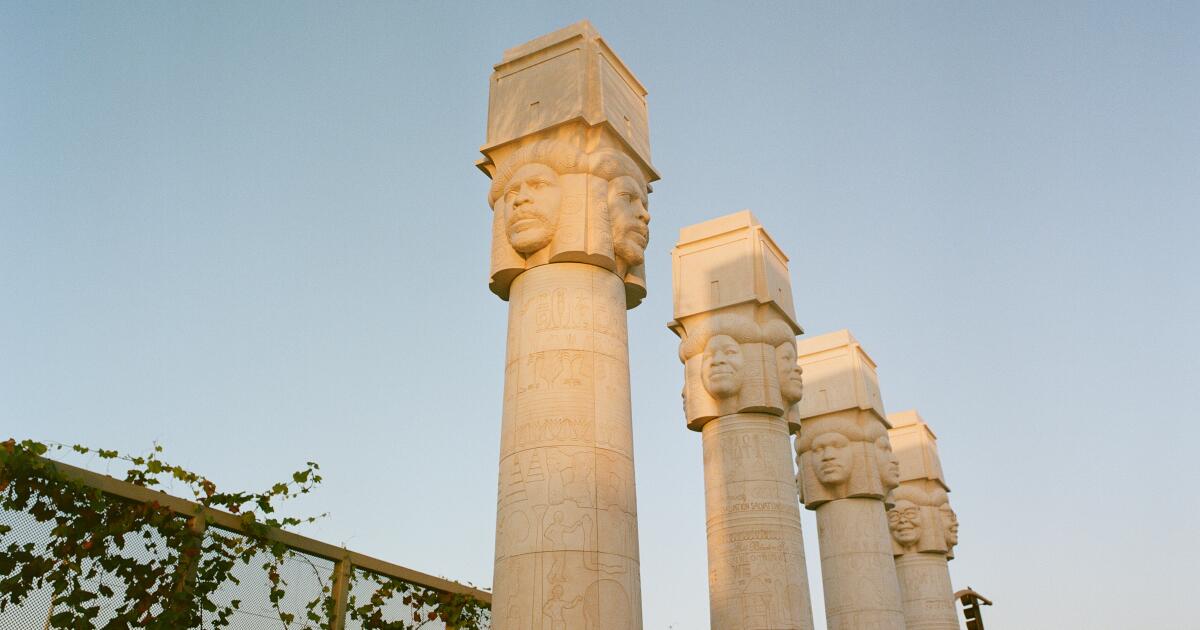
Someone said heaven is on the corner of 76th and Western.
It’s nearly 90 degrees on a Saturday in South-Central and “sister dreamer lauren halsey’s architectural ode to tha surge n splurge of south central los angeles” is gleaming and activated.
Thousands of people fill the streets that surround it in lit, ecstatic union. Parliament-Funkadelic is playing a live show onstage while we stomp the pavement in faithful entrancement. The line forming for fittingly swaggy merch becomes a site for sweet reunions unfolding one after another — some version of “this is crazy, this is amazing, this is L.A.” being thrown back and forth on a loop. On the sidewalk, generations play spades in the shade and the joyful screams of children emanate from a custom bouncy house adorned with an Egyptian pharaoh bust. Across the way, skateboarders do their thing on the Neighbors Skate Shop ramp, flipping and flexing, making sculptures out of their bodies in midair, while others double-dutch or Hula-Hoop in exacting harmony.
This block party — multigenerational, multivibrational — is in celebration of the sand-colored sanctuary and sculpture park that is “sister dreamer,” a direct expression of its spirit and purpose.

From left to right: Andre “Sketch” Hampton, Emmanuel Carter, Lauren Halsey and Kenneth Blackmon.
Artist Lauren Halsey has been dreaming and scheming on this sculpture park for 17 years. (She has the Photobucket receipts to prove it.) The paper trail follows from her third semester studying architecture at El Camino College, when she used to take long bus rides down Western and project her ideas onto empty lots, cutting them together in Photoshop — part-planning, part-manifestation. Variations of these ideas have appeared at the Studio Museum in Harlem, the now-iconic Crenshaw District Hieroglyph Project at the Hammer, the rooftop at the Met and the Venice Biennale. But “sister dreamer” has always been the goal — a way to go beyond only representing or depicting her community and giving back to it in a tangible way.
The location of “sister dreamer” is specific and important — for one, it’s the former site of neighborhood ice cream staple Gwen’s Double Dip, a history honored at the block party through a pop-up parlor created by Halsey’s studio. But it’s also because Halsey grew up around the way and can trace her family history back more than 100 years to this place. She comes from a long line of people who have served their community and taught Halsey to do the same. “sister dreamer” is the culmination. Both a once-in-a-lifetime artwork and a free, public venue where every day, from dawn till dusk, people can live and imagine.
“From the beginning, the conceit was to summon all the types of experiences of Blackness in one place, the project being a vessel or container for all of that expression,” Halsey says. “If I could create spaces that democratize Blackness because they’re gorgeous, they’re inclusive, they pay homage to all of us, that’s just a cool type of unity I want to see. And if I could do that through funk as the language, it would also be fun and playful and attract the energies I’m looking for.”

“From the beginning, the conceit was to summon all the types of experiences of Blackness in one place,” artist Lauren Halsey says about “sister dreamer.”
To see L.A.’s newest architectural monument in effect is to experience people being celebrated. This public artwork and its function — as in, this party and the space’s purpose — feels like a mirror, a temple to self, a shrine to funk, a dedication and invitation to experience what is still so divine and aspirational about the present moment. Writer Douglas Kearney illuminates it strikingly in the curatorial statement etched into a back wall in “sister dreamer”: “… it’s the sacred phenomenon of luxe space that remembers without memorializing, celebrates without eulogizing. An anti-tomb.”
Life in its most beautiful forms — the poetic, artistic range of Black life in South-Central — is on display everywhere you look here.
Standing in the open-air cube that is the oculus of “sister dreamer,” most people have their gaze pointed up, seeing — what else? — themselves. The entire space is dripping in the dense Black L.A.-meets-Egyptology that has become Halsey’s signature. People run their fingers over carved reliefs telling the rich story of a neighborhood, culture and creed, reflecting the folk art that has existed in South-Central since forever. The hand-painted signage and hood graphics are familiar, the mantras and spiritual emblems — “Be Ye Who Ye Is,” a spiral of cornrows wreathed on the back of a head, the comma-curve of an XL nail — are personal. Known legends stare back at us — hi, Sika — and others are finally given agency, including the Black women who were killed at the hands of the Grim Sleeper in the 1980s, their faces framing the entrance of the oculus like guardian angels.
“Lauren Halsey in her work brilliantly represents the range of contributions, resistance and resilience by our communities including the collective work I have been part of demanding payment for all caregiving work, and working for justice, dignity and visibility for the scores of Black women who were victims of serial murders in South L.A. and who were marginalized dehumanized and treated as throwaway women,” says Margaret Prescod, founder of the Black Coalition Fighting Back Serial Murders.
These carved reliefs span dimensions of the Black L.A. experience — there’s so much joy, there’s this overdue reverence too; another, fuller frame. All of this is a result of Halsey’s obsession with the way her community speaks to each other through visual language. There are five infinity fountains, also clad in carvings, punctuating the space while fragrant native plants perfume the warm, dry L.A. air, identified by information cards written in Halsey’s recognizable script. L.A.-based Current Interests served as the project architect, while Phil Davis came in as the landscape designer.
There are eight Hathoric columns and eight sphinxes in “sister dreamer” that honor local heroes, community workers and Halsey’s friends and family. “I love this sort of ceremonial procession as you walk through the sphinxes and columns — these figures who have created safe space for me, literally, conceptually, spiritually,” Halsey says. DaVinci, Bopbop, Barrington, Damien, Janine, Margaret, Susan and Rosie stand 22 feet tall, kissing the sky. While Dominic, Aujunae, Bobby, Monique, Glenda, Robin, Londyn and Antoinette ground us, warm expressions on long sphinx bodies, serving as ultimate anchors.


Michael Towler and Dominique Moody.


“Seeing it in person, yeah, that was different. Compared to the work you’re doing in community, boots on the ground, and then actually seeing your picture, or you know — your face — on something like that, it is something you’ll never imagine,” says Robin Daniels, co-founder of Sisters of Watts, who is depicted as one of the sphinxes in “sister dreamer.”
First debuted in “the eastside of south central los angeles hieroglyph prototype architecture (i)” as part of New York’s skyline, this marks a homecoming for the columns and sphinxes. L.A.’s sons and daughters, mothers and grandmothers, uncles and aunties, leaders and stewards, artists and musicians, holding court on native soil. These are people, Halsey says, “who have summoned a love and care that I’ve admired, both on a micro and macro level.” Those depicted include Halsey’s mother, whom she wanted to put on a physical pedestal for her family, for the neighborhood, for the public “to see her in the light that I experience her in every day,” she says. There’s her little brother, whom she describes as “my BFF … love incarnate,” and her now-teenage cousins, who were kids when Halsey was doing mock-ups in their grandmother’s backyard. “I’m [having] difficulty expressing the words because I’m overwhelmed with emotion. This is not easy work,” says another cousin Damien Goodmon, one of the columns and CEO of Downtown Crenshaw Rising/Liberty Ecosystem. “People see the glamour and all the awards, but it’s hard, and I can only imagine how difficult it is for her to carry this as a person who’s not necessarily always that public. She’s been trying to do this for years — lifting up that tremendous history.”
In creating a new monument for her city, Halsey has made her loved ones landmarks in L.A.’s architectural legacy — cementing them as giants in its rich universe. “When I saw my face I was shocked,” says Rosie Lee Hooks, director of the Watts Towers Arts Center Campus. “It was so personal and me! I am not used to seeing myself so clearly. Lauren is a carrier of the culture. She is a storyteller, a griot. A documentarian, an architect, a dream-catcher. Keeper of our community and world culture. She honors all those who came before her, are here now and those to come. Right on with the right on.”
An opening block party like this one — “the block party of the year,” as one or 100 attendees put it — feels like the only appropriate way to mark the realization of a vision this singular and interconnected. And it’s a living, breathing reminder of a tenant that’s been a part of Halsey’s work from the jump: An architectural monument only becomes truly meaningful when people can see a space for themselves there. Architecture, at its best, is people. “Seeing yourself at that scale makes you feel many ways,” says Barrington Darius, an artist and one of Halsey’s collaborators depicted on a column. “Seen, respected and larger than life.” The party is also a slice of what “sister dreamer” will be home to every day: music, funk, fashion, art, games and space. (The three pillars of Halsey’s nonprofit Summaeverythang Community Center — art, education and wellness — will officially inform the space’s programming, including things like museum visits, film screenings, Kemetic yoga and more.)

From left to right: Cheryl Ward, Kenneth Blackmon, Monique McWilliams, Rosie Lee Hooks, Michael Towler, Dominique Moody, Andre “Sketch” Hampton, Monique Hatter, Christopher Blunt, Robin Daniels, Margaret Prescod, Barrington Darius, Damien Goodmon, Londyn Garrison, Dyani Luckey, Autumn Luckey, Lauren Halsey, Emmanuel Carter.

From left to right: Cheryl Ward, Kenneth Blackmon, Monique McWilliams.
“When I first saw myself as a sculpture in the work, I thought about representation — how it matters and what that image will sow into the fabric of our youth.”
— Monique McWilliams, partner


Autumn Luckey, Emmanuel Carter, Christopher Blunt.
It’s extra in all the best ways. Hosted by Watts Homie Quan, performers like Roc’co Tha Clown, and Divas and Drummers of Compton keep the energy high near the DJ booth. At one point the sound of a preschooler’s voice singing “This Little Light of Mine” belts through the streets. “Let it shine, let it shine, let it shiiiiiiine.” Throughout the day, people can’t seem to stop reaching for means of documentation — their camcorder, digicam, phone, at one point even a palm-size notebook where a young artist from the neighborhood was sketching one of the sphinxes. The desire, or compulsion, to document this moment seems to come from a shared understanding that the opening of “sister dreamer,” all of us here together, is a historic event.
Back in the park, I sit for a while and watch, thinking about how this couldn’t feel more different from a gallery opening. People breathe with the art, they touch it, they feel it, they laugh with it. Goddesses on roller skates glide in buttery figure eights across the glass-fiber-reinforced concrete. Wait, is that Usher dancing with Tiffany Haddish in front of the oculus? Of course it is. Jane Fonda too. Oh, and there’s Kamasi Washington, Maxine Waters, Charles Gaines and Erykah Badu.
An older Black woman saunters down Western, low and slow, holding a watermelon and mango cup in one hand and her cane in the other. She wears a matching Kelly green set and a bedazzled baseball hat that reads, “Relax, God is in control.” Fly, of course, and yet another example of the brilliance and style of Black people on display today, but it also conjures something Halsey said weeks before the “sister dreamer” opening. “People don’t talk about God a lot, but I’m just so grateful that God gave me the endurance to continue and push through despite whatever,” Halsey says. “It’s just a testimony to the power of prayer and ancestors and work ethic and alignment. So, I’m just so tired, but it’s so worth it.”
In line for the merch booth, sweat drips down our backs. Even in the heat, multiple people walk by wearing the “sister dreamer” X Supervsn collab from head to toe or have already pulled on their “sister dreamer” X Come Tees longsleeves they picked up from the shop, its signage reading: “Treat yaself don’t cheat yaself!” An hour passes, but we’re all determined to take a piece of this day home — more than a memento, but proof that we were a part of it. It is that serious.
“I want to see the art last,” a musician standing behind me tells their companion.
“Is it the dessert?” the companion asks in response.
“It’s just the last thing I want to think about. The last thing I want to linger on.”


new video loaded: The New Aesthetic of ‘Euphoria’
By Gina Cherelus, Jacob Gallagher, Callie Holtermann, Léo Hamelin and Gabriel Blanco
April 13, 2026

Two Detroit Pistons Facing Uncertain Roles in NBA Playoff Rotation

Meet the District 2 candidates: How should SFUSD students be assigned to schools?

Stephen Jones’ Comments Add Fuel To Dallas Cowboys NFL Draft Trade Rumors

Forward Brant Byers leaving Miami RedHawks for Penn State | Report

Biddeford woman runs Boston Marathon in honor of late mother

Florida High School Football Rankings: Top 25 teams – Oct. 21

How old is Bo Nix? What to know about Oregon quarterback ahead of 2024 NFL Draft

Cleary's 21 help Le Moyne down Central Connecticut State 69-64 in OT

99th annual Pony Swim held in Virginia

Indiana Members Credit Union announced as new anchor tenant at Bottleworks District

Video: How Stephen Miller Is Adjusting Trump’s Immigration Agenda

Biden DOJ weaponized FACE Act against pro-life Americans, 882-report alleges

Mass drone warfare is Europe’s rising security threat

Man accused in Molotov cocktail attack of OpenAI CEO’s home charged with attempted murder

Embattled Rep Tony Gonzales announces plans to resign amid sexual misconduct allegations
-

 Atlanta, GA1 week ago
1 teenage girl killed, another injured in shooting at Piedmont Park, police say
-

 Georgia1 week ago
Georgia House Special Runoff Election 2026 Live Results
-

 Arkansas4 days ago
Arkansas TV meteorologist Melinda Mayo retires after nearly four decades on air
-

 Pennsylvania1 week ago
Parents charged after toddler injured by wolf at Pennsylvania zoo
-
 Milwaukee, WI1 week ago
Potawatomi Casino Hotel evacuated after fire breaks out in rooftop HVAC system
-

 Austin, TX7 days ago
ABC Kite Fest Returns to Austin for Annual Celebration – Austin Today
-

 World1 week ago
Zelenskyy warns US-Iran war could divert critical aid from Ukraine
-

 Politics1 week ago
FBI’s Patel delivers blunt warning to law enforcement attackers: ‘We’re going to put you down’