Lifestyle
Modern parenting can be so isolating. This L.A. dad group builds a village while the kids play

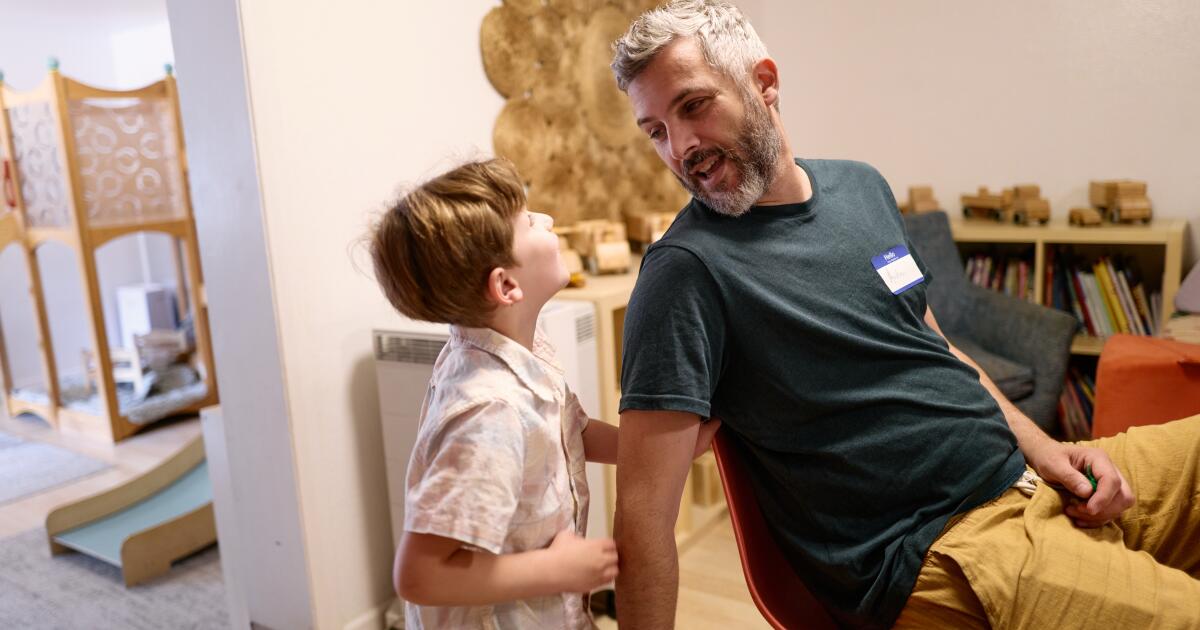
In the back room of a children’s play space in Eagle Rock, Andrew Thomas asks a familiar parenting question: How do you stay calm when your kid is testing every last nerve?
Heads nod and chuckles fill the air. The participants — a handful of dads — begin sharing personal stories about toddlers that melt down like snow on summer asphalt, frayed patience and what it means to parent with intention. The conversation deepens, touching on masculinity and how hard it could be to ask for help.
Suddenly, Henry, 6, walks into the dads’ circle, cradling three baby dolls. Thomas, his dad and the group’s facilitator, does not miss a beat.
“Henry has very recently become a father to triplets,” he jokes.
Phil Klain and Robert Tellez during a Dads’ Group meeting.
(Marcus Ubungen / For The Times)
At the Dads’ Group in Eagle Rock’s PlayLab, children and dolls are welcome, but dads and father figures take center stage. The free biweekly morning sessions are built around a simple idea: Dads need community too. The hour-long meetings bring the community support model back to parenting — especially for dads, an often-forgotten population for supportive care.
In Los Angeles, support groups exist to help moms move their bodies around strollers while blowing bubbles, and tour fire stations with the kids while fostering connections with other caregivers. Fewer opportunities exist for dads even as gender roles continue to evolve and men spend more time on the care of their children.
PlayLab’s Dads’ Group hopes to soften some of those sharp edges of fatherhood. Sessions are casual and small — usually with four to eight participants — and operate on a drop-in basis (though reservations are preferred). It’s a dad-led model for dads and father figures to receive the kind of care traditionally offered to mothers.
The bonus is the space: PlayLab’s indoor play space is designed for young children to frolic and, in this case, witness dads build their emotional muscles. Here, vulnerability is welcome and the chance of an interruption from a child asking for a third snack is high.
In this meeting on a warm June morning, Leo, 5, wanders off to play the drums in the next room. Then he falls silent. His dad, Andrew Jacobs, quietly slides out of his seat in the support circle to check on his son. Leo is tucking an elephant stuffed animal into a toy bed. It’s nap time for the dolls and the elephant, and it turns out for dad talk too. The children ask for quiet. Voices drop to a whisper.
The next minute, the dads toggle their attention between the discussion and an impromptu game of catch between the kids and a heavy toy.
“Dads are going through all the same things moms are going through,” said Jacobs, 44. “Being able to talk to other people is really important and helpful.”

Nick Bender shares parenting tips with other dads in a discussion facilitated by Andrew Thomas, right, while Henry, 6, plays.
(Marcus Ubungen / For The Times)
This meeting was Phil Klain’s first. He chose not to bring his 2-year-old son so he could be more present. Klain has been searching for a community like this. Earlier in his fatherhood journey, he joined a new dads’ group on social media, but found the space difficult to form connections — a challenge that sometimes seeps into real life.
“I’ve got friends I can talk about stuff with,” said Klain, 45, after the meeting. “But, do I?”
Modern parenting can be isolating — now more intense and more individualistic than ever with hyper-scheduled monitoring of children’s every milestone and moment. Sociologists call it “concerted cultivation,” said Jennifer Hook, a professor of sociology at the University of Southern California.
“Our expectations of parents have gone up, but we haven’t really provided them additional resources,” said Hook.
At the same time, connections to supportive systems — the “village” of friends and family that helps raise children — have faded or become untenable. PlayLab’s ethos, said co-founder Jason Shoup, has always focused on the growth of the village’s connective tissue — especially for dads. When PlayLab’s new space in Hollywood opens this month, he hopes to launch a second version of the dads’ group in the new location.
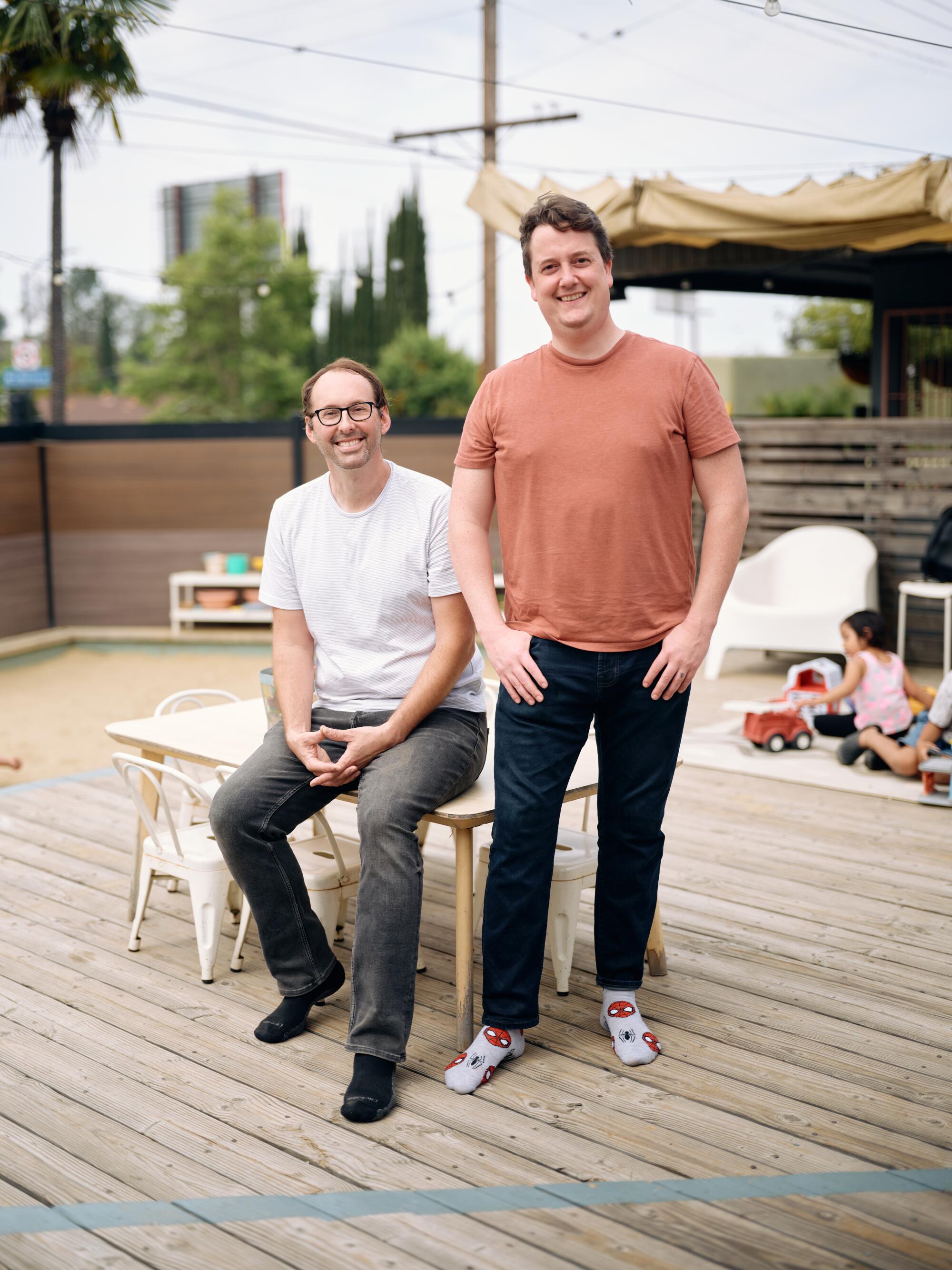
Playlab co-founder Jason Shoup, left, with Andrew Thomas, a parent coach and children’s television writer who facilitates the Dads’ Group.
(Marcus Ubungen / For The Times)
“If you’re part of a team,” said Shoup, 45, about parenting, “you should support the team.”
Shoup’s earlier iterations of a dads’ support group — including a sporadic weekend gathering called “Dadder-day” — all fizzled. Then last winter, Thomas, 39, a children’s television writer and a parent coach, pitched his services. Why not start a group for dads by dads?
They kept the name simple: Dads’ Group. A necessity, said Thomas, because otherwise, dads won’t know the group is for them. In January, the meeting of the dads began.
Robert Tellez, 42, has attended most of the sessions. Before the first one, he anticipated a lot of silence.
“Like, crickets, right?” said the dad of two daughters. “And just awkwardness.”
Instead, he found a space that felt surprisingly safe.
“I didn’t know what I needed and how it felt. And so now that I’ve put myself into the situation of being a part of a dads’ group – participating, and being vulnerable, and giving advice, and taking advice – I know what that feels like now,” said Tellez.
If the rest of the week is a high-octane rush of services for the children, these Sunday sessions are a reserve time for some of the dads to just be present.
In little moments, connections form. While shoes are being put back on, dads trade birthday party venue recommendations. Talk is also burgeoning about going to a nearby deli together after the meeting for lunch.
Main character energy
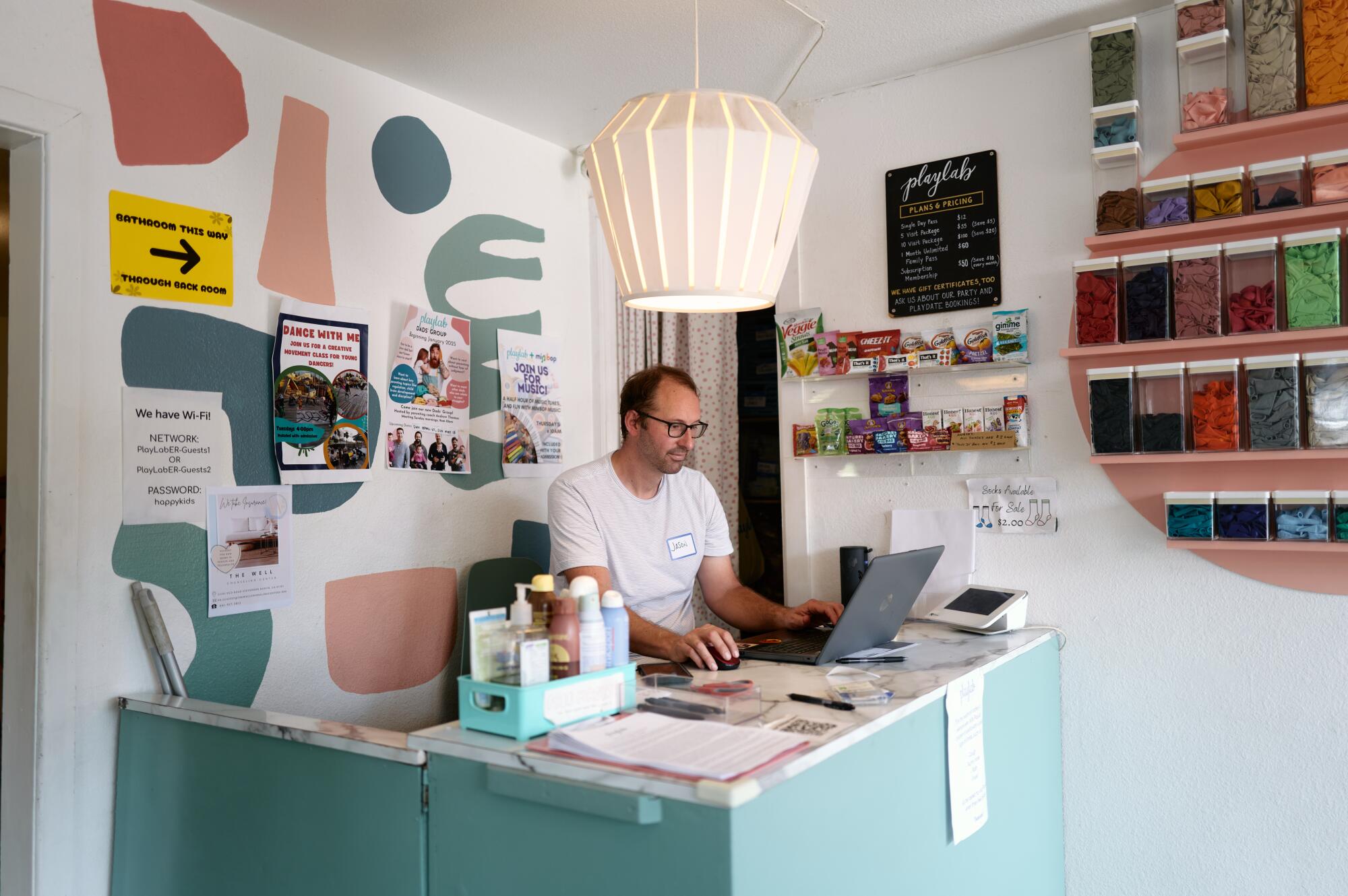
Jason Shoup works on a computer at the front desk of the colorful PlayLab.
(Marcus Ubungen / For The Times)
In a traditional parenting binary, the mom is often labeled the default parent. Dads? They are cast in supporting roles.
“Like the stereotype of the dad ‘babysitting’ his kid, right?” said Shawna J. Lee, a professor of social work at the University of Michigan. “It’s a very vexing phenomenon.”
Especially since fathers today are increasingly tackling more diverse childcare tasks like sculpting the perfect hair bun for a child’s ballet class or packing roasted broccolini in a school lunch.
“We, as a society, don’t do a great job of treating dads as equals,” said Lee. “I don’t know that every single mom out there is optimally well-prepared to parent any more than a dad is. It’s a little bit of a sink or swim, maybe for all of us, to some degree.”
If dads are continually being sidelined into secondary roles, added Lee, then they never get the chance to become experts in their parenting and in their parent-child relationship.
Because of these lingering gender norms, the barrier for dads to seek support can be high. Nick Bender, 39, saw the poster for Dads’ Group several times during visits to PlayLab with his 4-year-old daughter. It took a while to work up the nerve to go.
“I didn’t know any of the other dads,” he said. “So, you know, it’s obviously nerve-racking to go into any new situation and, let alone, prepare to potentially be vulnerable about our lives.”
Now after each meeting, Bender feels seen. Last month, Thomas had to cancel a meeting at the last minute because of a family emergency. Bender didn’t get the message, so he showed up anyway and ended up chatting with some other dads for an hour.
Solo time is precious, he said with a laugh at the end of the meeting.
So is connection time.
Frank Lopez, 29, meant to bring his partner’s kids to attend the dads’ group, but he misread the start time. He missed the meeting, but the kids — a 4-year-old girl and a 6-year-old boy — still got to play in the sandbox. Lopez is new to fathering. He recently moved in with the kids and their mother. Today is a milestone: his first solo outing with the children.
“It feels great, honestly, one for her trusting me to do so,” he said about his partner. “And then to the kids for cooperating. They’re usually like, ‘Where’s mommy? I want mommy.’ But now they like — wow — have that trust to just come with me.”
Lopez pauses and watches the kids fill a bucket with sand.
“I just want to make sure that I’m a good example,” he added.
He’s already planning to come back.
“And I’ll be on time next time.”



Lucy Dacus performs at Spotlight: Lucy Dacus at GRAMMY Museum L.A. Live on October 08, 2025 in Los Angeles, California. (Photo by Rebecca Sapp/Getty Images for The Recording Academy)
Rebecca Sapp/Getty Images
hide caption
toggle caption
Rebecca Sapp/Getty Images
This week’s show was recorded in Chicago with host Peter Sagal, guest judge and scorekeeper Alzo Slade, Not My Job guest Lucy Dacus and panelists Adam Burke, Helen Hong, and Tom Bodett. Click the audio link above to hear the whole show.
Who’s Alzo This Time
Mega Media Merger; Cars, They’re Just Like Us; The Swag Gap
Panel Questions
An Hourly Marriage
Bluff The Listener
Our panelists tell three stories about a new TV show making headlines, only one of which is true.
Not My Job: Lucy Dacus answers our questions about boy geniuses
Singer-songwriter Lucy Dacus, one third of the supergroup boygenius, plays our game called, “boygenius, meet Boy Geniuses” Three questions about child prodigies.
Panel Questions
Bedroom Rules; Japan Solves its Bear Problem
Limericks
Alzo Slade reads three news-related limericks: NHL Superlatives; Terrible Mouthwash; The Most Holy and Most Stylish
Lightning Fill In The Blank
All the news we couldn’t fit anywhere else
Predictions
Our panelists predict what will be the next big merger in the news.

In Fairfax, nestled on Beverly Boulevard near Pan Pacific Park, I ran a modest yet beloved pan-Asian restaurant called Buddha’s Belly. More than a place to eat, it was a gathering spot where our team and loyal regulars created an atmosphere of warmth and community. Every day, we exchanged stories about our guests, the generous, the quirky and the kind souls whose smiles lit up our little corner of L.A.
For five years, one regular stood out. The Buddha’s Belly team referred to her as “Aloha.” She had a familiar and beautiful face and she adored our shao bing finger sandwiches and pad Thai. During those five years, all I ever said to her was: “How’s your pad Thai?,” “Nice to see you” and “Thanks for coming in!” Her friendly smile and presence were the highlights of our routine interactions.
Then one hectic afternoon changed everything. Rushing to a meeting and about to leap into my car, I caught a glimpse of Lynda sitting at Table 64, smiling at me through our bamboo-lined patio (a.k.a. “bamboo forest”). I went over to say a quick hi.
“How’s your pad Thai?” I asked, and then I was off.
A couple blocks from the restaurant, I was struck by the feeling that our brief encounter was different this time. There was a spark — a look in her eye. So I did something out of character: I called the manager on duty and asked him to go to Table 64, Seat 3, and ask for her number.
The next day, I found a business card on my desk with Lynda’s cell number. It was on! That small gesture signaled the start of something extraordinary.
Eager to seize the moment, I called and invited her out for a date that same weekend. However, it was her birthday month, and that meant her calendar was booked solid for the next three to four weekends. Not wanting to let time slip away, I proposed an unconventional plan: to join me and an octogenarian friend at our annual opening night at the Hollywood Bowl. Little did I know this would turn out to be equal parts amazing and mortifying. My friend was so excited — she had no filter.
Shortly after picking up our dinner at Joan’s on Third, my friend started asking Lynda questions, first light questions like “Where are you from?” and “What do you do?” Then once seated at the Bowl, her questions continued. But now they were more pointed questions: “Have you ever been married?” and “Do you have kids?”
Amazingly, Lynda didn’t flinch, and her honesty, unfiltered yet graceful, was refreshing and alluring. She had been through life’s fires and knew that when it’s a fit, it should not be based on any false pretense. Although I did manage to get a few questions in that evening, I still chuckle at the memory of myself, sitting back, legs extended with a note pad in hand taking notes!
After dropping her off, she didn’t know if she would hear from me, as she didn’t know anything about me. But I didn’t wait three days to contact Lynda. I called her the next day to make plans to see her again. With it still being her birthday month, I asked her to join me that night for a surf film at the Ford with my best buddy. She said yes, and there we were on another chaperoned date.
By our third date, we were finally alone. We ventured to an underground gem affectionately dubbed the “Blade Runner” restaurant. Hidden on Pico Boulevard behind no obvious sign and characterized by hood-free mesquite grills and stacked wine crates, the place exuded a secret charm. Sharing a bottle of wine with the owner, our conversation deepened, and the electricity between Lynda and me became undeniable.
Our story took another turn when I was opening a new bar named Copa d’Oro (or Cup of Gold) in Santa Monica that was similar to a bar down the street called Bar Copa. The owner of Bar Copa invited me to discuss whether the concept was going to be too like his own. While we waited in the packed room, I instinctively put my hand around the small of Lynda’s back to steady us from the ebb and flow of the crowd of people around us. The intensity of our closeness and the energy between us was palpable, and we soon found ourselves at a quieter bar called Schatzi on Main where we had our first kiss.
Our courtship continued, and it would be defined by ease and grace. There were no mind games or calculations. One of us would ask whether the other was free, and it was an easy yes. Our desire was to be together.
I fondly remember being at a Fatburger not far from where Lynda lived, and I phoned her to ask if she wanted to sit with me as I scarfed down a Double Kingburger with chili and egg (yum!), and she said yes. By the time she arrived, I was halfway through eating the sandwich. But I was practicing a new way of eating a sloppy burger that my brother taught me. Why bother to continuously wipe your mouth when you’re only going to mess it up with the next bite? To save time and energy, wipe your mouth once at the end.
I was practicing this new technique with a smear of sauce on my face, and it didn’t faze her one bit. I could only imagine what her internal monologue was!
After six months of effortless companionship, I asked Lynda to move in, and a year later, while at Zephyr’s Bench, a serene and cherished hiking spot in the Santa Monica Mountains behind Bel-Air, I asked her to marry me.
Now, more than 17 years later, with two beautiful boys and our pandemic dog in tow, I can say I found my own aloha right here in the vibrant chaos of Los Angeles.
The author lives in Santa Monica with his wife and two children. They go to the Hollywood Bowl every chance they can. He’s also aspiring to make it into the Guinness World Records book.
L.A. Affairs chronicles the search for romantic love in all its glorious expressions in the L.A. area, and we want to hear your true story. We pay $400 for a published essay. Email LAAffairs@latimes.com. You can find submission guidelines here. You can find past columns here.
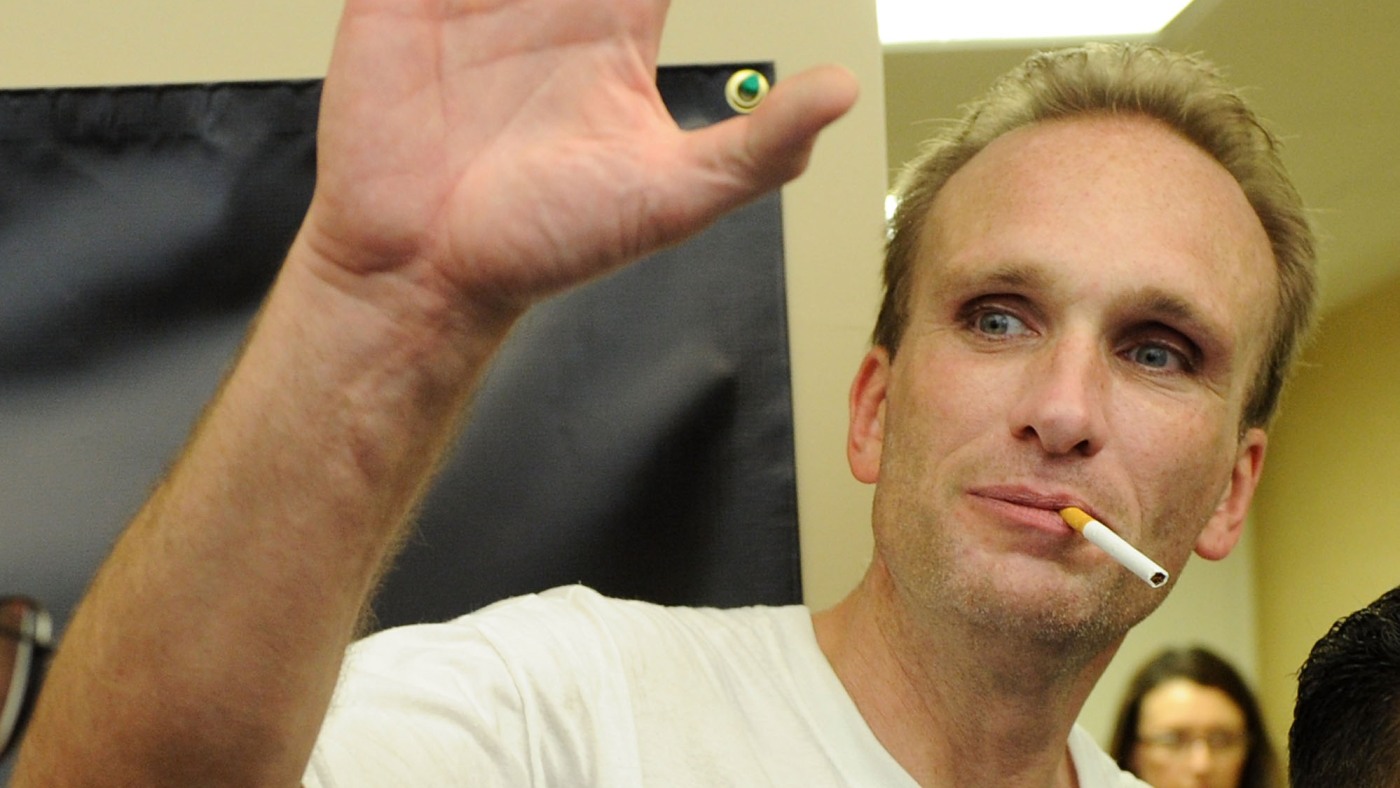
Actor Peter Greene at a press conference in New York City in 2010.
Bryan Bedder/Getty Images
hide caption
toggle caption
Bryan Bedder/Getty Images
Actor Peter Greene, known for playing villains in movies including Pulp Fiction and The Mask, has died. Greene was found dead in his apartment in New York City on Friday, his manager and friend, Gregg Edwards, told NPR. The cause of death was not immediately provided. He was 60 years old.
The tall, angular character actor’s most famous bad guy roles were in slapstick and gritty comedies. He brought a hammy quality to his turn as Dorian Tyrell, Jim Carrey’s nemesis in the 1994 superhero movie The Mask, and, that same year, played a ruthless security guard with evil elan in the gangster movie Pulp Fiction.
“Peter was one of the most brilliant character actors on the planet,” Edwards said.
He went on to work steadily, earning dozens of credits in movies and on TV, such as the features Judgment Night, Blue Streak and Training Day, a 2001 episode of Law & Order, and, in 2023, an episode of The Continental, the John Wick prequel series.
At the time of his death, the actor was planning to co-narrate the in-progress documentary From the American People: The Withdrawal of USAID, alongside Jason Alexander and Kathleen Turner. “He was passionate about this project,” Edwards said.
Greene was also scheduled to begin shooting Mickey Rourke’s upcoming thriller Mascots next year.
Rourke posted a close-up portrait of Greene on his Instagram account Friday night accompanied by a prayer emoji, but no words. NPR has reached out to the actor’s representatives for further comment.
Peter Greene was born in New Jersey in 1965. He started pursuing acting in his 20s, and landed his first film role in Laws of Gravity alongside Edie Falco in 1992.
The actor battled drug addiction through much of his adult life. But according to Edwards, Greene had been sober for at least a couple of years.
Edwards added that Greene had a tendency to fall for conspiracy theories. “He had interesting opinions and we differed a lot on many things,” said Edwards. “But he was loyal to a fault and was like a brother to me.”

Report: Pirates Among Teams Interested in Luis Robert Jr.

Augusta Men Drop Overtime Thriller to Georgia College and State – Augusta University

DC police chief accused of manipulating crime data in new House Oversight Committee report – WTOP News

Snow keeps stacking up: See early city-by-city totals as parts of NE Ohio near 8 inches

Austin opens cold weather shelters ahead of freezing temps

Florida High School Football Rankings: Top 25 teams – Oct. 21

Cleary's 21 help Le Moyne down Central Connecticut State 69-64 in OT

How old is Bo Nix? What to know about Oregon quarterback ahead of 2024 NFL Draft

99th annual Pony Swim held in Virginia

Video: ‘It Didn’t Have to Happen This Way:’ U.Va. Faculty Call for Review of Police Response to Protests

Trump’s election win filled Hamas with ‘fear,’ hostage held like ‘slave’ for 505 days recounts

In Khartoum, exhumation of makeshift graves reawakens families’ grief

Manhunt under way for attacker after two students killed at US university

Video: At Least Two Killed in Shooting at Brown University

FBI ousts reinstated whistleblower over unauthorized media talks, ‘poor judgment’
-

 Alaska1 week ago
Howling Mat-Su winds leave thousands without power
-

 Texas1 week ago
Texas Tech football vs BYU live updates, start time, TV channel for Big 12 title
-

 Washington5 days ago
LIVE UPDATES: Mudslide, road closures across Western Washington
-

 Iowa1 week ago
Matt Campbell reportedly bringing longtime Iowa State staffer to Penn State as 1st hire
-

 Miami, FL1 week ago
Urban Meyer, Brady Quinn get in heated exchange during Alabama, Notre Dame, Miami CFP discussion
-

 Cleveland, OH1 week ago
Man shot, killed at downtown Cleveland nightclub: EMS
-
World7 days ago
Chiefs’ offensive line woes deepen as Wanya Morris exits with knee injury against Texans
-

 Iowa1 day ago
How much snow did Iowa get? See Iowa’s latest snowfall totals

