Lifestyle
Low on PTO? Join the Gen Z travelers taking international ‘microtrips’


One Friday night last year, Akylah Cox and her boyfriend took a red-eye flight from Pennsylvania to Dublin for a whirlwind adventure. The trip lasted less than 30 hours. They hit up an impressive number of spots: the Guinness Storehouse, the Book of Kells experience at Trinity College, Ha’penny Bridge, Capel Street for thrifting (“I gave myself only 30 minutes to do this, but it had to get done,” Cox says) and the Celtic Nights dinner and show.
They were back home on Sunday and went to work the next day.
She shared her experience on TikTok with the caption, “Was this crazy?!” The responses varied.
“I would be tired the rest of the week,” one person commented with two woozy-face emojis.
“This inspired me!” another said.
“I’m tryna be this level crazy,” commented another.
Akylah Cox and boyfriend Akram Imam in Dublin in February 2025.
(Akylah Cox)
For Cox, who was working full time in engineering and pursuing an MBA while her boyfriend was completing his medical residency, creating an ultra-compacted itinerary was the only possible way to travel. And she loves the practice. On TikTok, she shares her itineraries for “microtrips” — short, usually international trips lasting 24 to 72 hours.
“You can just leave,” says Cox, who lives in Chicago. “You can have that quick break, that quick reset.”
She’s part of a new wave of travelers, particularly Gen Z, opting for these types of trips over extended vacations, according to an AirBnb trend report. Partly fueled by a viral TikTok trend in which people break down how they spent one to two days in another country, young travelers are no longer waiting for spring break or to accumulate paid time off to cross destinations off their bucket lists. A recent Expedia survey found that 25% of Gen Z and millennial travelers said they plan to take a microtrip in 2026, with Toronto; Nassau, Bahamas; and San Juan, Puerto Rico, being the most popular destinations.
“Short trips can fit busy schedules much better than a longer vacation can, which allows more people to explore the world without committing to long absences from work or family,” says Airbnb communications lead Ali Killam. “I think people are really embracing this idea that even brief changes of scenery can really recharge you, your mind and spirit.”
Another driver of the trend could be the fact that younger generations consider travel a top priority in their lives. In 2023, Gen Z and millennial travelers took an average of five trips per year, compared with Gen Xers and baby boomers who took less than four. Gen Zers and millennials allocate an average of 29% of their income for travel, reports the management consulting firm McKinsey & Co. (though a study last year by Savings.com found that a growing number of parents are helping their adult children out financially more than ever). Among younger generations, there’s also a mantra of doing things “for the plot” and taking chances because the future feels uncertain.
“Younger millennials and Gen Z are really creating their own version of the American dream, which I think is really based off of experiences and the memories that you’re able to create,” said N’Dea Irvin-Choy, 30, an L.A.-based content creator who posts about luxury travel, skiing and tennis experiences.
Kareen Hill, 27, of New York, is another microtrip crusader on social media. Since October, he’s been taking trips to explore the food scenes of various cities. In January, he went to London for two days and posted a recap video on TikTok that received more than 1.5 million likes. He now tries to take a trip, either international or domestic, about every two weeks.
“I just realized you do have free will,” says Hill, who works at an airport. “Like why not?”

N’Dea Irvin-Choy at the Eiffel Tower in Paris, left, and Kareen Hill at the Colosseum in Rome.
(N’Dea Irvin-Choy; Kareen Hill)
Beyond convenience, microtrips can also be more affordable than longer trips — an important factor as oil prices rise and airfares are already beginning to surge. With the help of credit card points and a travel credit, Cox’s trip to Dublin was just under $450. She says these quick trips are a “low barrier to entry” to international travel because you only have to plan an itinerary for one or two days. And the more flexible you can be on the timing or destination, the better chance you’ll have at finding deals.
Another benefit is how short trips force you to be intentional about how you spend your limited time. “You can get a lot more done than maybe you think you can,” she said. During a three-day trip to Japan with her mother and grandparents in May (not including the travel time), they were able to squeeze in a food tour and multiple tourist attractions in Tokyo and Mt. Fuji.
Of course, a common concern about microtrips is how exhausting they can be, especially if you’re traveling across time zones. And, yes, the fatigue can be real and travelers should certainly consider their bodies’ limits. But the purpose of these trips is to explore a destination rather than relax, Cox says. Once you’re in that mindset, you can better embrace the experience. “You really don’t have the impact of jet lag because you’re purely running on adrenaline,” she says.
Want to take a microtrip yourself? Here are some tips:
- Book the earliest flight possible to your destination and the latest flight back so you can optimize your time, advises Irvin-Choy. Definitely try to opt for nonstop flights.
- Make it easy to move around your destination. Hill says it’s best to avoid checking a bag and to pack light. Cox recommends booking a hotel that allows you to store your bag even if your room isn’t ready.
- Prioritize your “musts.” For each of her microtrips, Cox uses the same formula: Pick three must-do activities or sights and plan the rest of your trip around those. One of her favorite things to do in any new city she’s visiting is go on a food tour.
- Prepare to jump back into the grind at home. Irvin-Choy recommends parking your car at or near the airport, which can sometimes be cheaper than opting for a ride share when it’s such a short trip. You also might want to wear your work clothes on the plane, so you can head straight into work if necessary.
- And finally, don’t forget to get some rest during your trip — even if it’s on the plane. “That’s the hardest part when it’s so short,” Irvin-Choy says. “But make sure you get some sleep at some point during the weekend.”



YouTube
Featured Songs
- Randy Newman, “A Wedding In Cherokee County”
- Bruce Springsteen & The E Street Band, “Racing in the Street”
- The Beatles, “Any Time at All”
- Pavement, “Silence Kid”
- Joni Mitchell, “Carey”
We’re rolling out a new feature on World Cafe called Personal Records. We’re inviting non-musicians — or musicians working outside of the industry — to share the songs that define them.
The concept is simple: If someone were to assemble a mixtape that holds the key to who you are and what you do, what songs would be on it?
Tim Heidecker has been on the show a few times to talk about his own music, but he’s also an actor, director, writer and comedian, known for Tim and Eric Awesome Show, Great Job!, On Cinema at the Cinema and his podcast Office Hours.
Today, Heidecker joins World Cafe to gush about Randy Newman, talk about the Joni Mitchell song that reminds him of his childhood and more.
This episode of World Cafe was produced and edited by Kimberly Junod. Our digital producer is Miguel Perez. World Cafe‘s engineer is Chris Williams. Our programming and booking coordinator is Chelsea Johnson and our line producer is Will Loftus.

Miley Cyrus in Hannah Montana 20th Anniversary Special.
Ser Baffo/Disney
hide caption
toggle caption
Ser Baffo/Disney
This year marks 20 years since Hannah Montana premiered on the Disney Channel. The show made a global phenomenon of star Miley Cyrus and her pop-star alter ego. It’s been streamed millions of hours since going off the air, and influenced the next generation of pop stars like Chappell Roan and Sabrina Carpenter. With the new Hannah Montana 20th Anniversary Special on Disney Plus, we figured it’s a good time to look back at the legacy of the show, and where it fits into Miley’s career.
Follow Pop Culture Happy Hour on Letterboxd at letterboxd.com/nprpopculture
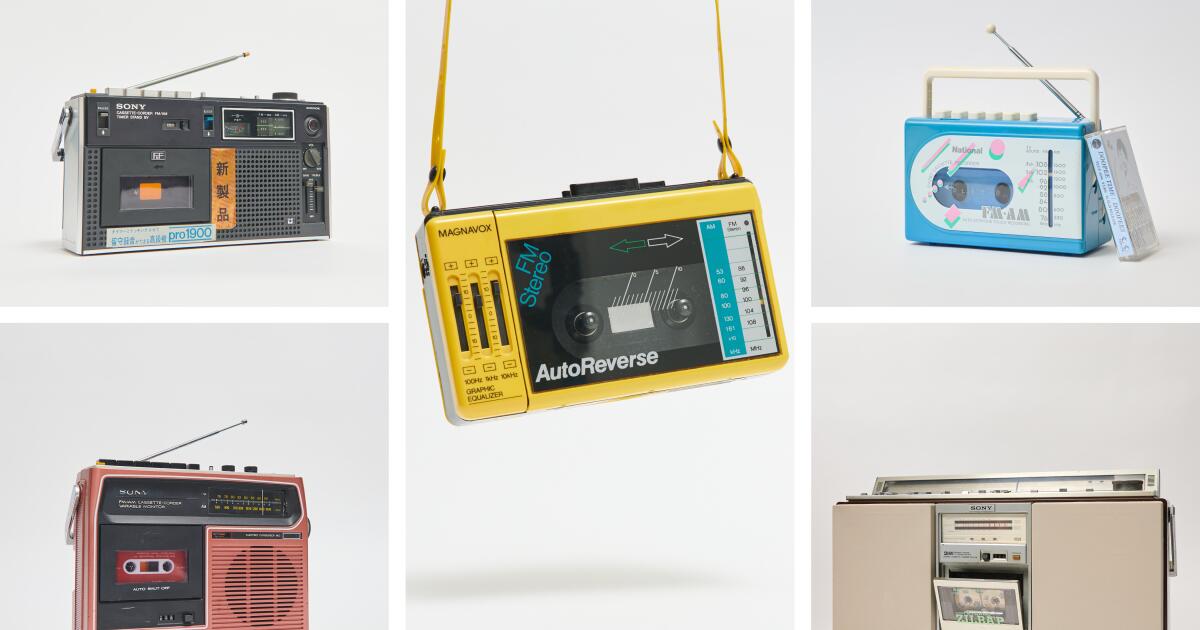
Stepping into Jr. Market boutique in Highland Park is like entering a 1980s time warp. Built into a refurbished shipping container, it’s filled with everything from tiny Walkman-style portables to colorful, number-flip clock radios and, naturally, boom boxes of all sizes. Few are more imposing than the TV the Searcher, a Sharp boom box from the early ’80s that features a built-in, 5-inch color television.
“Try lifting it, it’s really heavy,” warns Spencer Richardson, the shop’s owner. Indeed, the machine is at least 15 pounds without the 10 D batteries that power the unit. He adds, “I don’t think you’re taking this to the beach so you could watch TV while you listen to music.”
An affable, hyper-knowledgeable proprietor in his early 30s, Richardson repairs and resells analog music technology from the 1980s or earlier. In bringing these rehabbed players back into circulation, he’s helping others rediscover a musical format once left for dead. While his hobby-turned-side hustle started as “a gateway to discover sounds” that he otherwise would not have heard, it now attracts curious customers willing to drop $100-plus for a vintage Technics RS-M2 or My First Sony Walkman. His customers include older baby boomers and Gen Xers nostalgic for the players of their childhood, but most have been millennials like himself, drawn to something tactile and analog in an era when everything else disappears into the digital ether.

A rare Technics RS-M2 stereo radio tape deck. “I’ve worked on a lot of tape players and this one shouts quality inside and out,” Richardson writes on Instagram.
(Spencer Richardson)
Unlike turntables, which have become increasingly high-tech thanks to the “vinyl revival” of the last 20 years, almost all cassette players in current production rely on the same, basic tape mechanism from Taiwan, Richardson explains. Though cassette culture is enjoying its own period of rediscovery — albeit on a far smaller scale — he hasn’t seen a market emerge for newly engineered tape decks. And he’s fine with that.
“I’m not one of those people that’s like, ‘Why don’t they make good new tape players?’” he says. “No one needs to make it better. You’re still better off buying a refurbished one from the time when they made them.”
That’s where he steps in.

Richardson works on a Nakamichi tape deck out of his repair studio in downtown L.A.
(Genaro Molina / Los Angeles Times)
It’s easy to forget that when cassettes debuted in the mid-1960s, the technology was groundbreaking. Not only were the players far more portable than turntables but unlike records, tapes were resilient to being tossed about. Even more profoundly, cassettes democratized access to the act of recording itself since cassette technology required minimal infrastructure and cost.
“I think about how incredible it must have been for people to realize they could just put whatever they wanted onto a tape, dub it, give it to a friend,” says Richardson.
Entire genres of music, especially in the developing world, became far more accessible across borders. In some countries, big records are still released on cassette. “I have a Filipino release of Kanye West’s ‘College Dropout’ on tape,” Richardson says.
The constraints of the technology guided the listening experience. Because skipping songs on a player was a hassle, most people sat with cassette albums as a track-by-track, linear journey, the antithesis to the algorithmic, shuffle-centric playlists ubiquitous on today’s streaming platforms. It’s a pace that Richardson appreciates.
“I want things to be intentional and slow,” he says. “I don’t need them to be optimized.”

He learned how to repair gear by watching YouTube videos, perusing old manuals and through trial and error.
(Genaro Molina / Los Angeles Times)
Born in the early 1990s, Richardson grew up in Santa Monica and the Pacific Palisades, where his mother’s home was lost in the L.A. wildfires last year. He’s just old enough to remember cassettes as a child: “My mom had books on tape like ‘Winnie the Pooh,’ but I wasn’t out buying tapes.” Fast forward to the mid-2010s and he was working at the now-defunct Touch Vinyl in West L.A. “Back in 2014, we started this little in-store tape label,” he explained. “Bands would come to play, and we’d duplicate 10 tapes and give them away or sell them.” Richardson slowly began collecting cassettes but after the store closed a few years later, he realized how hard it was to find people to service his tape players.
Finally, once the pandemic hit in 2020 and everyone was stuck at home, he decided to learn how to repair his gear by watching YouTube. “I was just fascinated by the videos, absorbing soldering techniques and tools you might need,” he said. With no formal engineering background, Richardson began collecting information online, perusing old manuals, learning through trial and error. “You just need to get your hands in there and be like, ‘Oh, OK, I see how this works,’ or maybe I don’t see how this works, and I’m just going to bang my head against the wall, and then a year later, try again.” His first successful repair was for his Teac CX-311, a compact stereo cassette player/recorder that he still owns. “It has some quirks but runs well.”
A few years later, Richardson’s girlfriend, Faith, suggested he start selling his players online via an Instagram account — jrmarket.radio — originally created for a short-lived internet station. Tim Mahoney, his childhood friend and a professional photographer, shot the units against a plain white backdrop, as if for an art catalog. A community of enthusiasts quickly found his account and Richardson began selling pieces online and via pop-ups. In 2024, the owners of vintage clothing store the Bearded Beagle invited him to take over the parking lot space behind their new location on Figueroa Street Opening a brick-and-mortar store hadn’t been his ambition but Richardson accepted the opportunity: “I never envisioned opening my own physical store. It’s hard enough to have a retail space in Los Angeles to sell something that’s very niche.”

Jr. Market operates as a shop Thursday through Saturday in Highland Park.
(Spencer Richardson)
Jr. Market — whose name is inspired by Japanese convenience stores known as “junior markets” — isn’t trying to appeal to audiophiles though Richardson does stock studio-quality recording decks. He primarily looks for players with appealing visual design, most of them made in Japan where Richardson has been traveling to since graduating high school. Through those trips, he’s learned where to source pristinely kept gear, including his best-selling Corocasse: a bright red plastic cube of a radio/tape player, introduced by National in 1983. He also keeps an eye out for the unique Sanyo MR-QF4 from 1979, an elongated boom box with four speakers, designed to play either horizontally or flipped into a vertical tower.
The store also stocks a small selection of portable record players, including a Victor PK-2, a whimsical, plastic-bodied three-in-one turntable, tape player and AM radio that looks like something designed by a modernist artist for Fisher-Price. That went to local author and historian Sam Sweet, who visited the store with no intention of buying anything and left with the Victor, which now sits on his writing desk. “Spencer’s part of a grand tradition of workshop tinkerers and specialty mechanics,” Sweet says. “The refurbished devices he sells are as much a reflection of his ethos and expertise as they are treasures of the past.”
Last year, Imma Almourzaeva, an Echo Park art director, came to the store and purchased a massive 1979 Sony Zilba’p boom box, which is nearly 2 feet wide and over a foot tall, with wood veneer panels to boot. Almourzaeva, who grew up in Russia in the ’90s, wanted a player that offered “the tactile feel of my childhood and bringing it back into my daily routine, something familiar, something warm.” The Zilba’p is the largest boom box Richardson has carried and Almourzaeva said, “It’s aesthetically a showstopper. Maybe I have a Napoleon complex because I’m pretty small too. It’s like ‘go big or go home’ for me.” She shared that she recently bought a Soviet-era boom box from Richardson for her brother for Christmas. “It turned out my mom grew up using the same brand of stereo,” Almourzaeva says. Richardson had told her that Soviet boom boxes are “very DIY, more funky and finicky.”
Refurbishment is one of Richardson’s specialties, including repairing customer units, each of them a puzzle he enjoys solving. No matter if a player is sparse or feature-packed, the simple act of playing a cassette creates a sense of calm and focus for him. “You’re not distracted, because it doesn’t do anything else,” he says. In a time where every “smart” device is marketed with dizzying arrays of features, that simplicity can feel downright revolutionary.

Pittsburgh Riverhounds vs Virginia Dream FC LIVE 2026-04-01

Washington Nationals vs Philadelphia Phillies Game Thread

Judge panel dismisses lawsuit seeking to redraw Wisconsin’s congressional maps

After man’s death following insurance denials, West Virginia tackles prior authorization

Report: Game & Fish tests 5,370 samples for chronic wasting disease in 2025

Florida High School Football Rankings: Top 25 teams – Oct. 21

How old is Bo Nix? What to know about Oregon quarterback ahead of 2024 NFL Draft

Cleary's 21 help Le Moyne down Central Connecticut State 69-64 in OT

99th annual Pony Swim held in Virginia

Indiana Members Credit Union announced as new anchor tenant at Bottleworks District

Read the Judge’s Decision on the Trump Administration’s Subpoena Against Penn

Man wearing ICE uniform brutally beaten in Honolulu not affiliated with agency, DHS says

Analysis: Hezbollah backs Iran ambassador as conflict deepens Lebanon rifts

Hegseth slated for House testimony as pressure builds over Iran war, sources say
Latino Republicans in South Texas Turn on Trump Over Birthright Citizenship
-

 South-Carolina2 days ago
South Carolina vs TCU predictions for Elite Eight game in March Madness
-

 Miami, FL5 days ago
Jannik Sinner’s Girlfriend Laila Hasanovic Stuns in Ab-Revealing Post Amid Miami Open
-

 New Mexico1 week ago
Clovis shooting leaves one dead, four injured
-

 Minneapolis, MN5 days ago
Boy who shielded classmate during school shooting receives Medal of Honor
-

 Tennessee1 week ago
Tennessee Police Investigating Alleged Assault Involving ‘Reacher’ Star Alan Ritchson
-

 Politics1 week ago
Trump gives Iran 48-hour ultimatum to reopen Strait of Hormuz or face strikes on power plants
-

 Technology1 week ago
YouTube job scam text: How to spot it fast
-

 Technology1 week ago
Halide co-founder is suing former partner Sebastiaan de With for taking source code to Apple