Lifestyle
L.A. Affairs: My ‘Eat, Pray, Love’ life failed. Would returning to L.A. work out this time?


I had just slipped back into bed after our infant daughter’s 4 a.m. feeding when my partner, Sean, turned over and said, “We should go now. I smell smoke.”
Our air-quality monitor leaped from green to yellow. My breath dried my throat.
We hadn’t gotten an evacuation notice yet. “Let’s wait a bit,” I said, as if staying in bed meant the Eaton fire wasn’t real.
In L.A.’s brittle landscape of concrete rectangles and choking freeways, Eaton Canyon, just seven miles from where we live, was a sanctuary to thousands of people. It saved my life many times. And it was now ablaze, with the fire spreading rapidly.
From our dark bedroom, we scanned our phones for information, zooming in and out of the slow-loading Cal Fire evacuation map. The red perimeter pushed against the yellow warning zone that our Eagle Rock house fell under.
The evening before, I’d reported the burned acreage aloud to my partner as LAist updated its website: “400 acres, zero containment.” Then, “800 acres, zero containment,” my voice trembling as if the burn map was of my own skin. The next morning the number of acres on fire had reached the thousands.
I looked at pictures we’d taken at Eaton Canyon on New Year’s Day, a week before the fire: Our baby wrapped against my chest smiling her toothless grin; my feet planted in the stream.
The Arroyo Seco, “dry stream” in Spanish, comes down from the San Gabriel Mountains in Angeles National Forest and runs along the two-lane freeway in Pasadena. In the last few years, this oft-parched waterway gained depth because of unprecedented rainfall. Three inches of water became three feet, and swimming holes appeared.
Eaton Canyon trail hikers showed up in their bathing suits, carrying towels. A waterfall and swimmable creek nestled in a shady canyon is a Southern California unicorn. And it welcomed dogs!
During the pandemic, families, tiny day-camper explorers and the public en masse hit the trails in their masks and basketball sneakers; it suddenly felt like Disneyland. Portable speakers drowned out the creek music. The litter irritated me, as did waiting in line to log-cross the creek. But the crowds also meant something important: Eastside Angelenos had a place to put their fear and worries during a time when we were afraid just to breathe.
I’d started hiking the Altadena trails after my divorce a decade earlier. I offered my loneliness and heartbreak to the live oaks and sycamores, refuse they could make into something useful the same way they convert carbon dioxide into oxygen. Nature became my refuge. It gobbled up my sorrows with its gaping mouth of everything-ness.
I’d start on a trail, breathe in the sweet sage brush and dust and feel myself fall into a harmonic unfolding that had nothing to do with me personally.
With the end of my marriage, California’s raging drought and wildfires and the impending 2016 elections, I fled to Berlin. At the time, I didn’t know how to grow a new life for myself in L.A. The brown hills past the 134 Freeway made me lonely. I bolted to a city of more verdant environs. Green meant hope.
When I returned a year later, the man I had not voted for was still president, my “Eat, Pray, Love” experiment had notably failed and I was certain that, at 38, I’d never find love again or have children. I showed up at the Arroyo most days, sometimes to a half-dry, cracked creek bed. I realized then that nature feeds us in two ways. The first is through recreation and adventure. The other is when we are grappling with the unknown and surrounded by chaos. Then, nature presents its cycles as consolation, reminding us that, whatever is happening, we can rely on things to change.
Eventually, the drought passed, as did the one in my heart. The waterfall went from trickle to spout. I baptized my pregnant belly in the Arroyo waters. I would bring my new-mother-overwhelm there. And 12 days after her birth, I introduced my newborn to the Arroyo, beaming as though she was meeting a grandparent. I wanted to show her what I learned: that we are never alone among the tadpoles, silt and stones, that we belong to nature too.
As the Eaton fire raged, lashing palm trees and devouring the Craftsmans of our L.A. neighbors, our daughter slept in her bassinet, unaware of airborne toxins. Sean and I shoved her rompers and sleep sacks into a backpack, rummaged through our clothes and grabbed enough underwear for an indeterminable amount of time away. I scooped my jewelry into a shoebox with my passport. We dressed for the day, then returned to bed for a couple of hours of fitful sleep, ready to go when we needed to.
Sean looked at me as if I had lost my mind when I grabbed the dog’s leash at 7 a.m., opened our door to a screen of tawny haze and pulled our confused pet behind me. A thin, rusty coil of sun smoldered through a patch in the clouds.
The nursery rhyme that goes “Ladybird, ladybird, fly away home, your house is on fire, your children are gone” cruelly repeated in my head. It’s all going to be gone, I thought with a shudder.
By 9 a.m., we were sitting in evacuation traffic on the 5 Freeway, heading to family in Orange County. The fire had not jumped the freeway into Eagle Rock, but an evacuation warning appeared on my phone beside dozens of frantic texts from my San Marino moms group: “Don’t come to Joshua Tree! Power’s out. No gas or groceries!,” “Unsafe water alert for Pasadena!” and a slew of links to resources for formula, diapers and wipes.
With our daughter and dog, Sean and I shuttled back and forth between my mother-in-law’s and parents’ houses for the next two weeks. I downloaded the Environmental Protection Agency’s air-quality app. I still keep careful watch on the stats. Now we’re back in our house and the fires have ceased, but we no longer open the windows when cooking for fear of polluted air. Instead of off-leash sloshing up the Arroyo, I take the baby and dog to the park and worry because neither of them can wear masks. Once again, life feels chaotic. I’m afraid to breathe.
I know healthy forests need regular burnings, but it is not natural for whole communities to be leveled overnight, for fire insurers to abandon their patrons and for people to lose their homes and what they love most about living in them.
I tell myself that nature’s gift in hard times is to remind us of its perpetual cycles. Today it is raining. The air will be breathable again one day. Spring will come, but I don’t know if there will be green leaves this year in the canyon.
The author is a writer, educator and mother who’s working on a memoir. She’s on Instagram: @sophiecsills
L.A. Affairs chronicles the search for romantic love in all its glorious expressions in the L.A. area, and we want to hear your true story. We pay $400 for a published essay. Email LAAffairs@latimes.com. You can find submission guidelines here. You can find past columns here.

Lifestyle
Terry Tempest Williams on why women with big ideas get labeled ‘crazy’ : Wild Card with Rachel Martin
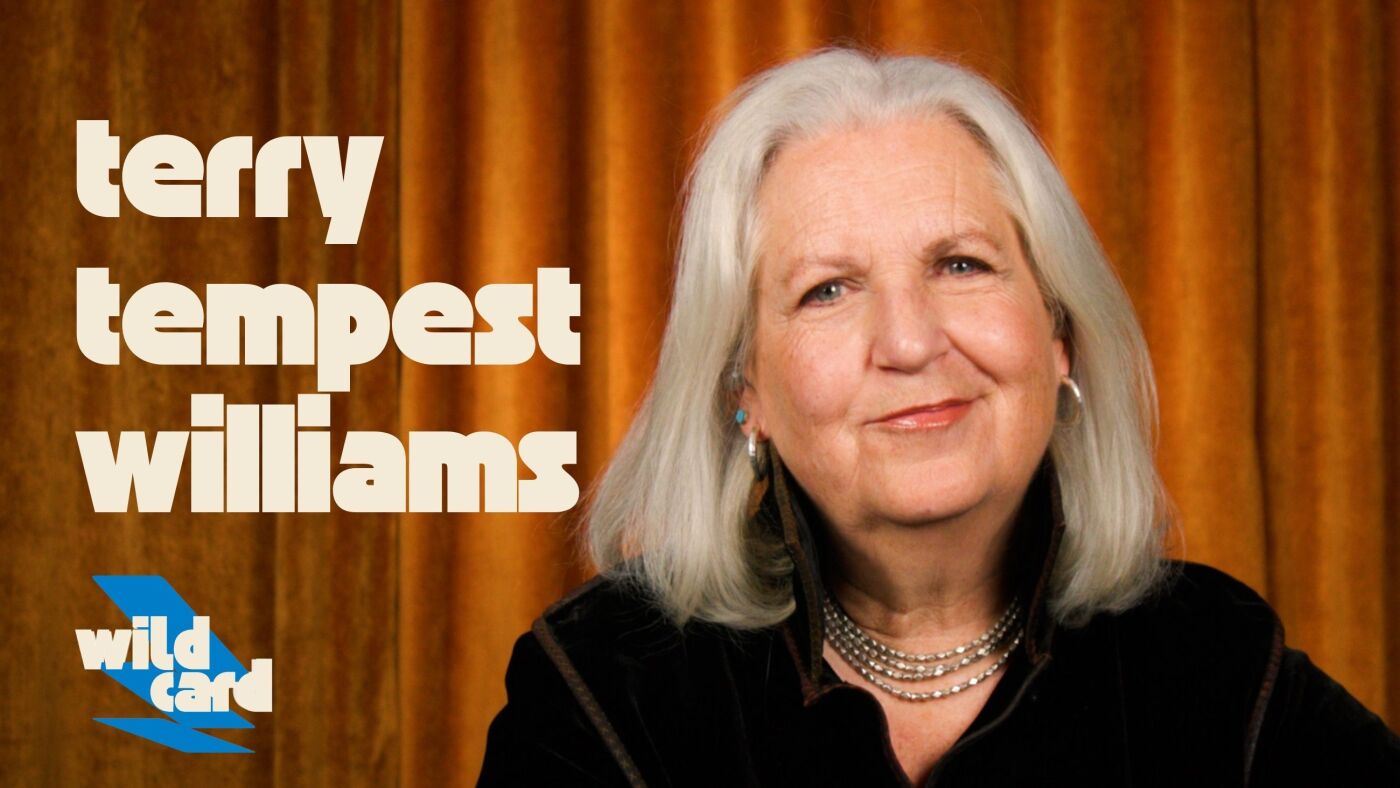
A note from Wild Card host Rachel Martin: I met Terry Tempest Williams about 25 years ago at a writer’s conference in Yosemite Valley. I was a young reporter who was there to do a story about how literature was addressing climate change and she made such a huge impression on me. I had never heard someone talk about the natural world the way Terry did and she had a spiritual depth I hadn’t encountered in my life at that point.
To this day, Terry’s writing always reorients me towards what is good, what is beautiful, and what is true. Her newest book is called “The Glorians.”

For its upcoming Los Angeles venue, experiential art firm Meow Wolf will focus on the art of storytelling, with a specific eye toward skewering our city’s moviemaking magic. To help bring that vision to life, Meow Wolf has entered into a creative partnership with Titmouse, one of L.A.’s most renowned independent animation houses.
The Hollywood-based studio behind popular series such as “Big Mouth” and “Star Trek: Lower Decks” will create animation that will be shown throughout the West L.A. venue, which is on target for a late 2026 opening at the Howard Hughes entertainment complex.
It’s a move that represents a shift for Santa Fe, N.M.-based Meow Wolf. Over the last decade-plus, the art collective has grown beyond its anything-goes, punk-meets-psychedelic roots into an organization with full-scale, maximalist installations in its hometown, Denver, Las Vegas, Houston and the Dallas suburbs. In the past, Meow Wolf kept most of its media in-house.
As part of its larger-than-life participatory art installations, Meow Wolf L.A. will feature a mix of live action and animation, the former filmed by Meow Wolf in its Santa Fe studio. Meow Wolf’s James Stephenson, a senior VP with the company and its creative director of emerging media, said the degree to which the L.A. exhibition will lean into various animation styles necessitated an outside partner. Titmouse’s work, in development by a number of directors with contrasting tones, will be shown on a variety of formats, ranging from cinema screens to full-room projections.
“I really believe in animation as an art form, and I know the Titmouse folks do too,” Stephenson says. “Animation is made by artists. It’s made by artists with their own hands. It’s something that is still very rooted in craft.”
Meow Wolf’s L.A. space is set in a former cinema complex, and will champion its location, taking guests on a journey through a converted movie house and beyond, into a sci-fi-inspired fantasyland with sentient spaceships and a 30-foot-tall mushroom tower. Meow Wolf creatives have spoken of the fantastical movie theater as one that will feature animated, self-aware candy before attendees enter the main exhibition space, making Titmouse’s work some of the first art guests will encounter. Titmouse co-founder Chris Prynoski has said the studio has lined up at least six directors for the exhibit.
An in-progress art installation destined for Meow Wolf L.A. at the art collective’s Santa Fe, N.M., headquarters. The L.A. exhibition will feature animation from Titmouse.
(Gabriela Campos / For The Times)
Titmouse, says Stephenson, is the right partner because “they’re known less for a house style, and more for a house vibe.” Over the years, Titmouse has been behind such diverse shows as “Scavengers Reign,” owning a Jean Giraud influence rooted in French and Spanish surrealism, the lively “Jentry Chau vs. the Underworld,” with an unique color palette that took inspiration from anime and Chinese mythology, the exaggerated comic book feel of Adult Swim’s “Metalocalypse,” and the approachable yet expressive tone of “Star Trek: Lower Decks.”
“Meow Wolf’s vibe is similar to Titmouse’s vibe,” Stephenson says. “It’s artist-first, artist-driven, independent and kinda edgy. They are always trying to find the edge of what’s possible. They try to see how far they can go, and it’s done for fun and in the spirit of taking risks.”
Prynoski says working with Meow Wolf will give Titmouse a sense of artistic freedom it doesn’t always have when delivering content for more traditional Hollywood partners. He says the multi-director approach is a callback to the early days of Warner Bros. Animation, when individual creators put their own stamp on Looney Tunes material.
“I use Bugs Bunny as an example,” Prynoski says. “You’ve got a Friz Freleng Bugs Bunny short. You’ve got a Chuck Jones Bugs Bunny short. You’ve got a Tex Avery Bugs Bunny short. They’re all different versions of Bugs Bunny, and people who are really paying attention can tell which director directed each one. Even though to the layman, these are all Bugs Bunny, but if you lined them up, they are drawing in different styles, sensibilities and techniques.”
Prynoski says that was a centerpiece of his pitch to Meow Wolf, noting that characters will reappear in multiple installations, each handled by a different artist. Meow Wolf L.A., in fact, will be the firm’s most character-driven exhibition, as guests will follow the storylines of three main protagonists throughout the space.
In announcing the partnership, Meow Wolf and Titmouse released an image from an animated work directed by Luca Vitale. It features a key character having a moment with a hummingbird and it’s done in an elegant, slightly anime-influenced style. It’s an image full of movement, reflecting a character in transition with inviting pastels and bold dashes.
“I like that image because I think it captures some of the sense of wonder that we want people to feel,” Stephenson says. “The character is having an encounter with the elusive nature of creativity and reality in a way that makes them have a different perspective of what’s possible.”
Other contributing animation directors to Meow Wolf L.A. include Space Dawg, Felix Colgrave, Alexander Vanderplank and Phimémon Martin, and Jun Ioneda.
Titmouse’s partnership with Meow Wolf will extend beyond the L.A. exhibition. The two will be working on the development of Meow Wolf New York, which is slated to open some time after Los Angeles, and are collaborating on a planned animated series, which Prynoski is spearheading.
Meow Wolf exhibits are the result of sometimes hundreds of disparate artists coming together in a shared space. Distilling that into a signature, singular style for a series could be a challenge. Stephenson pinpoints some guiding principles.
“You really need to feel the hand of the artist,” he says. “You need to feel a DIY aesthetic. You need to feel the materiality. Those are very specific to what we are.”

The Kennedy Center on June 28, with its facade signage still covered by a tarp and scaffolding.
Alex Wroblewski/AFP via Getty Images
hide caption
toggle caption
Alex Wroblewski/AFP via Getty Images
On Wednesday, a federal appeals court denied President Trump’s request to stop the removal of his name from Washington, D.C.’s Kennedy Center. The signage on the building has been covered with tarp and scaffolding since June 13, but in a court filing last month, the center’s current executive director said that Trump’s name has been removed.
In their decision, three judges from the U.S. District Court of Appeals for the District of Columbia Circuit said that the president had failed to prove that the arts center would be “irreparably injured” without Trump’s name attached to it.
NPR requested comment from the Kennedy Center, but did not receive an immediate reply.
This latest round of court decisions is part of the ongoing litigation filed by Rep. Joyce Beatty, D-Ohio, against President Trump and the board of the Kennedy Center. In a statement emailed Wednesday to NPR, Beatty said: “Today’s ruling again affirms that this administration’s efforts to rename the Kennedy Center were unlawful. His name no longer desecrates this sacred memorial, which belongs to the American people. Now it is time for the Trump administration to accept this, comply with the law, and take the tarps down.”
In previous court filings, Trump’s legal team had asserted that removing the president’s name from the arts complex, both on the physical building and in its digital materials, would inflict irreparable harm in both time and money already spent. In the denial, the three judges — Patricia Millett, Robert Wilkins and Gregory Katsas — wrote that since Trump’s name has already been removed, “a stay would not avert those harms.”
Furthermore, Trump had claimed that without his name attached, future fundraising would be threatened “and [will] contribute to the financial decline of the Center.” In response, the appeals judges wrote: “Appellants, however, have failed to support this assertion with any specific facts or evidence. They offer only the conclusory assertions of the Kennedy Center’s Executive Director that were made in a factually unsupported declaration.” The center’s current executive director, Matt Floca, specializes in physical plant management.
The presiding judge in the case, Christopher R. Cooper, has ordered that the center provide him a status report on the center’s operation and programming before the end of this month. As of Wednesday, the center’s calendar lists a small roster of programs, including outdoor free movie screenings, workshops for children, and five free live performances in July on its Millennium Stage. In the past, the Kennedy Center presented over 2,000 arts and education events each year, including free daily Millennium Stage performances.

-

 Detroit, MI11 minutes ago
Our picks for state\nSenate from Wayne Co. | Endorsements
-

 San Francisco, CA21 minutes ago
Man reported missing in San Francisco
-

 Dallas, TX26 minutes ago
How to buy France World Cup semifinal soccer tickets in Dallas
-

 Miami, FL33 minutes ago
Miami-Dade Schools names six semifinalists for superintendent
-

 Boston, MA36 minutes ago
Lawsuit: ICE detained East Boston father despite legal status
-

 Denver, CO41 minutes ago
Victor Marx wins GOP primary for Colorado governor, defeating veteran lawmaker after unorthodox campaign
-

 Seattle, WA48 minutes ago
Widower of pregnant woman who was shot to death in Seattle sues homelessness authority
-

 San Diego, CA51 minutes ago
Terrifying moment huge sea lions chase tourists off popular California beach

