Lifestyle
L.A. Affairs: I grew up on Disney princesses and fairy tales. Was I ready for my own happily ever after?


Marriage has been ingrained in me since I could form memories. That my purpose in life is to get married and have babies. I know this sounds old-fashioned and maybe that has something to do with the fact that I was born a girl in the Soviet Union to a Jewish family, but I’ve spent my life toggling between the tradition of marriage and the liberal Los Angeles ideologies I internalized. I’ve often found myself wondering if it is even possible to be a good writer, an artist and be married.
At 11 years old, I was a flower girl at my cousin’s wedding in Calabasas. I remember walking down the aisle with a tiny basket of rose petals, a pair of adult-sized breasts and a petrified look on my face, unable to smile even though I was a generally happy kid. The horse and carriage, the vintage bridal kimono, the perky orchids, the flash, flash, flash of cameras, the expectations on everyone’s faces, the stressful night’s sleep no amount of Valerian root could remedy — I wasn’t sure if all this was for me.
But I loved love. I had grown up on an unhealthy dose of Disney princesses and fairy tales and the idea that one day my prince will come. I memorized the entirety of the film “The Notebook.” I would often fantasize about lying on my deathbed with the love of my life, hand in hand, like Noah and Allie.
In my teens, I flirted for hours with strangers on AIM. I hooked up with boys in the landscaping at the Century City mall after sharing a bowl of orange chicken at Panda Express. I had boyfriends and friends with benefits and cutouts of my idols: Victoria’s Secret models like Adriana Lima taped to the walls of my childhood bedroom. I was fully liberated by the over-sexualized, MTV-obsessed early aughts.
Then I lost my virginity to my high school sweetheart who soon became my boyfriend of seven long years.
In a conversation I don’t remember having, my cousin asks me when I think I will be married. I reply matter-of-factly: “By 25.” She then scoffs and laughs in my face. “Yeah, right.”
By the time I reached my mid-20s, I had broken up with my high school sweetheart whom I had little in common with other than the fact that we were supposed to get married. I was living alone in a studio apartment in Palms, sleeping in the same room as my refrigerator. I had stacks of books near my bed, a county government temp job in a downtown L.A. skyscraper and a stream of notifications from a dating app lighting up my apartment at odd hours of the night.
Marriage was beginning to seem impractical, uncool. I was living a life my immigrant parents deemed “acceptable,” but what I really wanted was to be a writer, although I was too scared to even utter the fact that I was an artist back then. I honed my craft and spent my nights in adult-education writing classes.
Meanwhile, I dated plenty. A musician. A botanist. An artist. An art writer. I fawned over a co-worker, a photographer a decade older than me. Eventually I met someone my own age: a graphic designer from work who I ended up dating for 4 ½ years.
A year into my relationship with the graphic designer, marriage began to follow us around like a hungry dog. I was a bridesmaid in two different weddings, one week apart. I wore a grass-green, floor-length dress. I wore a lace, Champagne-colored floor-length dress. I got my face airbrushed. My lips lined. My eyes powdered. My cheeks contoured. My hair sprayed. I looked like a Russian mail-order bride. I was a reverse mail-order bride, born in Belarus, now an American. Actually, no one had ordered me. I had never been so unlike myself. My graphic designer boyfriend noticed. His knees buckled as he watched me dance the hora and attempt to catch the bouquet again and again.
What’s funny is that my own parents didn’t get married until their mid-30s. My dad was divorced, and my mom was an old maid by Belarusian standards. But I was raised on their love story: the couple of life-altering years in which they got married after three months of dating, had me and moved to the U.S.
The graphic designer and I broke up in 2020. I was a mess, but it was clearer than ever what I needed to do: stop trying to control everything and just let life happen. A few months later, a kind, gentle, handsome, funny, optimistic, wildly creative man replied to one of my prompts on Hinge, agreeing that mayonnaise was indeed disgusting.
Tyler and I fell in love and dated for four years. Together we lived through family tragedies, the worst of the COVID-19 pandemic, my grad school, his grad school, supporting each other’s creative practices, quitting jobs, finding jobs, moving in together, adopting our sweet mutt Agnes. In the summer of 2024, he proposed at Crater Lake, surrounded by a swarm of dragonflies.
At first, I felt weird talking to people about the engagement. Some of our friends were newly married, some were single by choice (or not), but most were in long-term monogamous relationships with no plans for marriage. I had never been happier, but I still housed the fear that getting married was too status quo, out of fashion, an uncool thing to do. My favorite writers certainly thought so with the most popular books that year being about divorce and self-actualization: “All Fours” by Miranda July, “Splinters” by Leslie Jamison and “Liars” by Sarah Manguso.
The Paris Review once asked writer Helen Garner whether being a writer and marriage are generally compatible. She replied: “They probably are, but it probably takes a lot of generosity and flexibility. If you’re burdened by a classic idea of the artist as a figure to whom everything is owed and whose prerogatives are enormous and can never be challenged, forget it.”
In one of her more judgmental essays titled “Marrying Absurd,” Joan Didion chastises those who choose to get married in Las Vegas. She insists that they are doing it not out of convenience, but because of the fact that they don’t know “how to make the arrangements, how to do it ‘right.’”
How do you do it right, Joan?
Tyler and I got married in January (nine years after the age I insisted to my cousin I would get married) in Las Vegas, by an Elvis impersonator singing “Can’t Help Falling in Love” at the famous Little White Chapel with three dozen of our closest friends and relatives in attendance, two weeks after L.A.’s devastating wildfires, and the week of Trump’s inauguration.
While I had my hair and makeup done in front of the hotel window overlooking the faux Eiffel Tower, with the Bellagio fountain going off every 30 minutes, I was weepy. But not because of the usual suspects: cold feet or the last-minute cancellations or the eczema reappearing after years of dormancy on my arms or the lack of sleep, although I did forget to pack some Valerian root.
At some point, I had convinced myself that getting married was uncool, not what an artist does, but here I was doing it. In fact, I was marrying the man who supported my creative pursuits the most. I had changed my mind about marriage yet again. It’s a symbol of hope in a hopeless world, a sacred pact between two people, and it can be whatever the hell you want it to be.
And yes, it might not work out, but also, it might.
Maybe the question isn’t: Does marriage make you less of an artist? Maybe the question is: Who gets to be an artist anyway?
The author is a freelance writer from Los Angeles. She’s on Instagram: @druzova_.
L.A. Affairs chronicles the search for romantic love in all its glorious expressions in the L.A. area, and we want to hear your true story. We pay $400 for a published essay. Email LAAffairs@latimes.com. You can find submission guidelines here. You can find past columns here.

Lifestyle
Terry Tempest Williams on why women with big ideas get labeled ‘crazy’ : Wild Card with Rachel Martin
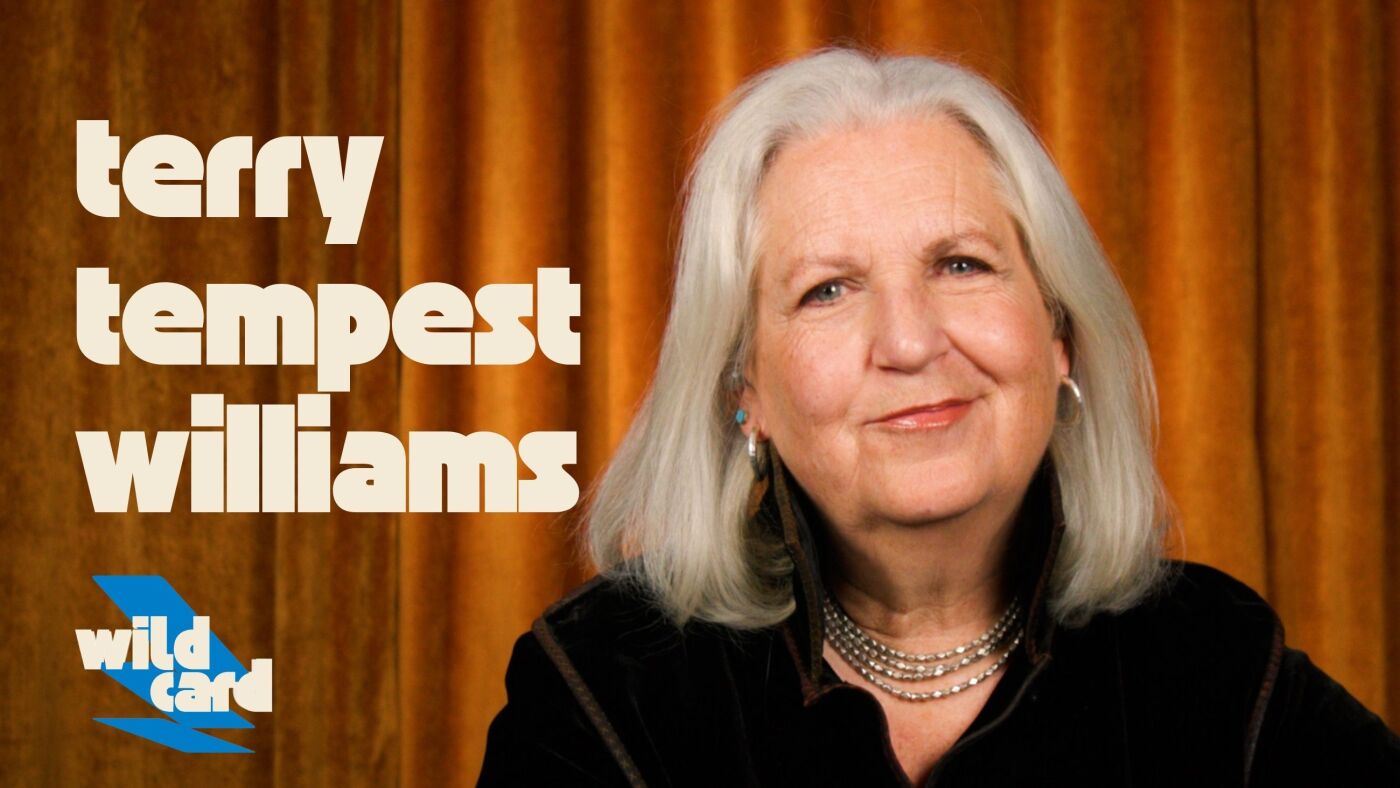
A note from Wild Card host Rachel Martin: I met Terry Tempest Williams about 25 years ago at a writer’s conference in Yosemite Valley. I was a young reporter who was there to do a story about how literature was addressing climate change and she made such a huge impression on me. I had never heard someone talk about the natural world the way Terry did and she had a spiritual depth I hadn’t encountered in my life at that point.
To this day, Terry’s writing always reorients me towards what is good, what is beautiful, and what is true. Her newest book is called “The Glorians.”

For its upcoming Los Angeles venue, experiential art firm Meow Wolf will focus on the art of storytelling, with a specific eye toward skewering our city’s moviemaking magic. To help bring that vision to life, Meow Wolf has entered into a creative partnership with Titmouse, one of L.A.’s most renowned independent animation houses.
The Hollywood-based studio behind popular series such as “Big Mouth” and “Star Trek: Lower Decks” will create animation that will be shown throughout the West L.A. venue, which is on target for a late 2026 opening at the Howard Hughes entertainment complex.
It’s a move that represents a shift for Santa Fe, N.M.-based Meow Wolf. Over the last decade-plus, the art collective has grown beyond its anything-goes, punk-meets-psychedelic roots into an organization with full-scale, maximalist installations in its hometown, Denver, Las Vegas, Houston and the Dallas suburbs. In the past, Meow Wolf kept most of its media in-house.
As part of its larger-than-life participatory art installations, Meow Wolf L.A. will feature a mix of live action and animation, the former filmed by Meow Wolf in its Santa Fe studio. Meow Wolf’s James Stephenson, a senior VP with the company and its creative director of emerging media, said the degree to which the L.A. exhibition will lean into various animation styles necessitated an outside partner. Titmouse’s work, in development by a number of directors with contrasting tones, will be shown on a variety of formats, ranging from cinema screens to full-room projections.
“I really believe in animation as an art form, and I know the Titmouse folks do too,” Stephenson says. “Animation is made by artists. It’s made by artists with their own hands. It’s something that is still very rooted in craft.”
Meow Wolf’s L.A. space is set in a former cinema complex, and will champion its location, taking guests on a journey through a converted movie house and beyond, into a sci-fi-inspired fantasyland with sentient spaceships and a 30-foot-tall mushroom tower. Meow Wolf creatives have spoken of the fantastical movie theater as one that will feature animated, self-aware candy before attendees enter the main exhibition space, making Titmouse’s work some of the first art guests will encounter. Titmouse co-founder Chris Prynoski has said the studio has lined up at least six directors for the exhibit.
An in-progress art installation destined for Meow Wolf L.A. at the art collective’s Santa Fe, N.M., headquarters. The L.A. exhibition will feature animation from Titmouse.
(Gabriela Campos / For The Times)
Titmouse, says Stephenson, is the right partner because “they’re known less for a house style, and more for a house vibe.” Over the years, Titmouse has been behind such diverse shows as “Scavengers Reign,” owning a Jean Giraud influence rooted in French and Spanish surrealism, the lively “Jentry Chau vs. the Underworld,” with an unique color palette that took inspiration from anime and Chinese mythology, the exaggerated comic book feel of Adult Swim’s “Metalocalypse,” and the approachable yet expressive tone of “Star Trek: Lower Decks.”
“Meow Wolf’s vibe is similar to Titmouse’s vibe,” Stephenson says. “It’s artist-first, artist-driven, independent and kinda edgy. They are always trying to find the edge of what’s possible. They try to see how far they can go, and it’s done for fun and in the spirit of taking risks.”
Prynoski says working with Meow Wolf will give Titmouse a sense of artistic freedom it doesn’t always have when delivering content for more traditional Hollywood partners. He says the multi-director approach is a callback to the early days of Warner Bros. Animation, when individual creators put their own stamp on Looney Tunes material.
“I use Bugs Bunny as an example,” Prynoski says. “You’ve got a Friz Freleng Bugs Bunny short. You’ve got a Chuck Jones Bugs Bunny short. You’ve got a Tex Avery Bugs Bunny short. They’re all different versions of Bugs Bunny, and people who are really paying attention can tell which director directed each one. Even though to the layman, these are all Bugs Bunny, but if you lined them up, they are drawing in different styles, sensibilities and techniques.”
Prynoski says that was a centerpiece of his pitch to Meow Wolf, noting that characters will reappear in multiple installations, each handled by a different artist. Meow Wolf L.A., in fact, will be the firm’s most character-driven exhibition, as guests will follow the storylines of three main protagonists throughout the space.
In announcing the partnership, Meow Wolf and Titmouse released an image from an animated work directed by Luca Vitale. It features a key character having a moment with a hummingbird and it’s done in an elegant, slightly anime-influenced style. It’s an image full of movement, reflecting a character in transition with inviting pastels and bold dashes.
“I like that image because I think it captures some of the sense of wonder that we want people to feel,” Stephenson says. “The character is having an encounter with the elusive nature of creativity and reality in a way that makes them have a different perspective of what’s possible.”
Other contributing animation directors to Meow Wolf L.A. include Space Dawg, Felix Colgrave, Alexander Vanderplank and Phimémon Martin, and Jun Ioneda.
Titmouse’s partnership with Meow Wolf will extend beyond the L.A. exhibition. The two will be working on the development of Meow Wolf New York, which is slated to open some time after Los Angeles, and are collaborating on a planned animated series, which Prynoski is spearheading.
Meow Wolf exhibits are the result of sometimes hundreds of disparate artists coming together in a shared space. Distilling that into a signature, singular style for a series could be a challenge. Stephenson pinpoints some guiding principles.
“You really need to feel the hand of the artist,” he says. “You need to feel a DIY aesthetic. You need to feel the materiality. Those are very specific to what we are.”

The Kennedy Center on June 28, with its facade signage still covered by a tarp and scaffolding.
Alex Wroblewski/AFP via Getty Images
hide caption
toggle caption
Alex Wroblewski/AFP via Getty Images
On Wednesday, a federal appeals court denied President Trump’s request to stop the removal of his name from Washington, D.C.’s Kennedy Center. The signage on the building has been covered with tarp and scaffolding since June 13, but in a court filing last month, the center’s current executive director said that Trump’s name has been removed.
In their decision, three judges from the U.S. District Court of Appeals for the District of Columbia Circuit said that the president had failed to prove that the arts center would be “irreparably injured” without Trump’s name attached to it.
NPR requested comment from the Kennedy Center, but did not receive an immediate reply.
This latest round of court decisions is part of the ongoing litigation filed by Rep. Joyce Beatty, D-Ohio, against President Trump and the board of the Kennedy Center. In a statement emailed Wednesday to NPR, Beatty said: “Today’s ruling again affirms that this administration’s efforts to rename the Kennedy Center were unlawful. His name no longer desecrates this sacred memorial, which belongs to the American people. Now it is time for the Trump administration to accept this, comply with the law, and take the tarps down.”
In previous court filings, Trump’s legal team had asserted that removing the president’s name from the arts complex, both on the physical building and in its digital materials, would inflict irreparable harm in both time and money already spent. In the denial, the three judges — Patricia Millett, Robert Wilkins and Gregory Katsas — wrote that since Trump’s name has already been removed, “a stay would not avert those harms.”
Furthermore, Trump had claimed that without his name attached, future fundraising would be threatened “and [will] contribute to the financial decline of the Center.” In response, the appeals judges wrote: “Appellants, however, have failed to support this assertion with any specific facts or evidence. They offer only the conclusory assertions of the Kennedy Center’s Executive Director that were made in a factually unsupported declaration.” The center’s current executive director, Matt Floca, specializes in physical plant management.
The presiding judge in the case, Christopher R. Cooper, has ordered that the center provide him a status report on the center’s operation and programming before the end of this month. As of Wednesday, the center’s calendar lists a small roster of programs, including outdoor free movie screenings, workshops for children, and five free live performances in July on its Millennium Stage. In the past, the Kennedy Center presented over 2,000 arts and education events each year, including free daily Millennium Stage performances.
-

 Georgia1 minute ago
West Nile infections starting to raise concerns in Georgia
-

 Hawaii4 minutes ago
First 5 Hawaii is a comprehensive online resource that helps families with young children find and connect to state and federal programs and services.
-
 Idaho10 minutes ago
Brush fire prompts GO NOW evacuations near Mesa in Adams County
-

 Illinois17 minutes ago
Illinois waives tax penalties for 11 counties hit by storms, including Stephenson and Winnebago
-

 Indiana19 minutes ago
Attempted murder suspect arrested in Indianapolis for Bloomington shooting
-

 Iowa24 minutes ago
Iowa WWII veteran approaching 100th birthday honored in Cedar Rapids
-

 Kentucky29 minutes ago
Exantus may be subject to involuntary hospitalization due to Kentucky law
-

 Louisiana40 minutes ago
Parasitic stomach illness that can cause explosive diarrhea rises in Louisiana

