Lifestyle
L.A. Affairs: He’s a Bruin. I’m a Trojan. Could I fight on in the name of love?

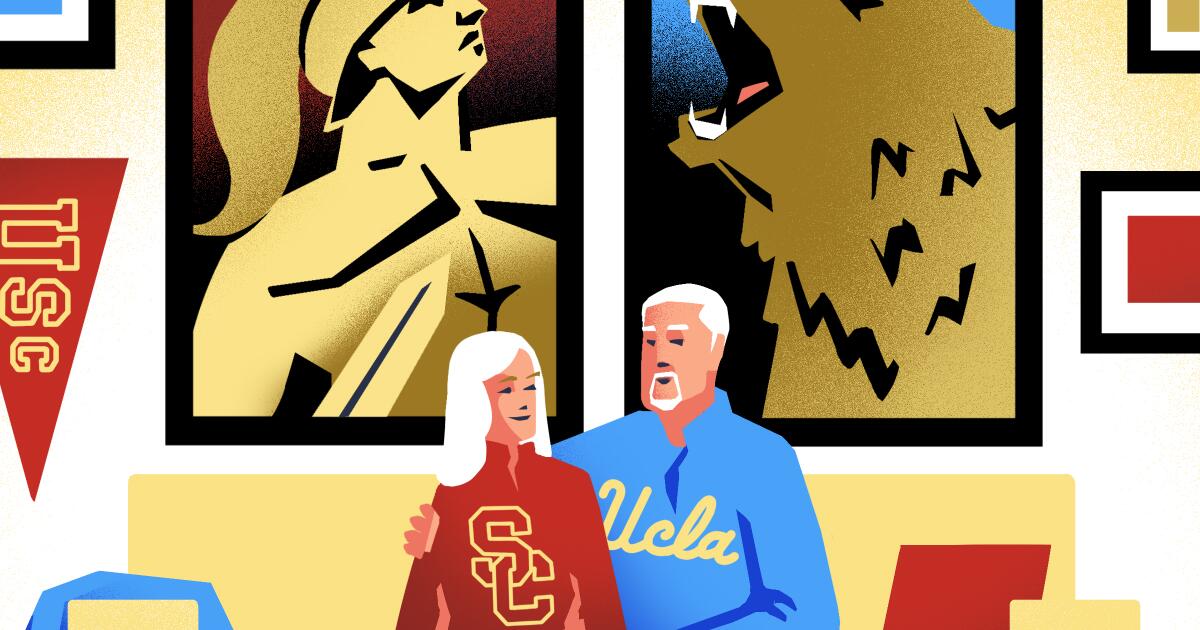
My mother, a UCLA graduate, switched her allegiance on a dime the day I enrolled at USC. She and my father attended every Trojans home game from that day forward. Familial blood may be thicker than alumni water but not so, it seems, when it comes to spousal relations.
And I know about it all too well. My husband, Brad, and I, both divorced and not in the market for anyone who didn’t ooze quality, had engaged in a keyboard courtship. He was avid, while I was reluctant at best. I refused to meet him for months, having been single for six years and not the least bit interested in sharing anything with anyone ever again. But he said he was willing to wait however long it took for me to muster up the courage, and he would even manage to overlook the fact that my diploma was from USC because he (unfortunately) was a devoted Bruin.
Letters soared back and forth between us, and because we were both 50 and counting, once I caved and we came face to face we wasted no time before announcing the nuptials, even though we both knew football season could be an impediment to forever after.
We shopped for rings before our first cross-town rivalry contest, the battle that former UCLA football coach Red Sanders once stated is not a matter of life and death: “It’s more important than that!” he insisted.
We set our wedding date for April, long before we truly realized what would happen in the fall at kickoff. Whereas I pictured us reveling in teasing trash talk, curled up on the sofa, popcorn at the ready — maybe even buying tickets to the big game someday — I was soon to learn that the Los Angeles gridiron civil war was more than we’d bargained for and, in fact, would permeate the walls of our love nest.
Brad started it. The first year, I scurried to Trader Joe’s like a nurturing newlywed bride to gather fun football food for what promised to be the fulfillment of my dream: our enjoying the light banter of frivolous competition in front of the television on a sunny Southern California Saturday afternoon.
When I emerged from the market, shopping bags in hand, I realized the man I’d promised to honor (Had I remembered to tell the priest to omit the word “obey”?) had switched out my striking cardinal and gold USC license plate frames for the ones decorated in the pale baby blue of his alma mater — ugh, UCLA Bruins!
Two could play at this game. I plopped the bags on the back seat, hopped on the 405 Freeway and beelined to SC Trojan Town at South Coast Plaza — yes, Virginia, there really is a retail Santa Claus for the University of Spoiled Children.
I whipped out my husband’s Visa card and promptly placed every fanatical fan item I could carry on it. I toted two suitcase-size handled bags filled with cocktail napkins, plates, cups, a king-size blanket, T-shirts, sweatpants, pajamas, signs, streamers, pennants, socks, hats, jerseys and my personal favorite, because he pretends to have symptoms of a stroke every time he hears it, a refrigerator magnet that plays the Trojan fight song.
Fight on! In no time, I had racked up an unconscionable dollar amount of paraphernalia that was sure to bring the house down. Then there was the year when USC was favored by a margin wider than the Pacific Ocean, the year the man I thought I’d be sharing my life with chose to clean out the garage and not even watch one quarterback toss. That was the year I ate all the cardinal and gold M&Ms myself.
Shortly after standing at the altar before family and friends, when we attended a UCLA-USC basketball game outfitted in our respective school sweatshirts, we were observed by a group of boorish Bruins. “Aw man,” one of them said to my husband. “Couldn’t you have done better?”
Clearly, you can’t major in manners on the west side of town. To this day, whenever the big day arrives for the football game more crucial than the Super Bowl, I find myself sometimes rising above it all in the company of Brad’s fraternity bro and his wife, an ex-UCLA song girl.
Although outnumbered and having to sit next to a song girl, I handle it gracefully despite some tiresome enemy tirades on the topic of campus controversy, á la parents paying to get their progeny into USC.
I point out that it’s a feather in one’s cap to be able to graduate from such a prestigious university, while our Bruin guests argue that those parents threw away their money.
Twenty years into sacramental union, we’d like to think we have for the most part let it go, especially since neither team provides the stellar spectacle that they did in our glory days from 1969 to 1973.
But every time November rolls around, unfurled is the flag flying our schools’ colors: half cardinal and gold, half just boring blue and yellow. “A House Divided,” it proclaims for all the neighbors to see. So perhaps to gain the truly proper perspective, it’s time for us to arrange a ceremony during which we renew our sacred vows adding just one more to the list: For better or for worse, for richer or for poorer … and no matter who wins the game.
The author is a second-generation Los Angeles native who lives in Fallbrook, Calif. A graduate of USC, she is the author of essays and stories that have appeared in newspapers and magazines including the Los Angeles Times, Orange Coast Magazine and Newsweek for over two decades.
L.A. Affairs chronicles the search for romantic love in all its glorious expressions in the L.A. area, and we want to hear your true story. We pay $400 for a published essay. Email LAAffairs@latimes.com. You can find submission guidelines here. You can find past columns here.


Inde Navarrette and Michael Johnston in Obsession.
Focus Features
hide caption
toggle caption
Focus Features
Two big horror films, Obsession and Backrooms, just smashed all box office expectations. So much of their success has been driven by Gen Z, which is now the biggest moviegoing demographic. But what makes a movie a Gen Z movie? Today we’re bringing you an episode of NPR’s It’s Been a Minute. Host Brittany Luse talks about this trend with Sam Adams and Reanna Cruz.
If you want to hear more about these movies, check out these episodes:
In ‘Obsession,’ love hurts. It really, really, really hurts.
‘Backrooms’ brings YouTube horror to the big screen
Zendaya brings ‘The Drama,’ we bring the spoilers
Connect with Pop Culture Happy Hour:
Letterboxd / Facebook
Our weekly newsletter
Support Pop Culture Happy Hour+

I regret to inform you I’ll need to keep this introduction brief. Not because there’s any lack of things to say about July’s crop of notable new releases; it features award-winning journalists and several different flavors of anxiety about our bleak ecological future and data-dominated present, as well as the welcome returns of several beloved novelists.
No, these books certainly deserve some love, dear readers. It’s just that I’m finding it a bit tough to type while bearhugging a box fan. And since it seems that may be my last best chance to get through this latest U.S. heat wave here on the east coast without sweating through my shirt, I feel some urgency to get back at it.
So enough with the ado. With any luck, you’ll soon be cracking open one of these great reads on the beach — or in front of a decent air-conditioning unit, at any rate.
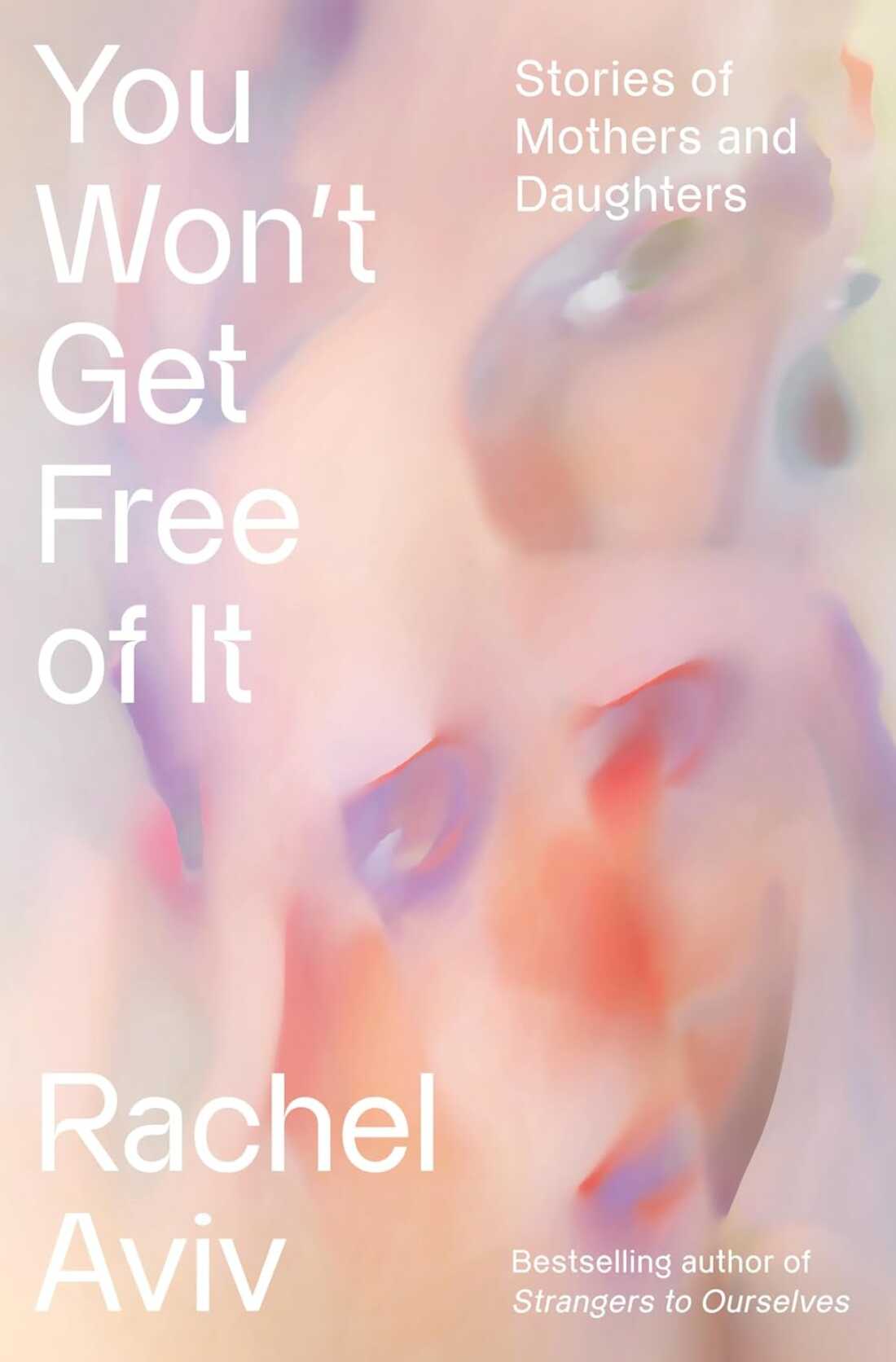
You Won’t Get Free of It: Stories of Mothers and Daughters, by Rachel Aviv (July 7)
Aviv, New Yorker staff writer and finalist for this year’s Pulitzer Prize, has a fairly extensive purview in her role as reporter at large. Still, when reviewing her latest work, Aviv noticed a crucial throughline: “I realized that, to some degree, I’d been writing about mother-daughter pairs for the last decade,” she explained to the Paris Review. Seeing this, she decided to collect and revise half a dozen of those stories, which cover ground from a daughter’s troubling fugue states to the immigrant nannies who must leave their own children behind, to Alice Munro’s daughter, whose claims of sexual abuse went unheeded yet regularly resurfaced in her mother’s fiction.
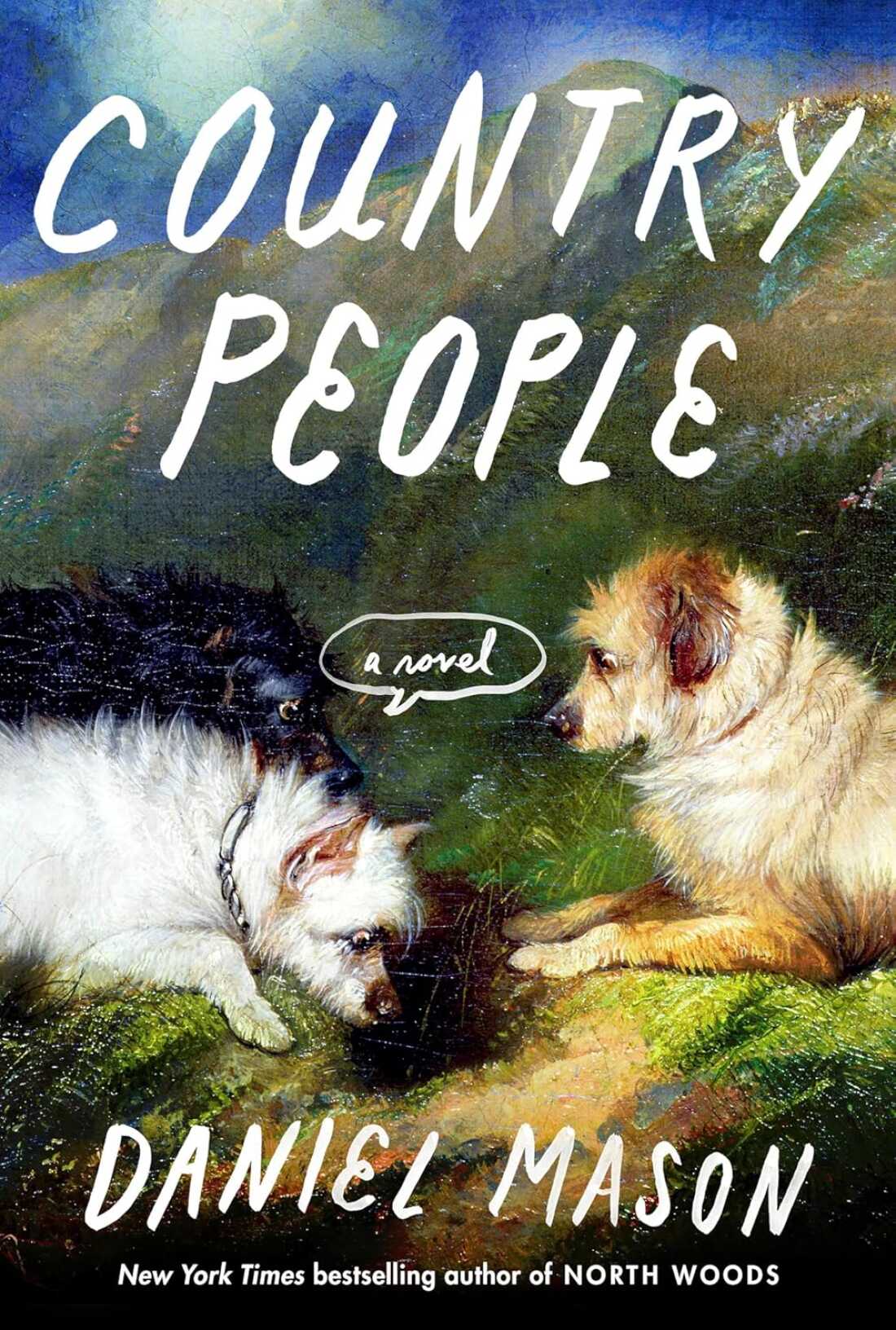
Country People, by Daniel Mason (July 7)
In Mason’s first novel since North Woods, 2023’s critical darling and book club stalwart, readers are plopped right back in the New England woods but the time scale has shrunk considerably. Whereas North Woods spanned centuries, his new novel confines itself to a single year, during which Miles, loving family man and lackadaisical Ph.D. candidate, plans to finally buckle down on that derelict degree of his and reassert his worth to one and all! At least, that’s the idea. But plans don’t stand much of a chance when there are eccentric neighbors to befriend and mysterious local legends to investigate.

Catch the Devil: A True Story of Murder, Deception, and Injustice on the Gulf Coast, by Pamela Colloff (July 14)
This is the first book from Colloff, a veteran investigative journalist for ProPublica and The New York Times Magazine. She has won multiple National Magazine Awards for stories focused on miscarriages of justice – such as her 2019 piece about Paul Skalnik, a grifter, fabulist, sexual predator and snitch, whose fabrications can be linked to dozens of wrongful convictions in Florida, including some sending the innocent to death row. Here Colloff expands upon that investigation, which gets a lot more room to breathe in the transition from magazine article to full-length book. What emerges in this disturbing account is a portrait of one man’s callous cruelty, and the law enforcers who had no problem tolerating a deal with the devil, provided it kept juicing the conviction rate.

Cloudthief, by Nathaniel Rich (July 14)
Though it’s his fiction we’re discussing here, it’s important to note Rich’s reporting has earned plaudits, too, as well as a few film adaptations. No matter the medium, climate change is usually on his mind, as well as the blunt, rather bleak, prognosis he offered on Fresh Air in 2019: “There’s a huge range of outcomes … ranging from the not very good to the apocalyptic.” Which is to say I’m surprised to find myself describing his newest response to global catastrophe as a rollicking good time – and not just because I’ve never said those words, in that order, in my life. This spry, funny caper features a freelance environmental reporter who inadvertently breaks bad, careening under the influence of lust and a light wallet toward the novel’s big centerpiece: the planned heist of a massive data center.

Data Empire: The Power of Information to Organize, Control, and Dominate, by Roopika Risam (July 14)
And now, for another book centered on data – albeit from a rather different angle. This illuminating history from Risam, a Dartmouth professor, traces the practice of collecting information – and the power conferred by possessing it – from the bones that were humans’ first archives, to the omnipresent systems that shape (or outright determine) life today. As Risam asks, “What has it meant – and what will it mean – when records that once served only to help us remember, come to rule?” A pressing question (see: those data centers), which you’re probably better served trying to answer with the help of Risam than, say, Alexa or Claude.

It Will Come Back to You: Stories, by Sigrid Nuñez (July 14)
For someone with nine novels to her name, Nuñez got a later start than you might expect, having published her first book when she was already in her mid-40s. More than three decades later, now a spry 75 years old, the National Book Award winner has gotten around to publishing her first collection of short stories. The 13 stories here have been culled from across her career, but each one resonates clearly with the warm timbre of her voice: simple, unadorned prose and mundane setups, from which she consistently manages to tease out glimpses of truth, elusive and profound.

They Stole a City: Wilmington’s White Supremacist Coup and the Families Who Live with Its Legacy, by Lauren Collins (July 14)
The only coup d’etat to succeed on U.S. soil is, at most, a distant historical afterthought these days. To be honest, I can’t recall reading a single textbook entry that even remarked on the 1898 race massacre in Wilmington, N.C., an action led by white supremacists that left many (historian estimates say up to 300) Black Wilmingtonians dead and permanently scarred a community newly aware of its simmering animus and vulnerability to violent overthrow. So I’m grateful for Collins’ new chronicle of the infamous event, which fills in some serious gaps in the American collective memory and explains how its perpetrators cultivated the disorienting silence that persists in the historical record today.

Yellow Pine, by Claire Vaye Watkins (July 21)
I don’t think I’ve ever actually laid eyes on the Mojave Desert but after reading Watkins’ latest novel, it feels like I can picture it more vividly than some streets I’ve actually lived on. No, it’s “not a beginner’s wilderness,” as Watkins concedes in Yellow Pine, but this landscape so redolent of death is also deceptively robust with life, if only you’re patient enough to find it. Too bad, then, that it’s also on fire. And choked by drought, irradiated by military test sites and soon to be sacrificed to a massive new solar array named, inexplicably, Yellow Pine. But those aren’t the only complications confronting the book’s main character, Rose, whose aspirations of becoming a kind of climate hermit warp a bit under the pressure of a rekindled love and the pendulum swing of rage and despair at the state of the world.

Cool Machine, by Colson Whitehead (July 21)
Ray Carney is back, for what regrettably appears to be the last time. The lifelong Harlemite, hard-luck furniture dealer and ambivalent crook starred previously in Harlem Shuffle and its sequel, Crook Manifesto. His perspective is our window on the changing eras of the historically Black neighborhood, from the mid-1950s on. In this, the final installment in Whitehead’s brisk, exceedingly entertaining Harlem Trilogy, readers catch up with Carney around the start of the 1980s, following him deeply into Reagan’s decade. The novel also represents the end of an era for Whitehead, whose attention has been exclusively occupied with these characters since he won Pulitzer Prizes for consecutive novels, The Underground Railroad and Nickel Boys.

Beginning Middle End, by Valeria Luiselli (July 28)
The gifted young Mexican writer returns this month with her fourth novel, the second she has written in English and her first since Lost Children Archive launched to widespread plaudits more than seven years ago. Her new book, like her previous one, also concerns the travels of a small family – only this time, the road leads not through the American Southwest but Sicily. And the history sought by its mother-daughter main characters is not a record of bureaucratic cruelty but something much more intimately personal: the links shaped and tested by generations of shared heritage and experience.



-

 Los Angeles, Ca10 minutes ago
Bicyclist killed by hit-and-run driver in Long Beach
-

 Detroit, MI28 minutes ago
Child shot while riding bike outside home on Detroit’s west side, police say
-

 San Francisco, CA40 minutes ago
Bay Area restaurant has strict policy on acceptable children behavior
-

 Dallas, TX43 minutes ago
Detroit Pistons trade Marcus Sasser to Dusty May’s Dallas Mavericks
-

 Miami, FL48 minutes ago
The offseason has been a massive success for the Miami Heat
-

 Boston, MA55 minutes ago
Can’t afford Boston’s priciest restaurants? Try these instead. – The Boston Globe
-

 Denver, CO58 minutes ago
City of Denver says images of piling waste a case of illegal dumping
-

 Seattle, WA1 hour ago
14-year-old dies in electric motorcycle crash at Seattle bike park

