Lifestyle
Inside L.A.'s invite-only mom group that’s better than Google

At first, Cathlene Pineda was reluctant to join the Atwater Village Moms’ Facebook group.
The jazz pianist and composer doesn’t particularly like Facebook, and she’s wary of online communities. But she acquiesced because, as she put it, “Some other moms were like, ‘You have to be part of this group.’”
After joining in 2021, she realized it had benefits. When she needed a trustworthy mechanic, the Atwater Moms told her who to call. When she was ready to sleep train her baby, they recommended books like “The Happy Sleeper” and “The No-Cry Sleep Solution.” When she went to Vegas, they told her to stay at the Cosmopolitan.
Then, a few months into her membership, she was diagnosed with late-stage breast cancer. She had a 2-year-old and a 4-year-old at home and couldn’t imagine how she would get through the long, involved treatment her doctors prescribed. Not sure what else to do, she turned to the Atwater Moms for help.
“I was expecting what I usually got, which is a few responses,” she said. Instead, more than 90 women commented on her post. They shared lists of specialists and free resources, including how to sign up for meal services and get a one-time cash grant. But for Pineda, their validation helped the most.
“Some of the women who commented had gone through this when their kids were the same age as my children and they said, ‘You can do this,’” she said. “I didn’t even really need the advice. I just needed to feel real.”
Founded in 2011 as a way for new mothers in Atwater Village to meet each other, the Atwater Village Mom’s Group has evolved over time to become a crowdsourcing powerhouse with more than 6,000 members scattered across L.A. and around the world. One member in a recent post called it the best advice group on the Internet. Another described it in an interview as “Yelp times 100.”
“Obviously I still Google things, but before I do, I ask myself: ‘Can I ask Atwater Village Moms?’” said Swati Kapila, an actress and mother of a 2-year-old. “People jokingly call it Moogle all the time — Mom Google. It’s mama mutual aid.”
If you have questions about summer camps, the going rate for nannies, the best local preschools or where to go for date night — the Atwater Moms have answers. They’ve helped one another find gifts for their partners, swapped recommendations for the best birthday party parks and compared experiences with pediatricians, dentists and kid barbers. At the same time, they’ve supported each other through life’s biggest challenges, many of which extend far beyond birthing and caring for a child.
Daryl Dickerson, a mother of two who teaches gardening at a charter school, bought a car from a mom in the group. It was the first step in her divorce. When Sharon Sognalian’s apartment rental fell through, the legal staffer and mother of a 12-year-old moved into another member’s back house.
Tanya Reyes, a mother of three who teaches at a school for pregnant and parenting teens in Echo Park, said members of Atwater Moms have donated strollers, car seats and used clothes to her students. Any time she posts her Amazon wishlist to the group, packages soon appear at the school.
“This community has allowed me to serve my community of students,” she said. “It’s moms supporting moms.”
“People jokingly call it Moogle all the time — Mom Google. It’s mama mutual aid.”
— Swati Kapila, Atwater Village Moms member
Reyes has received other types of support from the group as well. When she recently posted about the challenges of getting her “neurospicy” kid out of the house each morning, she got 87 responses. Like Pineda, she said her fellow moms’ solidarity was even more valuable than their advice. “It’s nice to know I’m not crazy, this is really happening.”
Brandi Jordan, a parenting specialist who has worked as a doula for celebrities like Julia Stiles, Mandy Moore and Megan Fox, never expected this kind of communal support when she started Atwater Village Moms back in 2011, soon after Facebook first introduced its groups feature. At the time she was running a boutique called the Cradle Company that catered to Atwater’s moms and babies. Her oldest son, now 16, was just 3.
She and another mom, Leonora Pitts, started the group to connect with other women with babies in the area and to coordinate occasional meet-ups at the park. She’d heard of similar groups on the Westside but didn’t think they would be her vibe. “I’m not trying to figure out how to get my baby’s eyebrows waxed,” she said. “But good on you if that’s your thing.”
Initially Jordan and her co-founder aimed for 25 women to join Atwater Village Moms, but word spread and interest soared. Then they thought the group might top out at 200, but it quickly surpassed that number too. The criteria for joining then were the same as they are now: You must be a parent, identify as female or nonbinary and — though you’re not required to live in Atwater Village, or even L.A. — you must be invited by another member to join. (A discussion about whether men can join the group is ongoing, but for now they remain excluded.)
“This community has allowed me to serve my community of students. It’s moms supporting moms.”
— Tanya Reyes, Atwater Village Moms
Jordan doesn’t have demographic data on the group, but she said that, historically, members tend to be white and affluent and live on the Eastside. But in recent years, there’s been a shift. “We’ve had more women of color joining,” said Jordan, who is Black. “As people have seen it is a safe space, they are sharing with more women of color.”
Atwater Village Moms has gone through different phases over the years. In the early days, discussions centered around places to go with small kids and member meet-ups. As time went on, it grew into a general resource for any question about L.A. and beyond. The posts became more political after the 2016 election and again after what Jordan describes as “the George Floyd era,” when the moms in the group began more openly discussing race.
“It was difficult, but as a group we didn’t give up,” she said. “We have this idea that this place is not safe — it’s brave. We’re going to make mistakes, we’re going to get over it, we’re going to talk about it and we’re going to hear different sides. And we started making rules to support that.”
Before joining, the group members have to agree to a set of rules that includes respecting everyone’s privacy (no screenshotting posts), refraining from hate speech or bullying and abstaining from deleting a post because it’s drawing unwanted comments (this is grounds for removal).
“Anything that affects women and mothers, you can talk about in the group and we don’t limit that conversation,” Jordan said. “But we also tell people you have to understand that people are going to voice opposite opinions and you have to be OK with that.”
Lauren Amaro, a professor of communication at Pepperdine University who has studied online mom groups (and who recently found a general practitioner on a moms Facebook group in Camarillo), said it’s rare for a group the size of Atwater Moms to be seen in such a positive light by its members. These communities can devolve into mom-shaming that is especially painful for new parents.
“The fact that women are willing to trust other women on the internet is both a beautiful and necessary thing and sometimes, depending on the topic and context, unwise,” she said. “There is a really wide range of how these mom groups function.”
Careful moderation, along with clear, consistent rules, can help groups like Atwater Moms thrive, she said.
Liza Sacilioc, a communications specialist who has been a member of the group for more than a decade, said Jordan is a skilled moderator. “Brandi does a really good job seeing people and setting the ground rules without it feeling like a slap on the hand,” she said. “We’re a very respectful group.”
“We have this idea that this place is not safe — it’s brave. We’re going to make mistakes, we’re going to get over it, we’re going to talk about it and we’re going to hear different sides.”
— Brandi Jordan, co-founder and moderator of Atwater Village Moms
Three years after she joined Atwater Moms, Pineda is grateful for all she’s gained as a member. A self-described introvert, she said it wasn’t like her to post about her cancer diagnosis to a group of 6,000 people. But somehow, doing it on Atwater Village Moms felt safe.
“For me to share that, I had to feel that they would respond appropriately and helpfully, and in so many Facebook groups that’s not the case,” she said. “Looking back at some of those comments, they were like: ‘I have no advice, I’m just sending you love and holding you close in my heart.’ That’s it. Everyone was so respectful.”
And today, with her cancer in remission, she often finds herself responding to other women’s questions, whether they’re about cancer, child-rearing or just life in general.
“You want to help someone if you can,” she said. “It takes five minutes to say, ‘This worked for me, I don’t know if it will work for you.’ And also: You’re doing a great job.’”


Ryland Brickson Cole Tews in Hundreds of Beavers.
Hundreds of Beavers
hide caption
toggle caption
Hundreds of Beavers
The streaming service Tubi has become a repository for a wild assortment of movies, TV shows, and original properties. They’re all free to watch, provided you’re willing to sit through some ads. So we asked some Tubi-philes to recommend some great movies that you can find on the service: Hundreds of Beavers, Color Out of Space, Petey Wheatstraw, and Mambo Italiano.
Follow Pop Culture Happy Hour on Letterboxd at letterboxd.com/nprpopculture
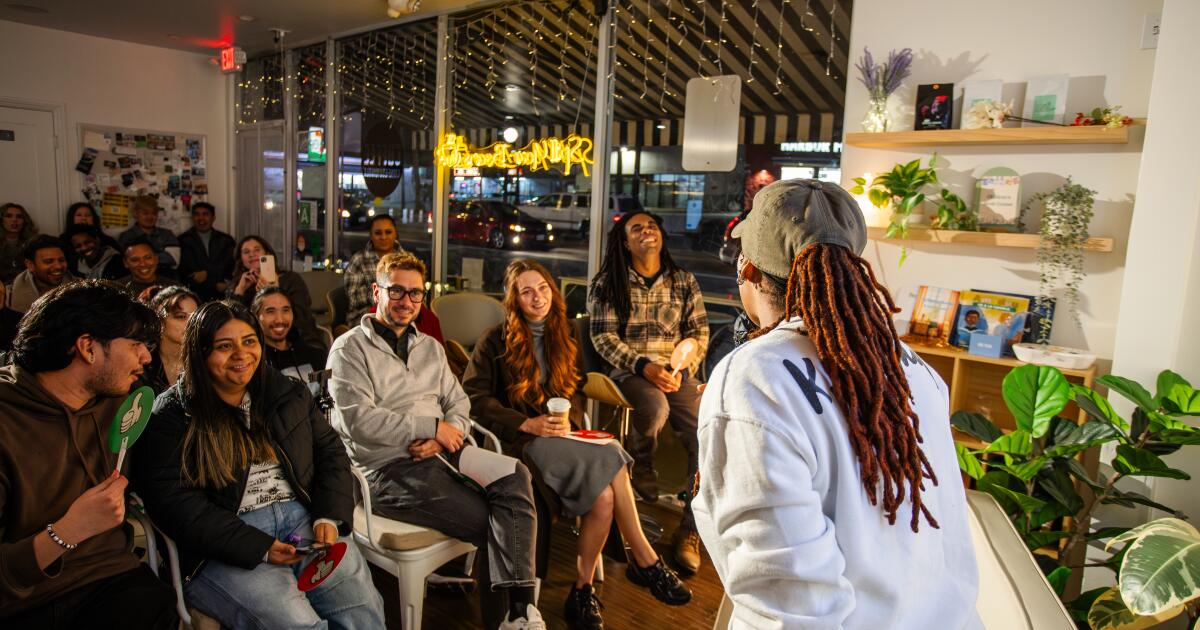
The doctors are in — and they’re funny.
Tucked near a Mobil gas station and a Harbor Freight Tools on Hollywood Boulevard, this is one of the highest-energy live comedy shows in town. Or maybe it’s the most comedic of therapy sessions in town. Or both.
Comedian Mina Quarterman (@minaquarterman) performs her set at Coffee Confessionals in Hollywood.

-
Share via
Welcome to “Comedy & ‘Therapy,’ ” a monthly event at the cafe Coffee Confessionals, in which comedians on stage dispense advice to audience members in the crowd. It’s far simpler than navigating your patient portal. After buying a $16 entry ticket — no deductible — audience members have the option of scribbling an anonymous confession or a personal dilemma onto a piece of paper before dropping it into a box.
Each show features six comedians — three who perform straight comedy sets and three who serve as “therapists” for the evening. The therapists each draw a submission from the box, then read it to the audience before scanning the crowd and inviting the participant up on stage to the therapy couch.
Hilarity then ensues — and it’s interactive. After the comedian riffs with the “patient,” the audience weighs in on the issue with green and red “thumbs up/thumbs down” paddles, often yelling out comments or directly querying the participant. The action is punctuated by booming sound effects — canned applause, the “wah-wah” of a sad trombone and a hyperactive electronic buzzer, among them — coming from a trigger-happy soundboard operator behind the coffee counter.
“Recently, a friend’s girlfriend told me she had a dream I got her pregnant,” comedian Chris Collins reads, after drawing from the box. “Well, if she’s not into me, she’s having second thoughts about marrying him. Do I tell him?” (Ooohs and aaahs from the audience.)
Audience member Matthew Robinson, 36, hides his face with his paddle before finally heading up to the stage.
“Well, if you’re thinking about telling him you kind of have to now because this is on camera,” comedian Collins tells him. “This is gonna be out there forever!” (No pressure.) Robinson chuckles as canned laughter from the soundboard fills the room.

Crowdmembers casts their votes during comedy set at Coffee Confessionals.

Comedian Chris Collins (@chrisco11ins)
“Give a thumbs up if you think he should tell his friend,” Collins later urges the crowd.
“Yeeaaah,” most of them yell, waving their green paddles in the air.
“Nooo,” comes a shout from the back of the room, a solo red paddle wiggling.
“One toxic guy in the back says don’t tell him!” Collins quips, as the room erupts in real human laughter.
“It’s a fun event,” says Coffee Confessionals owner Jing Lin. “But there is a genuineness to it. We’re not calling people up on stage to make fun, it’s really to help them through their problems.”
Robinson said, later in the evening, that his “therapy session” was actually helpful.
“That was something that gave me anxiety recently and it feels good to have everyone say ‘No, you should tell him.’ It was kind of a relief.”
Lin says she opened Coffee Confessionals in 2024 because she wanted to create community around coffee, conversation and the sharing of vulnerabilities. (There’s a neon sign in the window that says “Spill Your Beans.”) Lin missed the coffee culture of New York, where she’d moved to L.A. from, and has long had an affinity for coffee shops — she studied filmmaking in college and coffee shops are where she feels most creative, often spending afternoons there sipping a drip coffee while writing.

Shop owner Jing Lin sits post-show at Coffee Confessionals.
After about a decade working in marketing at NBCUniversal, Lin left the job during COVID in 2020 and hatched plans to open “a different kind of coffee shop.”
“I thought a lot about how to bring people together: How do you make a new friend, a new acquaintance, without just talking about the weather?” she says. “It’s really when you connect on a deeper level, when you’re revealing something. Those stories are what bring people closer together because you find ‘oh my God, I can really relate to what this person is going through.’ So I wanted to build a shop to get to those deeper conversations.”
Lin leaves stacks of “conversation cards” featuring icebreaker questions on the tables at Coffee Confessionals, to help prompt connection between strangers or for those on first dates. “What makes a good lasting marriage?” reads one; “Where do you see yourself five years from now, 10 years from now?” reads another. There’s also a “spill your beans confessional board,” where visitors can anonymously respond to prompts.
In addition to “Comedy & ‘Therapy,’ ” the coffee shop also hosts open mic nights, art walks and networking panels, among other events. For the comedy show, Lin says she’s mindful about booking a diverse group of comedians, with a cross-section of ethnic and LGBTQ+ backgrounds, as well as a mix of emerging and established performers.

Janelle Marie (@iamjanellemarie) assumes the role of host for the evening’s “Comedy and ‘Therapy.’ ”
Coffee Confessionals is admittedly small but cozy, with hardwood floors, bountiful string lights and just a few cafe tables inside. But that’s part of why the “Coffee & ‘Therapy’ ” show works. With about 35 audience members the night I attended, the tiny coffee shop felt packed, with standing room only in the back. The vibe was festive, social and playfully raucous — more impromptu living room performance among friends than comedy club.
Comedian Janelle Marie, who served as the evening’s MC, says the configuration of the room is an asset to her as a performer.
“It’s a very intimate space,” she says. “As a comedian standing up there you’re able to look out and see everyone and do crowd work and really connect with people.”
Even the straight comedy sets, sans interactive therapy, were shot through with intimate admissions, albeit humorous ones.
Olivia Xing, who is “made in China,” as she says, riffed on why she married her husband.
“I married him because he’s Mexican and I just know if ICE comes to get me, they’d get him instead. So I feel safe.”

Comedian Jordan Conley (@loljordancon1ey) offers some therapy advice during his set with randomly-selected crowdmembers.

The golden box of crowd-submitted confessions that comedians scoured through to incorporate during their interactive sets.
Toward the end of the evening, there was an unexpected confessional.
“I farted in the supermarket,” comedian Jordan Conley read from a piece of paper he’d drawn from the box.
Suddenly, a tall, lithe woman in a long overcoat stood up and made her way to the stage. The increasingly hilarious exchange between Conley and 27-year-old Nicky Marijne covered the basics (Which aisle? Produce. Audible or not? No.) But despite the absurdness of the topic, the conversation was not without therapeutic insight.
Marijne had come to the show “just for fun” and submitted her confession as a joke, she told The Times later. But the on-stage interaction with Conley got her thinking, nonetheless.
“As a woman you’re not supposed to fart, but it happens. Whereas [with] guys, it’s ha-ha funny. But for us, it’s like ‘oh my God,’ and we feel shameful. So [this] had a little therapy to it.”

Comedians Chris Collins (@chrisco11ins), left, and Mina Quarterman (@minaquarterman) prep for their sets while fellow comic Olivia Xing (@oliviacrossing_) beams with support from the crowd at Coffee Confessionals.
After the show, one of the evening’s comedians, Mina Quarterman, turned to the crowd for advice, as attendees were zipping their coats and readying to leave.
“OK, so I had the crowd [at the Laugh Factory] turn on me because of something I said on stage [recently],” she said. “And I wanna know if you guys think I was wrong.”
The crowd leaned in around her as she relayed a story about using a term on stage that an audience member felt was offensive.
“It caused a ruckus,” Quarterman said.
Everyone at Coffee Confessionals, however, seemed in agreement that Quarterman hadn’t been in the wrong — and she appeared visibly relieved. “Thank you for [workshopping] this!” she said.
Ultimately, whether you come to Coffee Confessionals seeking real advice, community and connection or stand-up performances, laughter itself is therapeutic, the evening’s MC, Marie, says.
“Laughter is everything. When you laugh — like a real belly laugh — you’re letting out your inner self,” she says. “It’s true freedom.”

Post-show with Sammy Cantu (@boom_shenanigans), standing from left, Jordan Conley (@loljordancon1ey), Chris Collins (@chrisco11ins), and, seated from left, Jing Lin (shop owner) and Olivia Xing (@oliviacrossing_) at Coffee Confessionals.

Some 20 years ago, a cobweb descended over my right eye. What I thought was a migraine, turned out to be a semi-detached retina. Even saying those words now makes me flinch.
After surgery, I lay still for days on my side, eye patch in place. Back then, my husband and daughter went to our local library to find books on tape for me. Since I’d reviewed Allegra Goodman’s novel Intuition just before this scary event happened, they brought home cassettes of two of Goodman’s earlier novels: Kaaterskill Falls and The Family Markowitz.
I was lucky and my sight recovered, so I now think of that interlude of being marooned on the couch listening to Goodman’s novels unspool as one of the most idyllic reading experiences of my life. Which is why, even though I’ve kept up with Goodman’s work, I was hesitant to read her new novel, This Is Not About Us.

Most of her books have explored intense and enclosed worlds: from the labs of cancer researchers in Intuition, to rare book zealots in The Cookbook Collector, to the island prison of a 16th-century castaway in last year’s Isola. This Is Not About Us, however, is different: It’s a throwback, in form and subject to The Family Markowitz, which came out 30 years ago.
Both novels are domestic tales about three generations of a Jewish family and both are structured as a series of linked stories in which various family members take center stage. I worried that returning to a familiar formula might mean that Goodman was running out of energy as a writer. Then, I started reading and stopped worrying.

When I finished This Is Not About Us — I kid you not — I read it a second time, just to savor all the interconnections, all the shifts in family members’ opinions of each other.
This Is Not About Us opens at the prolonged deathbed of Jeanne who, at 74, is the youngest of the three Rubenstein sisters. Jeanne’s house is packed with flowers:
[T]he sunflowers from her daughter-in law, Melanie, the roses from the Auerbachs next door. …
The flowers depressed her, especially those already wilting. When she looked at the mums, she felt she wasn’t dying fast enough.
Sardonic Jeanne does inevitably depart and that’s when the mood here darkens — not because of her death, but because of an apple cake that middle sister Sylvia serves at Jeanne’s shiva. The apple cake recipe originally came from the eldest Rubinstein sister, Helen, but Helen is not a gifted baker like Sylvia.
When Sylvia entices the entire extended family to gather around a Bundt cake that emits the warm sweet fragrance of apples, Helen storms out of the shiva. And she refuses to forgive Sylvia for … well, Goodman postpones the emotionally overwhelming ending to this preposterous and painful family rift till the very last pages of her novel.

The 17 chapters of This Is Not About Us can stand as independent stories, but they accrue power from the subtle ways in which they alter our initial impressions of family members. “Deal Breaker,” for example, focuses on Helen’s older daughter Pam who’s in her early 50s and single. In an earlier story, another character describes Pam as: “a black hole”; someone who “[a]t the best of times, … looked askance.”
But in “Deal Breaker,” we see Pam cut to the quick when she realizes the man she loves will always put his ex-wife and teenaged daughter first. That’s when her mother Helen’s superhuman ability to hold a grudge (remember the apple cake?) becomes a quality that fortifies Pam.
Talking with her parents about the reason for the break-up, Pam struggles to characterize her ex-boyfriend’s steadfast loyalty to his ex-wife and daughter. She asks her mother for the word that describes those trees that hold onto their leaves all winter:
“‘Marcescent,’ says Helen, because she knows the word for everything. She is such a puzzler.
“That’s how he is,” Pam tells [her parents].
“Good for him,” says Helen, and Pam knows she means good riddance. …
Pam can’t help but admire her mother’s clarity.
Helen is difficult. She’s daunting, but she’s crisp.
She never clings.
Goodman herself is pretty “marcescent” as a writer. She holds fast to the gifts that have marked her since her earliest books: psychological acuity, humor and an abiding curiosity about the volatile chemistry of people bound together by affinity, profession or blood.

Man dead after Windsor, New Hampshire, house fire

San Diego Wave FC Unveils “Balboa Park Kit”: New Community Jersey for 2026 Season – San Diego Wave Fútbol Club

NMSP release details on capture of Fort Sumner shooting suspects

Lawmakers discuss solutions to solving a 'child care crisis' in NC

North Dakota ambulance providers losing money on every run, according to survey

Florida High School Football Rankings: Top 25 teams – Oct. 21

Cleary's 21 help Le Moyne down Central Connecticut State 69-64 in OT

How old is Bo Nix? What to know about Oregon quarterback ahead of 2024 NFL Draft

99th annual Pony Swim held in Virginia

Indiana Members Credit Union announced as new anchor tenant at Bottleworks District

DHS shutdown triggers TSA ‘emergency measures’ as lawmaker warns airports could feel economic pain

How Trump’s 2026 Iran ‘war’ script echoes and twists the 2003 Iraq playbook

As Nancy Guthrie’s disappearance nears one month, other Tucson families have been waiting decades for answers | CNN

Video: An Inside Look at the State of the Union

Biden’s FBI subpoenaed Kash Patel’s and Susie Wiles’ phone records during federal Trump investigation
-

 World15 hours ago
Exclusive: DeepSeek withholds latest AI model from US chipmakers including Nvidia, sources say
-

 Massachusetts24 hours ago
Mother and daughter injured in Taunton house explosion
-

 Montana7 days ago
2026 MHSA Montana Wrestling State Championship Brackets And Results – FloWrestling
-

 Oklahoma1 week ago
Wildfires rage in Oklahoma as thousands urged to evacuate a small city
-

 Louisiana3 days ago
Wildfire near Gum Swamp Road in Livingston Parish now under control; more than 200 acres burned
-

 Technology5 days ago
YouTube TV billing scam emails are hitting inboxes
-

 Culture1 week ago
Test Your Knowledge of the Authors and Events That Helped Shape the United States
-

 Technology5 days ago
Stellantis is in a crisis of its own making