Lifestyle
In 'The Party's Interests Come First,' Joseph Torigian tries to understand Xi Jinping through his father


Xi Jinping, left, with his father Xi Zhongxun in 1958.
History/Universal Images Group via Getty Images
hide caption
toggle caption
History/Universal Images Group via Getty Images
To many observers of China, its top leader, Xi Jinping, is an enigma. Scholars and journalist have tried to glean insight into his thinking by reading his speeches and writings and going through archival tape.
Joseph Torigian, an associate professor at American University in Washington D.C., takes another approach through his forthcoming book, The Party’s Interests Come First — a riveting, if dense, biography of Xi Zhongxun, the leader’s father and a noted Chinese politician himself.
What is striking about The Party’s Interests Come First is the book’s emphasis on understanding the emotional life of the elder Xi (in addition to its extensive archival research), and how a lifetime of enduring immense psychological pain and personal tragedy shaped the father’s political convictions and may have sharpened those of his son’s.
Below is a conversation NPR had with Torigian about his research. It has been edited for clarity.
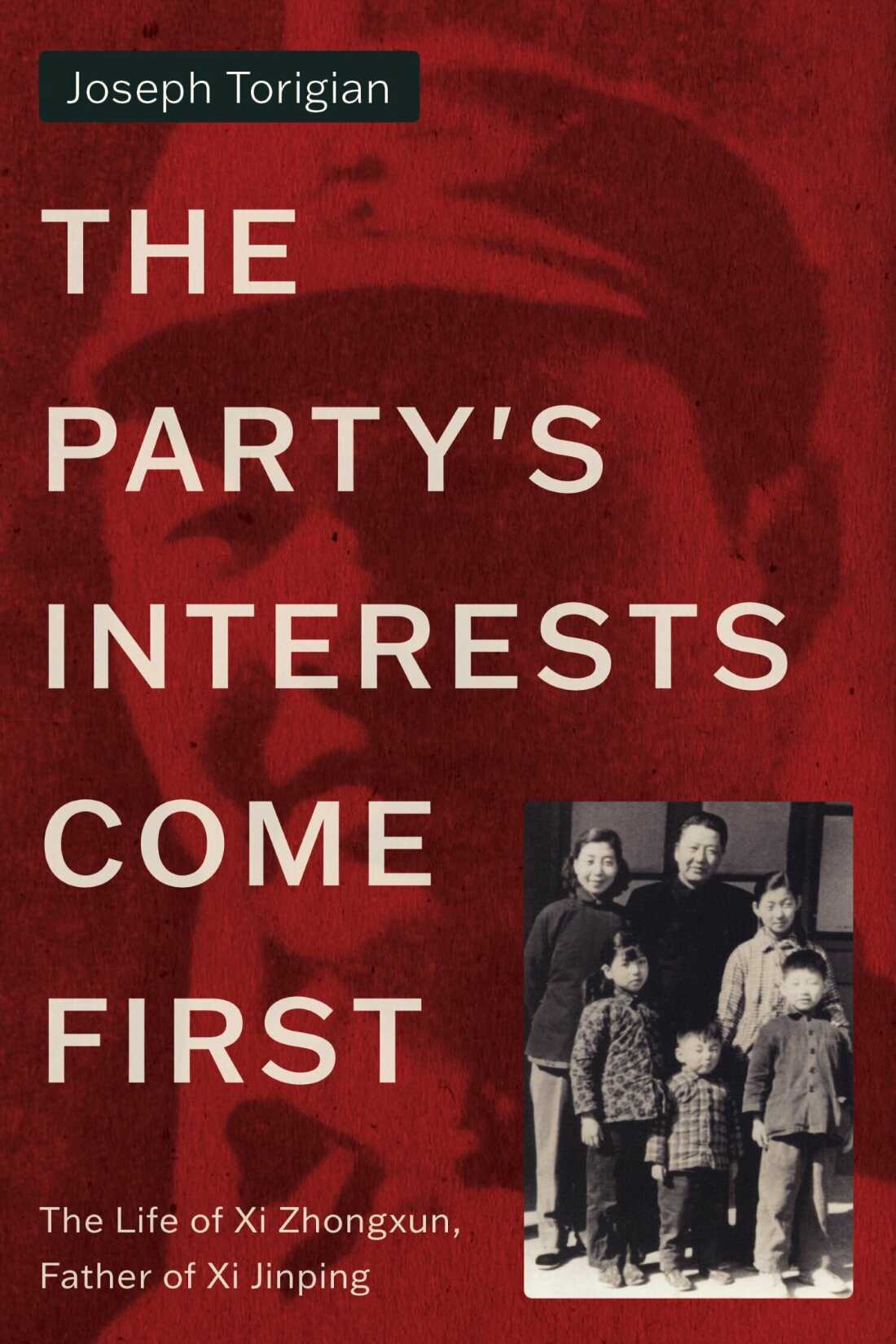
A new book examines the life of Xi Zhongxun, the famous father of China’s current leader, Xi Jinping – and how father may have shaped the son.
Stanford University Press
hide caption
toggle caption
Stanford University Press
…
FENG: Why focus on Xi Jinping’s father?
TORIGIAN: Xi Jinping has often described how his own political agenda is rooted in what he learned from the revolutionary elders, and his father was one of the most important of those individuals. Like his father, Xi is also the product of multiple sources of gravity and is a politician who often, I think, reacts according to the specifics of the situation.
The more interesting story here isn’t what Xi Jinping learned from his father, but what Xi Zhongxun tells us about the nature of the Chinese Communist Party in the 20th century. And the reason for that is Xi Zhongxun was someone who had a front row seat to many crucial moments that are foundational for our understanding of modern Chinese history. He was someone who helped build the regime. He was someone who helped incorporate Xinjiang into the People’s Republic of China. He was someone who worked for Zhou Enlai in the 1950s. He was someone who worked for general secretary Hu Yaobang in the 1980s. He was deeply involved in the party’s relationship with foreign communist parties. He was someone who led the party’s efforts with ethnic minorities such as Tibetans and Uyghurs. He was the party’s point person on relations with Catholics. And so understanding how the party has changed over time and how it has thought about these issues is something we can learn by looking at Xi Zhongxun’s life.
FENG: What does his life say about the Chinese Communist Party as a political entity that’s persisted over decades, despite multiple challenges when many other communist regimes have collapsed?
TORIGIAN: You know, outside observers who look at China often see elite politics as a division between good guys and bad guys, as a division between pro-reformers and anti-reformers. And what emerges from my book is an individual with fault lines within himself, an individual who was a man of competing impulses, an individual who was no stranger to the extraordinary emotional, organizational and coercive power of the party but also had his own views on things. And he struggled to manage those two parts of himself throughout his entire life, although ultimately it was the party’s interests that came first for him.
When you read my book, one of the questions it poses is whether a different party was ever possible. And one of the reasons that question is there is because Xi Zhongxun was most prominent in the 1950s and the 1980s. These were moments when many figures in the top leadership believed that a more consensus-oriented, less confrontational regime was possible. But of course, by the late 1950s and again at the end of the 1980s, both of those periods ended. The book reveals, I think, why those moments of experimentation failed, which is that ultimately the party decided that a model of co-optation, a model of less revolutionary zeal, was one that made the regime vulnerable.
FENG: One of the big themes in your book is personal suffering of the Xi family. The patriarch, Xi Zhongxun, and Xi Jinping himself underwent just huge amounts of personal pain and tragedy. Why do you think that’s important to highlight? How did that shape come into being the politicians they are today?

Joseph Torigian
via Joseph Torigian
hide caption
toggle caption
via Joseph Torigian
TORIGIAN: So that’s one central puzzle of the book is how someone like Xi Zhongxun, who suffered so much at the hands of his own party, remained so dedicated to it and why his son, who witnessed his father’s humiliation and suffering, has dedicated his life to the Chinese Communist Party as well.
To understand that requires an appreciation for the political culture that these individuals marinated in. They were part of a system that believed that suffering was something that dedicated you to the cause and revealed just how much you cared about it. And so if you’re Xi Jinping and you’re witnessing this, I think it’s possible to presume that you might have two reactions. One is, if my father continued to remain faithful, then why wouldn’t I? And second, since my father suffered so much at the hands of this party, I want to show just what my family is capable of. And I want to be redder than red.
FENG: Why do you think that suffering then didn’t compel Xi Jinping to reform the party, to make it less dogmatic and to be so black and white when it comes to enforcing top-down policies?
TORIGIAN: Well, it’s certainly the case that many people who went through the Cultural Revolution came out of it with very different conclusions. Some believed, after witnessing that chaos, that the party needed constitutionalism, that it needed rule of law, that it needed to avoid another strongman leader from leading the country onto a path like that. And so how you react to that kind of political experience reveals something about you because the answers are not always immediately obvious. It tells us something about Xi Jinping. And what Xi Jinping learned, it seems, was that if you take ideology too seriously, that’s dangerous because you get a Cultural Revolution. When you don’t have a strong state, people act in dangerous ways.

Xi Jinping waves as he leaves after speaking at a press event with members of the new Standing Committee of the Political Bureau of the Communist Party of China and Chinese and Foreign journalists at The Great Hall of People on October 23, 2022 in Beijing, China.
Kevin Frayer/Getty Images/Getty Images AsiaPac
hide caption
toggle caption
Kevin Frayer/Getty Images/Getty Images AsiaPac
FENG: Why was it important to you to give such a human face to Xi Zhongxun?
TORIGIAN: You know, when we think about a Bolshevik, we tend to have an image of a person without interiority. Counterintuitively, precisely because the party wanted to impose so much on the people who were in it, the party created an interiority because they had to hide their true selves. So there is this constant tension within him between human-ness and party-ness, where on the one hand Xi Zhongxun was someone with his own views, his own ambitions, and his own emotions. Yet on the other hand, he was expected to do whatever the top leader wanted, to keep his own doubts to himself, and to obey the party’s interests. It was never easy for him, even though his so-called “party nature” always emerged triumphant.
Xi Zhongxun’s own children learned different lessons about the meaning of their father’s life. One of them very sadly killed herself during the Cultural Revolution. One of them apparently had sympathies with the pro-reform elders in Beijing that hoped for a path that was different from the one that Xi Jinping took. Other members of the family wanted to make a lot of money. Xi Jinping stands out for his devotion to the party and his skepticism of materialism – traits that suggest he believes that he is taking the revolutionary baton from his father.



Sunday Puzzle
NPR
hide caption
toggle caption
NPR
On-air challenge
I’m going to read you some sentences. Each sentence conceals the name of a major U.S. city in consecutive letters. As a hint, the answer’s state also appears in the sentence. Every answer has at least six letters. (Ex. The Kentucky bodybuilders will be flexing tonight. –> LEXINGTON)
1. Space enthusiasts in Oregon support landing on Mars.
2. Contact your insurance branch or agent in Alaska.
3. The Ohio company has a sale from today to next Sunday.
4. The Colorado trial ended in a sudden verdict.
5. Fans voted the Virginia tennis matches a peak experience.
6. I bought a shamrock for decorating my house in Illinois.
7. All the Connecticut things they knew have now changed.
8. Can you help a software developer in Texas?
Last week’s challenge
Last week’s challenge came from Mike Reiss, who’s a showrunner, writer, and producer for “The Simpsons.” Think of a famous living singer. The last two letters of his first name and the first two letters of his last name spell a bird. Change the first letter of the singer’s first name. Then the first three letters of that first name and the last five letters of his last name together spell another bird. What singer is this?
Challenge answer
Placido Domingo
Winner
Brock Hammill of Corvallis, Montana.
This week’s challenge
This week’s challenge comes from Robert Flood, of Allen, Texas. Name a famous female singer of the past (five letters in the first name, seven letters in the last name). Remove the last letter of her first name and you can rearrange all the remaining letters to name the capital of a country (six letters) and a food product that its nation is famous for (five letters).
If you know the answer to the challenge, submit it below by Thursday, December 18 at 3 p.m. ET. Listeners whose answers are selected win a chance to play the on-air puzzle.


Lucy Dacus performs at Spotlight: Lucy Dacus at GRAMMY Museum L.A. Live on October 08, 2025 in Los Angeles, California. (Photo by Rebecca Sapp/Getty Images for The Recording Academy)
Rebecca Sapp/Getty Images
hide caption
toggle caption
Rebecca Sapp/Getty Images
This week’s show was recorded in Chicago with host Peter Sagal, guest judge and scorekeeper Alzo Slade, Not My Job guest Lucy Dacus and panelists Adam Burke, Helen Hong, and Tom Bodett. Click the audio link above to hear the whole show.
Who’s Alzo This Time
Mega Media Merger; Cars, They’re Just Like Us; The Swag Gap
Panel Questions
An Hourly Marriage
Bluff The Listener
Our panelists tell three stories about a new TV show making headlines, only one of which is true.
Not My Job: Lucy Dacus answers our questions about boy geniuses
Singer-songwriter Lucy Dacus, one third of the supergroup boygenius, plays our game called, “boygenius, meet Boy Geniuses” Three questions about child prodigies.
Panel Questions
Bedroom Rules; Japan Solves its Bear Problem
Limericks
Alzo Slade reads three news-related limericks: NHL Superlatives; Terrible Mouthwash; The Most Holy and Most Stylish
Lightning Fill In The Blank
All the news we couldn’t fit anywhere else
Predictions
Our panelists predict what will be the next big merger in the news.

AU’s Healthy Grandparents program holds Christmas party

READ: Report accuses DC Police Chief Pamela Smith of ‘fear, intimidation, threats’

Cleveland Homicide Unit investigates early morning shooting near bars

Southwest Airlines to open a new Crew Base in Austin, Texas

Alabama Adds JUCO Defensive Back, Tuscaloosa Native to 2026 Signing Class

Florida High School Football Rankings: Top 25 teams – Oct. 21

Cleary's 21 help Le Moyne down Central Connecticut State 69-64 in OT

How old is Bo Nix? What to know about Oregon quarterback ahead of 2024 NFL Draft

99th annual Pony Swim held in Virginia

Video: ‘It Didn’t Have to Happen This Way:’ U.Va. Faculty Call for Review of Police Response to Protests

Bill and Hillary Clinton’s Stance on Epstein Testimony Nov. 3

Small Business Administration unveils new initiative to roll back federal regulations

Analysis: Trump’s policies set to widen EU-US innovation gap

With federal relief on the horizon, Black farmers worry it won’t come soon enough

Trump’s election win filled Hamas with ‘fear,’ hostage held like ‘slave’ for 505 days recounts
-

 Alaska1 week ago
Howling Mat-Su winds leave thousands without power
-

 Texas1 week ago
Texas Tech football vs BYU live updates, start time, TV channel for Big 12 title
-

 Washington6 days ago
LIVE UPDATES: Mudslide, road closures across Western Washington
-

 Iowa1 week ago
Matt Campbell reportedly bringing longtime Iowa State staffer to Penn State as 1st hire
-

 Miami, FL1 week ago
Urban Meyer, Brady Quinn get in heated exchange during Alabama, Notre Dame, Miami CFP discussion
-

 Iowa2 days ago
How much snow did Iowa get? See Iowa’s latest snowfall totals
-

 Cleveland, OH1 week ago
Man shot, killed at downtown Cleveland nightclub: EMS
-
World1 week ago
Chiefs’ offensive line woes deepen as Wanya Morris exits with knee injury against Texans

