Lifestyle
'I Just Keep Talking' is a refreshing and wide-ranging essay collection


Nell Irvin Painter — author, scholar, historian, artist, raconteur — rocked my world with her The History of White People and endeared me with her memoir Old in Art School. Painter’s latest book, I Just Keep Talking is an insightful addition to her canon.
Painter’s professional accomplishments are stratospheric: a chair in the American History Department at Princeton, bestselling author of eight books along with others she’s edited, too many other publications to count, and an entirely separate career as a visual artist. She calls her latest book “A Life in Essays,” which I found reductive. Although the first group of essays is entitled “Autobiography,” this volume reaches far beyond Nell Painter’s own story in the best possible way.

Painter’s The History of White People combines scholarship with readability to prove that “whiteness” is a relatively newly created sociological construct. Slavery has been around for millennia, as has war and conquering peoples, but whiteness, with its bizarre, insidious, and pervasive myths about racial superiority, dates from around the 15th century forward. The concept of whiteness is entangled with America’s mendacious justifications for its capture and trade in human beings, and the terrible, lasting consequences of chattel slavery.
Painter has been clear that she stands on the shoulders of others in naming whiteness as a construct. What makes The History of White People indispensable is that it collects the historical antecedents of whiteness in a compelling narrative, and calls out to readers, including myself, the need to unlearn whiteness as a norm, even — and especially — if it is an unconscious norm.
As Painter wound down from a full academic load at Princeton, she obtained undergraduate and graduate degrees in fine art. In Old in Art School, as well as this current volume, she recounts the putdowns and hazing she suffered from fellow art students and her art professors, just as The History of White People was hitting the bestseller lists. Painter acknowledges that book’s commercial success but does not hide her bitterness that it did not win any major prizes.
Painter’s tour through her life and interests makes for a fascinating journey. To introduce her essay collection, Painter writes, “My Blackness isn’t broken… Mine is a Blackness of solidarity, a community, a connectedness….” She grew up in an intellectual family in the Bay Area amidst the burgeoning Black power movement. Her studies took her to Ghana and Paris, before completing her Ph.D. in U.S. history at Harvard.
Painter started making art at an early age. She threads that interest through the essays, wondering what would have happened if her professional life had started with art, instead of as a scholar.
Painter’s captivating mixed media illustrations in I Just Keep Talking speak to injustice. She combines words that blister — “same frustrations for 25 years” (a work from 2022), with blocks of color and figurative representations. I felt drawn in by these visual pieces with their trenchant messages. “This text + art is the way I work, the way I think,” she writes. In Painter’s hands, a picture can be worth a thousand words.
Painter’s essays pose critical questions. She will not accept received wisdom at face value, refuses the status quo, and freely offers her expert opinions. The pieces in this book address such wide topics as the meaning of history and historiography; America’s false, rose-colored-glasses-interpretation of slavery; the appalling absence of Black people from America’s story about itself; how and where feminism fits in; southern American history; the white gaze; and visual culture.
She takes a hard look at Thomas Jefferson’s hypocrisy concerning Black people and slavery, and compares his viewpoint to that of Charles Dickens, who toured the U.S. 15 years after Jefferson died. Audiences cooled to Dickens after he “excoriate[d] Americans for…tolerating the continued existence of enslavement by shrugging their shoulders, saying nothing can be done on account of ‘public opinion.’”

Painter was onto Supreme Court Justice Clarence Thomas well before Professor Hill delivered her explosive testimony at his confirmation hearing. In a chapter called “Hill, Thomas, and the Use of Racial Stereotype,” Painter delivers a withering takedown of Thomas’ manipulation of gender stereotypes to advantage himself.
Painter dates her essays and provides extensive endnotes, but I wanted more information about which essays had been previously published and which, if any, derived from unpublished journal entries. I wondered particularly about the shorter, less annotated pieces, which I could imagine her writing to develop analyses for longer efforts (though only speculation on my part).
The variety in length and scholarly sophistication is refreshing in this collection. Each entry deals with topics that are sadly as relevant today as they have been throughout America’s history.
Please keep talking Nell Painter, and we’ll keep listening.
Martha Anne Toll is a D.C.-based writer and reviewer. Her debut novel, Three Muses, won the Petrichor Prize for Finely Crafted Fiction and was shortlisted for the Gotham Book Prize. Her second novel, Duet for One, is due out May 2025.

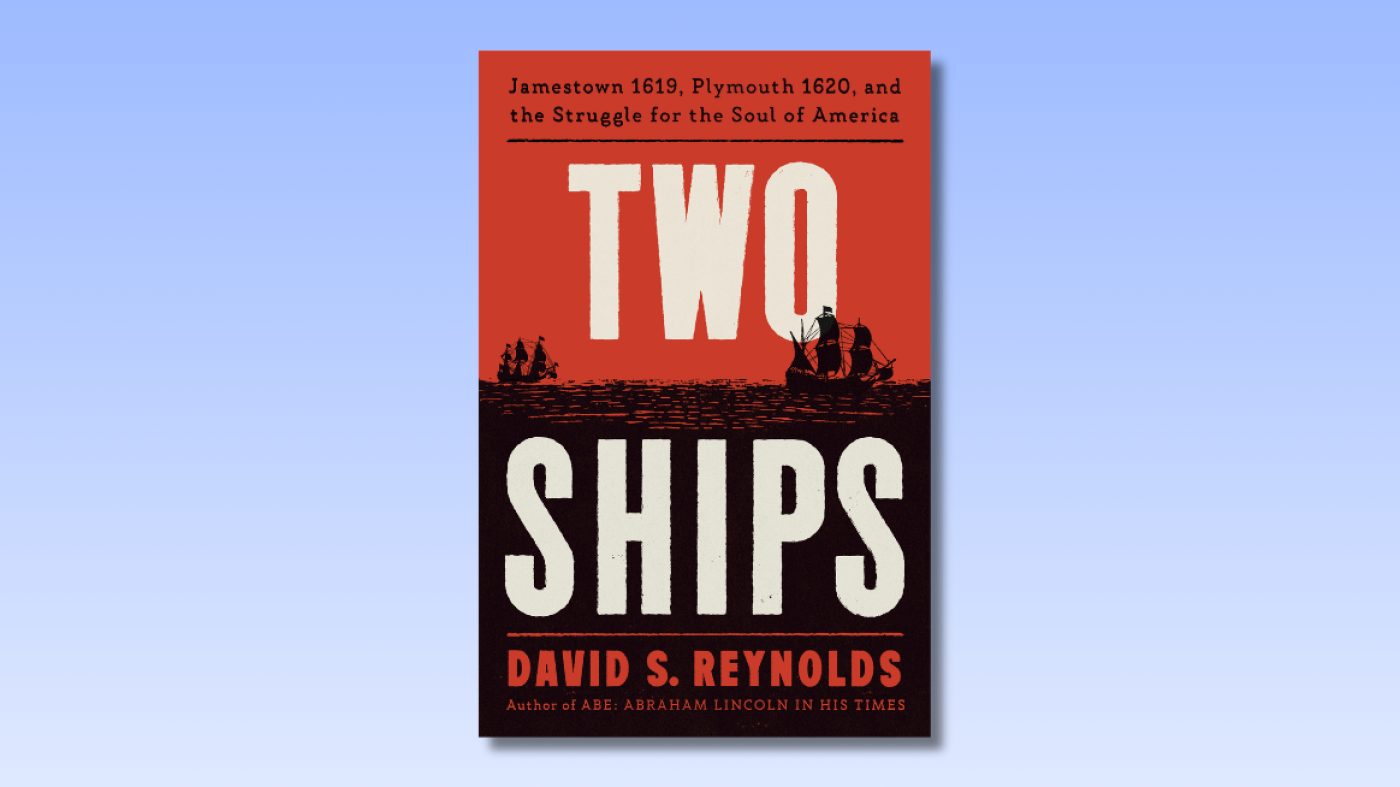
Just in time for a contentious 250th anniversary of the United States of America, historian David S. Reynolds’ latest book, Two Ships, helps us realize that any country that couldn’t agree on its own origin story is destined for divisive times.
Two Ships is about the complicated, conjoined legacy of the landings of the Mayflower, which carried the Pilgrims to Plymouth, Mass., in 1620, and the White Lion, which arrived in Jamestown a year earlier, bringing the first enslaved Africans to Virginia.
As Reynolds demonstrates, it’s not so much the facts of these two voyages, as it is the meanings ascribed to them, that made them such a powerful metaphor for two conflicting visions of American identity.
To simplify, the Mayflower’s passengers were separatist Puritans, dissenters to the reign of the English king, James I. As the United States developed, the Mayflower was credited with carrying the seeds of a radical democracy to the New World, one in which all men (in theory, at least) were equal before God.
In contrast, the European settlers of Jamestown were Royalists, also known as Cavaliers. Loyal to the monarchy, they believed in a strict hierarchy.
But the meaning of the images of the two ships shifted depended on who was invoking them and when. Not surprisingly, the metaphor was deployed most vigorously during the Civil War. In abolitionist speeches and writings, the White Lion or the “Slave-Ship,” as it was commonly called, was condemned for infecting America with the “plague-spot” of slavery.
Reynolds says that Frederick Douglass resorted to the “two ships” metaphor frequently, while Lincoln avoided it, hoping to preserve a unified ship of state. Meanwhile, Southern descendants of Cavaliers invoked the Mayflower to emphasize the intolerance and “cruel, persecuting” character of the Puritans. In a comment that resonates for our own times, Reynolds says:
It didn’t matter to the South that … by the mid-nineteenth century, the North had become a kaleidoscope of religious denominations, …, few of which resembled the faith of the Plymouth colonists. Distortion is intrinsic to cultural memory, especially when amplified by sectional or political bias. For Southerners, the Mayflower had brought Puritanism, which had yielded fanatical movements like abolitionism, now a dire threat to the Union.
In a brief-but-fascinating digression into the unpredictable power of literary fiction, Reynolds observes that the South’s fondness for Nathaniel Hawthorne’s anti-Puritan novel, The Scarlet Letter, and, even more, for the medieval historical romances of Sir Walter Scott, bolstered its nostalgia for a largely-imagined feudal society.

Reynolds quotes the always-quotable Mark Twain, no fan of Scott’s, as saying that Scott “did measureless harm; more real and lasting harm, perhaps, than any other individual that ever wrote …”
Two Ships is a dazzling survey of some three centuries of American history through a close reading of a metaphor. By the 1890s, Reynolds says, the interpretive tide had turned again: “Southern and Northern whites, feeling threatened by people of color and by an array of European immigrants, were retreating to a cocoon of racial solidarity that Mayflower celebrations helped reinforce.”
By the later-20th century, the image of the Mayflower was depoliticized and commercialized into Pilgrim hats and Black Friday sales. The powerful metaphor of the two ships receded into the mist.
Seven years ago, however, the 1619 Project piloted the White Lion — “The Slave-Ship” — back into view and anchored it at the center of debates about slavery’s place in the national story. The 1619 Project has been faulted for its historiography, and it does lie outside of the chronological boundaries of Reynolds’ book; still, it seems too momentous a reappearance of the White Lion not to at least acknowledge in this book.
That criticism noted, I think reading Two Ships would be an excellent way to observe this particular Fourth of July. It’s wise for all of us to have a more informed awareness of how Americans have understood, misunderstood and, often, flattened each other into stereotypes. Or, as Ernest Hemingway, one of the Mayflower Pilgrims’ more cynical descendants, might say in response to that sentiment: “Isn’t it pretty to think so?”



I took a kid’s camera to Paris Fashion Week, because was it ever really that serious? Yes and no. This men’s season happened during one of the hottest weeks in France’s recorded history, which inspired that specific brand of collective hysteria brought on by living through yet another unprecedented moment together — taking over our brains and ruining our plans to wear boots — and a grander reflection on what we were doing there and why. The throngs of teenagers doing back flips into the Canal Saint-Martin and playing soccer in the street set the mood for the week. If the world is ending, you might as well swim in dirty water and have fun doing it, no?
As far as the shows went, there was the coastal stoner energy of Tokyo-based Auralee — brightly colored leathers and furry flip-flops — that reminded me of the low-key elegance of hanging out in Southern California. At the Rick Owens show, Rick-heads made minimal weather-restrictive tweaks to their usual uniforms — platforms, leather, ground-grazing garments — making you appreciate the beauty in that level of ascetic dedication. Louis Vuitton built a literal beach as its runway, complete with sand and a giant wave that felt like a mirage: Is this a heat-induced hallucination or yet another buzzed-about set design under men’s creative director Pharrell Williams? At the Dries Van Noten show, there was an ice-cold beer fridge and popsicles, a chic and inspired detail only rivaled by a collection that was a breath of fresh air during a week where I Googled the symptoms of heat stroke more than once. The Willy Chavarria show was air-conditioned, pumped with Xinú perfume and felt expensive. Sven Marquardt, a Berlin photographer and Berghain’s most famous bouncer, was sitting in front of me, which I took as an incredibly good omen. The painted blue feet and Oakley collab sunglasses at the Kiko Kostadinov show felt auspicious as well.

A look from the Auralee show.
There were conversations floating around about how apocalyptic it felt sitting at a fashion show in over 100-degree Fahrenheit weather, our backs soaked, our minds dizzied, when the industry is responsible for something like 10% of global greenhouse gas emissions. The cognitive dissonance contributed to the thickness in the air that week.
At the Comme des Garçons show, called “If the War Were to End..,” models danced and ran and skipped out onto the runway for the finale, soundtracked by the joyous sound of children singing “You’re So Good to Me” by the Langley Schools Music Project. In that moment, we were happy, we were clapping, we might have even been hopeful. Humans have the capacity to hold a lot — a fan in one hand while attempting not to completely melt in the front row, and a fantasy that there might still be a future where we get to wear those leopard-print Dries shoes we fell in love with on the runway.

The moments before the Comme des Garçons show.

Comme des Garçons show attendees.

Comme des Garçons, head-to-toe.

The Comme des Garçons show.

The Dries Van Noten show.

A chic and inspired detail at the Dries Van Noten show: ice-cold beer.


Scenes from the ERL presentation.


The Kiko Kostadinov show.


Tapping in from Louis Vuitton beach.

Quavo at the Louis Vuitton show.

Scenes from after the Louis Vuitton show.

Scenes from the Louis Vuitton show.

Scenes from the Nahmias x Puma dinner at Gigi Paris.

Scenes from the On X Online Ceramics rave.


At Silencio to see Venezuelan DJ and producer Safety Trance.

The Willy Chavarria show.

Scenes from Willy Chavarria.

The throngs of teenagers doing back flips into the Canal Saint-Martin and playing soccer in the street set the mood for the week.

Taylor Swift and Travis Kelce of the Kansas City Chiefs, pictured at a basketball game in May, announced their engagement in August 2025.
Gregory Shamus/Getty Images
hide caption
toggle caption
Gregory Shamus/Getty Images
NEW YORK — Taylor Swift and Travis Kelce are officially married.
After three years of dating, The pop icon and Super Bowl-winning football player, both 36, tied the knot in New York, according to a statement from Swift’s publicist, Tree Paine.
There were neither bridesmaids nor groomsmen. “Instead, her brother Austin Swift served as Taylor’s Man of Honor and Jason Kelce was Travis’ Best Man. The ceremony joined both families together,” Swift’s publicist said in the statement released Friday evening.
The ceremony was officiated by comedian and a friend of the couple, Adam Sandler, the statement added.
The singer’s rep said that the couple was dressed in Christian Dior Haute Couture.
“The bride and groom’s wedding ceremony looks have been created by Christian Dior Haute Couture. They are designed by Jonathan Anderson, Creative Director of Dior Women’s, Men’s and Haute Couture Collections, in close collaboration with the Bride and Groom,” the statement said. “This is the designer’s first couture wedding dress for a world-renowned celebrity. Their shoes were custom made by Christian Louboutin and the bride wore Cartier jewelry.”
Security around the event was intense, so it remains unclear if the wedding was charming, if a little gauche. But the night before the ceremony the 20,000-person stadium was bathed in a lavender haze.
Details gleaned from a city permit obtained by The Associated Press, showed details of a “special event at MSG” scheduled to begin Friday evening and running overnight Saturday.
As speculation built, fans began gathering in front of the stadium ahead of the expected wedding, despite the couple’s efforts to keep details of the celebration under wraps.
Superfans and sleuths appeared to have their hunches confirmed on Friday, as dozens of black cars dropped off elegantly dressed guests outside of Madison Square Garden in New York City.
Lisa Benham and her daughter, Zara, posed for selfies outside the Garden. They’re visiting from England and both told NPR they’re huge Swifties.
“I just remember always listening to her,” said Zara Benham, age 17. The women said they’ve followed all the ins and outs of Swift’s romance with Travis Kelce, a tight end with the Kansas City chiefs.
“I’m thrilled for her. I love it. I love the whole story,” gushed Lisa Benham, 47, who says she became a fan after her daughter dragged her to a Swift concert. “I’m pleased for them, really pleased for them.”

A woman wearing a white veil stands outside Madison Square Garden in New York City on July 3, 2026. Taylor Swift and Travis Kelce’s official wedding plans are tightly under wraps, but New York is bracing to host the celebrity marriage of the year.
CHARLY TRIBALLEAU/AFP
hide caption
toggle caption
CHARLY TRIBALLEAU/AFP
Swift has a massive global platform, and a tendency to pull back the curtain on her personal life in song lyrics and the occasional documentary. But the shared little about her wedding plans since she and Kelce announced their engagement last August.
“You would think that I had been the type of person who would have obsessed over the idea of a wedding my whole life, but I actually never thought about what I would ever do or what I would want until I met the person,” Swift told the U.K.’s Heart Radio in October, while promoting her last album The Life of a Showgirl.

In the months since, speculation mounted over where and when the wedding would take place. In recent weeks, the theories all pointed in the same direction: New York City’s Madison Square Garden on July Fourth weekend.
Swift loves a good Easter egg, and her fans have been known to crack at least some of them successfully. That appears to have been the case with her wedding, even as some wondered for days whether it was merely a high-profile ruse.

Swift and Kelce celebrate the Kansas City Chiefs’ Super Bowl victory in Feb. 2024.
John Locher/AP
hide caption
toggle caption
John Locher/AP
A recap of their romance
Swift and Kelce began dating in the summer of 2023, during the first year of her record-breaking Eras Tour.
The Kansas City Chiefs tight end admitted on a July 2023 episode of New Heights — the podcast he co-hosts with his brother, retired NFL player Jason Kelce — that he had tried to meet Swift after one of her shows in the area.

“I was a little butt-hurt I didn’t get to hand her one of the [friendship] bracelets I made for her,” Kelce said. “I wanted to give Taylor Swift one with my number on it.”
Swift later told Time she thought that call-out was “metal as hell.”
Within months, she was attending his games — most famously, the 2024 Super Bowl his team went on to win. He was spotted in the crowd — and even onstage — at many of her shows the next year.
Fans got a peek into their chemistry when Swift appeared on New Heights last August to announce her 12th studio album, The Life of a Showgirl (which she said was heavily influenced by their relationship). She said she and Kelce bonded in part over similarities in their careers, in which they both “entertain people for three-plus hours in NFL stadiums.”

Less than two weeks later, Swift announced their engagement on Instagram, with photos of a flower-filled backyard proposal and a massive diamond ring. In an episode of The Graham Norton Show a few months later, Swift deflected questions about her wedding planning but joked about inviting “anyone I’ve ever talked to.”
Sleuths had been eyeing Madison Square Garden
Speculation about a July 3rd wedding at MSG reached new heights this month.
Part of that was through the process of elimination: Swifties descended on Watch Hill, R.I. — where Swift owns a seaside estate — on June 13, but tabloid reports of a ceremony there proved unfounded.
But there also seemed to be a paper trail leading to Manhattan.
New York City Mayor Zohran Mamdani seemed to drop a hint while talking to reporters in June.
“We are used to big events, and we are incredibly excited for this one,” Mamdani said, referring to the World Cup. “We know it coincides with the Knicks Finals run. We know it coincides with July Fourth, America 250, Taylor Swift’s wedding all happening at the same time.”

Forklifts and trucks were spotted outside Madison Square Garden in New York on Tuesday, as speculation about a weekend wedding grew.
Leonardo Munoz/AFP via Getty Images
hide caption
toggle caption
Leonardo Munoz/AFP via Getty Images
Then, The New York Times reported that an event company obtained permits for a gathering of up to 1,000 people at Madison Square Garden on July 3rd (and a smaller event the day before). It also cited unnamed sources with details about plans for street closures in the area, later confirmed by City Hall spokesperson Dora Pekec to Reuters.
CBS News shared video this week of trucks unloading “garden party” themed equipment outside the venue earlier this week. And the venue’s online event calendar is suspiciously empty until July 7.
Mamdani appeared to double down Tuesday, while speaking to reporters about the forthcoming heat wave.
“My recommendation to all New Yorkers is to stay inside and stay cool, and if you happen to be getting married at Madison Square Garden you will be staying inside and staying cool, and I think it’s a good example to set for the city at large,” he said with a smile.
This isn’t the first celebrity wedding celebration to take place at MSG. Sly Stone married actress Kathy Silva there in June 1974. As Stone wrote in his memoir, he was talking to his A&R liaison at Epic Records, Stephen Paley, about wanting to marry Silva, and one of them jokingly suggested he do so before an upcoming show.
“I could do a gig, get paid, and get married at the same time. ‘Go, go, go,’ I told him. He went and went fast,” Stone wrote, adding, “Steve wanted everyone to wear gold to keep the shine high.”
According to a New York Times report at the time, the two married in front of nearly 23,000 people, at a ceremony that turned into a full-fledged Sly and the Family Stone concert.

A closer look at Swift’s engagement ring from the 55th Annual Songwriters Hall of Fame Induction and Awards Gala in New York last month.
Kena Betancur/AFP via Getty Images
hide caption
toggle caption
Kena Betancur/AFP via Getty Images
Why New York, and why now?
Madison Square Garden, which can hold nearly 20,000 people, may seem like a surprising choice for a singer who prizes her privacy.
But Emma Fitzsimmons, one of the New York Times reporters covering the wedding, told NPR last week that it makes sense for privacy and security reasons.
“It’s sort of this locked box where paparazzi can’t get inside,” she said. “There’s not going to be helicopters overhead. She can release photos of the event and her dress, which we’re all very curious to see, on her own terms.”
Swift, who owns a sprawling Tribeca compound, is famously a fan of New York City. She even has a song about it: “Welcome To New York,” on the album 1989, inspired by her relocation to the city.

And she has a well-documented love of Fourth of July. Over the years, many photos have emerged — some on Swift’s own Instagram — of the star celebrating the holiday weekend in Rhode Island with friends and fireworks.
And it’s not lost on Swifties that she met Kelce shortly after the holiday in 2023, which she celebrated with girlfriends and shared photos of on Instagram.
“Happy belated Independence Day from your local neighborhood independent girlies,” she captioned the photo. “See you tonight Kansas Cityyy.”
-

 West Virginia16 seconds ago
Two Mountaineers Could Be on Team USA’s Radar in the Near Future
-

 Wyoming7 minutes ago
Audit spots some errors, but gives Wyoming Business Council passing grade
-

 Crypto10 minutes ago
Zcash Price Climbs 13% in a Week as Network Preps Ironwood Upgrade
-

 Finance15 minutes ago
Former top Treasury adviser warns that HMRC plans to track personal finances with AI
-

 Fitness22 minutes ago
The Fitness Secrets of Wimbledon’s Top Tennis Pros
-

 Movie Reviews30 minutes ago
1986 Movie Reviews – About Last Night, Big Trouble in Little China, The Great Mouse Detective, Howling II, Psycho III, Under the Cherry Moon | The Nerdy
-

 World35 minutes ago
Turkey's Erdogan Says Israel Must Not Scupper US-Iran Deal
-
Lifestyle1 hour ago
You know the Mayflower. What about the White Lion? Here’s the story of ‘Two Ships’

