Lifestyle
How Lauren Sanchez Helped Design Blue Origin’s Flight Suits


What do you wear for your first trip to space?
If you are like most people, probably whatever spacesuit or astronaut outfit the company (or government agency) you are flying with provides. However, if you are Lauren Sánchez — journalist, pilot, children’s book author, philanthropist and fiancée of Jeff Bezos, the second-richest man on the planet — you have another idea. You think, “Let’s reimagine the flight suit.”
“Usually, you know, these suits are made for a man,” Ms. Sánchez said recently on a video call from the West Coast. “Then they get tailored to fit a woman.” Or not tailored: an all-female spacewalk, planned in 2019, had to be canceled because NASA did not have two spacesuits that fit two women. (Instead they sent out one woman and one man.)
But Ms. Sánchez is part of the first all-female flight since Russia sent Valentina Tereshkova on a solo flight in 1963. She will be going up on a Blue Origin flight with a pop star (Katy Perry), a journalist (Gayle King), two scientist/activists (Amanda Nguyen, Aisha Bowe) and a film producer (Kerianne Flynn). Feeling like yourself is what makes you feel powerful, she said, and you shouldn’t have to sacrifice that because space has been — well, a mostly male space. Even if you are a space tourist, rather than a full-fledged astronaut.
So five months ago, Ms. Sánchez got in touch with Fernando Garcia and Laura Kim, the co-founders of the brand Monse, who are also creative directors of Oscar de la Renta (Mr. Garcia and Ms. Kim made Ms Sánchez’s 2024 Met Gala outfit). She wanted to know if they would work with Blue Origin, Mr. Bezos’ space company.
“I was like: right away!” Mr. Garcia said over Zoom.
The result of their collaboration will be unveiled on Monday, when Ms. Sánchez and crew climb into the Blue Origin rocket in West Texas, and take off for their approximately 11-minute trip past the Kármán line and into zero gravity.
“I think the suits are elegant,” Ms. Sánchez said, “but they also bring a little spice to space.”
When Gayle King tried hers on, she said, she loved it. She thought the suits looked “professional and feminine at the same time.”
Which, when it came to space, happened to be “something we had never seen before,” she said.
The Monse Blue Origin suits, which were produced by Creative Character Engineering, look like a cross between “Star Trek” (on top) and the outfits Elvis wore in his Vegas years (on the bottom) and are made of a flame-resistant stretch neoprene, rather than the shiny polyester-looking fabric of the original, baggier, Blue Origin suits, as modeled by Mr. Bezos on a flight in 2021. (Ms. Sánchez helped design those suits as well.)
Still, “We really didn’t know where to start,” Mr. Garcia said. “There’s no precedent. All the references are men’s spacesuits.”
Because Blue Origin fliers do not go out into space, Mr. Garcia and Ms. Kim did not need to incorporate the life-support system of the classic astronaut suit, but they still had to work within technical specifications.
“Simplicity was important, and comfort, and fit,” Mr. Garcia said. “But we also wanted something that was a little dangerous, like a motocross outfit. Or a ski suit. Flattering and sexy.”
Ms. Kim added: “I, personally, would want to look very slim and fitted in my outfit.”
They batted ideas back and forth with Ms. Sánchez. “We even had a meeting on what underwear Lauren is going to wear,” Mr. Garcia said.
“Skims!” Ms. Sánchez responded.
The result is a body-con jumpsuit, with a compression layer, a slight mandarin collar, a dual-zip front that can look like it is open to the waist, a belt, and a zipper on the side of each calf, so the wearer can create a flared effect according to their own taste. “You’ll be able to zip or unzip,” Mr. Garcia said. (Ms. King said she liked the bell-bottom idea.)
The suits also feature a darker, ombre effect on the sides that works to shade the body, almost like trompe l’oeil. There are small pockets on the arms, but leg pockets were dropped because they were too bulky, Ms. Kim said. Every crew member was three-D body-scanned so the suits could be made exactly to their measurements.
“I almost put a corset in your suit, because I know you wouldn’t have been against it,” Mr. Garcia said to Ms. Sánchez.
“I probably wouldn’t have,” she said. But “we’re going to be in zero gravity. So we have to be able to move.” When Ms. Sánchez first tried the prototype on, she said, “I was stretching. I was doing a back bend. I was like, ‘OK, let’s make sure it doesn’t split up the back in space.’”
Mr. Garcia said when he saw the suit on he thought, “Damn, you look good. You’re going up in space looking hot.”
Amanda Nguyen called the suits “revolutionary.” Clothes are about identity and representation, she said, and by allowing women to look like women, the suits are a statement that “women belong in space.”
Blue Origin is not the first private space company to enlist a fashion brand for help in outfit design. Axiom Space has also been working with Prada on their Extravehicular Mobility Unit spacesuit, otherwise known as the suit that NASA’s astronauts will wear when they walk on the moon during the Artemis III mission in 2026 (prototypes were revealed last October). Similarly, Elon Musk worked with the costume designer Jose Fernandez, the man behind the ‘fits of “The Fantastic Four” and “The Avengers,” on the SpaceX suits.
As to why fashion designers were suddenly so popular with the astrophysics set, Mr. Garcia said, “if we make suits look approachable and like something anyone could wear, then space might feel a little bit less distant.” Maybe, Mr. Garcia said, when people saw the Monse Blue Origin style, they might even think they “want to buy that spacesuit to go to the gym.”
In fact, he went on, he and Ms. Kim were thinking they might “set up an office on Mars.” In both cases, he was joking. Sort of.
It turned out Mr. Garcia, Ms. Kim and Ms. Sánchez were already working on something else for Blue Origin, related to “the moon.” Blue Origin has been selected by NASA to develop the human landing system for the Artemis V mission to the Moon, but Ms. Sánchez would not say if Monse would have anything to do with that.
She was, however, excited to give space travel a new look.
“This isn’t what you would call ‘normal,’ but neither is sending six women into space,” she said. “If you want to do glam, great; if you don’t, great.” The point was everyone gets to choose.
Then she quoted something she said Katy Perry had told her: “We’re putting the ‘ass’ in astronaut,” she said.



A tarp covers the facade of the John F. Kennedy Memorial Center for the Performing Arts in Washington, DC, on June 13, 2026. Workers removed President Donald Trump’s name from the facade of the building.
Alex Wroblewski/AFP via Getty Images
hide caption
toggle caption
Alex Wroblewski/AFP via Getty Images
WASHINGTON – Workers have taken down President Donald Trump’s name from the Kennedy Center, hours after a court-ordered Friday deadline to remove it from the building, and less than six months after it was first affixed to the iconic performing arts venue. The removal of the more than a dozen bronze letters followed a judge’s ruling that the Center could not be renamed without Congressional approval.

In a court filing, Kennedy Center Executive Director and Chief Operating Officer Charles Matthew Floca confirmed that President Trump’s name has been removed from the building façade, despite what Floca said were weather-related delays. References to Trump on the center’s website are also gone.
Just a month into his second term, Trump ousted the Kennedy Center’s president, board chair and board members, then replaced them with a group of trustees that soon named Trump as chairman. Soon after, the president’s name was added to the building, so that it became, “The Donald J. Trump and the John F. Kennedy Memorial Center for the Performing Arts.”
The administration had on Friday asked a higher court to stay the ruling as it argued that Trump’s name on the building had helped attract donors and was crucial to raising funds for the Kennedy Center’s renovation.
“Without the name, “Trump” on the Building, our fundraising will not only come to a halt,” the administration wrote in a court filing, “but any and all monies raised or committed would be obligated to be returned, refunded or terminated.”

An appeals court denied that request Friday night. Workers erected scaffolding on Friday around the section of the building where Trump’s name had been added in December 2025. Then, in a pre-dawn operation, the laborers draped the scaffolding in tarpaulin, before removing the giant metallic letters. The Kennedy Center had asked a judge to briefly extend the deadline for this removal —because of Friday night thunderstorms forecast for Washington D.C.
Finally, with the scaffolding up, and tarpaulin covering their efforts, workers began to remove Trump’s name. Hundreds of people braved the rain and thunderstorms overnight to document the take-down. Some heckled those involved for hiding the removal using tarpaulin – with shouts of “Cover up!” and “Cowards!”
Among the onlookers watching proceedings was Krystal Brewer, 40, who works for a social justice advocacy group. She said removing Trump’s name was a way to enforce accountability, maintain government checks and balances, and reclaim a piece of Washington from a president who she said has tried to impose his stamp on the nation’s capital. “It’s about just not being able to do something just because you think you’re the most powerful person and you can defy the courts,” Brewer said.

Protestors wave a U.S. and signs as workers prepare to remove President Donald Trump’s name from the John F. Kennedy Center for the Performing Arts in Washington, Saturday, June 13, 2026.
Cliff Owen/AP
hide caption
toggle caption
Cliff Owen/AP
Trump has recently overseen the controversial demolition of the White House’s East Wing in favor of a giant ballroom, and ordered large banners of his face to hang from several federal buildings during his second term. “I wanted to see us get a part of our city back,” said Brewer. “With all the things that he’s trying to destroy and corrupt and taint and alter, it’s nice to see a piece of it being restored.”
Also among those gathered on the Center’s plaza Friday was Rep. Joyce Beatty of Ohio, who initiated the lawsuit to remove Trump’s name from the building. She wrote on social media that she had stood outside to watch, writing “No more stalling. It’s time for Trump to obey the law.”

Watching the tarps go up a little before 2 a.m., Saturday, another onlooker, 60-year-old nurse Mary Foltz, said it was a metaphor for the Trump administration.
“I think there’s a lack of transparency — and that’s just the epitome of it,” Foltz said. “This is a meme.”

There’s a sense of quiet mystery in tarot. That’s why during my reading last week, it was more peculiar than disruptive when a dancer hopped on a table to lay at a 90-degree angle and jet her feet in the air.
Despite said activity, the tone was contemplative, and moments later, as I was being asked to describe the colors and mood of a Ten of Swords card, I was tapped on the shoulder. After a gesture to follow, I was handed a lantern.
The way I swayed the light would now dictate the performer’s movements. We may not have been dancing, but it was close. Melancholic and intimate, the performer (Haylee Nichele) silently guided me to become comfortable in my discomfort, to sit with the evening’s themes of longing, loss, confusion and impending grief.
Sam Alper’s Bill, foreground, and Haylee Nichele’s Constance in Koryn Wicks’ “You Must Be Here for the Reading,” an immersive tarot show.
(Daniel Kleen)
“You Must Be Here for the Reading,” running through June 20 at North Hollywood’s After Hours Theatre, is part theatrical and dance performance, part tarot reading and part cocktail hour. It’s also personal, led by two actors who encourage the attendees to open up, to complete poems and to generally tune into their vulnerability.
The 60-minute show, partly scripted and partly improvised, comes from the mind of Koryn Wicks. Trained in dance and choreography, Wicks’ day job is in themed entertainment while her personal projects explore the immersive space. They’re theatrical works that experiment with audience interaction. “You Must Be Here for the Reading” is no different.
The setup: Collectively, our group of eight has arrived at a tarot reading, only the famed reader we are there to work with, Constance, performed by Nichele on the night I saw, never arrives for her assigned role. We know her fate, but her partner, Sam Alper’s Bill, who nervously attempts to carry on with the performance in her absence, does not.
From there, “You Must be Here for the Reading” becomes a show heavy on audience participation. There are scripted, story-specific beats, but the cards pulled — and the tales they tell — is, of course, randomized.

Sam Alper as Bill, an unsuspecting tarot card reader in Koryn Wicks’ “You Must Be Here for the Reading.”
(Daniel Kleen)
“I knew that I wanted the audience to be the primary drivers of the tarot reading,” Wicks says. “I knew that I wanted the host to not be a tarot reader and there to be some sort of event that made it so the audience would have to take the reins and read the tarot.”
In turn, “You Must Be Here for the Reading” works for both those who are novices to the space as well as those who are more experienced. During the pre-show, guests can explore tarot books and uncover slips of paper hidden in them that prompt us to answer questions or complete poems — the latter will figure into the performance. A worksheet given to us asks us to interpret some core tenets, as well as to enter the reading with a question we would like to explore.
The show then focuses on how each attendee’s desires, concerns or lived experiences shape the perception of the reading.
“What’s drawn me to tarot is the way it’s built on symbolism and the way that symbolism is embedded in the collective unconscious,” Wicks says. “I think it’s really fascinating that we have this artifact that has this ability to give us insight into a lot of shared experiences. When I’ve read different books about tarot, or had my cards read by different people, there is an openness to interpenetration.
“The assignment I gave myself for this piece,” Wicks continues, “was to create an experience in which you had a group of people coming together and going through the process of defining the symbolism and meaning of the cards in real time.”
And yet the show also pulls from Wicks’ background in dance. While Constance never shows for the reading, her presence is still felt, often hovering or circling around the table with movements designed to interpret the tone of the reading. She’s a ghostly presence, the gracefulness heightening the somber emotions of the night. Though she and Bill never interact directly, much of the dance seeks to explore their unseen bond. At times, Constance may call on various audience members to act as a dance partner.
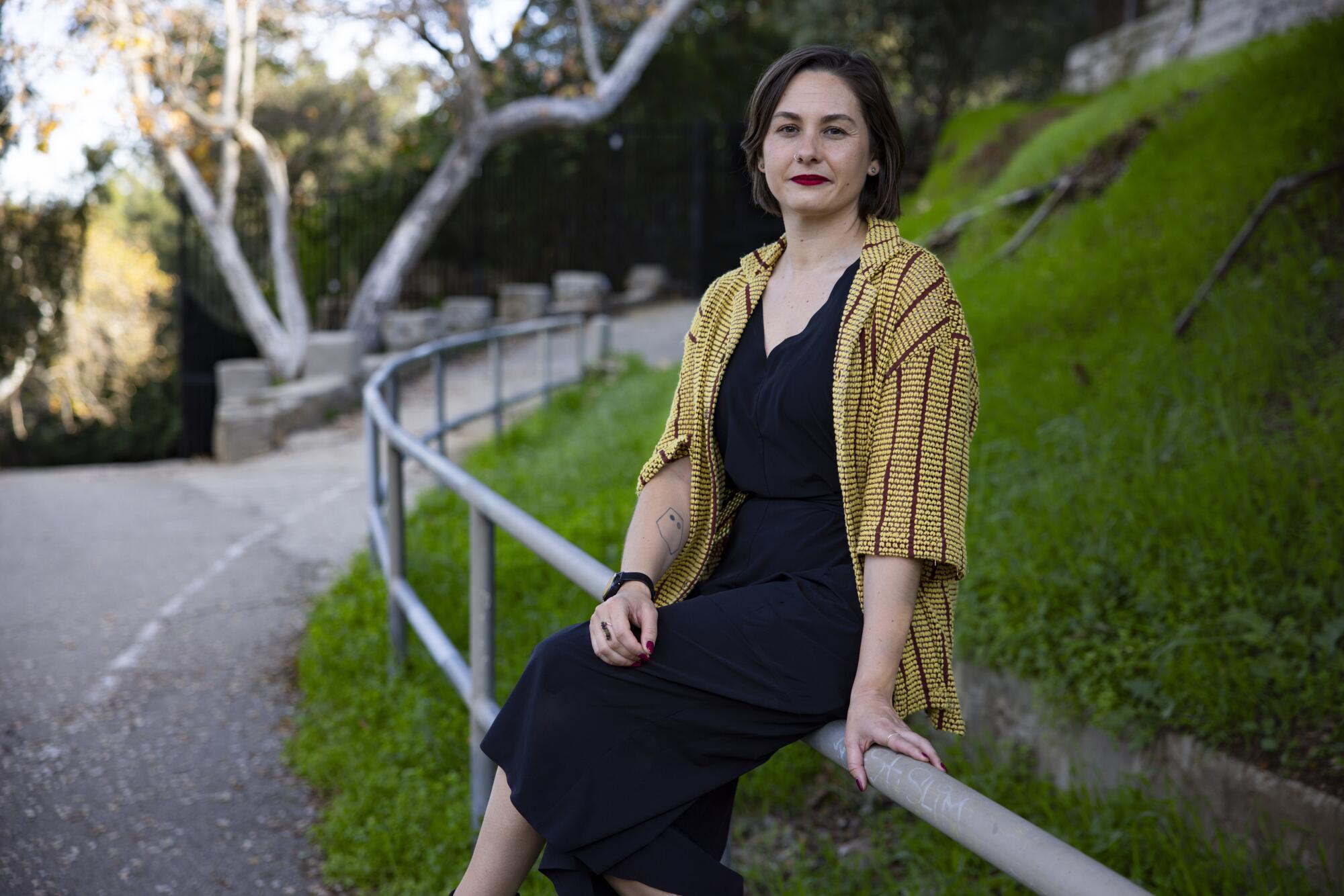
Koryn Wicks, creator of “You Must Be Here for the Reading,” an immersive tarot performance in which audiences are tasked with deciphering their own cards while a melancholic story unfolds around them.
(Kayla Bartkowski / Los Angeles Times)
“I really believe that one of the most beautiful things art does for us is remind us that we are not alone,” Wicks says.
Immersive art allows for a sense of participation, which Wicks hopes will increase one’s appreciation of dance.
“Dance is an embodied art form,” Wicks says. “There is science that shows that some of the enjoyment from watching dance comes from imagining yourself moving. In North America, a lot of people haven’t had an experience or education with dance, especially not concert dance. Then we ask them to sit in a dark auditorium in a small chair and not move to enjoy it. I found through my research, both practical and academic, there is something to inviting audiences to participate in dance that allows them to derive meaning from it.”
‘You Must Be Here for the Reading’
While there isn’t enough time in the show for everyone to have a one-on-one experience with the dancer, watching an audience and cast member attempt to get in sync with each other underlines the night’s themes of connecting. Ultimately, that’s the space where the show resides. “You Must Be Here for the Reading” uses tarot as a means to bring some structure to our often disconnected lives.
“It stands in contradiction to our current historical moment,” Wicks says of the show. “It’s very anti-AI. It’s asking people to sit with books and to find little seeds and not necessarily pursue solutions or puzzles. It’s asking us to connect, sometimes with strangers.”
I kept my question that I brought to the reading secret, but I found the show provided a hopeful answer. Not because the cards offered a solution. Instead, they provided a community.

Sunday Puzzle
NPR
hide caption
toggle caption
NPR

On-air challenge
Every answer is the six-letter name of a world capital, in which I’ve changed the first and last letters. You name the capitals.
Ex. VASSAL –> NASSAU (capital of the Bahamas)
1. CONDOR
2. ROSCOE
3. PUBLIC
4. SAVANT
5. ZANILY
6. DRAG UP
7. ETHENE
8. TARSAL
9. TUSCAN
10. NONACT
11. I AGREE
12. [7 letters:] CALLING
Last week’s challenge
Rearrange the letters of NECESSARY MISPRINT to spell a familiar phrase.
Answer: Sic semper tyrannis.
Winner:
Judy Alexander of South Burlington, Vermont.
This week’s challenge
This week’s challenge comes from listener Michael Pickard. Name something in 10 letters that’s found in a kitchen. Drop its sixth letter to name something on a keyboard. Then drop the new word’s fifth letter to name something no one wants to get. What words are these?
If you know the answer to the challenge, submit it here by Thursday, June 18 at 3 p.m. ET. Listeners whose answers are selected win a chance to play the on-air puzzle. Important: include a phone number where we can reach you.
-

 Alaska2 minutes ago
The Sunday Minefield – June 14, 2026
-

 Arizona9 minutes ago
Arizona Lottery Pick 3, Fantasy 5 results for June 14, 2026
-
Arkansas12 minutes ago
Arkansas Lottery Cash 3, Cash 4 winning numbers for June 14, 2026
-

 California17 minutes ago
Miss California competition returns to Fresno at the Saroyan Theatre
-

 Colorado24 minutes ago
Colorado Parks and Wildlife kills ‘elusive’ wolf tied to attacks on at least 22 sheep since 2025
-

 Connecticut27 minutes ago
Water safety expert warns of fast-changing tides as Fairfield police search for missing fisherman
-

 Delaware32 minutes ago
3-year-old shot in Wilmington, Delaware
-

 Florida39 minutes ago
Intense heat wave grips South Florida: Storms and “feels like” temps near 105°F this week

