Lifestyle
Come for the roller coaster, stay for the shops: Can malls be fun again?


Mall of America’s amusement park is one of the ways the shopping center lures tourists and locals to make a day of their visit.
Jenn Ackerman for NPR
hide caption
toggle caption
Jenn Ackerman for NPR
In the bleary predawn hours, it’s hard to tell Mall of America from any other high-end shopping center. Workers wield mops, hammers and forklifts. Under dim lights, Cinnabon bakers stretch and roll buttery dough. Around 7 o’clock, mall walkers silently swarm the building, meticulously tracing every nook of the perimeter.
But then, you grasp the scale.
Mall walkers count in the dozens, speed-stepping past towering unlit Christmas trees and 11-foot nutcracker statues. One lap around the mall is just over a mile. Local shopping malls vary in size, of course, but Mall of America is at least three of them stuck together. Maybe seven. Arriving in Minneapolis by plane, you first see it from the sky.
At 10 a.m. — opening time — a caravan of yellow buses releases a horde of middle-schoolers on a field trip. Like a shock wave, they push to the center of Mall of America, where roller coasters loop around a carousel, a zip line, a SpongeBob-themed jumping gym. The amusement park, Nickelodeon Universe, is a top reason locals visit.
“I feel like most of the time, we just go on rides,” says Sarah Matteen, whose 6-year-old daughter, Maeve, just went on her first big-kid ride: the soar-then-plunge Splat-O-Sphere. Now, Maeve is clinging behind her mom’s leg. “She said she had lots of butterflies.”
And now that’s over, what will they do?

The exterior of Mall of America in the Minneapolis suburb of Bloomington, Minnesota.
Jenn Ackerman for NPR
hide caption
toggle caption
Jenn Ackerman for NPR

Shoppers stroll inside Mall of America on a catwalk-like bridge connecting stores, food spots and the amusement park.
Jenn Ackerman for NPR
hide caption
toggle caption
Jenn Ackerman for NPR
“Probably go to a couple of different stores,” Matteen says. Will she buy something? “Probably.”
This was exactly the goal when Mall of America developers, back in 1989, decided to stick five football fields’ worth of roller coasters and playgrounds in the middle — with stores encircling them.
It was rare then; it’s still rare now. But the idea behind it — dubbed “retailtainment” — is a strategy many believe could save the American mall.
After a tipping point, malls try to be destinations
People don’t visit malls like they used to. For two decades, shopping centers have lost sales to the Internet. Foot traffic at indoor malls is 5% below what it was before the COVID-19 pandemic, according to tracking firm Placer.ai.
At the same time, malls have sprawled so much that per capita, Americans still have four times more retail real estate than Europeans, says retail expert Mohit Mohal.
“At some point of time, you know, you reach a tipping point,” says Mohal, who advises malls and retailers at the consulting firm Alvarez & Marsal. Growing by adding locations no longer works, he says, so: “Malls have now been asking, how do I create a compelling value proposition?”
That’s how the mall becomes home to gyms and salons, golf simulators and pickleball courts — not just shops but stuff to do, reasons for people to return. There are even hotels, offices and apartment complexes so a shopper may never have to leave the vicinity.

Passengers soar and whirl on a ride named after the Teenage Mutant Ninja Turtles at Nickelodeon Universe, the amusement park inside Mall of America.
Jenn Ackerman for NPR
hide caption
toggle caption
Jenn Ackerman for NPR

Plenty of malls cannot afford this change. Some are too far gone to try. Some grapple with theft or other crime, deciding to resort to limits like curfews.
But of those with a chance to make it for the long haul, many are trying to turn back time — to when a mall was more than just a place to return an online order, but a destination for the day.
They’re adding activities that “traditionally — 20 years back — people would have not gone to a mall for,” Mohal says. “And that is helping revive the traffic in the mall.
“I don’t think it’s the silver bullet, nor would I say that malls are dying, but I would say malls are evolving,” he adds.
If you build it, they will come — and shop
By lunchtime, Mall of America is teeming with toddlers toting Build-A-Bears, babies bouncing in strollers, adults studying store maps. A girl, around 10 years old, dangles from the top of a human claw machine.
The mall started out 80% retail and 20% entertainment, but now the split is closer to 60% and 40%, says Jill Renslow, one of the executives running this place. There’s a Sea Life aquarium, mini golf, arcades, escape rooms and a psychedelic fun house called Wink World. Gleaning from sister malls — New Jersey’s American Dream and Canada’s West Edmonton Mall — Mall of America is now building a water park.
Something stands out, however, talking to mall visitors around these spots: Many say the only things they bought or would buy that day, besides tickets, are snacks at the food court. How does that make sense for the rest of the mall, for the stores?

Some 32 million people visit Mall of America each year. “We’re 70 and sunny every day,” jokes Jill Renslow, one of the executives running the mall.
Jenn Ackerman for NPR
hide caption
toggle caption
Jenn Ackerman for NPR
“The longer time that [people] spend in a space, typically they’re going to spend more money,” replies Renslow, chief business development and marketing officer. “But even if they don’t on that first visit, they’re going to come back because they had a great experience. … We’re along for the ride for the long haul.”
Mall of America doesn’t disclose financials as a privately held company, but Renslow says retail sales are up 5% so far this year. Visits are up 4%, she says. That’s nearly the reverse of the drop in foot traffic at malls nationwide.
Grabbing a bite turns into a ride — or two
Being a tourist destination certainly helps. Some 32 million people come every year. In a Minnesota winter, “we’re 70 and sunny every day,” Renslow jokes.
Almost on cue, a couple rolls full-size suitcases at the edge of Nickelodeon Universe: Janelle Mayfield and Evan McManus of Louisville, Kentucky.
“We literally just landed,” Mayfield says.
They jumped on the light rail at the airport and discovered it drops them directly at the mall. With a few hours to kill before Airbnb check-in, they thought they’d grab a bite — but found themselves between a log chute and a climbing wall. A roller coaster thunders overhead, heading for a loop.
“I’m wanting to, as soon as the Airbnb opens up, drop off our luggage and then come back,” Mayfield says, laughing.
The mall’s gravitational pull has worked once again.
Dreaming up reasons for people to visit
The strategy, it seems, hinges on a simple premise: Just get people in the door.
Mall of America throws 300-some events a year: the largest gathering of people dressed as Teenage Mutant Ninja Turtles, a 67-foot-tall real gingerbread house, hair-bedazzling before Taylor Swift’s concert, wrestling matches, even a rave.

Dan Jasper, who’s in charge of leading visitors on tours of the mall, steps out from behind the scenes of Nickelodeon Universe.
Jenn Ackerman for NPR
hide caption
toggle caption
Jenn Ackerman for NPR

Dan Jasper says he first visited Mall of America the week it opened in 1992. He’s now a senior vice president who has been with the company for over 19 years.
Jenn Ackerman for NPR
hide caption
toggle caption
Jenn Ackerman for NPR
“We brainstorm. We go, ‘What can we do? What would be fun? What would grab the attention?’” says Dan Jasper, a senior vice president. “We had a bride and groom get married in Sea Life, in the shark tank, in scuba gear. … Shark knocked her veil off, live on national TV.”
One time, they got singer Ed Sheeran staffing the Lego store. Renslow says the staff constantly tracks upcoming concerts, music and movie releases.
This also means a never-ending hunt for uncommon stores and pop-ups: a spa for children, a shop of Japanese snacks and toys, a physical space for a TikTok brand.
“There’s always been construction here for the whole 16 years I’ve been here,” says Andrew Stokke, a housekeeper, leaning on his cleaning cart at the foot of a roller coaster tower. He points in every direction: “This is brand-new. That’s brand-new. It’s constant.”

Shoppers walk through Mall of America, the largest shopping mall in the United States.
Jenn Ackerman for NPR
hide caption
toggle caption
Jenn Ackerman for NPR
This, of course, takes a lot of money and staff. Renslow acknowledges this and the fact that Mall of America’s size, history, reputation and private ownership give it power that few other malls enjoy. She also calls change the key ingredient and staleness the enemy of survival.
“You can’t fall by the wayside of just doing what you’ve always done,” Renslow says.
It’s the mall’s job to reinvent itself to draw people in — then it’s up to the stores to turn those visitors into shoppers.



The Tin Soldier, one of Nicolas Coppola’s marionette puppets, is the main character in The Steadfast Tin Soldier show at Coppola’s Puppetworks theater in Brooklyn’s Park Slope neighborhood.
Anh Nguyen for NPR
hide caption
toggle caption
Anh Nguyen for NPR
Every weekend, at 12:30 or 2:30 p.m., children gather on foam mats and colored blocks to watch wooden renditions of The Tortoise and the Hare, Pinocchio and Aladdin for exactly 45 minutes — the length of one side of a cassette tape. “This isn’t a screen! It’s for reals happenin’ back there!” Alyssa Parkhurst, a 24-year-old puppeteer, says before each show. For most of the theater’s patrons, this is their first experience with live entertainment.
Puppetworks has served Brooklyn’s Park Slope neighborhood for over 30 years. Many of its current regulars are the grandchildren of early patrons of the theater. Its founder and artistic director, 90-year-old Nicolas Coppola, has been a professional puppeteer since 1954.
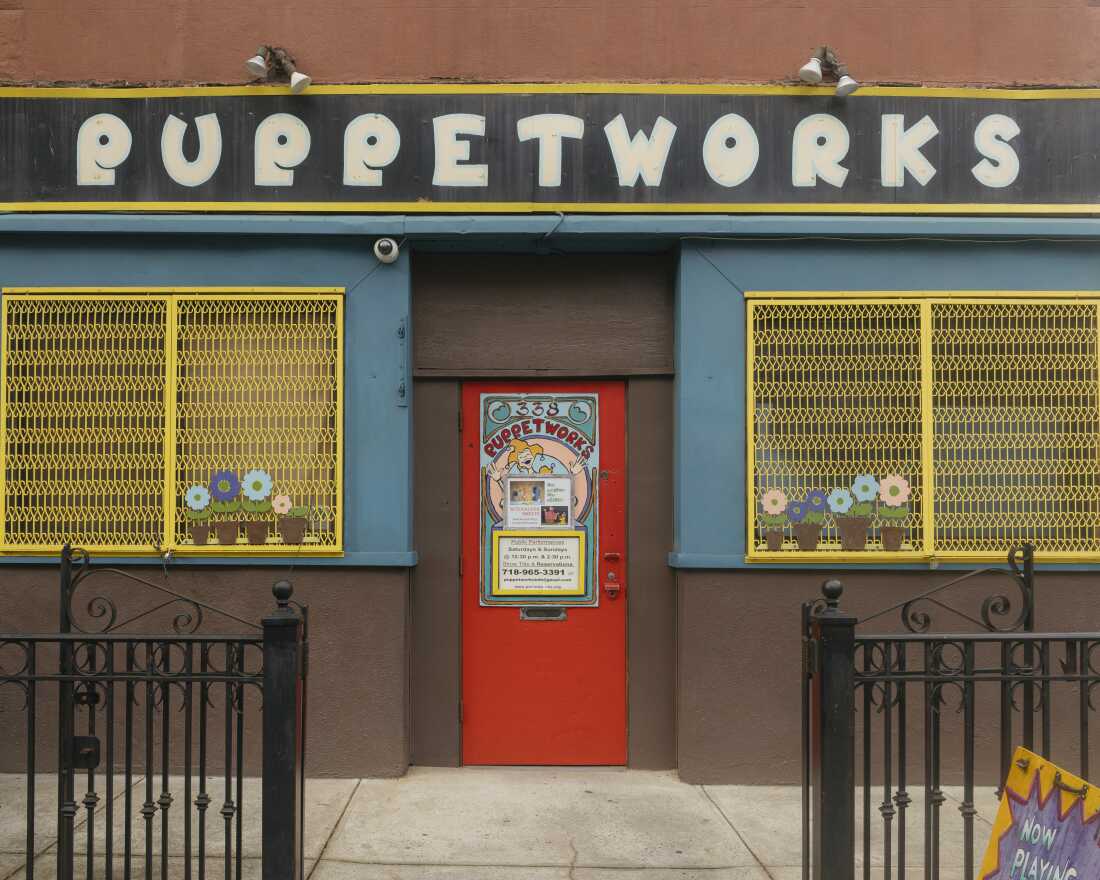
The Puppetworks theater in Brooklyn’s Park Slope neighborhood.
Anh Nguyen for NPR
hide caption
toggle caption
Anh Nguyen for NPR

A workshop station behind the stage at Puppetworks, where puppets are stored and repaired.
Anh Nguyen for NPR
hide caption
toggle caption
Anh Nguyen for NPR
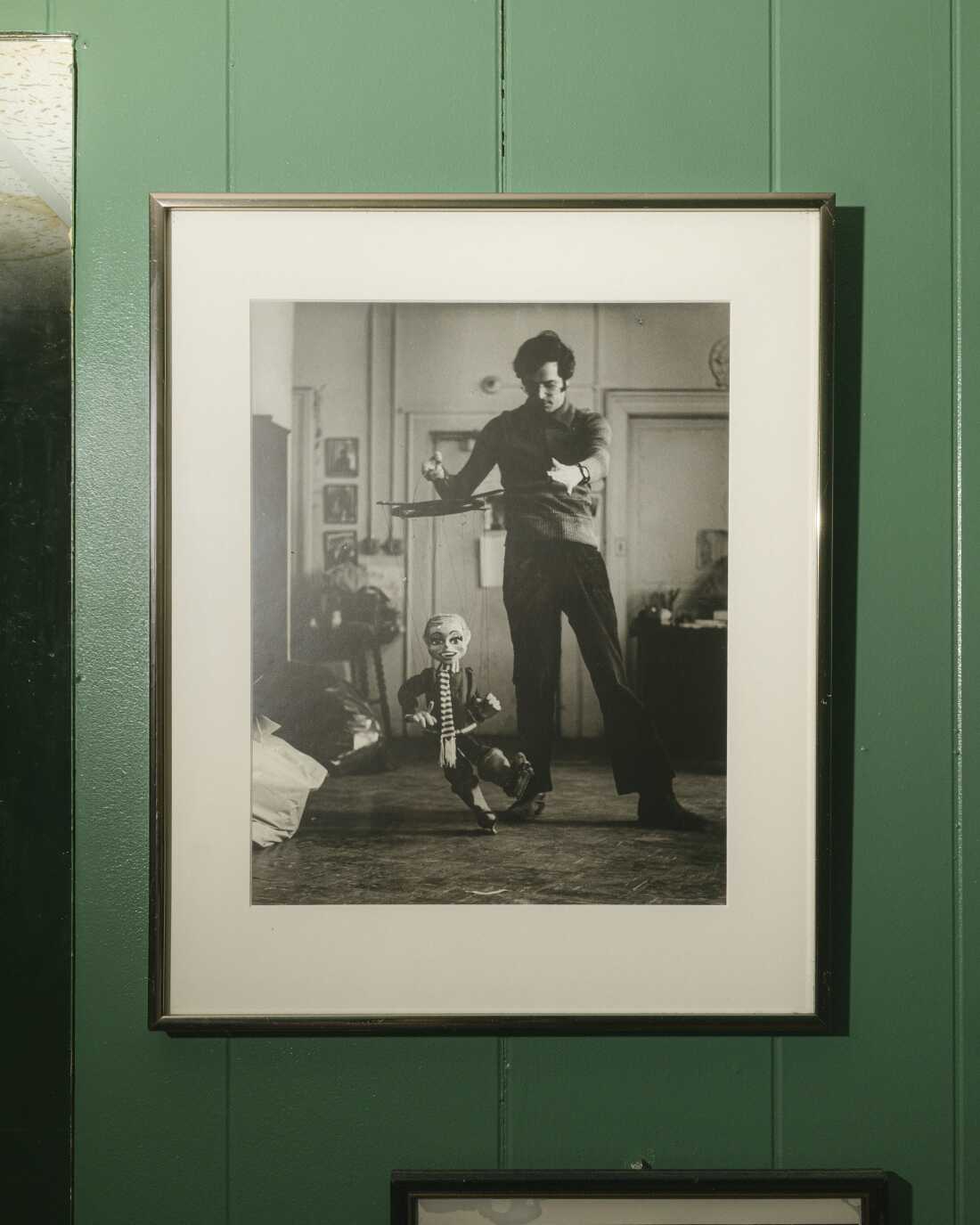
A picture of Nicolas Coppola, Puppetworks’ founder and artistic director, from 1970, in which he’s demonstrating an ice skater marionette puppet.
Anh Nguyen for NPR
hide caption
toggle caption
Anh Nguyen for NPR
For just $11 a seat ($12 for adults), puppets of all types — marionette, swing, hand and rod — take turns transporting patrons back to the ’80s, when most of Puppetworks’ puppets were made and the audio tracks were taped. Century-old stories are brought back to life. Some even with a modern twist.
Since Coppola started the theater, changes have been made to the theater’s repertoire of shows to better meet the cultural moment. The biggest change was the characterization of princesses in the ’60s and ’70s, Coppola says: “Now, we’re a little more enlightened.”

Right: Michael Jones, Puppetworks’ newest puppeteer, poses for a photo with Jack-a-Napes, one of the main characters in The Steadfast Tin Soldier. Left: A demonstration marionette puppet, used for showing children how movement and control works.
Anh Nguyen for NPR
hide caption
toggle caption
Anh Nguyen for NPR

Marionette puppets from previous Puppetworks shows hang on one of the theater’s walls.
Anh Nguyen for NPR
hide caption
toggle caption
Anh Nguyen for NPR

A child attends Puppetworks’ 12:30 p.m. showing on Saturday, Dec. 6, dressed in holiday attire that features the ballerina and tin soldier in The Steadfast Tin Soldier.
Anh Nguyen for NPR
hide caption
toggle caption
Anh Nguyen for NPR
Streaming has also influenced the theater’s selection of shows. Puppetworks recently brought back Rumpelstiltskin after the tale was repopularized following Dreamworks’ release of the Shrek film franchise.
Most of the parents in attendance find out about the theater through word of mouth or school visits, where Puppetworks’ team puts on shows throughout the week. Many say they take an interest in the establishment for its ability to peel their children away from screens.
Whitney Sprayberry was introduced to Puppetworks by her husband, who grew up in the neighborhood. “My husband and I are both artists, so we much prefer live entertainment. We allow screens, but are mindful of what we’re watching and how often.”

Left: Puppetworks’ current manager of stage operations, Jamie Moore, who joined the team in the early 2000s as a puppeteer, holds an otter hand puppet from their holiday show. Right: A Pinocchio mask hangs behind the ticket booth at Puppetworks’ entrance.
Anh Nguyen for NPR
hide caption
toggle caption
Anh Nguyen for NPR
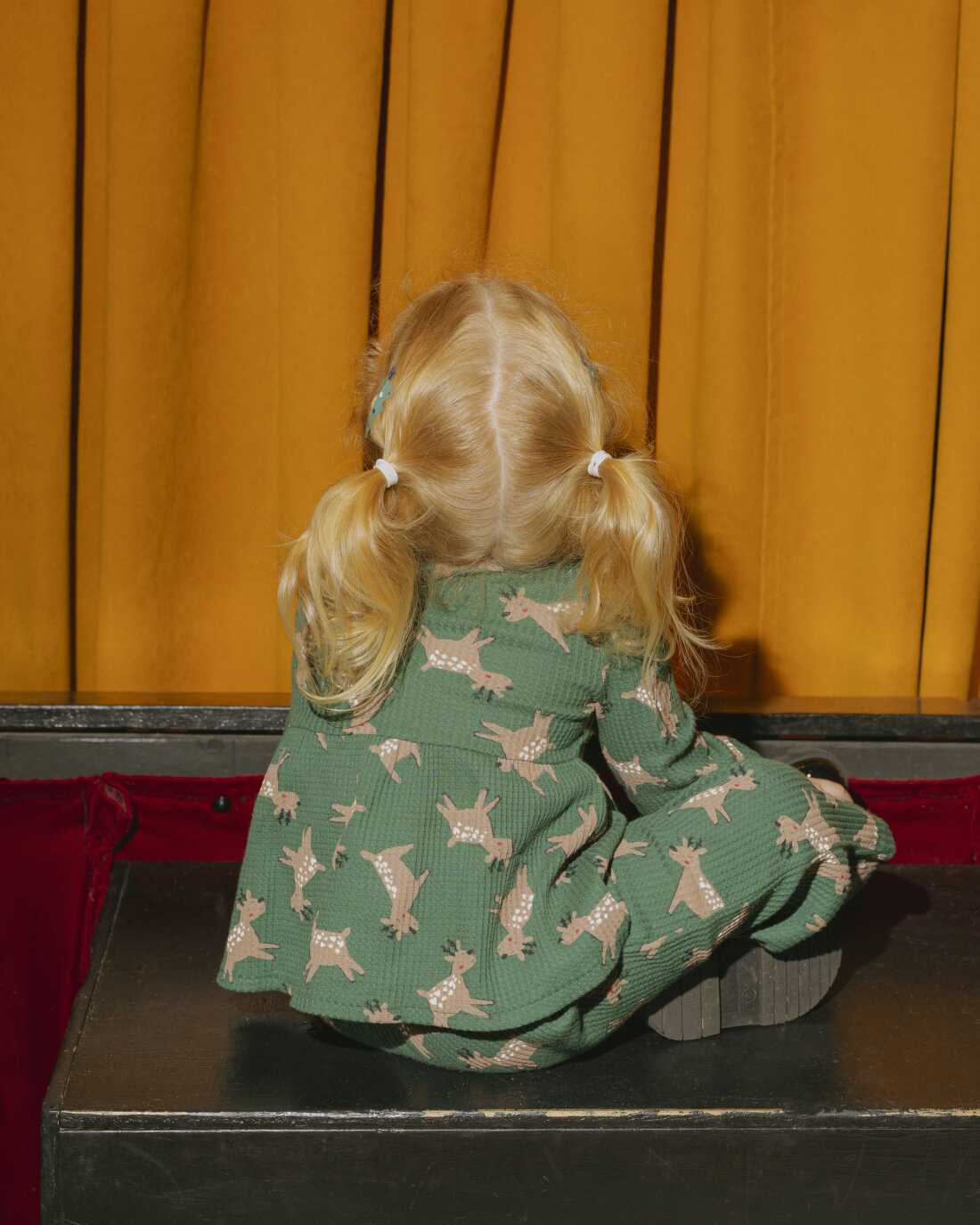
A child attends Puppetworks’ 12:30 p.m. showing on Saturday, Dec. 6, dressed in holiday attire.
Anh Nguyen for NPR
hide caption
toggle caption
Anh Nguyen for NPR

Left: Two gingerbread people, characters in one of Puppetworks’ holiday skits. Right: Ronny Wasserstrom, a swing puppeteer and one of Puppetworks’ first puppeteers, holds a “talking head” puppet he made, wearing matching shirts.
Anh Nguyen for NPR
hide caption
toggle caption
Anh Nguyen for NPR
Other parents in the audience say they found the theater through one of Ronny Wasserstrom’s shows. Wasserstrom, one of Puppetworks’ first puppeteers, regularly performs for free at a nearby park.
Coppola says he isn’t a Luddite — he’s fascinated by animation’s endless possibilities, but cautions of how it could limit a child’s imagination. “The part of theater they’re not getting by being on the phone is the sense of community. In our small way, we’re keeping that going.”
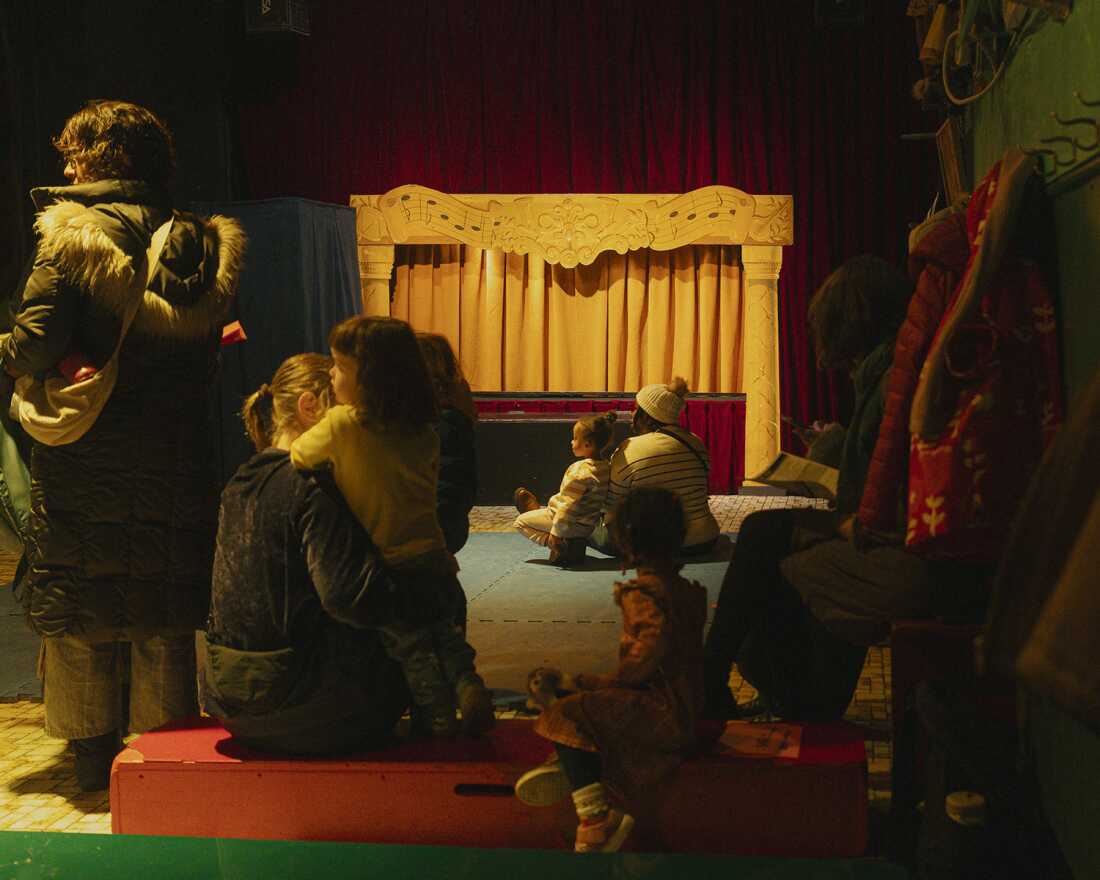
Puppetworks’ 12:30 p.m. showing of The Steadfast Tin Soldier and The Nutcracker Sweets on Saturday, Dec. 6.
Anh Nguyen for NPR
hide caption
toggle caption
Anh Nguyen for NPR
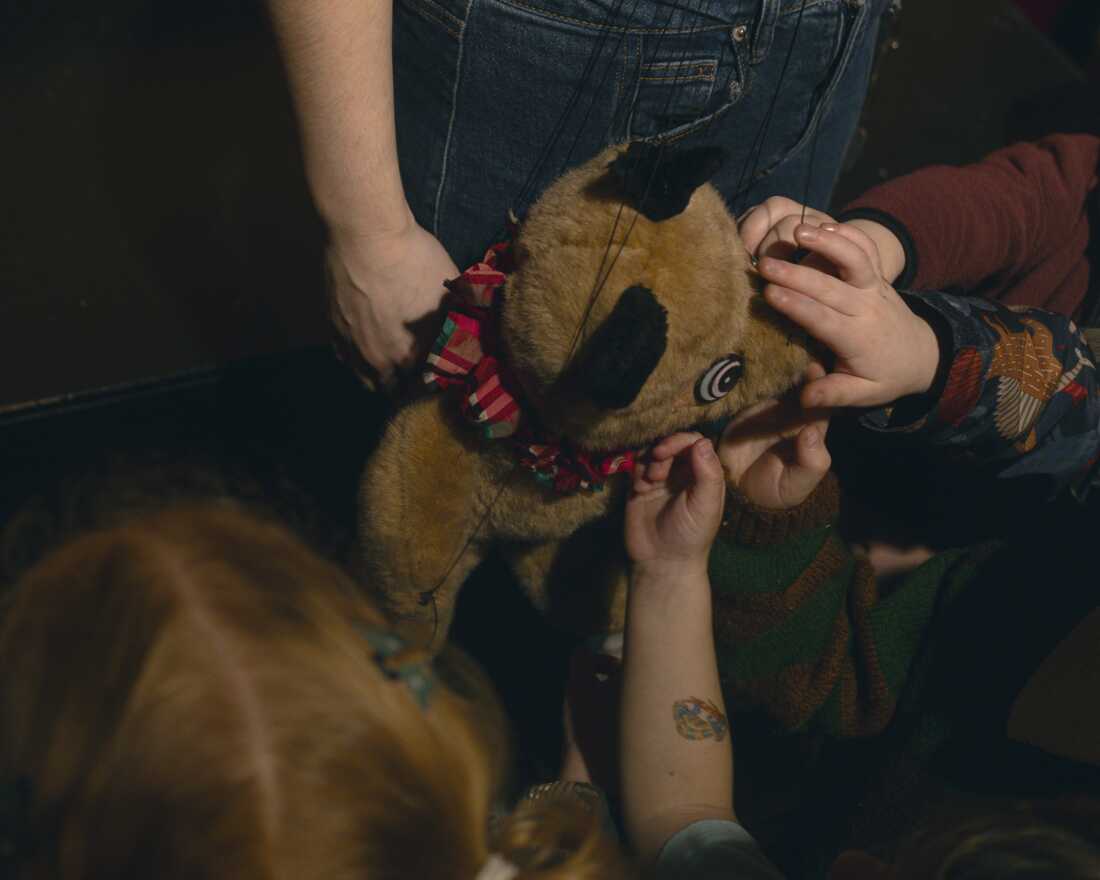
Children get a chance to see one of the puppets in The Steadfast Tin Soldier up close after a show.
Anh Nguyen for NPR
hide caption
toggle caption
Anh Nguyen for NPR
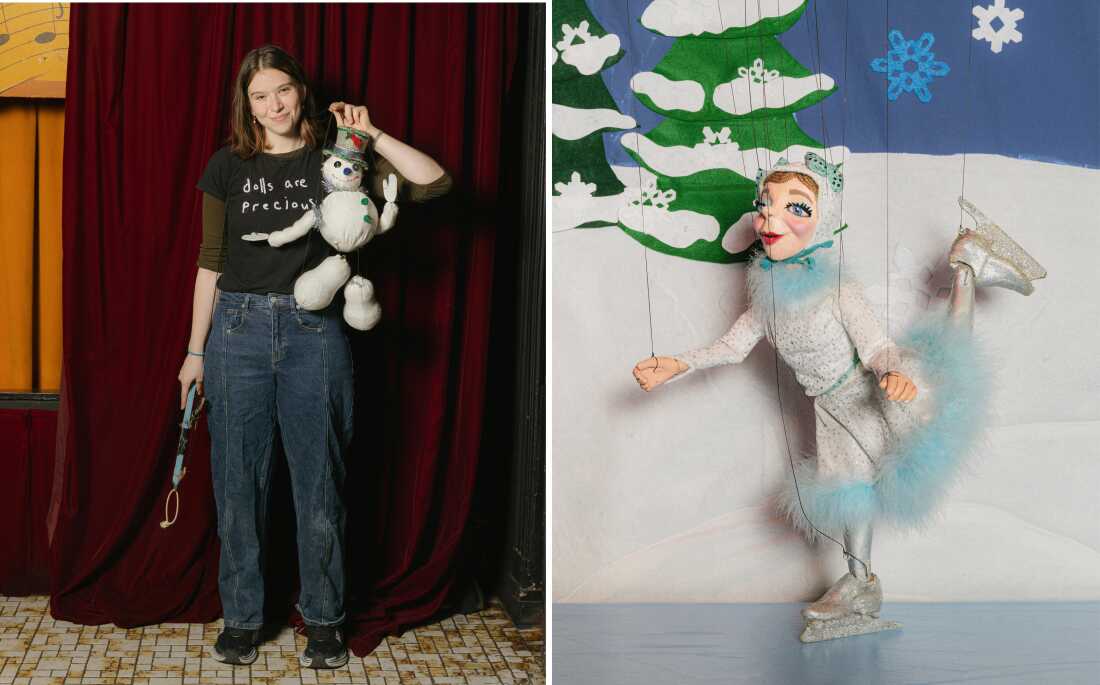
Left: Alyssa Parkhurst, Puppetworks’ youngest puppeteer, holds a snowman marionette puppet, a character in the theater’s holiday show. Right: An ice skater, a dancing character in one of Puppetworks’ holiday skits.
Anh Nguyen for NPR
hide caption
toggle caption
Anh Nguyen for NPR
Community is what keeps Sabrina Chap, the mother of 4-year-old Vida, a regular at Puppetworks. Every couple of weeks, when Puppetworks puts on a new show, she rallies a large group to attend. “It’s a way I connect all the parents in the neighborhood whose kids go to different schools,” she said. “A lot of these kids live within a block of each other.”

Three candy canes — dancing characters in one of Puppetworks’ holiday skits — wait to be repaired after a show.
Anh Nguyen for NPR
hide caption
toggle caption
Anh Nguyen for NPR
Anh Nguyen is a photographer based in Brooklyn, N.Y. You can see more of her work online, at nguyenminhanh.com , or on Instagram, at @minhanhnguyenn. Tiffany Ng is a tech and culture writer. Find more of her work on her website, breakfastatmyhouse.com.


In Brooklyn’s Park Slope neighborhood, children’s entertainment comes with strings

Read Oklahoma Student Samantha Fulnecky’s Essay on Gender

Trump administration bars former EU official and anti-disinformation and hate researchers from US

Pope Leo XIV says he’s ‘very disappointed’ after Illinois approves assisted suicide law

Trump admin sues Illinois Gov. Pritzker over laws shielding migrants from courthouse arrests

Florida High School Football Rankings: Top 25 teams – Oct. 21

Cleary's 21 help Le Moyne down Central Connecticut State 69-64 in OT

How old is Bo Nix? What to know about Oregon quarterback ahead of 2024 NFL Draft

99th annual Pony Swim held in Virginia

Video: ‘It Didn’t Have to Happen This Way:’ U.Va. Faculty Call for Review of Police Response to Protests
Trump admin sues Illinois Gov. Pritzker over laws shielding migrants from courthouse arrests

Europeans show solidarity with Denmark after Trump’s Greenland threat

Explosion at a Pennsylvania nursing home kills at least 2, governor says

What does Christmas look like for Ukraine? | Global News Podcast
404 | Fox News
-

 Iowa1 week ago
Addy Brown motivated to step up in Audi Crooks’ absence vs. UNI
-

 Maine1 week ago
Elementary-aged student killed in school bus crash in southern Maine
-

 Maryland1 week ago
Frigid temperatures to start the week in Maryland
-

 New Mexico7 days ago
Family clarifies why they believe missing New Mexico man is dead
-

 South Dakota1 week ago
Nature: Snow in South Dakota
-

 Detroit, MI1 week ago
‘Love being a pedo’: Metro Detroit doctor, attorney, therapist accused in web of child porn chats
-

 Health1 week ago
‘Aggressive’ new flu variant sweeps globe as doctors warn of severe symptoms
-

 Maine7 days ago
Family in Maine host food pantry for deer | Hand Off