Lifestyle
The National Dog Show explained: How a dog contest became a Thanksgiving tradition


Handlers show their hounds during the National Dog Show in 2022 in Oaks, Pennsylvania.
Mark Makela/Getty Images
hide caption
toggle caption
Mark Makela/Getty Images
Thanksgiving Day isn’t just about turkey. It’s also about man’s best friend.
Each year, millions of Americans tune in for one of the holiday’s hairiest and most beloved traditions: The National Dog Show.
This month, some 2,000 of the country’s finest canines converge in Philadelphia to compete in their respective categories and, for the furry finalists, the coveted title of Best in Show. They represent 205 breeds, from the Australian shepherd to the Yorkshire terrier.

The contest will air Thursday on NBC — directly after Macy’s Thanksgiving Day Parade — for the 22nd year in a row.
Here’s what you need to know about the dog show, from its tail of origin to its newest breeds.
How it works
The dogs of the hour are categorized into seven groups based on their breeds’ characteristics and intended functions: sporting (including labrador retrievers), hound (including greyhounds), working (including boxers), terrier (including Scottish terriers), toy (including pugs), non-sporting (including poodles) and herding (including border collies).
The canines compete within their categories for First in Group, then those seven finalists face off for Best in Show. The winner gets the prestigious title and $20,000 in prize money.
While every dog is the best dog, judges evaluate the hopefuls according to “how closely each dog compares with the judge’s mental image of the perfect dog as described in the breed’s official standard,” based on qualities like appearance, temperament and structure.
Last year’s Best in Show title went to a tiny, cream-colored Sealyham terrier named Stache.
Winston the French bulldog won in 2022, and back-to-back champ Claire the Scottish deerhound won both years before that. Other past winners include Thor the bulldog, Whiskey the whippet and Newton the Brussels Griffon.

Thor the bulldog wins “Best in Show” in the 2019 National Dog Show. The contest has been a Thanksgiving staple since 2002, but started long before that.
Mark Makela/Getty Images
hide caption
toggle caption
Mark Makela/Getty Images
How the tradition started
Dog shows have their roots in mid-19th century England, and made their way to the U.S. shortly after the Civil War: The American Kennel Club (AKC) says 21 pointers and setters participated in the country’s first dog show in Chicago in 1874.
In 1877 the Westminster Kennel Club hosted its first dog show, which continues to this day — it’s the second-oldest continuously held sporting event in the U.S., after the Kentucky Derby. The annual Westminster Kennel Club Dog Show, not to be confused with the Thanksgiving competition, is coming up in New York City in February.
The National Dog Show, hosted by the Kennel Club of Philadelphia, started in 1879 as the Kennel Club of Philadelphia Dog Show and has been held annually since 1933, according to NBC. It’s sanctioned by the AKC, meaning only purebred dogs registered with the American Kennel Club can participate.
So how did the display of doggies become required Thanksgiving viewing? We have Christopher Guest’s 2000 movie Best in Show to thank.
Jon Miller, the president of programming for NBC Sports, watched the film — a satirical portrayal of a fictionalized dog show — at a movie night and realized the real thing could make for a Thanksgiving hit in the key window between the morning parade and afternoon football.
Miller persuaded Purina to sponsor the event, convinced the Philadelphia Kennel Club to rename it the “National Dog Show” and persuaded his bosses to give it a try, according to the Washington Post.
At the time, NBC had been filling that slot with reruns of It’s a Wonderful Life, but the network noticed it wasn’t holding viewers’ attention. Executives let Miller try it out for a single year in 2002 — and the ratings were so high that it’s aired every year since, even keeping the same co-hosts: Seinfeld actor John O’Hurley and presenter David Frei.
Who’s new this year
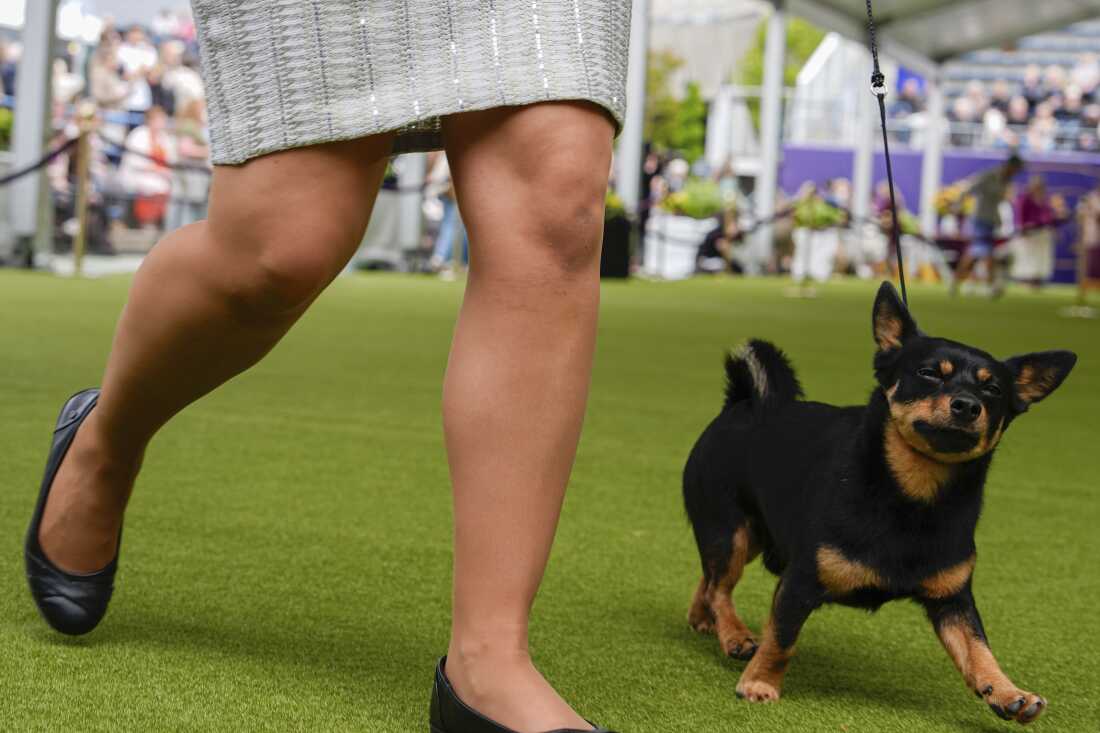
Handler Jessica Plourde competes with Lancashire heeler Mando during breed group judging at the 148th Westminster Kennel Club Dog show in May in New York.
Julia Nikhinson/AP
hide caption
toggle caption
Julia Nikhinson/AP
This year’s show features 205 breeds, the most ever. And one of them is brand new to the competition: the Lancashire heeler.
The Lancashire Heeler, which has long been recognized as a breed in the United Kingdom, joined the AKC’s list of official dog breeds earlier this year, making it eligible for thousands of U.S. dog shows.
The dogs, originally bred as cattle herders and ratters, are classified as part of the herding group.
Lancashire heelers have long bodies and short coats, often in black and tan. The Associated Press describes their shape as a “bit like a downsized corgi.” They are typically between 10 and 12 inches tall and weigh between 9 and 17 pounds, according to the AKC, which describes them as intelligent, versatile and affectionate.
“They are affectionate with their owners, always happy, talkative and always ready for a walk,” the organization says. “They have a unique characteristic called the Heeler Smile; when content, Heelers have been known to draw back their lips in an effort that emulates a human smile.”
The Kennel Club, U.K. recognized the breed in 1981 and placed it on its endangered species list in 2003 due to the small number of dogs making up the gene pool and the risk of several inherited diseases. The AKC estimates there are only about 5,000 Lancashire heelers worldwide.
How to watch
The dog show directly follows Macy’s Thanksgiving Day Parade and will air on NBC from noon to 2 p.m. in all time zones. It will also stream on Peacock, NBCSports.com and the NBC Sports app.
And for those looking for more on-demand doggo content, the shows from 2013 to 2023 are also available to stream on Peacock.

For Iris van Herpen, couture is a laboratory as much as a runway. Our chief fashion critic, Vanessa Friedman, takes us inside this Dutch designer’s latest Paris show — from sci-fi-inspired gowns to an audacious attempt at a dress made of charged plasma.
Lifestyle
The BoF Podcast | Decoding Paris Haute Couture: Wonder, Restraint and the Call of the Void


-
 Politics4 minutes ago
Trump administration clears path for controversial Mojave Desert water pipeline
-
 Sports12 minutes ago
World Cup fans flock to In-N-Out, Erewhon and Trader Joe’s for a taste of California
-

 World22 minutes ago
Hundreds of thousands evacuated as Typhoon Bavi barrels towards China
-
 News49 minutes ago
With the white nationalist group Patriot Front, what you see is not what you get
-

 New York2 hours ago
How ‘The Wire’ Star Jamie Hector Spends a Hot Day in Brooklyn
-

 Los Angeles, Ca2 hours ago
Burglars ransack Sherman Oaks condo building during fumigation
-

 Detroit, MI2 hours ago
Metro Detroit weather forecast, July 10, 2026 — 11 p.m. Update
-

 San Francisco, CA3 hours ago
Classical music series helps reconnect downtown San Francisco community

