Lifestyle
Classics Just Twisted Enough to Wear


Hang around the fashion industry for all of, oh, five minutes, and you’ll start to hear the term “classics with a twist.”
Designers say it, writers use it, marketing execs cite it. What they mean, typically, is something familiar, bent just enough to feel fresh — stylistically, and, of course, commercially.
Is it trite? Certainly. But I’ve been thinking about this cliché in recent days, as it applies so well to the best of what I’ve seen trudging through Paris Fashion Week: the clothes and outfits that contort the conventional just enough to make me lean in and say, “What’s going on there … and do I need it?”
It’s what I thought of when I saw the Yankees hat that Sigurd Bank, a forthright Dane who designs Mfpen, a Copenhagen label, was wearing when we met for coffee on Friday morning.
The hat looked like a kindergarten art project set upon by a hammerhead. Its faded brim was cleaved in half, a logo on the side had been stitched over by his daughter and the “NY” logo on the front had been covered with a swatch of plaid fabric held on by a safety pin.
He wasn’t taking a shot at New York in particular, but he did mention that there was “kind of an anti-U.S. thing going on in Europe” that compelled him to make his hat look less American.
I’ve seen tens of thousands of Yankees hats before, but none like Mr. Bank’s.
I’d also never seen an olive military jacket like the one Andre 3000 wore as he slithered into the Kenzo show just before the music kicked in. Here was the rarest creature at fashion week: a celebrity in the front row wearing his own clothes. What a concept.
The jacket was ragged and shredded. On the back, the musician had screen-printed a photo of his son. The most winning clothes are, as ever, the most personal.
Not that great style can’t be bought. On Friday, I visited the Avenue Montaigne store of Loewe, a brand that is skipping the runway this season as rumors circulate about the future of its creative director, Jonathan Anderson.
There I found a pair of pebble-grain penny loafers upgraded in a Kermit green so “aaoogah” eye-popping that it almost made me pay the roughly $1,000 price. The right twist can be budgetarily devastating.
If I was thinking more than usual about how much clothes should be tweaked this week, it was because I’d witnessed so much that felt overindulgent, if not borderline silly.
I saw, at Kenzo, bunny suits worn with underwear, an outfit suited only for a deleted scene in a Harmony Korine film. I saw, at Hodakova, a woman “dressed” in a stringless cello that nearly rendered her incapable of walking. At Vivienne Westwood, I saw ties the length of XXL lassos. (Designers, please stop trying to make the tie anything more than it is.)
Before these designers are given the keys to their venues, someone should remind them that a little adjustment can do a lot.
At least a few designers got the memo.
In a continuation of the paring-it-all-back approach he took in January for his men’s show, Rick Owens presented his version of wardrobe building blocks for women.
“Every once in a while we have to pull it back a bit,” Mr. Owens said backstage. He pulled it back just enough.
I’m not going to say that what Junya Watanabe presented wasn’t out there — moto jackets with sleeves made of boots are only for double-black, diamond-level dressers. But the flared snakeskin-like pants? The black coat made in geometric panels? The leather jacket that looked as if it had swallowed a hula hoop? All classic designs nudged along toward something new.
As for Matières Fécales, a label making its runway debut in Paris, the name almost kept me away. (It translates to fecal matter.) That would’ve been a mistake.
With the backing of Dover Street Market’s brand incubator, this was a sure-footed planting of the flag from the designers Hannah Rose Dalton and Steven Raj Bhaskaran. The pair, who are personalities in Mr. Owens’s extended universe, met in design school in Montreal a decade ago but are largely known for their own alien way of dressing. (Backstage after the show, Mr. Bhaskaran described their style as “posthuman.”) They are probably the only fledgling designers I can think of to already have 175,000 Instagram followers.
A flighty influencer brand this is not. Their debut, which owed a significant debt to the work of Mr. Owens as well as that of Alexander McQueen, flashed some true chops.
Hourglass blazers brandished shoulders peaked enough to recall the letter M. Sweaters were distressed with care, and leather jackets featured fecund sprouts of shearling at the collar and sleeve hem.
Models wore theatrical white makeup and witchy heels, but the nearly all black palette of the clothes themselves made the collection go down easily. They were classics. Twisted classics, but classics nonetheless.



A federal jury found that Live Nation and Ticketmaster, which merged in 2010, have been stifling competition and overcharging consumers when it comes to live events.
Paul Sakuma/AP
hide caption
toggle caption
Paul Sakuma/AP
A federal jury in Manhattan found that Ticketmaster and its parent company, Live Nation, have been acting as a monopoly, stifling competition and overcharging consumers.
But that doesn’t mean your next concert ticket will automatically be a better deal.
Wednesday’s verdict is a legal win for the 33 states and Washington, D.C., that accused the company of wielding its immense power over too many aspects of the live entertainment industry, from concert promotion and artist management to venue operations and ticketing services.

And it’s vindication for the many disgruntled artists, venues and fans who say they have been paying the price. The verdict has the potential to reshape the live music industry in the U.S. But the fight isn’t over.
States’ attorneys general now have to argue in favor of specific “remedies and financial penalties” — as many of them put it in celebratory press releases — at a separate trial. The lead lawyer for the plaintiffs, Jeffrey Kessler, declined to comment to NPR because that trial has not been scheduled.
One remedy that many ticketing advocates and Democratic lawmakers want is for the government to force the breakup of Live Nation and Ticketmaster — which merged in 2010 — separating the concert promoter from the ticket seller.
Meanwhile, Live Nation said in a statement that “the jury’s verdict is not the last word on this matter.” It has not responded to NPR’s request for comment.
The company said several motions are still pending in front of the court, including one to strike some expert testimony from the trial.

“Of course, Live Nation can and will appeal any unfavorable rulings on these motions,” it added.
Rebecca Haw Allensworth, a visiting professor at Harvard Law School who specializes in antitrust law, said a verdict from a jury is generally harder to fight successfully than one from a judge. In any case, she said, whatever remedy the court orders would likely be paused while an appeal plays out.
“So it’s not like next month … certainly not in 2026, will Live Nation be severed from Ticketmaster,” she said.
What about the long-term?
Thales Teixeira, a professor at UC San Diego’s Rady School of Management, says this next phase is “a little bit complicated because there’s so many parties involved … that might want different things out of a potential settlement or a trial.”
Beyond major restructuring, Live Nation could be forced to take steps like end exclusive contracts, cap service fees and open booking at its venues to competing platforms like SeatGeek and AXS.

The company is also likely to face financial penalties, which could include payouts to some consumers: The jury found that Live Nation overcharged customers by $1.72 per ticket in 22 states. Live Nation said that applies to only a fraction of tickets sold, and estimated total damages below $150 million (which it says the court would triple, per legal standards).
But that money most likely won’t go directly to consumers, Allensworth says, unlike in a class-action lawsuit (which the company also faces). She says any judgment amount would go back to the participating states, which can use it as they see fit — most likely for some sort of consumer-related issue, not back into ticket-buyers’ pockets.
“Really, here, the win for the consumers is the future and the restoration of competition, if that happens, which is why I think it’s so important for the remedy to go beyond this dollar amount,” she says.

A young fan tries her luck outside Taylor Swift’s concert in London in August 2024. A chaotic Eras Tour presale in 2022 crashed Ticketmaster, canceled the general fueled calls for the platform to be held accountable.
Alishia Abodunde/Getty Images Europe
hide caption
toggle caption
Alishia Abodunde/Getty Images Europe
Teixeira says consumers in the U.S. have gotten used to the high cost of concert tickets, not to mention food, parking and other expenses. If anything, he says some of fans’ anger may have been alleviated by Ticketmaster’s implementation (to comply with federal regulations) of all-in pricing in 2025, labeling fees upfront rather than revealing them at checkout.
And he doesn’t think the outcome of this case will lower ticket prices in the long term. For one, he says Live Nation can make up any lost fees in other ways, like upping the cost of a parking spot at one of the many venues it controls.
“My view is that even in the best-case scenario, if the states that have gone forward with the trial win most of their claims, I’d say very little will change for the average concertgoer,” he said.
What about the settlement?
While many states’ attorneys general have uniformly referred to their effort as a “coalition,” Teixeira says it’s possible that some could leave the process early, depending on which of their demands are met.
A version of that has happened in this case already: About half a dozen states joined a tentative $280 settlement between President Trump’s Justice Department and Live Nation last month, just days into the trial.
As part of the settlement, the company agreed to do things like cap service fees at 15% and divest exclusive booking agreements with about a dozen amphitheaters, which ticketing organizations and Democratic lawmakers say does not go nearly far enough. That settlement must undergo a 60-day public comment period and get federal court approval before it can be finalized.

Just this week, several of the most vocal Democrats on this topic — including Sens. Amy Klobuchar of Minnesota, Elizabeth Warren of Massachusetts and Richard Blumenthal of Connecticut — submitted a letter urging the judge in the case to “closely scrutinize this settlement,” which they called insufficient.
Live Nation said in its Wednesday statement that it is confident “that the ultimate outcome of the States’ case will not be materially different than what is envisioned by the DOJ settlement.”
Allensworth says that Live Nation can point to the settlement to show the judge that it is already taking steps to restore competition, in hopes of less intrusive remedies. But she expects states to have the same response as the Democratic lawmakers: “It’s a slap on the wrist and, your Honor, you need to impose something more meaningful here.”
Even if the company is forced to split up, she says, it’s not clear how long it would take for the live events landscape — which Live Nation and Ticketmaster have dominated for so long — to feel the effects. But she says the pressure of competition would undoubtedly improve the experience for venues, artists and fans alike.
“It’s one of the wonderful, and I think frustrating, things about organizing our whole economy through competition, is that we don’t know what new ideas will come forward,” Allensworth says. “We don’t know how they will affect consumers. But we do know that the best way to provide long-term consumer welfare is to have a place for new ideas to come to life.”
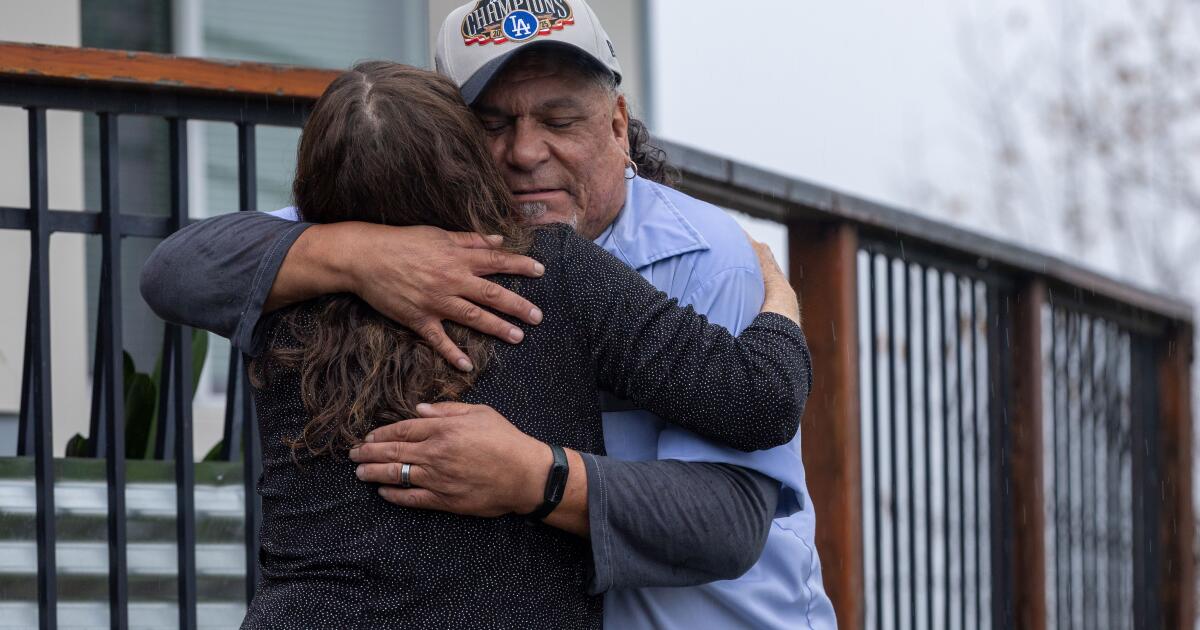
There were 200 people on the back patio of Glassell Park’s Verdugo Bar, and John Ayala had a hug for all of them.
Wiping tears from his eyes as he slowly made his way through the intergenerational crowd, he recognized almost everyone in attendance — if not by name, then definitely by address.
For four decades, the 61-year-old Ayala delivered mail to their homes, and now he was finally retiring, to the great surprise of everyone, including himself. He’d been talking about it for years — working it into the many conversations he had each day with the friends he’d made along his mail route in the hills of Mount Washington, a small residential community in northeast Los Angeles.

-
Share via
The folks at the retirement party were glad that he would finally get some well-deserved downtime, but they were also wistful. For them, Ayala’s departure represented the end of an era when mail delivery came with a side of conversation.
“He talked with everyone,” said Jonathan Sample, a graphic designer who grew up in Mount Washington and now lives there with two kids of his own. “He was a really unifying presence.”
At a time when just 26% of Americans say they know their neighbors, according to a recent Pew Research study, Ayala helped create a sense of community in Mount Washington, even if it was only through the shared experience of having an unexpectedly personal relationship with the local mailman with a gruff voice and a gregarious disposition.
Over the years, Ayala would invite people from his route to the shows he played with his metal band Horns Up, and whether or not they liked the music, they‘d come out because they liked him. He would frequently talk about sports (especially the Dodgers and the Packers) and many on the hill knew he had two knee replacements — a result of a job that required him to hop in and out of a truck all day — because he would share updates on his recovery.
And when he started delivering reams of college marketing materials to families with high school seniors, he’d often inquire where the soon-to-be graduate was headed.

Ayala, center, celebrates with friends at his retirement party at Glassell Park’s Verdugo Bar.
(Carlin Stiehl / For The Times)
“He’s amazing. He knows my kids — my daughter is 40 and my son is 37 — and they love him,” said John Amour, a Mount Washington resident who has known Ayala since the ’90s. “They’ve grown up with him. He remembers their name. He says, ‘How is Brianna?’”
Because Ayala made daily visits to the homes on his route, he also knew who was on vacation, who was moving and who was having a medical crisis.
A few years ago, he was delivering mail to a man whose wife had been in the hospital. When Ayala asked “What’s up with Sandy?” the man shared that she had just passed away.
“I was the first one to see him after that and I just had to hug him,” Ayala said. They still text occasionally.
1

2

3

1. A goodbye sign is displayed on Ayala’s route during his final shift. 2. John Ayala delivers mail to a home. 3. Los Angeles resident Seonna Hong stops on the road to thank Ayala. (Ronaldo Bolaños / Los Angeles Times)
“If people are sick, he’ll tell people in the neighborhood,” said Laura Lee, who has lived in Mount Washington for 40 years. “If I start wondering about someone I haven’t seen in a while, I’ll ask him, just to make sure they’re OK.”
For Ayala, connecting people with one another comes naturally.
“I’ll find out someone is a Red Sox fan and I’ll tell them, you know your neighbor Neil up the street is from Boston too. You guys should talk,” he said.
Ayala, who grew up in El Sereno and is married with two sons, has deep family roots in the United States Postal Service. His mother, Yolanda, worked for the agency for 39 years, as did each of her four brothers and a sister-in-law. Ayala’s uncle was the first Latino vice president of finance for the Postal Service in the 1990s.
Ayala was an honors student at South Pasadena High School, but he wasn’t interested in college. Toward the end of his senior year, his mom saw a job opening at work and encouraged him to apply. He’s been working for the Postal Service since 1984 — even during the time his metal band Lace was selling out the Whiskey a Go Go and the Roxy in the mid ’80s.

Neighbors made a USPS-themed cake for Ayala’s retirement party.
(Carlin Stiehl / For The Times)
“I always wanted to be a rock star, but I probably wouldn’t be alive today if we’d made it,” he said.
He started delivering mail in Mount Washington in 1987 and never looked back. He loved the people and taking a break by the Self-Realization Fellowship’s verdant headquarters to read the newspaper. “It’s a neighborhood I could never afford,” he said. “It’s like a different world.”
Also, he said, “I never had to buy lemons. My customers always gave me lemons.”
The Postal Service changed his route once in 2008, but a few years later, he was able to return to Mount Washington. “I couldn’t wait to get back up there,” he said. “It was just like, oh man, I’m going to be in heaven again.”
After 42 years of service, Ayala’s pension couldn’t get any higher, so he decided to retire at the end of 2025. He could have retired in 2020, but as he wrote in a Facebook post in 2023, “I’m having too much fun.”
On a rainy day in December, Ayala maneuvered his truck one final time through Mount Washington’s narrow streets. Even as he emptied it of mail, it gradually filled up with gifts from his longtime customers — a bottle of vodka, a few bottles of wine, a six-pack of craft beer, homemade biscotti, a signed farewell poster, several thank you cards and a giant foam cheese hat from one of the many residents who knew he was a Packers fan.


Graphic designer Jonathan Sample made dozens of signs saying “Rock on Mailman John” for neighbors who wanted to send well wishes to Ayala on his last day.
(Ronaldo Bolaños / Los Angeles Times)
And then there were the signs, stuck on stakes, posted on telephone poles, taped to mailboxes all over the hill.
Good Luck John! We’ll Miss You!
Mailman John!! Thank you!!
Rock on Mailman John! Enjoy Your Retirement. We Love You!
Not everyone who made signs and delivered gifts knew each other, but they all knew Ayala.
Even after he retired, Ayala was still bringing the people of Mount Washington together. The farewell party at the Verdugo Bar was put together by a trio of neighbors who got to know each other because they all wanted to be involved in celebrating their beloved mailman. At the bar, residents who live on the same street finally got around to introducing themselves.
“See that group in the corner?” said Penny Jones, an artist who helped organize the party. “That’s the Glenalbyn contingent. They are just getting to know each other.”
Also among the many people who had come to wish Ayala a fond farewell? Alex Villasenor, the neighborhood’s UPS driver, wearing an Iron Maiden shirt in Ayala’s honor.
“I had to represent,” he said. “We always chat and clown around and block each other and honk at each other on the hill. He goes for the Raiders and I go for the Packers. I’ll be sad not to see him.”
I was at the party, too — and not just to report this story, but because for the last 18 years, Ayala was my mailman. More than anyone else in my life — even my parents — he religiously read my stories in The Times, always commenting when I had a piece on the front page.
“Great story, Deb!” he’d yell from his truck after putting some real estate fliers in my mailbox. It always made my day.

Ayala has a hug for everyone at his party.
(Carlin Stiehl / For The Times)
Like everyone else, I’m going to miss him.
A few months after his retirement, I called Ayala to see how he’s been doing. It’s been a difficult adjustment.
“I just miss everybody, “ he said. “It’s hard. You lost a friend. One person. I lost like 2,000 friends.”

Two hundred residents attended John Ayala’s retirement party after 40 years with the USPS.
(Carlin Stiehl / For The Times)
He said sometimes in the middle of the night when he’s tossing and turning, he imagines traveling street by street, just thinking about everyone on his mail route.
But he is committed to staying in touch. He still texts some of his friends about sports, and he’s planning to make a trip up the hill soon just to walk around and greet people.
Ayala may have stopped delivering the mail, but he’s not done delivering connection.

Carey Mulligan as Lindsay.
Netflix
hide caption
toggle caption
Netflix
There was something special about Lee Sung Jin’s Beef when it premiered on Netflix in 2023. The sometimes surreal but always emotionally grounded dramedy was premised upon how one minor, negative interaction between strangers — in that case, a road rage incident involving a struggling contractor (Steven Yeun) and a well-to-do business owner (Ali Wong) – can open the floodgates for misdirected anger and surface long unexamined disappointments and unrelated resentments. It tapped into something both mundane and potent, cleverly dramatizing a general sense of societal chaos via two richly-rendered Asian American leads.
Three years later, and Season 2 finds Lee swapping in an entirely new cast while pivoting the locus of ire. At its center are two couples: Josh (Oscar Isaac) and Lindsay (Carey Mulligan), the married general manager and interior designer of a Montecito, Calif. country club, and fiancés Ashley (Cailee Spaeny) and Austin (Charles Melton), low-level staff members at the club. In the opening episode, the latter couple accidentally happen upon Josh and Lindsay having a nasty drag-out fight that, from outside looking in, appears on the verge of turning violent.
As Beef reiterates many times in various ways, Austin and Ashley are Gen Z — so, naturally they capture the argument on video. The video’s existence is the first small cut of beef, which quickly ripples out to meatier and more consequential beefs, entanglements and manipulations. The younger pair, dissatisfied with their low wages and lack of health benefits, sees an opportunity to leverage what they’ve documented, and they do. But Josh and Lindsay have a lot more drama going on besides a sexless, unhappy marriage; despite their proximity to wealth and seemingly cushy lifestyle, they’re drowning in debt, and Josh’s employment at the club is in limbo as his contract nears its end. Predictably, both couples turn to extreme (and extremely illegal) measures to meet their wants and needs.
Season 1 was equally, if not more so, interested in the knotty personal lives of Yeun’s Danny and Wong’s Amy, apart from their beef with one another. Season 2 benefits from taking this same approach, though with far more primary characters to flesh out and intertwining storylines to serve, it can become unwieldy. To get across a heavily underlined message that “capitalism is soul-sucking,” an entirely separate and somewhat uninspired international plot dovetails with the quartet’s mess. Still, it’s fun to see Youn Yuh-jung leans into her role as Chairwoman Park, the shrewd and menacing billionaire owner of the club whose own dirty laundry drives much of the high-octane action in the back half of the season. (Ditto the great Song Kang-ho as Dr. Kim, the chairwoman’s much younger husband who has a poignant moment in a late episode.)
The digs at capitalism probably feel overdone because of how the media landscape looks now. It seems as if nearly every show or movie in recent memory throws in a corrupt wealthy person (or several) to comment on the disparities between the haves and have nots (The White Lotus, Triangle of Sadness, The Girlfriend) or presents middle-aged married couples wading through malaise and regret (DTF St. Louis, Fleishman Is In Trouble, plenty of Nicole Kidman projects). But it also seems like this iteration of Beef struggles with narrative substance on its own; while the exact details of how its story shakes out aren’t easily predictable, some of the emotional novelty has worn off by the time we arrive at any twists. (This is also true of some of its wry observations on cultural identity, which come off rote and obvious — a running gag is that Isaac’s Josh and Melton’s Austin are frequently perceived as ethnically ambiguous to white people. Isaac is Cuban and Guatemalan; Melton is white and Korean.)

Charles Melton as Austin, Cailee Spaeny as Ashley.
Netflix
hide caption
toggle caption
Netflix
Season 2 is compelling enough largely because its stars gamely tap into the spirit of the show’s M.O.; at any given moment, each character may reveal the worst of themselves, which looks different for everyone. Josh, for one, is an avoidant personality whose contempt simmers ominously for the demanding one percenter clientele he serves at the club, yet when he does explode, the limber and expressive Oscar Isaac lets him rip. In contrast, Carey Mulligan’s Lindsay is clearly exhausted from putting on airs as if everything between them is fine, and resentful of the sacrifices she feels she’s made for her increasingly distant husband at the expense of the dreams they once shared.
Lee Sung Jin and his writing team have added nice touches when it comes to Ashley and Austin, too – their relative youth reveals that media literacy and basic life skills are seriously lacking, all of which makes for silly comedic bits that Spaeny and Melton carry through handily. But even better is when the cracks in their “perfect,” non-confrontational relationship widen into a gaping abyss, reflecting and refracting that of their older counterparts.
“Couples fight. It’s normal,” Lindsay insists to Josh in the first episode, right after they realize Austin and Ashley were in the audience for their domestic row. Neither couple is as stable as they’ve convinced themselves they are. In its best moments, the show leans into this: depicting people who are actively avoiding reality until they’re forced to confront it by the skin of their teeth.

Orbán’s defeat is a win for democracy and a warning to Trump, some say

Pentagon Reportedly Asks Detroit to Use More Car Factories as Arms Factories

San Francisco considers closing some permanent supportive housing

Minnesota Wild – Dallas Stars – Apr 18, 2026 | NHL.com

3 men hospitalized after shooting in NW Miami-Dade

Florida High School Football Rankings: Top 25 teams – Oct. 21

How old is Bo Nix? What to know about Oregon quarterback ahead of 2024 NFL Draft

Cleary's 21 help Le Moyne down Central Connecticut State 69-64 in OT

99th annual Pony Swim held in Virginia

Indiana Members Credit Union announced as new anchor tenant at Bottleworks District
Orbán’s defeat is a win for democracy and a warning to Trump, some say

Firefighters Likely Had Limited View of Approaching Plane in LaGuardia Crash

Tennessee governor signs nuclear family month resolution as critics push back on exclusions

Displaced Lebanese wary as ceasefire between Israel and Hezbollah begins

Retired Coast Guard officer with decades of public health experience is Trump’s pick to lead CDC | CNN
-

 Ohio3 days ago
‘Little Rascals’ star Bug Hall arrested in Ohio
-

 Georgia1 week ago
Georgia House Special Runoff Election 2026 Live Results
-

 Arkansas7 days ago
Arkansas TV meteorologist Melinda Mayo retires after nearly four decades on air
-

 Austin, TX1 week ago
ABC Kite Fest Returns to Austin for Annual Celebration – Austin Today
-

 Politics2 days ago
Dem fundraising giant in the hot seat as GOP lawmakers demand answers over dodged subpoena
-

 Politics5 days ago
Trump blasts Spanberger ahead of Virginia meetings, says state faces tax base exodus like New York, California
-

 Health1 week ago
Woman discovers missing nose ring traveled to her lungs, causing month-long cough
-

 San Francisco, CA5 days ago
President Trump terminates Presidio Trust