Lifestyle
Children are stuck inside, glued to screens. Are 'forest schools' the antidote?

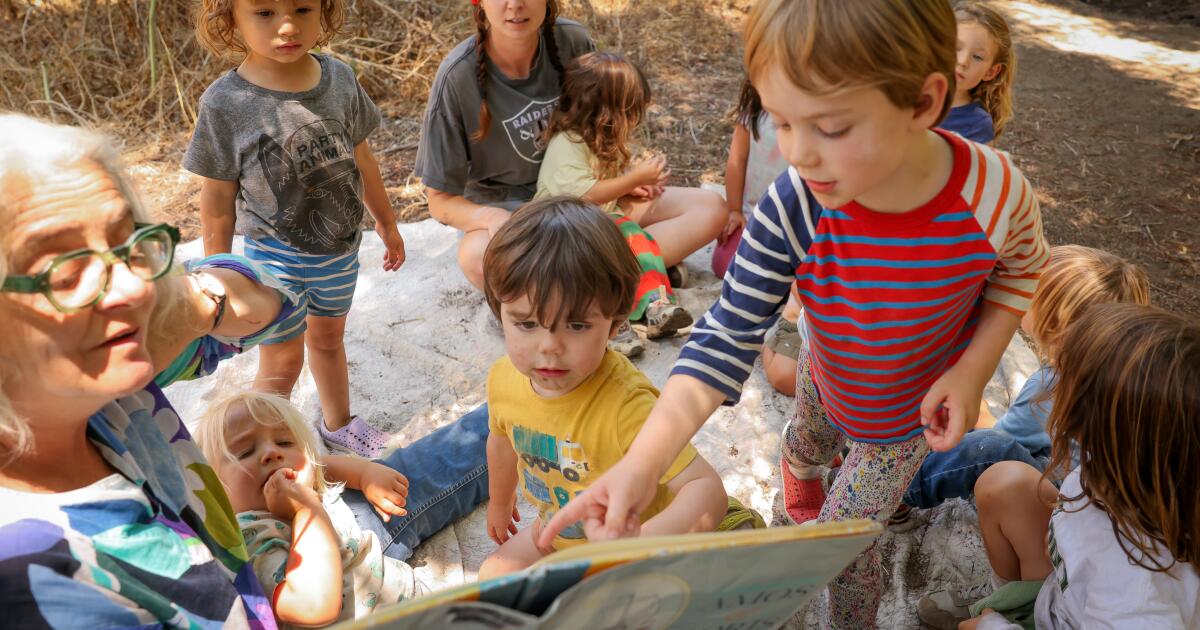
On a glorious summer day, a preschooler named Roger teetered on rocks dotting a creek in eastern Orange County, unsure if he could make it back to where his classmates and caregivers were waiting.
A volunteer youth mentor with Earthroots Field School stuck out her hand, reassuring the 3-year-old, who grasped it and took one confident step toward her. Then another. “There we go!” someone called out as he cleared the burbling waterway.
Pushing edges — like learning to balance on rocks without a parent swooping in — is a central tenet of nature-based education, according to Angela Capps, a teacher at the school, one of a rapidly growing number of early education providers that are centered around the natural world.
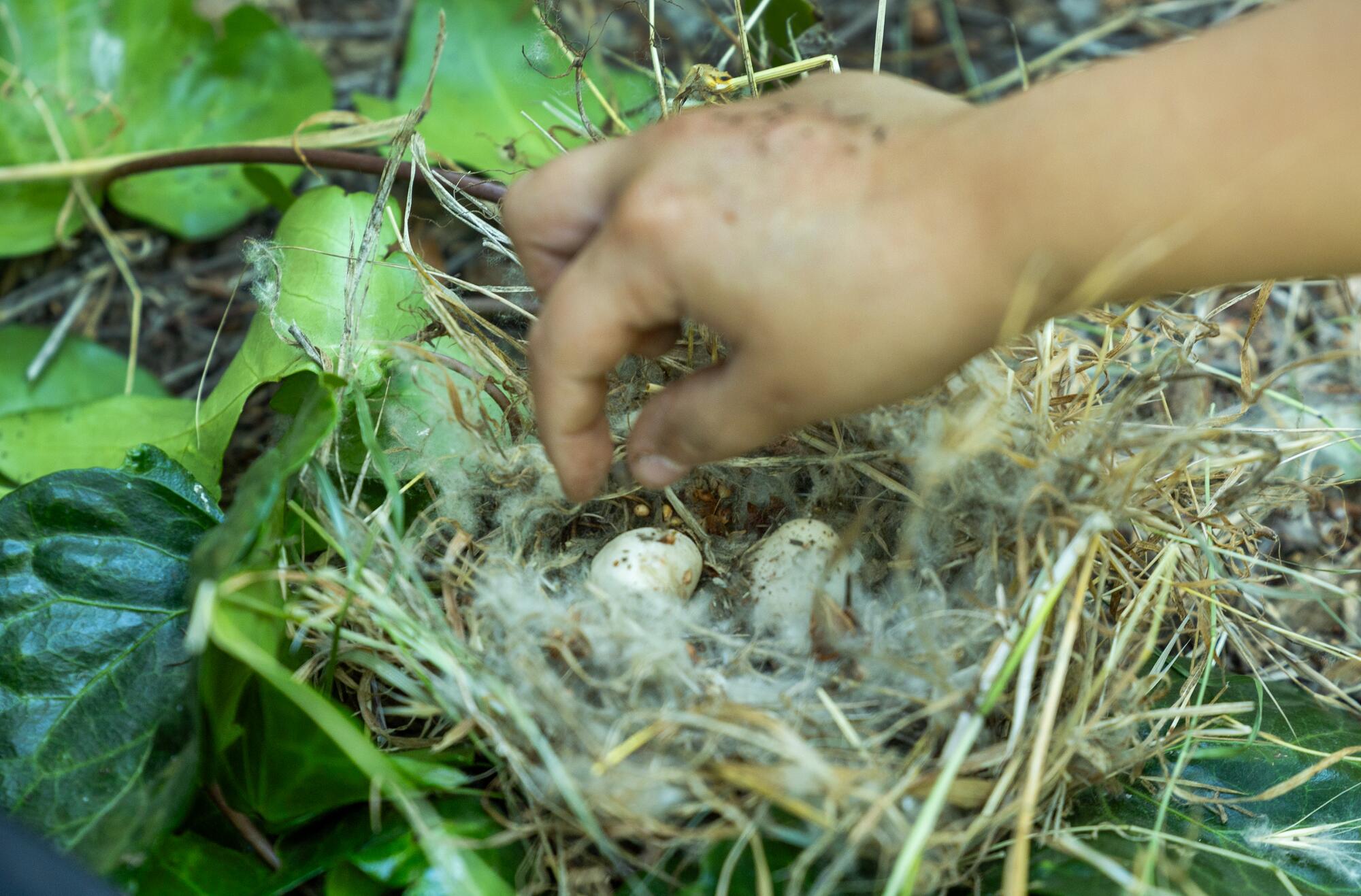
Youngsters use artificial eggs and natural materials to create nests during forest kindergarten summer camp at Earthroots Field School in Silverado Canyon.
(Allen J. Schaben / Los Angeles Times)
Nature-based education — sometimes called forest schools, nature preschools or outdoor kindergartens — is based on a straightforward premise: “that it’s really good to have kids outdoors a goodly chunk of their day,” said David Sobel, professor emeritus at Antioch University New England and author of “Beyond Ecophobia: Reclaiming the Heart in Nature Education.”
Indeed, researchers have found nature-based learning supports creativity, resiliency, executive function, school readiness and a host of other benefits for the body and mind.
Scandinavia-originated forest schools arrived in the U.S. in the 1960s and are part of the broader nature-based education movement. In recent years, the concept has exploded amid worries about children getting lost in the virtual world and the country’s youth mental health crisis. The pandemic turbocharged the trend, as schools closed and parents sought safe learning environments for their preschoolers.
As of the last school year, there were about 800 nature preschools in the U.S., a 200% increase since 2017, according to a survey by the nonprofit Natural Start Alliance, which supports access to nature-based early childhood education. California is among the top three states with the highest number of schools, which primarily serve children ages 3 to 5.
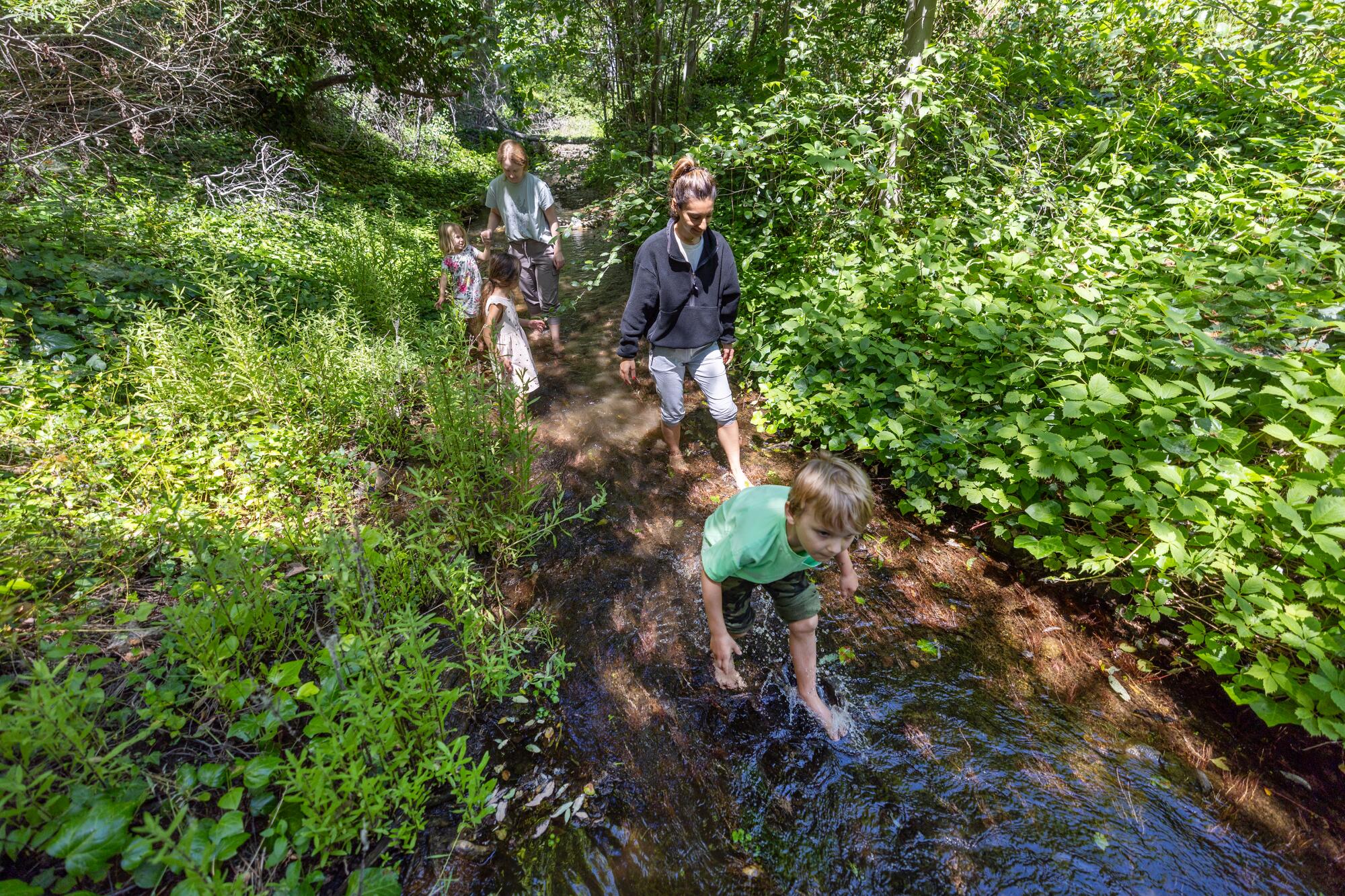
Children and parents explore a creek on a temperate summer day during forest kindergarten camp at Big Oak Canyon, a 39-acre property that serves as home base for Earthroots Field School.
(Allen J. Schaben / Los Angeles Times)
Proponents say children immersed in nature are happier and healthier — and may be poised to become the next generation of climate warriors. An early connection to nature can plant the seeds for its stewardship.
“We only protect that which we love,” said Lia Grippo, president of the California Assn. of Forest Schools. “If we want children to grow into adults who can carry the burdens, honestly, we and previous generations have created for them, then they have to be in love with the land they live on.”

While the movement is suffused with optimism — as growth shows no sign of slowing down — there are challenges.
A large number of programs are unlicensed and therefore unable to tap public funding, prompting criticism that they’re only accessible to wealthy families who can pay tuition, and the movement is contending with a stark lack of diversity that hasn’t meaningfully improved even as programs multiplied.
According to Alliance’s recent survey, white children made up 78% of the student bodies of nature preschools, compared with roughly 47% of the U.S population. Latino and Black children are underrepresented relative to the broader population. (Addressing racial disparities is top of mind for many nature educators, and this past year saw the creation of the Black Educator Network, an Alliance-affiliated professional community for Black educators in nature-based early education.)
Many of the programs are geared toward preschoolers, in part because of a desire to front-load a child’s life with meaningful experiences in nature. Another reason is early education tends to be more flexible than grade school in terms of structure and regulation, or as Sobel puts it: It’s “less riddled with academic expectations so it’s a place where the innovation could happen easier.”
Many programs strive to develop environmental literacy, which can broadly be defined as understanding and caring about environmental issues and having the skills needed to work toward solving them. But how do teachers start molding preschoolers into model environmental citizens?
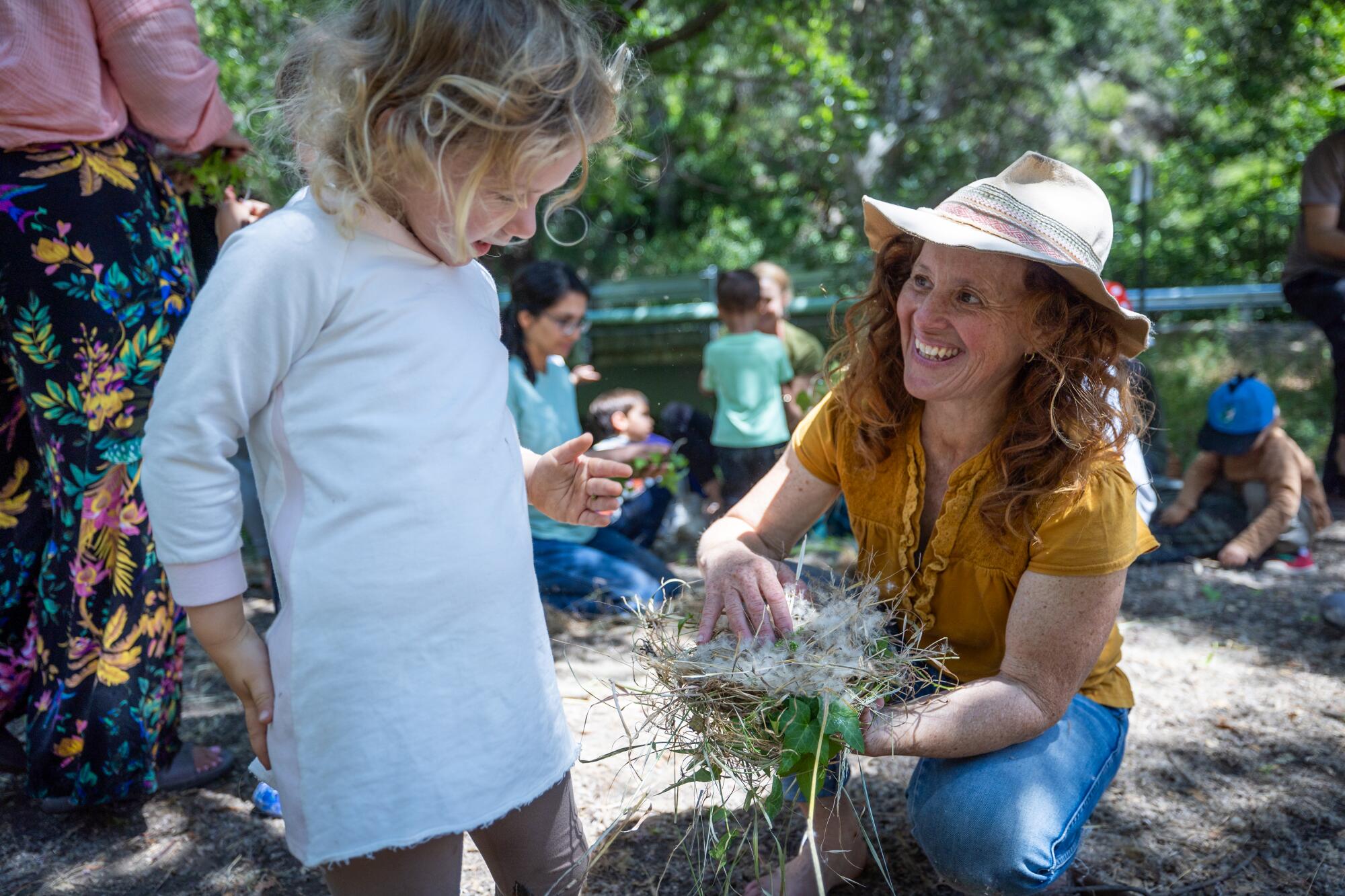
Jodi Levine, executive director of Earthroots Field School, helps a summer camp attendee make a nest.
(Allen J. Schaben / Los Angeles Times)
Jodi Levine, executive director of Earthroots, said the teachers don’t directly discuss climate change with their very young learners. Creating lessons that help kids “fall in love with nature” is “all that they need to understand the beauty of it and the value so that it’s not destroyed,” she said.
Becca Hackett-Levy, founder and director of Northeast L.A. Forest School, said learning about climate change “can start the day they come out of the womb.” It’s not about discussing the science or overarching concepts, but “about being present in nature and seeing what we as humans are doing.”
Children also experience it firsthand. Last year, a brush fire forced a group to evacuate from Elysian Park. Ash rained down as the children were asked to share what they felt, saw, heard, tasted and smelled. Hackett-Levy said it was a concrete lesson about a warming climate colliding with dry invasive grasses.
Fabienne Hadorn, co-founder of the Arroyo Nature School, which operates outdoors in a public park in Pasadena, said the topic sometimes comes up as children ask questions and make observations. The discussions don’t involve the term “climate change,” but center on the impacts — such as cars causing damage to the air. The emphasis is often on the need to take care of the planet.
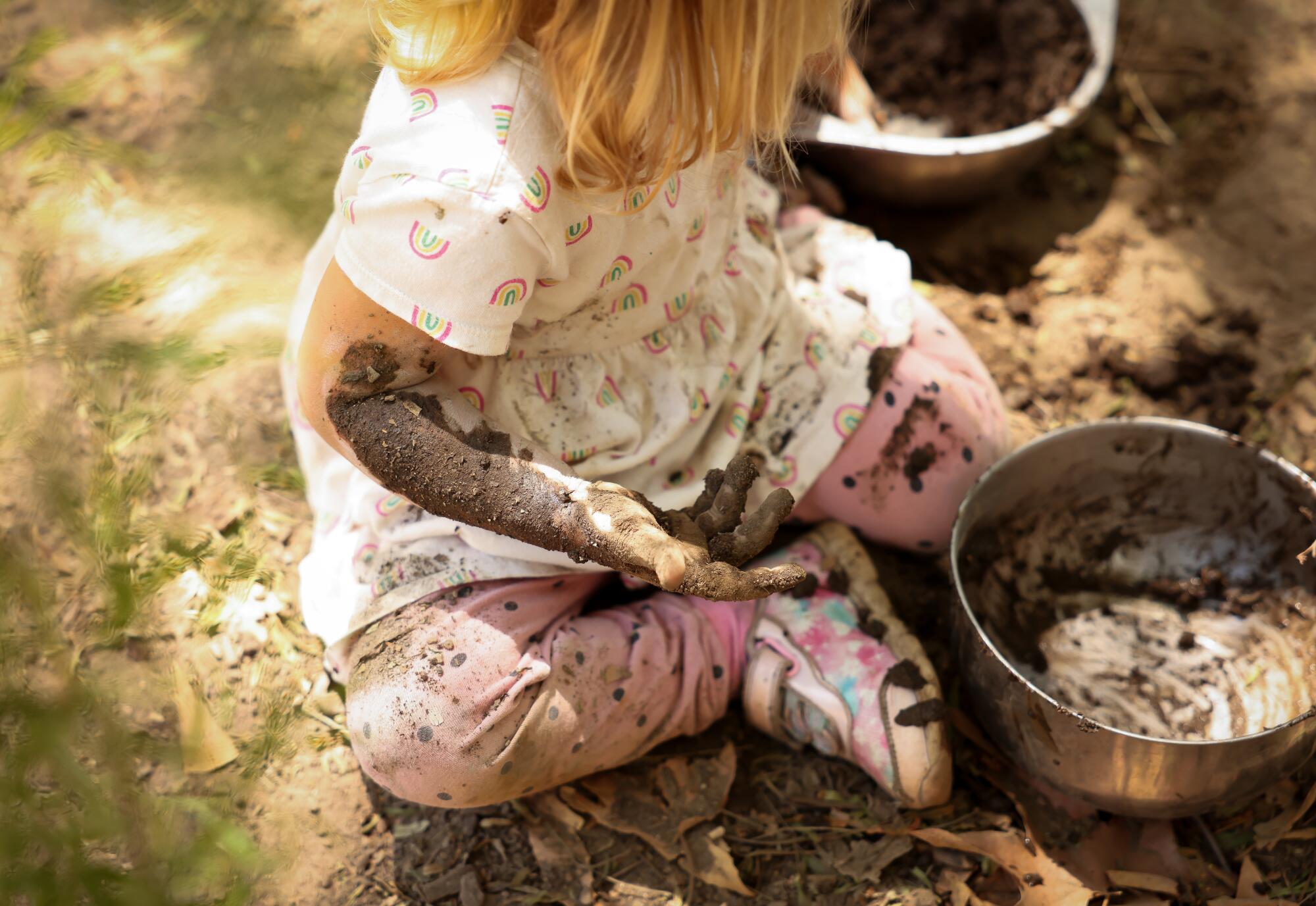
Scout, 2, plays in the mud kitchen at Arroyo Nature School. She made several delicious “cakes.”
(Christina House / Los Angeles Times)
Talking about climate change can be stressful, but not all stress is equal, according to Rahil Briggs, national director of Zero to Three’s HealthySteps, a pediatric primary care program. If a child is in a stable, safe and nurturing environment, they can experience “positive stress.” A small amount of motivating anxiety, she said, is helpful for learning new skills. It can be felt while learning to cross a stream or discussing the environment in a developmentally appropriate way.
While California education officials have championed environmental literacy for students, foundational elements of nature school can put it at odds with public education and regulatory norms.
Nature schools, for example, typically embrace managed risk. Many in the movement see exposing kids to experiences such as climbing a tree as key to developing the resiliency needed to withstand future stressors.
Hadorn said her staff may offer guidance as the children climb trees, advising where to put their foot, or catch them if they falter, but the youngsters lead the charge. “We make sure a teacher at every moment is there if they want to climb,” she added.
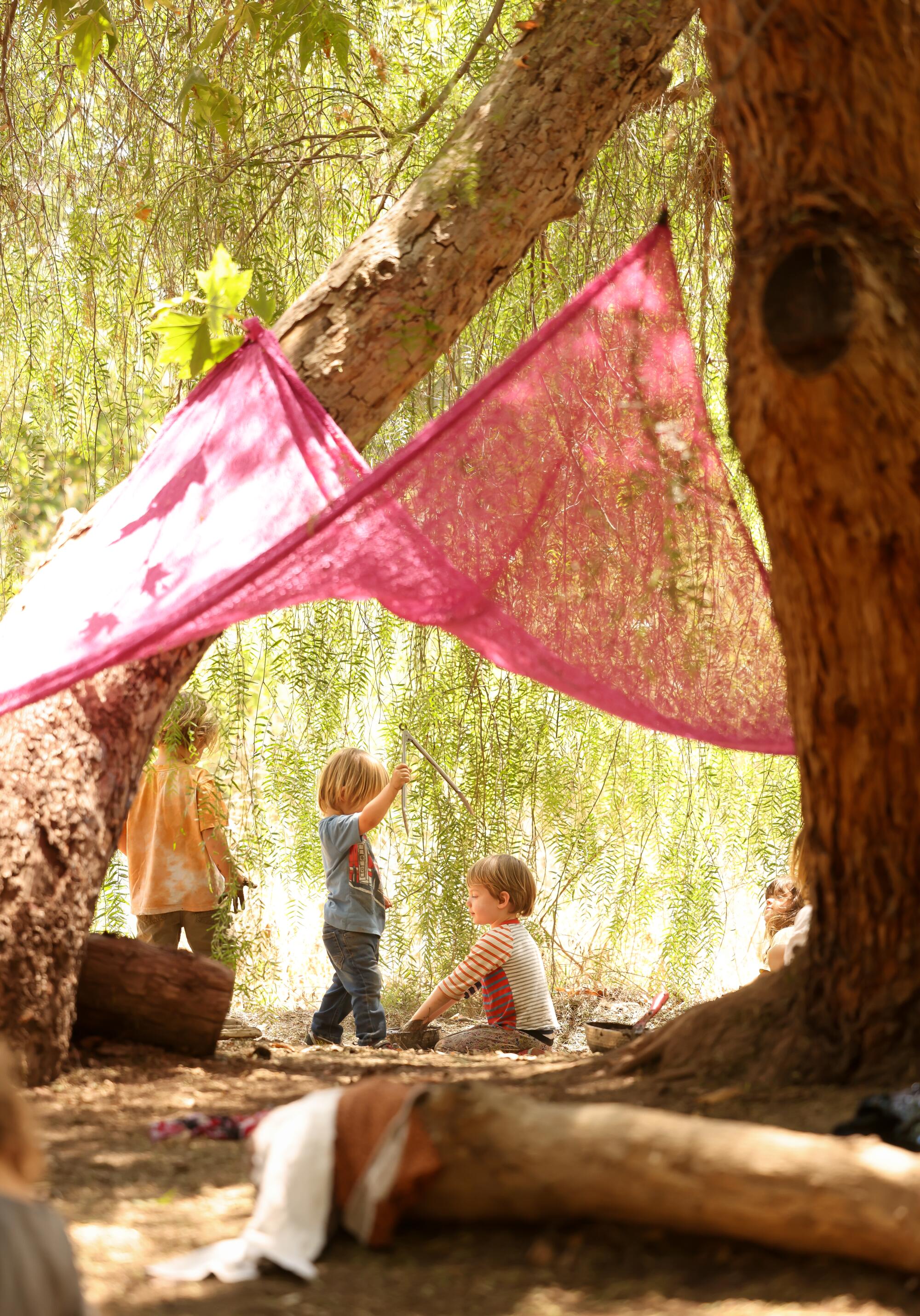
Children play beneath the trees on a warm summer day at Arroyo Nature School.
(Christina House / Los Angeles Times)
Operating outside can also create tension with public land managers. Levine said she was kicked out of two parks as she learned to navigate the rules — including the requirement that visitors stay on paths. “We know better now,” she said, and students are taught to respect the rules of places they go. (Eventually the school acquired a property in Silverado Canyon.)
Hadorn said she moved locations in Lower Arroyo Park after officials tried to charge her a fee associated with renting out a specific area of the park — a category she doesn’t think applies to her roving band of children. She said she has a good relationship with the rangers and always makes sure the area is left in pristine condition.
Hackett-Levy approached L.A. city park officials and worked out an agreement to hold classes in Elysian and Griffith parks. Previously, she’d sometimes try to nab a first-come, first-served area, but would find herself scrambling if someone else had gotten there first.
According to the survey by Natural Start Alliance, 42% of nature schools are not licensed. The percentage is much smaller for programs that are based entirely outdoors, and, according to state regulators, there are none in California.
Kit Harrington, Alliance’s senior policy advisor, said these schools often operate for fewer hours or with fewer children than required for licensing, or are otherwise exempt. Being unlicensed “could imply that something should be licensed but isn’t (as in an unlicensed doctor, for example),” she said in an email. “In the case of these programs, they are primarily operating in ways that don’t require them to be licensed.”
In many states, fully outdoor schools aren’t eligible for licensing. California regulators indicated it’s a gray area and there does not appear to be an effort to clarify the rules or develop new ones.
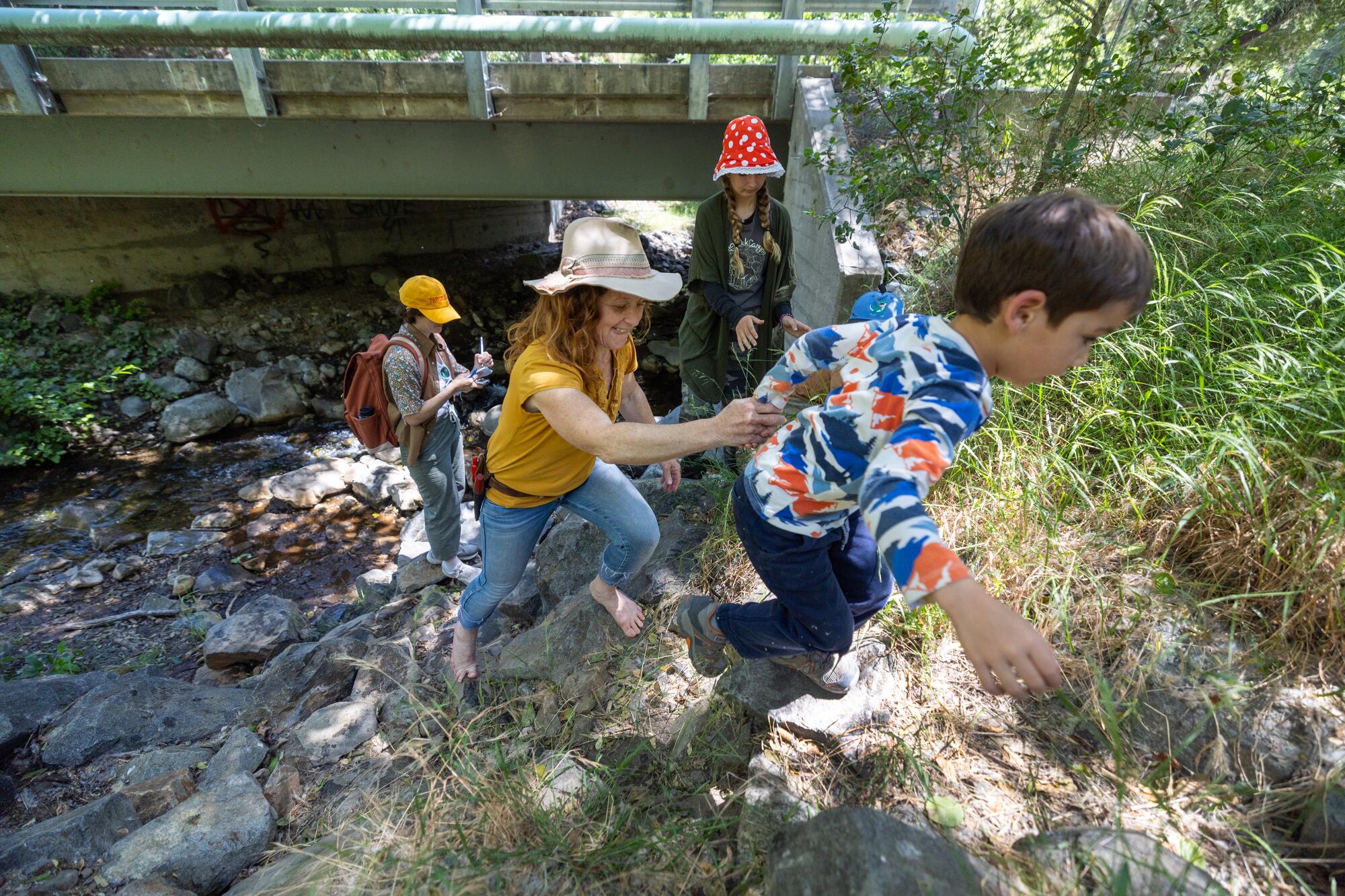
Earthroots Field School’s Jodi Levine helps children up a bank after checking out a creek.
(Allen J. Schaben / Los Angeles Times)
Some nature educators want a path to licensing, but others fear regulations will undercut the spirit of the programs.
Hadorn wonders what might become of tree climbing. Would they set a height limit? She acknowledges that there are upsides, however, such as providing security for parents.
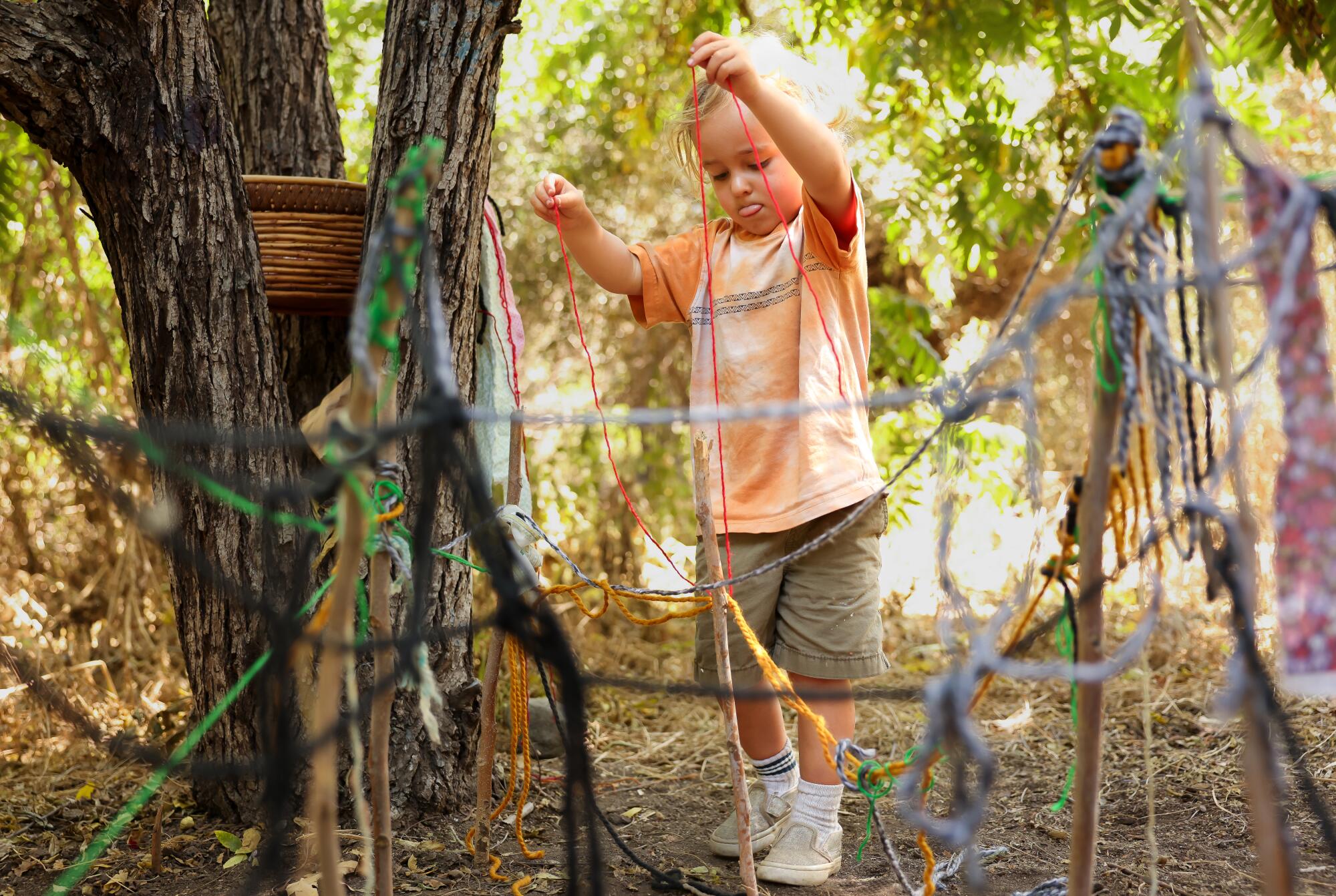
Zoli, 4, plays with yarn and sticks at Arroyo Nature School.
(Christina House / Los Angeles Times)
There’s also concern that the landscape — the primary classroom for nature schools — is becoming less safe for youngsters. Extreme phenomena are challenging nature schools’ emphasis on withstanding the elements by simply wearing the right gear. California — touted as a great backdrop for outdoor education because of its frequent bluebird days — is experiencing increasingly fierce wildfires and punishing heat.
The elements disproportionately affect young children, whose smaller bodies absorb “more of the bad stuff,” said Briggs, who is also a clinical professor of pediatrics, psychiatry and behavioral sciences at the Albert Einstein College of Medicine in New York.
As the climate and regulatory landscape evolves, nature continues to teach.
On a recent scorching day, the cascading branches of a California peppertree enveloped a dozen children attending Arroyo Nature School. Hours passed without a phone in sight. Leo, Zoli and Francis wrapped yarn around sticks to create a makeshift jail. Desmond worked water into clay. Asa and Mylo read books about bugs and cars.
Scout brought over a fresh-baked cake to sample. The secret ingredient? Mud.
The gloopy stuff clung to the 2-year-old’s arms like organic opera gloves. It threatened to sully her white dress flecked with rainbows.
She didn’t mind.

Lifestyle
L.A. Affairs: It’s hot when a man drives to me. But would this new guy make the trek from the Valley?
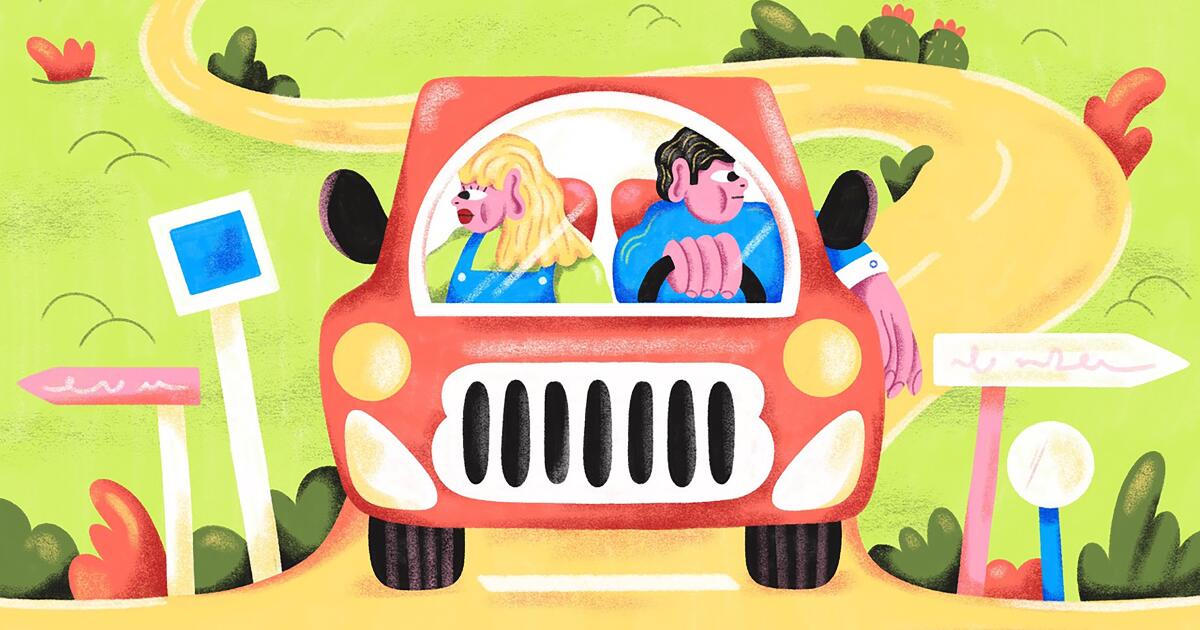
I met Dan on Hinge.
He lives in Woodland Hills, and I live in Venice. In Los Angeles, this is considered a long-distance relationship. In another city it might be nothing. Here, it’s a factor.
But I believe that with the right person, you can make anything work, so I stay open. I’m a native New Yorker, and if I were living in Brooklyn and a guy lived on the Upper West Side, that would be a 45-minute subway ride, which is truly nothing in New York. So with that same logic, I try to have flexibility with men in L.A.
When we started planning our first date, Dan suggested three options: a hike on mushrooms, a wine tasting or a walk on the beach.
A hike on mushrooms is something I’d only do with someone I already trust, not someone I just met online. I don’t do first-date hikes because I don’t like feeling trapped if the guy’s a dud. So I chose the wine tasting.
Then I learned the wine tasting was in West Hills.
On a Friday night, driving there from Venice would be insane. So I said I didn’t want to meet there because of the traffic. He suggested Malibu. That was also not ideal on a Friday.
I was getting annoyed — this was a pink flag because in my dating world, the guy is supposed to come to the woman’s neighborhood in the early days. I’ve gone out with plenty of men from the Valley who effortlessly suggested they come to me. It’s not rare or impossible.
I suggested he come to the Westside. I didn’t specifically say Venice, and in hindsight, I probably should have. He landed on Brentwood, which was manageable for both of us. On our first date, we met at an Irish pub on Wilshire Boulevard. He was cuter and more interesting than I had expected, and with the Guinness flowing, we had fun.
When I got home, he texted me: “Well, I like you 🙂 Less the tik tok and the lack of rock music in your life, but it’s not a deal breaker — there are other qualities 🙂 What are your thoughts?”
I noticed the slight negativity but was mostly dazzled that a man texted immediately after the date to say he liked me. In the modern dating economy, this felt rare.
The next day, both of our evening plans fell through, so we made a last-minute date. The wine tasting he originally suggested still sounded like fun, and although it meant me driving to the Valley, I was up for it now that we’d met.
We sipped flights at Malibu Wines & Beer Garden in its airy, romantic courtyard and played a flirty version of Truth or Dare. Halfway through, he dared me to kiss him.
We ended with sushi on Ventura Boulevard and a short make-out session in his car. He invited me to Thanksgiving at his uncle’s, which felt too soon, but also sweet.
After the second date, he texted and said he had his kids that week and was also hosting an event on Thursday, so his only day to meet was Wednesday. I said great.
On Tuesday night, he checked if we were still on, and I said yes.
Then he texted: “I’m flexible on time but not on location. I have a big event on Thursday, hopefully you can come to me again.”
My stomach tightened. This again?
So I texted back: “I drove to you last time, which was a bit of an exception for me especially in the early days, but the wine tasting location sounded special. Usually guys come to my area. How about we switch it up this time?”
He replied: “I appreciate the effort! Because of my event, I’d rather be close to a computer just if needed … Here is what i offer:
— I’ll come to your area anytime next week/end
— Lunch/dinner on me
I want to continue where we stopped last time 😉 No pressure of course, but let’s snuggle”
I responded: “Ok let’s meet next week. Snuggles sound nice … let’s see what happens …”
Then he wrote: “So I won’t see you tomorrow?”
I replied: “Unless you wanna come to me and bring your laptop along, let’s rain check until you have more flexibility.”
He said: “Dang, you are hard. I’ll let you know tomorrow around midday if it’s ok.”
And then — surprise — he decided to come.
He drove to Venice for a 5 p.m. date. He said his ETA was 5 p.m., and it ended up being 5:25 p.m., typical 405 Freeway.
When he showed up, he was in a cranky mood. On our way to KazuNori in Marina del Rey, I thanked him for picking me up and told him I think it’s hot when the guy comes to the girl.
“You’re just saying that because you want me to come to you more,” he said, not playfully, but aggressively.
That was basically the end for me. But there I was, in his car, heading to dinner. So I stayed pleasant and tried to make the best of it.
I shared that in the early stages of dating, I find it’s good etiquette for the guy to come to the woman’s neighborhood. He immediately disagreed and started ranting about how dating rules are ridiculous and how they swing in women’s favor. He resented paying for dates and declared he wasn’t looking to “sponsor a woman’s life.”
“If women want equality and equal rights,” he said, “then it should apply all across the board, including dating, and the man shouldn’t have to pay.”
I said women don’t actually have equal rights because we get paid less than men and often receive lower salaries than men in the same position.
I tried to change the subject and reset the mood, but he insisted we keep hashing it out.
I tried to explain masculine/feminine dynamics: providing and protecting, giving and receiving.
“What does the man get out of this arrangement?” he asked.
It was like watching someone’s personality warp into Mr. Hyde. Then he brought up another point: He’s a single dad of two kids, so he gets tired; and because I don’t have kids, that should factor into who drives where.
At this point, I was barely engaging and focused on eating my hand rolls, and I couldn’t wait to get home.
The check came, and I happily split it, wanting nothing further from him.
In the car back to my place, he remarked: “It’s obvious we’re never gonna see each other again.”
Obvious, but did it need to be stated?
Then he showed me a Spotify playlist he’d made for me of his favorite electronic music, because he knows I like EDM.
“Oh, that’s sweet,” I said.
“Yeah, that’s how I show interest. Through things like this, not who drives to who,” he replied.
When I got out of the car, we wished each other luck, and I headed inside and shut the door.
Two hours later, he sent me the playlist. I’ve yet to listen to it.
It wasn’t the distance that ruined it. It was the resentment. I’m not looking for a man who feels burdened by the effort. I’m looking for a man who sees the value of courting a woman in the first place.
The author is a writer, comedian and former psychologist who lives in Venice. She is the creator of the new vertical series “Manfari.” She’s on Instagram: @solange_neue and @manfari.show.
L.A. Affairs chronicles the search for romantic love in all its glorious expressions in the L.A. area, and we want to hear your true story. We pay $400 for a published essay. Email LAAffairs@latimes.com. You can find submission guidelines here. You can find past columns here.

Lonnie Bunch III is the 14th Secretary of the Smithsonian. He’s pictured above in September 2017.
J. Scott Applewhite/AP
hide caption
toggle caption
J. Scott Applewhite/AP
In a memo addressed to staffers sent Tuesday, the secretary of the Smithsonian, Lonnie G. Bunch III, defended the institution after the White House issued a 162-page report that characterizes the National Museum of American History as a place which has become “subject to institutional capture by a radical, activist ideology that is fundamentally opposed to telling the noble, honest story of the great country we know and love.”
In his email, which NPR has obtained, Bunch wrote in part: “While there will always be room for improvement, this report is not a fair characterization of the work and totality of the National Museum of American History. At the Smithsonian, our work is driven by scholarship, accuracy and an uncompromising commitment to tell the fullness of America’s story. As public servants and the keepers of this institution, we are charged with helping a nation find understanding, hope and clarity and as part of that duty, we are dedicated to excellence, reflection and growth.”

He continued: “We remain focused on what grounds us: a steadfast commitment to scholarship, nonpartisanship, independence, accuracy and integrity. For nearly 180 years, the Smithsonian has worked alongside partners across government — from the White House to Congress to our governing Board of Regents — guided by our enduring mission to increase and diffuse knowledge. That purpose remains: to pursue knowledge with rigor and to serve the American public with clarity and care.”
The White House report was issued on July 4 by the Domestic Policy Council under the title “Saving America’s Story: How Ideological Capture at the Smithsonian Institution’s National Museum of American History Erases Our Heritage.”

The council faults the National Museum of American History on a multitude of fronts, saying it underemphasized the Founding Fathers and early colonial and Revolutionary history; was not sufficiently celebratory of the country’s 250th anniversary; and that it engaged in “anti-white,” “illegal alien” and transgender activism.
It also accuses the museum of trying to “indoctrinate” teachers and students through its exhibitions, programming and teaching resources.
In the report, the council also specifically criticizes museum director Anthea Hartig, who has led the National Museum of American History since 2019 and is concurrently the president of the Organization of American Historians, calling her “an activist advancing an ideological agenda contradictory to the museum’s founding purpose of fostering patriotism.”

The Trump administration has made the Smithsonian museums one of its primary targets in its efforts to reshape cultural narratives to align with its viewpoints. In August 2025, the White House requested a “comprehensive internal review” of eight Smithsonian museums, including the National Museum of American History, following an executive order issued by President Trump in March 2025 in which he called for the removal of “improper ideology” from the Smithsonian’s offerings.
According to the Smithsonian’s charter, all of its 21 museums, 14 education and research centers, and the National Zoo are meant to be run independently of the federal government. The Smithsonian is overseen by Bunch and a board of regents, which includes Vice President Vance, Supreme Court Chief Justice John Roberts and other members appointed by Congress.
In an interview with NBC’s Meet the Press on Sunday, Bunch spoke about the Smithsonian’s 250th anniversary special exhibition at the Smithsonian Castle, which is called “American Aspirations.”
He told NBC: “It’s really important for people to understand that America is much an ideal as it is a place, that it’s a series of aspirations that have really shaped who this country is. And so for me, what is so powerful is to say, ‘Let us honor the words of Thomas Jefferson and the founders, but let us use those to challenge us to be better.’”
Jennifer Vanasco edited this story.

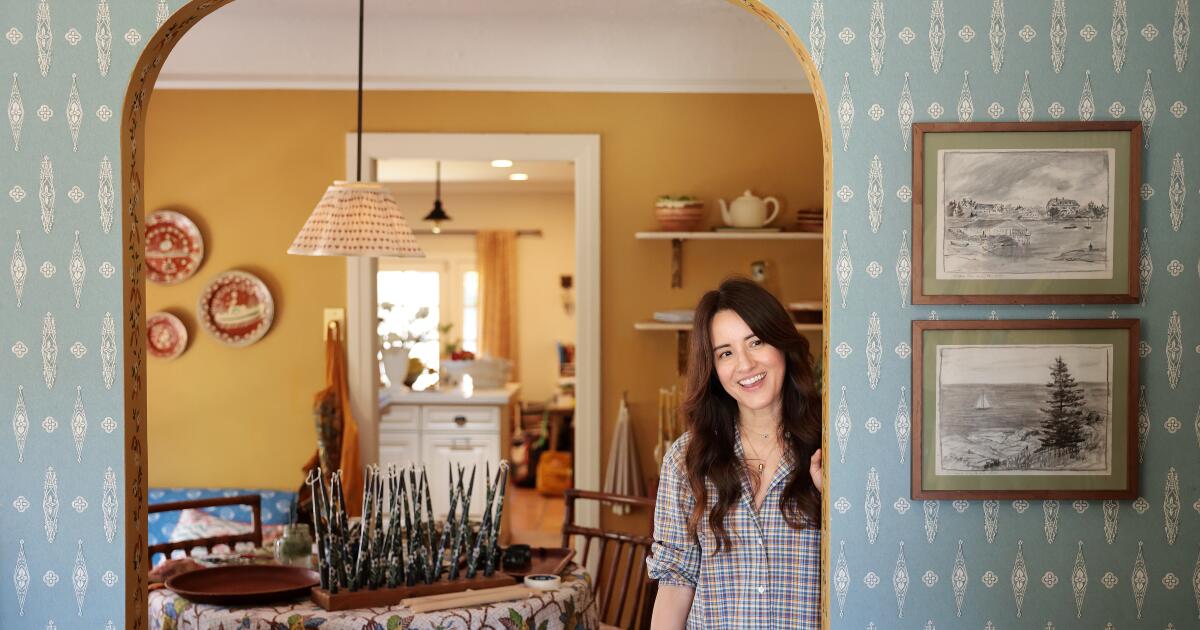
It was after the death of her son, Laith, that Esme Saleh decided to become a folk artist.
She had always been creative, experimenting with watercolors and learning to sew and embroider at a young age.
“I had a creative inkling,” she said, “but I never pursued it.”
Everything changed on Aug. 17, 2013.
In this series, we highlight independent makers and artists, from glassblowers to fiber artists, who are creating original products in and around Los Angeles.
When Saleh was nine months pregnant, she woke up with stomach pains and presumed she was in labor. She and her husband, Nasim, immediately went to the hospital, where doctors checked her and put the baby on a heart monitor. Saleh’s blood pressure was high, however, and the baby’s heart rate kept dropping. After about an hour, his heartbeat stopped. Doctors rushed her in for an emergency C-section, but it was too late. Laith did not survive.
Saleh lost a tremendous amount of blood and developed postpartum HELLP syndrome, a dangerous form of preeclampsia, but doctors were able to stabilize her.
When she woke up, the first thing she asked was, “How’s my baby?”

After losing her son in 2013, Esme Saleh left her job as a television producer. Since then, she has sold her hand-painted candles to local designers in Los Angeles and to LVMH in Paris.
“Aug. 17, 2013, was the most difficult day of my life, and Aug. 22 was the second most difficult, the day we drove home with an empty car seat,” she said of her and her husband’s new reality.
They named their son Laith Finn Saleh.
“His first name means ‘lion’ in Arabic. His middle name is an ode to Huckleberry Finn — sharp wit, kind heart, strong moral compass — all the attributes he’s imparted on us in spirit,” said Saleh, 45.
After such a devastating loss, she found it difficult to trust the world again. “It was hard to trust anything,” she said. “The medical system. Myself. It made me realize the fragility of bringing anything to life. We take so much for granted.”
So after years of working as a television producer, Saleh left broadcast journalism and leaned into her creative spirit.
She grew up in San Diego. Her mother was raised on a farm in Mexico, and her father moved from Tijuana to Los Angeles to be near her mother, who started working for a family in Sherman Oaks at 16. They eventually settled in San Diego, where Saleh’s father, now a church deacon, worked as a car salesman.


“The word Mystic has also become a driving force of what this journey means to me,” Saleh says. “A magical, otherworldly journey that has led me to some beautiful friendships, projects and unlimited well of curiosity. When I paint each pair of candles, it feels like I’m imparting a piece of that magic.”
“He always wanted to be a weatherman on TV,” she said, explaining how he hoped to get his big break on television by doing a weather report from the car lot.
Saleh wanted to be a broadcast journalist as her father had. After graduating from San Diego State, she interned in the sports department at CBS affiliate KFMB-TV although she didn’t know much about sports. She enjoyed sharing information with people, learned how to write plays of the week and felt she had found the right career.
But during a summer class at Mesa College, she started to think journalism might not be for her.


Saleh’s home is filled with her artwork. “My home expresses a lot of the things that I do,” she says. “If it works here, then I feel like I can put it out in the world.”
“I’m an empath — a sensitive soul — so when I was reading news about death and destruction, my eyes could not lie,” she said. Her professor told her, “This may not be your thing.” But when she arranged flowers on camera, she really came alive. She decided to work behind the scenes as a producer.
Her professor helped her get her first network news job in 2003, and she moved to Los Angeles, working on hard news and entertainment coverage.
After losing Laith a decade later, she couldn’t keep doing red-carpet interviews and acting like everything was fine. “It all felt so different, superficial and hard,” she said. “I felt like there was a bigger purpose out there for me. It’s in the small things that we find the big things.”
She started by painting folk art-inspired invitations for a friend’s baby shower. She painted delicate flowers, oranges and leaves on glass, leather and even lampshades. She created a logo. “I was just trying to say yes to things that were really scary,” she said. “Laith gave me the courage to do that.”

“I was just trying to get out of hole,” Saleh says of taking up painting after her son died.
Her first son, she said, became “a catalyst for painting.”
Then, at the first Thanksgiving during the COVID-19 pandemic when people could gather again, she had a light-bulb moment. “I was setting the table and didn’t have flowers or anything to add to decorate, so I thought, ‘I have these candles. I’m going to paint them and make them fancy,’ ” she said.
Her guests were impressed.
As time went on, painting taper candles helped her find joy again, and others noticed too.
“The one thing I hear when people pick up a pair of my candles is, ‘This makes me so happy. It makes me feel like there’s life here,’ ” she said.
1

2

3

1. Saleh sometimes leads painting workshops where participants can decorate items like ornaments and lampshades.
2. Leather napkin rings Saleh has painted for Nathan Turner. 3. Saleh’s hand-painted candles retail for approximately $42 to $50.
One of the hardest parts of losing a child “is that you’re not just grieving the person, you’re grieving the future you imagined with them,” said Chicago-based grief specialist Carla Harvey. “A lifetime of love suddenly has nowhere to go. Creating art doesn’t erase grief, but it can become a way to carry it.”
Saleh created her brand Mystic by Esme in 2021, but it took her some time before she could gather the courage to try to sell them.
When she brought a shoebox full of samples to Nickey Kehoe, the L.A. store agreed to carry her candles. “I was beside myself,” Saleh said.
“Her candles were absolutely beautiful, and she had a fantastic spirit that made selling them a no-brainer,” said interior designer Todd Nickey, co-founder of Nickey Kehoe.

Saleh gets a surprise kiss from her dog Olive while painting candles at her dining room table.
Saleh viewed her new side project as a way to earn extra money for piano lessons for her 11-year-old son Linus, who is an entrepreneur like his mother. “I felt proud painting the candles while he was in lessons in the next room,” she said. “It became this circular economy, and it led to bigger opportunities for me.”
Last year, luxury conglomerate LVMH commissioned Saleh to paint 465 pairs of candles, or 930 candles in total, for its Chaumet jewelry brand. The collection was unveiled at an elaborate event at the Abbaye des Vaux de Cernay, just outside Paris.
“It was fun,” Saleh said about the process, which took six months from conception to delivery. “I felt like I was dressing my candles up for a party.”
Always a hard worker, which she attributes to being a first-generation child of immigrant parents, Saleh has now created a candle collection for Pierce and Ward in Los Feliz, leather napkin holders for interior designer Nathan Turner and pomegranate wrapping paper for Olive Ateliers. The candles retail between $42 to $50 for a pair, and recently, she developed a handsome pewter candle shaver that will be released in the winter.

Her dining room can sometimes feel like “an assembly line,” Saleh says.

Saleh holds a pair of candles she has embellished with florals.
Occasionally, she leads painting workshops, and she loves helping others tap into their creativity. The most meaningful one for her was an ornament workshop attended by several victims of the 2025 Los Angeles wildfires. “Without saying anything, we understood each other,” she said. “I understood that they were trying to create memories.”
Saleh knows what it means for things not to last — “impermanence,” she calls it — whether it is homes, candles or life itself.
She paints every day in the art-filled dining room of her home (unless it’s Little League season), surrounded by her family, candles and her two dogs, Lennon and Olive. ”Painting is like meditation,” she said. “You can sit in your dining room and tune everything out and just be in the moment.”

Even the family’s summer bucket list receives an artistic flourish.

An arch inside Saleh’s home receives a personalized touch.
She knows painting candles isn’t new, but she believes her motivation and the care she puts into each candle makes them special beyond their looks.
She has learned to look at the world that way, that painting in her dining room has offered her healing and joy, that she can trust herself and her body, that continuing to be inspired by her two boys — “one in spirit and the other here on Earth” — means that Laith will always be with her.
Many people think healing means moving on, said grief specialist Harvey, but “it’s really about finding ways to move forward while keeping the people we love woven into our lives. That’s what I see in her candles, not an ending, but an ongoing relationship with her son.”
“I feel like my son is channeling through this medium,” Saleh said, her voice breaking as she painted a taper. “He’s whispering to me, ‘Mom, this is your path.’ That has been my driving force. We’re going to grow this together.”
-

 Technology11 minutes ago
I spent a week using the Trump phone — it sucks
-

 World14 minutes ago
With US unleashing attacks, Iranian official threatens that the Islamic Republic will deliver a ‘hard slap’
-

 Politics19 minutes ago
WATCH: Trump’s Energy chief reveals what escalating Iran tensions could mean for gas prices
-

 Health26 minutes ago
Coffee may have powerful effect on liver health, major study suggests
-

 Sports29 minutes ago
Oba Femi vs Brock Lesnar at SummerSlam is a ‘generational matchup,’ WWE legend JBL says
-
 Business41 minutes ago
Billionaire exodus? California drew 10 times more venture capital than any other state this year
-
 Entertainment44 minutes ago
Disney Channel maximalism to pop-star glam: What fans wore to Hilary Duff’s L.A. show
-
Lifestyle49 minutes ago
L.A. Affairs: It’s hot when a man drives to me. But would this new guy make the trek from the Valley?

