Lifestyle
Cats on leashes … yes, it's a thing

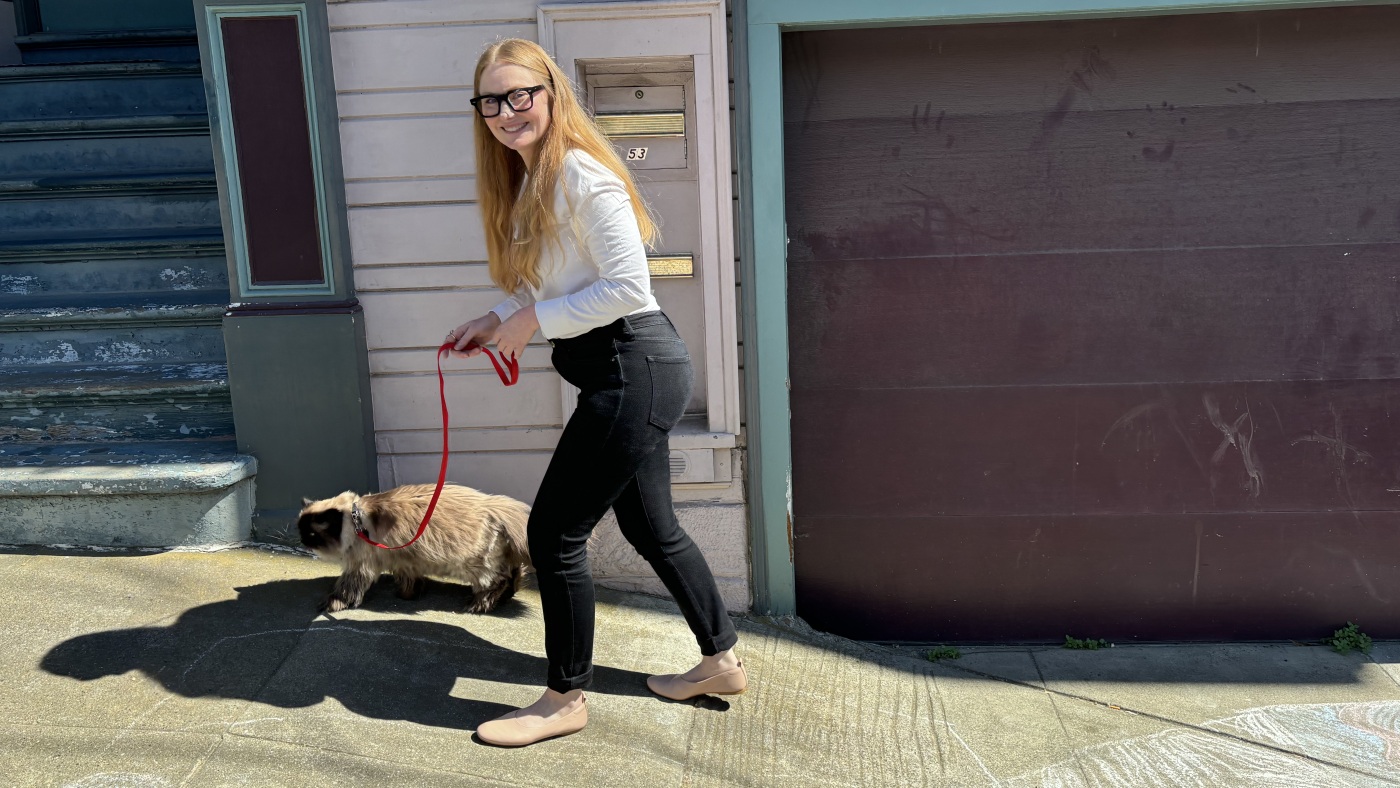
Jennifer Privett takes her Himalayan cat Jean Claude out for a stroll in San Francisco on June 28.
Chloe Veltman/NPR
hide caption
toggle caption
Chloe Veltman/NPR
On a sunny afternoon in San Francisco, Jennifer Privett took a stroll with her very large, very fluffy, blue-eyed Himalayan, Jean Claude.
With his luxurious, cream-colored coat and chocolate face, tail and paws, Jean Claude would turn heads even if he wasn’t sauntering along the streets of San Francisco on a leash.
As it is, he attracts a lot of attention from passersby when Privett walks with him several times a week through the neighborhood.
“People all the time are stopping to talk to us,” Privett said, just as a stranger walked up to ask the cat’s name. “He’s very sociable, and I’ve also made new friends because of this guy.”
Privett said the cat accompanies her to nearby destinations such as the dry cleaner, a pizzeria and several coffee shops.
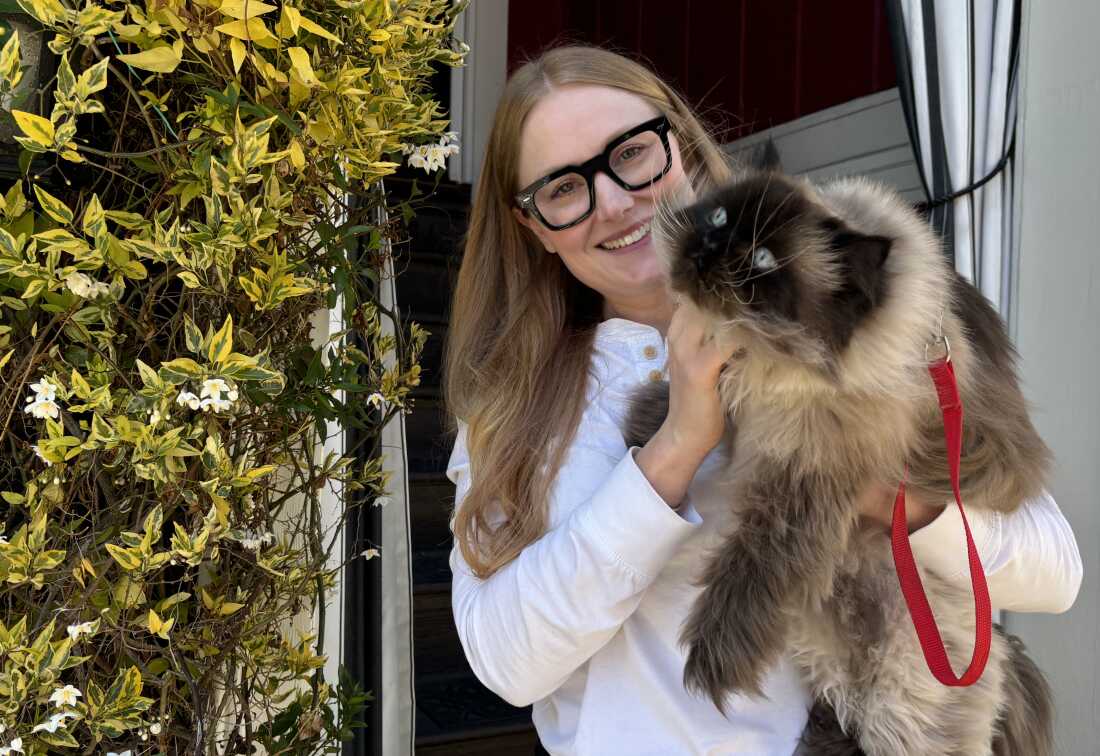
Jennifer Privett and Jean Claude
Chloe Veltman/NPR
hide caption
toggle caption
Chloe Veltman/NPR
“If I ever go there without him on the weekends, they ask, ‘Where’s Jean Claude today?’”
The cat dilemma
Whether or not cats should be allowed outside the home is controversial in this country — though they roam freely in many others, such as the United Kingdom, Morocco and Japan.
Cats can get hurt outside. But it is also estimated that cats kill over 1 billion birds each year in the U.S.
“There’s no good answer to the cat dilemma,” said Jessica Pierce, a bioethicist who’s written a book about the ethics of keeping pets. “It really seems problematic to let cats outside because of the implications for wildlife and also because of the danger cats are in from cars and malicious people and so forth. At the same time, it also seems bad to keep cats indoors all the time, because they’re wild at heart and they have a lot of cat behaviors that just don’t get satisfied, or are difficult to satisfy, inside.”
Taking cats out for walks while still restraining them has become a way for some owners to try to navigate this.
“I think for the right cat, it can certainly create environmental enrichment, get them some more exercise and things like that,” said cat veterinarian Grace Carter.
But Carter said cat-walking is not for everyone.
“Some cats are too stressed for it,” she said. “Some never adapt to the harness and leash.”
Reasons to walk a cat
For Privett, walking Jean Claude was a practical decision. She said they started taking neighborhood walks about 10 years ago, when the cat was 3.

“It kind of just happened naturally,” she said. “I mostly have lived in apartments, and he wanted to go outside. But I didn’t feel comfortable just letting him out anytime.”
For fellow San Francisco cat owner Jennifer Balenbin, the great outdoors are a way to improve her kitty SpongeBob’s mental health. They even show up together at occasional meetups in San Francisco parks for likeminded people and their sociable felines.
“The vet wanted to put him on Prozac,” Balenbin said. “But she first was like, ‘Can you let him outside, to roam around?’ I was like, ‘No, this is the city. I can’t do that.’ So we tried walking him. And we found that the more he goes out and he’s with us, he’s more calm at home.”
A trend driven by Instagram
Cat-walking isn’t a new phenomenon. Owners have long paraded their prize felines on leashes for competitive cat shows.
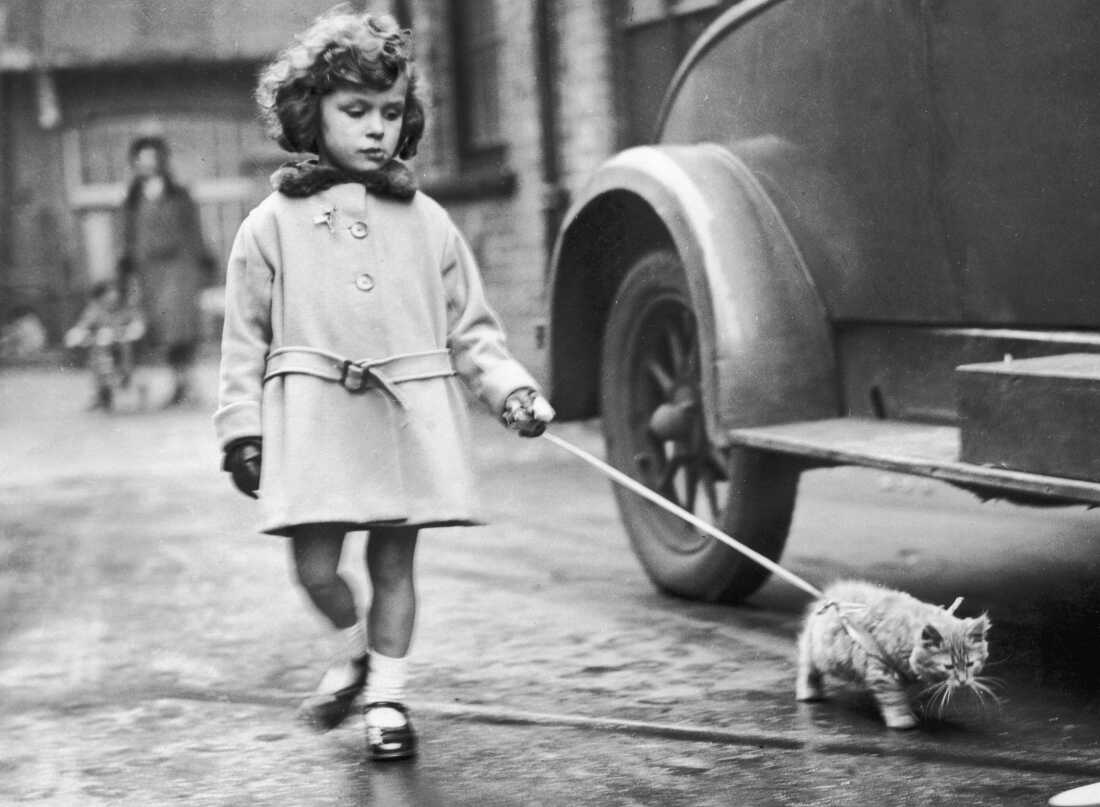
A young exhibitor arrives with her kitten on a lead at the National Cat Club show at Crystal Palace, London, 1931.
Fox Photos/Getty Images
hide caption
toggle caption
Fox Photos/Getty Images
But the more recent trend has been fueled by social media.
“People are seeing these gorgeous photos of cats outdoors,” said Laura Moss, the creator of Adventure Cats, an online resource for people who want to take their cats out and about safely. “And they want to try it for themselves.”
Moss said owners who want to leash-train their cats should do it slowly and gently.
“Introduce the harness when they’re indoors — don’t put it on them yet, let them just sniff it and get used to it. Make it a positive experience, so put some treats on it,” she said. “Once they’re used to that, clip the harness on, tighten it, add the leash, and just practice walking around at home. And then, once your cat is comfortable like that, you can take them outdoors.”



Nearly 280 filmmakers entered the Internet Archive’s Public Domain Film Remix Contest this year. Above, a still from King of Jazz. The 1930 film was used as source material in several contest submissions.
Universal Pictures/Internet Archive
hide caption
toggle caption
Universal Pictures/Internet Archive
One of the most unusual of the creative treasures to enter the public domain this month is King of Jazz. The plotless, experimental 1930 musical film shot in early Technicolor centers on influential bandleader Paul Whiteman, nicknamed “The King of Jazz.”
In one memorable scene, the portly, mustachioed Whiteman opens a small bag and winks at the camera as miniature musicians file out one after another like a colony of ants and take their places on an ornate, table-top bandstand.
A new video based on clips from King of Jazz has won this year’s Public Domain Film Remix Contest — an annual competition that invites filmmakers from around the world to reimagine often long-forgotten literary classics, films, cartoons, music, and visual art that are now in the public domain. This means creators can use these materials freely, without copyright restrictions. In 2026, works created in 1930 entered the public domain.
Titled Rhapsody, Reimagined, the roughly two-minute video captures the King of Jazz‘s surreal quality: Cookie-cutter rows of musicians, showgirls, office workers and random furniture cascade across the screen as Whiteman’s winking face looks on.
“I wanted to transform the figures and bodies into more dream-like shapes through collage and looping and repetition,” said Seattle-based filmmaker Andrea Hale, who created the piece in collaboration with composer Greg Hardgrave. For video artists, Hale said discovering what’s new in the public domain each January is a thrill. “We’re always looking for things to draw from,” Hale said. “Opening that up to a bigger spread of materials is amazing. That’s the dream.”
A massive repository of content
The Internet Archive, the San Francisco-based nonprofit library behind the contest, digitizes and provides public access to a massive repository of content, including many materials used by contest participants. “These materials have often just been in film canisters for decades,” said digital librarian Brewster Kahle, who founded the Internet Archive in 1996.
This year’s submissions range from a reworking of the 1930 film The Blue Angel starring Betty Boop — another public domain entrant this year — instead of Marlene Dietrich, to an AI-generated take on the 1930 Nancy Drew book The Mystery at Lilac Inn.
Kahle said the Internet Archive received nearly 280 entries this time around, the highest number since the competition launched six years ago. “Things are not just musty, old archival documentation of the past,” Kahle said. “People are bringing them to life in new and different ways, without fear of being sued.”
The public domain in the era of AI
Lawsuits have become a growing concern for artists and copyright holders, especially with the rise of generative AI. Recent years have seen a surge in online video takedowns and copyright infringement disputes.
Media companies are trying to address the problem through deals with tech firms, such as Disney and OpenAI’s plan, announced late last year, to introduce a service allowing users to create short videos based on copyrighted characters, including Cinderella and Darth Vader.
“On the one hand, these licensing agreements seem quite a clean solution to thorny legal questions,” said Jennifer Jenkins, director of the Center for the Study of the Public Domain at Duke Law School. “But what’s exciting about the public domain is that material, after a long, robust 95-year copyright term, is just simply free for anyone — without a team of lawyers, without a licensing agreement, without having to work for Disney or OpenAI — to just put online,” Jenkins said.
Jenkins also pointed out an interesting twist for people who create new works using materials from the public domain. “You actually get a copyright in your remix,” she said. “Just like Disney has copyrights in all of its remakes of wonderful public domain works like Snow White or Cinderella.” (The Brothers Grimm popularized these two characters in their 19th century collection Grimm’s Fairy Tales. But their roots are much deeper, going back to European folklore collections of the 1600s and beyond.)
However, this only applies to works created by humans — U.S. copyright law currently doesn’t recognize works authored by AI. And Jenkins further cautioned that creators only get a copyright in their new creative contributions to the remix, and not the underlying material.
This year’s Public Domain Film Remix Contest winner Andrea Hale said she’s using a Creative Commons license for Rhapsody, Reimagined. This means the filmmaker retains the copyright to her work but grants permissions that allow other people to freely use, share, and build upon it. “I’m keeping with the spirit of the public domain,” Hale said.

Mitt Romney’s Sister-In-Law
Suicide Note In Book of Mormon, Xanax In System
Published
Mitt Romney‘s sister-in-law left a handwritten suicide note tucked inside a Book of Mormon and had Xanax in her system when she died … according to the L.A. County Medical Examiner.
The ME’s report says detectives discovered a Book of Mormon on the front passenger seat of Carrie‘s car. In the final pages of the book, authorities say Carrie left a handwritten suicide note. Medications were also found inside the vehicle.
The report states Carrie had 6.3 ng/mL of Xanax in her system at the time of her death. A witness told first responders Carrie was seen pacing on the top level of the parking structure, watching security cameras, and looking over the edge of the parapet. The report also states surveillance footage captured her final moments.
The medical examiner’s findings note the injury occurred when she fell backward from a seated position on the rooftop parapet.
As we reported … Carrie died from blunt traumatic injuries after falling from the rooftop of a parking structure in Valencia, California, back in October.
Carrie’s husband, Scott Romney — Mitt’s brother — had reported her missing to the Sheriff’s Department. He told authorities she previously drove her car off a cliff two years earlier and had struggled with anxiety, per the report.
At the time of her death, Carrie was also in the middle of a divorce. Scott filed in June, citing “irreconcilable differences.” The couple married in 2016, and Carrie was Scott’s third wife.

This is the last year the Sundance Film Festival will be held in Park City, Utah. It is moving to Boulder, Colo., in 2027. Above, the Egyptian Theatre on Main Street in Park City.
Mandalit del Barco/NPR
hide caption
toggle caption
Mandalit del Barco/NPR
The Sundance Film Festival begins for the last time in Park City, Utah before heading to Boulder, Colo., next year. It’s a bittersweet finale for the country’s premier independent film festival, founded by Robert Redford in 1978.
With a gala, the festival plans to pay tribute to the late actor and director, who died of natural causes in September.
“Before he passed earlier this year, [Redford] shared with us this quote: ‘Everybody has a story,’” says the festival’s director, Eugene Hernandez. “This notion is such a great framing for a festival that has always been about finding and sharing with audiences the stories that come from all over the world.”
This year, the festival will screen films that got their starts at Sundance, including Little Miss Sunshine, which went on to be nominated for best picture at the 2007 Oscars.

The festival will also screen a remastered print of the 1969 movie Downhill Racer, in which Redford plays a champion skier. Redford was also a producer on this indie film.
“He would tell this story year after year about getting Downhill Racer made,” recalls Sundance senior programmer John Nein. “It became a way that he understood the notion of protecting independence and protecting the artistic voice of a film. He often used that when he talked to emerging filmmakers, to relate to the struggles that they had in getting their films made the way that they wanted to.”
Nein says one way to recognize that legacy is by programming 40 percent of the slate from first-time filmmakers. More than 16,200 films were submitted from 164 countries. Throughout the year, the Sundance Institute hosts labs and programs and provides grants and fellowships for independent filmmakers.
Over the years, Sundance has been a launching pad for filmmakers such as Quentin Tarantino, Ava DuVernay, The Coen brothers, Ryan Coogler, Chloe Zhao and Paul Thomas Anderson.
Another filmmaker whose career Sundance supported is Rachel Lambert, who says she was inspired by a film Redford directed: Ordinary People.
“It’s a profound legacy a single human being can leave an entire nation’s culture,” she says of Redford. “It’s remarkable.”
Lambert will premiere her newest film, Carousel, a love story starring Chris Pine and Jenny Slate.
Also showing at Sundance: documentaries about Chicano theater pioneer Luis Valdez, singer Courtney Love, tennis star Billie Jean King, and South African leader Nelson Mandela.
Among the features in competition is The Gallerist with Natalie Portman and Jenna Ortega.
Another is The Invite, with Olivia Wilde, Seth Rogen, Penélope Cruz and Edward Norton. The Invite‘s producer, David Permut, has been faithfully attending Sundance since the late 1980s, when he was in the audience for Steven Soderbergh’s breakout Sex, Lies, and Videotape.
“I never miss Sundance. I’ve been going every year since,” says Permut. “I stay for 10 days, I’m not in and out like a lot of people from Hollywood when they’re there with their film. I love the second week because it’s basically cinephiles from all over the world.”
Permut showed his first film at Sundance — Three of Hearts — in 1993. Last year, his film Twinless won the festival’s audience award.
“I have 57 movies I want to see this coming Sundance,” he says. “For me, it’s about discovery.”

Actress Hana Mana in The Friend’s House Is Here. The film was smuggled out of Iran to premiere at this year’s Sundance Film Festival.
Alma Linda Films
hide caption
toggle caption
Alma Linda Films
Some filmmakers have gone to great lengths to get their work screened this year — including the Iranian film The Friend’s House is Here.
The drama—set in Tehran’s underground art scene — was shot under the radar of Iranian authorities. Amid the country’s recent political turmoil, members of the film’s crew had to drive 11 hours to smuggle the film over the Turkish border to get it to the festival. According to the film’s publicist, the film’s two main actresses were not heard from for weeks during Iran’s recent unrest. The publicist says the women are now safe but have been denied visas by the United States to attend Sundance.

Can Pickles Help You Lose Weight? Discover the Perks of Fermented Foods
Public domain contest challenges filmmakers to remix Betty Boop, Nancy Drew and more

Hundreds of creatives warn against an AI slop future

Iran accused of sex assaults on teenage prisoners, while families charged to recover remains of loved ones

Judge rules NYC’s lone Republican congressional district unconstitutional, orders redraw

Florida High School Football Rankings: Top 25 teams – Oct. 21

Cleary's 21 help Le Moyne down Central Connecticut State 69-64 in OT

How old is Bo Nix? What to know about Oregon quarterback ahead of 2024 NFL Draft

99th annual Pony Swim held in Virginia

Indiana Members Credit Union announced as new anchor tenant at Bottleworks District
Judge rules NYC’s lone Republican congressional district unconstitutional, orders redraw

French firm Lactalis latest to recall baby formula amid contamination scare

Autopsy finds Cuban immigrant in ICE custody died of homicide due to asphyxia

Supreme Court appears ready to keep Lisa Cook on Federal Reserve board despite Trump efforts to fire her

Greenland, NATO and war: Fact-checking Trump’s Davos speech
-

 Sports4 days ago
Miami’s Carson Beck turns heads with stunning admission about attending classes as college athlete
-
 Detroit, MI1 week ago
School Closings: List of closures across metro Detroit
-

 Culture1 week ago
Try This Quiz on Myths and Stories That Inspired Recent Books
-
 Lifestyle1 week ago
Julio Iglesias accused of sexual assault as Spanish prosecutors study the allegations
-

 Education1 week ago
Video: Lego Unveils New Smart Brick
-

 Pittsburg, PA3 days ago
Sean McDermott Should Be Steelers Next Head Coach
-
Education1 week ago
How a Syrian Hiking Club Is Rediscovering the Country
-

 Sports2 days ago
Miami star throws punch at Indiana player after national championship loss