Lifestyle
Blake Lively inspires more actresses to speak out against Hollywood toxicity


Kate Beckinsale (left) and Abigail Breslin are sharing stories of on-set harassment and retaliation, inspired by Blake Lively’s public accusations against Justin Baldoni.
Amy Sussman/Getty Images and Valeria Macon/AFP via Getty Images
hide caption
toggle caption
Amy Sussman/Getty Images and Valeria Macon/AFP via Getty Images
Blake Lively’s civil rights complaint against Justin Baldoni isn’t just dominating headlines. It’s also inspiring other actresses to speak out against the toxic masculinity and on-set harassment they say they’ve experienced themselves.
In separate social media posts this week, Kate Beckinsale and Abigail Breslin shared their own stories about harassment and retaliation, describing them as part of an industrywide problem. And while they didn’t name many names, they both pointed to Lively’s high-profile case as the impetus for speaking up.

“What it has highlighted is this machine that goes into effect when a woman complains about something legitimately offensive, upsetting, harmful, or whatever in this industry,” Beckinsale said in her Instagram video.
Months after the release of Lively’s movie It Ends With Us, she filed a lengthy complaint with California’s Civil Rights Department accusing Baldoni — her co-star and director — of sexually harassing her and violating her physical boundaries, prompting her to raise concerns during filming.
In the complaint, which was published by the New York Times in mid-December, Lively also alleges that Baldoni and his production studio, Wayfarer, then retaliated against her by hiring a crisis publicity firm to smear her reputation during the movie’s promotional cycle this summer.

Bryan Freedman, an attorney for the studio, told NPR that Lively’s claims are “categorically false” and “another desperate attempt to ‘fix’ her negative reputation.” But consequences for Baldoni have been swift: His talent agency dropped him, his podcast co-host publicly quit and a global women-focused nonprofit rescinded a solidarity award it had given him just weeks earlier.
Lively’s complaint — which could be the precursor to a lawsuit — includes thousands of pages of texts and emails between Baldoni and his representatives, which her lawyers say were obtained through a subpoena. She hasn’t spoken publicly beyond the legal filing.
“I hope that my legal action helps pull back the curtain on these sinister retaliatory tactics to harm people who speak up about misconduct and helps protect others who may be targeted,” Lively told The Times in a statement.
In the days since, a growing number of Hollywood actresses have come forward to thank Lively for doing so — and to lend a hand in lifting that curtain.
Beckinsale says she has “about 47 million” similar stories
Beckinsale posted an Instagram video on Monday detailing examples of poor working conditions on various film sets and the retaliation she said she’s experienced for speaking out about them.
Speaking into the camera, Beckinsale stressed that she doesn’t know Lively or Baldoni personally and wasn’t on the set of It Ends With Us herself — but in her own career has amassed “about 47 million stories similar to this.”

The British actress, who made her on-screen debut in Kenneth Branagh’s 1993 adaptation of Much Ado About Nothing, is known for her roles in action films like Van Helsing, Total Recall and the Underworld franchise.
Beckinsale described being “felt up” by a trusted crew member on a film when she was 18, and having her concerns dismissed by both actresses she told — including one who was “known for being a supporter of women.”
She also recalled working on a film set where her co-star was “drunk every day,” which resulted in long hours that kept her from seeing her daughter. She said raising those concerns only ended up hurting her, as people on set referred to her in pejorative terms and the studio dismissively gave her a bike “so I could ride around the studio lot while I was waiting.”
Editor’s note: The following video contains profanity which some viewers may find offensive.
Some of the consequences were physical, she said. She cited two instances where she was put on such a strict diet and exercise regimen for a movie that she lost her period, and spoke of being forced by her own publicist to do a photoshoot while bleeding from a miscarriage.
Beckinsale also said she had been harmed in a “very unsafe fight situation” with two different actors in two different films.
“I was gaslit and made to feel like I was the problem — blamed and ostracized, left out of cast dinners, not spoken to — as soon as I mentioned there was a problem,” she added.
The only individual Beckinsale mentioned by name was disgraced former producer Harvey Weinstein, whose decades of alleged sexual misconduct fueled the global #MeToo movement when they came to light in 2017. Beckinsale says in the video that she was fortunate enough never to have been harassed by Weinstein, but described how he would blacklist actors who turned down his projects.
Beckinsale says she often hears men say the climate has gotten better since over the years — but was quick to dispute that notion.
“I’m grateful to Blake Lively for highlighting the fact that this is not an archaic problem that no one’s facing — this is continuing,” she said. “And then when it does happen, a machine goes into place to absolutely destroy you.”
Breslin breaks her silence on the since-dismissed lawsuit against her
Abigail Breslin — whose 2006 starring role in Little Miss Sunshine propelled her to fame at age 10 — also took to social media to share her thoughts.
“In light of recent events regarding the attempt to destroy the career and livelihood of a fellow actress and woman, I have felt compelled to write this, as I have unfortunately been subject to the same toxic masculinity throughout my life,” Breslin, now 28, wrote in a Tumblr post that she also shared on Instagram.
Breslin went on to discuss one of those experiences, commenting publicly for the first time on a since-withdrawn lawsuit filed against her last year by producers of her 2024 film Classified.

“When a suit was filed against me by a former employer, (the suit was withdrawn), after making a confidential complaint against a coworker for unprofessional behavior, I had the silly and naive impression that they would believe me,” Breslin wrote.
According to Variety and other entertainment news outlets, the producers of Classified sued Breslin after she made accusations against her older male co-star, Aaron Eckhart.
The complaint, obtained by Variety, says production on the film “almost ground to a halt” after Breslin accused Eckhart of “aggressive, demeaning and unprofessional behavior” that “placed her at various times in peril.” The lawsuit says the on-set producer investigated and “found no evidence” to support Breslin’s “wild, hysterical and imaginary allegations” against her co-star. Her refusal to be alone with Eckhart in certain scenes also forced them to spend $80,000 in accommodations, according to court documents cited by Variety.
A representative for Breslin told People at the time that the actress “categorically denies all contended allegations against her and unequivocally stands by her statement, which she confidentially provided to SAG,” referring to the actors’ union.
NPR has reached out to representatives for Eckhart, who has not commented publicly on the lawsuit or the allegations within it. Jeffrey Konvitz, who represented the producers in the lawsuit, confirmed to NPR that the case was settled by the parties and dismissed, but declined to comment further.
“Instead of being believed and protected, a suit was filed against me for having the audacity to speak up,” Breslin wrote. “I was publicly shamed and defamed in the process. A reputation I had cultivated for over 2 decades had now been tainted as I became the crazy, paranoid and, to quote directly, ‘hysterical and wild’ woman, who apparently just had it in for men.”
Breslin expressed her disappointment that the #MeToo movement didn’t lead to more lasting changes as she had hoped. She said she’s realized that experiences like hers have become the norm, and that “behind closed doors — to them — we are still just noisy women.”
“To change the narrative, we do not need more women to scream,” she said. “We just need a lot more men to shut up and listen.”
Other actresses speak up in support of Lively
A number of other actors have come forward to show their support for Lively in the days since news of her complaint broke.
She’s received public encouragement and thanks from several people involved in It Ends With Us, from book author Colleen Hoover to co-stars Jenny Slate and Brandon Sklenar.
Alexis Bledel, America Ferrera and Amber Tamblyn — friends of Lively’s since they starred together in the Sisterhood of the Traveling Pants films of the early 2000s — issued a joint statement of solidarity.
“We are struck by the reality that even if a woman is as strong, celebrated and resourced as our friend Blake, she can face forceful retaliation for daring to ask for a safe working environment,” they wrote. “We are inspired by our sister’s courage to stand up for herself and others.”



Neve Campbell in Scream 7.
Paramount Pictures
hide caption
toggle caption
Paramount Pictures
The OG Scream Queen Neve Campbell returns. Scream 7 re-centers the franchise back on Sidney Prescott. She has a new life, a family, and lots of baggage. You know the drill: Someone dressing up as the masked slasher Ghostface comes for her, her family and friends. There’s lots of stabbing and murder and so many red herrings it’s practically a smorgasbord.
Follow Pop Culture Happy Hour on Letterboxd at letterboxd.com/nprpopculture

Abriana Vicioso is the host of the Flower Hour, which takes place monthly.
(Jennifer McCord / For The Times)
Each flower carries a personal history. For Abriana Vicioso, the calla lily was her parents’ wedding flower — a symbol of her mother’s beauty. “She had this big, beautiful white calla lily in her hair,” Vicioso says. “I love my parents. They’re the reason I’m here. I’ll never forget where I came from.”
The Flower Hour begins with Vicioso announcing, with a warm smile: “Today is about touching grass.” The florist-by-trade gestures behind her to hundreds of flowers contained in buckets — blue thistles, ivory anemones and calla lilies painted silver — all twisted and unfurling into the air. “Tonight is going to be so sweet and intimate,” Vicioso says, eyeing the beautiful chaos at her feet. A grin buds across her face.
Moments before the workshop, participants sit at candlelit tables exchanging horoscopes and comparing their favorite flowers. A mention of the illustrious bird-of-paradise flower elicits coos and awe from the women. Izamar Vazquez, who is from Jalisco, Mexico, reveals her fondness for roses, which make her feel connected to her Mexican roots.
Vicioso hosts her flower-themed wellness workshop near the iconic Original Los Angeles Flower Market in downtown L.A. In January, the first Flower Hour event sold out, prompting her to make it a monthly series. Vicioso describes the event as a “three-part journey” where participants are invited to drink herbal tea, smoke rose-petal-rolled cannabis joints and create a floral arrangement. “The guide is to connect with the medicine of flowers,” Vicioso says.


Rose petal joints, tea and flower arranging are all part of The Flower Hour event’s offerings.
The event is hosted at the Art Club, a membership-based co-working space. “The Flower Hour is really beautiful. Everyone gets to explore their creativity while meeting new people,” says Lindsay Williams, the co-owner of the Art Club.
The idea for Flower Hour came to Vicioso during a conversation with her mother. “We joke all the time that flowers were destined to make their way into my life,” she says. She works as a florist and models on the side, even appearing in the pages of Vogue. Vicioso grew up in a Caribbean household, where flowers and offerings were part of daily life. “In my culture and religion, a lot of my family practices — an Afro-Caribbean religion — we build altars.”
Like many cultures, flowers carry sentimental value in her religion. “I’m Caribbean, so a lot of my family practices a Yoruba religion, which comes from Africa. In the Caribbean, it’s well known as Santería.”

-
Share via
After a difficult year and a breakup, Vicioso wanted to marry her love of flowers with community building. Because Vicioso uses cannabis medicinally, the workshop naturally includes a smoking component. “My family has smoked cannabis for a lot of reasons for a long time. It’s a really healing plant,” she explains.
In the workshop, even the cannabis gets the floral treatment. Vicioso presents her rose-petal-wrapped joints on a silver platter at each table. She rolled each by hand. “If you’ve never smoked a rose-petal-rolled joint, the difference with this is it’s going to have roses that have a slight tobacco effect,” she announces.
During the workshop, Vicioso stresses the importance of buying cannabis from local vendors. The cannabis provided was purchased from a Northern Californian vendor. The wellness workshop aims to reclaim the healing ritual of smoking cannabis. “This is a plant that has been commercialized,” Vicioso says. “There’s a lot of Black and Brown people who are in jail for this plant.”
The resulting workshop is what Vicioso describes as “an immersive wellness experience that is the intersection of wellness, creativity, community and an appreciation of flowers.” The workshop serves as a reminder to enjoy Earth’s innate beauty in the form of flowers — including cannabis. “It’s this gift that the universe gave us for free and that I have this deep connection with,” Vicioso says.


Conversation cards to generate discussion among participants (top, letf). The workshop serves as a “third space” for Angelenos to engage in tactile creativity and community building outside of traditional nightlife settings.
After enjoying lavender chamomile tea and smoking a joint, Vicioso introduces the flowers to the group before inviting them to pick their own. She emphasizes each flower’s personality traits, describing green dianthus as a “Dr. Seuss” plant. Then, there are calla lilies with their “main character moment.” It gets personal. “Start thinking of a flower in your life that you can discover,” she says. “If you’re feeling like you need inspiration, you can always remember that these flowers have stories.”
Vicioso infuses wisdom into her instruction on floral arrangements: There are no mistakes. Let the flowers tell you where they want to go, she urges. Intuition will be your guide — the wilder, the better.
“Hecho in Mexico” reads a sticker on a bunch of green stems. “Like me,” says Vazquez with a laugh. “They’re all doing their own thing. Like a family,” she says later, arranging stems.

The Flower Hour participants and Vicioso, center, chat as they build their own floral arrangements at the sold-out event.
Two participants — Vazquez and Rebeca Alvarado — are friends who run a floral design company together called Izza Rose. Like Vicioso, the friends have a connection to flowers through their Latin American culture. They met Vicioso in the floral industry and were overjoyed to discover her workshop.
“This is a great way to connect with other people,” says Vazquez.
Alvarado agrees, adding: “You’re getting to know people outside of going to bars. You can connect in different ways when there’s an activity.”
Vazquez uses flowers to stay connected to her Mexican heritage, adding that she prefers to support Mexican vendors. In recent months, the downtown L.A. flower market has struggled to recover from ongoing ICE raids. “Some are scared to come back,” says Vazquez.


Hand-rolled cannabis joints wrapped in rose petals are presented on a silver platter at The ArtClub (top, right). The Flower Hour aims to reclaim the healing rituals of cannabis and flowers.
Another participant, Barbara Rios, was attracted to the workshop for stress relief. “You can hang out with your friends, but it’s nice to do things with your hands,” she says. “I work a stressful job, and it’s nice to have that third space that we’re all craving.”
On this February night, the participants were predominantly women, save for one man. In the future, Vicioso hopes that more men learn to engage with flowers. “There’s a statistic about men receiving flowers for the first time at their funerals, and I think we have changed that,” she says.
To conclude the workshop, Vicioso encourages participants to build lasting friendships and incorporate flower arranging into their daily practice — even if it’s just with a small, inexpensive bouquet.
“Get some flowers together, go to the park, hang out with each other and hang out with me,” she says. Participants leave with flower arrangements in hand. In the darkness of the night air, it briefly looks as though the women carry silver calla lilies that are blooming from their palms.

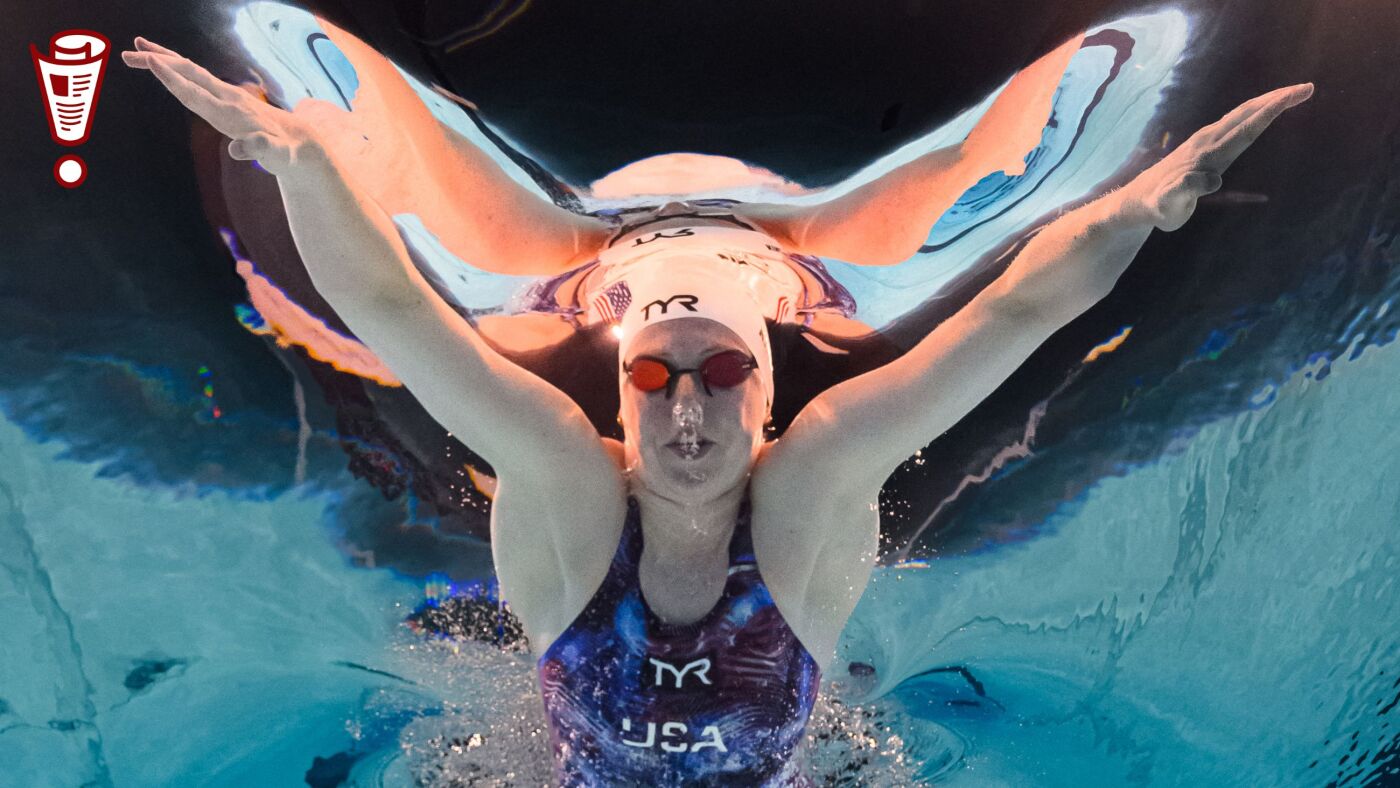
An underwater view shows US’ Lilly King competing in a heat of the women’s 200m breaststroke swimming event during the Paris 2024 Olympic Games at the Paris La Defense Arena in Nanterre, west of Paris, on July 31, 2024. (Photo by François-Xavier MARIT / AFP) (Photo by FRANCOIS-XAVIER MARIT/AFP via Getty Images)
François-Xavier Marit/Getty Images
hide caption
toggle caption
François-Xavier Marit/Getty Images
This week’s show was recorded in Bloomington, Indiana with host Peter Sagal, judge and scorekeeper Bill Kurtis, Not My Job guest Lilly King and panelists Alonzo Bodden, Josh Gondelman, and Faith Salie. Click the audio link above to hear the whole show.
Who’s Bill This Time
State of the Union is Hot; The Tribal Council Convenes Again; A Glow Up In the Doll Aisle
Panel Questions
The Toot Tracker
Bluff The Listener
Our panelists tell three stories about a travel hack in the news, only one of which is true.
Not My Job: Olympic Swimmer Lilly King answers our questions about Lil’ Kings
Olympic Swimmer Lilly King plays our game called, “Lilly King meet these Lil’ Kings” Three questions about short kings.
Panel Questions
Cleaning Out The Cabinet; Bedtime Stacking
Limericks
Bill Kurtis reads three news-related limericks: Getting Cozy With Cross Country Skiing; Pickleball’s New Competition; Bees Get Freaky
Lightning Fill In The Blank
All the news we couldn’t fit anywhere else
Predictions
Our panelists predict, after American Girls, what’ll be the next toy to get an update.

Michigan State Police sends message to drivers after trooper involved in hit and run:

Yes, an $8 Burger Exists in Downtown San Francisco

Daisy’s Memorial Dog Strick Library| The Post

Red Sox rotation contender strikes out four in dominant outing

9NEWS

Florida High School Football Rankings: Top 25 teams – Oct. 21

Cleary's 21 help Le Moyne down Central Connecticut State 69-64 in OT

How old is Bo Nix? What to know about Oregon quarterback ahead of 2024 NFL Draft

99th annual Pony Swim held in Virginia

Indiana Members Credit Union announced as new anchor tenant at Bottleworks District

Map: Earthquake Shakes Central California

Gas prices could jump as Middle East tensions threaten global oil supply

Pakistan calls troops, orders 3-day curfew as 24 killed in pro-Iran rallies

US says Kuwait accidentally shot down 3 American jets

House Republicans push Johnson to go to war with Senate over SAVE Act
-

 World5 days ago
Exclusive: DeepSeek withholds latest AI model from US chipmakers including Nvidia, sources say
-

 Massachusetts5 days ago
Mother and daughter injured in Taunton house explosion
-

 Denver, CO5 days ago
10 acres charred, 5 injured in Thornton grass fire, evacuation orders lifted
-

 Louisiana1 week ago
Wildfire near Gum Swamp Road in Livingston Parish now under control; more than 200 acres burned
-

 Technology1 week ago
YouTube TV billing scam emails are hitting inboxes
-

 Politics1 week ago
OpenAI didn’t contact police despite employees flagging mass shooter’s concerning chatbot interactions: REPORT
-

 Technology1 week ago
Stellantis is in a crisis of its own making
-

 News1 week ago
World reacts as US top court limits Trump’s tariff powers