Lifestyle
Beyond Erewhon: Inside the L.A. grocery store where all the cool vegans are flocking

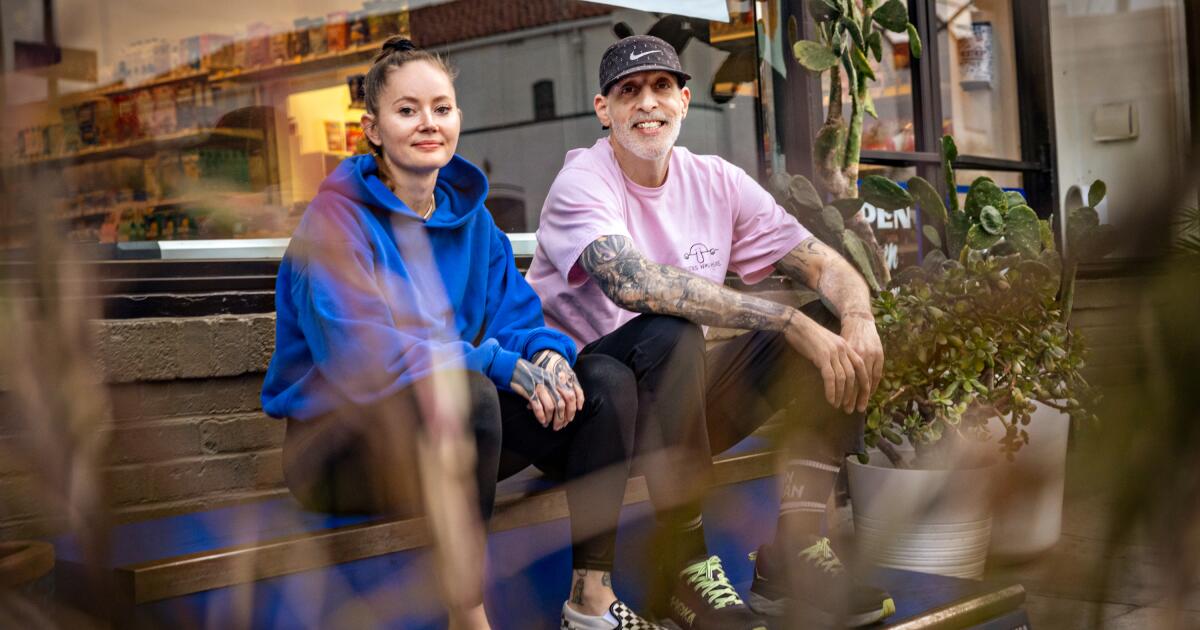
On a rainy Saturday afternoon in late March, a block of East Hollywood is unusually quiet but for the corner of Fountain Avenue and North Edgemont Street. There, a line snakes halfway around the perimeter of a little vegan grocery store that’s sparking with activity.
Inside, grime music blasts as a pop-up vendor doles out vegan banh mi to shoppers who clutch bamboo toilet paper and vegan lox. Even a Siberian husky named Chaka gets in on the action, scarfing up a vegan dog treat — every canine who comes through the door gets one.
“Welcome!” yells Matt Fontana, the store’s tattoo-sleeved co-founder.
The Besties store after its run club event, which always ends with free soft serve for all.
(Jason Armond / Los Angeles Times)
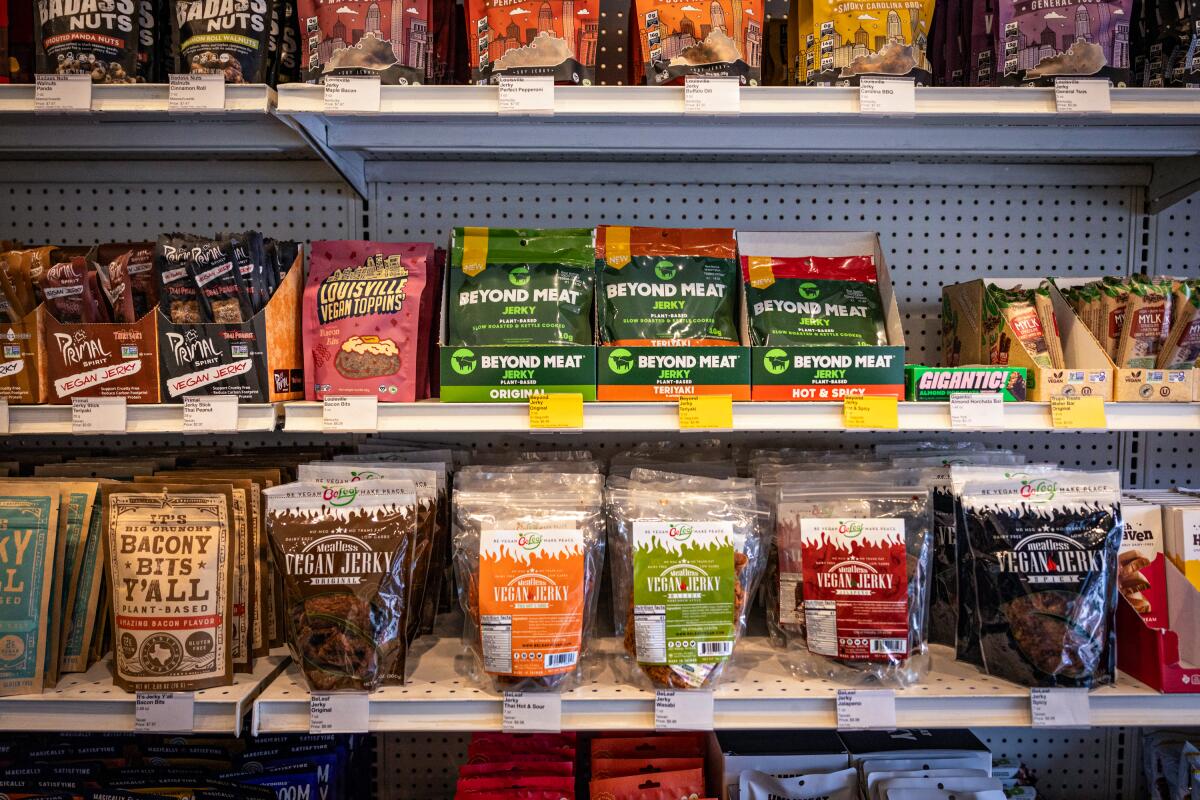
Besties sells a wide array of vegan jerky.
(Jason Armond / Los Angeles Times)
“Hey Paul, hi!” Fontana bellows in his New York accent, while filling a cup with the store’s vegan soft serve ice cream for another customer. Then, waving his free arm: “Everyone, you guys — come on in!”
It’s a typical day at Besties Vegan Paradise. Since opening in 2019, the grocery store has become a hub for a particular type of cool vegan in Los Angeles. The clientele is culturally diverse, spanning age, gender and style. But it coalesces around especially trendy aesthetics and a staunch desire to live responsibly.
Environmentally conscious, animal-loving DJs, chefs, writers, filmmakers, graphic designers and other creatives mingle there over free natural wine and vegan Brie during a “meet the maker” session, showcasing how the store’s cheese is made. “Open forum” talks there address topics such as environmental sustainability and the food chain. As you grab a beverage out of the cooler, hand-painted lettering above proclaims you’re “So Cool You Hot.”
There are other vegan markets in L.A. — X Market in Venice and Glowing Plant Based Eatery & Market in Echo Park, among them. But Besties is the only one that sources 100% of its products from all-vegan manufacturers so that customers don’t have to scrutinize labels. And while the store’s purpose is utilitarian, Besties is as much about the vibes — the shopping experience and connections made while there — as it is about picking up a fresh bottle of plant milk for your morning cereal. Customers trade tips about vegan tattoo ink during Wu-Tang Wednesdays, which Besties observes with religious fervor. (Every Wednesday, Wu-Tang Clan’s hip-hop plays loudly and on repeat in the store from opening until closing.) Over the last five years, the establishment has grown beyond the parameters of a retail store and into a cultural center for vegans in L.A. focused on food, fashion, art and athleticism.
Fontana, who sports a shaved head and a gold tooth, and co-owner Asia Rain, a vegan tattoo artist whose studio is above the store, host these in-person events at Besties to give like-minded customers a space to socialize and vegan-curious newcomers a place to learn about the diet. Pop-ups supporting local vegan brands, such as Tiffany Luong’s Long Beach-based Vegan Bánh Mì Thảo, are a regular occurrence. Besties makes its own chocolate, candies and cheese — “celebratory foods people are emotionally attached to,” Fontana said. Rain also designs a line of street-inspired branded hoodies, T-shirts and socks that come in handy at the store’s popular weekly, vegan 5K run club that ends at Besties with free soft serve for all.
“Veganism isn’t a diet, it’s a lifestyle and a mind-set,” Fontana said. “It’s an act of love.”
Veganism has come a long way from the days of limp soy hot dogs. In 1971, author Frances Moore Lappé published “Diet for a Small Planet,” a seminal guide that argued Americans’ insatiable appetite for meat was damaging Earth — and our bodies. Soon after, meatless diets gained popularity among a small percentage of Americans. But it wasn’t until the early 1980s that soy became a more common replacement for animal-based proteins such as meat and dairy, standing in for burgers, ice cream and other American comfort foods. Restaurants and grocery stores now offer shockingly sophisticated and culturally diverse items. But veganism still suffers from something of a branding issue: It’s often seen as an exclusive, hippie-ish club of well-meaning but judgy disciples, with restrictive diets, who can afford $42 artisanal vegan salami. “People ask me if I miss meat or dairy,” Julio Torres says while discussing his veganism in a 2017 Comedy Central stand-up show. “I mean, I miss being liked.”
Part of Besties’ mission is rebranding veganism as something that’s diverse, inclusive and, yes, even hip.
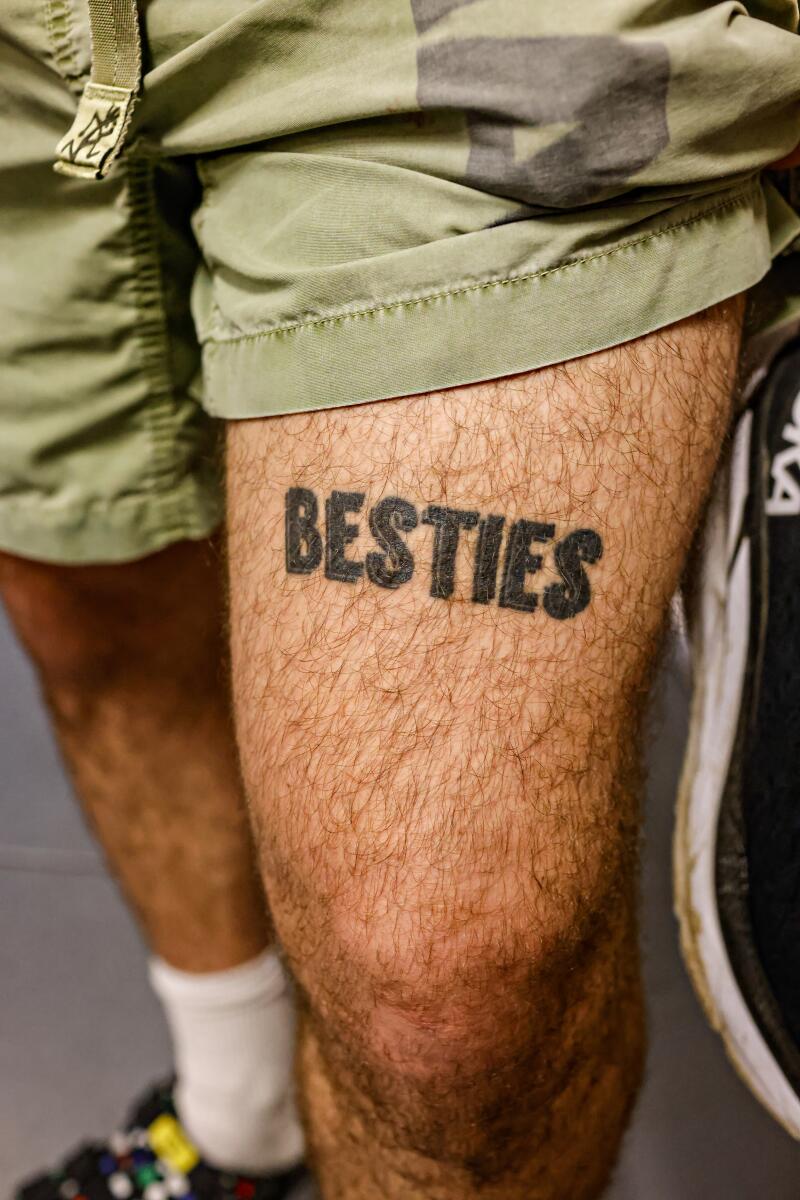
A patron shows off a “Besties” thigh tattoo from Asia Rain. (Jason Armond / Los Angeles Times)
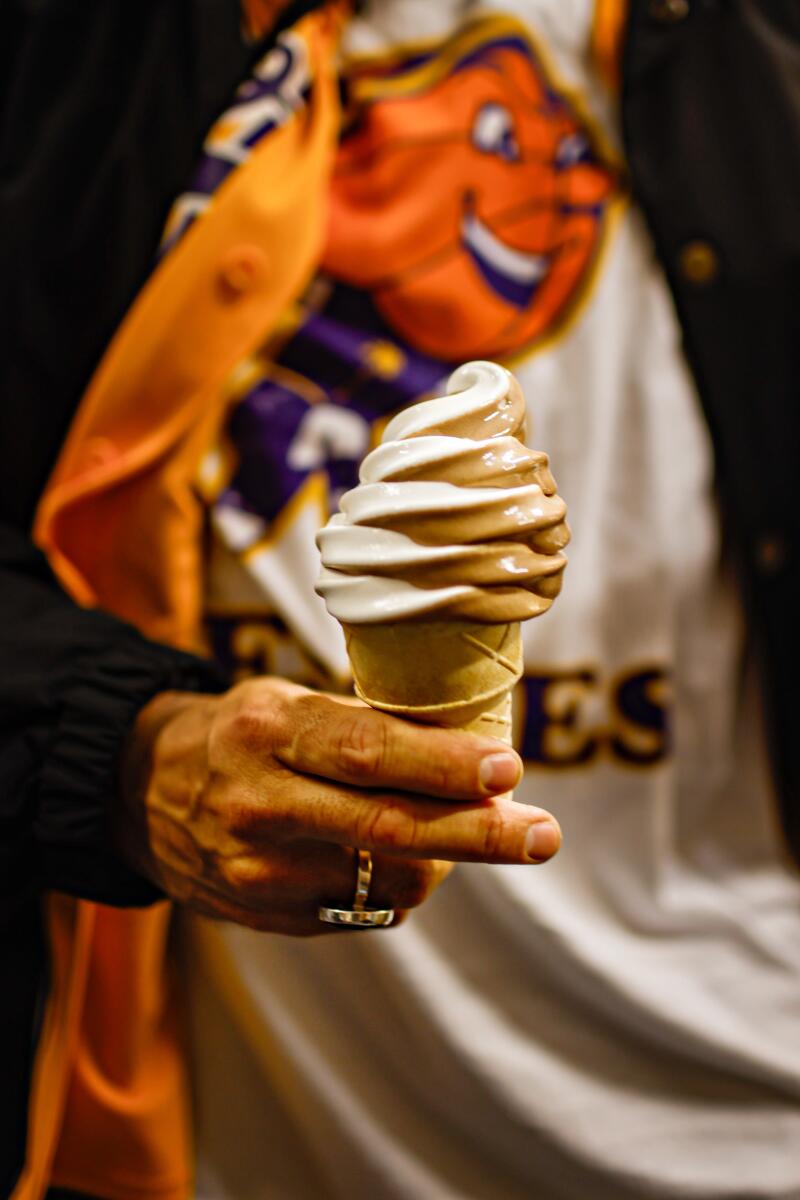
Cesar Asebedo enjoys a vegan ice cream cone. (Jason Armond / Los Angeles Times)
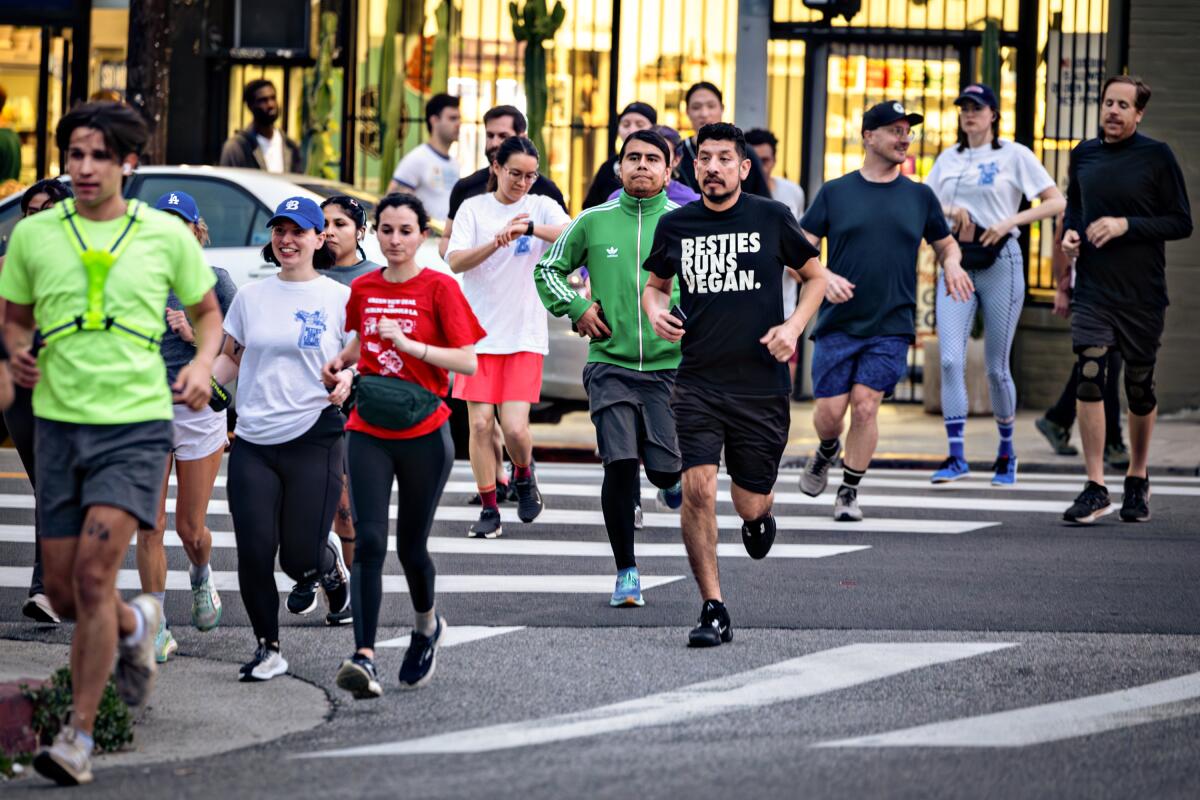
The Vegan Run Club in action.
(Jason Armond / Los Angeles Times)
“It’s for everyone: goths, punk rockers, hippies, bike messengers, basics,” Fontana said. “Hip-hop heads and normcore hikers and campers. Veganism is small, but it crosses all identities. It’s for anyone who truly champions equality, who realizes they have a chance to make a difference in real time.”
The charge Fontana is leading has been shared by a handful of other vegan outposts in the U.S., according to Alicia Kennedy, author of 2023’s “No Meat Required: The Cultural History and Culinary Future of Plant-Based Eating.” She notes food destinations with similar “hip, young, vegan identities,” such as Williamsburg’s Foodswings (which closed in 2014), the Chicago Diner and Philadelphia’s Grindcore House.
Collectively, these spaces are valuable, she says, because vegans, historically, have always been far more diverse than the dominant cultural stereotype: “This white, crunchy, kind of angry activist vibe,” Kennedy said. “Has it changed? Not really. So anything that pushes back against that is going to help change the mainstream perspective.”
On a recent Friday night, Besties hosted a lively vegan Mexican street food event, featuring Jessie Gil’s Sylmar-based pop-up El Compa Vegano, that drew more than 150 people over four hours. Straight-edge 20-somethings, with nose rings and decorative tooth gems, mingled with middle-aged “basics” in jeans and unisex button-down shirts outside the store. Carne asada, with impeccably seasoned lion’s mane mushrooms standing in for steak, sizzled on the grill as plumes of smoke filled the air. Some customers sat on a custom skateboard obstacle that doubles as a Brooklyn-style “stoop” outside Besties’ front door. (The shop lends it to local skater kids.) Hand-painted signs designed by Rain hung in the window, advertising “Classic Hot Dog $6.96” and “Oat Based Soft Serve” in the style of a 1950s soda fountain. It was a mashup of crowds from the Venice Beach Skatepark, the KITH streetwear store in Beverly Hills and the Smorgasburg food market.
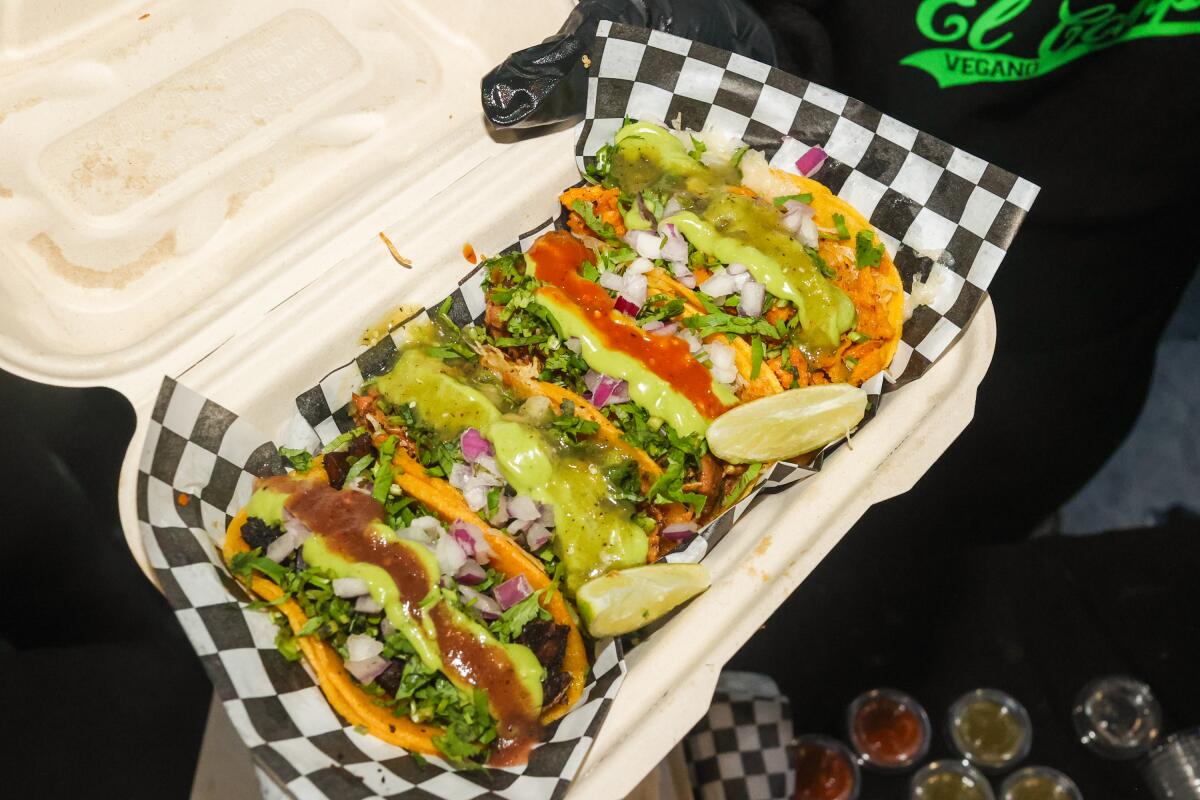
Vegan carne asada, carnitas, al pastor and pollo tacos from El Compa Vegano.
(Michael Blackshire / Los Angeles Times)
“The reason this place feels so authentic is because they’re making healthy choices for themselves — they’re walking the walk — but they’re cool kids too, and that makes it realistic. You can do it too,” said Besties customer D’Andrée Galipeau, a DJ who lives nearby and “leans vegan.”
Fontana, 48, grew up in a Sicilian-American family in Brooklyn in the 1970s and ’80s immersed in the hip-hop culture of the time. “Anything anti-establishment,” he says. He collected basketball sneakers and tattoos, and carried his skateboard everywhere. His mother was a vegetarian and he, an animal lover, followed suit at 14. He turned vegan at 20 when — while studying eastern philosophy and religion at San Francisco State University — he met his now ex-wife and she taught him about the diet.
“I hadn’t seen behind the veil,” he said. “I didn’t know about the industrialized animal agriculture industry, the enslavement of millions of female animals across the world,” the latter referring to the dairy industry. “Once all of that got explained to me, it was an obvious choice as somebody who rejects violence, rejects oppression and is a champion of reproductive freedom.”
Fontana went on to become an influential streetwear, sneaker and hip-hop fashion entrepreneur in the early to mid-2000s on the Lower East Side of Manhattan.
The cultural influences of his past are apparent at Besties. The store creates “limited-edition” soft serve flavors to match its calendar of food pop-ups. The Besties hot dogs pay homage to the Coney Island of Fontana’s youth, the soft serve to the Carvel ice cream he grew up with.
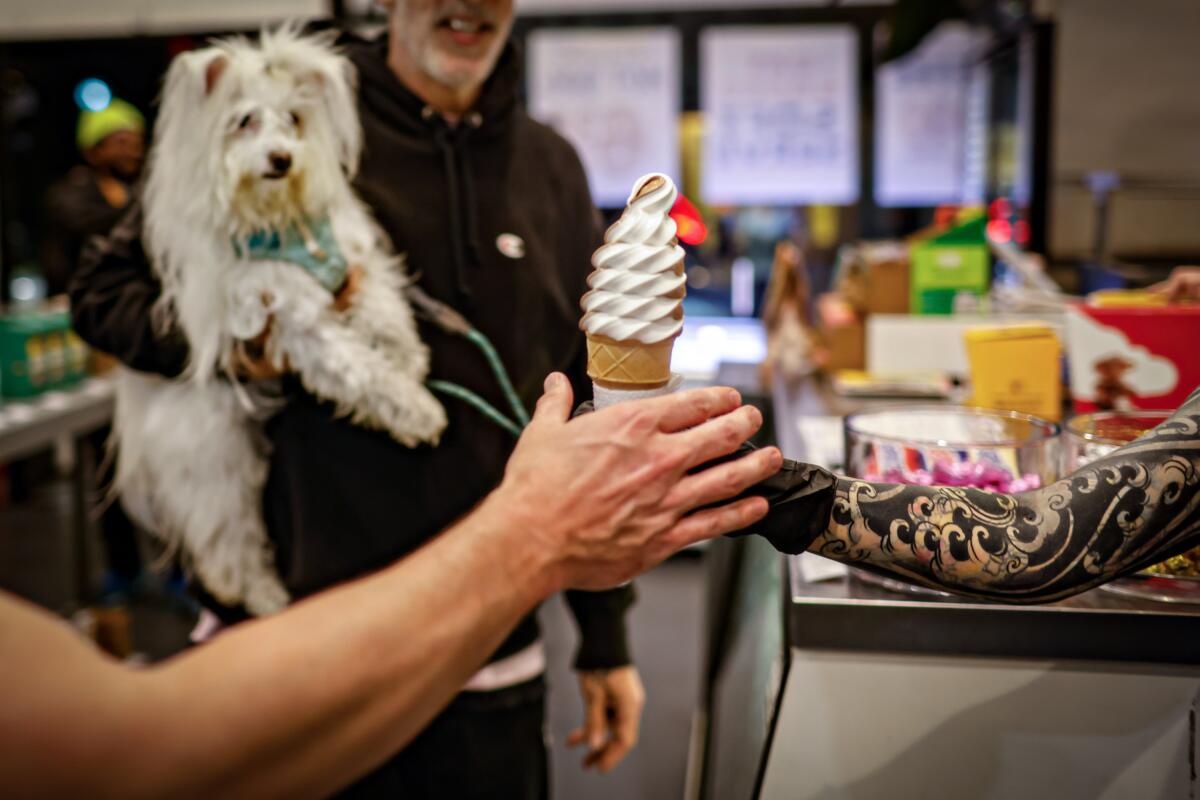
Asia Rain serves up vegan ice cream. Matt Fontana holds their Maltese mix, MacKenzie, in the background.
(Jason Armond / Los Angeles Times)
“It’s got to be lighthearted,” Fontana said of making veganism appealing. “We’re elevating veganism to be something that’s culturally aspirational as opposed to something that’s frowned upon by society.”
If Fontana is the mouthpiece of Besties, Rain, 34, is the artistic eye. She was born Asia Rain Phoenix (her last name is one her parents invented for their kids, and she goes by her first and middle name now). She spent her early years in Victoria, British Columbia, with parents who battled addictions, she says, and took odd jobs.
When Rain was 10, her parents moved her and her two younger siblings to Atlanta. They were undocumented immigrants, so when the kids got older, they couldn’t open a bank account, get a driver’s license or apply for financial scholarships.
Rain left home at 17 and spent a year traveling around the U.S. as a carnival barker (“Step right up!” she demonstrated) and airbrushing T-shirts at fairs and in malls. That led to work in an Indiana tattoo shop. She received her citizenship at 24, at which point she’d built a thriving clientele in the Midwest.
For the first time, she had a steady income. She bought a house with her partner, grew her own food, kept bees. But she felt stagnant and depressed. She gave it all up in 2016 and traveled to Peru, where she spent six months hiking and studying the culture, Spanish and the natural environment, including how to make tattoo ink from fruit.
When she returned to the U.S. in 2017, she met Fontana through a fine art tattooer. Through their conversations, Rain quickly decided to go vegan.
“Everywhere I looked it was … government manipulation and disrespect of natural resources,” she said. “And I felt powerless. Veganism is an act of choice to abstain from committing cruelty to anything. And that’s what I wanted to do.”
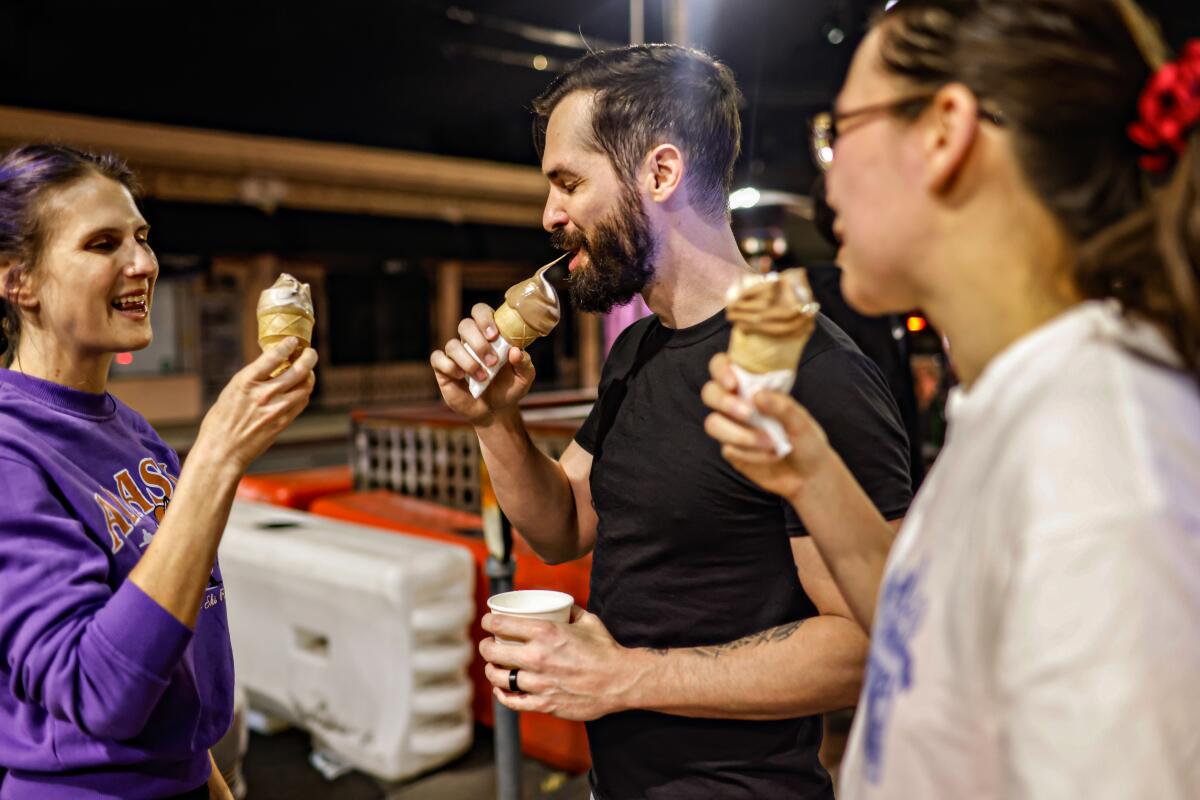
Ash Williams, left, Addison Blue and Nicolette Brannan enjoy free vegan soft serve after their weekly run.
(Jason Armond / Los Angeles Times)
While dating over the next year or so — he living in L.A. and she in Vancouver — Fontana shared multiple business plans with Rain, including one for a vegan 7-Eleven-type store. He invited her to be his partner. Then things progressed rapidly.
Fontana sold almost everything he owned, put the rest in storage and lived out of his car — a black Jaguar — for several months in late 2018. Rain sold her beloved, baby blue VW Westfalia and moved to L.A. They lived in an Airbnb while they remodeled a former mini-mart. In January 2019, they opened Besties, where she now tattoos many of the customers.
Rain came up with the name: “If we all treated each other like besties, the world wouldn’t be in the state that it’s in,” she said.
For both Rain and Fontana, cool cachet and social-environmental responsibility are not mutually exclusive. Besties might dress up the vegan lifestyle in trendy clothing and designer sneakers, but it still demands from them rigorous research, unwavering commitment, attention to detail and relentless principle.
“There’s Besties Vegan Paradise, the cultural center — and it says ‘All are welcome’ on the door,” Fontana said. “But personally, I’m a vegan activist. This place is my activism.”
Helping plant-based brands connect with customers is central to Besties’ mission. Most businesses charge pop-up vendors for space or take a percentage of their sales from events, Fontana said. Besties does neither.
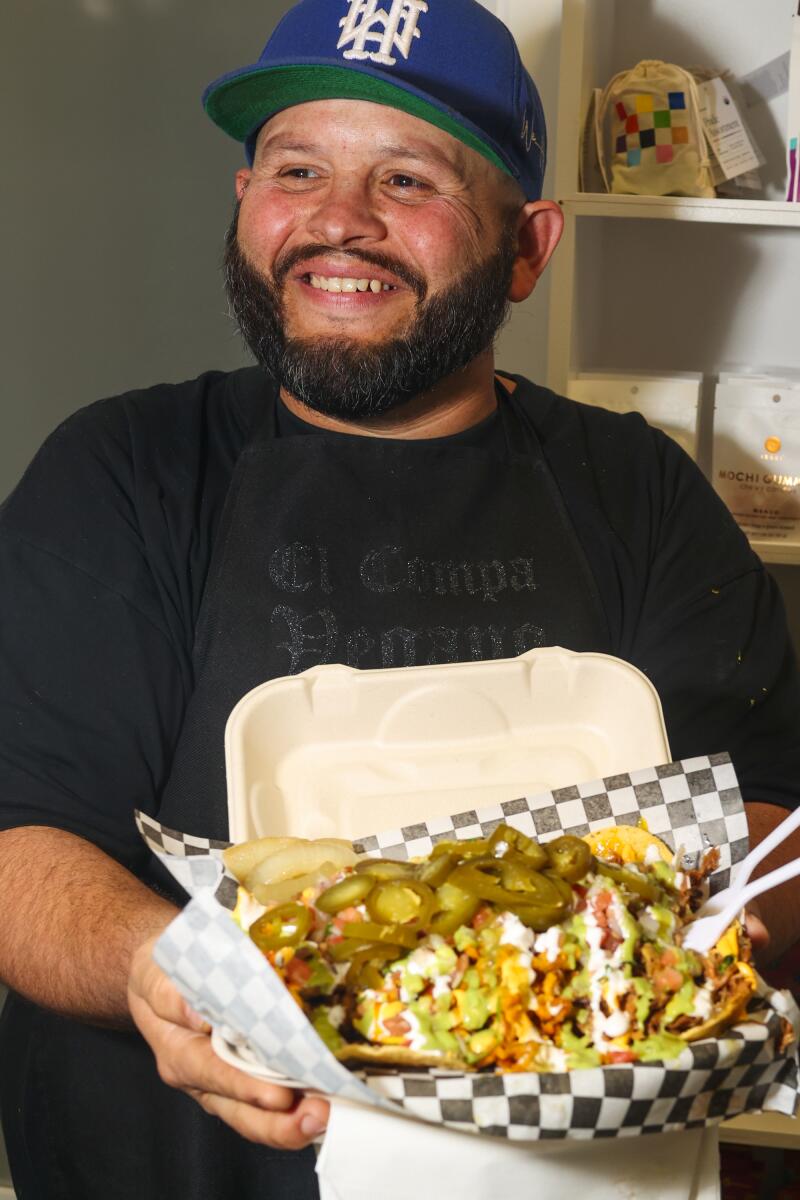
Jessie Gil, founder of El Compa Vegano, holds vegan nachos, fully loaded. (Michael Blackshire / Los Angeles Times)
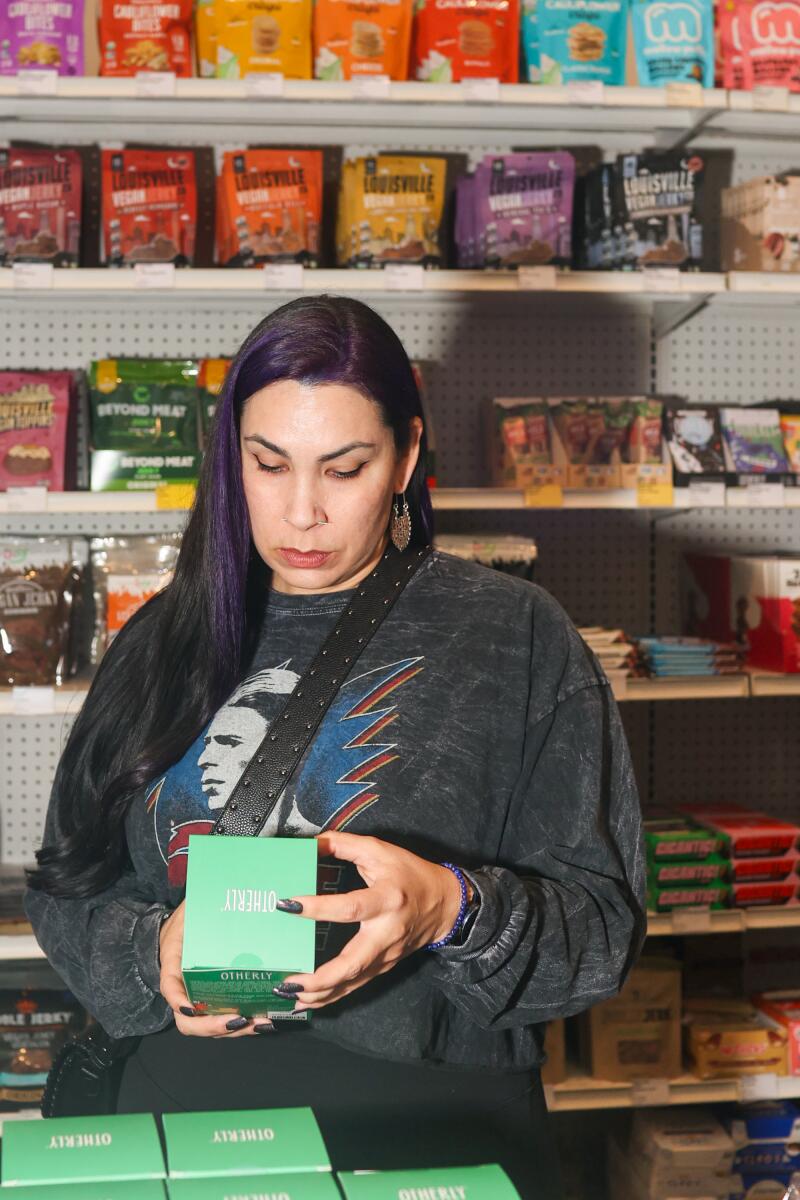
Julie Reyes shops for groceries at Besties Vegan Paradise. (Michael Blackshire / Los Angeles Times)
“They do a great job of marketing me in their newsletters and on social media,” Luong said of Besties during her bánh mì event (she’s done 10 there now). “I feel supported, I feel seen.”
What does Besties get out of giving away space and time for free?
“Traffic,” Fontana said. “These pop-ups have followings that they bring to us. But it’s also part of how we’re breaking down the stereotypes of veganism, that ‘not for you’ club. These vendors showcase what’s usually the food from their culture and they bring with them a totally different community than maybe we’re able to reach directly.”
Fontana said one family even comes in every Saturday from Aliso Viejo for the soft serve.
The secret recipe took about three years to perfect, as Fontana and Rain experimented with coconut milk and soy milk for its base. (It’s now made with oat milk.) Ultimately, it was Rain’s mechanical expertise that made the difference. She took apart Besties’ large Taylor soft serve machine and adjusted it to dispense nondairy milk. “Changing the viscosity changes how you experience the flavor,” she said.
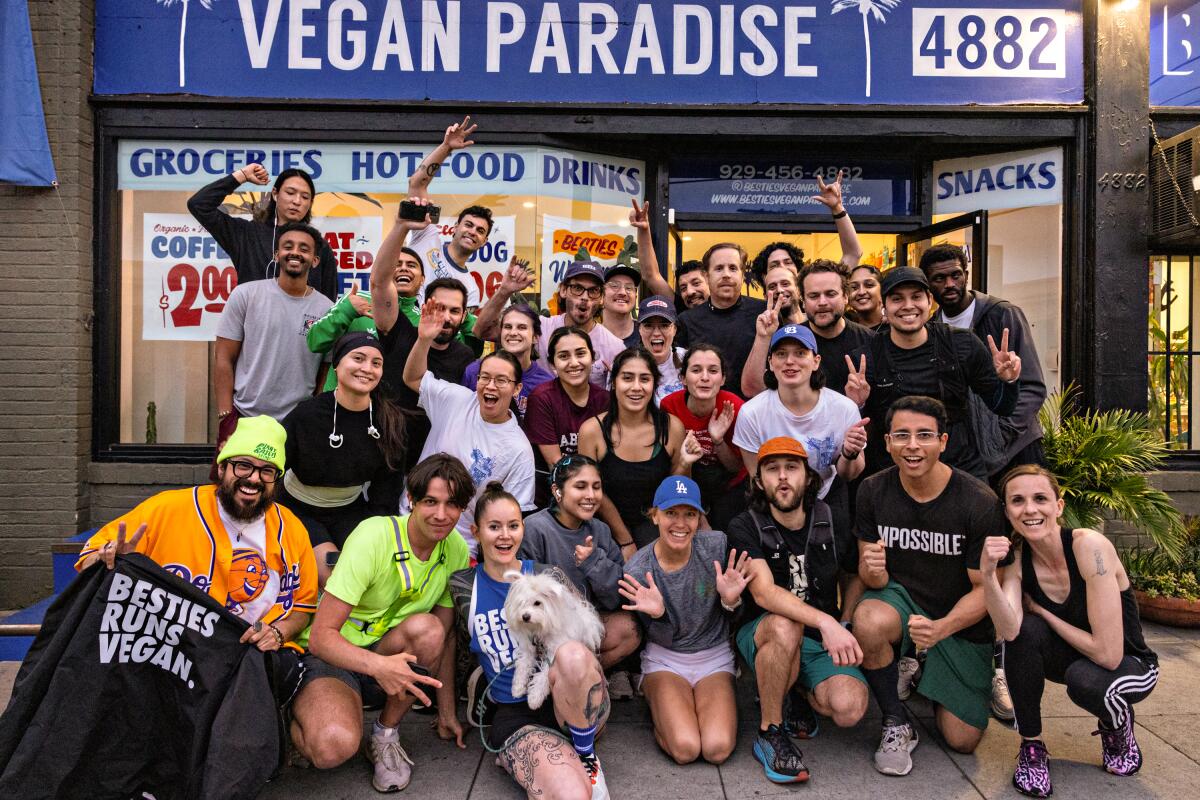
Vegan runners at Besties after their 5K run.
(Jason Armond / Los Angeles Times)
The store gives away soft serve to customers and vendors so readily that some question the business model.
“A friend of mine was like, ‘What’s the perk of them giving away all this stuff for free?’” said Sara Schunck, a member of Besties’ run club. “But the best people come out and you’re looking forward to the ice cream at the end. I’ve met a lot of really cool people.”
Fontana, now sitting on the skateboard-stoop outside the store, pops a vegan sour gummy into his mouth, contemplating the question.
“It’s about spreading the vegan love, paying it forward,” he said.
One vegan ice cream scoop at a time.



The Kennedy Center, the facade of which remains covered with a tarp, is seen in Washington, DC, on June 28, 2026. A US federal judge asked on June 24 for an explanation for why a tarpaulin continues to cover the facade of the Kennedy Center where President Donald Trump’s name was recently removed. District Judge Christopher Cooper gave the board of trustees of the performing arts venue until the end of July to explain “the purpose for and status of the tarp and scaffolding that Defendants have erected on the front portico of the Center.”
ALEX WROBLEWSKI/AFP via Getty Images
hide caption
toggle caption
ALEX WROBLEWSKI/AFP via Getty Images
More than two weeks ago, President Trump’s name was removed from the Kennedy Center facade though it is still covered by a tarp and the legal battle continues.
On Monday, a U.S. Department of Justice filing on behalf of the Kennedy Center included some surprises. The document was submitted in response to issues raised by lawyers for ex-officio board member Rep. Joyce Beatty of Ohio who is suing to remove President Trump’s name from the center and stop its closure for renovations.
Among the revelations, the Kennedy Center admitted that, during a board meeting on December 18, 2025, Beatty had been “muted and prevented from speaking.” It was at that meeting that the board voted to add President Trump’s name to the center. The filing later acknowledges the congresswoman was “prevented from voicing her opposition.”
The John F. Kennedy Center for the Performing Arts is a living memorial to its namesake. The guidelines for how the theatre complex spends federal dollars are very specific. Among other rules, it states that “no additional memorials or plaques shall be designated or installed.” Beatty argues adding Trump’s name runs afoul of those rules and that any change requires approval from Congress.
According to one of Beatty’s filings, “There was no advance notice in the agenda that the Board would be considering a name change,” a statement the Kennedy Center now does not deny. The center admits that, prior to voting, there was “no discussion about potential risks or downsides of the vote to adopt a secondary name for the Center.” Nor was there a board discussion “about any potential conflict of interest that might result from the vote.”
The center’s lawyers previously contended that if Trump’s name were to be removed, it would “lose money from donors who support” him and “impede the Center’s fundraising efforts.”
Closing for renovations
Earlier this year, Trump announced on social media that the Kennedy Center would close for two years for renovations. He wrote that he made the decision after “a one year review” with “Contractors, Musical Experts, Art Institutions, and other Advisors and Consultants.”
But, according to the center’s lawyers, Trump’s announcement “was made without presenting any plans, analyses, timelines, or funding information to his cotrustees and without any Board vote.”
The Kennedy Center has long denied reporting by The Washington Post that ticket sales plummeted after President Trump became the Center’s board chair. In Monday’s legal filing, the Center admits that, by October 2025, “nearly half of the Center’s tickets were going unsold.”


Paul Tremblay has made a career of pushing the horror genre – and the novel format – in strange and exciting new directions.
In his latest, Dead but Dreaming of Electric Sheep, the author offers an amalgamation of genre elements that can be best described as psychological-dystopian-science-fiction horror. It’s a mouthful, but the narrative does all of that and more in a way that defies categorization.
Julia Flang is a former semiprofessional gamer working two mediocre jobs she dislikes and living in a modest ranch house in a San Fernando Valley suburb with her retired uncle, whom she calls Uncle Fun. Julia likes movies and gaming but there’s little else going on in her life, so when her estranged mother, the CFO of a large tech company, contacts her with a possible job offer – a “once-in-a-lifetime thing” that pays handsomely just for doing the interview – she hesitantly agrees.

The job is relatively simple and perfect for someone with gaming skills: using a controller built into a phone to get a man, who is stuck in a vegetative state, from California to the East Coast. It will require her to learn how to control his body – walking, moving, sitting, standing, using his arms – so she can maneuver him out of the facility where he is located and into cars and planes and through crowded airports. A fan of movies, Julia decides to call the man Bernie – after the movie Weekend at Bernie’s. When the ethics of the job start to bother her, Julia realizes it’s too late and she must go through with it. However, she’s soon contacted by people interested in sabotaging the whole thing, people who, like her, don’t align with the shady interests of conglomerates and those set to make “gobs of money” from this new, somewhat inhuman technology.

As with every Tremblay novel, any synopsis barely scratches the surface. The novel’s chapters alternate between Julia and you (yes, you). Julia’s chapters are “normal” in the sense that they obey a chronological order and have action, basic descriptions of movement and places, and dialogue. The chapters in second person are like fever dreams from a shadow world; the desperate experiences of a man trapped inside his own body with no control of it, no clue what’s happening to him, and only a few fragmented memories of his life. Also, Tremblay uses a similarly fragmented style of storytelling (including words and sentences trapped in boxes and/or “moving” on the page) to keep things interesting but also confusing and creepy.
This novel operates on several different levels and – planes of existence? Bernie has a head full of AI that controls his body, but his consciousness is still there and struggling to regain control, struggling to remember things. There are monsters, leeches, mysterious rabbits, and eerie shadows in his world, but the true horror comes from the lack of control, from being moved around against his will and having no clue what comes next. Bernie is the embodiment of losing control to AI, and when taken together with the commentary of creativity and AI and the meta interludes in which the author takes a wrecking ball to the fourth wall and addresses readers, this is the best anti-Generative AI story horror has produced so far.
Despite the horror of it, this is a very funny novel. Julia is sarcastic and struggles to keep her comebacks in line, but the conversations she has and messages she writes are always entertaining. However, the humor is far from the crown jewel here. That title belongs to a plethora of big ideas Tremblay juggles. The nature of life, death, and consciousness, the evils of conglomerates, inhuman practices in the name of capitalism, and AI, and even what it means to be human are all explored here: “Is Bernie alive? Is he feeling pain? Is he experiencing everything as a prisoner looking through the bars of his body? Has his consciousness been winnowed to a metaphysical keyhole? Where does consciousness begin or end?” There are no definite answers here, but the way Tremblay infuses humanity, love, the importance of relationships, and humor throughout the narrative provides the kind of answers that can’t and don’t need to be spelled out.
A genre-bender full of big ideas that constantly switches between a world full of real or uncomfortably plausible nightmares and a bizarre hellscape in which loss of self, memory, and autonomy are only the tip of the proverbial iceberg, Dead but Dreaming of Electric Sheep is a horrific and terrifyingly disorienting novel that invites readers to consider a future that already started. Tremblay has always been an innovator, but this beautifully written collection of real and imagined grotesqueries cements him not only as one of the most original and exciting voices in horror but also as one of the smartest, most engaging authors in contemporary fiction.
Gabino Iglesias is an author, book reviewer and professor living in Austin, Texas. Find him on X, formerly Twitter, at @Gabino_Iglesias.

-
Sports5 minutes ago
2026 World Cup knockout round TV schedule, game previews and results
-

 World17 minutes ago
Russian gas imports rise despite EU phase-out
-

 News40 minutes ago
Woman survives falling 1,500 feet down Mount Shasta
-

 Los Angeles, Ca2 hours ago
Man dies after violent solo crash in Sherman Oaks
-

 Detroit, MI2 hours ago
Priority Waste CEO shares progress on plan to fix disruptions, delays across Metro Detroit
-

 San Francisco, CA3 hours ago
The San Francisco Church That Holds America’s Secrets
-

 Dallas, TX3 hours ago
Crews battle large fire at Pilates studio in Uptown Dallas, officials say
-

 Miami, FL3 hours ago
alaïa clads first miami boutique in pink mosaic tiles, from interior to facade

