Lifestyle
At your service: A restaurant maître d' tells all in 'Your Table Is Ready'


DAVID BIANCULLI, HOST:
This is FRESH AIR. I’m Dave Bianculli.
Across his career, Michael Cecchi-Azzolina says he’s been threatened, cursed at, punched and called every ugly name imaginable. He’s also had people press a hundred dollar bill into his hand, sometimes more than one of them. That’s because for years he controlled a very valuable commodity – the tables at high-end Manhattan restaurants. He’s written about his experience in his memoir, “Your Table Is Ready: Tales Of A New York City Maitre D’,” now out in paperback. Cecchi-Azzolina has encountered celebrities, captains of finance, plenty of nice regular folks and one bona fide mobster who repeatedly threatened him due to a perceived slight. In his book, Cecchi-Azzolina takes us behind the scenes of the restaurant world where we learn who gets choice tables and who doesn’t, but also how restaurant staffs in the 1980s and ’90s worked, fought and loved in adrenaline-fuelled workplaces where booze and cocaine were plentiful. Michael Cecchi-Azzolina has worked as a server, maitre d’ and manager in several exclusive restaurants. Last year, he opened his own bar and grill in New York called Cecchiâs. He spoke with NPR contributor Dave Davies in 2022.
(SOUNDBITE OF ARCHIVED NPR BROADCAST)
DAVE DAVIES: Well, Michael Cecchi-Azzolina, welcome to FRESH AIR.
MICHAEL CECCHI-AZZOLINA: Thank you so much. It’s great to be here, Dave.
DAVIES: So when you were a maitre d’ at a lot of pretty exclusive place – there was one called The River Cafe, which had this – was on a barge in the East River – had this spectacular view of Manhattan. And people would come in and ask for a window table – you know, normal folks who are there on a special occasion – and they would see all the window tables are empty. And you would be steering them to the middle of the room, and they would say, hey, hey, can’t you help me here? Don’t we – we’d love to do this. What would you do?
CECCHI-AZZOLINA: You know, it was one of the hardest things in the world to do. There were nine window tables, and generally, every evening, each table was spoken for. Now, were they spoken for when we opened at 5:30? No. Would people start coming 6:30, at 7? Absolutely.
So you have a guest that’s waited a month for a reservation. It’s the wife’s anniversary or birthday or the husband’s anniversary or birthday. And they see these incredible tables, staring at probably the most incredible view of any restaurant in the world, and they’re not allowed to sit there. Well, people get really, really angry. And what do you do?
First, you tell them I’m so sorry, but those tables are already reserved. What do you mean they’re reserved? There’s no one in the restaurant. Well, they’ve been spoken for by a number of people. Well, who? Well, you can’t tell who the tables are for. You’re not allowed to do that. It’s bad policy.
So you can’t say who they’re for. You can’t say – especially at The River Cafe, the owner never wanted us to say it was held by the owner. So you just have to really deal with irate people quite a bit. And so, you know, you try to get them a nicer table. I’m so sorry. I can’t do this – which leads to a lot of anger, hence me being punched, cursed at, yelled at, screamed at. Most people are very nice about it. And when you can, you’ll give them that window table.
Now, someone walks in, and they want a window table, hands me a hundred dollar bill. What do I do here? Can I give a table up? Sometimes, yes, you can do that because you know that they’re there at 5:30 or 6 o’clock and you need a table at 8 o’clock for, oh, let’s say Barbra Streisand. You’ll say, look, I can do this for you. I’ll need the table back at a certain time. Or you just go for it and say, hopefully somebody’s going to be late.
So, yeah, so tipping absolutely always helps. Being nice always helps. I’ve given a window table and gotten myself into trouble because this lovely couple was there for their 30th or 40th anniversary, and there’s no way I wasn’t going to give them the best table in the restaurant. That’s where you take the risks, and it comes back and haunts you sometimes.
DAVIES: So you’ve got some discretion here. What should we know about whether to tip the maitre d’ or not? Should you always do it? Should you do it when you’re looking for a special favor? How much should you tip?
CECCHI-AZZOLINA: If you are not known and you’re walking into the restaurant for the first time and you really want to eat there and you’re told very nicely and very politely by the maitre d’ that, I’m so sorry, there’s nothing available, I would absolutely tip that person. I do it. If I go out and I need a table, I will do it all the time. And I’ll tip on the way in.
That pretty much guarantees you either the answer that, yes, you’re going to get the table or I’m sorry, I cannot do this at all. I’ve been handed – at Le Coucou, someone handed me five brand-new hundred dollar bills for a table for the next night, and I turned them down. I didn’t have it. And nor was I going to be bought for a table. That I won’t do.
DAVIES: And in that circumstance, you hand them the money back?
CECCHI-AZZOLINA: I handed it right back to them, yeah. My host next to me, their jaws dropped. They couldn’t believe I did that. But, you know, I don’t want to be bought, for one. I don’t want to be indebted for not-great reasons. It just never sat well with me. But have I taken these tips? Of course I have. People are showing gratitude, and I’m in the hospitality business and that’s what you do – the basis of the business.
DAVIES: How do you hand someone the bill? Do you – is it the handshake with the bill in the palm? I mean…
CECCHI-AZZOLINA: Yes. It’s usually – it’s folded. Yeah, it’s folded and it goes in your hand. Though there are those people that walk in the door with swag and they put the hundred dollar bill right down on the stand. That’s for you, sir. If you can help me, I’d truly appreciate it. So – but the best way to do it is to – just to put it into someone’s hand and shake them. See, if you can help me, I’d appreciate it.
DAVIES: You’ve got to be a diplomat here because, you know, people make absurd demands at times. I mean – you know, about the food, about the seating, about the noise, about the temperature or whatever. You describe one person that you nicknamed the Shah, I guess, because he’s so imperious. How do you summon, you know, the gracious kind of voice that you need to deal with that?
CECCHI-AZZOLINA: It can sometimes be the most difficult thing in the world, when this person that you’re dealing with is truly obnoxious and hateful. We’re in the hospitality business, you know? We’re there to make everyone feel welcome. And you do your best. You try. This particular person was egregiously awful. And I probably – and I don’t know why I let this person stay in the restaurant and took his reservations beyond that. I have no idea why I did it, but I did it. And you just summon up this inner hospitable gene that we all have, those – these lifers in the business who we are – and you try and make the best of it. Though I have thrown people out. I just will not take their crap, for lack of a better word.
DAVIES: Well, I thought maybe I – we do a little mini-role-play here where you show me the voice that you use when the answer is no. And this is kind of from something that is in the book. I’m arriving. I’m the assistant of a very important person who I haven’t named and had asked when we called for the reservation for a private room. This is at Le Coucou, where there are no private tables. And we arrive early. And so I’m arriving, and I say, well, you know, as you know, the person I’m with is extremely important. He can’t be in a public place. So I assume you have a private room or a private table for us.
CECCHI-AZZOLINA: We don’t. This is a public restaurant. We have no private rooms. I’m so sorry.
DAVIES: Now, you can’t – you don’t understand her. This person is dating a member of the British royal family. He simply can’t be – she simply can’t be out among the public. There’s – there are partitions. There must be some way you can accommodate us sir, right?
CECCHI-AZZOLINA: There absolutely is not. Like I said, it’s a public restaurant, and people come here to dine and to be seen. If your guest doesn’t want to be seen, I suggest perhaps this is not the best place for you. But I have no private space, nor do I have a partition. I can seat you at a corner table, but there’ll only be one other person next to you. But you’re still in the middle of a very public dining room.
DAVIES: All right. And in this case, that was eventually accepted?
CECCHI-AZZOLINA: Eventually, yes, with great indignation, I have to say. But they wound up taking it. And, you know, they – these people came in early, a half an hour early for a reservation. And this is Le Coucou, and it was the hottest ticket in town. And we booked out weeks in advance. And it was – people waited a year for a reservation. And they came early, wanted to be seated early. Well, I’m obviously not going to have the table. You try and seat tables as close together as possible to maximize revenue. You know, you’re – it’s business. You need to pay the bills.
They came half an hour early and were very angry that the table wasn’t ready. And I apologized. I’m so sorry. Why don’t you just wait at the bar? Well, we can’t wait at the bar. We’ll be seen. Well, you can go – Le Coucou’s in a hotel, the 11 Howard Hotel, downtown New York. And I said, well, they have a lovely library upstairs or a bar. You can go up there. Well, we can’t do that. We came here to have dinner. OK, I’m very sorry then. You need to just stay at the bar. And as soon as the table’s ready, I’ll be glad to seat you.
Well, they went to the bar. And you know what happened? No one knew who they were. Nor did anyone care. So they stood there for half an hour. I don’t even think they had a drink. And then, eventually, the table was ready.
DAVIES: Let’s take a break here. Let me reintroduce you. We are speaking with Michael Cecchi-Azzolina. His new book is “Your Table Is Ready: Tales Of A New York City Maitre D’.” He’ll be back to talk more in just a moment. This is FRESH AIR.
(SOUNDBITE OF MUSIC)
DAVIES: This is FRESH AIR, and our guest today is Michael Cecchi-Azzolina. He spent years in New York as a maitre d’ of some high-end restaurants. He has a new book. It’s called “Your Table Is Ready: Tales Of A New York City Maitre D’.”
This book is full of fascinating, really fun tales of restaurant life. And you did a lot of this in the ’80s, when, as you said, you know, Studio 54 had closed at some point and people started going to high-end restaurants to have a lot of their fun. And it was amazing to me how much drinking was done, you know, by the staff during their shifts – bartenders, servers, others. I mean, did owners know and tolerate this?
CECCHI-AZZOLINA: Good question. You know, I think it’s an old standard in the business that you know your bartenders are going to steal and drink. And so it depends how much you want to lose…
DAVIES: (Laughter).
CECCHI-AZZOLINA: …And what you’re willing to put up with. Now, do they all do that? No, not at all. But people do drink. The ’80s was like the Wild West in New York City. People were partying. You know, you had Studio 54 that glamorized cocaine and alcohol and sex. And it was the lead-in to the restaurant world.
And if you knew the bartender, you got a drink. Even if you didn’t know the bartender, you got a drink. People drank in places that I worked and other restaurants that I know of, many through the whole shift. We had a bartender that was an ex-New York City policeman, and we used to call him Dr. Dewar’s ’cause he’d polish off a bottle of Dewar’s during a shift. It was standard practice back then.
DAVIES: Well, you know, we’re talking about this in general terms. I mean, you talk about doing it yourself. Even when you were at Le Coucou where – you know, it’s stressful to have to be managing people who want all these exclusive tables and telling people no and trying to get tables cleared in time for the next celebrity to come in. And you say, like, there are times I needed a shot of vodka to keep going. Wow. Can you stay mentally sharp when you’re doing that?
CECCHI-AZZOLINA: Well, you’re not getting drunk (laughter), for sure. But sometimes, to steady the nerves, about 8:30, 9 o’clock, when you’ve got 50 people waiting at the bar, waiting for a table. And you’re behind. And everyone’s looking at you with the death stare and about to stab you, I would run behind there, get a chilled shot of vodka and go smile, take a deep breath and get right back into it.
DAVIES: Wow.
CECCHI-AZZOLINA: And were other people drinking? Yeah, of course. People find a way to do it. Through the years, I’ve had to fire people who were on the floor absolutely drunk. I’ve had situations where service would go down to their locker or out back and have a flask and come up. And by 10, 11 o’clock at night, they were slurring their words. People – it’s a very, very, extremely stressful job. The demands, especially in fine dining with a very high-caliber clientele, it’s incredibly stressful. People are demanding. Even ones that aren’t demanding, you’re held to a standard. And that standard must be abided by.
Restaurants were run, and most – some cases, they still are run like the military. This had to be done precisely this way. Food had to – order had to be taken within five minutes. Drinks had to arrive at the table two minutes after they were ordered. Your entrees had to be served 10 minutes after the appetizers were cleared. Then dessert menus. It was a very strict protocol. Now, when you have a restaurant, when each table is booked to the maximum from 5 to 12 o’clock at night, you need to keep this thing moving straight through the night – plus, dealing with people that want to talk to you.
They have questions. They expect you to be pleasant. Customers that you know, they want to hear about your family and what you did that day. And you need to balance all of this. You’re juggling this. You’re juggling a kitchen that’s very stressed out because they’re trying to put the food out, a maitre d’ at the door who needs tables, customers who are demanding. It is incredibly stressful. And people do go to alcohol and drugs to get through it. Historically, my 40 years in the business, it’s always been that way. Not everyone.
DAVIES: The other thing besides booze and cocaine we find is sex, a lot of it – among staff, among guests, between guests and staff, a lot of this on the premises. Was this everywhere? Did owners know about this stuff?
CECCHI-AZZOLINA: Did owners know? You know, it’s really tough to say. Look, as we’ve gotten into the 2000s and the teens and all that, and all the incidents that have been documented and caught where owners were actually abusing staff – so obviously, they did know because they were doing it. This didn’t happen back then.
DAVIES: You mean owners were sexually preying upon staff? Is that what you mean?
CECCHI-AZZOLINA: Yes, preying upon staff. Yeah.
DAVIES: Yeah.
CECCHI-AZZOLINA: I mean, they’re documented cases, you know?
DAVIES: Yeah, not – yeah, that’s not unheard of. Yeah.
CECCHI-AZZOLINA: The #MeToo movement highlighted many of these. And a couple of owners had to divest themselves from their restaurants because of it. But back then, it was – look, like I said, this is after Studio 54. And it was a party. You had customers coming in handing you hundred-dollar bills with a gram of cocaine in them. They expected you to party with them. And they did. Did the owners know? I can’t imagine that they didn’t know.
But at the Water Club, the general manager was getting as wasted as everybody else and eventually got caught for embezzlement. So from the top down, it was happening. Not necessarily just the owners, but the managers were doing it, absolutely doing it. So it would happen. And you have alcohol. You have drugs. Well, the next logical thing is sex to happen. And it happened quite frequently in very different establishments.
DAVIES: You know, and there are some wild stories here, some involving you that I couldn’t come within a mile of describing on this show. But they make for interesting copy. And, you know, I know that as you kind of got a little older, you eventually married and had a daughter. Has your wife read this stuff? Is this going to be news to her (laughter)?
CECCHI-AZZOLINA: Yes, she has. I have two daughters. And, yes, she has read this stuff.
DAVIES: OK.
CECCHI-AZZOLINA: I have the most wonderful wife in the world. And she’s – you know, she’s read the book in bits and pieces, you know, all the way through and actually helped, you know, do some good editing for me. But only recently has she read the entire – the book in its entirety, straight through. And I’d see her sitting on the couch just laughing through the whole thing. She loved it. And, no, she’s not upset by these stories.
And, look, did I have to put all these stories in? And I thought about this. And I thought long and hard about it. And I had to because I wanted to document this exactly the way it was. It’s not about braggadocio. I’m not the, you know, the high school football quarterback bragging about his exploits. I really wanted people to know what it was and what people went through and the detriment that it caused, not just, you know, the party that it was, because the party ended. It didn’t last. Though, this is for me. But the restaurant, yeah, it’s still ongoing. And there’s cases now that things are still happening, which is crazy to me.
DAVIES: When you say the detriment, what do you mean?
CECCHI-AZZOLINA: Well, it – people just didn’t last…
DAVIES: Oh.
CECCHI-AZZOLINA: …I mean, from the alcohol and from the drugs and AIDS. AIDS hit, and the sex killed people. And I was with a bunch of my co-workers that died because of this. And it was a horrific time. So it had to stop at some point, you know? These things don’t go – they stop till, then, people forget about it and start up again, which I think happened in the 2000s.
DAVIES: One of the other things you describe is the two-minute drill that a restaurant would engage in when the food inspector comes. I mean, you’re not particularly fond of food inspectors. You think that they are more interested in piling up fines than actually protecting the public from serious harm. But when a food inspector was spotted, what would happen in a restaurant?
CECCHI-AZZOLINA: It’s a nightmare. It’s – everything stops. That is the worst day of the year for you because – now in New York City, there are letter grades. So you get A, B, C, D, and – or failing. And who doesn’t want an A in that window? You have to post these in the window. So the stress of having an A is incredibly difficult, especially when the system first started. Look, I’ve worked in a lot of restaurants, and many of these restaurants are in very old New York City buildings where it’s very difficult to comply with health standards as they are written. It’s almost impossible, actually. You know you’re not going to hit every point that needs to be hit. So when the health inspector comes in, what you want to do is be as prepared as possible so that the fine you get – and you will get fines, always – is as little as possible so you’re not paying – you know, spending that nice revenue on your health inspector fines.
So what I’ve done in many restaurants is you have a drill. Once the health inspector is spotted and they come in – because they’re wearing a uniform, and they have to show their badge – the word goes out through the dining room. And we’ve used different words in different restaurants – tsunami, souffle, different terms – and to alert the rest of the staff that the inspector’s there. So the maitre d’ or the host – as soon as the inspector comes in, the maitre d’ will stall him as much as possible, and the host will go through the dining room whispering your code word. Let’s say it’s tsunami. So go to the bar – tsunami. The servers – tsunami. Go to the kitchen. And once everyone hears that, they know they have to go to their stations and take care of it.
So bussers will go to the bread station, swipe away all the bread crumbs, throw out all the cut bread ’cause you can’t have cut bread there. There can’t be a crumb in the station. You make sure that’s neat. You run down to the basement. We’ve had managers run down, pick up a vacuum cleaner, and get on their hands and knees vacuuming up mouse poop because there are always mice in restaurants in New York City. It’s impossible to keep them out. The most – the cleanest restaurant, the most – with exterminators and all – cannot stop mice. And there’s always a little piece of poop that you miss. Look, we all try to keep it as clean as possible, but it’s impossible. So someone’s doing that.
Bartenders throw out all the cut fruit at the bar. It just gets thrown out because it’s illegal. It’ll never be up to the temperature that it needs to be. You go into the dairy refrigerator, and you dump out all the milk because in the refrigerator, when you’re making coffee, say cappuccino, the milk is coming in and out. It’s not going to be at the temperature that it’s supposed to be for your health inspector. So that gets thrown out.
In the kitchen, anything that’s ready to cook, that – so you take a piece of fish out of the refrigerator, put it on the sizzle platter – it’s sitting there for the – waiting for the rest of the order to be cooked. So say you’ve got some steaks waiting to be cooked, and then, the fish goes on last. So the fish sits there waiting to be cooked. By the time it left the refrigerator and sat on the counter in that sizzle plate, it’s become illegal because it’s too warm. So if the inspector comes in and puts his thermometer in the fish, you fail that, and it’s more points against you. So every position in the restaurant has a job on basically throwing out a lot of food.
BIANCULLI: Former maitre d’ Michael Cecchi-Azzolina spoke to Dave Davies in 2022. His memoir, “Your Table Is Ready,” is now out in paperback. We’ll hear more after a break. And later, we remember William Whitworth, who was a longtime editor-in-chief of The Atlantic and before that was an editor at The New Yorker. And I’ll review the new MGM+ documentary about Paul Simon which examines his old music about Paul Simon while capturing him making some new music. I’m David Bianculli, and this is FRESH AIR.
(SOUNDBITE OF MUSIC)
BIANCULLI: This is FRESH AIR. I’m Dave Bianculli, professor of television studies at Rowan University. Let’s get back to our interview with former maitre d’ Michael Cecchi-Azzolina about the decades he spent in the New York restaurant world, most of them at high-end eateries. His memoir “Your Table Is Ready” is now out in paperback. He spoke with Dave Davies in 2022.
(SOUNDBITE OF ARCHIVED NPR BROADCAST)
DAVIES: Tell us a little bit about your family.
CECCHI-AZZOLINA: I grew – Bensonhurst at the time was very Italian American, and I’m from an Italian American family. I was raised by my mother and didn’t really know anything of my father till many, many, many, many years later. But things I heard about him were not the best in the world. And the – my uncles and cousins and their friends were – and it was a very tough neighborhood. And my uncles and cousins and their friends were all in some way connected to the mob on various different levels. One was a bookie. One would come home and would have jewelry there. I’m not sure what they were doing. I never knew what they did, but I knew they drove Cadillacs and that they always dressed well, and everyone had a fedora, and it was of its time, you know? This is the days of Sinatra and the Rat Pack and Dean Martin, and my whole family looked up to these guys. They were the role models.
DAVIES: Yeah. Describe the Sunday afternoons after Mass at your house.
CECCHI-AZZOLINA: So I’d go to church and do my thing and come home. And my mother would be – or my aunts would come over, and they’d be making the sauce and, you know, roast beef, etc. And my uncles would come and they’d sit in the living room and they’d play poker. And this was the beginning of my service career – serving mass was because when you – at church, you’re – it’s called serving as an altar boy, and you’re laying out the linens for the altar, and you’re polishing the gold plates for the communion and for the altar, and you’re filling up the cruets for the wine and the water. And so it’s basically setting up a restaurant. And so that’s – began my career. I’d come home, and my uncles would be there, and they’d be playing poker, and they’d be smoking up a storm. And I would go in there, and I’d clean ashtrays, and I would give them shots of their scotch and take it back to the kitchen, and I would clean the room. And they’d sit there playing poker while the ladies cooked.
BIANCULLI: You know, you mentioned that your mom would work in an office. And there was this guy there who you knew as your Uncle Joe, and people would come for – and line up for a few quiet words with him to take care of some mysterious business. Who was your Uncle Joe? What did you eventually learn?
CECCHI-AZZOLINA: Well, my mother worked in a real estate office, and in summers she would bring me there. We – you know, we didn’t have much money, so there was no summer camp or anything like that. And I’d just play on the street outside. And this guy, Uncle Joe – you called – you know, you grow up, you call a lot of people your uncle, your – and they’re not. But so he was Uncle Joe.
He would come in every Friday and sit at this desk at the front and people would come in and have a few words with him and leave. And he always came in, and he’d always – you know, he’d see me, go, Mickey, and he’d squeeze my cheek, and he’d hand me a dollar bill, and then it’d be time for lunch. And he’d say, come on, Mikey, let’s go and have lunch.
And we go around to a bar around the corner where he’d walk in, and there’d be a bunch of guys in fedoras. And he walked in, they all kissed him, and I assumed that he was giving them dollar bills as well. I didn’t know. And I’d get propped up on the bar and we’d eat – I’d have a pot roast sandwich that I could taste today. It was the most delicious thing in the world. And that’s what I knew of this guy.
Jump ahead maybe 15, 20 years later, I’m reading the newspaper, and I see on the front of the newspaper, Joe Colombo shot. And I look at it, and I realize that was my Uncle Joe – the head of the Colombo crime family, Joe Colombo. I had no idea.
DAVIES: Wow. Before we completely leave the world of your family and mob connections, you tell a story of working as a maitre d’ in one of the restaurants – this might have been The River Cafe, which was a really high-end place, where you ended up offending a wise guy. You want to tell us the story?
CECCHI-AZZOLINA: Yeah. It was a quiet night at the restaurant, and I’m sitting down at my table having dinner. And this gentleman comes into the bar, closely followed by a valet who comes up to me and says, Michael, this guy’s drunk. He blocked the door with his car. He won’t give me his keys. We’ve got to get him out of here.
So I turn to the bartender. I give him our signal to cut him off, and he doesn’t do it. He serves him a drink. And the next thing I know, the guy’s sitting there drinking at the bar. Well, I go to the bar to get a glass of water, a glass of wine, and this guy comes over to me – and he’s about 5’8”, 200 pounds – pushes me against the wall. He says, you tried to cut me off. I don’t know who you are, I don’t know what you do, but you disrespected me. And I’m going to take care of you.
And at that point, I thought, they’re going to break my legs or they’re going to kill me. The detective comes back, says don’t worry. You know, we’ll get you out of here tonight. I spent the next couple of weeks in absolute fear of my life. Turned out there had to be a sit-down through one of my regular customers who was in one family with another customer who’s in another family. They had a talk, and they came back to me and said, Michael, next time he comes in, you’ve got to go up to him and say, Mr. Anthony, I’m sorry for having disrespected you. Let me buy you a drink, which is what I did.
He came in about a week later to do that. And then he started getting phone calls at the restaurant and wanting special services. And I thought, I am going to be his lapdog for the next, you know, five years. Walk in the restaurant one night, same bartender’s at the bar, smiling. He says, did you see this? He’s holding up a copy of The New York Post and the headline, this guy – mobster was killed. They offed Fat Anthony in some nightclub he was trying to shakedown, and that ended it.
DAVIES: You said one of the things that you would do as maitre d’ is something you call touching the tables.
CECCHI-AZZOLINA: Yeah.
DAVIES: What is this?
CECCHI-AZZOLINA: It’s – every single table in the restaurant, I would go to, and I would make sure that everything was good that evening. This way – look, if there’s something wrong, tell me. We’ll take care of it. Or you get to meet the guest. I love people. It’s why I do this. I want to create an experience. I want to know who these people are, why they’re there. If they don’t want to be bothered, I walk away. But I just walk in – you touch the table and make sure everything’s OK and move on.
I learned this from the great chef Andre Soltner, whose restaurant, Lutece, was the No. 1 restaurant in America for many, many years. And after every service, Soltner would leave in his starched whites and his toque and go to every single table to check on how things were. You felt as though the pope was there to – greeting you at the end of a meal. It was so wonderful. And I’ve done that my whole career now. I just want to be there and see that the experience is correct ’cause that’s what we do in a restaurant. We provide an experience.
DAVIES: Well, Michael Cecchi-Azzolina, thanks so much for speaking with us.
CECCHI-AZZOLINA: Thank you so much. This has been wonderful to be here.
BIANCULLI: Michael Cecchi-Azzolina speaking with Dave Davies in 2022. Since they spoke, Michael has opened his own restaurant in New York, a modern bar and grill called Cecchi’s. His memoir, “Your Table Is Ready,” is now out in paperback. Coming up, we remember former William Whitworth, who worked first for The New Yorker and then The Atlantic. This is FRESH AIR.
(SOUNDBITE OF MUSIC)
Copyright © 2024 NPR. All rights reserved. Visit our website terms of use and permissions pages at www.npr.org for further information.
NPR transcripts are created on a rush deadline by an NPR contractor. This text may not be in its final form and may be updated or revised in the future. Accuracy and availability may vary. The authoritative record of NPR’s programming is the audio record.


A gold-colored item embossed with the word “President” sits on the Resolute desk in the Oval Office of the White House on Nov. 10, 2025.
Jacquelyn Martin/AP
hide caption
toggle caption
Jacquelyn Martin/AP
The New York Times journalist Jonathan Swan has spent the past 11 years covering President Trump through three political campaigns, his first, and now second, term in office and the ongoing war with Iran. Swan says aside from the COVID-19 pandemic, he can’t remember a time where Trump looked “as stuck as he looks right now.”
“It’s pretty clear he realizes that this war [with Iran] has not gone well, has not played out the way that Netanyahu pitched him or that Trump himself thought [it] would play out,” Swan says. “Trump is someone who is naturally given to hubris, but I think we saw a very extreme version of that with this war.”
Swan and his co-author Maggie Haberman spoke with more than 1,000 sources for their new book, Regime Change: Inside the Imperial Presidency of Donald Trump. The book paints a picture of an unrestrained president remaking the American government and its international relations in profound ways.

Swan notes that the president, who sat for an interview for the book, has been particularly fixated on becoming a “great man of history” during his second term. During one interview, Trump showed Swan and Haberman a document that compared him to notorious historical figures like Mao, Stalin, Hitler, Attila the Hun and Genghis Khan.
“[The list had] nothing to do with morality, all just about pure power projection. And Trump was relishing being in their company,” Swan says. “Maggie and I talked about it afterwards, and it really occurred to us that when you look at it through that lens, his second term makes a lot more sense.”
Swan says the president’s fixation on power is reflected in his decisions to go to war in Iran and implement regime change in Venezuela. But he also sees it manifested in Trump’s White House decor, which leans on what Swan calls the president’s “inner Louis XIV” style.
“He’s gilded almost every corner of the Oval Office,” Sway says. “The history of the Oval Office in the White House has been of modesty when it comes to design and decoration, reflecting the fact that America is a republic, not a monarchy. Trump has no use for that history.”
In a post on Truth Social, Trump referred to Regime Change as “mostly made up, Fake News, largely fiction, as have been most of the things [Haberman] has written about me for so many years.”
Interview highlights

On how Trump’s second term differs from his first
This term is unrecognizable from term one. And I still think a lot of people view [this] administration and government through the lens of the first term. It just couldn’t be more different. One of the ways in which it’s different is the team around him.
I remember in term one covering Trump, and you would have so many conversations with senior officials, including senior national security officials, and the overwhelming impression that you would receive from talking to these people was, A, they thought they were working for someone who was dangerous. And they saw their own roles as protecting the country and the world from the person that they were ostensibly working for. Those types of people don’t exist anymore in this administration. …
At a senior level, it’s really a group of people who believe in him, are loyal to him, in some cases went through the campaign with him. Many of them were radicalized on the campaign through the investigations and the efforts to prosecute Donald Trump. Many of them received some subpoenas themselves and viewed the stakes of the 2024 election as not so much about policy, but about staying out of prison.
So that’s the mindset of Trump and his inner circle. And it’s created a situation where there’s very little friction between a Donald Trump idea that might’ve just leapt straight from his internal monologue out of his mouth, with no filter, to an effort to make it actual American policy and execution.
On Trump’s meeting style
Meetings have no beginning, middle or end. There’s almost no delineation. And what often ends up happening is it’s essentially one meeting that just rolls throughout the afternoon with different people joining and leaving. And Trump [is] engaged or not engaged, people who have no business being in the meeting sometimes joining, whether it’s a pro wrestler, or a crypto investor, or foreign somebody from a golf monarchy, or a CEO. …
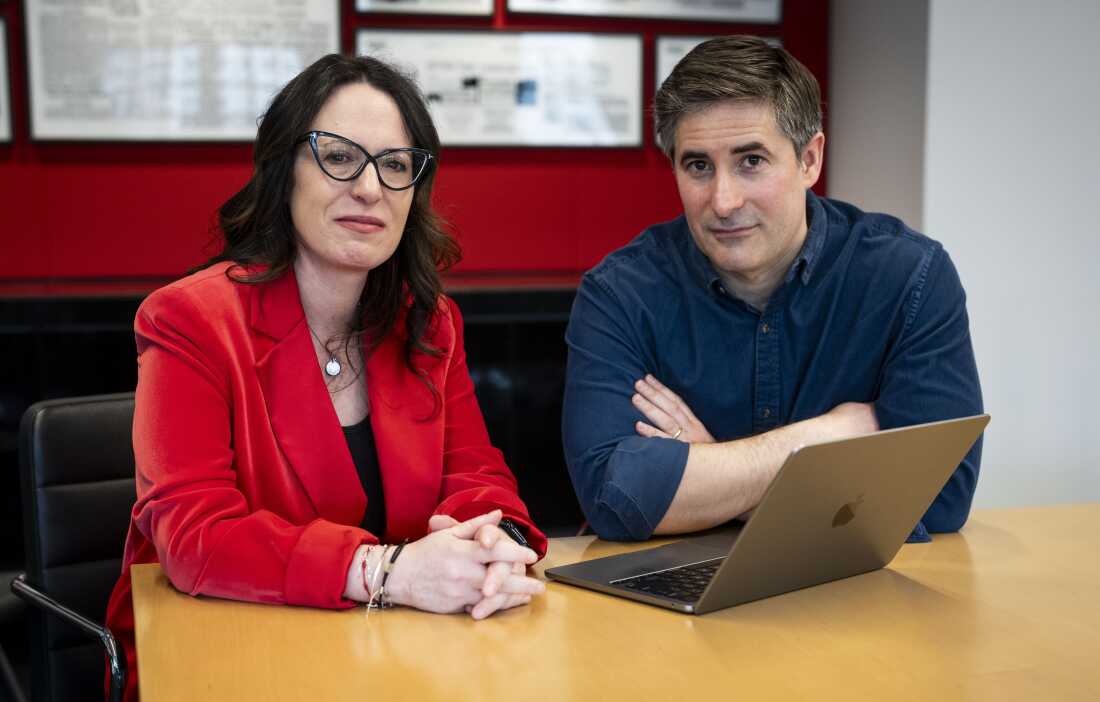
The New York Times journalists Maggie Haberman and Jonathan Swan are the authors of Regime Change: Inside the Imperial Presidency of Donald Trump.
Doug Mills/The New York Times
hide caption
toggle caption
Doug Mills/The New York Times
The conversations are non-linear. Trump will get fascinated about one thing that has nothing to do with the topic and that can derail a meeting. We have a scene in the book where he’s having a conversation, a very small meeting, which is highly classified about a defense program, and this guy comes in, just walks into the Oval, salt of the earth, kind of country looking guy, and he’s holding stone samples for the Rose Garden … and the two go off and sort of start conferring, looking out the window, talking about the paving and the stone and this and that, gets on the phone with another contractor. And before time’s up, the meeting’s ended, they haven’t actually resolved the issue they were going to resolve.
On the higher level of secrecy in Trump’s second term
When there are issues that Trump really cares about, or his team wants to keep secret, they can be incredibly secretive, to the point of great frustration across the government. And when it comes to the weightiest issues like the planning of going to war with Iran, we found that very, very senior people in the government were, A, completely cut out of the loop and, B, had no idea about what was being discussed in the Oval Office.
On Trump’s focus on decorating the White House

I traveled with President Trump to the Middle East, palace after palace. And it was really instructive to watch him with these Middle Eastern rulers in Saudi Arabia and Qatar and the United Emirates. He was just in a state of absolute pleasure, going from one palace to the next, admiring the marble, looking at most rarefied displays of state wealth on Earth. And that’s essentially what he’s trying to create at the White House. … He’s building this grand ballroom. He seemed to almost be competing with Melania as to who had had the better bedroom. They have separate bedrooms and he was taking objects that she had placed in the center hall of the residence and putting them in his bedroom.
YouTube
On the challenge of interviewing Trump
An interview with Trump requires an enormous amount of preparation if you want to hope to come out of it with any level of success. He’s a really difficult interview… He’s an overwhelming presence and you are confronted with a sort of tidal wave of words. Many of the words and the sentences are detached from reality or completely false. And you have to make judgments in real time about what you let go. You can’t fact-check everything. You just can’t. You can pick your moments.
I see my role in every interview as the representative of the people in that chair. You’re the one who’s lucky enough to be sitting in that chair interviewing the president of the United States. What would regular people want to know and want me to do in that situation? And I think that when you’re interviewing a president of the United States, you want to find the balance between letting them explain themselves and not cutting in every two seconds, but finding moments that are really important to puncture the bubble. Trump creates an unreality bubble. It’s the way he operates. … Tucker Carlson actually described it publicly as like being under a spell and I certainly wouldn’t ascribe a supernatural dimension to it, but I know what he’s getting at.
Thea Chaloner and Susan Nyakundi produced and edited this interview for broadcast. Bridget Bentz, Molly Seavy-Nesper and Meghan Sullivan adapted it for the web.

The real spectrum of housing insecurity
Annika McFarlane/Getty Images/Getty Images
hide caption
toggle caption
Annika McFarlane/Getty Images/Getty Images
Who counts as homeless in America?
If you ask the Department of Housing and Urban Development, around 750,000 people are homeless in America. If you ask the Department of Education, that number shoots up into the millions. What does this discrepancy tell us? And how do our cultural ideas about homelessness shape who we see as homeless, and who gets help? To find out, Brittany talks with Dr. Margot Kushel, Director at the UCSF Benioff Homelessness and Housing Initiative, and Dr. Molly Richard, assistant professor in the Department of Public Health at the University of Rhode Island’s College of Health Sciences.
Want more deep dives on cultural taboos? Check out these episodes:
The truth about men on the ‘down low’
Why can’t we be normal about polyamory?
Support Public Media. Join NPR Plus.
Follow Brittany on Instagram: @bmluse
For handpicked podcast recommendations every week, subscribe to NPR’s Pod Club newsletter at npr.org/podclub.
This episode was produced by Corey Antonio Rose. It was edited by Neena Pathak. We had engineering support from Josephine Nyounai. Our Supervising Producer is Cher Vincent. Our Executive Producer is Barton Girdwood. Our VP of Programming is Yolanda Sangweni.
Lifestyle
They just completed all of L.A. Times’ 101 Best California Experiences — and we’ve got questions!

By December of 2023, Paul Preston realized that his girlfriend Susan Huckle was a big fan of road trips and lists. So for Christmas, he gave her L.A. Times’ ”101 Best California Experiences” zine, a traveler’s bucket list highlighting my top destinations throughout my four decades of traveling the state.
The gift, I’m delighted to hear, was a hit.
Preston and Huckle went through it and checked off locations they’d seen already. Then they hit the road.
And now, after two and a half years of roaming the state between work assignments, they’re back to report that they’ve covered all 101 locations on that list. Though the two have also traveled beyond state lines, the quest to cover California “totally informed our lives for the last two or three years,” said Huckle, who sent me a note of thanks after ticking the last box.
After the note arrived, I was eager to call them and learn more. I caught the couple, of course, in the middle of a day trip.
Susan Huckle and Paul Preston set out to visit every spot on the L.A. Times’ 2023 list of “101 Best California Experiences.” Along the way, they got married in Yosemite Valley.
(Nick Wuthrich)
“We’re out exploring,” Preston said. “So you’re getting what we’re about.”
They’re also now married. That happened last July in Yosemite Valley, which, yes, was on the list.
Huckle, 41, an actress, a host on “L.A. This Week” on Channel 35, a Universal Studios performer and an author, grew up in Santa Maria on California’s Central Coast.
Preston, 56, is also an actor. He leads movie location tours and hosts podcasts, movie trivia nights and special events. He grew up and went to college on the East Coast, so he had fewer California miles under his belt when the couple met in 2020.
Their California 101 travels began in early 2024 with a trip to Paso Robles, where they saw the green slopes along Highway 46, Morro Rock and the elephant seals at Piedras Blancas near Hearst Castle.
“And then,” Preston said, “we just kept going.”
Some of their most satisfying stops, the two agreed, were places they hadn’t heard of, such as Orange Works in the Central Valley town of Strathmore and Angel Island State Park, sometimes known as the Ellis Island of the West. Huckle called Angel Island “a marriage of natural beauty with great, powerful, historic information.”
By early this year, there were only a few destinations left to check.
In April, they did the Indian Canyons and Sunnylands estate near Palm Springs, the Integratron near Joshua Tree and the Cheech Marin Center for Chicano Art & Culture in Riverside. In June, they rafted the South Fork of the American River, along with stops in Old Sacramento and, last of all, Columbia State Historic Park. Then they made their own favorites lists.
Susan Huckle’s top 10:
Yosemite Valley
Badwater Basin
Mammoth Mountain
Angel Island State Park
Cheech Marin Center
Joshua Tree National Park
American River South Fork
The Marshall Store on Tomales Bay
Santa Cruz Island
Sunnylands
Paul Preston’s top 10:
Yosemite Valley
Hollywood Bowl
Griffith Observatory
Catalina
Mammoth Mountain
American River South Fork
Erick Schats’ Bakery in Bishop
Huntington Library and Gardens
Palm Springs Aerial Tramway
Balboa Park, San Diego
Now that they’ve seen so much of the state, I had questions. For one, which spots not on the list would they have included?
Alcatraz, they agreed. Also, as an admirer of redwoods, Preston liked Calaveras Big Trees State Park. As an avid cyclist, Huckle liked the 22-mile Marvin Braude Bike Trail from Torrance to Pacific Palisades.
And was anything on the list a disappointment?
“The Carmel Mission,” Huckle said quickly. “It’s beautiful and the missions are an important part of California history.” But she said the mission’s account of its own history seemed “whitewashed,” saying little about the Native loss and trauma that historians are increasingly recognizing in accounts of the missions.
Said Huckle: “I was like, ‘C’mon guys, nobody really thinks this any more, right?’”
Now that they’re done with the Times’ “101 Best California Experiences,” what what will shape their next trips?
They have a list for that. Huckle picked up an L.A. guide, Danny Jensen’s “Secret Los Angeles,” and the couple plans to start where the book does, with the Triforium, a many-colored sculpture that went up outside City Hall in 1975 (and once featured music).
After that? Maybe the Faces of Elysian Valley, a traffic circle sculpture that Huckle said “looks like Easter Island in the middle of Cypress Park.”
That will leave only about 138 more destinations in the book to cover.
If anybody can do it, it’s these two.
-

 Milwaukee, WI2 minutes ago
MPS students repair bikes for free through WI Bike Federation program
-

 Atlanta, GA8 minutes ago
World Cup isn’t over: Best places to watch the final matches in Atlanta
-

 Minneapolis, MN14 minutes ago
Federal lawsuit raises questions about culture at prior job of Minneapolis mayor’s nominee for fire chief
-

 Indianapolis, IN20 minutes ago
See ‘The Odyssey’ as Nolan intended at one Indiana IMAX theater
-

 Pittsburg, PA26 minutes ago
2 arrested following Downtown Pittsburgh drug bust, police say
-
Augusta, GA32 minutes ago
Augusta, GA Weather Forecast
-

 Washington, D.C38 minutes ago
Calls grow for Green to recall Hawaii National Guard from DC | Honolulu Star-Advertiser
-

 Cleveland, OH44 minutes ago
19 First Alert Days: Smoke in the air today; severe storms possible Saturday

