Lifestyle
Ann Patchett finds bits of Catholicism and America appalling: 'But I am those things'


Ann Patchett says she was closer to her Catholic faith when she was in her mid 30s and writing Bel Canto.
Emily Dorio
hide caption
toggle caption
Emily Dorio
A note from Wild Card host Rachel Martin: Ann Patchett is a hugely popular writer. She was a Pulitzer finalist for her book The Dutch House. Her most recent novel, Tom Lake, was a New York Times bestseller. But she’s perhaps most well known for her 2001 book Bel Canto.
It tells the story of a group of strangers taken hostage somewhere in Latin America. It’s lyrical and heartbreaking and it has been adapted into an opera and a movie. Overall, it’s been a massively successful book. And Patchett recently decided to do a fascinating thing: She published an annotated version of Bel Canto with her own handwritten notes in the margins.

She calls out clunky turns of phrase, confusing plot points, repetitive language. She also gives herself credit for good writing and thoughtful observations about the human condition. But mainly, she is owning her shortcomings. Which feels like a bold quality that we need more of.
This Wild Card interview has been edited for length and clarity. Host Rachel Martin asks guests randomly-selected questions from a deck of cards. Tap play above to listen to the full podcast, or read an excerpt below.
Question 1: What’s a place that shaped you as much as any person did?
Ann Patchett: When I was a child, we lived on a farm for several years. It was in Ashland City, about 30 minutes outside of Nashville. It was not a working farm. It was just a collection of absolute weirdness.
We had a couple of horses. We had a rabbit. We had chickens, which were all named after members of Nixon’s cabinet. We had dogs, which meant that dogs would just go through and they would stay for a couple of years. Same with the cats. It was real country life. And most importantly, I had a pig, which I got from my ninth birthday because I was obsessed with Charlotte’s Web.
It was just a very animal-laden, isolated life. And because I’m an introvert, that worked out fine for me. And childhood was: you would go outside and climb up a hill. I collected moss, lots of flowers. I actually had a moss business. I sold moss in town when I was about 10 to florists.

Rachel Martin: Wait, other kids are like selling lemonade and little Ann Patchett is like, “Some moss, sir?”
Patchett: I’m in the moss trade. Make a lot more money off a moss than you do lemonade, Rachel.
And I remember my mother saying things like, “Remember the rattlesnakes are blind when they’re molting. So if you get into the blackberry bushes where the rattlesnakes go to shed their skins because they have those little tiny thorns on the blackberry bushes, just be aware because they can’t see you so they’re more likely to strike.”
That was the bedrock advice of my childhood.
Question 2: What’s an expression of love you’re trying to get better at?
Patchett: Complete acceptance. Complete blanket acceptance, which is the love my husband gives to me. He just accepts me for who I am. Always. No matter what. And I think I’ve always been somebody who wants to fix, and I work very hard to not fix and to just see the people in my life and accept them for who they are and love them for who they are.
The trailer for the film adaptation of “Bel Canto.”
YouTube
Martin: Is this right — that you dedicated the original version of Bel Canto to the man who is now your husband and you weren’t married, you were just dating?
Patchett: Yes. Yes! What kind of madness was that? And I want to tell you – my second novel, which was a book no one ever read called Taft – I dedicated it to my boyfriend at the time. And I found out that he was, shall we say, stepping out on me as the book was going to press. And I frantically called my publisher and said, “Can you pull this?” And they were like, “Hang on, let me check. Yes! We got it back!”
Martin: It’s like you stopped the tattoo artist right as they were about to go into your arm to put his name.
Patchett: It’s so true. And I dedicated it to my beloved cousins. And I thought, “Never gonna make that mistake again.” But then I met the right guy and I dedicated the book to him. And we weren’t married because I didn’t want to get married, but I knew that I would always be with him.
Question 3: How have your feelings about God changed over time?
Patchett: So there’s a lot about God in Bel Canto. There’s a lot about faith. And one of the things that I found very moving when I went back to it was I was much closer to my Catholic faith when I was 35 or 34, when I was writing that book.
You know, it’s a two-part thing. There’s God and then there’s Catholicism, which I always say, Catholicism is to God what sorority is to college. For some people, it’s everything. For some people, it’s nothing. For other people, it’s part of the experience.
I still believe in God. And here’s the thing, if I tried to tell you what that meant, I would be wrong. The only thing that I know for sure is that whatever I know is wrong. And it does not behoove me to spend a moment’s time thinking about it.
We are alive and that’s an astonishing gift. And it seems very possible to me that being alive is God and that the trick is whether or not we know it. The trick is whether or not we can keep our focus and remember that we are, for all of the suffering, the recipient of the most beautiful gift for a limited period of time, which is our life.

Martin: I’m interested in your preservation of the word “God” to define that. That the word carries so much for me because of how I was raised. And so it feels very dramatic for me to say, “I don’t believe in God.” But I guess I appreciate that you, even though you are no longer a Catholic and don’t identify that way —
Patchett: Yes I do. I don’t go to church, but I do still call myself a Catholic.
Martin: But that’s even more interesting!
Patchett: I am still a Catholic and there is an enormous amount about Catholicism that I don’t believe and am appalled by. I am still an American and there is an enormous amount about being an American that I don’t believe in and that I am appalled by. I am a Tennessean. There is an enormous amount about being a Tennessean that I don’t believe in and I am appalled by. But I am those things. And there are – about all of those things – parts that I love and I’m proud of.
When I was a sophomore at Sarah Lawrence, I had a humanism teacher. We had a class called “Humanism.” And it was a point in my life where I thought, “I loathe Catholicism. I want nothing to do with this. This is just an anathema to everything of who I am and who I believe in, what I believe in.”

And I went out to dinner at the Raceway Diner, I remember, in Yonkers with my humanism teacher. And I told him my problems. And he said, “If you’re going looking for something as big as God, just go where you’re comfortable. Go with what you know. It doesn’t make any difference. You’re not going to pick a better religion. You’re not going to pick a better set of words. It’s not about the words. It’s not about the religion. Don’t waste your time picking out your luggage. Just go on the trip.”
What matters is that we do our best with the life that we have, that we show up, that we love each other, and that we try to be as aware as is humanly possible of the life and the gift that we’re given, and to help other people wherever we can.



Wyle, who spent 11 seasons on ER, returns to the hospital in The Pitt. Now in Season 2, the HBO series has earned praise for its depiction of the medical field. Originally broadcast April 21, 2025.
Hear The Original Interview
Television
After years of avoiding the ER, Noah Wyle feels ‘right at home’ in ‘The Pitt’

TMZ Live Stream
Come Into Our Office and Watch News Happen!!!
Published
We want you to be a part of TMZ, so every weekday, between 9:30 AM and 11:30 AM PT, we take you inside our newsroom via live stream.
You never know what you’re gonna get … a big story that breaks, an argument erupts in the room, or someone’s just joking around.
Your comments are a big part of the stream, and the staff spends a lot of time speaking directly to you. Every day is different!
We also use our live stream to produce our “TMZ Live” TV show.

From left: Noah Wyle plays Dr. Michael “Robby” Robinavitch, the senior attending physician, and Fiona Dourif plays Dr. Cassie McKay, a third-year resident, in a fictional Pittsburgh emergency department in the HBO Max series The Pitt.
Warrick Page/HBO Max
hide caption
toggle caption
Warrick Page/HBO Max
The first five minutes of the new season of The Pitt instantly capture the state of medicine in the mid-2020s: a hectic emergency department waiting room; a sign warning that aggressive behavior will not be tolerated; a memorial plaque for victims of a mass shooting; and a patient with large Ziploc bags filled to the brink with various supplements and homeopathic remedies.
Scenes from the new installment feel almost too recognizable to many doctors.
The return of the critically acclaimed medical drama streaming on HBO Max offers viewers a surprisingly realistic view of how doctors practice medicine in an age of political division, institutional mistrust and the corporatization of health care.
Each season covers one day in the kinetic, understaffed emergency department of a fictional Pittsburgh hospital, with each episode spanning a single hour of a 15-hour shift. That means there’s no time for romantic plots or far-fetched storylines that typically dominate medical dramas.
Instead, the fast-paced show takes viewers into the real world of the ER, complete with a firehose of medical jargon and the day-to-day struggles of those on the frontlines of the American health care system. It’s a microcosm of medicine — and of a fragmented United States.

Many doctors and health professionals praised season one of the series, and ER docs even invited the show’s star Noah Wyle to their annual conference in September.
So what do doctors think of the new season? As a medical student myself, I appreciated the dig at the “July effect” — the long-held belief that the quality of care decreases in July when newbie doctors start residency — rebranded “first week in July syndrome” by one of the characters.
That insider wink sets the tone for a season that Dr. Alok Patel, a pediatrician at Stanford Medicine Children’s Health, says is on point. Patel, who co-hosts the show’s companion podcast, watched the first nine episodes of the new installment and spoke to NPR about his first impressions.
To me, as a medical student, the first few scenes of the new season are pretty striking, and they resemble what modern-day emergency medicine looks and sounds like. From your point of view, how accurate is it?
I’ll say off the bat, when it comes to capturing the full essence of practicing health care — the highs, the lows and the frustrations — The Pitt is by far the most medically accurate show that I think has ever been created. And I’m not the only one to share that opinion. I hear that a lot from my colleagues.
OK, but is every shift really that chaotic?
I mean, obviously, it’s television. And I know a lot of ER doctors who watch the show and are like, “Hey, it’s really good, but not every shift is that crazy.” I’m like, “Come on, relax. It’s TV. You’ve got to take a little bit of liberties.”
As in its last season, The Pitt sheds light on the real — sometimes boring — bureaucratic burdens doctors deal with that often get in the way of good medicine. How does that resonate with real doctors?
There are so many topics that affect patient care that are not glorified. And so The Pitt did this really artful job of inserting these topics with the right characters and the right relatable scenarios. I don’t want to give anything away, but there’s a pretty relatable issue in season two with medical bills.
Right. Insurance seems to take center stage at times this season — almost as a character itself — which seems apt for this moment when many Americans are facing a sharp rise in costs. But these mundane — yet heartbreaking — moments don’t usually make their way into medical dramas, right?
I guarantee when people see this, they’re going to nod their head because they know someone who has been affected by a huge hospital bill.
If you’re going to tell a story about an emergency department that is being led by these compassionate health care workers doing everything they can for patients, you’ve got to make sure you insert all of health care into it.
As the characters juggle multiple patients each hour, a familiar motif returns: medical providers grappling with some heavy burdens outside of work.
Yeah, the reality is that if you’re working a busy shift and you have things happening in your personal life, the line between personal life and professional life gets blurred and people have moments.
The Pitt highlights that and it shows that doctors are real people. Nurses are actual human beings. And sometimes things happen, and it spills out into the workplace. It’s time we take a step back and not only recognize it, but also appreciate what people are dealing with.
2025 was another tough year for doctors. Many had to continue to battle misinformation while simultaneously practicing medicine. How does medical misinformation fit into season two?
I wouldn’t say it’s just mistrust of medicine. I mean that theme definitely shows up in The Pitt, but people are also just confused. They don’t know where to get their information from. They don’t know who to trust. They don’t know what the right decision is.
There’s one specific scene in season two that, again, no spoilers here, but involves somebody getting their information from social media. And that again is a very real theme.
In recent years, physical and verbal abuse of healthcare workers has risen, fueling mental health struggles among providers. The Pitt was praised for diving into this reality. Does it return this season?
The new season of The Pitt still has some of that tension between patients and health care professionals — and sometimes it’s completely projected or misdirected. People are frustrated, they get pissed off when they can’t see a doctor in time and they may act out.
The characters who get physically attacked in The Pitt just brush it off. That whole concept of having to suppress this aggression and then the frustration that there’s not enough protection for health care workers, that’s a very real issue.
A new attending physician, Dr. Baran Al-Hashimi, joins the cast this season. Sepideh Moafi plays her, and she works closely with the veteran attending physician, Dr. Michael “Robby” Robinavitch, played by Noah Wyle. What are your — and Robby’s — first impressions of her?
Right off the bat in the first episode, people get to meet this brilliant firecracker. Dr. Al-Hashimi, versus Dr. Robby, almost represents two generations of attending physicians. They’re almost on two sides of this coin, and there’s a little bit of clashing.
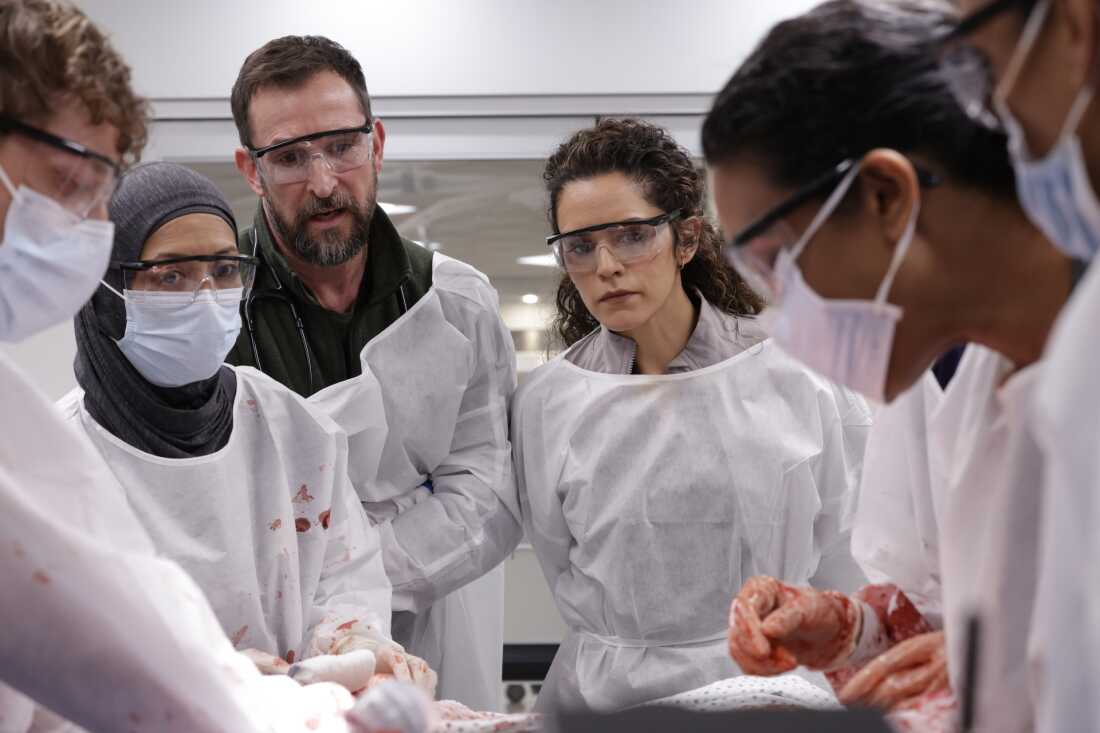
Sepideh Moafi, fourth from left, as Dr. Baran Al-Hashimi, the new attending physician, huddles with her team around a patient in a fictional Pittsburgh teaching hospital in the HBO Max series The Pitt.
Warrick Page/HBO Max
hide caption
toggle caption
Warrick Page/HBO Max
Part of that clash is her clear-eyed take on artificial intelligence and its role in medicine. And she thinks AI can help doctors document what’s happening with patients — also called charting — right?
Yep, Dr. Al-Hashimi is an advocate for AI tools in the ER because, I swear to God, they make health care workers’ lives more efficient. They make things such as charting faster, which is a theme that shows up in season two.
But then Dr. Robby gives a very interesting rebuttal to the widespread use of AI. The worry is that if we put AI tools everywhere, then all of a sudden, the financial arm of health care would say, “Cool, now you can double how many patients you see. We will not give you any more resources, but with these AI tools, you can generate more money for the system.”
The new installment also continues to touch on the growing corporatization of medicine. In season one we saw how Dr. Robby and his staff were being pushed to see more patients.
Yes, it really helps the audience understand the kind of stressors that people are dealing with while they’re just trying to take care of patients.
In the first season, when Dr. Robby kind of had that back and forth with the hospital administrator, doctors were immediately won over because that is such a big point of frustration — such a massive barrier.
There are so many more themes explored this season. What else should viewers look forward to?
I’m really excited for viewers to dive into the character development. It’s so reflective of how it really goes in residency. So much happens between your first year and second year of residency — not only in terms of your medical skill, but also in terms of your development as a person.
I think what’s also really fascinating is that The Pitt has life lessons buried in every episode. Sometimes you catch it immediately, sometimes it’s at the end, sometimes you catch it when you watch it again.
But it represents so much of humanity because humanity doesn’t get put on hold when you get sick — you just go to the hospital with your full self. And so every episode — every patient scenario — there is a lesson to learn.
Michal Ruprecht is a Stanford Global Health Media Fellow and a fourth-year medical student.

Dead Man’s Wire review: Gus Van Sant tackles true-crime intrigue

Some flu measures decline, but it’s not clear this severe season has peaked

‘Weight Loss Has Never Been About Calories’: How This Low-Insulin Diet Helped Lillie, 58, Drop 70 Lbs!

Video: Read These 3 Books Before Watching the Movie

After years of avoiding the ER, Noah Wyle feels ‘right at home’ in ‘The Pitt’

Florida High School Football Rankings: Top 25 teams – Oct. 21

Cleary's 21 help Le Moyne down Central Connecticut State 69-64 in OT

How old is Bo Nix? What to know about Oregon quarterback ahead of 2024 NFL Draft

99th annual Pony Swim held in Virginia

Video: ‘It Didn’t Have to Happen This Way:’ U.Va. Faculty Call for Review of Police Response to Protests

AOC accuses Vance of believing ‘American people should be assassinated in the street’
Mercosur: How Macron’s domestic weakness undercut his Brussels clout

National Park Service will void passes with stickers over Trump’s face

Trump plans to meet with Venezuela opposition leader Maria Corina Machado next week

Trump says meeting Iran’s ‘Crown Prince’ Pahlavi would not be appropriate
-

 Detroit, MI6 days ago
2 hospitalized after shooting on Lodge Freeway in Detroit
-

 Technology3 days ago
Power bank feature creep is out of control
-

 Dallas, TX4 days ago
Defensive coordinator candidates who could improve Cowboys’ brutal secondary in 2026
-

 Health5 days ago
Viral New Year reset routine is helping people adopt healthier habits
-

 Iowa3 days ago
Pat McAfee praises Audi Crooks, plays hype song for Iowa State star
-

 Nebraska2 days ago
Oregon State LB transfer Dexter Foster commits to Nebraska
-
 Nebraska3 days ago
Nebraska-based pizza chain Godfather’s Pizza is set to open a new location in Queen Creek
-
 Entertainment2 days ago
Spotify digs in on podcasts with new Hollywood studios