Fitness
Women gain twice the benefits from exercise than men, study shows


New research finds that women derive greater benefits when it comes to reducing cardiovascular and all-cause mortality risk from doing the same amount of physical activity as men.
In a study published in the Journal of the American College of Cardiology, 412,423 US adults (55% female, age 44 ± 17 years) were examined from 1997 – 2019 by a team from institutions including the School of Clinical Medicine, Tsinghua University, Beijing and Smidt Heart Institute, Cedars-Sinai Medical Centre, Los Angeles.
Participants provided data on their exercise habits, and their levels of aerobic physical activity and strength training were measured. The variables of frequency, duration, intensity and type were taken into account.
What were the benefits for women compared to for men?
The results showed that both men and women saw the maximum benefits at around 300 minutes per week of moderate-to-vigorous physical activity, like rope jumping, plateauing afterwards, but that women experienced more benefits in half the time.
Men experienced an 18% risk reduction in all-cause mortality for this duration. By contrast, women experienced the same gain in under half the time, at 140 minutes per week, continuing to benefit with increasing minutes of exercise. At 300 minutes per week, they had a 24% lower risk of premature death from any cause.
Women who were regular exercisers were also 36% less likely to have a heart attack, stroke or other cardiovascular incident compared with non-exercisers; for men, the difference in risk between the active and inactive was less than half that of women’s, at just 14%.
Strength training
When it came to strength training, men who did three sessions per week saw their risk of death fall by 14%, whereas women saw the same benefits from just one session. When women also did three sessions per week, their risk was reduced by almost double compared to that of men.
Vigorous physical activity
The greatest sex difference was seen in vigorous physical activity, such as running or swimming, with men achieving a 19% lower risk in all-cause mortality after engaging in 110 minutes a week of this type of exercise, while women saw the same gains after only 57 minutes a week. Moreover, for women, the 110 minutes a week were associated with a 24% lower mortality risk.
Moderate physical activity
For men engaging in moderate activity, like cycling or brisk walking, they saw the greatest benefits at 90 minutes a week, with a 20% lowered risk, whereas women achieved the same advantages at 50 minutes per week, and saw 24% reduction at 90 minutes.
‘Our study…encourages women who may not be getting enough exercise for various reasons, that even relatively small amounts of exercise can provide significant benefits,’ Dr Hongwei Ji, co-author of the study from the Affiliated Hospital of Qingdao University, said to The Guardian.
‘The 300-minute threshold is where we observed the greatest benefits, but statistically significant sex differences emerge with even smaller doses,’ continued Ji.
Prof Emmanuel Stamatakis, of the University of Sydney, who was not involved in the study, also suggested to The Guardian that it was likely that the different responses were because ‘physical effort women make for a given physical task is higher than in men.’ He also thought that the study’s results highlighted differences in skeletal muscle composition between the sexes.
Similarly, the authors suggested to The Telegraph that, since men generally have greater lung capacity, larger hearts and greater muscle mass, women may have to work harder in terms of respiration, metabolism and strength to perform the same movements, hence the increased benefits.
Dr Martha Gulati, director of Preventive Cardiology at the Smidt Heart Institute told The Times: ‘The beauty of this study is learning that women can get more out of each minute of moderate to vigorous activity than men do.’
How much exercise should I be doing?
The NHS recommends that adults aged 19-64 should do at least 150 minutes of moderate intensity activity a week or 75 minutes of vigorous activity. They advise that adults aim to do strengthening activities that work all your major muscle groups (legs, hips, back, abdomen, chest, shoulders and arms) on at least two days.
However, research shows that women consistently engage in less moderate-to-physical activity than their male counterparts, with the far-reaching health consequences of cardiovascular diseases, type 2 diabetes and cancer.
Become a member of the Women’s Health Collective and get full access to the Women’s Health app, available to download on Google Play and the App Store, to get the latest celebrity-inspired workouts and fitness content.



It is possible to counteract age-related mobility decline. Fact. While research shows that hip mobility reduces by 6-7% per decade after the age of 55, other studies show that long-term stretching and mobility after the age of 60 can produce meaningful improvements – and mobility and stretching coach @stretchy.bendy says there’s one exercise everyone needs: lateral lunges with hip rotations.
‘Want to move like you’re 25 when you’re 65? You need this move,’ she says. ‘When you think about your everyday movement, we’re basically moving forwards and backwards. But our hips are made to rotate in and out. When we stop rotating our hips, we get an achy lower back, cranky knees and of course, stiff hips. This move will bring rotation back.’
Here’s exactly how to do it.
Instructions
- Stand wide, feet pointing forward, then send your hips back and bend into your right knee.
- Check your knee alignment – make sure it’s above your ankle, pointing in the same direction as your toes. You don’t want it to fall in.
- While your hips are sinking back, hips squared, take the straight leg and simply go up onto your heel and rotate, so your toes are pointing up, then rotate to tap your toes down.
- Continue for 4-6 reps, then repeat on the opposite side.
‘Add this to your daily routine and I promise you’ll feel amazing, age well and move well forever,’ @stretchy.bendy says. And don’t just take her word for it – her followers concur it works. One wrote: ‘I was 83 but after I tried this, I’m 63 again.’
As for how long it’ll take for you to feel a significant difference in your hip mobility, one study on home-based exercise programmes that included daily hip rotation work showed noticeable improvements in hip range of motion (how far your hip joint can move, in all directions: flexion, extension, abduction, adduction, and rotation) after six weeks. Squatting down to pick something up or getting into a chair should feel easier, as should crossing your legs and getting in and out of a car. Any lower back pain should also reduce.
If you do feel any pain, @stretchy.bendy recommends ‘keeping your stance narrower, reducing the depth of the lunge, and skipping the rotation (toe lift)’. ‘Always listen to your body and stay in the ranges that feel strong and supported,’ she adds. ‘And if your physio or medical professional has given you specific guidelines, follow those.’
As Women’s Health UK’s fitness director and a qualified Pilates and yoga instructor, Bridie Wilkins has been passionately reporting on exercise, health and nutrition since the start of her decade-long career in journalism. She secured her first role at Look Magazine, where her obsession with fitness began and she launched the magazine’s health and fitness column, Look Fit, before going on to become Health and Fitness writer at HELLO!. Since, she has written for Stylist, Glamour, Cosmopolitan, Marie Claire, Elle, The Metro, Runner’s World and Red.Now, she oversees all fitness content across womenshealthmag.com.uk and the print magazine, spearheading leading cross-platform franchises, such as ‘Fit At Any Age’, where we showcase the women proving that age is no barrier to exercise. She has also represented the brand on BBC Radio London, plus various podcasts and Substacks – all with the aim to encourage more women to exercise and show them how.Outside of work, find her trying the latest Pilates studio, testing her VO2 max for fun (TY, Oura), or posting workouts on Instagram.

Through the upper-level course Exercise Testing and Prescription, Elon students will work one-on-one with volunteer participants from the university community.
Share:
Members of the Elon community have the opportunity in Spring 2026 to receive individualized fitness programming through a partnership with students in the Department of Exercise Science.
Through the upper-level course Exercise Testing and Prescription, students will work one-on-one with volunteer participants from the Elon community. Students will conduct fitness assessments, learn about participants’ health histories and goals, and design customized exercise programs. Throughout the semester, students will meet individually with participants at times that are mutually convenient to help guide progress and make adjustments as needed.
National Physical Activity Guidelines recommend that adults engage in at least 150 minutes of moderate aerobic activity each week, along with two sessions of resistance training. While these recommendations provide a general framework, they often leave individuals wondering how to tailor exercise to their own lifestyles, schedules and health goals.
“The exercise necessary to improve fitness takes time from other things, and exactly what to do to get the benefits you want can be hard to figure out,” said Liz Bailey, assistant teaching professor of exercise science. “The best exercise program for most individuals is one that is designed to meet individual goals and takes into consideration individual likes/dislikes, time and access.”
Research consistently demonstrates the benefits of improved cardiorespiratory and musculoskeletal fitness. Higher fitness levels are associated with a reduced risk of premature death and improved symptoms of mild depression. At the same time, prolonged sedentary behavior — such as sitting more than seven hours per day — has been linked to increased risk of conditions including diabetes and dyslipidemia.
“We want to empower participating individuals so they can access some of the many benefits increased fitness can bring,” said Liz Bailey, assistant teaching professor of exercise science. “The opportunity to work with an individual is also a valuable learning experience for the students and me, so participants have the potential to make a lasting impact on us as well.”
Community members interested in participating or learning more are encouraged to contact Liz Bailey, assistant teaching professor of exercise science, at ebailey@elon.edu.

GAINESVILLE, Fla. (WCJB) – In this week’s edition of Your Fitness, Gainesville Health and Fitness trainer Adam Brandel shows you some different chest workouts you can do and different variations of the push-up.
For more information on these workouts and more, you can go a to the Gainesville Health and Fitness website HERE
RELATED: Your Fitness: Learn about group HIIT classes with Gainesville Health & Fitness
Click here to subscribe to our newsletter.
Copyright 2026 WCJB. All rights reserved.

Where AP voters ranked South Carolina women’s basketball after another top 10 victory

From Smithfield to Sanford, what we know about the ‘monumental’ change

Tennessee Republicans push bills targeting LGBTQ+ community

Trump says he hasn’t decided endorsement in Texas Senate race

Utahns wake up to power outages statewide as strong winds impact Utah

Florida High School Football Rankings: Top 25 teams – Oct. 21

Cleary's 21 help Le Moyne down Central Connecticut State 69-64 in OT

How old is Bo Nix? What to know about Oregon quarterback ahead of 2024 NFL Draft

99th annual Pony Swim held in Virginia

Indiana Members Credit Union announced as new anchor tenant at Bottleworks District

‘ShamWow Guy’ reveals what is motivating him to run for Congress: ‘This woke mess won’t clean itself’

Mapping forced displacements and settler attacks by Israel in the West Bank

Rev. Jesse Jackson, a civil rights icon, dies at 84

Video: At Least 2 Killed During High School Hockey Game in Rhode Island

Tom Emmer blasts Democrats’ double standard on SAVE Act: ‘They require photo IDs’ at their own DNC
-

 Alabama1 week ago
Geneva’s Kiera Howell, 16, auditions for ‘American Idol’ season 24
-

 Illinois1 week ago
2026 IHSA Illinois Wrestling State Finals Schedule And Brackets – FloWrestling
-

 Culture1 week ago
Try This Quiz on Passionate Lines From Popular Literature
-
 Science1 week ago
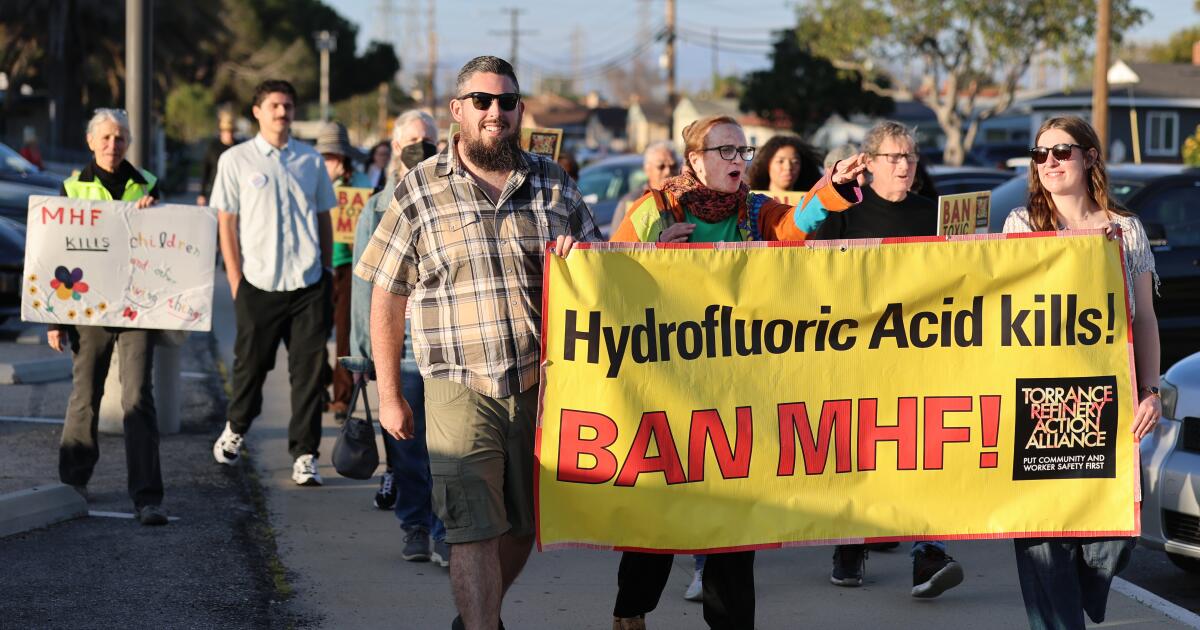
Torrance residents call for the ban of ‘flesh-eating’ chemical used at refinery
-

 Politics1 week ago
West Virginia worked with ICE — 650 arrests later, officials say Minnesota-style ‘chaos’ is a choice
-
 Science1 week ago
TrumpRx is launched: How it works and what Democrats say about it
-

 Fitness1 week ago
13 best fitness watches for 2026, tried and tested
-

 Health6 days ago
James Van Der Beek shared colorectal cancer warning sign months before his death