

Connect with us

Fitness

People Swear by ‘Exercise Stacking’ on Weekends: 'I Feel So Validated by This'

Published

on

People Swear by ‘Exercise Stacking’ on Weekends: 'I Feel So Validated by This'

Being a “weekend warrior,” or practicing “exercise stacking” on weekends, comes with its benefits. According to recent research published in Obesity, leaving your workouts solely for the weekend—and exercising hard—can be just as effective as exercising throughout the week when it comes to burning fat and achieving your fitness goals.

We spoke with Tyler Read, BSc, CPT, the founder of PTPioneer.com and a personal trainer who has been involved in the health and fitness world for the past 15 years, who breaks down everything you need to know about exercise stacking, along with how it can speed up your progress. Keep reading to learn more, and when you’re finished, check out the 6 ‘Power Foods’ That Helped This Woman Lose 100 Pounds.

What is exercise stacking all about?

“Stacking exercises refers to the practice of cramming essentially an entire week’s worth of workouts and exercise into just a few back-to-back days, such as on the weekend,” explains Read. And research backs up the benefits.

TikTok user Kevin Gendreau, a board-certified obesity medicine doctor, posted a video with the caption, “I’m a weekend warrior—are you?” He mentioned a 2022 “weekend warrior” study published in JAMA Internal Medicine, which revealed that you can lower your risk of all-cause mortality by squeezing all of your exercise for the week into the weekend.

RELATED: 10 Best Exercises for Seniors To Do at Home

Advertisement

“So, for example, you can work out for 75 minutes Saturday and 75 minutes Sunday and still get the same all-cause mortality benefit as if you were to disperse your workouts through the week,” Gendreau explains. “This was a game-changer, and it means that people with super busy schedules throughout the week can actually push off their workouts to the weekend. And whether you work out through the week or you just work out really intensely Saturday and Sunday, you still have a benefit of decreased myocardial infarction or heart attack, decreased risk of stroke, decreased risk of heart failure, and even atrial fibrillation.”

TikTokers were quick to comment, with one user writing, “I feel so validated by this,” and another commenting, “Love this!”

RELATED: 10 Strength Training ‘Rules’ to Follow for the Best Results

How can exercise stacking help you progress?

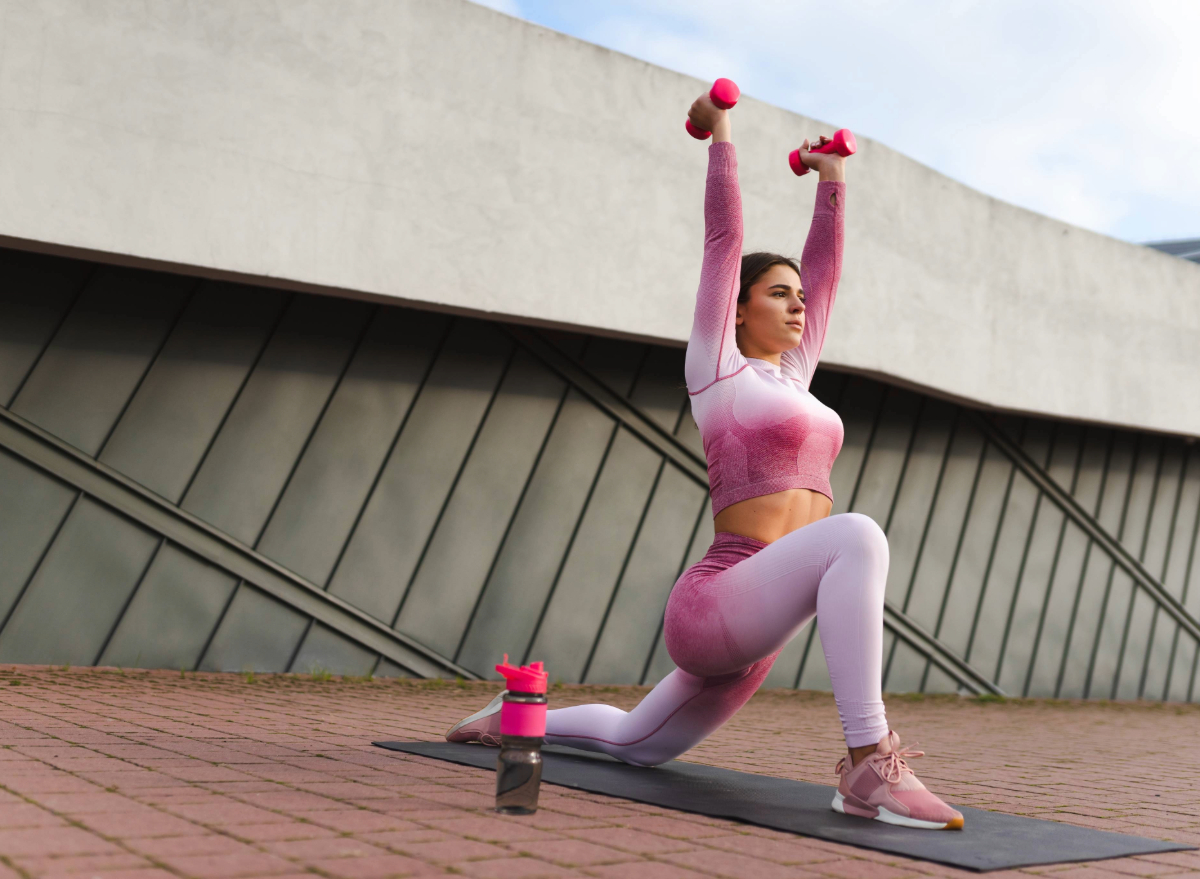
dumbbell lunge to press, concept of the 4-2-1 workout method
Shutterstock

If you lead a hectic, jam-packed lifestyle during the week, exercise stacking can help you be productive with your fitness goals over just a couple of days. “Research suggests that stacking may be as effective as spread-out exercise for general health benefits,” Read tells us. This doesn’t come without a caveat, though.

“Based on my knowledge of strength and conditioning for serious performance goals, the lack of recovery between the stacked workouts followed by the extended period without exercise may be detrimental,” Read stresses. “However, for general fitness and making ‘some gains’ compared to ‘no gains,’ stacking is far better than nothing.”

RELATED: 10 Best Compound Exercises for a Fit & Lean Lower Body

Advertisement

What are examples of exercise stacking?

fit woman running outdoors in sunny park, concept of easiest exercises for weight lossfit woman running outdoors in sunny park, concept of easiest exercises for weight loss
Shutterstock

When it comes to aerobic training, Read suggests stacking various forms of exercise like swimming, cycling, or running to add variety to your program and help steer clear of overuse injuries.

If you’re working with weights, Read recommends performing total-body workouts with superset aspects, like push-pull, and incorporating several sites of a wide range of exercises. “Make sure you don’t only focus on a single body part; instead, spread the love across all the muscles in your body to make sure they each get the work they need,” says Read.

Alexa Mellardo

Alexa is the Mind + Body Deputy Editor of Eat This, Not That!, overseeing the M+B channel and delivering compelling fitness, wellness, and self-care topics to readers. Read more about Alexa

Advertisement

Fitness

Can’t Get To The Gym RN? I’m Opting For Plank Shoulder Taps After A PT Confirmed They’re The Most Effective Home Move

Published

on

Can’t Get To The Gym RN? I’m Opting For Plank Shoulder Taps After A PT Confirmed They’re The Most Effective Home Move

How many times have you said, “I can’t believe it’s December already,” this year? If your answer veers somewhere between “a fair few” and “honestly, I’ve lost count”, you’re in good company. It’s become the seasonal equivalent of asking about the weather – a reliable go-to as the year starts winding down. And while I’ll spare you the usual cosy festive clichés, December is the month when gym plans loosen, and most of us swap weighted plates for quality time and mince pies.

Still, if moving your body is something that helps you feel grounded, there’s no reason you can’t carve out little pockets for it over the festive period (just as there’s absolutely no shame in pressing pause altogether). Research consistently shows that even short bursts of exercise can support both mental and physical health, which is why keeping one or two genuinely effective, at-home moves in your back pocket can be a lifesaver when festive stress starts simmering.

Advertisement
Continue Reading

Fitness

Applying the Stoic Cardinal Virtues for Both Optimal Performance and Longevity

Published

on

Applying the Stoic Cardinal Virtues for Both Optimal Performance and Longevity

Making healthy, sustainable choices for our health and fitness can often feel like a secondary goal, always on the back burner. The philosophy of Stoicism, originating in Greece and refined in Rome, offers a timeless framework for living well. Its four cardinal virtues, taught by philosophers such as Plato, are wisdom, courage, justice and temperance. These virtues can help you navigate health, wellness and fitness decisions with clarity and purpose by helping you:

  • Make healthier choices (moderation in food/drink; exercise)
  • Reduce stress through focusing on what’s controllable
  • Push outside your comfort zone to grow
  • Act responsibly for our community
  • Find peace by accepting mortality

Together, these lead to a more virtuous, less anxious, and purposeful life, which inherently supports well-being and longer, better living. 

Wisdom (Understanding/Learning)

Wisdom starts with learning, but it also requires understanding what is truly within your control: your judgments, actions and responses. Working out for an hour a day is the easy part of the fitness goal. The other waking hours of making healthy choices are the more challenging parts of the goal. In health and fitness, this means focusing on your habits and mindset rather than worrying about uncontrollable outcomes such as genetics or trendy social media posts from fitness influencers selling supplements. In a nutshell, use wisdom in these three ways to improve health, fitness and wellness: 

  • Control what you can control. Do this especially when faced with setbacks, such as a missed workout or a slip in diet. Redirect your energy toward what you can do next, not what you cannot change.
  • Seek facts, not opinions. Approach nutrition, exercise plans and wellness advice with an objective mind that is based on science. Avoid emotional reactions and look for evidence-based information.
  • Make sound choices. Use reason to evaluate what’s beneficial or harmful for your training and nutrition, avoiding extreme diets or fad workout routines. 


Courage (to Push Outside Your Comfort Zone)

Courage is not just about bravery. Courage is more about enduring discomfort and doing the right thing, especially when it’s hard. In your fitness journey, this means pushing through challenges and facing fears, such as trying a new activity or simply walking into a gym for the first time. The courage to challenge yourself with activities you are new to or not good at doing will help you become a well-rounded exerciser with performance and longevity goals. Try these three ways to add courage that enables you to make better decisions:

  • Accept the discomfort that comes with growth, whether it’s physical strain in exercise or emotional struggle in changing habits.
  • Remain focused on your goals and health commitments. Prioritize sleep, rest or recovery, and along with not skipping training days, even when external pressures tempt you otherwise.
  • Act objectively and see your circumstances as they are, not how you wish them to be, and respond realistically to challenges. Assess your progress regularly.

Justice (Fairness and Kindness)

Justice is about treating others and yourself with fairness, kindness and respect. In fitness, much is passed down from the older generation to the younger. Be that person who shares what you know with the next generation. This means supporting a positive training environment, whether at the gym, in group classes or among friends and family.

  • Treat others well by showing encouragement to people at every stage of their health journey, regardless of ability or background. This is powerful in people’s lives and makes you feel good, too.
  • Serve others by sharing knowledge, motivating workout partners, family members, and contributing to a supportive culture of activity to help others build the habit of fitness. Justice is also holding each other accountable.
  • Teach and communicate about your experiences, failures, and successes with humility. Having others learn from your mistakes and experiences is a smart way to communicate with the younger generation and beginners to fitness.

Temperance (Moderation and Discipline)

Temperance is discipline. None of these works can be done without discipline. We must learn to manage desires, impulses and habits to avoid excess in anything. In fitness and wellness, this virtue is vital for long-term success and well being. Training needs to be balanced with recovery, and this takes discipline to make some days easier than others. Too much of any good thing becomes a bad thing.

  • Avoid too much food, social media, supplements or even exercise. Balance is key to optimal performance, longevity and long-term goal achievement.
  • Manage impulsive responses to stress, frustration or temptation, choosing actions that keep you on track with your values and goals.
  • Practice discipline by doing things that are good for you, even when you do not want to.  Working out daily is often the easy part. The rest of the day, when food choices are tempting us to cheat on our diet, is the hardest for most people.

For many who find comfort in making the easy options or cheating on diets, you can also experience the same comfort (dopamine hit) by not doing it and choosing the healthier choice. These four virtues work together to flip the switch on how your body responds to new disciplined actions. For example, justice requires wisdom to discern the right action. Then, it takes courage to act on those insights and push yourself outside the comfort zone. Finally, deciding to be disciplined and hold firm is the temperance that avoids selfishness or excess. In your health journey, applying all four virtues helps you stay resilient, make thoughtful choices, and build a sense of purpose and connection.

You can also use the Military.com Fitness Section to aid your health, wellness, and fitness journey. There are thousands of articles and videos full of practical tools for building resilience, mitigating stress and disciplined living for optimal performance and longevity. By focusing on what you can control, acting with courage and kindness to others, and practicing self-discipline, you create a foundation for lasting health and wellness, not just for yourself, but for the wider community as well.

Want to Learn More About Military Life?

Whether you’re thinking of joining the military, looking for fitness and basic training tips, or keeping up with military life and benefits, Military.com has you covered. Subscribe to Military.com to have military news, updates and resources delivered directly to your inbox.

Advertisement

Story Continues

Continue Reading

Fitness

This is the best budget-friendly fitness tracker we have tested this year

Published

on

This is the best budget-friendly fitness tracker we have tested this year

Why you can trust Live Science


Our expert reviewers spend hours testing and comparing products and services so you can choose the best ones for you. Find out more about how we test.

If you’re looking to get back into exercising, or are just starting out, the Xiaomi Smart Band 10 may be the best fitness tracker for you. This fitness tracker does a great job of tracking your workouts and summarizing the data in an easy-to-understand format, without overcomplicating anything. The interface is user-friendly, and even those who aren’t into tech should be able to navigate around this smartwatch in no time at all.

While this is a budget fitness tracker, that doesn’t mean it’s lacking in features. You can do more than just track your workouts with this smart band: you can also track your sleep, stress levels, heart rate and so much more. There’s also no shortage of sports modes — with 150+ to choose from, you’re bound to find the workout you want on this watch.

Continue Reading

Trending