Experts have long debated the best time to exercise, but now, researchers have identified two sweet spot sweat intervals that could play a “crucial role” in cancer prevention.
According to a revelatory new study, being active first thing in the morning or later in the evening may reduce the risk of bowel cancer by 11% — and they’ve even narrowed it down to two times on the clock.
Researchers published their findings in the journal BMC Medicine and maintain that highlighting specific times when physical activity is “most beneficial” could lead to targeted cancer prevention strategies.
Researchers have determined that those who exercise in the morning and evening have a lower chance of developing bowel cancer. Maksym Azovtsev – stock.adobe.comColorectal cancer is the leading cause of cancer-related deaths worldwide. New Africa – stock.adobe.com
Led by experts from Germany’s University of Regensburg, the study assessed 86,252 people aged 42 to 79 whose physical activity was tracked and measured using a wrist accelerometer.
Researchers highlighted four activity patterns among this population: continuous activity throughout the day, activity late in the day, activity in the morning and evening, and activity at midday and at night.
Advertisement
Over a five-year follow-up period, 529 cases of colorectal cancer, also called bowel cancer, were reported.
Researchers determined that two daily peaks, at roughly 8 a.m. and 6 p.m., “were associated with reduced colorectal cancer risk, beyond the benefits of overall physical activity.”
According to the study, people active in both the early and late parts of the day had an 11% lower risk of colorectal cancer, compared with 6% for daylong activity and no change for those who exercised in the middle of the day and the evening. Data from those who were only active later in the day proved inconclusive.
Professor Dr. Michael Leitzmann, chair of the Department of Epidemiology and Preventive Medicine at Regensburg, was the lead investigator for the study.
“Our study highlights that not only is physical activity important for reducing colorectal cancer risk, but the timing of peak activity throughout the day could play a crucial role,” he said.
Advertisement
He and his team are hopeful their findings can help shape the future of cancer prevention.
“By identifying specific times — early morning and late day – when physical activity is most beneficial, our findings open new avenues for targeted prevention strategies,” he said.
Bowel cancer an develop anywhere in the large bowel, which includes the colon and rectum.
About 150,000 Americans are diagnosed annually with colorectal cancer, which includes cancers of the colon and rectum, according to the Colorectal Cancer Alliance. It’s a leading cause of cancer-related deaths worldwide.
Colorectal cancer has long been associated with older adults, especially people over 65. However, rates have steadily risen among adults under 50 since the ’90s.
Advertisement
Exercising at different times of the day can affect the body in different ways. oneinchpunch – stock.adobe.com
Among these younger adults is 47-year-old actor and “Dawson’s Creek” alumni James Van Der Beek, who revealed his colorectal cancer diagnosis last week.
Exercising at different times of the day can affect the body in different ways, as nearly all cells and biological processes in the body rely on circadian rhythms — the natural bodily clock that runs close to a 24-hour cycle.
A separate study found that exercising in the morning on an empty stomach can boost your metabolic rate and help you burn more calories during your workout.
Meanwhile, researchers at the University of Sydney, Australia, found that people who exercise at night have a lower risk of developing heart disease and dying than those who exercise in the morning.
Dr. Helen Croker, assistant director of research and policy at the World Cancer Research Fund, which funded the latest study, said the findings further cement the importance of exercise in cancer prevention.
Advertisement
Experts say you don’t have to be a gym rat to avoid a cancer diagnosis. torwaiphoto – stock.adobe.com
“Being physically active is one of our cancer prevention recommendations, and we know this cuts cancer risk,” she said. “These intriguing new findings offer potential for developing more specific recommendations, including patterns and timing of physical activity, for reducing cancer risk.”
And experts say you don’t have to be a gym rat to avoid a cancer diagnosis.
According to a recent study, just four to five minutes of “vigorous physical activity” can significantly reduce cancer risk in sedentary folks.
What if you could put on a suit that did your workout for you, a way to exercise without much time or effort? That’s the premise and promise of a hot and fast growing fitness niche called Electro Muscle Stimulation (EMS) training. Recent years have seen a slew of bestselling books focused on longevity, lifespan and wellspan, and almost universally, the doctors and researchers behind these have identified the extreme importance of growing muscle mass as we age, while singling out a specific health danger, visceral fat. The EMS workouts promise to tackle both of these hot button health issues and help users with more muscle, less fat, and to do it in sessions of 20 minutes or less a couple of times a week.
What Is EMS?
Can It Help You Get More Muscle, Less Fat?
EMS gyms, classes and workouts are relatively new and still largely off the public radar in the United States, but they have been popular in Europe and other parts of the world for decades. The oversimplified explanation of the concept is that an electric impulse causes an involuntary contraction of your muscle similar to but more intense than what you experience while lifting weights or doing other strength training, giving your muscle the exercise without you doing much. In the 1960s sports scientists in the former Soviet Union discovered that EMS could boost muscle strength quickly and used it to train elite athletes for the Olympics, and an article on this history in the Physical Therapy & Rehabilitation Journal reported that one Russian scientist found force gains of 40% in the elite athletes using the technology.
The first full body suits for EMS training werre invented in Germany, where the fitness trend is very popular. This is star German actress Laura Preiss doing her workout in a Berlin park. (Photo by Jens Kalaene/picture alliance via Getty Images)
dpa/picture alliance via Getty Images
In the 1980s medical devices using EMS for physical therapy and rehabilitation became commonplace, and if you’ve had knee or shoulder surgery you might already be familiar with the technology. In the beginning of this century the first full (mostly) body suits for workouts were introduced in Germany, spawning a massive new fitness trend—today there are thousands of EMS gyms across Europe and other parts of the world.
But as Brendan Kennedy, owner of EMS fitness brand Katalyst told me, in Europe these are sold as consumer electronics, whereas in the U.S. they are FDA-regulated medical devices, which greatly limited access for Americans. Katalyst was the first suit to get FDA clearance for sale to U.S. consumers and the first you could buy, while recent EMS gym chains in this country such as Body20, Manduu and Iron BodyFit provide class participants with suits. Katalyst has a model more similar to Peloton, where they sell the suit for use at home and support it with a robust app full of digitally connected classes, broken into four categories, strength, recovery, cardio and power, with many sub-options in each, such as abs or upper body.
Advertisement
In recent years technology has greatly changed the exercise and fitness industries. As a health minded person who wrote a bestselling book about food and what we eat, and whose life and work has been closely associated with outdoor sports, these are subjects I pay a lot of attention to. I recently wrote here at Forbes about the boom in high-tech exercise recovery, as well as an article about a science-driven fitness and longevity resort retreat in Palm Springs, and an AI enabled all in one home strength training platform. So, the promise of EMS training, supported by many recent scientific and medical studies, and tons of anecdotal evidence, got my attention.
A complete at home EMS training kit from Katalyst, the first company in the US cleared by the FDA to sell to consumers.
Katalyst
Fast, Low Impact Strength Training For More Muscle, Less Fat
The commonality between the at home approach and the studio classes is that just about all providers target workouts of 25 minutes or less, and as the Body20 website explains, “EMS training activates up to 90% of your muscle fibers in just 20 minutes, offering a fast, efficient way to build strength, improve endurance, and achieve your fitness goals.” Manduu classes are 15-minutes, and the brand claims that “When the brain sends a signal to a muscle, only about 65% of muscle fiber is activated. By contrast, the external EMS stimulus penetrates nearly 100% of muscle tissue. This produces a workout that is simultaneously ultra-low impact and incredibly effective, gentle yet intense.” IronBody Fit comes from Europe (France), has 250 studios worldwide, and claims that 25 minutes of EMS equals a 4-hour conventional strength training session. Most basic Katalyst classes are 20-minutes long, but their extensive library also has lower intensity recovery and cardio add-ons of 5 or 10 minutes and these can be combined to suit users’ goals.
In the U.S., EMS sessions are especially popular with professional athletes and celebrities, and USA Today reported that actor Tom Holland used it to get ripped to play Spider Man and Kendall and Kyle Jenner did an EMS workout on The Kardashians, while supermodel Cindy Crawford was an early investor in Katalyst. Some of the biggest sports stars including Usain Bolt, Rafael Nadal and Christiano Ronaldo have been cited using EMS workouts. George Clooney bought the Katalyst system and told Esquire in 2025 that “My arms are twice the size they’ve ever been. It’s crazy.” There are multiple specialty EMS gyms in New York and Los Angeles, but it is still between hard to impossible to find elsewhere in this country, which is the big appeal of Katalyst, the first at-home product, and one that has been growing for years. In addition, with gym classes often running around $100 a session, the payback on a complete Katalasyt system ($3000) is less than four months.
Katalyst’s Kennedy is a lifetime fitness junkie and self-proclaimed “gym rat” who has done long distance cycling events and Ironman Triathlons. But he told me that since getting hooked on EMS he has not done a conventional weightlifting gym session in four years—and for the first time in his life, in his Fifties, has “six-pack abs.”
Advertisement
This is how most people going to a gym to do weight or strength training do it: the old fashioned way.
getty
It was his wife, a former professional ballet dancer, who discovered the company and EMS workouts. “She was essentially a professional athlete, extremely fit and had just had our first child. She was looking for something to give her that same workout and feeling of a satisfaction and she loved it. I had been going to gyms for 40 years, but during COVID gyms closed, and Katalyst was just getting FDA clearance to sell to consumers so we bought suits in 2021, and took them with us when we traveled around the world, and about a year ago we decided to buy Katalyst.” The portability of the lightweight package combined with the quick time frame of workouts and suitability to just about any hotel room make it extra appealing to frequent travelers.
“Everything we are learning about longevity tells us that strength is essential, at any age, but after we hit 40 or 50 it starts to decline. Same for people on GLP-1 drugs, and we’ve seen doctors telling people they put on those to get a Katalyst suit. It’s a way for people who don’t have time to go to the gym or don’t like going to the gym to get an extremely efficient workout in a short period of time, with a much lower chance of getting hurt.”
This is EMS strength training the Katalsyt way.
Katalyst
Whether at home or in a class setting, EMS workouts typically involve a series of light bodyweight movements, such as bicep curls or overhead presses with no weights, squats and standing “crunches.” The workouts require no weights or other accessories, though Kennedy says he sometimes uses very light dumbbells to help maintain better technical form, and his wife likes to use resistance bands. Workouts can be done entirely while standing in front of the screen, with no laying on the floor. It sounds too good to be true.
Advertisement
“Most fitness innovation is portability, ‘you can do this at home now’ or information, ‘you should do this,’ or motivation, ‘go do this,’ or entertainment that is distracting,” said Kennedy. “Katalyst has elements of that but the main thing that is different is that whether you are using some fancy piece of equipment on the wall or a fancy bike, you’re still doing the thing, you have to exert the effort. Katalyst is doing the thing to you. That’s really the key. I can have a workout on a day when I don’t necessarily want to workout and once I put on the suit I’m working out whether I want to or not, and in 20 minutes I’m getting the equivalent of a three to four hour weight workout. If I’m in the gym and do a curl, I’m using about 50% of my bicep. Even the best, most professional weightlifters might get to 55%. With Katalsyt, no matter how trained I am it’s firing 90% of that muscle. In a 20-minute workout, its four seconds on and four seconds off, so there are 150 impulses, and 26 pads for different muscle groups. That’s 3900 muscle impulses, but for me to do 3900 reps at the gym would take me at least four hours. It’s extremely efficient.”
Recent Studies on EMS Training
Numerous studies have shown the muscle and strength building effects of EMS compare favorably to considerably longer and more arduous traditional strength training sessions, and several also cite fat and visceral fat reductions. One conference paper aimed specifically at this followed a study group that did two 20-minute EMS workouts a week (basically what Katalyst recommends) for 10 weeks who were carefully measured before and after. The conclusion? “After 10 weeks of body weight training with WB-EMS, there is a significant difference in visceral fat between pre-test and post-test (P
A study available at the National Library of Medicine titled “Effects of Whole-Body Electromyostimulation versus High-Intensity Resistance Exercise on Body Composition and Strength: A Randomized Controlled Study,” compared doing a low-impact, low-effort EMS workout with a much more energetic HIT (High Intensity Training) strength workout in the gym. This was chosen because as the study says, HIT is widely considered the most efficient gym workout, “the gold standard reference HIT, for improving body composition and muscle strength.” Both groups exercised for 16 weeks with HIT participants doing workouts “to failure” and the study found nearly identical gains in muscle mass and strength, and concluded that, “In summary, WB-EMS can be considered as a time-efficient but pricy option to HIT-resistance exercise for people aiming at the improvement of general strength and body composition.”
Even most EMS proponents don’t claim that you can’t get as good a workout the old fashioned way, and most of the scientific literature I’ve found supports that, the notion that EMS is on par with longer and more strenuous traditional strength workouts. The advantage is that it’s much faster, much less strenuous, low impact, and if you don’t need to leave home and don’t need to have a room dedicated to machines and weight plates, you are much more likely to actually do it, which is a huge stumbling block in American health and fitness.
Another study, “Muscle Hypertrophy and Architectural Changes in Response to Eight-Week Neuromuscular Electrical Stimulation Training in Healthy Older People,” found EMS to be a “useful mean for combating age-related sarcopenia,” or loss of muscle mass and strength while ageing, and noted that, “Neuromuscular electrical stimulation (NMES), the application of an electric current to muscles in order to trigger muscle contractions, has been long used as an alternative intervention to resistance training in order to improve or attenuate muscle mass and strength losses. NMES has proven to be efficient across different populations, ranging from healthy adults and athletes to people with muscle weakness.”
Advertisement
Finally, a 2023 meta-analysis of 23 studies on EMS in Medicine Journal “concluded that WB-electromyostimulation has significant positive effects on muscle mass, body fat, strength, and power.” Those are all good things to have positive effects on.
I have been doing a lot of different kinds of exercise for decades and have been constantly tweaking and refining my workouts based on the latest research into health, fitness and ageing, and if it works as fans claim, I’m eager to add EMS to my routine. After all, I’m in the demographic that wants more muscle, less fat. Most of the studies I’ve read run from 8-16 weeks, so I’m going to give that a try with the Katalyst workouts, as where I live there is no gym-based class alternative. I’ll do it while using a smart scale with bioelectrical impedance analysis to track my muscle mass, body fat and visceral fat, and we’ll see how it goes.
Lenny Kravitz has shared the secret to his incredible physique, but it’s not what you’d expect.
Alongside his intensive workout regimen, what the 62-year-old singer wears while working out also plays a huge role in keeping him in check – namely, his famed leather pants.
Lenny Kravitz works out just as he performs: in leather pants. Adam Berry
The star is known for performing in tight, restrictive outfits like denim and leather, and it makes sense to him to train in the same materials.
“I perform onstage in leather, denim, whatever, so those are the pants I wear to train,” he recently told Men’s Health.
Advertisement
“It also means I can fit in a workout anytime, anywhere.”
It was words from his good friend Denzel Washington that gave him the idea, sharing that the actor told him, “The pants don’t lie.”
“I can gauge everything by how I’m in my pants,” he said.
“Like, if my pants are a little tight, I know I’m getting outta’ shape.”
Kravitz is not the only health-conscious celebrity with a wacky approach to fitness.
Advertisement
Mark Wahlberg previously revealed his crazily early wake-up time to squeeze a workout in.
The 62-year-old prefers working out in restrictive materials. Instagram/@lennykravitz
In 2022, the actor shared the details of his workout schedule with a photographer on the streets of New York.
“Tomorrow I’m getting up [at] 2.30, in the gym [by] 3.30, finish about 5.30, go to work 7.30,” he said, as per Fox News.
He also shared the rest of his bizarre routine to his Instagram stories back in 2018. It read:
Mark Wahlberg wakes up incredibly early to get to the gym. Instagram
2:30am wake up
2:45am prayer time
3:15am breakfast
3:40 – 5.15am workout
5:30am post-workout meal
6:00am shower
8:00am snack
9:30am cryo chamber recovery
10:30am snack
11:00am family time/meetings/work calls
1:00pm lunch
2:00pm meetings/work calls
3:30pm pick up kids @school
3.30pm snack
4:00pm workout
5:00pm shower
5:30pm dinner/family time
7.30pm bedtime
Fans were shocked by the early bedtime, though it makes sense with his early start time.
Meanwhile, The Hills star Audrina Patridge swears by an unusual hack for a home workout while making the most of her time: vacuuming in heels.
Advertisement
Audrina Patridge swears by vacuuming in heels for an at-home workout. Getty
“When I’m sitting in front of the TV, I lift five-pound weights or do squats,” she said, as per Just Jared.
“And I wear heels when I vacuum because it works my calves and my butt.”
Liam Gallagher is another celebrity with a peculiar workout habit, having been spotted by The Sun running backwards on the streets of north London in 2014.
Liam Gallagher was once spotted running backwards in London Getty
The Oasis star took part in the “retro running” trend, which has been used widely by athletes who play sports where they need to go in multiple directions.
The exercise targets different muscle groups and agility.
“We naturally lose muscle mass, reaction speed and balance as we age,” says this elite Hollywood coach who’s trained everyone from Margot Robbie and Scarlet Johansson to Richard Madden and Pedro Pascal — but recommends doing step-ups to undo the damage of aging in your glutes, quads and calves
There’s a reason why some of the most effective exercises tend to mirror movements in real life. It’s not because personal trainers and coaches lack imagination, but because the body doesn’t care how creative your programming is — it cares whether you can climb a flight of stairs without grabbing the banister, for example, or if you can catch yourself from a stumble.
These are just a few of the benchmarks that matter in later life, and for elite performance coach David Higgins — who has trained everyone from Margot Robbie and Scarlett Johansson to Samuel L. Jackson, David Harbour, Game of Thrones’ Richard Madden and the entire cast of The Batman, among many others — one exercise sits at the top of the list for anyone over 50: the step-up. Here’s why.
Lower-body power matters so much after 50
Most people understand that strength declines with age. What they underestimate, however, is how quickly it begins to matter in practical terms, despite not being able to be measured on the best smartwatches’ fitness age metrics.
Latest Videos From
“Lower body power becomes critical after 50 because we naturally lose muscle mass, reaction speed and balance as we age,” says Higgins. “The glutes, quads and calves are what keep you upright, stable and independent.”
If you can’t generate force through the floor, he says, “everyday movements like climbing stairs, getting out of a chair or catching yourself from a fall become harder.” The step-up addresses all of this in a single movement: “it trains strength, balance and coordination all at once and mirrors real life better than most gym exercises.” It’s slightly similar to the farmer’s carry, an application of a real-life movement.
It’s also the reason Higgins places it above more popular alternatives. Walking is excellent, of course, but doesn’t load the body enough to preserve muscle. Squats are bilateral — they share the work equally between both legs, which means they don’t expose or address the kind of side-to-side imbalances that tend to develop quietly over decades. Step-ups, however, are unilateral, as each leg works independently, building the stability and gait mechanics that bilateral training misses.
“If I could only choose one lower-body movement after 50,” says Higgins, “step-ups would be near the top because they combine strength, stability, balance, gait mechanics and unilateral control in one movement; they bridge the gap between rehab and performance.”
Sign up for breaking news, reviews, opinion, top tech deals, and more.
Watch the tutorial video below for advice on how to do a step up:
The mistake most older adults make
Before thinking about adding height, load or additional reps, Higgins is more concerned with something more fundamental: the quality of the movement itself. “The biggest mistake older adults make is chasing fatigue instead of quality movement,” he says. “Rushing through reps, leaning through the hips, or pushing through the stronger side of the body.” Your nervous system, he says, “has to trust the movement before your body can own it.”
Advertisement
Rushing through step-ups doesn’t just reduce the benefit — it reinforces the compensations you’re trying to correct. If you’re relying on the trailing leg to push you up, or leaning forward as you step, you’re not actually building the unilateral strength and hip control the exercise is there to develop.
Instead, Higgins’ coaching cue is worth memorising: “push the floor away and finish tall through the glutes.” Most people pull themselves up through the knee, instead of driving through the hip. It’s a subtle distinction, but makes an enormous difference to where the effort is actually made.
How to get started — and when to progress
(Image credit: Getty Images / Ildar Abulkhanov)
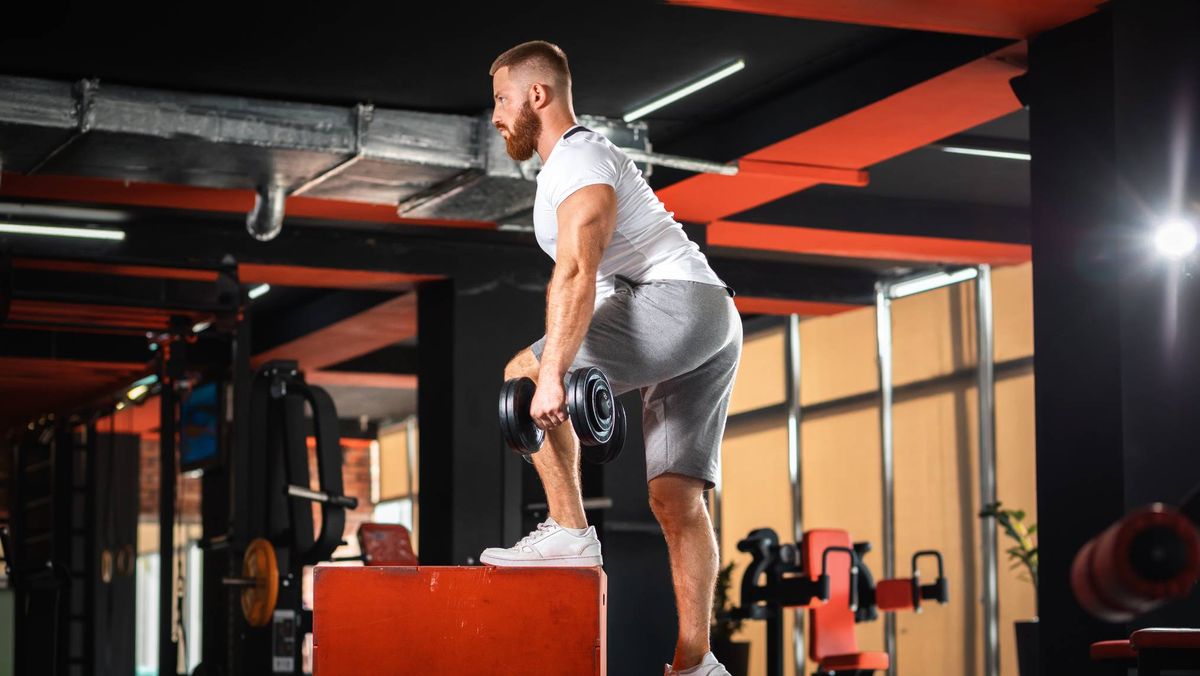
To perform the step-up, stand facing a sturdy bench, box, or step. Place one foot fully on the platform, then drive through that heel to lift your body up until both feet are on the step. Step back down with control and repeat for the desired reps before switching legs. Keep your chest up and avoid pushing off excessively with the trailing leg.
For step height, beginners should start with a low box, roughly ankle to mid-shin height. “You want control, not compensation,” he says. Fitter adults with solid mobility, balance and hip control can work up to knee height.
Advertisement
As for volume, Higgins prescribes 2–3 sets of 8–12 controlled reps per leg. “Tempo matters more than volume,” he says. Drive through the whole foot, stand tall at the top and lower slowly under control.
Higgins confirms that just your bodyweight is sufficient resistance to begin with and, for many people over 50, it’s exactly where they should stay — probably for longer than they’d expect. “Most people over 50 need to relearn movement patterns before adding load,” he says. “Once control, balance and posture improve, adding dumbbells or a weighted vest is a brilliant progression.” The dumbbells can wait. As for frequency? Two to three sessions a week is enough to see real benefit, Higgins says. “Consistency beats intensity every time.”
Precautions
Step-ups are accessible to most people, but Higgins flags a few situations worth considering. Anyone with severe knee osteoarthritis, significant balance issues or acute hip pain should approach the exercise carefully and ideally with professional guidance. “Often it’s not that the exercise is wrong,” he says, “it’s that the height is too ambitious or the body isn’t controlling the movement properly yet.” Low and slow is always the right answer.
What leg-day moves are your go-tos in the gym? Have you tried the step-up yet? Let us know below.
Follow TechRadar on Google News andadd us as a preferred source to get our expert news, reviews, and opinion in your feeds.