Science
Anger grows in Boyle Heights as warehouse fire leaves stench, flies and vermin in its wake
Nearly one month after a fire destroyed a massive cold-storage facility in Boyle Heights, the neighborhood has been overcome by the stomach-churning stench of rotting food.
As facility operator Lineage works to remove more than 85 million tons of weeks-old food from its 500,000-square-feet warehouse, the rancid odors have attracted throngs of rats and swarms of flies, as a foul-smelling brownish liquid pours from the seams of the building.
Now, with a heat wave descending over much of Southern California, residents worry the odor could get even worse and scores of residents have called air quality regulators to complain. At the same time, environmental groups are accusing Lineage representatives and emergency responders of downplaying the risks pose by chemicals released during the fire.
Boyle Heights, a neighborhood that has been subjected to decades of toxic pollution from rail yards and other industries, has again become the center of attention in another environmental disaster. Already, the official response to the Lineage fire has eroded trust in government agencies, residents say.
Remediation work continues at a Lineage facility in Boyle Heights, where residents and nearby businesses have complained of a rotting food odor for weeks.
(Allen J. Schaben / Los Angeles Times)
On Tuesday, Sen. Alex Padilla (D-Calif.) visited the gutted warehouse alongside L.A. Fire Chief Jaime Moore and representatives of the South Coast Air Quality Management District and a contingent of environmental organizations. Padilla, along with Sen. Adam Schiff (D-Calif.) and Rep. Jimmy Gomez (D-Los Angeles), wrote a letter to the U.S. Environmental Protection Agency, calling on the agency to return to the cleanup zone to monitor air and water quality.
“Given the materials present in the warehouse, we are concerned about the long-term health and environmental impacts from contaminated smoke and water runoff on communities surrounding the warehouse,” the letter read.
Joe Lyou, president of nonprofit Coalition for Clean Air, told Padilla that he has heard of people becoming sick in the weeks after the event.
“I think that pointed to a problem with the messaging while the event first happened,” Lyou said. “It wasn’t consistent [with] if you smell smoke, see ash to get out and protect yourself — make sure you’re not exposed to it. There were different messages coming from different people, and we need to fix that.”
“The whole community was completely overwhelmed … and concerned about the ammonia, concerned about burning plastic, concerned about all sorts of other [emissions] that are really hard, difficult, expensive to measure. But … we’ll just never know some of those things,” Lyou said.
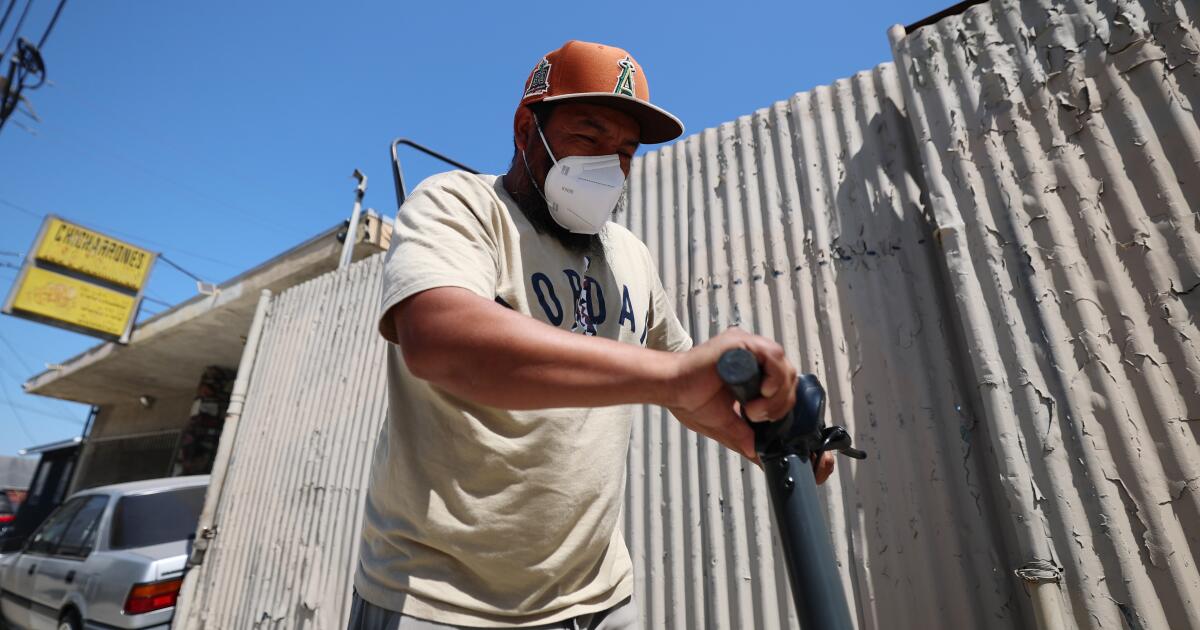
Street vendor Lupe Gonzalez pushes her cart away from a gutted warehouse in Boyle Heights.
(Allen J. Schaben / Los Angeles Times)
Chief Moore has faced criticism for his decision to advise residents to shelter indoors rather than to evacuate during the blaze. That stood in sharp contrast with Orange County fire officials, who evacuated tens of thousands of residents near an overheating chemical tank in Garden Grove in May.
On Tuesday, Moore told Padilla that the two incidents were very different. Moore said he had discussed the dilemma with TJ McGovern, the interim fire chief for the Orange County Fire Authority.
“He says everybody got mad at him because he evacuated everybody and nothing blew up,” Moore told Padilla. “But everybody’s mad at you because of the shelter-in-place [order] and it smells.”
Moore said that “there was nothing in the air that was hazardous” and that firefighters “never had a threat of an explosion.”
However, environmental experts said 14,000 pounds of flammable anhydrous ammonia were stored in tanks and used as refrigerant at the Lineage warehouse and posed a significant risk of explosion until it was removed days into the fire.
Environmental and community groups said L.A. fire officials also repeatedly emphasized the risks from ammonia in their radio communications. On the first day of the fire, a group of firefighters was hit by a plume of ammonia gas, and fire command quickly organized medical help.
“The majority of my division got exposed to ammonia gas. We’ll need to get them assessed.”
On Tuesday, Moore said no amount of ammonia was detected.
“When [firefighters] opened those doors, there was what looked like a big vapor cloud that came out,” Moore said. “That was the cold air mixing with the hot air that caused a vapor. It wasn’t ammonia.”
But residents remain skeptical.
Padilla’s visit follows a notice of violation that the South Coast Air Quality Management District issued to Lineage. The notice of violation was issued on July 12, after the agency received more than 40 public complaints of rotten, sour, garbage-type odors in the area. Inspectors confirmed the odors with community members and traced them back to cleanup operations at the facility, according to the air quality agency.
Boyle Heights residents are calling on Gov. Gavin Newsom to declare a mandatory evacuation of their community, saying the fire and the toxic aftermath are continuing to pose health risks. Without an evacuation order, they said, insurance companies won’t help residents who want to relocate with rent or mortgage relief.
“For nearly a month, a cold-storage warehouse fire has poisoned the air over the Eastside and Los Angeles County and City officials have refused to issue a mandatory evacuation,” read a statement from the community group Protect LA Now. “That refusal forces victims to pay their own way out, and leaves those who can’t afford to leave trapped in gases and toxins that no agency will name.”
Joe Lyou, president of the Coalition for Clean Air, explains how smell is affecting his health while talking to the media near a fire-gutted Lineage facility Tuesday.
(Allen J. Schaben / Los Angeles Times)
Tensions have been building in the community since the fire broke out on June 17 and burned for days.
At a contentious town meeting last week, Los Angeles Mayor Karen Bass struggled to open the meeting over the loud boos and yelling of community members, actions that were repeated as other elected officials took the microphone. The crowd grew even louder when Lineage Chief Operating Officer Jeff Rivera took to the stage and was met with shouts of “Liar!”
Air quality has been a constant concern for the community since the incident began. Beyond the health hazards of breathing in smoke from a building fire, there was a brief, temporary scare when an ammonia line that helped keep the building refrigerated was compromised, though Lineage has said the chemical was not detected in the air. Additionally, 85 million pounds of food thawed, burned and spoiled inside, creating a terrible smell that emanated from the property.
Nora Saenz, a resident of Bell, said she believed local leaders when they said there was no threat. During the fire, she took her niece and nephew to a community event in La Mirada, which was downwind of the fire.
Now Saenz fears what they might’ve breathed in.
“The day of the fire, we were told that the air was safe to breathe,” she recalled. “To this day, I don’t know what I exposed my niece and my nephew to.”
Times staff writers Salvador Hernandez, Clara Harter and Seamus Bozeman contributed to this report.

Science
Bonta accuses DuPont of corporate shell game to dodge PFAS cleanup in California
California Atty. Gen. Rob Bonta filed a complaint Thursday alleging that a cohort of the companies that make “forever chemicals” partook in a massive corporate shell game to defraud the state and others.
In an amendment to a 2022 lawsuit filed by Bonta against the makers of these chemicals, the state now alleges that several DuPont spin-off companies — New DuPont, Corteva, Chemours and Qnity Electronics — worked together to create a “fall guy” company designed to take the financial hit stemming from several multibillion-dollar pollution lawsuits while keeping the companies’ most valuable assets out of reach.
“The DuPont Defendants cannot game the system by illegally moving assets out of reach, dodging liabilities for the harm they have caused, and calling it restructuring,” Bonta said in a statement. “I look forward to ensuring that these companies are held accountable for PFAS pollution and that their assets cannot be hidden behind corporate walls while their responsibilities are left behind.”
The Second Amended Complaint, as the new amendment is called, was filed in U.S. District Court for the District of South Carolina on Thursday.
DuPont did not respond to multiple requests for comment.
In 2022, Bonta sued 20 chemical manufacturers, including 3M and DuPont, alleging the companies knew about the dangers of perfluoroalkyl and polyfluoroalkyl substances — or PFAS — when they made and/or sold products containing them. The suit also claims the companies failed to warn the public about the environmental and health risks of those chemicals and in many cases concealed the risks.
That lawsuit remains active and ongoing.
PFAS chemicals are found in a variety of consumer items, including food packaging and cookware, and are linked to cancer and other illnesses and health risks such as developmental defects, infertility and reduced bone density in children.
They are resistant to environmental degradation, according to the Centers for Disease Control and Prevention, the Environmental Protection Agency and hundreds of scientific studies. They have also been found in the bloodstreams of 98% of people tested, as well as in wildlife, fish, water — including rivers, lakes and nearshore waters — and soil.
Data from the State Water Resources Control Board show PFAS chemicals are in drinking, ground and surface waters in the state. They’ve been detected in at least 146 public water systems serving 16 million Californians, as well as in aquifers that provide millions of Californians with water through unregulated domestic wells.
According to a news release from Bonta’s office, the fraudulent DuPont scheme worked like this: By 2013, the original, “Old” DuPont company knew it faced billions of dollars in environmental cleanup costs and legal damages due to its PFAS products. To protect its assets and make itself appealing for a merger with industry giant Dow Chemical, the Old Dupont company initiated a multi-phase restructuring plan, which it called “Project Beta.”
Bonta referred to the original DuPont company as “Old Dupont” and a newer version as “New DuPont” in his filing.
It started with the creation of a company called Chemours, which the Old DuPont company spun off in 2015. The Old DuPont company transferred its PFAS business to this new company and extracted almost $7 billion in cash, stocks and notes from the new company. The new company was also forced to assume all of Old DuPont’s historical PFAS liabilities and sign an agreement to indemnify Old DuPont against them.
Bonta claims this was a sham transaction, leaving Chemours holding the liability bag with no way to pay the environmental debts it would incur should the courts come calling.
Old DuPont merged with Dow Chemical in 2015, and according to Bonta’s claim, the new company, DowDuPont, was again structured in a way that would protect the new company from any remaining PFAS liabilities.
In 2019, the company went through another reshuffling. A “New” Dow was created, which took the materials science assets, as well as a company called Corteva, which took the company’s agricultural businesses. A New DuPont company was also formed.
During this same year, Chemours sued the other DuPont companies, claiming it had been handed a financial time bomb because of the PFAS liability it had been left with. The company alleged the 2015 deal was a sham that set them up for bankruptcy.
In 2021, the companies sat down to resolve the lawsuit. Chemours agreed to drop the lawsuit and waive its right to sue. In exchange, Corteva and New DuPont agreed to split the costs of future PFAS liabilities with Chemours 50/50 — but only up to $4 billion.
Bonta alleges that $4 billion was a gross underestimate of the potential legal damages they were likely to face. The result of the agreement would have capped Corteva and New DuPont’s liability at $2 billion and saddled Chemours with any and everything else — a number he claims is likely to far exceed $2 billion.
Chemours also had insurance policies that would have helped pay for the PFAS lawsuits. However, Bonta alleges that Chemours sold 100% of those insurance payouts back to its sister companies in 2025 for a lump sum of cash that was worth less than half of what the insurance was actually valued at.
By transferring away its best assets (the insurance) while keeping the massive debt, Chemours was hollowed out so it can’t pay its potential creditors, including California.
To further protect their wealth, New DuPont is accused of continuing to chop up its remaining valuable businesses and separating them. For example, the court filing claims they took their profitable electronics business and turned it into a totally separate, independent company called Qnity.
Bonta claims these restructuring moves violate the Uniform Fraudulent Transfer Act and the Uniform Voidable Transactions Act. He is asking the court to stop the companies from selling, spending or moving any more assets or profits that belonged to the original, or Old DuPont company, in order to ensure that California gets its payout if the chemical companies lose the lawsuit.
“Ultimately, the question is whether courts will ‘pierce the corporate veil’ to allow California and other plaintiffs to hold new Dupont and other breakout companies liable,” Albert Lin, a law professor at UC Davis, said in an email.
“Courts are willing to pierce the corporate veil if spinoff companies are created to engage in fraud or wrongdoing or to evade legal obligations,” he said. “Allegations that Dupont undercapitalized or underinsured Chemours and other entities can support veil piercing.”
Science
California’s cyclosporiasis cases are ‘higher than expected,’ but officials aren’t sure why
California is reporting more cases of cyclosporiasis than it would on average for this point in the summer, including two recent cases where residents ate at out-of-state Taco Bell restaurants, according to state health officials and data.
Despite the uptick, officials say California is not included in the cyclosporiasis outbreak that’s hit 15 states, sickening tens of thousands of people with prolonged bouts of diarrhea.
However, officials with the California Department of Public Health told The Times the number of cases is “now higher than what we might expect for this point in the season.”
Latest cyclosporiasis case breakdown in California
California’s cyclosporiasis data now includes probable cases — meaning an ill person showed signs and symptoms of the parasite but the case lacks laboratory confirmation — as well as internationally acquired cases, significantly increasing the state’s case count from previous estimates in June.
Between Jan. 1 and July 15, there were 201 confirmed and probable cyclosporiasis cases in California, the state health department reported.
Of the total number of cases, 39 were domestically acquired, meaning these infected people became ill either in the state or after traveling within the United States.
The rest became ill after traveling internationally, it’s unclear where the sick individuals had traveled to.
“To date, CDPH is aware of 2 cases that traveled to an affected state, ate food at a Taco Bell location and are determined by CDC to be linked to the outbreak,” the agency stated. Because the parasitic disease was contracted from contaminated produce out of state, California is not counted as being a part of the current outbreak.
Of the 201 confirmed and probable cases in California, 11 people were hospitalized, officials said.
There have been no deaths in relation to the California cases of cyclosporiasis.
Why cases in California have gone up
Public health officials are working with local health departments to actively monitor cyclosporiasis cases statewide to determine if there are potential outbreaks here, and identify a possible cause for the increase in cases.
The agency said the high number of cyclosporiasis cases could be attributed to:
- Cyclosporiasis receiving recent, national attention due to the multi-state outbreak. “This has led to increased awareness of the illness in California and nationwide, which has likely led to increased testing for the illness,” the Department of Public Health stated. “We may be identifying more cases than we have in previous years.”
- Overall improvements to the department’s surveillance and data collection methods.
- An increase in cases in travelers to areas with cyclosporiasis outbreaks, whether international or domestic.
What’s happening in the multi-state outbreak
To date, 15 states have reported high numbers of cyclosporiasis cases; the epicenter continues to be in Michigan, whose state public health department has reported more than 12,400 sickened residents, 279 hospitalizations and two deaths.
The two patients who died may have had underlying health conditions that made them particularly vulnerable to the gastrointestinal illness and dehydration that can come with the disease, Michigan public health officials said.
According to the Centers for Disease Control and Prevention, cyclosporiasis is rarely fatal.
On Thursday, Michigan officials said the state’s data now suggests that, “new cyclosporiasis case reports are slowing, including a downward trend in diarrhea-related emergency department visits.”
On average, people exposed to cyclosporiasis — typically through contaminated food or water — start to feel sick seven days after exposure, but symptoms can take up to 14 days to appear.
Given the weeklong average incubation period, Michigan data suggests that:
- Most exposures occurred in late June to early July.
- The majority of the contaminated produce is likely no longer available for consumption.
The outbreak, which began in May, has affected tens of thousands of people who reported feeling ill after eating Taco Bell products with shredded lettuce.
Traceback and outbreak data have linked the shredded iceberg lettuce supplied to the Taco Bell locations to the Salinas-based company Taylor Farms and its Taylor Farms de Mexico facility in Central Mexico.
The company, also known as Taylor Fresh Foods, announced last month it was voluntarily recalling various products including chopped lettuce, shredded lettuce, blends of iceberg, romaine lettuce and salad mixes that were supplied to restaurants and retailers in 27 states.
Since May 1, the CDC has laboratory-confirmed 10,468 domestic cases of cyclosporiasis and is aware of more than 12,255 additional cases that have yet to be laboratory confirmed.
Officials say the true number of cases is likely higher because some people recover without medical care and are not tested for the parasite.
Science
Tiny toad, big discovery: New ice age amphibian found in La Brea Tar Pits collection
Researchers in Los Angeles have made a ribbiting new discovery at the La Brea Tar Pits and Museum — an extinct amphibian from the ice age.
The spadefoot toad, or Spea labreae, is one of only two ice age amphibians to have been found in the U.S. The other is an extinct species of tree frog in Florida, known as Hyla baderi, according to the museum.
“While the toad may be much smaller than the mammoths and saber-toothed cats that made the Tar Pits famous, this discovery has a big impact on our understanding of the climate at the end of the last ice age,” the news release read.
The discovery of the spadefoot toad was made two years ago but published recently in the Journal of Vertebrate Paleontology and marks one of several discoveries made at the Samuel Oschin Global Center for Ice Age Research at the La Brea Tar Pits, where the museum is undergoing renovation.
Unearthing the spadefoot toad wasn’t the result of a targeted search — it happened by accident, much like many of history’s greatest finds.
Dr. Alberto Cruz, the lead author, was reviewing the rarely studied collections of amphibians and reptiles as a postdoctoral fellow at the La Brea Tar Pits when he noticed an amphibian that looked different from the others.
At first glance, he thought he was looking at a specimen that had been sick or injured rather than a new species. Upon closer inspection, he realized that wasn’t the case.
This incomplete sacro-urostyle bone (base of the spine that connects to the hips) is the holotype specimen used to describe the new species, Spea labreae.
(La Brea Tar Pits)
To identify the spadefoot toad, Cruz said he examined the bones of amphibians found at the Tar Pits, a collection that hadn’t been analyzed in nearly 30 years. He then compared the collection with the 80 specimens at the Herpetology Collection at the Los Angeles County Natural History Museum and the Museum of Vertebrate Zoology at the University of Berkeley.
“I thought: ‘Oh my gosh, this is a new species,’” he said. “This material is originally from the 1950s, but when you study it again, you can find gold in these specimens. It’s very cool.”
Researchers say amphibians provide a window into the past because they don’t travel far during their lifetimes and are sensitive to climate change. When their fossils are discovered, it helps scientists piece together how local environments changed over time.
“If you change the environment, you change the vegetation, the climate is warmer or colder, it affects these animals directly,” Cruz said.
The miracle behind Cruz’s discovery is that amphibians such as frogs, toads and salamanders rarely make it into the fossil records because of their fragile skeletons.
Emily Lindsey, curator and excavation site director at the La Brea Tar Pits’ center, said the discovery of the ice age toad is an example of the ongoing discoveries being made at the museum.
“There’s definitely more to come,” she said.
Also detailed in the Journal of Vertebrate Paleontology is the first record of another amphibian: the Mexican burrowing toad —Rhinophrynus. The species, which still exists, once inhabited the Southwestern region including Los Angeles. Researchers note that its closest known population is now roughly 1,550 miles away in southern Mexico.
-
Augusta, GA3 minutes agoAugusta community honors Nathan Lewis Jr. with candlelight vigil
-
Washington, D.C9 minutes agoMan sent to hospital after being shot on R Street in Southeast DC
-
Cleveland, OH15 minutes agoGuardians News: Another Day, Another Stupid Bunt
-
Austin, TX21 minutes agoThese Austin hospitals declared best in Texas and more popular stories
-
Alabama27 minutes ago‘I Don’t Want to Talk About It’: The Haunting Workouts on Alabama’s Practice Field 3
-
Alaska33 minutes ago
In Alaska’s crowded race for governor, candidates struggle to stand out as primary nears
-
Arizona39 minutes agoArizona football training camp: Defense striving to be Desert Swarm 2.0
-
Arkansas45 minutes agoScientists placed cameras around an Arkansas solar farm where sheep graze and uncovered a hidden “feast” of frogs, snakes, and even badgers