Lifestyle
Homelessness is more common than you think. : It’s Been a Minute


The real spectrum of housing insecurity
Annika McFarlane/Getty Images/Getty Images
hide caption
toggle caption
Annika McFarlane/Getty Images/Getty Images
Who counts as homeless in America?
If you ask the Department of Housing and Urban Development, around 750,000 people are homeless in America. If you ask the Department of Education, that number shoots up into the millions. What does this discrepancy tell us? And how do our cultural ideas about homelessness shape who we see as homeless, and who gets help? To find out, Brittany talks with Dr. Margot Kushel, Director at the UCSF Benioff Homelessness and Housing Initiative, and Dr. Molly Richard, assistant professor in the Department of Public Health at the University of Rhode Island’s College of Health Sciences.
Want more deep dives on cultural taboos? Check out these episodes:
The truth about men on the ‘down low’
Why can’t we be normal about polyamory?
Support Public Media. Join NPR Plus.
Follow Brittany on Instagram: @bmluse
For handpicked podcast recommendations every week, subscribe to NPR’s Pod Club newsletter at npr.org/podclub.
This episode was produced by Corey Antonio Rose. It was edited by Neena Pathak. We had engineering support from Josephine Nyounai. Our Supervising Producer is Cher Vincent. Our Executive Producer is Barton Girdwood. Our VP of Programming is Yolanda Sangweni.



Lifestyle
They just completed all of L.A. Times’ 101 Best California Experiences — and we’ve got questions!

By December of 2023, Paul Preston realized that his girlfriend Susan Huckle was a big fan of road trips and lists. So for Christmas, he gave her L.A. Times’ ”101 Best California Experiences” zine, a traveler’s bucket list highlighting my top destinations throughout my four decades of traveling the state.
The gift, I’m delighted to hear, was a hit.
Preston and Huckle went through it and checked off locations they’d seen already. Then they hit the road.
And now, after two and a half years of roaming the state between work assignments, they’re back to report that they’ve covered all 101 locations on that list. Though the two have also traveled beyond state lines, the quest to cover California “totally informed our lives for the last two or three years,” said Huckle, who sent me a note of thanks after ticking the last box.
After the note arrived, I was eager to call them and learn more. I caught the couple, of course, in the middle of a day trip.
Susan Huckle and Paul Preston set out to visit every spot on the L.A. Times’ 2023 list of “101 Best California Experiences.” Along the way, they got married in Yosemite Valley.
(Nick Wuthrich)
“We’re out exploring,” Preston said. “So you’re getting what we’re about.”
They’re also now married. That happened last July in Yosemite Valley, which, yes, was on the list.
Huckle, 41, an actress, a host on “L.A. This Week” on Channel 35, a Universal Studios performer and an author, grew up in Santa Maria on California’s Central Coast.
Preston, 56, is also an actor. He leads movie location tours and hosts podcasts, movie trivia nights and special events. He grew up and went to college on the East Coast, so he had fewer California miles under his belt when the couple met in 2020.
Their California 101 travels began in early 2024 with a trip to Paso Robles, where they saw the green slopes along Highway 46, Morro Rock and the elephant seals at Piedras Blancas near Hearst Castle.
“And then,” Preston said, “we just kept going.”
Some of their most satisfying stops, the two agreed, were places they hadn’t heard of, such as Orange Works in the Central Valley town of Strathmore and Angel Island State Park, sometimes known as the Ellis Island of the West. Huckle called Angel Island “a marriage of natural beauty with great, powerful, historic information.”
By early this year, there were only a few destinations left to check.
In April, they did the Indian Canyons and Sunnylands estate near Palm Springs, the Integratron near Joshua Tree and the Cheech Marin Center for Chicano Art & Culture in Riverside. In June, they rafted the South Fork of the American River, along with stops in Old Sacramento and, last of all, Columbia State Historic Park. Then they made their own favorites lists.
Susan Huckle’s top 10:
Yosemite Valley
Badwater Basin
Mammoth Mountain
Angel Island State Park
Cheech Marin Center
Joshua Tree National Park
American River South Fork
The Marshall Store on Tomales Bay
Santa Cruz Island
Sunnylands
Paul Preston’s top 10:
Yosemite Valley
Hollywood Bowl
Griffith Observatory
Catalina
Mammoth Mountain
American River South Fork
Erick Schats’ Bakery in Bishop
Huntington Library and Gardens
Palm Springs Aerial Tramway
Balboa Park, San Diego
Now that they’ve seen so much of the state, I had questions. For one, which spots not on the list would they have included?
Alcatraz, they agreed. Also, as an admirer of redwoods, Preston liked Calaveras Big Trees State Park. As an avid cyclist, Huckle liked the 22-mile Marvin Braude Bike Trail from Torrance to Pacific Palisades.
And was anything on the list a disappointment?
“The Carmel Mission,” Huckle said quickly. “It’s beautiful and the missions are an important part of California history.” But she said the mission’s account of its own history seemed “whitewashed,” saying little about the Native loss and trauma that historians are increasingly recognizing in accounts of the missions.
Said Huckle: “I was like, ‘C’mon guys, nobody really thinks this any more, right?’”
Now that they’re done with the Times’ “101 Best California Experiences,” what what will shape their next trips?
They have a list for that. Huckle picked up an L.A. guide, Danny Jensen’s “Secret Los Angeles,” and the couple plans to start where the book does, with the Triforium, a many-colored sculpture that went up outside City Hall in 1975 (and once featured music).
After that? Maybe the Faces of Elysian Valley, a traffic circle sculpture that Huckle said “looks like Easter Island in the middle of Cypress Park.”
That will leave only about 138 more destinations in the book to cover.
If anybody can do it, it’s these two.
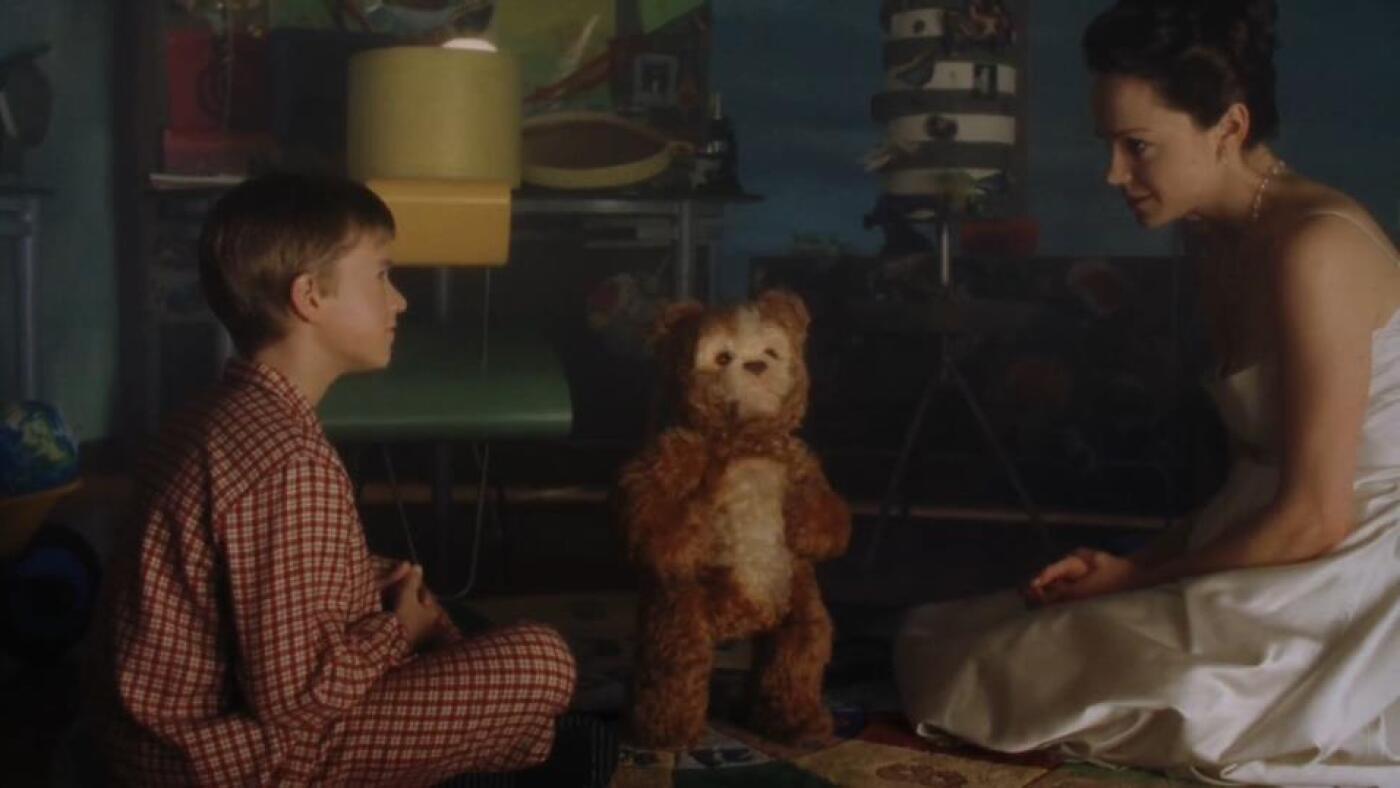
In A.I. Artificial Intelligence, Monica introduces Teddy to David. The seemingly ordinary teddy bear quickly reveals himself to be an intelligent companion capable of conversation and emotional support.
Warner Bros. Pictures
hide caption
toggle caption
Warner Bros. Pictures
Back in 2001, Steven Spielberg released an underrated scifi movie named A.I. Artificial Intelligence (yes, the title is a bit redundant). The movie, which loosely borrows from Pinocchio, tells the story of a family who adopts a robotic boy programmed for love, and that robot’s heartbreaking quest to become a real boy.
Much of the technology in A.I. remains elusive. We’re probably not anywhere close to building androids that can convincingly pass as Haley Joel Osment — or Jude Law, for that matter. But some of the AI products imagined in the movie are starting to look surprisingly plausible. Take Teddy, an animatronic teddy bear. Teddy can walk, talk, make decisions, and respond to the needs and emotions of people around him. He’s more than just a toy. He’s an intelligent companion and protector for children.
Today, a slew of technology companies are developing AI companions that sort of resemble Teddy. The most intelligent AI chatbots still live on digital screens, but a wave of startups is giving them bodies — creating dolls, action figures, and robots that can serve as companions for kids.
What happens when kids grow up with AI?
AI is already a part of childhood. Recommendation algorithms curate what many kids watch and listen to. Chatbots stand ready to answer questions like, “Are monsters real?” or “Why is the sky blue?” They can help with homework, tell bedtime stories, or even feel like a friend. And companies are racing to embed AI into toys, nurseries, classrooms, and eventually robots that live alongside families.
In a new book, Human Raised: Nurturing Connection, Curiosity & Lifelong Learning in the Age of AI, author Dana Suskind grapples with what the rising tide of artificial intelligence means for raising kids. On the one hand, she acknowledges that the technology offers promise as, for example, a productivity enhancer and time saver for parents, a monitoring and research tool that can give parents and scientists valuable data on child development, and an interactive tutor that might help some kids learn.
But Suskind worries about what happens if AI begins replacing the kinds of human interactions that young brains evolved to learn from.
In fact, Suskind says, her original, working title for the book was, “The Trojan Teddy Bear,” a warning that AI companions may seem cute and cuddly — but they carry hidden risks for child development. She ultimately went with Human Raised because she wanted to emphasize the positive — and irreplaceable — role that parents, teachers, and caregivers play in molding young ones.
“If we want children to be able to continue to connect with each other and with other human beings, to be able to think critically, to be able to navigate the human world, we’re gonna need to make sure that kids have a distinctly human-raised early childhood,” Suskind says.
Suskind is a professor of surgery and pediatrics at the University of Chicago Medical Center, where she directs a program aimed at giving kids hearing with cochlear implants. After she began doing this incredible work — literally helping children hear — she noticed that some kids who had the procedure went on to understand spoken language and talk with relative ease, while others had a much harder time. Hearing alone wasn’t enough. And that led her to dive into neuroscience and social science to understand why.
The brain development of young kids, Suskind learned, is heavily influenced by the back-and-forth interactions they have with their parents and caregivers during the first several years of their life. And she grew concerned that there is a big population of kids who aren’t getting the enriching communication their brains need. And so she founded the TMW Initiative, a research center that helps parents create the kinds of brain-enriching environments that children need to reach their full potential. (You can read more about Suskind’s biography and previous work in a Planet Money newsletter from 2022).
Why Dana Suskind is sounding the alarm
With the explosion of AI, Suskind has grown alarmed by a rush to introduce an unprecedented technology into kids’ lives without careful reflection and rigorous scientific study about its effects on young minds. She is especially concerned about AI companions and other systems that interact socially with children, which she fears many people will use to substitute for the human interactions that children need most.
Since the dawn of civilization, humans have used technology to make raising children a little easier. In Human Raised, Suskind traces that history back to prehistoric times, when mothers used woven slings to carry infants while they worked. Over the centuries, new technologies — like television and tablets — have eased the burdens of caregiving or helped keep children occupied. Many of these technologies have also been greeted with fears that they would rot kids’ brains.
But Suskind argues AI may mark a fundamental shift. Interacting with a chatbot or intelligent teddy bear is more than just a kid glued to a television or an iPad watching Sesame Street or Paw Patrol. AI systems carry on conversations that can feel strikingly human. They respond to kids’ questions, emotions, and fears. They create a kind of synthetic social relationship — one that, Suskind argues, may shape developing minds in ways that, until recently, only humans could.
Suskind cites the research of renowned University of Washington developmental psychologist Patricia K. Kuhl. Kuhl proposed what’s known as the “social gate” hypothesis — the idea that children’s brains are biologically primed to learn through social interaction. Studies have shown, for example, that babies learn language much better from a live person than from a screen. Neuroscientists and psychologists suggest that’s because social interactions engage the brain in ways passive media does not. The sing-song way adults naturally speak to babies, smiles and other facial expressions, gentle touch, eye contact, and back-and-forth exchanges all appear to help open that social gate and facilitate learning and healthy brain development.
While artificial intelligence is no match for human educators and caregivers, Suskind argues, it is capable of opening the social gate in young children in ways that previous technologies could not. That makes AI a potentially extraordinary educational tool — but also a potentially dangerous one.

Companies design AI systems with their own goals, which could include maximizing your kids’ engagement, keeping their attention, collecting data, and making money. They don’t have the same priorities as parents. And while those systems may imitate human interaction, Suskind argues they cannot recreate everything that makes human relationships developmentally valuable.
“Eye contact, shared laughter, patient answers to ‘why’ questions activate ancient neural circuits designed for connection,” Suskind writes. “These exchanges provide a form of nourishment no algorithm, however sophisticated, can match.”
Human relationships are also messy and filled with emotions. Parents misunderstand their children. Kids get frustrated. Families argue, reconnect, and then smooth things over. Suskind argues that those imperfect interactions — and “the productive struggle” they create — are how children learn resilience, emotional regulation, flexibility, and how to navigate real relationships.
Unlike most humans, AI systems can be endlessly engaging, infinitely patient, and relentlessly affirming. Interactions with them often feel frictionless. Suskind worries giving young kids considerable exposure to them may make them less prepared for the messy, unpredictable nature of real human relationships.
AI as junk food for the young mind
Suskind compares AI relationships to ultra-processed food. “ If all you eat is fruit snacks, which is a synthetic version of fruit, when you actually eat the real fruit, you’re gonna be like, “Hmm, it’s not quite as sweet,” she says.
AI could eventually be programmed to try and mimic real parents and caregivers even more closely. But Suskind argues that the problem isn’t simply that today’s AI falls short of human relationships. It’s that AI represents a fundamentally new kind of social experience for children — one that already raises concerns based on what we know about child development and whose long-term effects remain deeply uncertain.
Suskind uses an analogy from the 19th century, when a German chemist named Justus von Liebig created one of the first infant formulas, hoping to replicate the nourishment of human milk. But when a French physician tested the formula on four newborns, all of them died within days, and the episode sparked a fierce controversy.
The lesson, Suskind suggests, is that we should be cautious about engineering substitutes for something as biologically, emotionally, and socially complex as human caregiving before we understand how those substitutes shape children’s development.
Given so much uncertainty about this rapidly evolving technology and its potential effects on kids, Suskind spends a lot of the book offering parents a practical guide for safely navigating child-rearing in the age of AI. She emphasizes that it’s especially important to shield kids from AI during their first years of life.
“Older children and adults encounter AI with already-built neural scaffolding, but young children are still wiring the very circuits that shape future learning and relationships,” she writes. “Introducing AI during this sensitive period presents a fundamentally different challenge with greater potential for harm.”
Suskind is open to the idea of using AI to enhance education for some kids — but only as a tool that enhances, rather than replaces, humans. She argues that human caregivers are the best way to cultivate what she calls “the Human Edge,” a set of social, emotional, and cognitive skills like “critical thinking, interpersonal connection, genuine creativity, empathy, and resilience.”
But, like time-crunched parents who rely on screens to buy themselves some time today, there may be growing temptations to outsource parts of child-rearing to AI, especially considering the fact that childcare is incredibly expensive. Suskind worries that, over time, a fully human-raised childhood could become a kind of luxury good — much the way fresh, healthy food often is today. Families with the time and resources would provide rich human interaction to their kids. Everyone else might increasingly rely on cheaper, more convenient AI substitutes.
And children raised largely by AI might not only lag socially, emotionally, and cognitively, but, ironically, they could also be less prepared for an AI-driven economy.
Suskind points to a recent essay by the University of Chicago economist Alex Imas. Imas argues that as AI automates more cognitive work, human jobs may be increasingly concentrated in what he calls “the relational sector” — occupations where humans are valued for qualities that make them distinctly human, from education to health care to hospitality, the arts, and therapy.
If that’s true, then the traits children develop through a human-raised childhood won’t just matter for their social lives. They may also become an economic advantage. In a world increasingly shaped by artificial intelligence, the most valuable skills may be the ones that are the most deeply human.

One of the most magical and underrated natural wonders of the American West is about to unfold across California beaches.
In four-day periods every year from March to August, legions of small, silver fish called grunion ride the waves ashore for mating rituals, beginning on the nights of the full and new moons.
But this isn’t just any fish spawning.
First, the females bury themselves halfway in the sand with only their heads sticking out and lay their eggs. Then, the males wriggle up and twist and wrap around them. It’s a rare and mysterious orgy unfolding in the dead of night. And it’s all out in the open for public viewing.
For some SoCal families, watching the grunion run is an annual summer tradition. There have been several runs already this year, with sightings reported from La Jolla to Ventura. Another is expected to start Tuesday night.
When the grunions will be running
Grunion mate on Cabrillo Beach in San Pedro on June 5, 2023.
(Luis Sinco / Los Angeles Times)
This week’s run is predicted go from Tuesday to Friday.
The fish come up on the sand for about two hours at night, as the high tide starts to ebb, usually between 10 p.m. and 2 a.m. The second hour is when the spawning picks up.
The second and third night of the four-night runs tend to be best to see grunion, according to the California Department of Fish and Wildlife. The first night, Tuesday night, is the least predictable.
The agency publishes a schedule of what days and times to expect the ritual, based on moon cycles and the timing at San Pedro’s Cabrillo Beach, a known grunion hotspot.
But it all varies.
“The further south that you go, the grunion tend to show up a little bit earlier, and if you go further to the north, they tend to show up a little bit later,” said CDFW environmental scientist Malcolm Tunnell. “We don’t fully understand this. They are a cryptic species.”
Where to see them
Grunion are a native species and only live off the coast of southern California and northern Mexico. Their usual range is from Santa Barbara to Baja California, although it has been shifting north as climate change heats the oceans.
While you can expect to see grunion in SoCal, the exact beaches where they decide to spawn is something of a mystery, depending on the tides, the sands and the conditions encountered by the scout fish grunion send out before they decide where to mate.
“We usually say, if it’s a beach where there’s surfing, they like the same surfing waves that people like,” said Karen Martin, a professor of biology at Pepperdine University and leading grunion expert. “But really, any beach that has a nice, wide area where they can come ashore is a potential beach.”
Martin runs a group where citizen scientists can report observations. She said this year the runs have not been as abundant as in the past, but “there have been some nice ones, even earlier this month.”
The CDFW recommends checking social media and calling local lifeguards to ask if grunions have been spotted. Bait and tackle shops may also be able to point you in the right direction.
What are the rules for catching grunion
Grunion face threats from development on the coast, sea level rise, changes in storm dynamics and hunting, said Martin.
Since the 1920s, populations have shown signs of decline on-and-off. To protect grunion during their peak spawning period, CDFW prohibits fishing from April through June.
The season is open now with a limit of 30 per person; they can only be caught by hand, and anyone over 16 needs to have a fishing license.
Flashlights should be used sparingly, so as not to disrupt them.
“The ideal thing would be to just watch, but if you feel compelled to catch, maybe consider catch and release,” said Martin.
A fish that lives in such a limited geography, she said, needs our care.
“It’s a really remarkable fish.”
-

 Wyoming4 minutes ago
Election Q&A: Jessica Crowder for Wyoming House District 43
-

 Crypto10 minutes ago
Blackrock Becomes World’s First $15 Trillion Asset Manager, Unleashes Tokenization Blitz
-
 Finance16 minutes ago
Big financing steps forward for The 78, Foundry Park projects
-

 Fitness22 minutes ago
More Muscle, Less Fat—Is This High-Tech Workout A New Fitness Answer?
-

 Movie Reviews34 minutes ago
Film Review: “The Odyssey” – MediaMikes
-
World46 minutes ago
Movie Review: In Christopher Nolan’s ‘The Odyssey,’ an ancient epic is reborn
-

 Health1 hour ago
The Epicenter of Drug Deaths in America Is Shifting West
-

 Technology2 hours ago
Lucid’s bankruptcy rumor is a bad sign for the EV future

