Connect with us

Finance

These Stock Market Indicators Are Sounding the Alarm. Here’s What Investors Should Do Right Now. | The Motley Fool

Published

on

These Stock Market Indicators Are Sounding the Alarm. Here’s What Investors Should Do Right Now. | The Motley Fool

There’s no better time to start preparing your portfolio for volatility.

Stock prices may be surging, but many investors are having mixed feelings about the market.

While nearly 40% of investors still feel optimistic about the next six months, according to the most recent weekly survey from the American Association of Individual Investors, roughly 30% worry that stock prices will fall in the coming months.

Nobody can predict the future, especially the short term. But there are a couple of warning signs investors may want to pay attention to right now — along with some steps to prepare for a potential downturn.

Image source: Getty Images.

Advertisement

Will the stock market crash in 2026?

There’s no way to predict what the market will do this year, but it can sometimes be helpful to use historical context to get a sense of what’s happened in similar circumstances. And there are two stock market metrics that have not-so-good news for investors.

First, the S&P 500 Shiller CAPE (cyclically adjusted price-to-earnings) ratio. This metric is based on the average inflation-adjusted earnings over the last 10 years, and it’s commonly used to determine whether the S&P 500 is over- or undervalued. The higher the figure, the more overvalued the index may be.

Historically, the average Shiller CAPE ratio sits at around 17. As of February 2026, though, this metric is nearing 40. This is the second-highest value in history, next to the peak prior to the dot-com bubble in the early 2000s.
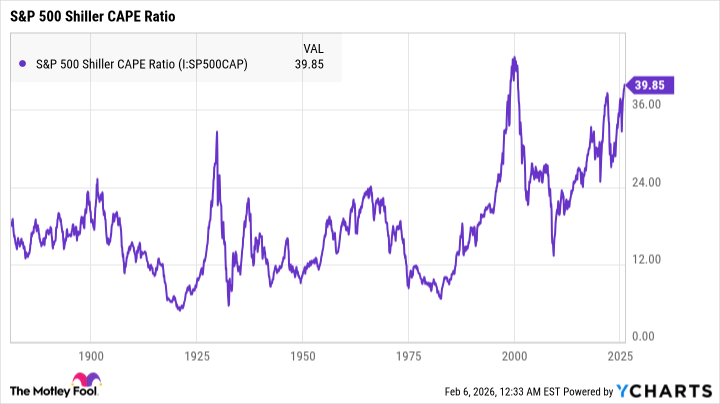
S&P 500 Shiller CAPE Ratio Chart

S&P 500 Shiller CAPE Ratio data by YCharts. CAPE Ratio = cyclically adjusted price-to-earnings ratio.

The second metric to watch is the Buffett indicator, which measures the ratio of U.S. gross domestic product (GDP) to the total market value of U.S. stocks. It was popularized by Warren Buffett, who explained in a 2001 interview with Fortune magazine how he used the metric to correctly predict the dot-com bubble burst.

Advertisement

“For me, the message of that chart is this: If the percentage relationship falls to the 70% or 80% area, buying stocks is likely to work very well for you,” he said. “If the ratio approaches 200% — as it did in 1999 and a part of 2000 — you are playing with fire.”

As of this writing, the Buffett indicator sits at 221%. The last time the metric neared 200% was in November 2021, just before stocks entered a bear market that would last nearly a year.

What should investors do right now?

No stock market metric is perfect, as past performance doesn’t predict future returns. Even if there are strong historical patterns suggesting a downturn could be looming, that doesn’t necessarily mean a crash, recession, or bear market is imminent.

Perhaps the best thing investors can do right now is ensure their portfolios are prepared for volatility, just in case. That involves double-checking that you’re only investing in stocks with strong fundamentals, such as:

  • Healthy finances: A company needs to be on a solid financial footing to survive an economic downturn. Shaky companies can still thrive when the market is surging, so stock price alone isn’t necessarily a sign of financial health. Now is a good time to comb through financial statements to review metrics such as profitability, debt, revenue growth, and other factors that can indicate whether a company is likely to survive tough economic times.
  • Competitive advantage: When the dot-com bubble burst in the early 2000s and much of the tech sector collapsed, the companies that survived were those that had a leg up over their peers. Organizations that didn’t offer anything unique or had nonviable business models crashed and burned, and the same could happen again if we face another significant downturn.
  • A strong leadership team: Sometimes, a company’s survival depends on the decisions by leadership during pivotal moments. Even a strong business may struggle if the executive team consistently makes poor choices, making this a key factor for long-term success.

The stronger your portfolio, the more likely it is that it will survive even the worst bear market or recession. By double-checking all your investments now, you’ll be prepared no matter what may lie ahead.

Advertisement
Continue Reading
Click to comment

Leave a Reply

Your email address will not be published. Required fields are marked *

This site uses Akismet to reduce spam. Learn how your comment data is processed.

Finance

Oregon Legislature passes controversial campaign finance changes

Published

on

Oregon Legislature passes controversial campaign finance changes
play

Legislators passed a bill March 5 to modify forthcoming changes to Oregon’s campaign finance system despite outcry from good government groups who say the bill creates new loopholes.

Those groups were key in creating House Bill 4024, which was created and passed in 2024 in place of warring ballot measures seeking to overhaul the system.

That legislation included new limits on contributions, including capping individual spending on statewide candidates each cycle at $3,300, and other changes. Parts of the bill were set to go into effect in 2027 and 2028.

Advertisement

Under the new proposal, House Bill 4018, the limits would still begin in 2027, but disclosure requirements and penalties would be pushed to 2031. It also gives the Secretary of State money to update the campaign finance system, but far less than the office previously thought it might need.

Representatives voted 39-19 to pass the bill. A few hours later, the Senate passed it 20-9.

Fourteen of the “no” votes in the House were Democrats, including Reps. Tom Andersen, D-Salem, and Lesly Muñoz, D-Woodburn.

Muñoz told the Statesman Journal she voted against the bill after hearing from people upset with the bill’s process.

Advertisement

Six Democratic senators cast a “no” vote on HB 4018.

Oregon campaign finance reform advocates say they were left out of negotiations

After working together in 2024, advocates said Speaker of the House Julie Fahey, D-Eugene, “ghosted” them.

Good government groups said the bill does far more than address necessary technical fixes to HB 4024.

HB 4018 is “a complete betrayal of the deal that was made two years ago,” Norman Turrill of Oregon’s League of Women Voters said.

Advertisement

Should the bill be signed by Gov. Tina Kotek, the groups said they will push their own changes through a 2028 ballot initiative.

Those advocates have outlined at least 11 different changes they believe the bill creates. The bill’s contents were first shared through a Feb. 9 amendment that was posted after 5 p.m., hours before it received a public hearing in an 8 a.m. work session on Feb. 10 and later, Feb. 12.

Secretary of State Tobias Read told legislators in January his office was requesting $25 million as a placeholder to fund a new campaign finance system for the state. Read was not secretary of state when House Bill 2024 was passed and his office is now working to implement the bill’s changes on a fast approaching deadline.

An additional amendment to the bill instead gives the Secretary of State’s Office $1.5 million for staff, some of whom would be tasked with updating the state’s current system.

House members agreed March 4 to send the bill back to committee, presumably to be amended. A 5 p.m. committee meeting was canceled about an hour after initially being announced.

Advertisement

A work session on HB 4018 was moved to the next morning. After an hour of delay, legislators convened and finished the meeting, moving the bill back to the floor without any changes, in less than three minutes.

A new campaign finance bill, Senate Bill 1502, was introduced and scheduled for a public hearing and work session March 4.

The bill is “very simple,” Senate Minority Leader Bruce Starr, R-Dundee, said. It tells the Secretary of State’s Office to draft a bill for the 2027 session with necessary campaign finance improvements from HB 4024 and HB 4018.

Three senators voted against the bill March 5. It now moves to the House. Legislators have a March 8 deadline to end the session.

“SB 1502 would not correct the severe damage to campaign finance reform that will occur, if HB 4018 B is enacted in this session,” Dan Meek of Honest Elections Oregon wrote in submitted testimony.

Advertisement

Lawmakers appear unsatisfied, but supportive, toward Oregon campaign finance bill

House Majority Leader Ben Bowman, D-Tigard, said HB 4018 made positive changes but acknowledged it was “a challenging vote for many of us.”

“We are implementing this whole new system that is new for all of us, and there are a lot of opinions and there are a lot of details to figure out,” House Minority Leader Lucetta Elmer, R-McMinnville, said. Elmer and Bowman carried the bill in the House. “With that being said, we’re moving forward in good faith, knowing that we’ll also be coming back next year to make sure that those details and all those kinks are worked out.”

Rep. Mark Gamba, D-Milwaukie, said he was concerned about the bill and the “non-inclusive process” that led to it.

Gamba pointed to a letter from the Washington, D.C.-based Campaign Legal Center that states in part that the bill “would substantially revise critical campaign finance reforms enacted two years ago in Oregon” and weaken the state’s campaign finance law.

The current bill is not the only possibility for moving forward, Sen. Jeff Golden, D-Ashland, told lawmakers. Proposed amendments that would have extended implementation timelines without the additional changes were ignored, he said.

Advertisement

“House Bill 4024 and this bill, 4018, have two things in common. One, they were thrown together in a few days behind closed doors, mostly by organizations who dominate campaign funding in the current system,” Golden said. “And two, very few legislators understand what is actually in these bills.”

He urged lawmakers to abandon the system created in House Bill 4024 as an “uncomfortably expensive learning experience” and develop a new plan based on successful programs in other states.

Sen. Sara Gelser Blouin, D-Corvallis, also spoke against the bill on the Senate floor.

“The concern that I had and that my constituents had was technical changes are one thing, but it should not be increasing the amount of money that candidates can take in or hold or carry over,” Gelser Blouin said. “Unfortunately, as it’s drafted, this bill does all of those things.”

HB 4024 is too complicated and “unimplementable” without the fixes in HB 4018, Starr said.

Advertisement

Sen. Lew Frederick, D-Portland, agreed, saying HB 4018 and SB 1502 give reassurance about a system he has concerns about.

“If there were no cameras and the lights were off, I think most people would agree this is not the bill we want,” Rep. Paul Evans, D-Monmouth, said.

Some lawmakers expressed similar feelings of discontentment with the bill in Ways and Means and one of its subcommittees on March 3, but said they felt it was important to make some progress on the issue. Discussions could happen again in 2027, they said.

Rep. Nancy Nathanson, D-Eugene, who ultimately voted in favor of the bill, said March 3 supporting it “is a very painful choice to make.”

Statesman Journal reporter Dianne Lugo contributed to this report.

Advertisement

Anastasia Mason covers state government for the Statesman Journal. Reach her at acmason@statesmanjournal.com or 971-208-5615.

Continue Reading

Finance

Paramount ally RedBird says using Middle East money to help buy Warner Bros. could be a good idea

Published

on

Paramount ally RedBird says using Middle East money to help buy Warner Bros. could be a good idea

  • Last year, Paramount said it would use $24 billion in funding from Saudi Arabia, Abu Dhabi, and Qatar to help buy WBD.
  • Now that Paramount has won that deal, it won’t say whether that’s still the plan.
  • A key Paramount backer suggests that Gulf money would be a good thing for this deal.

We still don’t know if Paramount intends to use billions of dollars from Gulf states like Saudi Arabia to help it buy Warner Bros. Discovery.

But if Paramount does end up doing that, it wouldn’t be a bad thing, says a key Paramount backer.

That update comes via Gerry Cardinale, who heads up RedBird Capital Partners, the private equity company that helped finance Larry and David Ellison’s acquisition of Paramount last year and is doing the same with their WBD deal now.

In a podcast with Puck’s Matt Belloni published Wednesday night, Cardinale wouldn’t comment directly on Paramount’s previously disclosed plans to use $24 billion from sovereign wealth funds controlled by Saudi Arabia, Abu Dhabi, and Qatar to help buy WBD.

Instead, he reiterated Paramount’s current messaging on the deal’s financing: The $47 billion in equity Paramount will use to buy WBD will be “backstopped” by the Ellison family and RedBird — meaning they are ultimately on the hook to pay up. The rest of the $81 billion deal will be financed with debt.

Advertisement

Cardinale also acknowledged what Paramount has disclosed in its current disclosure documents: It intends to sell portions of that $47 billion commitment to other investors: “We haven’t syndicated anything at this time,” he said. “We do expect to syndicate with strategic, domestic, and foreign investors. But at the end of the day, that alchemy shouldn’t matter because it’ll be done in the right way.”

And when asked about concerns about Middle Eastern countries owning part of a media conglomerate that includes assets like CNN, Cardinale suggested that could be a plus.

“I think we want to be a global company,” he said. “You look at what’s going on right now geopolitically. What’s going on right now geopolitically out of the Middle East wouldn’t be, the positives of that would not be happening without some of those sovereigns that you’re referring to.”

He continued:

“The world is changing. We can stick our head in the sand and pretend it’s not, or we can embrace globalization and the derivative benefits both geopolitically and otherwise that come from that. Content generation coming out of Hollywood is one of America’s greatest exports.
I firmly embrace the global nature and orientation that we bring to this from a capital standpoint, from a footprint standpoint, etc. At the end of the day, I do understand some of the concerns that you’ve raised, but that will work itself out between signing and closing because at the end of the day, worst-case scenario, Ellison and RedBird are 100% of this thing.”

All of which suggests to me that Paramount still intends to use money from Gulf-based sovereign wealth funds to buy WBD.

What I don’t understand is why the company won’t say that out loud. Does that mean it’s still negotiating with potential investors? Or that it’s reticent to disclose outside investors, for whatever reason, until it has to? A Paramount rep declined to comment.

Advertisement

Continue Reading

Finance

Crypto bill hits new impasse, raising doubts over its future

Published

on

Crypto bill hits new impasse, raising doubts over its future
Talks on landmark crypto legislation have hit a new impasse after banks said they could not back a compromise pushed by the White House, a development that cast doubt on whether the bill will pass this year and sparked criticism from President Donald Trump ​who accused lenders of trying to undermine it.
Continue Reading

Trending