
Connect with us

Finance

These Stock Market Indicators Are Sounding the Alarm. Here’s What Investors Should Do Right Now. | The Motley Fool

Published

on

These Stock Market Indicators Are Sounding the Alarm. Here’s What Investors Should Do Right Now. | The Motley Fool

There’s no better time to start preparing your portfolio for volatility.

Stock prices may be surging, but many investors are having mixed feelings about the market.

While nearly 40% of investors still feel optimistic about the next six months, according to the most recent weekly survey from the American Association of Individual Investors, roughly 30% worry that stock prices will fall in the coming months.

Nobody can predict the future, especially the short term. But there are a couple of warning signs investors may want to pay attention to right now — along with some steps to prepare for a potential downturn.

Image source: Getty Images.

Advertisement

Will the stock market crash in 2026?

There’s no way to predict what the market will do this year, but it can sometimes be helpful to use historical context to get a sense of what’s happened in similar circumstances. And there are two stock market metrics that have not-so-good news for investors.

First, the S&P 500 Shiller CAPE (cyclically adjusted price-to-earnings) ratio. This metric is based on the average inflation-adjusted earnings over the last 10 years, and it’s commonly used to determine whether the S&P 500 is over- or undervalued. The higher the figure, the more overvalued the index may be.

Historically, the average Shiller CAPE ratio sits at around 17. As of February 2026, though, this metric is nearing 40. This is the second-highest value in history, next to the peak prior to the dot-com bubble in the early 2000s.
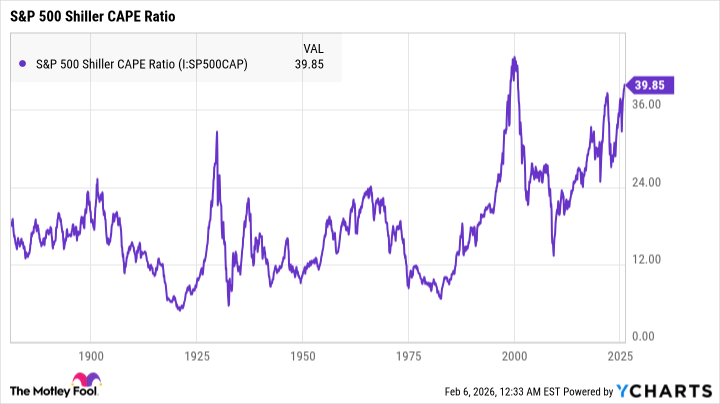
S&P 500 Shiller CAPE Ratio Chart

S&P 500 Shiller CAPE Ratio data by YCharts. CAPE Ratio = cyclically adjusted price-to-earnings ratio.

The second metric to watch is the Buffett indicator, which measures the ratio of U.S. gross domestic product (GDP) to the total market value of U.S. stocks. It was popularized by Warren Buffett, who explained in a 2001 interview with Fortune magazine how he used the metric to correctly predict the dot-com bubble burst.

Advertisement

“For me, the message of that chart is this: If the percentage relationship falls to the 70% or 80% area, buying stocks is likely to work very well for you,” he said. “If the ratio approaches 200% — as it did in 1999 and a part of 2000 — you are playing with fire.”

As of this writing, the Buffett indicator sits at 221%. The last time the metric neared 200% was in November 2021, just before stocks entered a bear market that would last nearly a year.

What should investors do right now?

No stock market metric is perfect, as past performance doesn’t predict future returns. Even if there are strong historical patterns suggesting a downturn could be looming, that doesn’t necessarily mean a crash, recession, or bear market is imminent.

Perhaps the best thing investors can do right now is ensure their portfolios are prepared for volatility, just in case. That involves double-checking that you’re only investing in stocks with strong fundamentals, such as:

  • Healthy finances: A company needs to be on a solid financial footing to survive an economic downturn. Shaky companies can still thrive when the market is surging, so stock price alone isn’t necessarily a sign of financial health. Now is a good time to comb through financial statements to review metrics such as profitability, debt, revenue growth, and other factors that can indicate whether a company is likely to survive tough economic times.
  • Competitive advantage: When the dot-com bubble burst in the early 2000s and much of the tech sector collapsed, the companies that survived were those that had a leg up over their peers. Organizations that didn’t offer anything unique or had nonviable business models crashed and burned, and the same could happen again if we face another significant downturn.
  • A strong leadership team: Sometimes, a company’s survival depends on the decisions by leadership during pivotal moments. Even a strong business may struggle if the executive team consistently makes poor choices, making this a key factor for long-term success.

The stronger your portfolio, the more likely it is that it will survive even the worst bear market or recession. By double-checking all your investments now, you’ll be prepared no matter what may lie ahead.

Advertisement
Continue Reading
Click to comment

Leave a Reply

Your email address will not be published. Required fields are marked *

This site uses Akismet to reduce spam. Learn how your comment data is processed.

Finance

4 instances when student loan refinancing doesn’t make sense

Published

on

4 instances when student loan refinancing doesn’t make sense

Student loan refinancing is often billed as a way to expedite and simplify student loan repayment. And it certainly can be: By replacing your existing loans with a new one, you can potentially score a lower interest rate, and you will have just one payment due date to keep track of. But refinancing is not the right strategy for everyone.

In general, it’s a move that tends to make sense if you have private student loans and if your credit score and income are “high enough to qualify you for a lender’s lowest interest rates,” said NerdWallet. However, in the following four instances, you may want to reconsider or at least think twice.

1. You have federal loans and may want those benefits

Continue Reading

Finance

How to protect your finances if you lose your job

Published

on

How to protect your finances if you lose your job


In historical terms, the current unemployment rate of around 5% isn’t much to write home about. You only need go back to 2011 for a rate of over 8%, to 1993 for a rate of over 10% and 1984 for one of almost 12%. However, there are plenty of reasons why even at this level, it’s incredibly unsettling – and why it’s important to consider what it could mean for you.

The main concern for many people is that things are moving in the wrong direction. Unemployment is rising, and the pace has picked up very slightly, redundancies are up over the year and job vacancies are falling. It means workplaces are more likely to be laying people off, so those who remain in work feel less secure.

When things are steadily getting worse, it’s difficult to know where this will end. The Office for Budget Responsibility is optimistic, expecting it to remain around 5% for a while and then drop back closer to 4.1% by 2027. The Bank of England thinks it’ll hang around for longer at the current level; however the monetary policy committee admitted there’s a risk it could be higher than expected.

There are a couple of potential spanners in the works. There’s the massive unknown quantity of AI, which has started to impact hiring decisions, and is only likely to play an increasingly important role as the technology improves.

Advertisement

A Kings College study found that those businesses with the most AI crossover have cut staffing by 4.5% and junior positions by 5.8%. They were also 16.3 percentage points less likely to advertise new jobs. It’s one reason why the ONS data shows the unemployment rate of those aged 18-24 in November was almost 13% and the employment rate less than 61%.

Interestingly, the loss of junior roles has an impact on the jobs market that may look at first glance to be a sign of strength. As junior roles go, it automatically means that average pay among those who remain in their jobs increases. It means we may see average pay rises and assume it’s a positive, when part of the movement will be directly as a result of job losses.

Fired woman · Jackyenjoyphotography via Getty Images

There’s also the risk that businesses are reluctant to invest in new staff. There’s a horrible level of uncertainty in the wider world, coupled with incredibly sluggish economic growth and the worry about business taxes every time there’s a budget.

Meanwhile, it has been 10 years since the consumer confidence index was in positive territory, so as people hold back on purchases, companies aren’t keen to expand.

This lack of confidence has led to cost-cutting, including the so-called ‘delayering’ of the workforce: removing levels of middle managers.

Advertisement

It means people later in their careers, many of whom are on higher incomes, suddenly find themselves out of work. Not only that, but because every business in their sector may be doing the same thing, they struggle to find work again.

Unemployment can have a devastating impact on your financial resilience. The HL Savings and Resilience Barometer shows that, on average, unemployed households don’t have anything left at the end of the month. Overall, households have enough cash to cover more than three months of their essential spending. Among unemployed households, this falls to less than a week.

If you find yourself in this boat, it’s worth checking whether you qualify for any state support. You may be able to get jobseeker’s allowance – assuming you have worked and paid national insurance contributions recently.

You may also get universal credit, although this won’t apply if you have savings and investments. In any case, you will need to budget for the fact this is likely to offer a much lower level of income than you’re used to.

Advertisement

It means that anything you can build while you’re working could be a lifeline later. It’s worth revisiting your emergency savings as soon as possible.

Ideally you should have enough cash to cover 3-6 months’ worth of essential spending – in a competitive easy access savings account. It’s worth checking online banks and savings platforms to make sure you’re making the most of this money.

Having a cushion of cash will help keep you on track if you are out of work for a period. At the moment, the HL Barometer shows just over half of people are in this position (52%), so it’s worth making sure you’re one of them.

Download the Yahoo Finance app, available for Apple and Android.

Advertisement
Continue Reading

Finance

Dear Nonprofit Leaders: Values Alignment Matters in Finance Too

Published

on

Dear Nonprofit Leaders: Values Alignment Matters in Finance Too

Tis the season: Quite soon, a slew of large public companies will be holding their annual shareholder meetings, which can feature voting on resolutions of all sorts of subjects and motivations—many of them advocating social and ideological causes that can be, intentionally, at odds with Judeo-Christian values and free-market principles.

Because of the controversial subject matter of these proposals (often given a spotlight courtesy of well-funded public relations efforts), they can and often do receive significant attention from the finance press.

And yet, despite the near-certain media attention and despite the controversy that can ensnare institutions—particularly religious denominations and non-profit advocacy groups—that own stocks and invested funds, there is widespread disinterest by faith-based groups in how they will deploy their moral standing, and investment muscle, in the realm of finance.

Why? This disinterest, for whatever its reason—lack of bandwidth, ignorance of the shareholder resolution process, ignorance of mission—can boomerang on faith-based groups. And it has.

Again, why? Because many organizations allocate their votes to third-party proxies, which can (and have) been cast in support of resolutions that are in direct opposition to the causes and mandates and beliefs of these nonprofits, especially of churches and religious orders.

Advertisement

It does not have to be that way. And so as the shareholder-resolution season approaches, it is time to level that prudent annual warning to nonprofit leaders that want their funds to be true to their principles.

It should be of central importance to nonprofit leaders to have clear values alignment with financial consultants and advisers. This is especially true for Christians responsible for church assets, endowments and foundations; retirement plans; operating capital; and other pools of money for churches, ministries, dioceses, religious orders, denominations, and religious schools.

There are consequences—spiritual and temporal—in neglecting values alignment.

Lack of Manager/Product Availability

It should come as no surprise that most advisory firms that do not specialize in managing Christian assets are not motivated to provide high-quality, Christian-aligned managers on their platform.

Recently, a leading private equity manager specializing in investments that promote human flourishing shared that most advisory firms, including major Wall Street banks, are not interested in allocating the time within their research teams to even begin the due diligence process required to make the strategy available. Consequently, their advisers often argue that products and managers that align with Christian values are just too few and far between, which is simply not true.

Advertisement

The fact: Quality Christian managers are far more numerous today than ever.

Proxy Voting

A values-aligned adviser/consultant should ensure the proxies are voted in alignment with Christian values.

Unfortunately, most advisers managing Christian portfolios have either ignored proxy voting or assumed they vote in line with the portfolio screening. However, proxy voting will not be Christian-aligned unless A. there is deliberate action to install a Christian proxy adviser or B. they are required to use formal Christian proxy guidelines, such as those created by The Catholic University of America.

The consequences of ignoring these stipulations are enormous and widespread: Corporate boards and, therefore, many an American C-Suite, have become intolerant, essentially casting Christians into the shadows, saying, “Jesus belongs only within the walls of your home and Church.”

In addition, there were five corporate resolutions adopted in 2025 supporting abortion benefits. Meanwhile the elimination by some firms of corporate matching donations to religious organizations have proven costly.

Advertisement

Determining Values Alignment

It does not have to be this way, for religious organizations or even for secular but un-woke nonprofits. Leaders of these organizations should take note of a wonderful resource, 1792 Exchange, which distributes reports that expose coercion and corporate bias. 1792 Exchange also evaluates thousands of companies “on their divisive problems, actions, and cancellation of business relationships based on viewpoints or beliefs.”

In addition to vetting legitimate concerns over investing assets and taking shareholder positions, we recommend nonprofit leaders engage in due diligence by asking financial advisers and third-party firms a series of questions about their own internal practices to determine if there is Christian values alignment. These questions should include:

  • Do you pay for abortion, abortion travel, or transgender services in your benefit plan?
  • Where does your firm or your foundation donate? Provide a list.
  • How does your organization treat Christians in the workplace? Are they allowed to display religious items such as Bibles, crosses, or crucifixes?
  • Do you have a statement of faith?
  • If you have Employee Research Groups, and if so, do you have a Christian ERG?
  • Describe your corporate culture. How do you ensure human flourishing in your workplace?

It is long past time for Christian fiduciaries to become more deliberate and intentional about their obligations. Christians responsible for Kingdom assets need to examine their adviser/consultant’s client list for comparable clients, speak with the adviser/consultant’s references, evaluate the adviser/consultant’s investment process and the qualifications of its professionals, and ensure the adviser/consultant is values-aligned and experienced in proxy voting.

Tis the season—always.

We publish a variety of perspectives. Nothing written here is to be construed as representing the views of The Daily Signal.

Advertisement

Continue Reading

Trending
