Entertainment
Tiffany Haddish just can't quit. Even when she knows she should

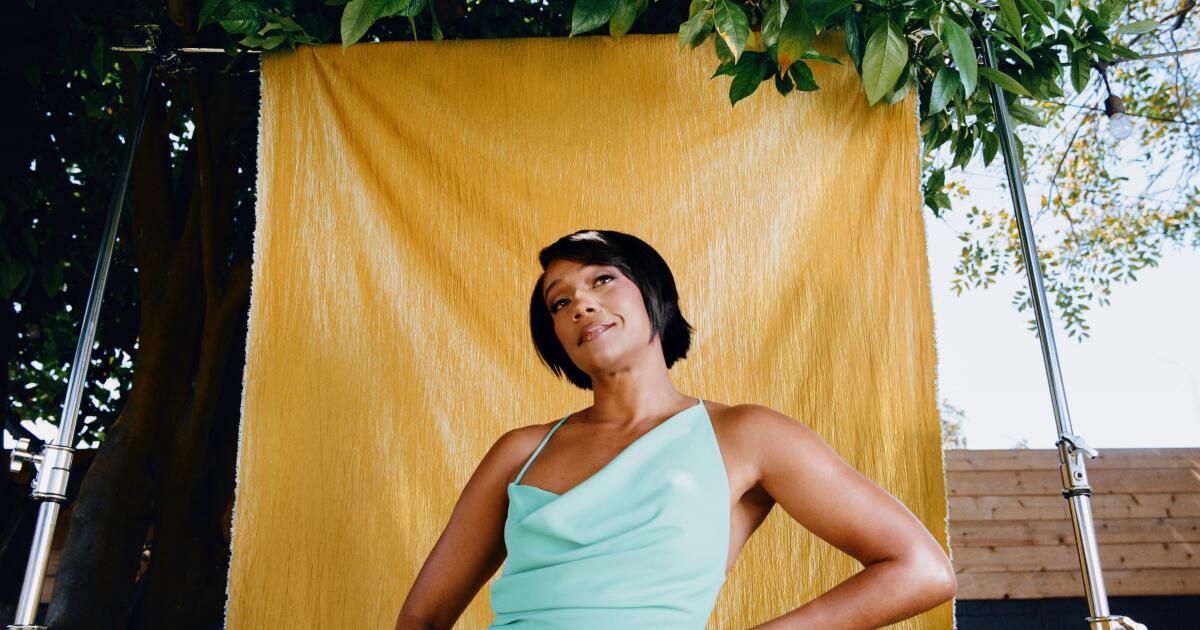
“Come with me,” Tiffany Haddish says, walking out her front door.
I’ve barely had the chance to say hello before she’s heading down the sidewalk. I trail behind, fumbling around in my bag for a recording device as she explains that there’s an open house she wants to check out before we sit in her Crenshaw home and discuss her new book of autobiographical essays — or anything else.
Haddish doesn’t sleep on local real estate opportunities. She’s deeply invested in South L.A., spiritually and financially. She already owns about a dozen properties in the area, many of which she rents out to organizations that house foster youth.

Who are the people shaping our culture? In her column, Amy Kaufman examines the lives of icons, underdogs and rising stars to find out — “For Real.”
She has two houses on this boulevard alone — one she sleeps in, one she works in — but neither needed the kind of work that is obviously required to make livable the for-sale property she walks into on this Sunday afternoon.
There are dark stains permeating the carpets, missing ceiling tiles, an enormous window above the toilet that opens to the hallway for no discernible reason.
“How many developers came through here today?” Haddish asks the real estate agent, who confirms that about 90% of the visitors have been investors. Most have estimated the house needs around $300,000 worth of renovations. But the sellers want a regular buyer.
“I’m a regular buyer!” she says. “I got my first house here for around $600,000, but that was in 2015. And now this is what, $1 million?”
The agent shakes his head.
“More?” she asks, incredulous. The 1,548-square-foot abode is in fact listed for $1.1 million, he says. She is aghast but continues surveying the space. There are kumquats and lemons growing in the backyard, which she likes. She’s big into eating healthy, and is in the midst of attempting to open a grocery store nearby that will give the community access to nutritious food choices.
“I’d need to do another movie,” she says, mulling it over.
By the end of the week, she has a tentative plan: Get a few of her friends to help her buy the place, then put the property in a trust, fix it up and rent it out for a reasonable price.
“I mean, if you want to get in on this, you are more than welcome to join,” she tells me over the phone from San Antonio, where she is, appropriately, giving a paid keynote for the Texas Apartment Assn.
And the thing is, she’s totally serious. Because that is who Tiffany Haddish is. Someone who divulges the details of her real estate portfolio in lieu of exchanging pleasantries. One of maybe three celebrities on Earth who will answer any question, no matter how intimate. A comedian who has bared her open wounds — homelessness, domestic violence, rape, miscarriage — and used them as material.
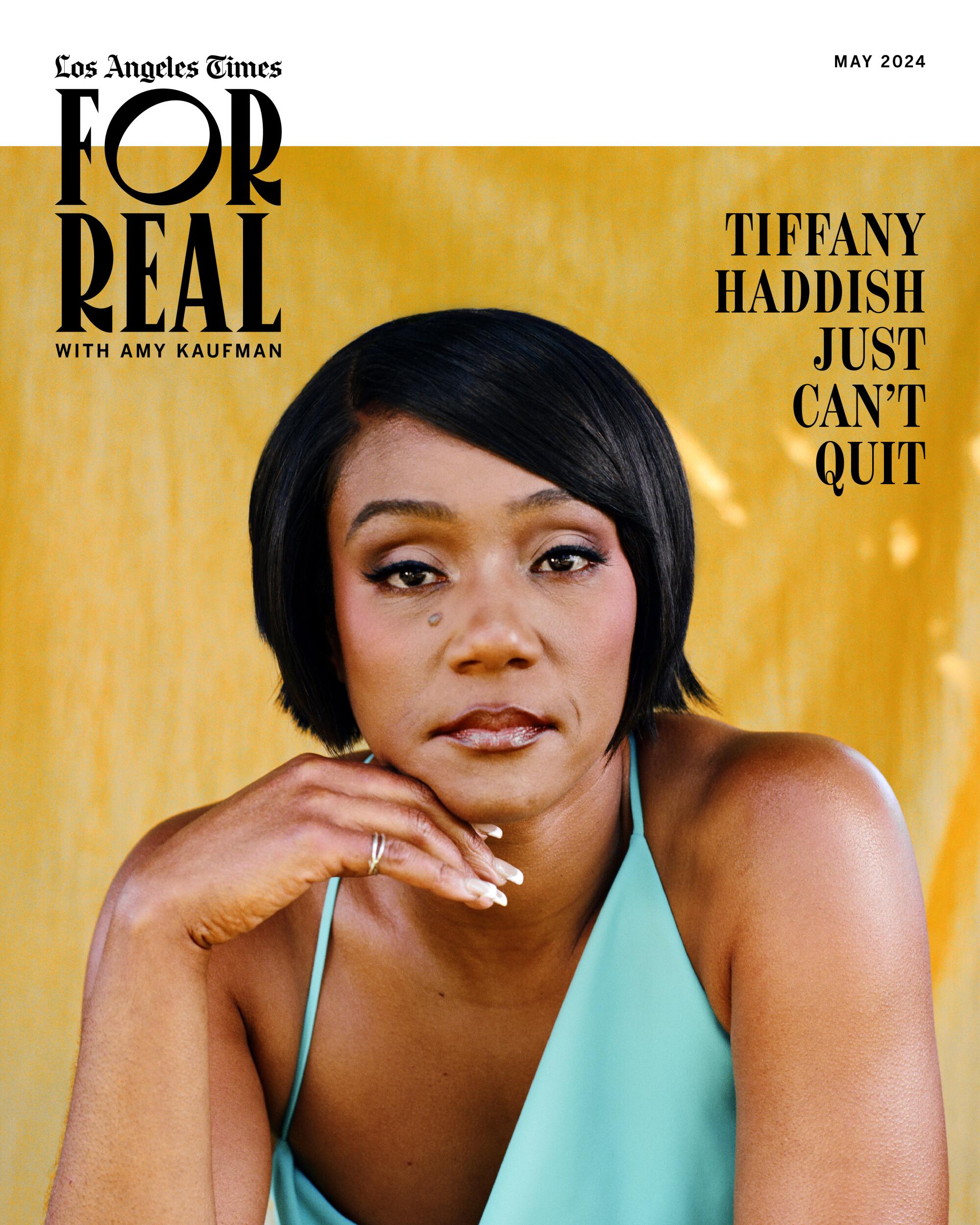
Her latest book, “I Curse You With Joy,” out May 7, is even more raw than her first: She goes from describing how she located her G spot to revealing that when she was 7, her mother got “Satan’s fire” in her eyes and hissed: “You wouldn’t even be here if [your dad] didn’t rape me.”
So when she says she’s been working with a therapist to learn how to set better boundaries — be more mindful of her own limitations — I believe her. It’s a decision she came to after her inability to draw lines started to threaten not just her career but her sanity. Since her star-making turn in “Girls Trip” seven years ago, headlines about Haddish have shifted from anointing her as Hollywood’s next big thing to predicting her downfall after a series of scandals.
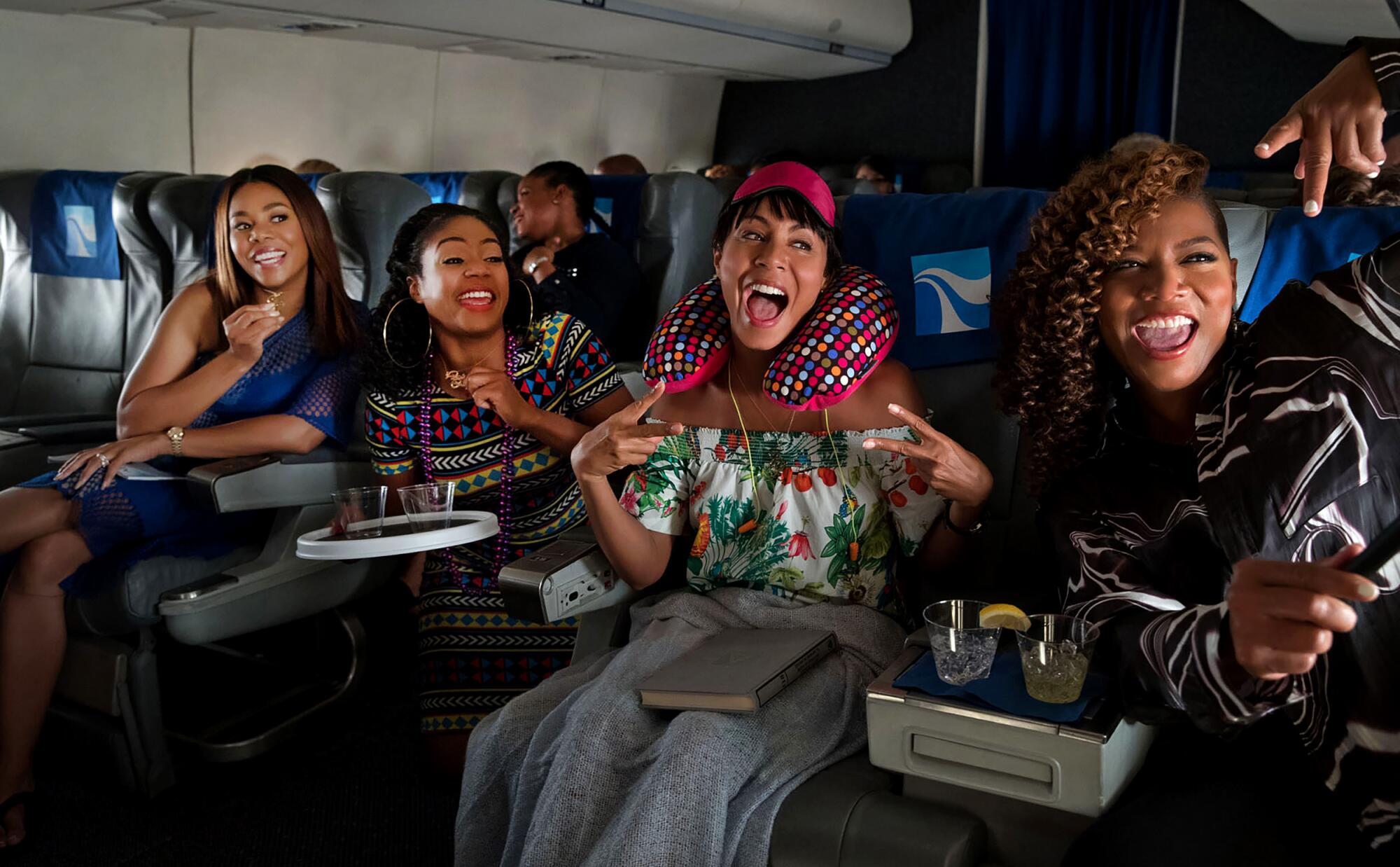
Comedy “Girls Trip,” starring Regina Hall, left, Tiffany Haddish, Jada Pinkett Smith and Queen Latifah, was a breakout hit for Haddish.
(Michele K. Short / Universal Pictures)
It started with a 2019 alcohol-fueled disaster, when Haddish was so inebriated at a New Year’s Eve show in Miami that she forgot her jokes and fans walked out in protest. Then, in 2022, she was arrested in Georgia on suspicion of driving under the influence after police received a call about a driver who was allegedly asleep at the wheel. She was similarly detained this past November, when Beverly Hills cops found her asleep in her badly parked car and charged her with her second DUI.
She’s never had a problem with alcohol, she insists. The issue was pushing herself past her limits.
Just before her 2023 arrest, she’d spent the day cooking and then serving food to 2,000 people at the Laugh Factory. Afterward, she went to her family’s house to share some leftovers when she got a call that more food was needed elsewhere. She could have — should have, she says she knows now — sent it in an Uber.
Instead, she drove herself, even though she’d been up since 5 a.m. and was exhausted. (Her blood alcohol level that night was 0.03% and the DUI charge was later dismissed; she ultimately pleaded no contest to a misdemeanor reckless driving violation.)
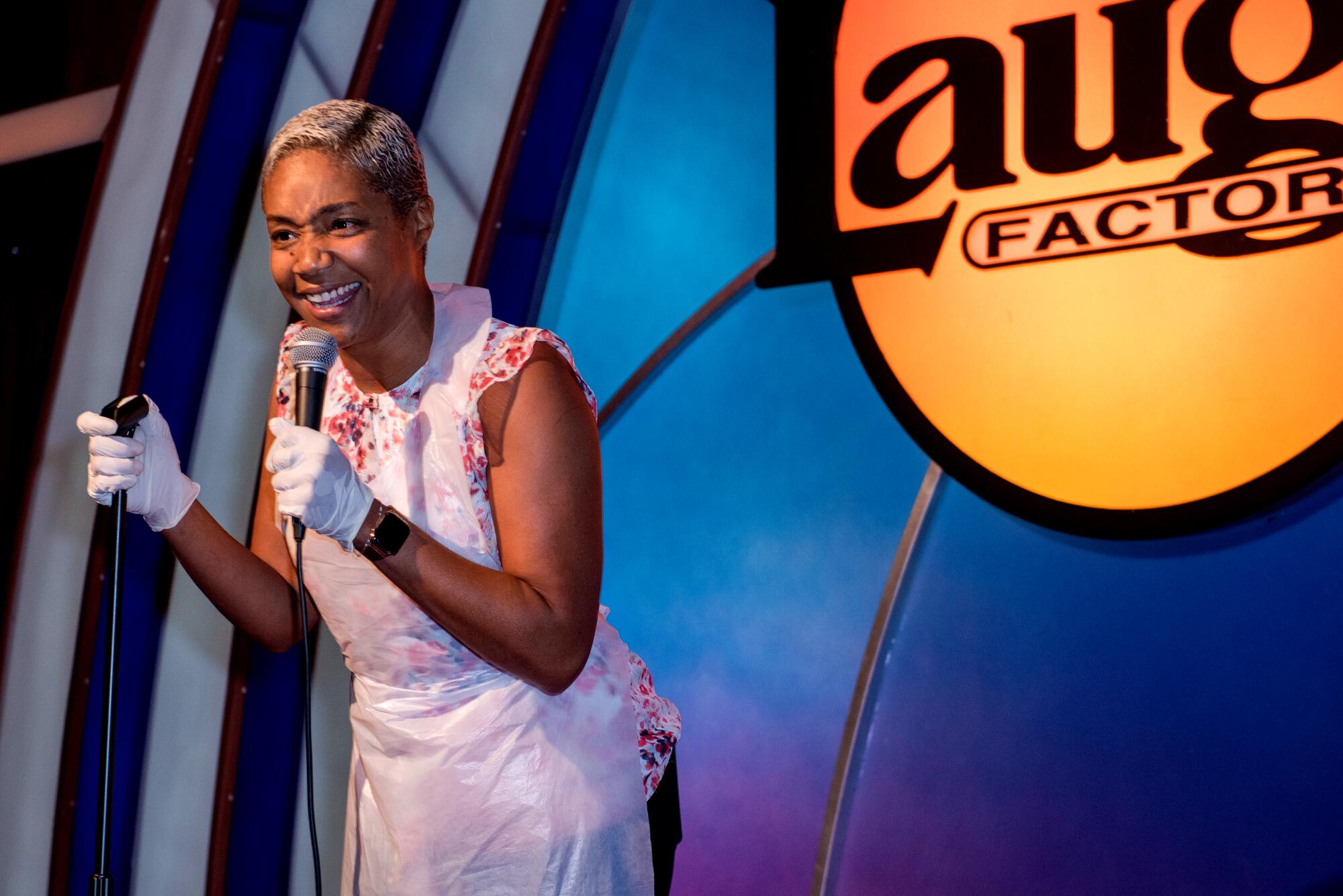
Tiffany Haddish performs at Laugh Factory Hollywood’s 43rd Thanksgiving Feast and Show on Nov. 23, 2023. She was arrested early the next morning for DUI but said she was just exhausted.
(Olivia Wong / Getty Images)
For those who know Haddish, this tracks. Shermona Clark, a friend since ninth grade, says, “It was like nothing for us” when their friends heard Haddish fell asleep in her car.
“It was like, that’s what she do. She’ll pull over and go to sleep in the car,” Clark says. “We’d ask her why she was driving, tell her it wasn’t safe. She’s always done that. Go, go, go.
“She always wants to prove that she’s not a quitter,” Clark adds. “That she’s gonna make it, that she’s smart and talented. We all know that already. But there’s something in her where she just can’t see it like we do.”
But at 44, Haddish says she’s legitimately trying to slow down. Not take every job she’s offered, stop doing so many favors, sleep more.
“If I say I can’t do something, I can’t do it. I feel way more comfortable saying that now,” she says. “I can’t bend backwards no more. I’m not built for it.”
Not everyone is convinced.
“She ain’t slowing down,” says Clark, laughing. “What does ‘chill’ mean? ‘OK, I’m not gonna take on 11 projects, just 10?’”
If you’ve been training yourself to keep pushing and tough things out for four decades, it becomes endemic to your personality. When Haddish got hugely, suddenly famous in 2017, so too did the story of her challenging upbringing.
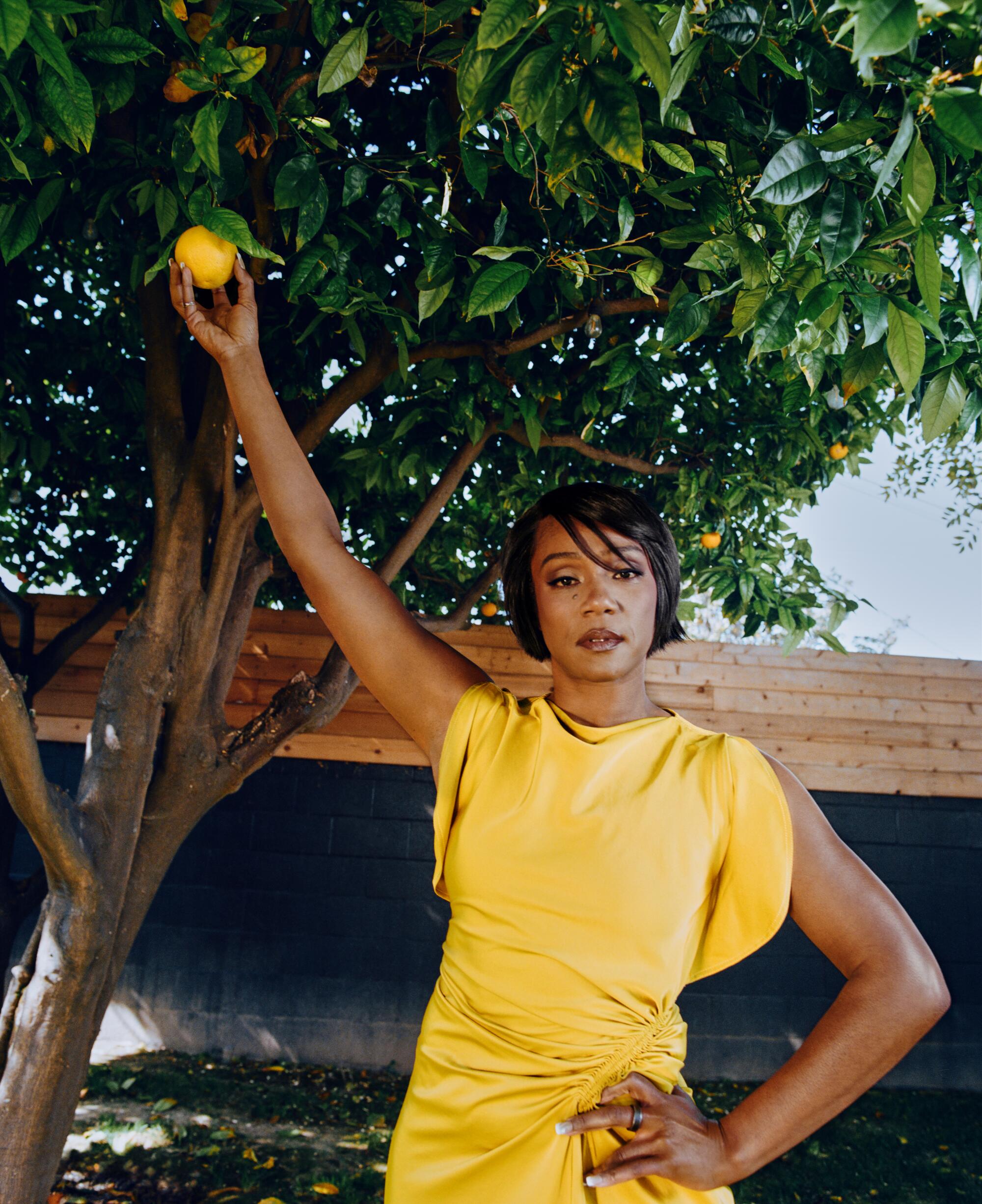
Growing up in South L.A., her home life was unstable. Haddish’s father had left the family when she was 3; five years later, her mother was in a car accident and suffered such serious brain damage that she started physically and verbally abusing her children. Haddish and her four younger half-siblings ended up in foster care.
When Haddish was 15 and living in a group home, she landed a spot in a free comedy camp at the Laugh Factory, where she was mentored by Richard Pryor. Still, she struggled for years to make ends meet. She was homeless and living out of her 1995 Geo Metro before she started getting roles in TV series like “Real Husbands of Hollywood” and “The Carmichael Show” beginning in 2013.
When “Girls Trip” came out, she was 37, and the media turned her into a sort of rags-to-riches, never-give-up poster child. She hosted “Saturday Night Live” and won an Emmy for it, landed the cover of Time’s 100 issue, took home a Grammy for narrating her New York Times bestselling memoir. She headlined a movie with Kevin Hart, voiced characters in all the big animated kids films, hosted MTV award shows.
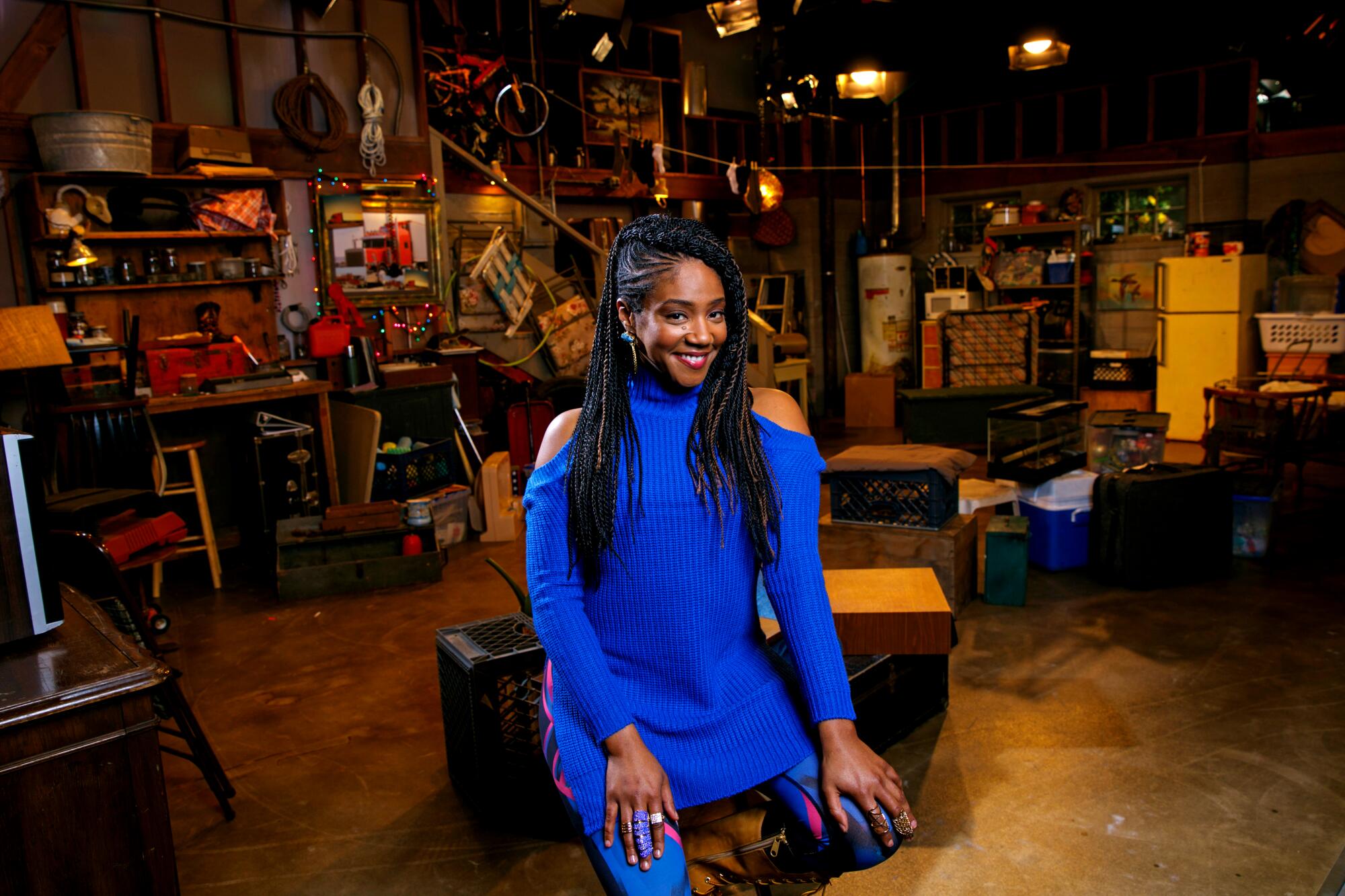
Haddish on the set of NBC sitcom “The Carmichael Show,” on the Fox Studios lot, in 2016.
(Jay L. Clendenin / Los Angeles Times)
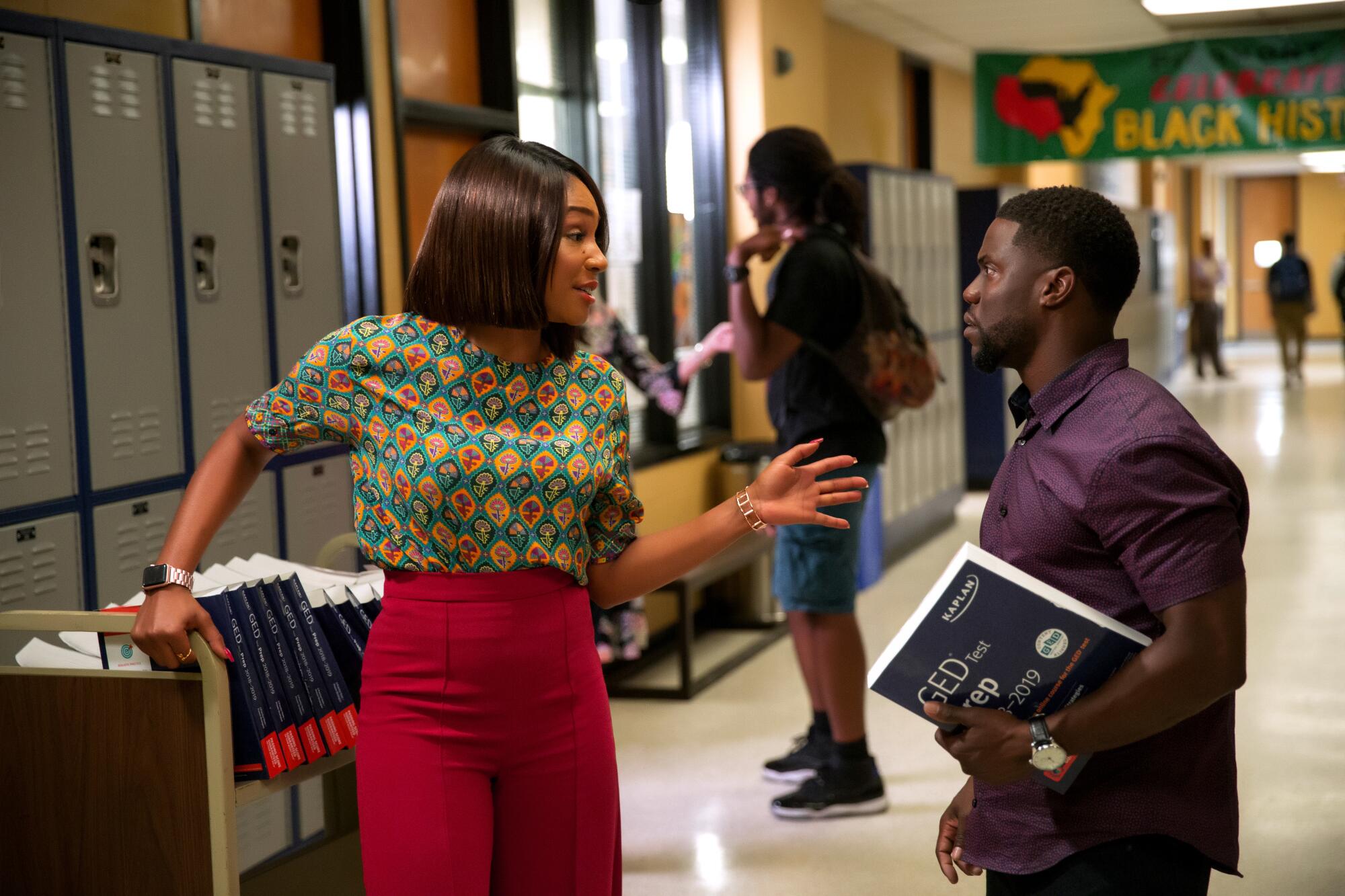
Haddish’s success in “Girls Trip” led to a leading role opposite Kevin Hart in the comedy “Night School.”
(Eli Joshua Ade / Universal Pictures)
“And then, all of a sudden, it almost felt like, ‘OK, now you too famous,’” says Lil Rel Howery, who has been close with Haddish since they met while competing on “Who’s Got Jokes?” in 2006. “People love underdogs until you become, I guess, a top dog.”
There has definitely been a palpable vibe shift surrounding Haddish. It’s not that she doesn’t still get work — in the last year she’s appeared in Disney’s “Haunted Mansion,” the last season of “The Afterparty” on Apple TV+ and filmed a role in the forthcoming “Bad Boys” sequel. But she’s no longer one of those beloved stars everyone seems to root for.
Some of that is due to a disturbing lawsuit that was filed and then dismissed within the span of three weeks in 2022.
In a legal complaint filed in L.A. Superior Court, an anonymous young woman claimed that Haddish and fellow comedian Aries Spears had “groomed” her and her younger brother to engage in sexually suggestive comedic sketches when they were minors.
Haddish and Spears denied this and less than a month later, the Jane Doe asked a judge to dismiss the case and released a statement recanting the accusation. “My family and I have known Tiffany Haddish for many years,” it read, “and we now know that she would never harm me or my brother.”
But the damage to Haddish’s reputation had been done. The deal she made for “I Curse You With Joy” in 2020 “went sour,” as did a second one; the publishing houses “got scared,” she says. “Scared of me, scared it wouldn’t do well. ‘Oh, she’s a problem. She’s too controversial.’”
Haddish says she was preparing to self-release the project, but it eventually found a home at Diversion Books. It will arrive on shelves a couple of months after her latest controversy — a February trip to Israel, which she announced via Instagram video from a first-class airline seat.
After reconnecting with her father as an adult, Haddish learned that she had Jewish roots in Eritrea. She dove into the religion, joining the Stephen Wise Temple and being bat mitzvah’d at age 40.
In the video, she said she was embarking to Israel for the first time on a self-funded trip to “learn and see with my own eyes.” But fans did not respond well to news that she was heading to the country in the midst of the war with Hamas. “Insecure” star Amanda Seales said on Patreon that she was so “disturbed” by the trip that she would end her friendship with Haddish, declaring the comedian didn’t “have the backbone to stand on what is right.”
To her closest friends, the prolonged backlash has been troublesome — and baffling.
“Because everybody was kissing her a—” after “Girls Trip,” says Howery, the “Get Out” star. “Then the jealousy started with other actors and stuff. They’re like, ‘How is she winning?’ Everybody was cheering her on for being herself, and then that’s the same thing that people got mad about. ‘She’s doing too much!’ But she’s been doing too much.”
The foster kids Haddish works with through her nonprofit She Ready Foundation get especially upset about hate they see directed toward her online.
“They cry to me, like, ‘Stop being famous! I want you to quit!” she says. “They said it hurts their feelings to see what people say about me.”
After the open house, Haddish and I have returned to the home she uses as an office. She bought it last year for $1.6 million — a totally redone three-bedroom with subway tile backsplash, soaking tub and solar panels. It’s modern and sparse, lacking personal details save for a random, small canvas on the wall that she made in a Sip ’n’ Paint class she bought off Groupon a few years back.
Haddish grabs an apple off the kitchen island, eats it and then clutches the core in her hand for half an hour, rather than throw it out and disrupt her thoughts about getting trolled.
Comments about her online have gotten so negative that last year, she began blocking certain phrases on Instagram, including “setback,” “pedo” and “not funny.” She hired a digital forensics analyst to research where her death threats were coming from — 75% were created by robots in Malaysia and Iran, which made her feel better.
She also created a fake Instagram account where an alter ego named Sarah will go in and “destroy” anyone hating on her by deploying details from their personal lives.
“I’ve learned how to find people’s information — like I pull up the credit report, police records. You can do that for $1.99,” Haddish says. “Sometimes, I get so mad that I’ll get they phone number and I’ll just call them.”
She registers the disbelief on my face.
“Oh, I have called people, honey,” she says. “They be shocked that I called. They’ll be like, ‘I can’t believe you even saw that.’ You did a whole video, b—! You made a full, five-minute video! On the internet, people think they can just say whatever and you not gonna say anything. I try my best not to, but I’m a human being.”
Many of the comments pertain to the lawsuit, she says. Haddish doesn’t feel it’s affected her career — plenty of folks still approach her to fan out in the airport, she says — but she has noticed an attitude adjustment from some people in the industry.
Recently, she says, someone “of status” approached her and asked: “Is your mental health OK? Your name is always in the headlines. You said this, you said that. All I see is people attacking you. It’s like, ‘Oh, don’t get too close to Tiffany. I’m going to get attacked too.’”
Her mental health is perfectly fine, she says. Not that there haven’t been moments she’s questioned it. Usually when she’s on her period, suffering from such bad menstrual cramps that she often passed out. For years, doctors shrugged off her pain, suggesting that she take birth control pills or eat less acidic foods. Haddish recounts the words of one relative — “We used to be out in the fields having babies and working right after.” A woman who complained about her period, Haddish was told, was lying, weak, just trying to get sympathy.
So she started to think maybe she was mentally ill. Then, last year, a doctor finally diagnosed endometriosis. The chronic disease also explained why she’d suffered eight miscarriages — something a prior OB-GYN had misattributed to the shape of her uterus. Until last year, she kept the losses from almost everyone.
“I’d call her and say, ‘How’s your day?’ and she might start talking about work,” recalls Selena Martin, who has been Haddish’s best friend since seventh grade. “And I’m like, ‘OK, that’s nice. But how are you doing?’ In track, our coach used to call us odd names if we were running slow, like ‘hamburger.’ So I’ll ask, ‘No, how’s old hamburger doing?’”
Even as she was miscarrying, Haddish kept quiet, showed up to work, went onstage. She saw the way people talked about pregnancy loss — how they treated women who went through it like pariahs. “I remember Gabrielle Union talked about having a bunch of miscarriages, and it was like, ‘Gabrielle Union can’t hold a baby,’” she says.
She didn’t want to hear that. Tried to be remain positive. This was just God’s birth control, she told herself, God’s way of telling her she was with the wrong man.
“Shame on you, Tiffany,” she admonishes herself now. “I didn’t want to be a quitter. Because my body was quitting. People have no idea what it feels like to have your soul falling out of your body. Because that’s what it feels like. My soul is like, ‘Oh, man. We was gonna grow that.’ You ever plant anything and then it f— dies and you really want it to live? You try to play cool, like it ain’t that bad. But it is.”
There are procedures Haddish could have to help her endometriosis — laparoscopic surgery to remove scar tissue. But she refuses. Years ago, she says, she had an abortion under anesthesia and she liked the feeling of the drugs so much that she’s scared that if she had access to them again, she’d develop an addiction.
She reasons with herself that menopause is probably only five years away and she finds ways to cope with the pain — marijuana helps a lot, though she’s been sober since Thanksgiving, when the judge in her ongoing Georgia DUI case instituted regular drug and alcohol testing following the Beverly Hills arrest. She says she plans to abstain from drinking even after the case is wrapped up, especially because she’s noticed a discernible difference in her pain over the last few months.
And she’s decided that she doesn’t want to have kids.
“I would hate to give birth to someone who looks like me, knowing they’re going to be hunted or killed,” she writes in “I Curse You With Joy.” “I don’t want the stress of worrying every time my Black baby goes to school or goes to hang out with their friends that they they could end up dead.”
Growing up three miles away near 54th and Western, she was in gang territory. The park she hung out at was infamous for drive-by shootings and filled with police. When she was 13, she says, she watched a boy in her friend group get beat to death by the cops.
“You see s— like that? That don’t go away,” she says, her voice turning quiet and heavy. “You develop this underlying narrative of: ‘Are we being hunted?’ And people always tried to take advantage of me, even when I didn’t have nothing. I see these helicopter parents worried about they child, and I get it, because there are a lot of predators out here.”
She starts to cry, apologizes. This is a topic she particularly hates talking about — at 17, she explains, she was raped by a police cadet on the night of her homecoming dance. She was going to delve into it in her second book, but when she went to record the audio version, she found the experience too painful and cut the pages.
The incident dramatically affected how Haddish viewed men. In the years following it, she attempted to take her sexuality into her own hands. She slept with men freely, spoke unabashedly about her exploits. “I Curse You With Joy” is filled with graphic details of her sex life, including an oral sex tutorial and her preference for a “smedium” penis — something she says she established after intercourse with an extremely well-endowed man sent her to the hospital with a tilted uterus.
She thought sex of her own volition would empower her. If she was the pursuer, she’d be taking something from the man.

“But I was hurting myself the whole damn time,” she says now. “You’re really just kind of raping yourself. You’re giving up a piece of your spirit. I feel different, a little less, every time.”
In her comedy, and in her life, Haddish talks a lot about how closed off she is to relationships. Her last serious one was with rapper-actor Common; that ended after two years in 2021. Since then, she says she’s adopted a new policy: Nine months and then she’s out. She’ll go on Bumble, but never Raya. No more celebrities.
“All the famous guys I used to think, ‘Oh, I would love to do it to him,’ I know them now and I’m like, ‘No,’” she says. “I used to really want Henry Cavill. I think he’s so hot. But I met him and he was so awkward. It was like, ‘This would be weird. I should be talking to him about Dungeons & Dragons. Maybe he’d be more comfortable.’
“Or,” she adds, “maybe he’s just never had a Black woman be like, ‘What’s up? What’s your credit score? Do you like spaghetti? I’ll cook for you. Are you afraid of South Central or not?’ But he’s still beautiful.”
Clark, who met Haddish when they were bused to El Camino Real Charter High School in Woodland Hills, isn’t buying this supposed stance on monogamy.
“Oh, she wants to be in a relationship,” says Clark. “I think it would be really, really good for her to be in a healthy — key word — relationship. She keeps that young, 20-year-old girl in her mind when she’s talking about it onstage, but really, deep down she’s such a relationship girl.”

Haddish says she has other things to work on first, like fixing her sleep routine. She used to get between two and three hours a night. Her fatigue got so bad that sometimes she even fell asleep during sex. And not always in the missionary position. She jumps up and gets on her hands and knees to imitate how it’s possible to be on top and still drift off with your head resting on someone’s chest.
So there’s the sleep thing — she’s getting between five and eight hours a night now. No more drinking. Exercising more frequently, cooking with the vegetables in her garden. Continuing to invest in her neighborhood. Coming to terms with her family.
Haddish’s mother lives with one of her half-sisters in Inglewood now after being institutionalized. Haddish takes their relationship “day by day,” she writes in her book. “I love her, but whew, it is still hard.”
If I met her mother, Haddish says, I wouldn’t notice anything off at first. But after a few hours, she’d start talking to herself, or turn swiftly argumentative. Haddish clings to the “glimmers of her — of my mommy” — the woman she knew before the accident. “And I miss her. But it’s not the same.”
Still, her mother’s admiration is the carrot that’s always dangling. “Am I doing all this, working myself to the bone, just for my mom’s approval?” she writes in “I Curse You With Joy.” “You know what? Kinda.”
There was a moment, recently, when Haddish brought her mom over to see a large home she’d just invested in. She watched as her mother took in the property, impressed.
“She goes, ‘I’m proud of you,’ and that was awesome. That was the best feeling in the world to hear that,” Haddish says. “At the end of the day, all you want is your mommy and daddy to be proud of you. Well, my daddy dead now. And I think she is proud.”


A Hollywood portrayal of OpenAI Chief Executive Sam Altman portrayed by actor Andrew Garfield will be released later this year, after Amazon MGM Studios dropped the movie.
“Artificial,” which chronicles Altman‘s 2023 ouster from OpenAI and his reinstatement as CEO, was acquired by Neon, the studio announced Tuesday.
“The acquisition underscores Neon’s commitment to partnering with visionary filmmakers, and bringing ambitious cinema to audiences around the world,” the studio said in a statement. “Artificial will compete in this year’s Oscar race.”
The film has a critical take on artificial intelligence, according to three sources briefed on it who declined to be named. That portrayal caused Amazon to want to distance itself from the film, given the company’s $50 billion investment in OpenAI, two of the sources said.
Amazon declined to comment on the claims. In a statement, the company said it has “the utmost respect and admiration” for the movie’s director Luca Guadagnino. “We believe that ‘Artificial’ will be better served if it were released by a different studio and are working closely with the filmmaking team to find the film a new home,” Amazon said.
The deal was negotiated by Neon, CAA Media Finance and Amazon. CAA and Amazon declined to comment. A Neon spokesperson did not immediately respond to questions regarding the financial terms of the deal.
Puck News first reported Amazon dropping the movie.
Other studios, including Netflix, A24 and Focus Features, screened “Artificial.” Netflix and Focus passed on the film.
Amazon’s decision to drop the film comes at a time when Hollywood is grappling with the growth of artificial intelligence. Some creatives are concerned that the technology could displace jobs; others worry that their likenesses are being used to train AI models without their permission or compensation.
Meanwhile, many AI companies are eager to work with studios, saying their AI tools can help speed processes and reduce costs.
To foster more nuanced discussions about artificial intelligence, Google is collaborating with talent management firm Range Media Partners to develop films that present a less dystopian view of the technology.
Amazon passing on the film raises questions about whether tech company-backed studios would be willing to release movies that are critical of innovations in which they have a stake. It could create a chilling effect, said Robert Thompson, director of Syracuse University’s Bleier Center for Television and Popular Culture.
“The chilling effect could not only be on films critical of AI, they could be on films critical of all kinds of things that these companies have their tentacles in,” Thompson said.
Stories about tech company founders can be attractive to audiences, most notably with the 2010 film “The Social Network” about the founding of Facebook. That film earned $225 million worldwide at the box office, according to Paul Dergarabedian, head of marketplace trends at Rentrak. “The Social Network” came out a time when many people were talking about Facebook and had big talent behind it, including director David Fincher, Dergarabedian said.
“Neon is a perfect custodian for this film, and they will shepherd it to the big screen, I think very effectively,” he said. “They’re very filmmaker-centric … I think they found the perfect home with Neon.”
“Artificial” features major talent, with actor Monica Barbaro portraying former OpenAI Chief Technology Officer Mira Murati, and Ike Barinholtz as Elon Musk. Other actors include Jason Schwartzman and Billie Lourd.
Director Guadagnino has worked on films including “Challengers” and “Call Me By Your Name.”
Staff writer Samantha Masunaga contributed to this report.

While a bit hollow as a character study, painting with broad thematic brushstrokes that often keep its hero at a distance, Young Washington is a compelling historical drama, with a grandiose scope that is rare in Hollywood, and an inspirational story befitting of America at its best.
About the Film
It’s trendy for Hollywood to disparage the United States with films that highlight how the country has fallen short of its lofty ideals (and the beauty of American liberty is that such critical self-reflection is possible). Last year’s One Battle After Another was the darling of the Academy Awards with such a tale. But this Independence Day, and in celebration of 250 years as a nation, audiences can be reminded that (like the men who founded it) America may be imperfect, but the American spirit is a noble and beautiful thing worth fighting for. Young Washington is the origin story, not just of one of those brave Founding Fathers, but of the patriotic spirit and noble values they inspired. While a bit hollow as a character study, painting with broad thematic brushstrokes that often keep its hero at a distance, Young Washington is a compelling historical drama, with a grandiose scope that is rare in Hollywood, and an inspirational story befitting of America at its best.
Director Jon Erwin (House of David, I Can Only Imagine) again proves to be one of the best all-around storytelling talents in Hollywood right now, faith-based or otherwise. Produced and distributed by Angel and Wonder Project, the film is among the most ambitious projects to emerge from the new wave of faith-based entertainment, even if Young Washington isn’t explicitly “faith-based” in a rigid sense. When I interviewed screenwriter Diederik Hoogstraten, he aptly referred to the storytelling approach as “values based.” It may not be a gospel-preaching cinematic tract (and it’s the better for it), but Christians will find plenty to affirm and celebrate here.
If we do count the film among the “faith-based” genre family, then it’s easily a peak achievement. It’s a visually beautiful and well-crafted film. For as good as the modern faith-based genre has become, few movies have warranted a theatrical viewing, being built more on wholesome narrative than visual spectacle. In contrast, seeing Washington gallop on a horse as cannon fire and the pandemonium of battle rages all around him is a full-blown cinematic experience that has rarely been achieved in the genre – other than perhaps Erwin’s own The House of David.
Young Washington is solid from start to finish, but it never fully soars. The film is more interesting than engrossing; good in most areas, but never quite great at any one of them. The clearest comparable, due to the subject matter, is perhaps Mel Gibson’s The Patriot (2000). Historical inaccuracies aside, that film packed a cinematic punch of action, spectacle, and emotional storytelling. Young Washington offers the first two but lacks the third. It’s a story that appeals more to the head than the heart, historically informative, but not making me feel much toward the story.

The creative decision to focus the story on a limited, formulative period of Washington’s early life shapes the film in significant ways. Many biopics fall into the trap of dutifully checking boxes, adapting a Wikipedia page more than unfolding a character journey. There’s still some of that with Young Washington, but the limited parameters lend the film a greater sense of focus and an opportunity to breathe. It feels like a story about something more than just putting historical events onto the movie screen.
At the same time, the film also feels like “part one” of a larger story, or a prequel for a film that doesn’t yet exist. The story seems constantly building toward something but then ends on the cusp of reaching it. Perhaps a future sequel is in the cards (although Middle Aged Washington doesn’t have the same ring to it), but the climactic pay off feels lacking. Interestingly, while the movie remains largely historically accurate (as far I can tell), the climactic final battle is more positively framed as a sort of inspirational victory, even when the historical battle was a crushing defeat. It’s perhaps an attempt to manufacture a thrilling third act resolution for a historical figure who was still only in the “first act” of his life. The decision mostly works, and that final battle is the film’s greatest triumph, but the story overall, as told, feels incomplete.

Also notable is that despite the intentionally patriotic release date, and centering on George Washington—arguably the American hero—the “Young” part of the film’s title means that the story pre-dates the revolutionary war. It sees Washington spend the duration of the runtime as a proud officer in the British army. Not quite the patriotic celebration the marketing has promised. Beyond existing knowledge of the historical significance of the protagonist, there is no real “America” at all, beyond a focus on his Virginian regiment, and some hints at the “American Spirit” that would one day define the nation (see themes below).
The fact that it has taken until the end of this review to discuss the character of George Washington himself is also telling. Unfortunately, he is the least interesting part of the film. The fault is not with actor William Franklyn-Miller, who does an admirable job. The problem is with the characterization. Washington has understandable motivations and inner conflict, but they are approached more from the perspective of an outside observer, rather than getting into his own headspace (we are told about struggles but rarely feel his turmoil). The film doesn’t probe deep enough into the root causes of these struggles, or the causes of his insecurity and drive for greatness. I left the film having learned about the events his early life, but without a better understanding of him as a man.
In the end, Young Washington boasts enough entertainment and quality filmmaking to please audiences. It’s a high floor, low ceiling type of film. There are no moments where the film fails to deliver consistent quality, but it just never seems able to achieve anything more. It’s good, but not great, which is something rarely said of George Washington himself. Still, I enjoyed it, and in retrospect, its legacy may be more for how it paved the way for the genre to enter a brighter future. Come to think of it, that sounds befitting of George Washington after all.
On the Surface
For Consideration
On the Surface—(Profanity, Sexual content, violence, etc.).
Language: There are three minor profanities (“d—” x2, “b—ard” x1).
Violence: There is plenty of wartime action, including men shot with rifles and cannon fire, although the action remains relatively bloodless. The most extreme violence comes when a man is hacked with an axe, although it is more implied than depicted on screen.
Sexuality: None.
Beneath The Surface
Engage The Film
The Makings of a Leader
George Washington was a larger-than-life person. By the end of the film, he is depicted as a near mythic figure (although, the scenes are adapted from details provided by several Pulitzer Prize winning biographies, so sometimes real life really is a Hollywood story). But one of the film’s central ambitions, and one emphasized in my interview with the screenwriter, is to humanize that mythical figure.

Early in the film, he is not necessarily even very likeable at times. He is stubborn, and his deep insecurities manifest as the appearance of pride and arrogance. His poor choices and refusal to heed wise counsel, such as the defeat at Fort Necessity, lead to serious consequences. Many biopics are hagiographical (such as the recent Michael), but Young Washington demonstrates the biblical truth that all men have sinned and fallen short of God’s standard (Romans 3:23). It answers the age-old question by suggesting that great leaders are not born great, they must become great.
In an early scene, George and his mother argue about their unfavorable circumstances. George’s mother wishes for her deceased husband back, but says, “Providence denied me this.” George responds, “Then providence is cruel!” His mother eventually counters, “God raises what is well grounded.” That exchange represents the heart of the film. We cannot control our circumstances, but we can shape our character (and allow God to shape it) to respond to them. As one character says, “Failure is the tutor sent by God.” Washington lacks the status and social advantages of others, and at first, he attempts to take it into his own hands to rise to prominence. Ultimately, after great failure, he learns that it is through humility and service that he can be used to do great deeds (Matthew 20:16). Interestingly, at the end of the film, even the pagan Indian tribes recognize God’s anointing on Washington’s life.

Entertainment
’47 Ronin’ director Carl Erik Rinsch sentenced to 30 months in prison for Netflix fraud case

Carl Erik Rinsch, the director of the 2013 Keanu Reeves action film “47 Ronin,” will serve more than two years in federal prison for defrauding Netflix of $11 million.
U.S. District Judge Jed S. Rakoff on Monday sentenced 48-year-old Rinsch to 30 months in prison, the U.S. Attorney’s Office, Southern District of New York, announced. Federal prosecutors convicted Rinsch in December of wire fraud, money laundering and other counts. A legal representative for Rinsch did not immediately respond to a request for comment on Tuesday.
Federal prosecutors indicted Rinsch in March 2025, alleging the $11 million went into Rinsch’s personal accounts. The filmmaker “quickly transferred” the money from the Rinsch Co. account, where it had been deposited March 6, 2020, by Netflix, through additional accounts until about $10.5 million wound up weeks later in a personal brokerage account. He lost more than half of that money in less than two months via risky investments in the stock market, the indictment said.
Though Rinsch told the streamer that his sci-fi show “White Horse” was progressing nicely, the filmmaker allegedly moved the remaining money into cryptocurrency and profited from crypto speculation over the next couple of years. The streamer had invested around $44 million in the show. Rinsch was accused of spending around $10 million on five Rolls-Royces, a Ferrari, watches, clothing, luxury bedding and linens, credit card bills, attorneys to sue Netflix for more money, and lawyers to work on his divorce.
He was arrested in West Hollywood and released the same day after agreeing to post a $100,000 bond to guarantee his appearance in a New York federal court.
Rinsch never finished the Netflix show.
During his sentencing, Rinsch and his legal team told the court his behavior was a result of mental health struggles and medication problems and they are working to address those issues with a new care provider, the Associated Press reported.
“I failed to recognize the danger of the state I was in,” Rinsch said, though his mental issues were not described in court, and his attorneys declined to provide further detail.
Ahead of the sentencing, Reeves — the star of Rinsch’s most notable project to date — penned a letter in May requesting “leniency and mercy as well as justice” in the filmmaker’s sentencing.
In addition to prison time, Rinsch must serve three years of supervised release, forfeit the $11 million and pay $700 in mandatory special assessments, according to Monday’s announcement. U.S. Attorney Jay Clayton said in the announcement: “Today’s sentence sends a deterrent message: fraud will not be tolerated.”
The Associated Press and former Times assistant editor Christie D’Zurilla contributed to this report.
-

 Technology2 minutes ago
Warehouse robots move packages without human handoff
-
 Business9 minutes ago
Disneyland to offer $59 evening tickets next month
-
Entertainment12 minutes ago
After Amazon drops OpenAI movie ‘Artificial,’ film finds new home at Neon
-

 Lifestyle17 minutes ago
ICICLE: Capturing Interest in Chinese Brands
-
 Politics24 minutes ago
Newsom signs off on 100% California tax for money from Trump’s $1.8-billion ‘slush fund’
-
 Science27 minutes ago
After bold pledge, EPA shelves microplastics testing in U.S. drinking water
-
 Sports32 minutes ago
Walter Alston, Dave Roberts and everyone in between: The 10 managers in L.A. Dodgers history
-

 World42 minutes ago
World’s oceans experience hottest June ever, scientists say more heat ahead

