Entertainment
The thrill is gone: Lifestyles of TV's rich and famous now must come with consequences


The rich, to put a spin on a biblical phrase, are always with us. In business, in politics — but also pretty consistently on TV too. HBO’s “Succession,” after all, took home three of the last four drama series Emmys before it wrapped its run last year. The small screen is filled with a parade of characters cossetted, burdened and driven to extremes by excessive wealth and its associated power — but is it a story we’ve seen a little too often and one that cuts a little too close to reality lately?
The answers are yes and yes, which means many series (limited and otherwise) are finding success by tapping into the lifestyles of the rich and horrible with new ways to expose those tarnished, gilded cages, including “Loot” (Apple TV+); “Mary & George” (Starz); “Griselda” and “The Gentlemen” (Netflix); “The Regime,” “The Gilded Age” and “The Righteous Gemstones” (HBO); and “Feud” (FX). And in the process, their creators are reconsidering that their wealthy, fantastically awful protagonists not only need a makeover — they also require some comeuppance.
“‘Dynasty’ was popular when I was a kid,” recalls Matthew Read, executive producer on “The Gentlemen,” a show about a man whose newly inherited estate houses a marijuana empire. “But it would be hard to have an audience look up to those characters or enjoy their conspicuous consumption in the same way [today]. Something like ‘Succession’ let you enjoy how unhappy these rich people are.”
Watching the rich enjoy their privileges, at one point, was a way for the have-nots to peep into a life they’d likely never attain. “People are aspirational,” says Gillian Anderson, who plays a TV journalist whose interview with Prince Andrew forces the royal to retreat from public life in Netflix’s “Scoop.” “Everyone always imagines that when you get that rich or famous, that means everything is going to be OK.”
“It’s interesting to see what people do with those opportunities,” says Chloë Sevigny, who plays a wealthy heiress on “Feud: Capote vs. the Swans.” “It’s something we’re all curious about: What would I do with that money?”
And as Julian Fellowes (creator of class-conscious historical drama “The Gilded Age,” who writes the show with Sonja Warfield) notes, not all rich folk need to be portrayed as horrible: “Some people who have made a lot of money are really nice and see it as their job to pull their weight. Others feel they’ve done the work and they should have fun and everyone else should push off.”
But that’s the trick these days in focusing on characters with unimaginable wealth. With suggestions that an abundance of money actually affects people’s thinking — consider the “affluenza” criminal defense — writers are shifting tack. Will Tracy has been doing this for a few years now, writing for “Succession,” penning 2022’s “The Menu” (with Seth Reiss) and creating “The Regime,” a limited series about an out-of-touch ruler in a fictional country.
“There’s that madness that seeps through all [those] projects,” Tracy says. “You can see it in ‘The Regime,’ that that amount of power and access to material resources has allowed her to create her own reality, and everyone around that person has to pretend that her reality is reality.”
That vicarious, fantastic thrill that audiences once gleaned from stories of the rich and powerful takes on different meanings in TV series about them today. As billionaires proliferate and expand the ever-widening class divide in the real world, watching the super-rich slip away without real consequences can make a show feel hollow, not aspirational.
Some series are addressing this more directly: “Griselda” invites audiences to identify with a female drug lord — a gender shift Eric Newman (who co-created the limited series with Doug Miro, Carlo Bernard and Ingrid Escajeda) says puts a new spin on things. Retribution, in the end, is exacted on her through the deaths of her children, a consequence he’d insisted on.
“As storytellers, we have an obligation to show that there is no happy ending when there’s this much trauma,” he says. “I look at criminals sympathetically, but if you’re telling a story that adheres to authenticity, these people don’t get away with it.”
Tracy’s fresh spin in “Regime” involves a political dictator who craves love from her constituency but is way too involved in her social media perception. “When shows like ‘Dynasty’ were on TV … the richest people in the country were ciphers, this black box,” he says. “Now the richest and most powerful people in the country are very visible … and they let us into their world through social media. They want us to be part of their thought process, and their thought process is, largely, insane. … We want to watch that freak show.”
“Mary” creator DC Moore says when he was putting together his limited series about a mother and son amassing wealth and status from King James I, he recognized there is an echo of the past in today’s real world. “I feel like we’ve come back to that sort of age, in the last 10, 20 years where absolute power and autocracy is on the rise and those leaders are everywhere,” he says. “I completely had that in mind when I was writing this.”
But not every show is aiming directly at a big, consequential ending for its characters. “We’re in an interesting time, and people have a greater understanding of behind-the-curtain [life] and that money doesn’t solve everything,” says “Gemstones” creator-star Danny McBride, whose show is about a family of wealthy televangelists. “But I don’t think consequences have to be the point of [my] show. That’s not how I view storytelling, that a certain show has to follow a certain payoff.”
Meanwhile, there’s “Loot,” which has gone all in on the concept of having billions fall into the lap of a protagonist who wants to do good with it — instead of spending it, say, shooting rockets into the air or stumping for autocracy.
Co-creator Alan Yang (with Matt Hubbard) notes that the show “isn’t a polemic; we’re not trying to change everyone’s minds. … but this show is on the end of the spectrum where we believe change is possible. It’s not just one lone billionaire, it’s not even every billionaire — everyone has to pull together to fight stratification in society. Ten nice rich people are never going to change the world. But do you have any hope that people can change? That’s baked into the show. Ultimately, that’s at the heart of what we do.”


By and large, the zombie subgenre has bitten off more than it can chew in modern times. Between George Romero survival films and camp comedies, the well has become pretty infected. But once in a while, along comes a movie like This Is Not A Test.
Let’s sink our teeth into this new release and see how it stacks up against the classics.
The tone and tenor of this film represent the classic survival movies like Night Of The Living Dead. But the thing that grabs the audience about This Is Not A Test is the trauma of the characters. Holt shines as a withdrawn survivor of an abusive home, trying to cut through the wreckage to reunite with her sister. Each of the main characters have standout traits, and they bathe in strongly acted moments as the stress of the situation changes who they are.
The gore in This Is Not A Test is pretty strong. The attacks spring quickly and when they do, the special effects team does a good job showcasing the battle scars. The camera work is also frenetic in a good way, because the chaos of the chase scenes puts the viewers in a first-person perspective. This film lets you feel like a part of the survivors, so their journeys are interactive.

Longtime fans may say that there’s nothing new in This Is Not A Test, and maybe they’re right. There’s no fresh take on the monsters here, no crazy origin, nothing that we haven’t seen in the past fifty-eight years. But the pacing nails a great balance between getting to know the characters and getting the zombie splatter fest. The mental meltdowns of the characters feel well earned, and the arc of Sloane and her sister brings a lot of heart and investment to the story. Even the most jaded zombie horror fans will find something to appreciate here, even as a background movie.
Adam MacDonald has made another intense hit here, and This Is Not A Test is currently available to stream on Shudder.
Entertainment
‘You’re scaring my people.’ Shia LaBeouf’s alleged stalker arrested after posting viral video
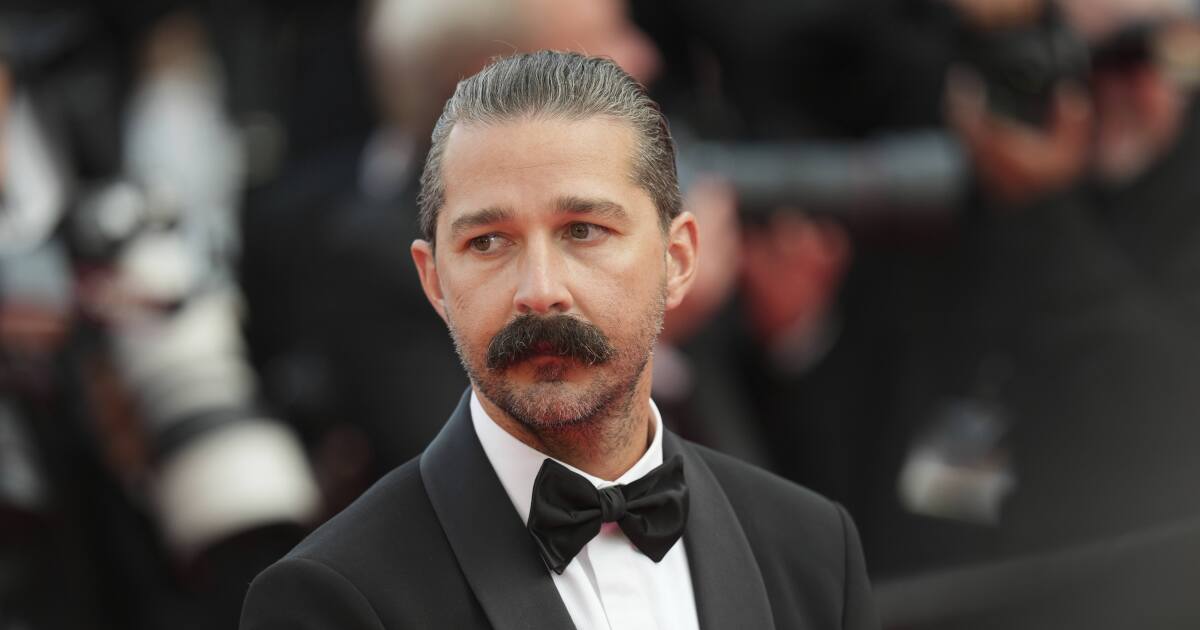
Shia LaBeouf’s alleged stalker has been arrested after posting a video of the actor asking to be left alone.
According to Orleans Parish Sheriff’s Office booking records, Alyssa Lee Couture, 40, was arrested Monday night and booked on a misdemeanor charge of stalking. Hours earlier, Couture had posted a video of a confrontation with LaBeouf in what appeared to be a grocery store parking lot. The “Honey Boy” actor is shown speaking to Couture through the window of a car.
“Leave me alone. God bless you. Leave me alone,” LaBeouf says calmly in the video. “You’re scaring my dad. You’re scaring my people. Leave me alone.”
Couture has posted more than 5,000 videos on her Instagram, most of which feature the woman addressing the embattled actor, whom she appears to believe is her husband. In a GoFundMe launched in May, Couture wrote that she was hoping to raise $70,000 to find permanent housing and that she had been living in her car and staying with family members. She also wrote that she had schizophrenia, among other disabilities.
Although the New Orleans Police Department does not identify Couture’s stalking victim as LaBeouf due to privacy policies, the timeline of her booking appears to line up with the confrontation with LaBeouf.
According to People, LaBeouf left Los Angeles after his split from actor Mia Goth last year and relocated to Louisiana to be closer to family.
In June, he pleaded guilty to three counts of simple battery, months after he went viral for his involvement in a Mardi Gras altercation in New Orleans. The actor, 39, was arrested in New Orleans on Feb. 17. At the time, New Orleans police confirmed LaBeouf was charged with two counts of simple battery for allegedly assaulting two men near a bar in the French Quarter. TMZ published bystander video of the incident and footage of LaBeouf walking through the French Quarter hours before the brawl.
The actor was released from jail shortly after his arrest and posted $100,000 in bond. More than a week after LaBeouf’s initial arrest, the New Orleans Police Department issued a second warrant for the actor’s arrest in connection with the same incident, and he racked up an additional simple battery charge. Prior to the second arrest, a New Orleans judge ordered LaBeouf to begin substance abuse treatment and undergo weekly drug testing.
Times staff reporter Alexandra Del Rosario contributed to this report.

- THE ODYSSEY
- Starring: Matt Damon, Tom Holland and Anne Hathaway
- Directed by: Christopher Nolan
- Rated: R
- Running time: 2 hrs 45 mins
- Universal
Our score: 4.5 out of 5
EPIC. If I was asked to describe Christopher Nolan’s latest film, that is the word I would use. He has mounted a film that rivals the greatest achievements of filmmakers like Cecil B. DeMille or David Lean. And, like the films of those mentioned, it’s runs a tad too long.
I was shocked, but pleased, to see that my 12-year-old granddaughter recently did a school paper on King Agamemnon. Thank goodness they’re still teaching History in our schools. Based on Homer’s “The Odyssey,” the film tells the story of King Odysseus (Damon) and his adventures which, if you’ve read “The Odyssey,” include the Trojan Horse, the Cyclops and assorted angry Greek gods. The film covers each of these adventures in great detail, sparing nothing in the production design department. While Odysseus is away – and he’s gone for a l-o-n-g time, his wife Penelope (Hathaway) has to endure a never ending string of “suitors,” men lining up in the hopes of replacing the King should he not return. The men are nothing more then scavengers, taking advantage of the law of Zeus, which decrees no one should be turned away. This angers the Queen’s son, Telemachus (Holland), who must control his temper when the men try to bait him into a fight, the idea being if Telemachus is killed, the new husband would become the King. It’s all very interesting and complicated. And long.
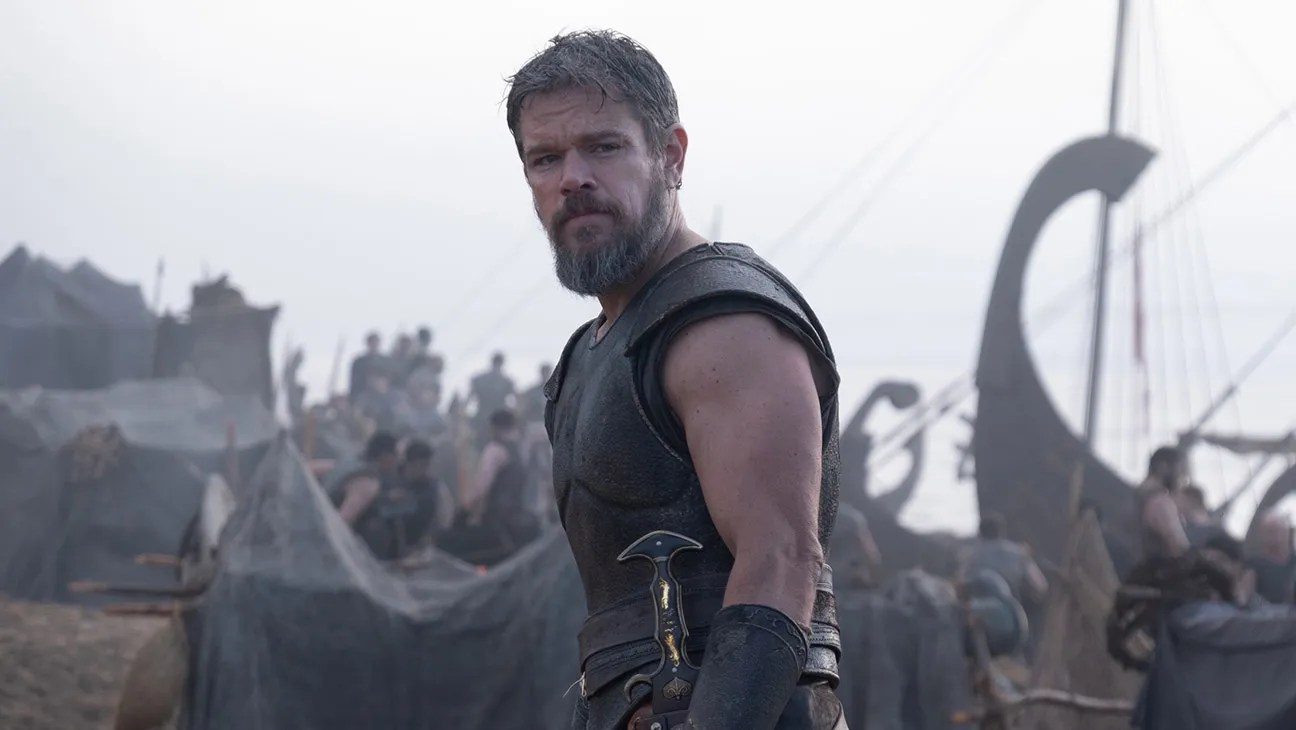
Director Nolan is one of the rare filmmakers who, in my opinion, has never made a bad film. From “Memento” to the “Dark Knight” trilogy to the Oscar-winning “Oppenheimer,” he has proven himself a true master of cinema. “The Odyssey” only adds to that distinguished resume’
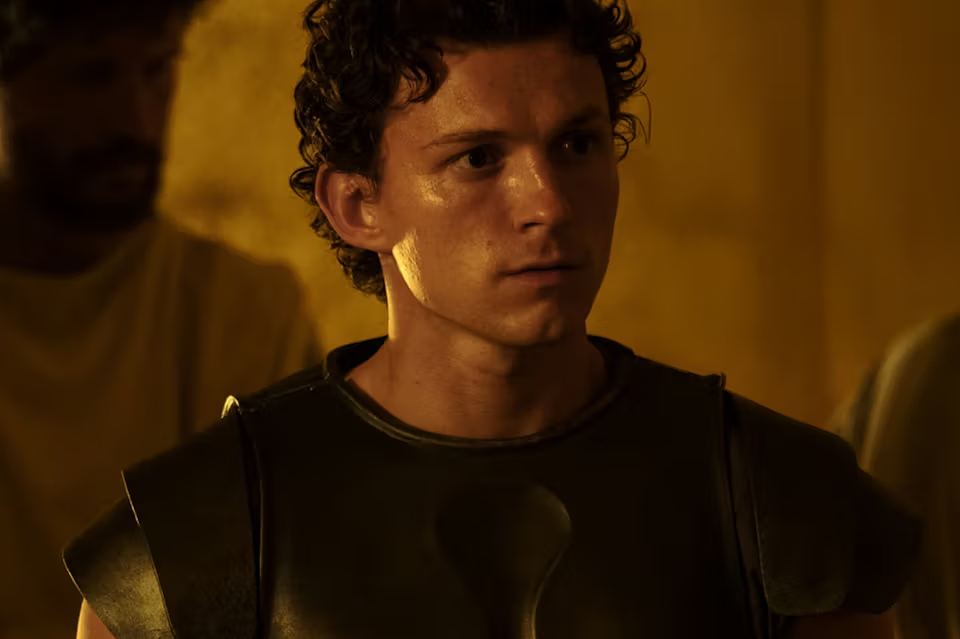
The cast is a tribute to Nolan himself who, like Woody Allen, can pretty much get anyone he wants for his films because, as an actor, why wouldn’t you want a credit in one of his films. Besides the three stars named above, the cast includes Robert Pattinson, John Leguizamo, Zendaya, James Remar, Jon Bernthal, Oscar nominees Samantha Morton and Elliot Page as well as Oscar winners Charlize Theron and Lupita Nyongo. As MGM used to advertise, “more stars than there are in heaven.”
The script and story are pretty faithful to the source material, though for some reason it bothered me whenever Telemacus referred to Odysseus as “dad.” Never father. The weird things you notice. Visual.y the film is stunning and the Trojan Horse and battle of Troy are worth the price of admission alone. I will add that I did see the film in 70 mm and, if that format is playing in your town, I urge you to see it in that format.
On a scale of zero to five, “The Odyssey” receives ★★★★ ½
-

 Delaware1 minute ago
Delaware oversight commission debates authority to reject utility rate hikes
-

 Florida7 minutes ago
Florida preacher buys VT campus to build Christian college | Fox News Video
-

 Georgia13 minutes ago
Northwest Georgia shelters overwhelmed: Catoosa tops 80 pets and Walker adds 73 in July
-

 Hawaii19 minutes ago
Records were set for June rainfall – Hawaii Tribune-Herald
-
 Idaho25 minutes ago
How the City of Boise tests water samples to ensure the Boise River runs clean
-

 Illinois31 minutes ago
Data center fears mount after Illinois village residents prepare for the worst
-

 Indiana37 minutes ago
Statewide Silver Alert issued for two missing Indiana children
-

 Iowa43 minutes ago
Weight loss drug needles creating safety risk for eastern Iowa law enforcement

