Entertainment
The best, worst and weirdest of Stagecoach Day 1 with Eric Church, Jelly Roll and more

After Coachella’s back-to-back weekends, barely any grass remains on the grounds of the Empire Polo Club. But that hasn’t stopped tens of thousands of country fans from venturing here for Stagecoach, which got underway Friday afternoon and runs though Sunday night with headliners Eric Church, Miranda Lambert and Morgan Wallen. The Times’ Mikael Wood and Vanessa Franko are at the festival, notebooks in hand and bandanas in place. Here’s a rundown of the highlights and lowlights of Day 1.
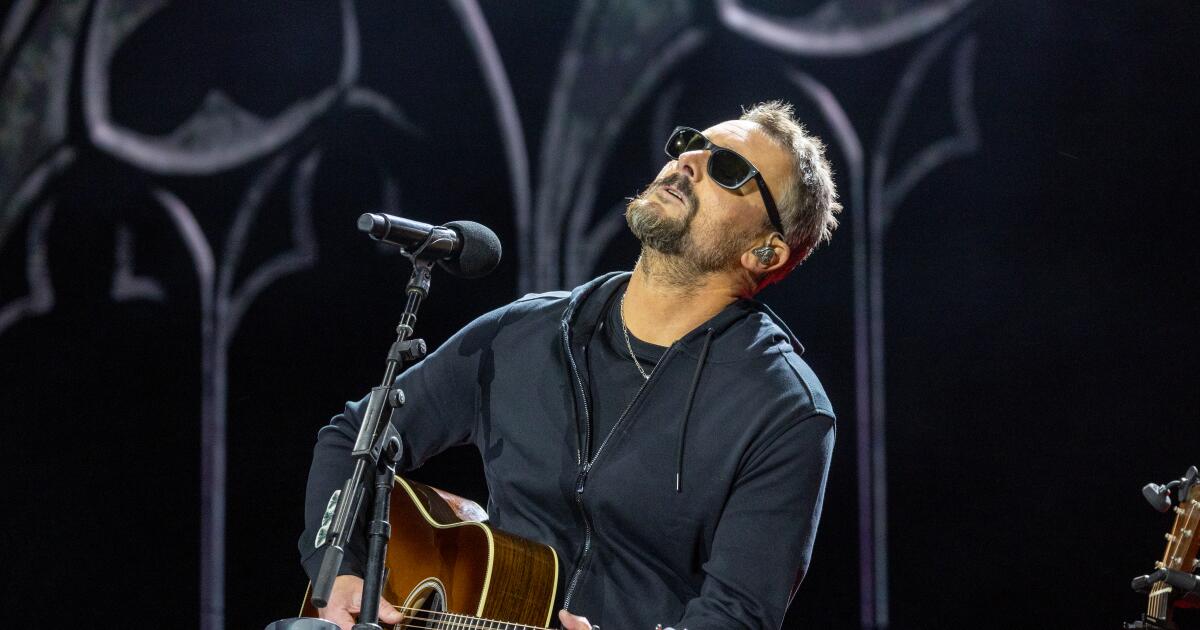
Eric Church performs on the Mane Stage on the first day of Stagecoach Country Music Festival at the Empire Polo Club in Indio.
(Allen J. Schaben / Los Angeles Times)
Eric Church lives up to his name
Church used his fifth headlining appearance at Stagecoach as an opportunity to try something different: Instead of leading his sturdy road band through a set of the hits that have made him a kind of older-brother figure to the likes of Wallen and Luke Combs, Church turned the so-called Mane Stage into an open-air chapel (complete with stained glass) for a stripped-down acoustic performance in which he was backed by a 16-member gospel choir.
The set mixed originals like “Mistress Named Music” and “Like Jesus Does” with far-flung covers: “Amazing Grace,” “I’ll Fly Away,” “Take Me to the River” and “Gin and Juice.” His aim seemed to be to showcase the music that formed him as a kid growing up in small-town North Carolina — and to draw attention, in this year of Beyoncé’s “Cowboy Carter,” to the Black roots of country music. (The performance also shared some DNA with the solo-acoustic residency Church has going at Chief’s, his new bar in Nashville, where Wallen was arrested this month for throwing a chair off the roof.)
Energy-wise, it was a risky choice at the end of a day many spent drinking in the sun: Half an hour or so after Church opened with Leonard Cohen’s “Hallelujah” — probably not a song anyone still needs to keep doing, if we’re being honest — one guy near me yelled, “This is Friday night, not Sunday morning!” As they went along, though, Church and his accompanists picked up a righteous steam. — Mikael Wood
Dwight Yoakam and the fabulous flying fringe
If you’re going to wear a Canadian tuxedo, make it memorable.
While top-and-bottom denim is a perennial look for Yoakam, on Friday the troubadour paired it with his standard cowboy hat and boots, but the standout was the jacket covered in white fringe on the front and back.
Yoakam, whose name was misspelled on the official Stagecoach set-times sign outside of the Palomino stage (as was Nickelback’s), started about 10 minutes after his scheduled start of 7:20 p.m.
Back to the fringe, it was almost hypnotic to watch it bounce and sway as Yoakam shimmied and shuffled across the stage while he and his band (also snazzily dressed with sparkles, no fringe) played songs including “Little Sister,” “Streets of Bakersfield” and a cover of Queen’s “Crazy Little Thing Called Love.”
Since Yoakam didn’t allow press to photograph his set, the best you can get from us is a stick–figure drawing I made — unfortunately art is not my strong suit and I really couldn’t do the fringe justice.
Other than a couple of feedback screeches on the microphone, Yoakam and his band played a tight set. The crowd began filtering out to hike over to the Mane Stage to catch Jelly Roll, which was a shame because Yoakam just kept getting better with “Honky Tonk Man” and “Guitars, Cadillacs” in the back half of the performance. — Vanessa Franko
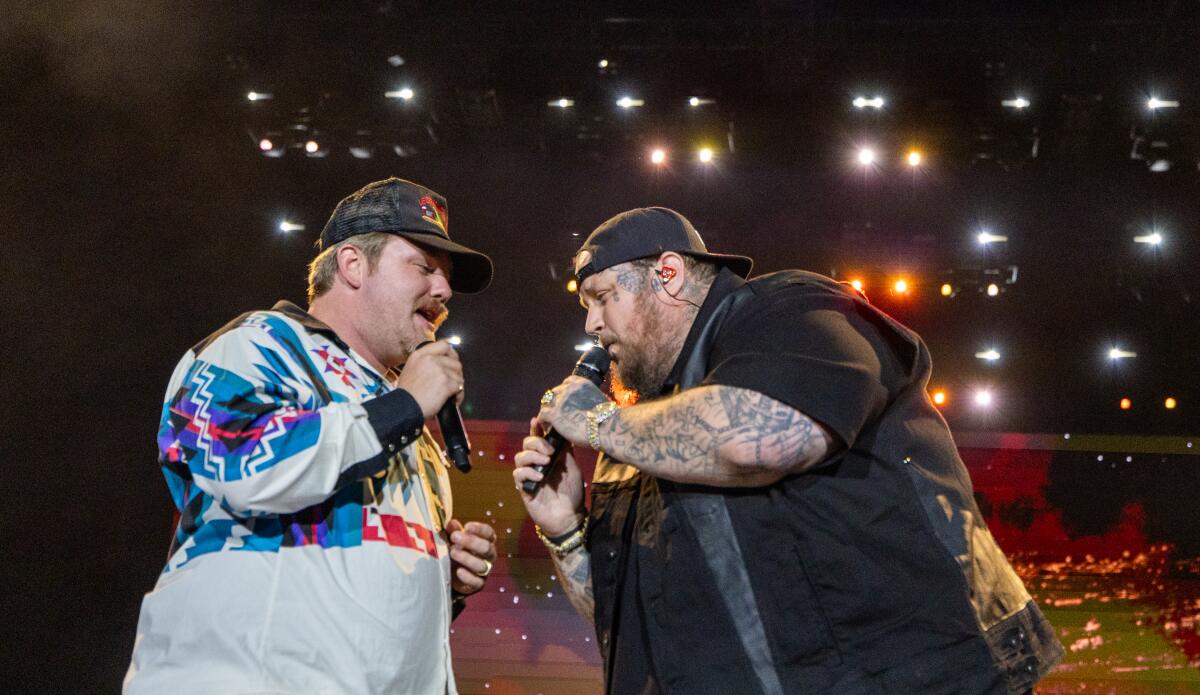
Jelly Roll, right, performs with his special guest Ernest on the Mane Stage on the first day of Stagecoach Country Music Festival at the Empire Polo Club in Indio.
(Allen J. Schaben / Los Angeles Times)
Best multitasker: Jelly Roll
Nobody made more of their time at Stagecoach than Jelly Roll, who, before his set on the Mane Stage, turned up for a cooking demo with Guy Fieri and afterwards schlepped over to the Palomino to join Nickelback for “Rockstar.”
His primary performance was a condensed version of the road show he’s been touring hard over the past couple of years, with bruised yet muscular country hits like “Son of a Sinner” and “Save Me” alongside a medley of the hip-hop classics (including Eminem’s “Lose Yourself” and Biz Markie’s “Just a Friend”) that inspired him to become a rapper before he turned to singing.
He brought out Maddie & Tae to do a new song, “Liar,” that he said he’d put on his next album if the crowd liked it (and wouldn’t if the crowd didn’t); he also brought out T-Pain, who did “All I Do Is Win” and helped Jelly Roll pay tribute to the late Toby Keith with a take on Keith’s “Should’ve Been a Cowboy.”
After “Need a Favor,” Jelly Roll ushered his wife and daughter to the stage — he’d taken his daughter out of school for the day and flown her to California, he happily pointed out — and thanked the audience for changing their trajectory of their lives. Then he did a spiel about proving naysayers wrong that climaxed with his enumerating how many People’s Choice Awards he’s won. Iconic, obviously. — M.W.
Worst surprise guest: the wind
Jelly Roll brought out T-Pain. Mother Nature brought out winds that were so bad that if you drove in to the festival along the 10 Freeway it was difficult to see the mountains because of the dust.
While the worst of the wind was west of the festival site (some gusts reached upwards of 60 and 70 m.p.h. in the Coachella Valley, according to the National Weather Service), the South Coast Air Quality Management District issued a windblown dust advisory through late Friday. And if you were on the grounds, you could feel all of that windblown dust sticking to you.
It did lead to some interesting people-watching, though, as many a cowboy hat was chased across the field. — V.F.
A return visit from a Coachella headliner
A week after she headlined Coachella — and with an album on the way called “Lasso” to hype — Lana Del Rey turned up at Stagecoach to trill the Righteous Brothers’ “Unchained Melody” with Paul Cauthen, a hammy up-and-comer with a booming baritone and a televangelist’s fashion sense. No idea what kind of relationship these two might share in real life, but together onstage they brought a touch of slightly creepy glamour to the desert. — M.W.

A fan sits up high and is silhouetted against a pyrotechnic display as Jelly Roll performs on the Mane Stage on the first day of Stagecoach Country Music Festival.
(Allen J. Schaben / Los Angeles Times)
Inside the secret spots that make you feel like you’re not at a country festival
Heading into the weekend, George Michael, INXS and the Human League were among the artists I would’ve least expected to hear at Stagecoach.
But if you make your way to the password-protected Sonny’s — the ’80s-tastic speakeasy from Attaboy with a light-up dance floor and tropical print wallpaper that could have been ripped from the bedroom of one of the Golden Girls — it’s less honkytonk and more new wave.
Surrounding Sonny’s is the outdoor tiki-inspired speakeasy Tropicale from PDT, but you still get the same ‘80s tunes pumping from inside Sonny’s. You can find the secret bars near the Golden Road patio heading to Diplo’s Honkytonk.
The third speakeasy, the Basement, is also back for Stagecoach. It still has black-light posters of Cheech & Chong and neon artwork of an alien with dorm-room vibes, but it’s where you’ll hear alt-rock and mainstream hip-hop from the ’90s. When I stopped by I was greeted with a Sublime sing-along from fellow patrons followed by some Cypress Hill and Eminem. You can access it via chef Aaron May’s Porky’s barbecue pop-up near the rainbow Spectra tower. — V.F.
One to watch
Is it too early to anoint the next Zach Bryan? Wyatt Flores, a 22-year-old singer-songwriter from Bryan’s home state of Oklahoma, seemed to be gunning for the job in an impressive set on the Palomino Stage that got the place shouting along at top volume, as folks do with Bryan at his famously rowdy gigs. With a scraped-up voice and a pained-looking expression on his face, Flores sang ragged yet cathartic emo-country songs about bottoming out emotionally; he also added the Fray to the list of 1990s/2000s rock acts shaping the sound of modern Nashville with a punked-up rendition of that band’s “How to Save a Life.” — M.W.

Elle King performs on the Mane Stage on opening day of the Stagecoach Country Music Festival at the Empire Polo Club in Indio.
(Allen J. Schaben / Los Angeles Times)
A difference of opinion
Her dad, comedian Rob Schneider, has lately reoriented his career around railing against what he calls “woke bull—.” But Elle King introduced her cover of Tyler Childers’ “Jersey Giant” with as woke a set of instructions as I heard all day: “Grab someone you know. If not, ask permission.” — M.W.
Best country singer dressed for her performance as a European milkmaid: Hailey Whitters
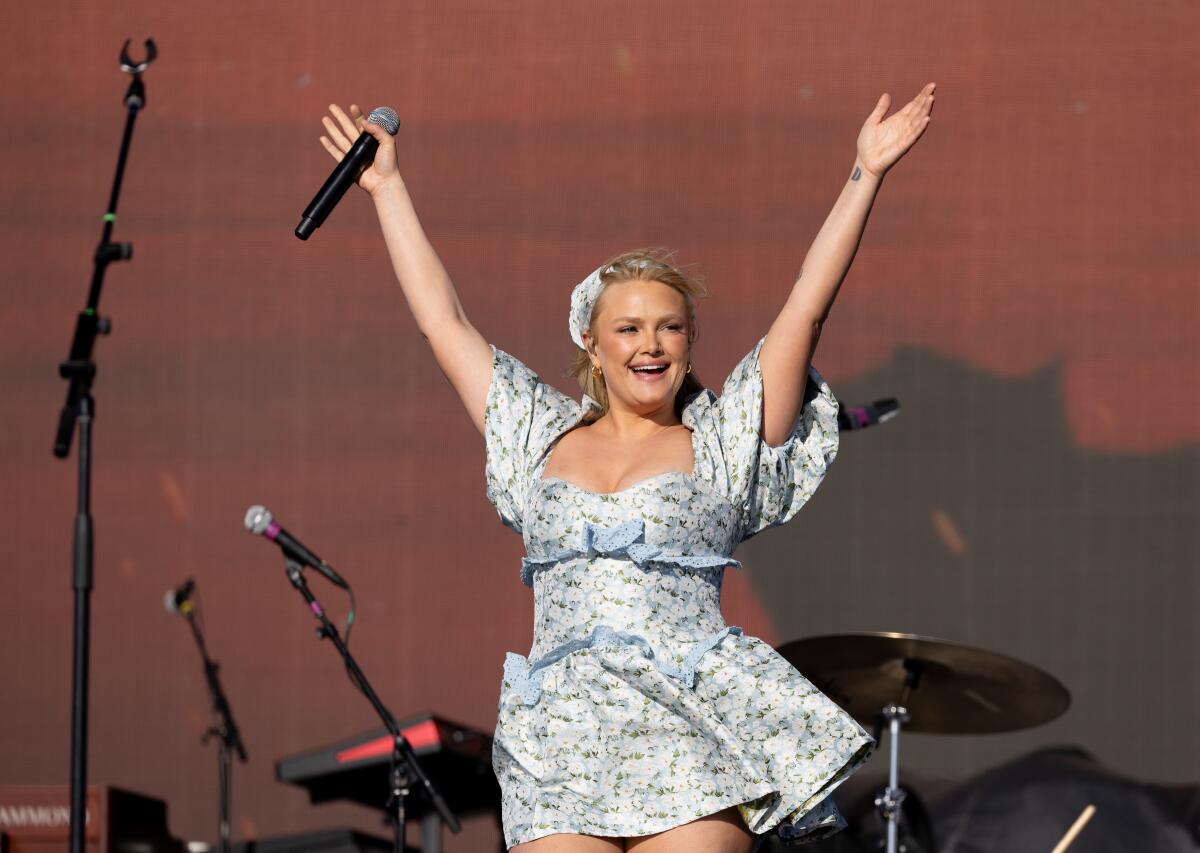
Hailey Whitters performs Friday on the Mane Stage at Stagecoach.
(Allen J. Schaben / Los Angeles Times)
Real Swiss Miss energy. — M.W.
Most stylish cowboy hat worn by an artist who also played Coachella: Carin León
The rootsy yet polished Mexican singer and songwriter was the first Spanish-language act to play a full set at Stagecoach, a sign of both his popularity and that of the regional Mexican music that also took him (and Mexico’s Peso Pluma) to Coachella this month. — M.W.
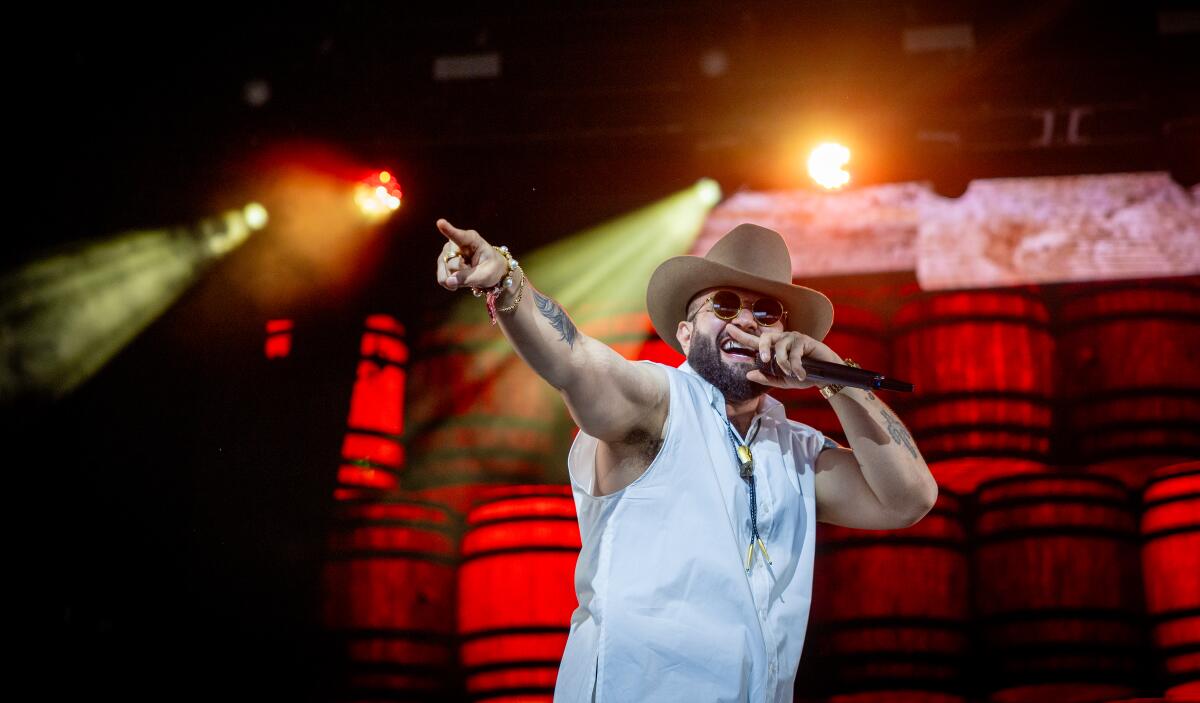
Carin León performs Friday on the Palomino Stage.
(Allen J. Schaben / Los Angeles Times)
Right where they belong
“Very strange to be playing a country festival,” Nickelback frontman Chad Kroeger said not long into the band’s late-night set, but it wasn’t really: Nashville has been absorbing Nickelback’s caveman-rock lessons for years, as Kroeger reminded us when he brought out Hardy (who shares Nickelback’s longtime producer, Joey Moi) to yowl his happily knuckle-dragging “Sold Out.” — M.W.


Train to Busan’s director is back with a new zombie movie, and Rotten Tomatoes reviews are pouring in. Here’s what critics are saying about Yeon Sang-ho’s Colony after its Cannes 2026 premiere.
What critics are saying about Colony in reviews
Director Yeon Sang-ho’s latest Korean zombie thriller Colony has drawn a range of reactions from critics following its Cannes 2026 premiere. The film stars Jun Ji-hyun as a professor trapped inside a sealed biotech facility after a rapidly mutating virus breaks out among conference attendees.
On the positive side, Joonatan Itkonen of Region Free called the film “clever and unexpected, if never quite scary,” praising it as “a thrilling zombie romp from one of the masters of the genre.” Juan Luis Caviaro of Espinof agreed it has “everything it takes to become another hit for Korean genre cinema,” while Nikki Baughan of Screen International noted that “as a modern zombie movie, Colony certainly has a satisfying bite.” Chris Bumbray of JoBlo called it “an epic return to zombie-form from the director of Train to Busan.”
Not all critics were convinced, however. Emma Kiely of Little White Lies felt the film’s concept “isn’t nearly revolutionary enough to hang a two-hour film on.” Ritesh Mehta of IndieWire observed that while “the deck he crafts is often masterful,” the film’s “communication lessons and memory of human loss don’t hit hard enough.” Jason Gorber of Next Best Picture was the harshest, calling the film “flawed and forgettable.”
Colony gets a strong score on Rotten Tomatoes
Despite the mixed opinions, Colony currently holds a Fresh score of 70% on Rotten Tomatoes based on 10 critic reviews. The majority of reviewers awarded the film 3 or 4 out of 5 stars, with praise centered on its creature design and relentless pacing.
With a limited U.S. theatrical release set for August 28, 2026 through Well Go USA Entertainment, the film’s solid Tomatometer score suggests it should appeal to fans of Korean action-horror. Colony may not reach the heights of Train to Busan, but the early critical consensus positions it as a worthy genre entry from a proven filmmaker.
Entertainment
‘Michael Jackson: The Verdict’ tackles 2005 trial that estate-approved ‘Michael’ did not touch
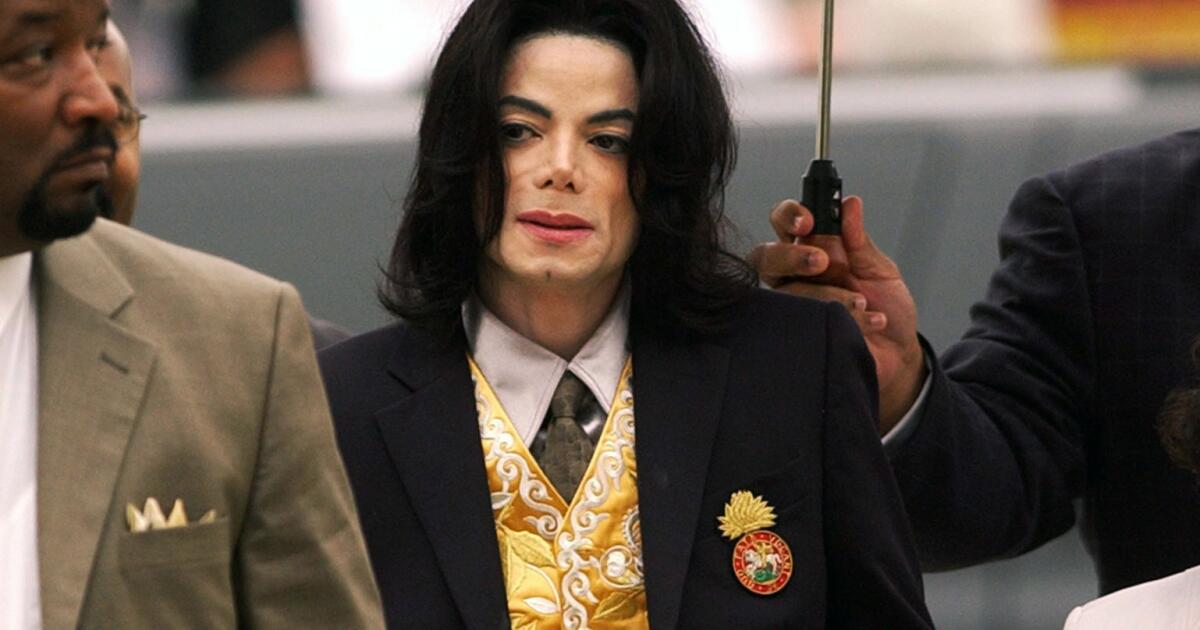
Netflix is dropping a three-part docuseries that revisits Michael Jackson’s 2005 trial in which he was acquitted on charges of child molestation.
“Michael Jackson: The Verdict” drops June 3 and features archival footage and interviews with key players involved in the trial including jurors, figures from both the defense and the prosecution, journalists who were inside the courtroom and other eyewitnesses who saw the events unfold firsthand.
“It has been 20 years since the trial of Michael Jackson in which he was found not guilty. Yet, to this day, controversy still rages,” the filmmakers said. “No cameras were allowed in court, and so the public’s view of the facts at the time were filtered by commentators and presented piecemeal. It was time to take a forensic look at the trial as a whole.
“Anyone interested in the Michael Jackson story should feel this documentary gives them a window into what was largely a closed event and a chance to feel closer to what happened.”
The Santa Barbara Superior Court trial lasted 14 weeks, and the jury, which included eight women and four men, deliberated for more than 30 hours across seven days.
Jackson was acquitted on 10 felony charges: four counts of child molestation, four counts of plying a minor with alcohol in order to molest him, one count of attempted child molestation and one count of conspiracy to hold the boy and his family captive at the Neverland Ranch. He faced more than 20 years in prison.
Produced by Candle True Stories, the production company behind Netflix’s “Untold: The Liver King,” and directed by Nick Green, “Michael Jackson: The Verdict,” comes at a time of renewed interest in the “King of Pop.”
The Jackson-estate-approved biopic “Michael” hit theaters last month, and depicts the origin story of the hitmaker from childhood through his upward trajectory to superstar status in the 1980s. Notably, the movie omitted the slew of allegations that followed Jackson from the ’90s until his death in 2009.

Boots Riley holds nothing back in his audacious, surrealist social satire “I Love Boosters.” The film is a go-for-broke expression of wild imagination and social consciousness that’s impossible not to admire for its wacky, bold vision, with teleporting, high fashion snobbery and pyramid schemes.
Here is a movie where we get Keke Palmer, Naomi Ackie and Taylour Paige leading a vigilante shoplifting operation, Demi Moore as a toxic girl boss, Don Cheadle as a sleazy lifestyle evangelist, Will Poulter as a fussy store manager and LaKeith Stanfield as a discount brand model with a strange accent and a hypnotizing stare. It sounds like fun, right? Like a raucous, madcap ride through the inequities of the fashion business from the executive suite, down to the retail store where the goods are sold and the Chinese factories where they’re made? And on a certain level it is all of that, but one thing it is not is very funny. “I Love Boosters” can be amusing and clever, but the laugh-out-loud comedy just isn’t quite there. And it doesn’t help that the film goes more off the rails as it progresses to a climax that is less rousing than mind-numbing.
The thing is, “I Love Boosters” does start on a strong, albeit minor key as we’re introduced to the Velvet Gang, Corvette (Palmer), Sade (Ackie) and Mariah (Paige) and their booster operation, stealing overpriced designer wares from high end stores and selling them for a steep discount on the street. There’s a kind of a Robin Hood sensibility to it all. Mariah calls it “Triple F,” or “Fashion Forward Filanthropy.” She knows how to spell philanthropy, she deadpans; This is branding.
But despite the colorful surroundings, there’s a pervasive hopelessness in this off-kilter world that looks a lot like our own. Corvette, particularly, feels outside of it all, as a woman who dreams of being a designer herself but is currently squatting in a closed fast food chicken shop and being haunted by a boulder of debt (like, literally). It doesn’t help that the founder she idolizes, Moore’s Christie Smith, has become obsessed with stopping the boosters. To Christie, a genius megalomaniac, they’re the big problem with her business and not the fact that her store employees are being paid a pittance and her factory employees even less. The people who work at the factories are also getting sick from sandblasting the denim. And yes, these are all real things.
Eiza González’s vaping Violeta becomes the face of the store employees forced to use their own paychecks to buy their uniforms. Poppy Liu’s Jianhu, who teleports herself from China to the Bay Area, is that for the factory workers. This oddball group of five women band together to get revenge against Christie. Again, this all sounds like it should be a fun time, but the film is too busy jumping around and throwing ideas and concepts at the screen (teleporting somehow the least distracting of them) for us to spend much time just hanging out with these vibrant personalities.
It is a crime that this is only Riley’s second produced movie. Though it might not reach the crackling heights of his debut, “Sorry to Bother You,” his imagination is still on fire. Unlike so much of what’s out there, “I Love Boosters” has both style and substance, which is worth something even if it doesn’t land perfectly (or capably inspire any kind of revolution). In a marketplace full of content and franchises, here is a filmmaker with something to say and an interesting way to say it.
“I Love Boosters,” a Neon release in theaters Friday, is rated R by the Motion Picture Association for “strong sexual content, brief drug use, nudity and language throughout.” Running time: 115 minutes. Two and a half stars out of four.
This image released by Neon shows, from left, Naomi Ackie, Taylour Paige, Poppy Liu and Keke Palmer in a scene from “I Love Boosters.” Credit: AP/Uncredited
-

 Los Angeles, Ca41 minutes ago
2 red-tailed hawk nestlings rescued after 63-foot fall in Santa Clarita
-

 Detroit, MI1 hour ago
Former Detroit Mayor Mike Duggan drops out of Michigan governor race
-

 San Francisco, CA1 hour ago
San Francisco Sheriff discusses security at houses of worship, pickpocket arrests
-

 Dallas, TX1 hour ago
3 Dallas Cowboys UDFAs Who Could Steal a Spot on 53-Man Roster
-

 Miami, FL1 hour ago
Man accused of following woman in his Tesla, exposing himself to her in South Miami
-

 Boston, MA2 hours ago
What’s happening in and around Boston during the World Cup
-

 Denver, CO2 hours ago
Denver weather: More sunshine, high plains storms
-

 Seattle, WA2 hours ago
The Status of Fare Evasion in Washington State

