Entertainment
The best moments of the 2024 BAFTA Awards that you might've missed — on-screen and off

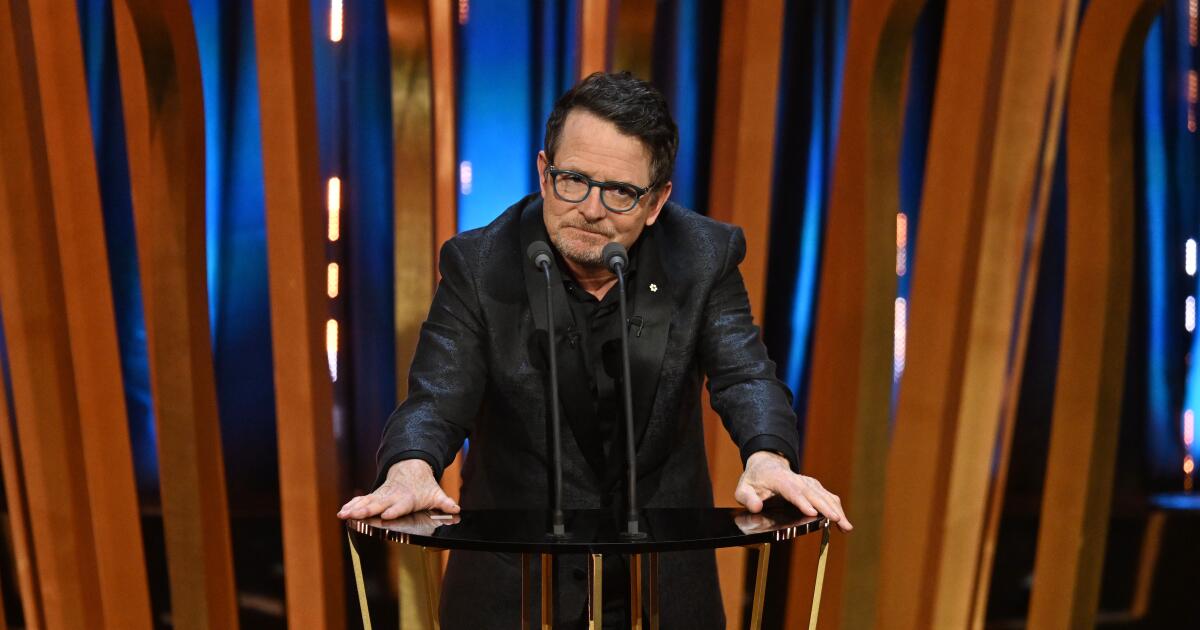
The 77th annual British Academy Film Awards have confirmed what pundits already know: “Oppenheimer” is the film to beat this year at the Oscars. Christopher Nolan’s opus scored for best film and director during tonight’s ceremony, held for the second year at London’s Royal Festival Hall. But while many of the winners were well-predicted, not everything that took place was quite so expected.
The BAFTAs satisfied with an amiable host, a pronounced focus on diversity and a celebration of British productions, including Jonathan Glazer’s “The Zone of Interest,” which, oddly, won both outstanding British film and film not in the English language (a first). The two-hour ceremony that aired on the BBC — as well as on BritBox streaming in the U.S. — was an edited version of what actually occurred in the room. What viewers at home didn’t see was plentiful, particularly as the cameras tended to focus on the nominees.
Here’s what happened behind the scenes of the BAFTAs.
A bit of housekeeping
After BAFTA attendees were properly lubricated at the pre-drinks reception, Royal Festival Hall staff had the unenviable task of herding them into the theater, where many continued to drink champagne out of paper cups. One of the last to be seated was Prince William, who arrived solo this year as the Princess of Wales is still recovering from recent surgery.
Before the show was properly underway, a few rules were laid out to the audience. One of most important notes (which was later ignored) was no clapping during the in memoriam segment. Another: “A camera could be looking at you even though you can’t see it.”
Sara Putt, Chair of BAFTA, then gave a short off-air speech, noting that the organization’s aim is to “champion talent, exceptional storytelling and make the screen industries a more equitable and sustainable place.” She referenced the recent WGA and SAG strikes, but noted a year of “stellar storytelling” from the film industry.
“It’s definitely been the most talked about awards season in years,” she said to applause. “Turbo-boosted by ‘Barbenheimer,’ audiences rediscovered cinema, seeking out the talked about films and discovering some lesser known gems.”
The real Bark Ruffalo
The BAFTAs were hosted by David Tennant.
(Joe Maher / BAFTA / Getty Images for BAFTA)
Scottish actor David Tennant (probably best known stateside for his vivid incarnation of the Doctor in “Doctor Who”) represents a younger, hipper host for the BAFTAs, which usually lean on stately icons to shepherd the evening along. He proved his comedic prowess with an opening bit about being obligated to dog-sit for Michael Sheen’s dog, Bark Ruffalo. After attempting to wrangle Dame Judy Dench and Tom Hiddleston into doing it for him, Tennant brought the dog along to the ceremony, arriving in the theater with a small white pup and its accessories in tow. To his (feigned) surprise, Sheen was in the front row, seated next to the “Saltburn” cast.
After handing Sheen the dog, Tennant joked that Bark Ruffalo was “actually being played by Andy Serkis” — who presented the first prize for original screenplay. “Playing Bark Ruffalo was, for me, a career highlight,” Serkis said on a roll, adding that many people will know the dog from “The Bone of Interest” and “Paw Things.”
The dog vanished backstage after the opening bit and, in fact, was not Sheen’s dog at all. Bark Ruffalo is actually a Maltese named Lilliput, who may be the first dog to get BAFTA accreditation, according to her manager Paula Stewart.
“Poor Things” sweep
Emma Stone and “Poor Things” had a good night, winning five awards including leading actress.
(Kate Green / BAFTA / Getty Images for BAFTA)
Early on, it became clear that Yorgos Lanthimos’ “Poor Things” had a grip on BAFTA voters, particularly in the crafts categories. The film triumphed in the second category bestowed, for special visual effects, to deafening applause and went on to win for costume design, makeup and hair and production design.
Many of the winners enthused about Lanthimos’ creative, risk-taking vision in their acceptance speeches, although the director himself didn’t win. Makeup artist Nadia Stacey credited Lanthimos for letting her team “go crazy,” while costume designer Holly Waddington described the film as an “experiment like no other.” Although BAFTA members don’t always vote in line with Academy, “Poor Things” just might prevail over “Barbie” at the Oscars.
Mr. Who?
Nick Mohammed appeared in character as his stage and TV character Mr. Swallow.
(Kate Green / BAFTA / Getty Images for BAFTA)
Fans of “Ted Lasso” may be aware of Nick Mohammed’s character, Mr. Swallow, but non-British audiences likely had no idea what was happening when the actor emerged onstage in roller skates. His appearance, billed as an interlude for the audience, brought a few jokes — and a perfect bathroom break. The theater literally thudded with the sound of high heels as attendees flooded out while Mohammed offered his own housekeeping notes, including a directive to “vacate in height order” in case of emergency. “We’re about 10 percent of the way through,” he told the crowd, most of whom were still on their way back from the toilets.
#BAFTAsNotSoWhite
Da’Vine Joy Randolph accepts the BAFTA award for supporting actress for her work in “The Holdovers.”
(Joe Maher / BAFTA / Getty Images for BAFTA)
BAFTA has come under fire in recent years for its lack of diversity, both in terms of nominees and winners. Last year, the entire winners pool was white, despite a major reform in 2020 to ensure more diversity in the acting categories and for the award of best British film. Finally, that effort paid off. Da’Vine Joy Randolph won supporting actress for “The Holdovers.” Through tears, she praised her character, noting “Mary is so much bigger than me. She showed us all what is possible when we look behind the differences.”
Later, Yasmin Afifi’s “Jellyfish and Lobster” won best British short film, Cord Jefferson scored a notch for “American Fiction’s” adapted screenplay (surprisingly beating Nolan) and Savanah Leaf’s “Earth Mama” was celebrated as outstanding debut by a British writer, director or producer. But it was writer and archivist June Givanni, honored with the outstanding British contribution to cinema award, who highlighted the importance of recognizing diverse voices — and earned a standing ovation from Ryan Gosling.
Another measure of change was the sign-language interpreter, who was filmed in one of the theater boxes for broadcast on the BBC throughout the ceremony. Less successful was an accessibility ramp, which was touted as an inclusive addition to ensure all winners could get up to the stage (there was also a set of stairs). Because the ramp was in front of the “Oppenheimer” cast and crew, many of its winners, including editor Jennifer Lame, hopped up the ramp awkwardly before giving their speeches. By the time Cillian Murphy won his leading actor award, he gracefully detoured to the stairs.
Politically inclined
In one of the evening’s most emotional moments, Samantha Morton accepted the BAFTA’s Fellowship Award, the highest accolade given, and spoke about her own childhood, dedicating her prize to “every child in care, or who has been in care, who is suffering or didn’t survive.”
(Kate Green / BAFTA / Getty Images for BAFTA)
The presenters and winners kept their political statements to a minimum this year, with almost no references to global events and literally none about the British government. But “The Zone of Interest” producer Jim Wilson, accepting the award for film not in the English language alongside director Jonathan Glazer, took the opportunity to reflect on the film’s themes in parallel with current conflicts.
“A friend wrote me after seeing the film the other day that he couldn’t stop thinking about the walls we construct in our lives which we chose not to look behind,” Wilson said. He added that “we should care about innocent people being killed in Gaza or Yemen in the same way we think about innocent people killed in Mariupol or in Israel.” The cheers from the audience were so loud Wilson repeated the line, saying, “Thank you for recognizing a film that asks you to think in those spaces.”
Last year, director Daniel Roher’s “Navalny” won for documentary, prompting Tennant to reference the film and the recent death of its subject, Alexey Navalny, before bringing Taylor Russell out to announce this year’s winner. Accepting the award, “20 Days in Mariupol” filmmaker Mstyslav Chernov took the moment to draw attention to the present situation in Ukraine. “The only comfort for me is that we give voice to Ukrainians,” he said, somberly. “We keep reminding the world of what’s happening there.”
Later in the evening, Samantha Morton received the BAFTA Fellowship, the British Academy’s highest honor. Morton’s “Minority Report” co-star Tom Cruise paid tribute to her during a clip recapping her storied career, but it was Morton’s speech that caught the audience’s attention. Morton, who grew up in foster care, used the platform to recognize children growing up in poverty, recalling her own experience of being “cold” and “hungry.”
“Film changed my life, it transformed me and it led me here today,” she said, noting that watching Ken Loach’s essential 1969 drama “Kes” in school allowed her to see herself on-screen. “I dedicate this award to every child in care, or who has been in care, who is suffering or didn’t survive.” As Morton choked up, so did those in the crowd.
In memoriam
The aforementioned rule about not clapping during the in memoriam segment? The audience attempted to be respectful as Hannah Waddingham sang a beautiful rendition of “Time After Time.” However, a few guests clapped and cheered when Tina Turner flashed on-screen. For everyone else: respectful silence.
Most supportive actors
Sophie Ellis-Bextor, center, performs her hit “Murder on the Dance Floor” during the EE BAFTA Film Awards.
(Joe Maher / BAFTA / Getty Images for BAFTA)
Speaking of Gosling, the “Barbie” standout may not have won supporting actor, but he was certainly the most supportive of the night. Gosling, seated in the front row near Prince William, spent the evening cheering on his fellow nominees and offering standing ovations for many. He was one of the first to stand for “The Holdovers” star Randolph and he offered Emma Stone a congratulatory squeeze as she passed by to accept the award for leading actress.
Across the aisle, “Saltburn” star Archie Madekwe was similarly supportive. He and director Emerald Fennell leapt to their feet after Sophie Ellis-Bextor’s dynamic performance of “Murder on the Dancefloor” and he was visibly excited for “How to Have Sex” breakout Mia McKenna-Bruce when she was named the EE BAFTA Rising Star.
The biggest standing ovation of the night came at the show’s end as Tennant announced that Michael J. Fox would present the award for best film — much to the surprise of the audience. The entire room got on their feet as Fox was wheeled onstage and then stood behind the podium. It felt genuinely celebratory — and generous, particularly as the actor’s documentary, “Still: A Michael J. Fox Movie,” lost to Oscar frontrunner “20 Days in Mariupol.”
The afterparty
Following the three-hour ceremony, attendees made their way to more than 150 dinner tables inside Southbank Centre. Each was decorated with a themed centerpiece for one of the nominated films (the press table was “Poor Things”). Many people stayed for the official afterparty, held in the building next door, where the highlight was a saxophone player wearing a dog mask who accompanied the DJ’s selections. The song that really got the crowd going though? “Murder on the Dancefloor,” of course.
A complete list of tonight’s winners
Best Film: “Oppenheimer”
Director: Christopher Nolan, “Oppenheimer”
Leading Actress: Emma Stone, “Poor Things”
Leading Actor: Cillian Murphy, “Oppenheimer”
Supporting Actress: Da’Vine Joy Randolph, “The Holdovers”
Supporting Actor: Robert Downey Jr., “Oppenheimer”
Outstanding British Film: “The Zone of Interest”
Outstanding Debut by a British Writer, Director or Producer: “Earth Mama”
Film Not in the English Language: “The Zone of Interest”
Documentary: “20 Days In Mariupol”
Animated Film: “The Boy And The Heron”
Adapted Screenplay: Cord Jefferson, “American Fiction”
Original Screenplay: Justine Triet and Arthur Harari, “Anatomy of a Fall”
Original Score: Ludwig Göransson, “Oppenheimer”
Costume Design: Holly Waddington, “Poor Things”
Production Design: Shona Heath, James Price and Zsuzsa Mihalek, “Poor Things”
Special Visual Effects: Tim Barter, Simon Hughes, Dean Koonjul and Jane Paton, “Poor Things”
Makeup & Hair: Nadia Stacey, Mark Coulier and Josh Weston, “Poor Things”
Editing: Jennifer Lame, “Oppenheimer”
Cinematography: Hoyte van Hoytema, “Oppenheimer”
Casting: Susan Shopmaker, “The Holdovers”
Sound: Johnnie Burn and Tarn Willers, “The Zone of Interest”
British Short Animation: “Crab Day”
British Short Film: “Jellyfish and Lobster”
EE Rising Star: Mia Mckenna-Bruce



Entertainment
Commentary: From late-night TV to viral memes, Kristi Noem was the gag that kept on giving. What now?

A moment of silence for all the comedians, late-night-show writers, political satirists, memers, animators and random influencers who just lost a wealth of inspiration.
Kristi Noem, Homeland Security secretary, was fired Thursday by President Trump, ending the 13-month tenure of a political figure whose bravado, cruelty, incompetence and commando cosplay inspired more wickedly funny material than Dick Cheney, Sarah Palin and Sean Spicer combined.
Social media’s so-called ICE Barbie, the first Cabinet secretary to leave the Trump administration during the president’s second term, was a font of material for “South Park,” “SNL,” late night and thousands more sketch artists, impersonators, musicians and everyday trash posters. She never disappointed, unless you were looking to her for feasible, humane immigration policy enforcement.
Former Homeland Security Secretary Kristi Noem.
(Julia Demaree Nikhinson / Associated Press)
Drama and spectacle marked her brief career, from posing in front of a packed holding cell at El Salvador’s maximum security prison CECOT, where the DHS had shipped and detained deportees, to casting herself as an agent of action in multiple ICE raid videos. Donning a big gun and long, flowing locks of hair, she insinuated herself into operations, vamping for the camera in a bulletproof vest while masked agents rounded up fellow humans like cattle.
Grim, to be sure, but at least she contributed a shred of comic relief (unintended, of course) to our new, sad reality of federal agents invading American cities and abducting people off the streets, out of their cars and from their homes.
“South Park” skewered Noem in unprintable ways. “SNL” brought back Tina Fey to play Noem. Dressed in a lavender pantsuit, too much makeup and brandishing a massive firearm, she introduced herself as “the rarest type of person in Washington, D.C.: a brunette that Donald Trump listens to.”
The endless stream of memes across social media date back to 2024, when in her memoir Noem recalled shooting and killing her 14‑month‑old dog, a wirehaired pointer named Cricket, after deciding the dog was “untrainable.” Gov. Gavin Newsom later trolled the DHS and Noem with a meme captioned “Kristi Noem’s Dog Obedience School: She’ll Treat Them As Good As She Treats Brown People.” The mock ad featured a smiling woman holding a gun and kneeling beside a dog.
If it seems cruel, consider that the DHS posted holiday-themed deportation memes around Christmas, proclaiming that federal agents were stepping up removals “for the holidays,” with a “holiday deal” offering a free flight and $1,000 to those who self-deport. One X post featured an AI-generated image of federal agents in Santa hats with the caption, “YOU’RE GOING HO HO HOME.”
Noem’s dismissal comes on the heels of two congressional hearings this week where she was questioned about her response to the ICE killings of U.S. citizens Renee Good and Alex Pretti in Minneapolis (she incorrectly called Good a domestic terrorist and claimed Pretti was involved in an act of domestic terrorism). She was grilled about the department spending $172 million for the purchase of two jets, the nature of her relationship with top DHS adviser Corey Lewandowski, and her $220-million DHS ad campaign starring none other than Kristi Noem. She testified in the hearings that Trump approved the ads. He said he knew nothing about them.
Her firing triggered an immediate rush of snarky content across social media, and a sharp a comment or two from prominent politicians. “Shouldn’t let the door hit her on the way out,” said Illinois Democratic Gov. JB Pritzker.
But all is not lost for those needing a laugh at Noem’s expense, or at the expense of the DHS, for that matter. The president said Thursday that Noem would take on a new, freshly invented role: Envoy for The Shield of the Americas. He described the position as one that will lead “our new Security Initiative in the Western Hemisphere.” The job title and description already sound like the basis for a villainous political satire, without even trying.
And for the new guy taking the post? He’s Sen. Markwayne Mullin (R-Okla.), a former MMA fighter. Let the memes begin …
Movie Reviews
Is ‘Josie and the Pussycats’ (2001) Really Even A Rock N Roll Movie? (FILM REVIEW) – Glide Magazine

The satirical romp Josie and the Pussycats (2001) is a fun movie. But is it a great rock ‘n’ roll movie?
Eh, not so fast on that second one. Welcome back to Glide’s quest for what makes a good rock ‘n’ roll movie. Last month, we looked at Almost Famous, a great launching pad because it gets so much right. And every first Friday, we’ll take another look at a rock ‘n’ movie and ask what it means in the larger pantheon. This month, the Glide’s screening room brings you Josie and the Pussycahttps://glidemagazine.com/322100/almost-perfect-why-almost-famous-sets-the-gold-standard-for-rock-movies/ts. The film is a live-action take on the classic comic-and-cartoon property of a sugary, all-girl rock trio that exists in the world of Riverdale, a.k.a. fictional home of the iconic Archie Andrews.
But this Josie has next to nothing to do with Riverdale and is instead a satire of consumerism and ’00s boy bands. A worthy target, and a topic that has stayed worthy in the quarter-century since Josie dropped. The film was not a hit, but it has become something of a cult classic (like many movies featured in this series).
The plot is fairly simple. Wyatt Frame, an evil corporate type, is making piles of money off boy band Du Jour. They start to wise up to his evil scheme and have to be… taken care of. Frame needs a new group to front his plot, which revolves around mind control to push consumer culture. Enter Josie and the Pussycats, who are about to have a whirlwind ride to the top. And along the way, foil a plot with tentacles so far-reaching they have ensnared… Carson Daly?
Josie is a fun, clever movie, but it doesn’t have a whole lot to say about real rock ‘n’ roll, unless you want to simply accept a perspective that it’s just another cynical consumer-driven product. Even that is an argument that can be made, as long as you’re willing to ignore underground and indie scenes and passionate artists making amazing music.
And it is true that this is a theme of Josie. The band triumphs at the end via their authentic music. But it somehow doesn’t feel authentic, which makes it something of a hollow victory. Let’s consider the criteria already established for a good rock ‘n’ roll movie, and how Josie delivers on that front. The first is in the characters department. The film dodges the previously established Buckethead Paradox, which states that “The real-life rock stars are so much larger than life that you can’t make up credible fictional versions. There is no way someone like Buckethead would come out of a writer’s room and make it to a screen.”
For better or worse, Josie dodges the Paradox by essentially embracing it. The characters themselves are cartoons, and there’s no effort at realism. Given that intent is a huge part of art, it seems unfair to call these characters “cartoons” as a criticism, and it should probably be a compliment. At the same time, they aren’t particularly memorable, which is not a great quality.
And—as a bonus—Tara Reid is perfectly cast as drummer Melody Valentine. Josie was a few years after her turn in Around the Fire (1998), an unintentionally hilarious classic that plays like a jam band afterschool special from the producers of Reefer Madness (look for this amazing film in an upcoming piece).
The acting in general is good, with Rachel Leigh Cook as Josie McCoy and Rosario Dawson as bassist Valerie Brown rounding out the band. And Alan Cumming almost steals the show as sleazy corporate weasel Wyatt Frame.
The character of Wyatt is the film’s funniest riff on a rock ‘n’ roll archetype: the sleazy, corporate manager accompanied by assorted crooked accountants. From Colonel Tom Parker to Albert Grossman to The Great Rock ‘n’ Roll Swindle. It’s all about the benjamins. Which is where the music comes in. If the music is good, that’s what makes it worth it. And Josie’s music has aged particularly well. It’s well-recorded, produced and executed. The songs are particularly catchy. The vocals are by Kay Hanley of Letters to Cleo. Much of the soundtrack sounds like a lost album from The Muffs, and one wonders why Kim Shattuck wasn’t involved.
There’s an argument that power pop was never supposed to be dangerous, and that the Muffs aren’t dangerous either. Fair on the surface, but they played real punk clubs and came from a real scene. There’s not even a hint of that in Josie. So an argument that they play pop punk (which they kinda do) is really lacking the punk part.
And it was produced by Babyface, of all people. While that doesn’t seem like it should lead to great rock ‘n’ roll, sometimes preconceptions are wrong.
That said, this is a very commercial product and sound—as catchy as it is—so maybe it’s not a misconception. Maybe the right question to ask is whether it’s all too perfect? And that’s what gives this ostensibly rock ‘n’ film a smoothed-down edge? After all, the basic ingredients are there. But part of what makes good rock good is that it feels actually dangerous. Maybe there are some actual subversive messages, or a genuine counterculture scene. And Josie simply isn’t that film. The soundtrack is fondly remembered enough that Hanley appeared live and performed the songs at a screening in 2017. That appearance also included the film’s stars Cook, Dawson and Reid.
It’s worth noting that while Cook and company obviously lip sync to the songs in the film, their performances are credible. They went through instrument boot camp, so they pull off the parts.
In the end, the film is primarily a satire of consumer culture. And even more strangely, is loaded with actual product placement. Clearly, the joke was intended to “hit harder” with real products, but having Target in the film constantly makes it feel like more of what it is parodying than a parody. Where’s the joke if the viewer actually pushes to shop at Target while watching the film? And if the filmmakers actually took money (which they almost certainly did)?
And perhaps that is the lesson for this month: a great rock ‘n’ roll movie needs to have something to say about the larger meaning or culture of the music. And while Josie may have a lot to say about culture in general, and it may say it in a fun and likeable way, it’s just not very rock ‘n’ roll. There’s no grit. Now, does it have some things to say about being in a band? Yes, though they are arguably true of most collaborations.
If someone in a hundred years wanted to understand early 21st century rock, Josie and the Pussycats is a bad choice. It doesn’t show the sweat of a performance or the smell of beer. But it’s a great choice for anyone looking for a light-hearted, fun watch with a great soundtrack. We could all use some sugar in our lives these days.
Join us again next month, when we’ll look at one of the inspirations for Josie, A Hard Day’s Night, the legendary first film from The Beatles
Entertainment
Commentary: As ‘The Pitt’ suffers a digital meltdown, a human with analog experience saves the day
This article contains spoilers for Season 2, Episode 9 of “The Pitt.”
Midway through Season 2, “The Pitt” has taken on the perils of the digital age and given me a reason to love the show as much as everyone else does.
Don’t get me wrong — I understand perfectly why so many people, including recent Emmy and Golden Globe voters, have lost their minds over the HBO Max medical drama: The propulsive day-in-the-life of a Pittsburgh ER conceit, the dazzling ensemble cast, the writers’ heroic attempts to showcase our perilously broken healthcare system, the healing power of empathy and, of course, the Noah Wyle-ness of it all. His brilliant and gentle-voiced Dr. Michael “Robby” Robinavitch is as aspirational a character on television as we’ve ever seen.
But having recently spent almost six hours passing out and vomiting from pain in the waiting room of my local ER (which was empty except for one other man), while being told there was nothing anyone could do until the next shift arrived, I confess I have watched “The Pitt” with a jaundiced eye. The regular crowd shots of the waiting room too often reduce the afflicted into a zombie-like horde bent on making life more difficult for our beloved medical staff.
Sure it’s tough to work in an ER when you are worried about your mother’s expectations, grieving your dead mentor, struggling with addiction or worrying about your sister, but no doubt many of those in the waiting room are experiencing similar issues while also in terrifying and hideous pain.
I’m just saying.
In this second season, however, “The Pitt” gave me reason to cheer. It chronicles the day before Robby is set to leave on a three-month sabbatical, and in the early hours, we meet his temporary replacement, Dr. Baran Al-Hashimi (Sepideh Moafi). Having already attempted to force those suffering in waiting rooms to create their own “patient portals,” Dr. Al-Hashimi goes on to advocate for an AI-supported system to aid the doctors with pesky paper work.
Robby, of course, does not think any of this is a good idea and since he is always right (and no television writer is going to openly promote AI), her plan backfires almost immediately. First, with a medical notes transcription that gets Very Important words wrong and then after a complete digital blackout.
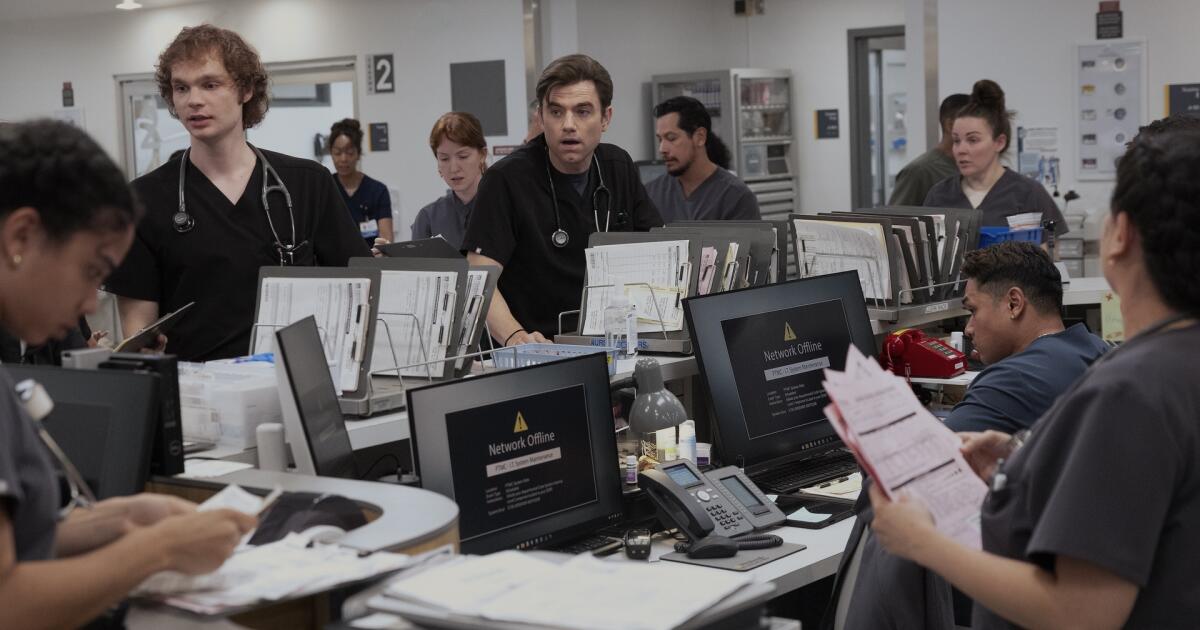
After a nearby hospital is hacked and ransomed, the higher-ups decide to defend its system by shutting it down, which means business must be conducted in the old-fashioned, paper-and-clipboards way.
The result is chaos, and a few too many jokes about young people not knowing how to work a fax machine or manage paper. Some of the more seasoned staff, including and especially the indefatigable charge nurse Dana Evans (Katherine LaNasa), remember the days before everyone carried an iPad well enough to keep things moving. Even so, Dana wisely calls upon the services of “retired” clerk Monica Peters (Rusty Schwimmer).
When the computer system at the Pitt is shut down, Dana (Katherine LaNasa), center, calls in Monica (Rusty Schwimmer), far right, who arrives to help.
(Warrick Page / HBO Max)
“Laid off by the digital revolution, not retired,” Monica corrects her. “And how’s all this digital s— working out for you now?”
This is where I cheered. I love the digital world as much as the next person currently typing on a computer to file a story that I have discussed with my editors on Slack and that I will not see in hard copy until it appears in the physical paper. But like pretty much everyone, I have suffered all manner of digital breakdowns and mix-ups, not to mention the inevitably increased workload that comes with the perception that I can do the work of previous multitudes with a few additional strokes of a keypad.
Except, of course, that’s a lie — a keypad is capable of nothing on its own. Neither are fingers, for that matter. They must be manipulated by someone whose brain has to figure out and execute whatever needs to be done. This requires an ability to navigate the ever-changing tech systems that store and distribute information (often in ways that are not at all intuitive) while also understanding the essentials of the actual work being done.
In “The Pitt,” that is the emergency medical treatment of human beings, which requires all manner of physical tasks. As this storyline makes clear, many of the medical staff do not quite understand how to order or handle these tasks without a screen to guide them.
Hence the need for Monica, representative of a large number of support workers who do understand because it was once their job to keep everything moving, to answer all manner of questions, prioritize what needs to be fast-tracked and make sure nothing falls through the cracks while also engaging with all and sundry on a human level.
The shutdown is obviously an attempt to underline the limits of AI but it also serves as a fine and necessary reminder of how readily we have surrendered people like Monica, with their knowledge and experience, to keyboards and touch pads (which, of course, don’t require salaries, benefits or lunch breaks).
But — and this is important — computers are tools not workers. Alas, that has not kept companies in virtually every industry from drastically cutting back on trained and experienced employees and handing large portions of their work (mental if not physical) to people, in this case doctors and nurses, who already have demanding jobs of their own.
But hey, you get a company iPad!

Nurse Dana (Katherine LaNasa), left, and Dr. Baran Al-Hashimi (Sepideh Moafi) have to resort to paper, clipboards and white boards to keep track of patients after the hospital’s systems are shut down.
(Warrick Page / HBO Max)
Often, including with those patient portals, what was once paid labor lands in the lap of the consumers, who in “The Pitt” are people sitting in an emergency room and likely not at the top of their game when it comes to filling out forms about their medical history or coming up with a unique password.
ER dramas, like the “The Pitt,” are inevitably fueled by the tension between the demands for speed and the need for humane care, something that is increasingly true, if not as intrinsically necessary, in all facets of our culture.
With computers in our pockets, we now expect everything to be available instantly. But when something in our online experience goes wrong, we need an actual human to help us fix it. Unfortunately, as the overwhelmed staff of the Pitt discover, those people are increasingly difficult to find because they have been laid off — even nurse Dana can’t do everything!
Dr. Al-Hashimi, like many, believes that patient portals and AI-assisted medical notes will save time, allowing the doctors and nurses to spend more of that precious commodity with their patients. But, as Dr. Robby and Dana repeatedly argue, what they really need is more staff.
There’s no point in saving a few minutes at the admittance window, or on an app, if you are then going to have to spend hours waiting for or trying to find someone who can actually help you when you need it.
That is certainly true in the medical sector, where digital technology has done little to eradicate long wait times for medical appointments or in emergency rooms. Being treated in a hospital hallway by people who can barely stop to talk to you is not an uncommon occurrence for many Americans. The U.S. is facing a critical shortage in hospital staff, with the ranks of registered nurses and other medical personnel having plummeted post-pandemic, often due to burn out.
The amount of time the staff of “The Pitt” spend with each patient, while dramatically satisfying, is almost as aspirational as the wisdom and goodness of Dr. Robby.
None of these problems is going to be solved by AI or any other “time-saving” device. We have not, as far as I know, figured out a way to extend an hour beyond 60 minutes or modified the human body so that it does not require seven to nine hours of sleep each night.
Medical institutions aside, I can’t think of any place I have visited lately that wouldn’t have benefited from more paid and experienced workers, especially those who know how to do things when computers glitch or fail.
The minute Monica sits down and starts barking orders in the ER, everyone feels much better. Here is someone who understands what needs to be done, why, and how to make it happen. Moreover, she has eyes, ears, hands and human experience enough to know that, in the end, people are less interested in saving time than getting the care they need.
In the ER and everywhere else.

Brain aging may accelerate after cancer treatment, study suggests

Chargers’ Justin Herbert gushes over Madison Beer in heartfelt birthday tribute: ‘Changed my life forever’

AI T-shirt could detect hidden heart risks

Labubu maker Pop Mart is opening U.S. headquarters in Culver City
Commentary: From late-night TV to viral memes, Kristi Noem was the gag that kept on giving. What now?

Florida High School Football Rankings: Top 25 teams – Oct. 21

Cleary's 21 help Le Moyne down Central Connecticut State 69-64 in OT

How old is Bo Nix? What to know about Oregon quarterback ahead of 2024 NFL Draft

99th annual Pony Swim held in Virginia

Indiana Members Credit Union announced as new anchor tenant at Bottleworks District

‘No deal with Iran except unconditional surrender,’ Trump says

A dead woman’s key fob and two grisly crime scenes: How the Utah triple-murder suspect was tracked across state lines | CNN

DOJ continues Biden autopen probe despite former president unlikely to face charges
Fact check: Did French border guards mock influencers returning from Dubai amid Iran war?

Iran’s fight for survival / The widening war / Trump’s nebulous goals : Sources & Methods
-

 World1 week ago
Exclusive: DeepSeek withholds latest AI model from US chipmakers including Nvidia, sources say
-

 Wisconsin4 days ago
Setting sail on iceboats across a frozen lake in Wisconsin
-

 Massachusetts3 days ago
Massachusetts man awaits word from family in Iran after attacks
-

 Massachusetts1 week ago
Mother and daughter injured in Taunton house explosion
-

 Maryland5 days ago
AM showers Sunday in Maryland
-

 Florida5 days ago
Florida man rescued after being stuck in shoulder-deep mud for days
-

 Denver, CO1 week ago
10 acres charred, 5 injured in Thornton grass fire, evacuation orders lifted
-

 Oregon7 days ago
2026 OSAA Oregon Wrestling State Championship Results And Brackets – FloWrestling