Entertainment
The best moments of the 2024 BAFTA Awards that you might've missed — on-screen and off

The 77th annual British Academy Film Awards have confirmed what pundits already know: “Oppenheimer” is the film to beat this year at the Oscars. Christopher Nolan’s opus scored for best film and director during tonight’s ceremony, held for the second year at London’s Royal Festival Hall. But while many of the winners were well-predicted, not everything that took place was quite so expected.
The BAFTAs satisfied with an amiable host, a pronounced focus on diversity and a celebration of British productions, including Jonathan Glazer’s “The Zone of Interest,” which, oddly, won both outstanding British film and film not in the English language (a first). The two-hour ceremony that aired on the BBC — as well as on BritBox streaming in the U.S. — was an edited version of what actually occurred in the room. What viewers at home didn’t see was plentiful, particularly as the cameras tended to focus on the nominees.
Here’s what happened behind the scenes of the BAFTAs.
A bit of housekeeping
After BAFTA attendees were properly lubricated at the pre-drinks reception, Royal Festival Hall staff had the unenviable task of herding them into the theater, where many continued to drink champagne out of paper cups. One of the last to be seated was Prince William, who arrived solo this year as the Princess of Wales is still recovering from recent surgery.
Before the show was properly underway, a few rules were laid out to the audience. One of most important notes (which was later ignored) was no clapping during the in memoriam segment. Another: “A camera could be looking at you even though you can’t see it.”
Sara Putt, Chair of BAFTA, then gave a short off-air speech, noting that the organization’s aim is to “champion talent, exceptional storytelling and make the screen industries a more equitable and sustainable place.” She referenced the recent WGA and SAG strikes, but noted a year of “stellar storytelling” from the film industry.
“It’s definitely been the most talked about awards season in years,” she said to applause. “Turbo-boosted by ‘Barbenheimer,’ audiences rediscovered cinema, seeking out the talked about films and discovering some lesser known gems.”
The real Bark Ruffalo
The BAFTAs were hosted by David Tennant.
(Joe Maher / BAFTA / Getty Images for BAFTA)
Scottish actor David Tennant (probably best known stateside for his vivid incarnation of the Doctor in “Doctor Who”) represents a younger, hipper host for the BAFTAs, which usually lean on stately icons to shepherd the evening along. He proved his comedic prowess with an opening bit about being obligated to dog-sit for Michael Sheen’s dog, Bark Ruffalo. After attempting to wrangle Dame Judy Dench and Tom Hiddleston into doing it for him, Tennant brought the dog along to the ceremony, arriving in the theater with a small white pup and its accessories in tow. To his (feigned) surprise, Sheen was in the front row, seated next to the “Saltburn” cast.
After handing Sheen the dog, Tennant joked that Bark Ruffalo was “actually being played by Andy Serkis” — who presented the first prize for original screenplay. “Playing Bark Ruffalo was, for me, a career highlight,” Serkis said on a roll, adding that many people will know the dog from “The Bone of Interest” and “Paw Things.”
The dog vanished backstage after the opening bit and, in fact, was not Sheen’s dog at all. Bark Ruffalo is actually a Maltese named Lilliput, who may be the first dog to get BAFTA accreditation, according to her manager Paula Stewart.
“Poor Things” sweep
Emma Stone and “Poor Things” had a good night, winning five awards including leading actress.
(Kate Green / BAFTA / Getty Images for BAFTA)
Early on, it became clear that Yorgos Lanthimos’ “Poor Things” had a grip on BAFTA voters, particularly in the crafts categories. The film triumphed in the second category bestowed, for special visual effects, to deafening applause and went on to win for costume design, makeup and hair and production design.
Many of the winners enthused about Lanthimos’ creative, risk-taking vision in their acceptance speeches, although the director himself didn’t win. Makeup artist Nadia Stacey credited Lanthimos for letting her team “go crazy,” while costume designer Holly Waddington described the film as an “experiment like no other.” Although BAFTA members don’t always vote in line with Academy, “Poor Things” just might prevail over “Barbie” at the Oscars.
Mr. Who?
Nick Mohammed appeared in character as his stage and TV character Mr. Swallow.
(Kate Green / BAFTA / Getty Images for BAFTA)
Fans of “Ted Lasso” may be aware of Nick Mohammed’s character, Mr. Swallow, but non-British audiences likely had no idea what was happening when the actor emerged onstage in roller skates. His appearance, billed as an interlude for the audience, brought a few jokes — and a perfect bathroom break. The theater literally thudded with the sound of high heels as attendees flooded out while Mohammed offered his own housekeeping notes, including a directive to “vacate in height order” in case of emergency. “We’re about 10 percent of the way through,” he told the crowd, most of whom were still on their way back from the toilets.
#BAFTAsNotSoWhite
Da’Vine Joy Randolph accepts the BAFTA award for supporting actress for her work in “The Holdovers.”
(Joe Maher / BAFTA / Getty Images for BAFTA)
BAFTA has come under fire in recent years for its lack of diversity, both in terms of nominees and winners. Last year, the entire winners pool was white, despite a major reform in 2020 to ensure more diversity in the acting categories and for the award of best British film. Finally, that effort paid off. Da’Vine Joy Randolph won supporting actress for “The Holdovers.” Through tears, she praised her character, noting “Mary is so much bigger than me. She showed us all what is possible when we look behind the differences.”
Later, Yasmin Afifi’s “Jellyfish and Lobster” won best British short film, Cord Jefferson scored a notch for “American Fiction’s” adapted screenplay (surprisingly beating Nolan) and Savanah Leaf’s “Earth Mama” was celebrated as outstanding debut by a British writer, director or producer. But it was writer and archivist June Givanni, honored with the outstanding British contribution to cinema award, who highlighted the importance of recognizing diverse voices — and earned a standing ovation from Ryan Gosling.
Another measure of change was the sign-language interpreter, who was filmed in one of the theater boxes for broadcast on the BBC throughout the ceremony. Less successful was an accessibility ramp, which was touted as an inclusive addition to ensure all winners could get up to the stage (there was also a set of stairs). Because the ramp was in front of the “Oppenheimer” cast and crew, many of its winners, including editor Jennifer Lame, hopped up the ramp awkwardly before giving their speeches. By the time Cillian Murphy won his leading actor award, he gracefully detoured to the stairs.
Politically inclined
In one of the evening’s most emotional moments, Samantha Morton accepted the BAFTA’s Fellowship Award, the highest accolade given, and spoke about her own childhood, dedicating her prize to “every child in care, or who has been in care, who is suffering or didn’t survive.”
(Kate Green / BAFTA / Getty Images for BAFTA)
The presenters and winners kept their political statements to a minimum this year, with almost no references to global events and literally none about the British government. But “The Zone of Interest” producer Jim Wilson, accepting the award for film not in the English language alongside director Jonathan Glazer, took the opportunity to reflect on the film’s themes in parallel with current conflicts.
“A friend wrote me after seeing the film the other day that he couldn’t stop thinking about the walls we construct in our lives which we chose not to look behind,” Wilson said. He added that “we should care about innocent people being killed in Gaza or Yemen in the same way we think about innocent people killed in Mariupol or in Israel.” The cheers from the audience were so loud Wilson repeated the line, saying, “Thank you for recognizing a film that asks you to think in those spaces.”
Last year, director Daniel Roher’s “Navalny” won for documentary, prompting Tennant to reference the film and the recent death of its subject, Alexey Navalny, before bringing Taylor Russell out to announce this year’s winner. Accepting the award, “20 Days in Mariupol” filmmaker Mstyslav Chernov took the moment to draw attention to the present situation in Ukraine. “The only comfort for me is that we give voice to Ukrainians,” he said, somberly. “We keep reminding the world of what’s happening there.”
Later in the evening, Samantha Morton received the BAFTA Fellowship, the British Academy’s highest honor. Morton’s “Minority Report” co-star Tom Cruise paid tribute to her during a clip recapping her storied career, but it was Morton’s speech that caught the audience’s attention. Morton, who grew up in foster care, used the platform to recognize children growing up in poverty, recalling her own experience of being “cold” and “hungry.”
“Film changed my life, it transformed me and it led me here today,” she said, noting that watching Ken Loach’s essential 1969 drama “Kes” in school allowed her to see herself on-screen. “I dedicate this award to every child in care, or who has been in care, who is suffering or didn’t survive.” As Morton choked up, so did those in the crowd.
In memoriam
The aforementioned rule about not clapping during the in memoriam segment? The audience attempted to be respectful as Hannah Waddingham sang a beautiful rendition of “Time After Time.” However, a few guests clapped and cheered when Tina Turner flashed on-screen. For everyone else: respectful silence.
Most supportive actors
Sophie Ellis-Bextor, center, performs her hit “Murder on the Dance Floor” during the EE BAFTA Film Awards.
(Joe Maher / BAFTA / Getty Images for BAFTA)
Speaking of Gosling, the “Barbie” standout may not have won supporting actor, but he was certainly the most supportive of the night. Gosling, seated in the front row near Prince William, spent the evening cheering on his fellow nominees and offering standing ovations for many. He was one of the first to stand for “The Holdovers” star Randolph and he offered Emma Stone a congratulatory squeeze as she passed by to accept the award for leading actress.
Across the aisle, “Saltburn” star Archie Madekwe was similarly supportive. He and director Emerald Fennell leapt to their feet after Sophie Ellis-Bextor’s dynamic performance of “Murder on the Dancefloor” and he was visibly excited for “How to Have Sex” breakout Mia McKenna-Bruce when she was named the EE BAFTA Rising Star.
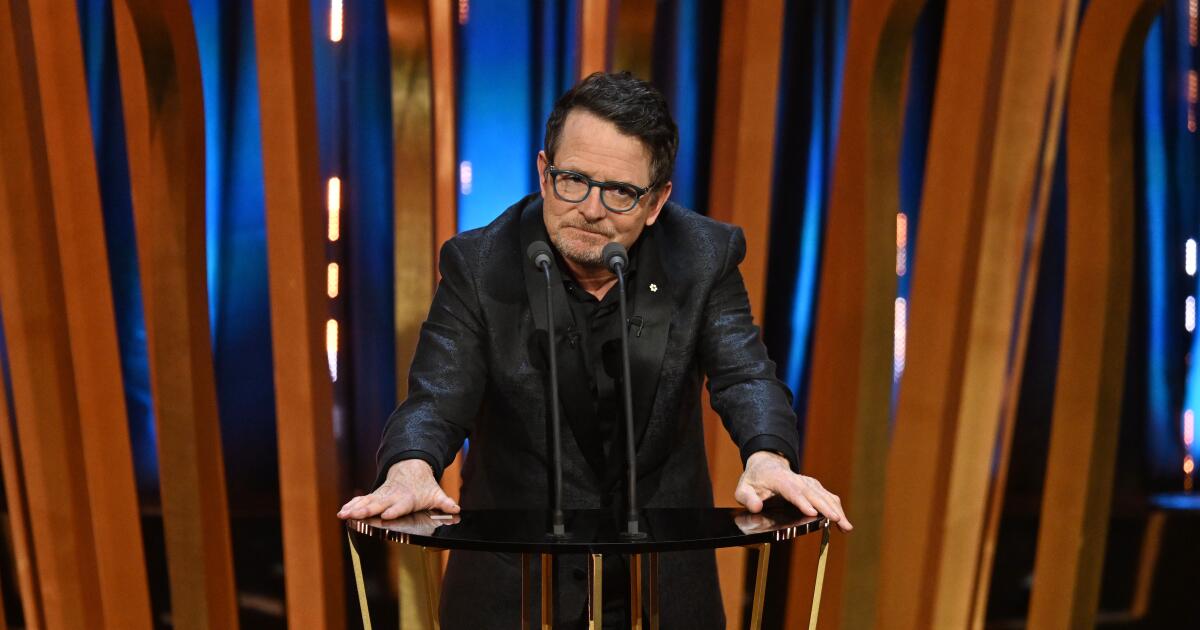
The biggest standing ovation of the night came at the show’s end as Tennant announced that Michael J. Fox would present the award for best film — much to the surprise of the audience. The entire room got on their feet as Fox was wheeled onstage and then stood behind the podium. It felt genuinely celebratory — and generous, particularly as the actor’s documentary, “Still: A Michael J. Fox Movie,” lost to Oscar frontrunner “20 Days in Mariupol.”
The afterparty
Following the three-hour ceremony, attendees made their way to more than 150 dinner tables inside Southbank Centre. Each was decorated with a themed centerpiece for one of the nominated films (the press table was “Poor Things”). Many people stayed for the official afterparty, held in the building next door, where the highlight was a saxophone player wearing a dog mask who accompanied the DJ’s selections. The song that really got the crowd going though? “Murder on the Dancefloor,” of course.
A complete list of tonight’s winners
Best Film: “Oppenheimer”
Director: Christopher Nolan, “Oppenheimer”
Leading Actress: Emma Stone, “Poor Things”
Leading Actor: Cillian Murphy, “Oppenheimer”
Supporting Actress: Da’Vine Joy Randolph, “The Holdovers”
Supporting Actor: Robert Downey Jr., “Oppenheimer”
Outstanding British Film: “The Zone of Interest”
Outstanding Debut by a British Writer, Director or Producer: “Earth Mama”
Film Not in the English Language: “The Zone of Interest”
Documentary: “20 Days In Mariupol”
Animated Film: “The Boy And The Heron”
Adapted Screenplay: Cord Jefferson, “American Fiction”
Original Screenplay: Justine Triet and Arthur Harari, “Anatomy of a Fall”
Original Score: Ludwig Göransson, “Oppenheimer”
Costume Design: Holly Waddington, “Poor Things”
Production Design: Shona Heath, James Price and Zsuzsa Mihalek, “Poor Things”
Special Visual Effects: Tim Barter, Simon Hughes, Dean Koonjul and Jane Paton, “Poor Things”
Makeup & Hair: Nadia Stacey, Mark Coulier and Josh Weston, “Poor Things”
Editing: Jennifer Lame, “Oppenheimer”
Cinematography: Hoyte van Hoytema, “Oppenheimer”
Casting: Susan Shopmaker, “The Holdovers”
Sound: Johnnie Burn and Tarn Willers, “The Zone of Interest”
British Short Animation: “Crab Day”
British Short Film: “Jellyfish and Lobster”
EE Rising Star: Mia Mckenna-Bruce


While a bit hollow as a character study, painting with broad thematic brushstrokes that often keep its hero at a distance, Young Washington is a compelling historical drama, with a grandiose scope that is rare in Hollywood, and an inspirational story befitting of America at its best.
About the Film
It’s trendy for Hollywood to disparage the United States with films that highlight how the country has fallen short of its lofty ideals (and the beauty of American liberty is that such critical self-reflection is possible). Last year’s One Battle After Another was the darling of the Academy Awards with such a tale. But this Independence Day, and in celebration of 250 years as a nation, audiences can be reminded that (like the men who founded it) America may be imperfect, but the American spirit is a noble and beautiful thing worth fighting for. Young Washington is the origin story, not just of one of those brave Founding Fathers, but of the patriotic spirit and noble values they inspired. While a bit hollow as a character study, painting with broad thematic brushstrokes that often keep its hero at a distance, Young Washington is a compelling historical drama, with a grandiose scope that is rare in Hollywood, and an inspirational story befitting of America at its best.
Director Jon Erwin (House of David, I Can Only Imagine) again proves to be one of the best all-around storytelling talents in Hollywood right now, faith-based or otherwise. Produced and distributed by Angel and Wonder Project, the film is among the most ambitious projects to emerge from the new wave of faith-based entertainment, even if Young Washington isn’t explicitly “faith-based” in a rigid sense. When I interviewed screenwriter Diederik Hoogstraten, he aptly referred to the storytelling approach as “values based.” It may not be a gospel-preaching cinematic tract (and it’s the better for it), but Christians will find plenty to affirm and celebrate here.
If we do count the film among the “faith-based” genre family, then it’s easily a peak achievement. It’s a visually beautiful and well-crafted film. For as good as the modern faith-based genre has become, few movies have warranted a theatrical viewing, being built more on wholesome narrative than visual spectacle. In contrast, seeing Washington gallop on a horse as cannon fire and the pandemonium of battle rages all around him is a full-blown cinematic experience that has rarely been achieved in the genre – other than perhaps Erwin’s own The House of David.
Young Washington is solid from start to finish, but it never fully soars. The film is more interesting than engrossing; good in most areas, but never quite great at any one of them. The clearest comparable, due to the subject matter, is perhaps Mel Gibson’s The Patriot (2000). Historical inaccuracies aside, that film packed a cinematic punch of action, spectacle, and emotional storytelling. Young Washington offers the first two but lacks the third. It’s a story that appeals more to the head than the heart, historically informative, but not making me feel much toward the story.
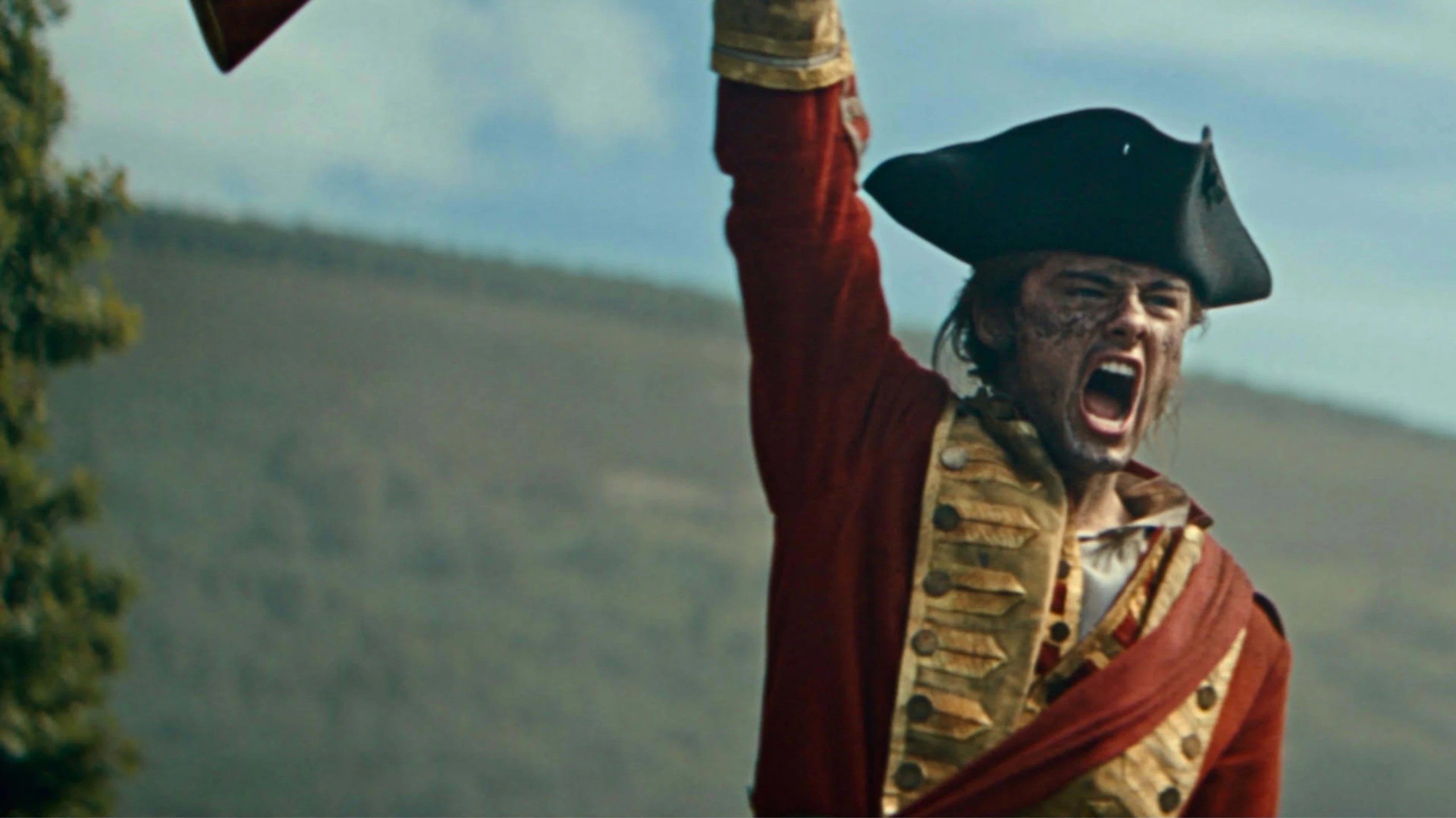
The creative decision to focus the story on a limited, formulative period of Washington’s early life shapes the film in significant ways. Many biopics fall into the trap of dutifully checking boxes, adapting a Wikipedia page more than unfolding a character journey. There’s still some of that with Young Washington, but the limited parameters lend the film a greater sense of focus and an opportunity to breathe. It feels like a story about something more than just putting historical events onto the movie screen.
At the same time, the film also feels like “part one” of a larger story, or a prequel for a film that doesn’t yet exist. The story seems constantly building toward something but then ends on the cusp of reaching it. Perhaps a future sequel is in the cards (although Middle Aged Washington doesn’t have the same ring to it), but the climactic pay off feels lacking. Interestingly, while the movie remains largely historically accurate (as far I can tell), the climactic final battle is more positively framed as a sort of inspirational victory, even when the historical battle was a crushing defeat. It’s perhaps an attempt to manufacture a thrilling third act resolution for a historical figure who was still only in the “first act” of his life. The decision mostly works, and that final battle is the film’s greatest triumph, but the story overall, as told, feels incomplete.

Also notable is that despite the intentionally patriotic release date, and centering on George Washington—arguably the American hero—the “Young” part of the film’s title means that the story pre-dates the revolutionary war. It sees Washington spend the duration of the runtime as a proud officer in the British army. Not quite the patriotic celebration the marketing has promised. Beyond existing knowledge of the historical significance of the protagonist, there is no real “America” at all, beyond a focus on his Virginian regiment, and some hints at the “American Spirit” that would one day define the nation (see themes below).
The fact that it has taken until the end of this review to discuss the character of George Washington himself is also telling. Unfortunately, he is the least interesting part of the film. The fault is not with actor William Franklyn-Miller, who does an admirable job. The problem is with the characterization. Washington has understandable motivations and inner conflict, but they are approached more from the perspective of an outside observer, rather than getting into his own headspace (we are told about struggles but rarely feel his turmoil). The film doesn’t probe deep enough into the root causes of these struggles, or the causes of his insecurity and drive for greatness. I left the film having learned about the events his early life, but without a better understanding of him as a man.
In the end, Young Washington boasts enough entertainment and quality filmmaking to please audiences. It’s a high floor, low ceiling type of film. There are no moments where the film fails to deliver consistent quality, but it just never seems able to achieve anything more. It’s good, but not great, which is something rarely said of George Washington himself. Still, I enjoyed it, and in retrospect, its legacy may be more for how it paved the way for the genre to enter a brighter future. Come to think of it, that sounds befitting of George Washington after all.
On the Surface
For Consideration
On the Surface—(Profanity, Sexual content, violence, etc.).
Language: There are three minor profanities (“d—” x2, “b—ard” x1).
Violence: There is plenty of wartime action, including men shot with rifles and cannon fire, although the action remains relatively bloodless. The most extreme violence comes when a man is hacked with an axe, although it is more implied than depicted on screen.
Sexuality: None.
Beneath The Surface
Engage The Film
The Makings of a Leader
George Washington was a larger-than-life person. By the end of the film, he is depicted as a near mythic figure (although, the scenes are adapted from details provided by several Pulitzer Prize winning biographies, so sometimes real life really is a Hollywood story). But one of the film’s central ambitions, and one emphasized in my interview with the screenwriter, is to humanize that mythical figure.

Early in the film, he is not necessarily even very likeable at times. He is stubborn, and his deep insecurities manifest as the appearance of pride and arrogance. His poor choices and refusal to heed wise counsel, such as the defeat at Fort Necessity, lead to serious consequences. Many biopics are hagiographical (such as the recent Michael), but Young Washington demonstrates the biblical truth that all men have sinned and fallen short of God’s standard (Romans 3:23). It answers the age-old question by suggesting that great leaders are not born great, they must become great.
In an early scene, George and his mother argue about their unfavorable circumstances. George’s mother wishes for her deceased husband back, but says, “Providence denied me this.” George responds, “Then providence is cruel!” His mother eventually counters, “God raises what is well grounded.” That exchange represents the heart of the film. We cannot control our circumstances, but we can shape our character (and allow God to shape it) to respond to them. As one character says, “Failure is the tutor sent by God.” Washington lacks the status and social advantages of others, and at first, he attempts to take it into his own hands to rise to prominence. Ultimately, after great failure, he learns that it is through humility and service that he can be used to do great deeds (Matthew 20:16). Interestingly, at the end of the film, even the pagan Indian tribes recognize God’s anointing on Washington’s life.

Entertainment
’47 Ronin’ director Carl Erik Rinsch sentenced to 30 months in prison for Netflix fraud case

Carl Erik Rinsch, the director of the 2013 Keanu Reeves action film “47 Ronin,” will serve more than two years in federal prison for defrauding Netflix of $11 million.
U.S. District Judge Jed S. Rakoff on Monday sentenced 48-year-old Rinsch to 30 months in prison, the U.S. Attorney’s Office, Southern District of New York, announced. Federal prosecutors convicted Rinsch in December of wire fraud, money laundering and other counts. A legal representative for Rinsch did not immediately respond to a request for comment on Tuesday.
Federal prosecutors indicted Rinsch in March 2025, alleging the $11 million went into Rinsch’s personal accounts. The filmmaker “quickly transferred” the money from the Rinsch Co. account, where it had been deposited March 6, 2020, by Netflix, through additional accounts until about $10.5 million wound up weeks later in a personal brokerage account. He lost more than half of that money in less than two months via risky investments in the stock market, the indictment said.
Though Rinsch told the streamer that his sci-fi show “White Horse” was progressing nicely, the filmmaker allegedly moved the remaining money into cryptocurrency and profited from crypto speculation over the next couple of years. The streamer had invested around $44 million in the show. Rinsch was accused of spending around $10 million on five Rolls-Royces, a Ferrari, watches, clothing, luxury bedding and linens, credit card bills, attorneys to sue Netflix for more money, and lawyers to work on his divorce.
He was arrested in West Hollywood and released the same day after agreeing to post a $100,000 bond to guarantee his appearance in a New York federal court.
Rinsch never finished the Netflix show.
During his sentencing, Rinsch and his legal team told the court his behavior was a result of mental health struggles and medication problems and they are working to address those issues with a new care provider, the Associated Press reported.
“I failed to recognize the danger of the state I was in,” Rinsch said, though his mental issues were not described in court, and his attorneys declined to provide further detail.
Ahead of the sentencing, Reeves — the star of Rinsch’s most notable project to date — penned a letter in May requesting “leniency and mercy as well as justice” in the filmmaker’s sentencing.
In addition to prison time, Rinsch must serve three years of supervised release, forfeit the $11 million and pay $700 in mandatory special assessments, according to Monday’s announcement. U.S. Attorney Jay Clayton said in the announcement: “Today’s sentence sends a deterrent message: fraud will not be tolerated.”
The Associated Press and former Times assistant editor Christie D’Zurilla contributed to this report.

Minions & Monsters, 2026.
Directed by Pierre Coffin and Patrick Delage.
Featuring the voice talents of Pierre Coffin, Trey Parker, Allison Janney, Christoph Waltz, Jeff Bridges, Jesse Eisenberg, Zoey Deutch, Bobby Moynihan, Phil LaMarr, and George Lucas.
SYNOPSIS:
Follows the Minions in 1920s Hollywood as they search for frightening creatures for their monster movie, partner with a green creature, and must save the planet after unleashing monsters.

Minions & Monsters comes with a genius creative choice to reinvigorate a tired schtick. The slapstick antics of the mischievous Minions have always felt partially inspired by comedic stuntwork from the likes of Buster Keaton (at one point, a house comes down over a Minion, paying homage) and Charlie Chaplin, so it’s seamless for director Pierre Coffin (who continues to voice all of them) to place them in the Golden Age of Hollywood. Yes, these movies are critic-proof and will crack one billion dollars regardless, and a case could be made that the filmmakers could have made bank once again going down an artistically bankrupt path, so it is refreshingly welcome that he (directing alongside Patrick Delage and crafting the screenplay with Brian Lynch) chooses to insert these yellow goofballs into a Hollywood love letter that doubles as an avenue for children and anyone else to develop an interest in the era.
Generally, when nostalgia-pandering is discussed or Easter Eggs flood a cinematic experience, it’s about placating fans and giving them what they want out of corporate obligation to put a film in the best position to succeed financially. Minions & Monsters is an animated feature that begins by rewinding the Universal Pictures logo all the way back to when it was The Trans-Atlantic Film Company, with an opening scene that uses The Horse in Motion, the earliest example of photography resembling a motion picture. From there, it’s an adventure involving Minions and Hollywood, giddy to reference anything it possibly can, from classic monsters to Humphrey Bogart to Westerns to Citizen Kane to a plot point that feels ripped out of the recent more cynical and vulgar Babylon, with the red-hot popular Minions struggling and failing to adjust to the transition from silent-era flicks to talkies.

There is a narrative here (more so than in the first two installments, which is a huge part of why this film works in addition to its sincerity) in that a present-day Hollywood museum tour guide (voiced by Allison Janney) educating kids about E.T. the Extra-Terrestrial, The Matrix, George Lucas (voicing himself while locked inside a glass casing), and more, eventually comes across a pair of Minions named James and Henry with quite the sweet friendship and story worth telling. Its initial stages aren’t too far off from what we already know about Minions in that they have always existed looking for evildoers to serve, this time coming across a cyclops, a wizard, a mummy, a viking, and others that they inadvertently kill through slapstick means.
The chaotic up-and-down history leads them to Hollywood, disrupting the shooting of an intense train robbery scene, which sends its director Max (voiced by Christoph Waltz) into a neurotic panic until studio executives, the Bright Brothers (voiced by Jeff Bridges), express that they find these yellow demons utterly hilarious and captivating to watch as they wreak havoc. As previously established, good things don’t last forever, and the Minions find themselves shoved aside in a new movie-making landscape, but not before a montage celebrating numerous genres across silent-era films and leaving James and Henry with a dream to make “the best movie ever”, Minions y Monsters.

This is where the film slightly loses its way, transitioning into a more familiar animated feature/Minions story, as they bust out the sorcerer’s spellbook they found ages ago to summon Cthulhu as their monstrous antagonist. Instead, they conjure up a tiny blob named Goomi (Trey Parker, voicing a different character in the franchise this time while sounding like an amalgamation of about five different South Park characters with plenty of Cartman coming through) who can’t be what they need for the movie but can help find other suitable monsters, all while joined by sidekicks Philips and Howard (voiced by Bobby Moynihan and Phil LaMarr).
While James and Henry (who are joined by Ed as their cinematographer) try to make this dream happen, the other minions search for another villain to serve, stumbling across robot Dort (Jesse Eisenberg voicing a character riffing on Gort from The Day the Earth Stood Still), who turns out to suck at being evil even though he desperately wants to break bad. Rather amusingly, he befriends a suffragette (voiced by Zoey Deutch) in a completely bizarre, random subplot that mostly works because of how out-of-left-field it is. Nevertheless, it’s mostly filler material until the Minions meet their match in the climactic showdown that, unfortunately, has more in common with modern blockbusters than the classical Hollywood it’s trying to imitate, even if the enormous blob they’re up against looks icky, with gross animation details that deserve applause.

Setting that aside, it is noteworthy that even if there are still plenty of jokes with the Minions here that don’t land, it is also funnier when they are interacting with not only recognizable scenes, genres, and movies, but also what shouldn’t be forgotten. There is also a joyous friendship at the center holding it together, whereas I couldn’t tell you a damn thing about the Minions from previous movies other than that one of them was named Bob. Minions & Monsters is still more of the same, while also a testament and celebration of the beauty and magic of making and watching movies, with earnest love for the era that shines through. For the first time, the brain isn’t turning to mush watching one of these.
Flickering Myth Rating – Film: ★ ★ ★ / Movie: ★ ★ ★
Robert Kojder
https://www.youtube.com/watch?v=embed/playlist
-

 Los Angeles, Ca1 hour ago
Los Angeles County man convicted of sex trafficking, abusing woman he was dating
-

 Detroit, MI1 hour ago
Detroit Tigers tee off on New York Yankees with 5 homers in win
-

 San Francisco, CA2 hours ago
Popular brewery shutters San Francisco location amid industry woes
-

 Dallas, TX2 hours ago
Eight arrested after repeated attempts to enter World Cup matches without tickets
-

 Miami, FL2 hours ago
Reports: Heat add potent bench scorer in Tim Hardaway Jr.
-

 Boston, MA2 hours ago
Boston Pops gearing up for major July 4th celebration: ‘You only turn 250 once’ – Boston News, Weather, Sports | WHDH 7News
-

 Denver, CO2 hours ago
Colorado wildfires destroy more than 100 structures, force more evacuations
-

 Seattle, WA2 hours ago
Will Katie Wilson’s endorsements help or hurt Seattle’s position in Olympia?

