Entertainment
The best moments from Camp Flog Gnaw 2025


As natural disasters in Los Angeles go, a rain delay temporarily washing out a music festival is pretty low stakes. But fans had to scramble last week after a sudden thunderstorm made Tyler, the Creator’s flagship festival at Dodger Stadium soggy and unnavigable.
Now kicked forward a week, a few acts (Sombr, Tems, Clairo) dropped off the bill, a few (Kali Uchis) joined in their stead, and travelers with nonrefundable plane tickets had to find other ways to amuse themselves in L.A. for a week. But once the Dodger Stadium gates finally opened, everything was more or less smooth sailing. Here are the highlights of the weekend’s performances.
Timothée Chalamet’s ‘Marty Supreme’ blimp makes an appearance
Last week, actor Timothée Chalamet released a parody of a marketing meeting, for his upcoming film “Marty Supreme.” The 18-minute clip consisted of the Oscar nominee pitching the team outlandish advertising ideas like painting the Statue of Liberty orange. In the Zoom meeting, he says, “We should have the blimp go above Flog Gnaw and rain ping-pong balls, Marty Supreme-branded, rain ping-pong balls on everyone.”
Low and behold, right before Tyler, the Creator’s set, a bright orange blimp reading “Marty Supreme” began circling Dodger Stadium — just as Chalamet prophesied. People all around the festival could be seen stopping and pointing out the flying spectacle.
But thankfully, no raining ping-pong balls made an appearance. (Cerys Davies)
Geese fly high
If every generation deserves its own cool/sexy/mystifying rock band, then Gen Z’s (or maybe Gen Alpha’s) seems to be Geese. Led by the deep-voiced Cameron Winter, the group from New York appeared at Flog Gnaw less than 24 hours after a hometown gig at the Brooklyn Paramount on Friday night. “We finished a tour but we couldn’t stay away from the limelight, so we got on a plane just this morning,” Winter told the crowd. Geese plays skronky yet weirdly beautiful guitar music that inspires both swaying and moshing; it’s in a clear lineage of NYC acts that stretches back through the Strokes and Television to the Velvet Underground. But here at least you could detect a distinct L.A. presence in Emily Green’s John Frusciante-coded strums and in the doomed-heartthrob proclamations that made Winter sound a little like Jim Morrison. (Mikael Wood)
Happy 10th anniversary to Mac Miller’s “GO:OD AM”
In the sea of vendor pop-ups, Mac Miller’s yawning face, the cover of his 2015 release “GO:OD AM,” stood tall. In celebration of the album’s 10th anniversary, photographer Brick Stowell put on a small exhibition to honor the late Pittsburgh rapper. While standing in line, fans were chatting, sharing anecdotes of listening to Miller’s music or memories of when they saw him perform at Camp Flog Gnaw many years ago. Inside, the exhibition is simple, consisting of a few large-scale prints of photos Stowell selected. Some of the images focus on a smiling Miller or depict him playing the guitar or with friends. The record played softly in the space and a few people sat on the couches, with their eyes closed. In the midst of the music festival’s craziness, the tent was filled with a weighted, reverent energy. (C.D.)
Kali Uchis performs during Camp Flog Gnaw on Saturday.
(Ronaldo Bolanos / Los Angeles Times)
Kali Uchis mixed red-hot seduction with ICE-cold activism
As a last-minute addition to the festival’s lineup, Kali Uchis might’ve been expected to put in a no-frills performance. Instead, the eternally vibey psychedelic-soul star sang the lovey-dovey “All I Can Say” from inside a giant teacup — “If you came with someone you like, you could kiss them,” she suggested — and did “Heaven Is a Home” on the back of a motorcycle driven by a woman in a lace bodysuit and shades. (There was also a giant bed with satiny pink sheets.) Uchis is among pop’s foremost fantasists; her music invites the listener to get lost in an expertly appointed dreamland. But here she also had the real world on her mind: She played a video in which she said that everyone in her Colombian American household worked three jobs when she was growing up and that “immigrants built this country and make it what it is today.” As she left the stage, Uchis said, “ICE is terrorizing our community” and called out “their violations against human rights.” (M.W.)
Tyler, the Creator’s heartfelt thank you
“We couldn’t let that rain stop us — no, no, no,” Tyler, the Creator said not long into his hour-long set, and indeed Flog Gnaw’s mastermind seemed just a bit more amped than usual as he presided over the festival that almost wasn’t. Dressed in a red leather suit à la Eddie Murphy in “Delirious,” Tyler came out punching with “Big Poe” and “Sugar on My Tongue,” which also open “Don’t Tap the Glass,” the high-energy hip-house album he dropped this past summer with very little warning. But he also performed stuff from last year’s “Chromakopia,” which just snagged a nomination for album of the year at February’s Grammy Awards. (“Don’t Tap the Glass,” amusingly, is up against LPs by the Cure and Wet Leg in the alternative music album category.)
Tyler’s stage was designed to resemble a New York City subway station complete with a train car that he climbed atop and herky-jerked his way across. For “Don’t You Worry Baby” he was joined by a female dancer on roller skates; for “Noid,” a couple of guys with cameras helped him act out his unhappy thoughts on paparazzi. As the set went on, Tyler started shortening each song, limiting himself to only a verse or a chorus to pack in more hits: “Earfquake,” “Wusyaname,” “See You Again.” He thanked the crowd for hanging with the festival’s postponement — “I know it wasn’t ideal,” he said — and for “rocking with us for 11 years” of Flog Gnaw. The connection he’s forged is real. (M.W.)
Ca7riel & Paco Amoroso’s roller coaster of a set
Fresh off 5 wins at the Latin Grammys earlier this month, Ca7riel and Paco Amoroso left the CFA crowd delightfully perplexed. The audience started off on the smaller side, as Tyler, the Creator was wrapping up his set. But as the Argentine rappers, decked out in Versace, plowed through their catchiest hits like “Dumbai” and “Sheesh,” a dancing stampede made its way over.
Less than a year after their viral NPR Tiny Desk, the notoriously kooky duo flexed their ability to slip between genres. One moment, a pulsating EDM beat, beaming lasers and intense fog machines took over the stage — emulating a rave. The next moment, Ca7riel is angrily screaming “F— you!” at the top of his lungs over an aggressive punky guitar solo. Finally, they act like their microphones have become dumbbells, and start to sing about their “#Tetas,” on their satirical, body positivity anthem. Ca7riel and Paco Amoroso will never let you know their next move. (C.D.)
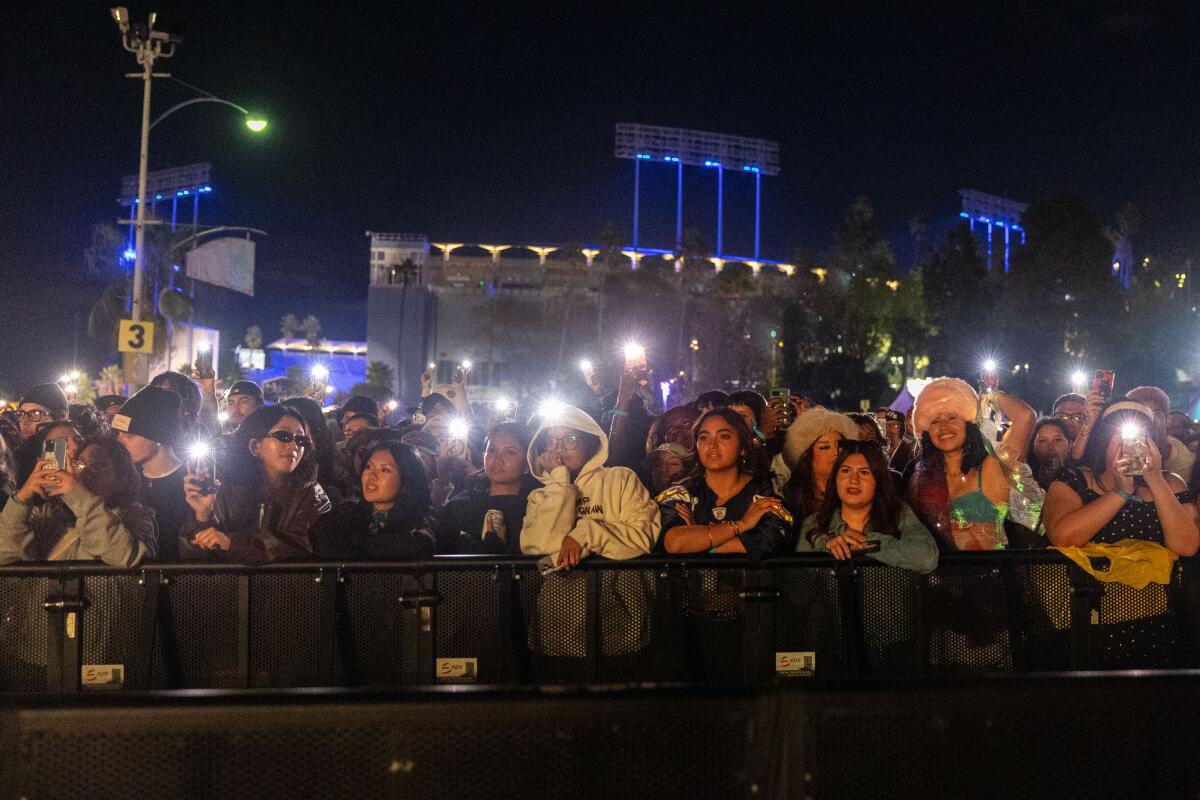
Fans raise their phones as Kali Uchis performs during Camp Flog Gnaw.
(Ronaldo Bolanos / Los Angeles Times)
Clipse turn in a triumphant set
The Clipse have had a hell of a year. After releasing their first album together in 16 years, “Let God Sort Em Out,” the formidable Virginia rap duo of Pusha T and Malice embarked on a victory lap, which included a successful reunion tour and a flurry of hilariously entertaining interviews. In the midst of that, they also stopped by NPR’s Tiny Desk — a performance that had more than 3.5 million views as of November— and racked up four Grammy nominations including best rap album and album of the year. So it was only right that they were invited to perform at Camp Flog Gnaw once again. (They also performed at the festival in 2023.)
Fittingly, the Clipse opened their set with the menacing “Chains and Whips,” which is jam packed with lethal, high-level bars about why contemporary rappers simply can’t sit with them. Not wasting any time during their set, the veteran emcees went bar for bar, diving into more tracks from their latest album including “Birds Don’t Sing” (a dedication to their late parents) and “P.O.V.,” which Tyler, the Creator joined them for just in time following his own high-energy set.
Satisfying their day one fans, the Clipse also performed a handful of their classic records like “Mr. Me Too” and “What Happened to That Boy.” As they rapped the lyrics to one of their most recognizable tracks, “Grindin,” a montage of Black people doing step routines, dancing and recreating the Neptunes beat on lunch tables played on the massive stage screens.
Much like “Let God Sort Em Out,” the Clipse’s performance further solidified why they’ve been in the game for more than 20 years and why they aren’t going anywhere anytime soon. — (Kailyn Brown)
Childish Gambino’s fast-paced, fan-voted retrospective
Childish Gambino’s set was a race against time. Prior to his set, the 42-year-old singer/rapper/actor (also known as Donald Glover) allowed fans to vote for his setlist. Playing anything from his biggest hits like “Redbone” and a very short snippet of “This is America” to his cover of Outkast’s “Prototype” and the 2011 release “Les,” Gambino made it clear he only had an hour and wanted to get to as many songs as possible. He often played the first verse of a track, allowing it to peak in the chorus and quickly brush past it — making the set feel like an invigorating sprint.
Halfway through the performance, Gambino, sparkling his glittery wifebeater, took a moment to get vulnerable with the crowd. This was his first performance since he had to abruptly cancel his world tour last year. He explained that he had a stroke unknowingly, on stage in Louisiana, and later found out that he had a hole in his heart and needed surgery. As he narrated his story, the sky lit up with a drone light show, depicting images of a heart and other dynamic patterns.
He said, during all of these health problems, the only things he could think of were “how many people I’m letting down” and “here I am still copying Jamie Foxx,” which got a laugh out of the crowd. Throughout the remainder of the show, he continued to exude a grateful energy, saying repeatedly, “I didn’t think I’d be able to [be here].” As he played the chosen songs, it was as if his only goal was to make the crowd as happy as possible.
The rapper left with a final message, “You have one life, so live your life as you want.” (C.D.)
Blood Orange puts CFG in a trance
Following Geezer’s (Kevin Abstract and Dominic Fike) endearing display of friendship, Blood Orange kept the cameraderie going on the fest’s main stage. Though the multi-piece band behind Dev Hynes’ musical moniker may sound melancholic, their energy was jolting. During tracks about grief and loneliness, like the cathartic “Charcoal Baby,” only Hynes could get the entire crowd to head bang.
After releasing his most recent album, “Essex Honey,” Blood Orange made his impromptu return to the fest — calling last year’s set “one of his favorite shows.” The British singer and his band trade instruments with a sense of ease — splitting their time among a cello, keyboards, synthesizers, a drum machine, electric and acoustic guitars. In this intricate display of instrumentalism, dark electronica and high-pitched vocals blend into feelgood jazz and ’80s synth pop without notice. With dense fog and transculent pink lights, the whole set started to fuse into a unifying dreamy moment. (C.D.)
Helicopters, a megaphone and pink hair curlers: ASAP Rocky keeps Flog Gnaw classic
Right before ASAP Rocky was meant to close out the festival, a helicopter started to circle the area, shining its light down on the crowd. A mock news livestream took over the stage’s screens in search of the Sunday headliner, accusing him of “never dropping the album.” On stage, the Harlem rapper descended on a floating helicopter of his own, megaphone in hand and pink curlers in his hair.
He made it clear he was there “to start a riot” (and he did consistently check in on the densely packed crowd too). The 37-year-old rapper was soon joined by a few dozen hooded figures, carrying upside-down American flags, who began to mosh while he continued to spit his ever-steady flow. Switching between his older stuff, like “L$D” and “Potato Salad” (which he was joined for by Tyler, the Creator) and more recent beloved singles like “Praise the Lord (Da Shine)” and “Sundress,” Rocky stuck to what he knows best — looking pretty and skillful rhymes. (C.D.)

A swing carousel at Camp Flog Gnaw.
(Ronaldo Bolanos / Los Angeles Times)
T-Pain knows your knees hurt
“I am old as f—,” T-Pain said as the R&B-rap crooner took a pause from his hit-studded set on Sunday night. “I was running out of time to do this. I saw the dimensions of the stage and my knees gave out.”
At 41, he is decently seasoned by Flog Gnaw standards (though still a surprisingly deft dancer). But his set was arguably one of the best-attended of the weekend, for good reasons.
Recent reappraisals from a mega-viral Tiny Desk concert and a boisterous Coachella set proved what close listeners have known all alon: Pain is an absolute savant of melody and ear-tickling chord changes, with a gorgeous R&B voice whose famous digital treatments were artistically prescient rather than any sort of fix.
Yet to Flog Gnaw’s young crowds, blissfully free from the AutoTune wars of the 2000s, Pain now represents an idyll and purity of party music in hip-hop, rising from the mire of the Great Recession and the aspirations of President Obama with witty, self-aware hit after hit that showed a musician in total command of his craft, writing songs that transcend today’s cynical bleakness.
This redemption arc is well earned — how can you not listen to “Bartender” and long for the easy, sweet camaraderie of sidling up to your favorite server (though today that cocktail will more likely be N/A)? Dispatches from a saner time of millennial life like “Up Down” and “Can’t Believe It” landed like an envelope of Instax photos from a half-remembered house party. For Gen Z, it was Unc Culture embodied in the best ways.
Other than a brief villain segment (where Pain sung his verses from collabs with Chris Brown, Kanye West and R. Kelly; more an indictment of the men of R&B, really), his set delivered hit after hit and re-framed them within R&B history. He did what the genre is best at — stirring up the old glow of past happiness, even if that was spilling tequila down your pinstriped business-casual wear at a Hollywood bottle club in 2008. (A.B.)
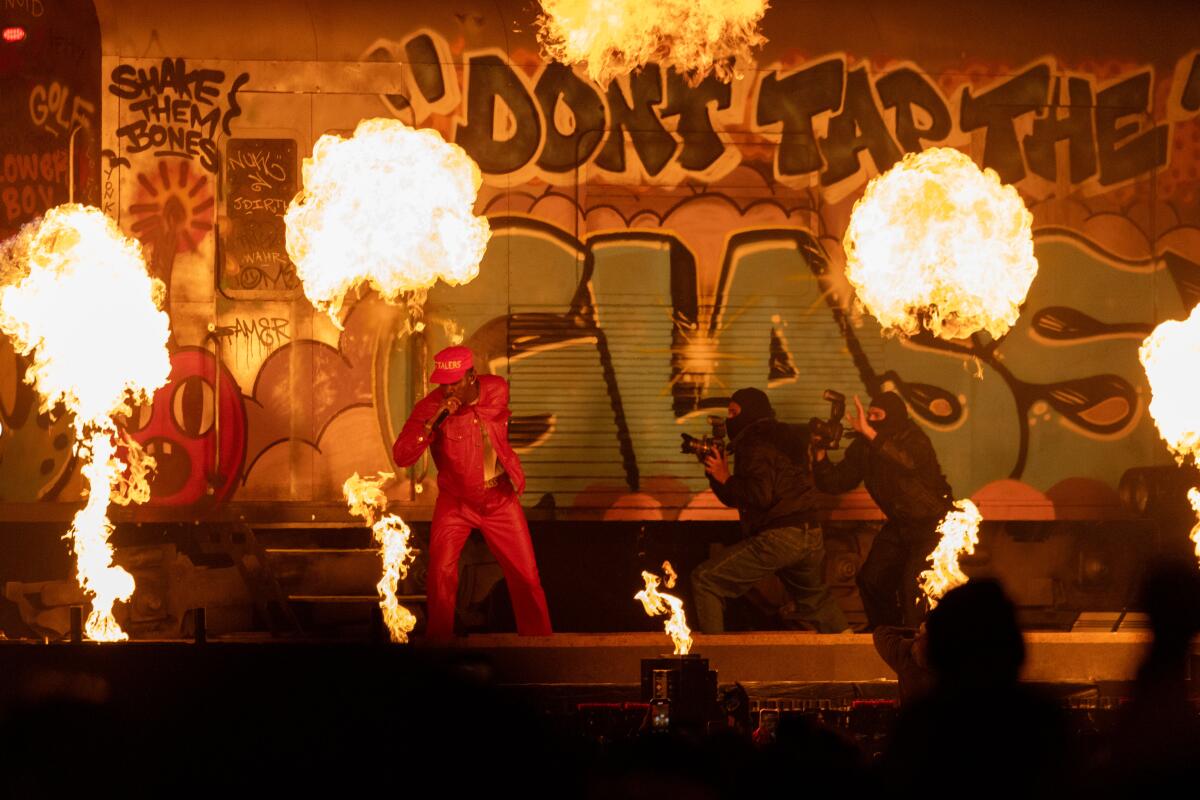
Tyler, the Creator performs during Camp Flog Gnaw.
(Ronaldo Bolanos / Los Angeles Times)
Doechii, the classroom disciplinarian of your dreams
Doechii framed her raucous Sunday night set as a stern classroom lecture on the craft of rapping. But in that case, she’s the kind of teacher that you bump into at the grocery store with a cart full of booze and a you-didn’t-see-this wink.
The Grammy favorite and new TDE superstar is so mercilessly good at rapping, so fully possessed of her gifts onstage, that her set made me wonder how all the backing-track reliant MC’s still get away with it. From the vicious opening lines of “Stanka Pooh” — “Let’s start the story backwards / I’m dead, she’s dead, just another Black Lives Matter” — to the joint-snapping house-music workout of “Alter Ego” and the horror-comedy sex romp of “Spooky Coochie,” she never settled for less than the full scope of her talents, deeply honed.
A gleefully bawdy and physically gifted dancer, with of sneaky comic timing and a low-key powerhouse singing voice, by the time she got to the deep cut “Boom Bap” and fan favorite “Catfish,” Doechii made an impeccable claim to being one of the best rappers working today.
She didn’t play the Grammy contender “Anxiety” — one sees how that song wouldn’t make sense in this relentlessly hard hitting context. But whatever worries keep on trying her, after Sunday night, she can definitively leave them behind. (A.B.)
Zack Fox brings us to the (f)unction with globetrotting set
Just 15 minutes into Zack Fox’s hour and a half DJ set on Sunday afternoon, which was dubbed Zack’s Big Nasty & Booty Shake, many audience members were already sweating and shedding the layers they wore in preparation for the evening cold.
Garbed in leather uncle sandals with white socks, an Atlanta Falcons apron and a grill for a DJ stand (because he was cooking, duh), the rapper, comedian and actor brought the crowd to the (f)unction. Fox, who’s become known for his high-energy performances, delivered a globetrotting set filled with genres including Brazil’s Baile funk, Chicago house, Baltimore club, Nola bounce, soul, gospel Detroit techno and of course Atlanta rap, which is where he’s from. “Dance music is Black music,” Fox told the crowd in between his gyrating and turning up. “Y’all gonna learn something today.” (He also had the crowd repeat back “Free Palestine” and “F— ICE.”)
But what’s a cookout without good company? Fox also brought along a crew of talented dancers, which included a church hat wearing grandmother (who unexpectedly broke out into a backflip) and popular ballroom dancer Pack Rat. As Fox masterfully weaved between tracks like Khia’s “Steer,” KW Griff’s “Bring in the Katz” and Frankie Beverly and Maze’s “Before I Let Go,” the dancers vogued, shuffled and line danced. Even his “Abbott Elementary” castmate Janelle James (a.k.a Principal Coleman) grooved alongside Fox during his set.
He closed out with a Black church anthem, Kurt Carr’s “We Lift Our Hands in the Sanctuary.” Each time the track seemed like it was about to end, he comically brought it back a few more times with the lyrics “Yes! Yes, Lord, for the rest of our days.” (K.B.)
Ying and yang rappers, Larry June and 2Chainz, show us the finer things in life
On paper, Larry June — the laid-back Bay Area rapper known for his straightforward rhymes about organic living and financial literacy — and 2Chainz — Atlanta’s trap elder known for witty tracks like “Birthday Song” — may seem like an unlikely match. But as the pair performed their collaborative album “Life is Beautiful,” they were in perfect stride. The large crowd was a testament to how rare the moment was as it was one of the few times that the pair has performed the opulent lifestyle rap album since it dropped in February.
Much like the vibe of “Life is Beautiful,” which feels like a luxurious vacation backed with jazz-infused serene beats by the Alchemist, swaying ocean waves and yachts served as the backdrop while they delivered tracks like “Colossal,” “Generation,” “I Been” and “Bad Choices.” (Unfortunately, the Alchemist is on tour with DJ Premier, and was not in attendance.)
The backgrounds changed to imagery that matched the rappers’ hometowns as they dove into their personal discography. In a casual windbreaking sweatsuit, Larry June performed smooth tracks like “Smoothies in 1991” and “Watering My Plants,” while 2Chainz, who was rocking a leather two-piece set, got the crowd hyped with songs like “I’m Different” and “Watch Out.”
Suitably, the duo closed out with tranquil, flute-based “Life is Beautiful,” reminding the audience to embrace the beauty of the grind and the small wins in life, and simply enjoy their time on this Earth. (K.B.)



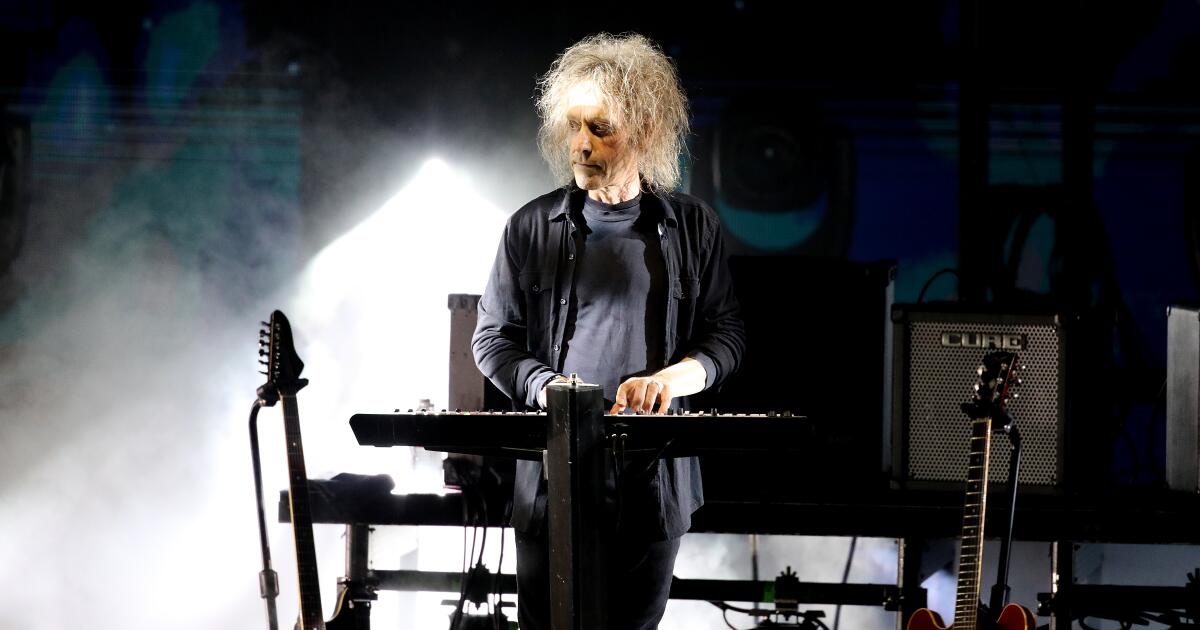
Perry Bamonte, guitarist and keyboardist for the Cure, has died. He was 65.
The band announced on its website on Dec. 26 that Bamonte died “after a short illness at home over Christmas.”
“Quiet, intense, intuitive constant and hugely creative, ‘Teddy’ was a warm hearted and vital part of the Cure story,” the band said.
The London-born Bamonte began touring with the Cure as a guitar tech and assistant in 1984, then joined the band full-time in 1990. He performed over 400 shows with the group and recorded on the albums “Wish,” “Wild Mood Swings,” “Bloodflowers,” “Acoustic Hits” and “The Cure.”
Bamonte parted ways with the Cure after 14 years, later performing with the group Love Amongst Ruin. He returned to the Cure in 2022 for “another 90 shows, some of the best in the band’s history,” the group said, including the Nov. 1, 2024, London show documented on the concert film “The Show of a Lost World.”
As a member of the Cure, Bamonte was inducted into the Rock & Roll Hall of Fame in 2019. The band is still scheduled for a run of European festivals and headline shows in 2026.
“Our thoughts and condolences are with all his family,” the group said. “He will be missed.”

The Housemaid, 2025.
Directed by Paul Feig.
Starring Sydney Sweeney, Amanda Seyfried, Brandon Sklenar, Michele Morrone, Ellen Tamaki, Megan Ferguson, Brian D. Cohen, Indiana Elle, Amanda Joy Erickson, Don DiPetta, Alexandra Seal, Sophia Bunnell, Lamar Baucom-Slaughter and Arabella Olivia Clark.
SYNOPSIS:
A struggling woman is happy to start over as a housemaid for an affluent, elite couple.

Whether or not one has read the recently published book by Freida McFadden, there is no question where director Paul Feig’s The Housemaid (adapted from Rebecca Sonnenshine’s screenplay) is headed. He is, first and foremost, a feminist filmmaker (absolutely not a bad thing), and there are certain predictable but vital modern-day storytelling trends. That’s not a fault here, but it is damn near maddening how long the film wears a mask before arriving at that turning point. Even while acknowledging quite a few clever bits of foreshadowing with a dash of welcome class commentary and themes surrounding gossip and how much of it should be taken credibly, the first half of this narrative doesn’t need to go on for roughly an hour with failed attempts at misdirection.
That the second half of The Housemaid, which lays out the details behind the obvious and fully embraces its trashiness with a sprinkling of truly sinister behavior, is as intense as it is, only makes the shortcomings more frustrating. When the specific “whys” of what is happening here are given to the audience, all that’s left is white-knuckle suspense that could go in multiple directions, with either an optimistic or tragic climax. For whatever reason, the journey to that turn is sometimes a slog – generally only salvaged by its trio of outstanding performances leaning into the campiness – that seemingly assumes its audience has never read a trashy paperback airport novel or seen a thriller.

Despite the predictability of some elements, one still doesn’t want to dive too deeply into the synopsis. Nevertheless, it involves Sydney Sweeney’s Millie, a woman on parole for an undisclosed crime desperately seeking employment to stay on the outside, even if it means telling white lies to hopefully get hired as a live-in housemaid. A meeting for such a position with Amanda Seyfried’s Nina goes as well as she could hope for. Still, in the back of her mind, she believes the resume will be scanned for its dishonesty, costing her the job opportunity.
It goes without saying that Millie gets the job and begins working for Nina, given an attic for a bedroom (which suspiciously has a deadbolt on the door and a window that no longer opens), and basic housework duties such as cleaning, cooking, and looking after the rude young daughter Cecelia (Indiana Elle), who has clearly gotten a bit too comfortable with such a privileged life. Now, there have been some traumatizing hardships as more is gradually revealed about Nina’s past and some actions as a mother. Nina also shows signs of schizophrenia immediately after giving Millie the position, repeatedly and frequently scolding her for doing what was asked, while insisting that she never requested that.

Fortunately, Nina’s husband Andrew (Brandon Sklenar, taking a page out of the Glen Powell charming playbook, but with sides to the performance the latter would struggle to pull off) witnesses much of the crashouts and mistreatment toward Millie for no justifiable reason, offering some support, peace, and stability. Unsurprisingly, Millie still wants to find another job and get the hell out of there.
As mentioned, Millie is also played by Sydney Sweeney. Hence, it makes sense that Nina, who is already spiraling and paranoid, would warn her not to make any passes or advances towards Andrew. That’s also where the film starts to fall apart in terms of logic, as no one in their right mind would hire this particular woman to be a housemaid if that insecurity or fear for potential adultery were there, especially after the background check on the resume raises several red flags. Nina’s behavior is also so erratic, temperamental, and hostile that one wonders why someone like Andrew is typically calm, still around, and always so quick to forgive her and downplay the severity of it all.

A lot is happening here regarding the character dynamics that doesn’t make any sense, which is also part of the point since we know there are ulterior motives at play. To sit with such illogical behavior for roughly an hour, while also knowing where this is ultimately going, is downright annoying. The viewer is in a constant state of knowing what’s up while ticked off, waiting for the specifics to come into play and the genre to shift for far too long. Then, The Housemaid starts doing what it should have done a while ago, becoming a genuine thrill ride in the process. It’s a film that admittedly does fire on all cylinders once the puzzle pieces fall into place.
Flickering Myth Rating – Film: ★ ★ ★ / Movie: ★ ★ ★
Robert Kojder
https://www.youtube.com/watch?v=embed/playlist

We might rarely get to see snowfall in Los Angeles, but logging onto social media in December means the arrival of a different kind of flurry. The one where our friends, both close and parasocial, excitedly share the year-end music-listening data dumps of their Spotify Wrapped.
Spotify Wrapped only represents the culmination of our listening habits on a single music platform, but every shared Wrapped post seems to come with some self-evident clarity about our personal identity. Spotify Wrapped bares our souls and provides us the opportunity to see ourselves deconstructed via our musical inclinations. By most accounts, it’s an irresistible delight. Oh, Spotify, you rascal, you’ve got us pegged.
For anyone in Los Angeles, 2025 has been one hell of a year to get the Wrapped treatment. We’re still processing the aftermath of the devastating Eaton and Palisades fires — and haunted by ICE raids and the federal administration’s ceaseless attacks on California. Not to mention Jimmy Kimmel getting silenced.
Maybe it’s not such a bad idea to take that temperature check.
But listening to music can be a passive experience — one enjoyed in tandem with folding laundry, or driving a car. To really learn about ourselves and how our year has been, we might want to turn elsewhere, to a habit with more intention. I’m talking, of course, about reading.
While there’s apps for tracking our reading habits, like StoryGraph or Goodreads, I’m devoted to a wholly analogue tracking method that’s helped me churn through books faster and with more intent than ever before: the book stack.
Starting every January, whenever I finish a book, I place it sidelong atop a shelf in the corner of my living room. With each new book I conquer, the stack gets taller, eventually becoming a full tower by December. A book stack, low on analytics, can’t tell me the total number of pages I’ve read, or how many minutes I spent reading, but it’s a tangible monument to my year’s reading progress. Its mere presence prods me into reading more. It calls me a chump when the stack is low and cheers for me when it reaches toward the ceiling.
My first book stack started in 2020, a wry joke to demonstrate the extra time we could all devote to reading books during a pandemic. The joke barely worked. I ended up reading just 19 books that year, only a few more than I had the previous year (though it could’ve been more if one of those books wasn’t “Crime and Punishment”).
Still, the book stack model gamified my reading habits and now I give books time I didn’t feel I had before. I bring books to bars, movie theaters and the DMV. If ever I have to wait around somewhere, you better believe I’ll come armed with a book.
The pandemic may have waned, but my book stack count continued to climb, peaking in 2023 after reading 52 books, averaging one per week.
But, hey, it’s about quality, not quantity, right? If there’s a quality to be gleaned from my 2025 book stack, you’d see that I’ve been looking for hot tips on how to survive times of extreme authoritarian rule. Some were more insightful than others.
In the stack was Carl Bernstein and Bob Woodward’s “All the President’s Men,” a landmark true story about two intrepid reporters who brought down the president of the United States by repeatedly bothering people at their homes for information. Fascinating as it is, it also feels like a relic from a time when doing something like that could still work. Philip Roth’s “The Plot Against America” tells the story of a Jewish New Jersey family in an alternate timeline where an “America First” Charles Lindbergh beats Franklin Roosevelt in the 1940 presidential election, ignoring the threat of Hitler in Europe and giving way to a rise in antisemitism at home. Roth paints a dreary portrait of how that scenario could have played out, but the horrors are resolved by something of a deus ex machina rather than by any one character’s bold, heroic actions. Then there’s Anthony Doerr’s Pulitzer Prize-winning “All the Light We Cannot See,” about the converging stories of a German boy enlisted in Hitler’s army and a blind French girl during World War II. Sadly, this novel reads less like a book about living under fascist rule than a thirsty solicitation to become source material for Steven Spielberg’s next movie.
Each of these titles have merit, but this year’s book stack had two gems for anyone who wants to know how best to resist tyranny. Pointedly, there was Timothy Snyder’s tidy pocket-sized handbook “On Tyranny” filled with 20 short but fortifying chapters of practical wisdom like “Do not obey in advance,” “Defend institutions” and “Believe in truth.” Each is applicable to our current moment, informed by historical precedent set by communist and fascist regimes of the past century. This book — well over a million copies sold — came out at the start of Trump’s first term in 2017, so I came a little late to this party. The fact that Snyder himself moved to Canada this year should give us all pause.
Practical advice can also be found in great fiction, and on that front I found comfort and instruction in Hans Fallada’s “Alone in Berlin” (a.k.a. “Every Man Dies Alone”), based on the true story of a married couple living in Berlin during World War II who wrote postcards urging resistance against the Nazi regime and secretly planted them in public places for random people to discover. Under their extreme political conditions, this small act of civil disobedience means risking death. Not only is the story riveting, there’s also great pleasure in seeing the mayhem each postcard causes and how effective they are at exposing the subordinate class of fascists for what they truly are: nitwits.
Also notable in “Alone in Berlin” is the point of view of both the author and his fictional heroes. Neither a target of persecution, nor a military adversary, Fallada nevertheless endured the amplified hardships of living under Nazi rule during World War II. His trauma was still fresh while writing this book and it’s evident in his prose. He survived just long enough to write and publish “Alone in Berlin” before dying in 1947 at the age of 53.
If I’ve learned anything from these books, it’s that it’s in our best interest to not be afraid. Tyrants feed on fear and expect it. A citizenry without fear is much harder to control. That’s why we need to raise our voices against provocations of our rights, always push back, declare wrong things to be wrong, get in the way, annoy the opposition, and allow yourself to devote time to do things for your own enjoyment.
And in that spirit, my book stack also includes a fair amount of palate cleansers in the mix: Jena Friedman’s “Not Funny,” short stories by Nikolai Gogol, Jhumpa Lahiri’s “The Namesake” (whose main character is named after Gogol), and a pair of Kurt Vonnegut novels. Though it’s hard to read Vonnegut without stumbling upon some apropos nuggets of wisdom, like this one from his novel “Slapstick:” “Fascists are inferior people who believe it when somebody tells them they’re superior.”
Zachary Bernstein is a writer, editor and songwriter. He’s working on his debut novel about a poorly managed remote island society.

Ukrainian capital Kyiv under massive Russian attack, officials say

Hunker down with these 13 mysteries and thrillers from 2025

Trump’s war on offshore wind faces another lawsuit

Israel becomes first country to recognize Somaliland; Trump ‘not ready’

Tiny Pacific nation to take up to 75 deportees as Trump administration accelerates mass removals

Florida High School Football Rankings: Top 25 teams – Oct. 21

Cleary's 21 help Le Moyne down Central Connecticut State 69-64 in OT

How old is Bo Nix? What to know about Oregon quarterback ahead of 2024 NFL Draft

99th annual Pony Swim held in Virginia

Video: ‘It Didn’t Have to Happen This Way:’ U.Va. Faculty Call for Review of Police Response to Protests
Tiny Pacific nation to take up to 75 deportees as Trump administration accelerates mass removals

NATO chief Rutte rejects calls for EU defence independence from US

Marijuana rescheduling would bring some immediate changes, but others will take time

Pro-police group asks DOJ to probe Soros-backed Virginia prosecutor using Biden-era law once aimed at cops

Israel becomes first country to recognise Somaliland
-

 Massachusetts1 week ago
MIT professor Nuno F.G. Loureiro, a 47-year-old physicist and fusion scientist, shot and killed in his home in Brookline, Mass. | Fortune
-

 New Mexico1 week ago
Family clarifies why they believe missing New Mexico man is dead
-

 Connecticut1 day ago
Snow Accumulation Estimates Increase For CT: Here Are The County-By-County Projections
-
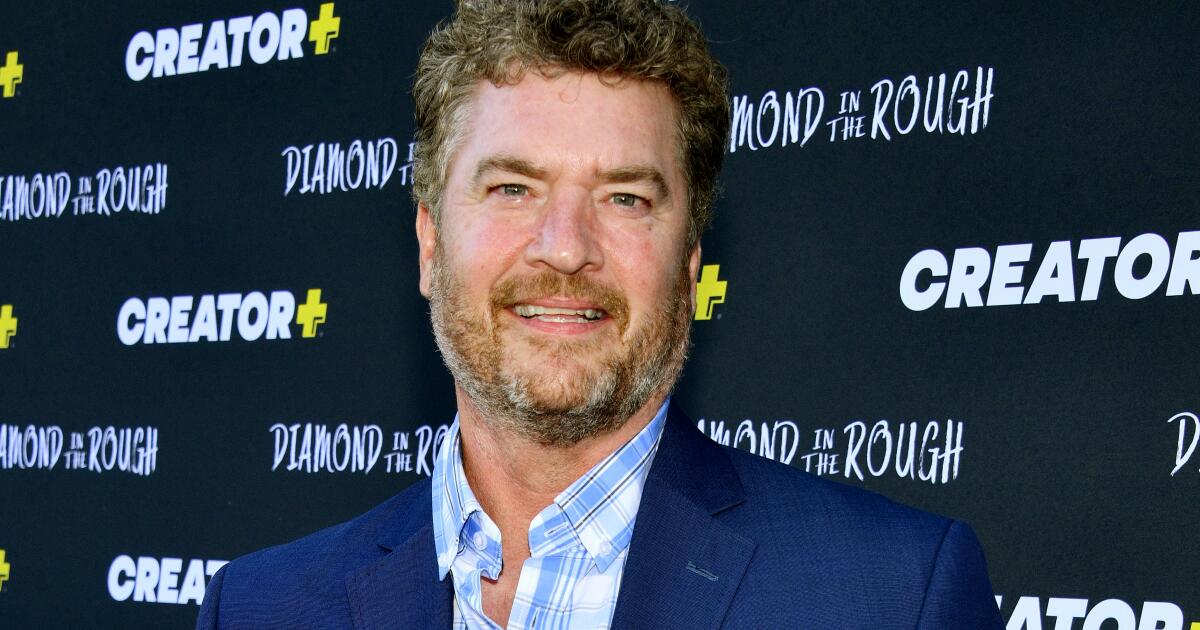 Entertainment2 days ago
Pat Finn, comedy actor known for roles in ‘The Middle’ and ‘Seinfeld,’ dies at 60
-

 World1 week ago
Putin says Russia won’t launch new attacks on other countries ‘if you treat us with respect’
-
 Entertainment1 day ago
How the Grinch went from a Yuletide bit player to a Christmas A-lister
-

 Milwaukee, WI3 days ago
16 music and theater performances to see in Milwaukee in January 2026
-

 Maine1 week ago
Family in Maine host food pantry for deer | Hand Off