Entertainment
Review: ‘The Testaments’ feels timely because it’s the Epstein files writ large

When the Hulu adaptation of Margaret Atwood’s “The Handmaid’s Tale” premiered during the early months of the first Trump presidency, it was seen by many as a timely prophecy — the crimson cloaks and white bonnets of the story’s eponymous sex slaves became a symbol of protest against a president who, though not a religious man himself, embraced many policies supported by the far-right Christian minority, especially those regarding the reproductive and civil rights of women.
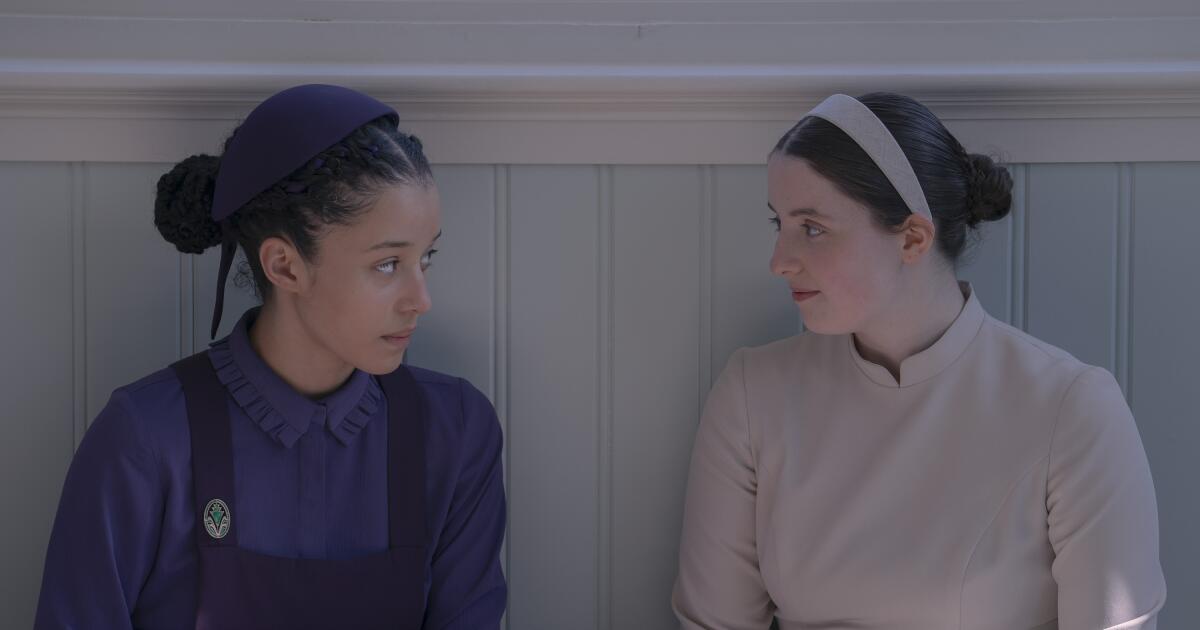
This was not the plan, of course, or at least not as regards the Trump factor. The book was written in 1985, the show greenlit long before Trump became president, which only proves the grim resilience of Atwood’s themes. So it shouldn’t be surprising that the sequel series, “The Testaments,” also has name-specific cultural resonance. Plum-cloaked in a YA-leaning, high school drama that owes as much to “Pretty Little Liars” or “Gossip Girl” as it does to “The Handmaid’s Tale,” “The Testaments” gives us an apocryphal version of the Epstein files.
Based on Atwood’s 2019 Booker Prize-winning novel, “The Testaments” takes place some years after the final events of “The Handmaid’s Tale” series and revolves around Ardua Hall where Aunt Lydia (Ann Dowd), having regained her Gileadean status, oversees the instruction of young women as they prepare to take up their lives as obedient wives and, Under His Eye, fruitful mothers.
Agnes (Chase Infiniti) is our initial central character and narrator. Though we know from her backward-looking tone that change is coming, her initial main worries are her mean stepmother and when (or if) she will finally begin to menstruate. She and her friends — Becka (Mattea Conforti), Shunammite (Rowan Blanchard) and Hulda (Isolde Ardies) — have all graduated from the “Pinks” (little girls) to the “Plums” (young women) but only Becka has achieved the “blessing” of menarche, which means she can now be chosen by an unmarried (or widowed) Commander or other man of lesser rank.
This particular form of reaping occurs midway through the season at a dance where all the eligible girls meet with all manner of young bachelors, only to discover that the oldest and most powerful members of the elite get first choice. Watching as the men joke among themselves before staking their claims, it is difficult not to think of Jeffrey Epstein parceling out young women to his powerful male friends (albeit not for marriage).
Though touched on throughout “The Handmaid’s Tale,” the horrifying connection between status and the systematic procurement of women is the sinister force that drives “The Testaments.” A global infertility crisis may have been the catalyzing force for Gilead’s rise but this “privilege” of power is not about repopulation; Agnes and the Plums are simply victims of sexual grooming taken to its pathological conclusion.
Becka is the only one who is less than thrilled by her “prospects” — everyone else, including Agnes, can hardly wait to be married off and, with any luck, quickly become pregnant (not that they know anything about sex, forced by the state or otherwise).
Having been raised in a beautiful home with no material wants, Agnes knows little about the outside world. Like most women in Gilead, she is not allowed to read or write, and she and her friends coolly accept public executions, torture and other means of corporal punishment as the inevitable consequence of breaking any of the many rules drilled into them. They accept that their bodies are instruments of the devil designed to compel men to commit lustful acts and that they are responsible for ensuring that this does not happen.
Ann Dowd reprises her role as Aunt Lydia in “The Testaments.”
(Russ Martin / Disney)
But girls will be girls and even under the stern eye of Aunt Vidala (Mabel Li) and the more kindly countenance of Aunt Estee (Eva Foote), they tease each other and romp together, compare hairstyles and trade snarky comments about the Aunts as they dream of a happy ending.
In its own way, that’s even more chilling and resonant than the horrors of “The Handmaid’s Tale.” Enslavement will always require some level of violence, but violence tends to spark rebellion — indoctrination is always more effective. Training people to believe they are fated, or even happy, to live without freedom, rights or real choice is the only way a totalitarian society can survive.
Showing this is far less exciting than the images of grown women being killed or stripped of their rights as presented in “The Handmaid’s Tale” (though “The Testaments” does offer a few very chilling flashbacks). But as social commentary, it’s difficult to beat the sight of young women, recognizable in so many ways as modern teens, complying with their own enslavement, out of ignorance and, as events proceed, the gut-wrenching fear of what the truth might mean.
Gilead’s future hangs on whether the Plums remain ignorant and compliant, as does the story of “The Testaments.” Agnes may not share Becka’s unhappiness with forced marriage, but she is soon given other things to worry about, including a growing attraction to one of the Eyes who guards her and a request to mentor one of the school’s new “Pearl Girls.” These young female missionaries, dressed in white, have been sent into Canada to draw girls to Gilead’s cause. Among the recruits is Daisy (Lucy Halliday), who Aunt Lydia puts under Agnes’ care.
Shunammite, the sharpest-tongued of Agnes’ friends, is convinced Daisy is a spy. Daisy, whose backstory includes, in the first episode, a brief glimpse of Elisabeth Moss’ June, certainly upsets things, most often by reacting to Gilead’s penchant for public atrocities the way a non-sociopath outsider would.
Over the course of the season (upon which many, many plot-point embargoes have been placed), Agnes and Daisy form a bond that threatens Agnes’ worldview, as well as her friend group. The novel “The Testaments” is a much larger and more complex book than “The Handmaid’s Tale.” Each are presented as historical records of a government long gone, but where Bruce Miller, who adapted both, had to first spin a series out of “The Handmaid’s Tale’s” relatively short and fairly elliptical story, he has much more to work with here.
He does so carefully, and perhaps a tad too slowly. Much of the first season is spent getting to know the girls, especially Agnes (whose pre-Gilead identity is obvious to anyone who read or watched “The Handmaid’s Tale.”) Coming off her Oscar-nominated performance in “One Battle After Another,” Infiniti masterfully conjures the rigorous placidity of a young woman so accustomed to holding herself in check she has a hard time recognizing the difference between her mask and her real self.
Her friends share the same disability, though to greater and lesser degrees. As their characters, Conforti, Blanchard and Ardies, deftly carve out discrete personalities beneath their plum-colored homogeneity, each playing a role that is, in turn, playing a role while also remaining desperately human.
Halliday as Daisy is the rawest nerve among them, but all the main characters, including the Aunts, are people trapped inside uniforms and all allow their intelligence to shine through state-imposed ignorance, embodying both the tense acceptance of indoctrination and the disorientation that strikes when it begins to crack.
Dowd, of course, is next level. Compressing and occasionally revealing all that she has been through in “The Handmaid’s Tale” and before, what she manages to make Aunt Lydia is both Dorian Gray and his portrait. What exactly Aunt Lydia is doing by handing Daisy into Agnes’ care is not made clear but she is obviously doing something.
Both “The Handmaid’s Tale” and “The Testaments” were written as historic documents gathered from a fallen regime; it doesn’t break any embargo to say that at some point Gilead will fall. Whether that fall begins, or occurs within, the action of “The Testaments” remains to be seen.
But we all know what happened to Epstein in the end.


The Invite is a remake of the Spanish film The People Upstairs, itself based on a play by the same director Cesc Gay. With all remakes, the question is: What’s this version bringing to the table. In this case, it’s a rock solid cast with great chemistry and some very snappy direction by Olivia Wilde.
Joe (Seth Rogen) and Angela (Olivia Wilde) are a dysfunctional couple with some noisily amorous upstairs neighbours. They invite Hawk (Edward Norton) and Piña (Penélope Cruz) to dinner and hijinks ensue.
There’s a lot to like about The Invite. Each member of the cast is funny in their own way. Rogen plays his usual schlub but his character is more nuanced than usual, with the rapid-fire jokes masking a deep frustration and melancholy. Wilde‘s Angela is a persnickety neurotic, but it’s not hard to see why. Cruz plays a sultry therapist who’s in permanent flirt mode but is also holding something back. Norton steals the show with a quietly hilarious performance as a retired firefighter who is all too eager to share his new age insights. The way each person interacts with the other results in a rollercoaster of cringe comedy, acerbic satire and genuine gut-busters. This is a film that relies entirely on performance and actually succeeds.
The story itself is a little masterpiece. Adapted from Gay’s original by Rashida Jones and Will McCormack, the dialogue is quick, laden with not-very-subtextual motivations and always up to something. It’s very even-handed, and all the characters are sympathetic but flawed in amusing ways. Watching the increasingly desperate Joe and Angela bouncing off the Hawk and Piña is both funny and excruciating. Joe’s attraction to Piña is played fairly straight, but Angela’s attraction to Hawk becomes side-splitting as she pours out her soul to his Zen-calm ears and gets responses that make her even more attracted to him and by the end she’s practically hyperventilating.
The Invite does take something of a turn towards the end, although the film is in a state of continual twist throughout. This final shift throws the couples’ dysfunction into stark terms but doesn’t ruin anything. In the end, it moves from a somewhat misanthropic tone to a sincere and compassionate one. It skillfully makes you complicit in Joe and Angela’s spatting and then forces you to reconsider. The comedy is so intense throughout the film that when this happens it might lose some viewers, but it’s well-earned, true to the characters and it’s a very satisfying payoff.
The Invite is a small film that feels like a return to a better era in cinema. It’s a remake that is worth watching for its performances, and it’s very, very funny. It’s the sort of film that can be watched at home given its confined setting, but it generates enough laughs that seeing with an audience is a real pleasure.
Entertainment
Jesús Ortiz Paz and Jimmy Humilde took their legal dispute to Instagram. Here’s the breakdown

What started off as a trailblazing music partnership between música mexicana band Fuerza Regida and L.A. label Rancho Humilde has now fizzled into a sticky online drama.
On Saturday, Fuerza Regida frontman Jesús Ortiz Paz, better known as JOP, took to his personal Instagram account to post a statement addressing the band’s ongoing legal battle with the independent label led by music mogul Jimmy Humilde, who signed the band in 2018.
“To everyone who supports Fuerza Regida, you deserve to hear our music,” Ortiz Paz wrote in a public statement. “You deserve to see us perform at the World Cup. You deserve to listen to us on the MLB [Major League Baseball] album.”
This statement, which has since disappeared from JOP’s Instagram post, alleged that music created by the música mexicana group “keeps disappearing.”
Among the songs that have been taken down from streaming platforms by Rancho Humilde are “Triston,” “Todos nos Shipean” and “67,” according to the band’s publicist.
In September 2025, Rancho Humilde filed a lawsuit against Fuerza Regida, alleging breaches of contract for unilaterally collaborating with artists outside the label — such as Chino Pacas and Drake — and signing exclusive live performance deals with Apple Music and Live Nation.
Fuerza Regida countersued, alleging that Rancho Humilde withheld millions in royalties and attempted to “sabotage” the band’s success, including by neglecting to submit its music for consideration ahead of the 2024 Latin Grammys.
The case is still making its way through the courts.
“Everyone knows [what’s] going on[.] [You see] it [in the] media, [that’s] why I’m going to let justice do its job, everyone is going to know who you really are,” the post by JOP continued in both English and Spanish. “[He who has nothing to hide has nothing to fear], go let [Jimmy Humilde] & [Rancho Humilde] know how you feel, make your voice heard. Our story isn’t over I promise.”
Humilde responded to the artist in the comment section shortly after the post was made public.
“You asked me for a bigger [deal], I got it done. You asked me for your [masters], I fought to make it happen. You wanted to become one of the biggest artists in the [world], I have everything I had to help build that dream,” wrote Humilde.
“When you needed help, I didn’t just bring business. I brought my lawyers, my doctors, my relationships, my time, and my heart. I stood by you when it mattered the most,” Humilde continued. “You walked away with the biggest check of your [life,] over $50 million. I never complained. I was happy to see you win because your success was our success.”
“What hurts is seeing everything we’ve built together reduced to a public narrative that doesn’t tell the whole story. If you believe people deserve the truth, then honor the agreement we made. Complete the contract the same way I honored every commitment I made to you. I never stopped looking out for you. I only ask that you do the same. [He who has nothing to hide has nothing to fear].”
In a separate comment — which Humilde uploaded to his own Instagram account with Fuerza Regida’s own song “El Dinero Los Cambio” (which describes how money can change someone) — the label head pushed back on allegations of robbery: “I robbed you? Robbed you of what, fool. You didn’t even have a dollar for me to rob.”
The music mogul also accused JOP — who founded his own label Street Mob Records in 2018 — of sabotaging his own bandmates. “Let’s talk about [how] your own band members went from partners to being employees. They didn’t have much of a choice.”
“And let’s not forget I helped you land a $15 million deal for your label. After that, how you choose to take care of your artists is on you. [Let’s] ask Chinito [Pacas], Calle [24] and Armenta!!” added Humilde, including the names of artists signed to Street Mob Records.
JOP of Fuerza Regida performs at South By Southwest on March 13 in Austin, Texas.
(Cat Cardenas / For De Los)
In an email to De Los, Humilde’s lawyer, Mike Trauben, pushed back on claims that Rancho Humilde is trying to stop Fuerza Regida from making music and obtaining other opportunities.
They cite two recent deals that were approved by Rancho Humilde, including Fuerza Regida’s appearance on “Grand Theft Auto” and in the online video game “Fortnite,” which aligns with the contractual framework both parties had negotiated.
With regards to the proposed MLB and FIFA collaborations, Humilde’s council said that Fuerza Regida sought to prevent Rancho Humilde from exercising its claimed contractual rights, which was ultimately denied by a federal court.
The reason certain songs were removed from streaming platforms is because Fuerza Regida chose to release music outside the agreed Rancho/Sony distribution structure and without the approvals required under the parties’ agreements, per Humilde’s lawyers.
“Ultimately, this case is not about stopping an artist from succeeding,” wrote Trauben to The Times. “It is about whether sophisticated parties are required to honor the agreements they voluntarily negotiated after success had already arrived.”
According to Trauben, Rancho Humilde and Fuerza Regida, both parties entered a completely new agreement in 2022 that fundamentally restructured their entire business relationship, fully terminating the initial 2018 contract in place. As a result, Fuerza Regida received a flat million-dollar bonus, Rancho Humilde converted its ownership of existing masters into a 50/50 structure and the two entered into a new agreement, which Humilde’s lawyers claim favors Fuerza Regida.
“This case is not about whether artists should have rights. They absolutely should. Nor is it about preventing Fuerza Regida from making music,” wrote Trauben. “Rather, this case asks a much broader question that affects the entire music industry: Do contracts still matter after artist success arrives?”
The Times reached out to Fuerza Regida’s attorney but did not hear back as of this publication.

NEW YORK (OSV News) – At what is meant to be a poignant moment in the DC Comics adaptation “Supergirl” (Warner Bros.), the title character, played by Milly Alcock, is told by her mother (Emily Beecham) that she doesn’t have to be nice but she must be good. The recipient of this advice takes it to heart in a way that lends the whole film an unpleasant tone.
We’re not talking Deadpool depths of obscene snark here. Yet scrappy Supergirl, aka Kara Zor-El, in contrast to her affable cousin — and fellow Kryptonian — Superman (David Corenswet), does not come across as especially likeable.
Nor is she a figure to be imitated since, before she embarks on the quest to which most of the running time is devoted, early scenes show her waking up with a succession of staggering hangovers. She gets blotto, we later learn, in an effort to blot out her troubled past. The only positive ingredient in her current life is the bond she shares with her beloved dog, Krypto.
So when evil alien Krem of the Yellow Hills (Matthias Schoenaerts) wounds Krypto with a poisoned dart, leaving him with only hours to live, Supergirl is desperate to help the pup survive. Learning that Krem carries the antidote with him wherever he goes, she sets off on an interplanetary hunt for the villain, racing against time.
Supergirl has already crossed paths with another of Krem’s victims, Ruthye (Eve Ridley). Having watched as Krem slaughtered her entire family, Ruthye is out for revenge and wants to join forces with Supergirl.
Since Ruthye, though courageous, is undersized and completely untrained for combat, Supergirl initially tries to ditch her. But Ruthye is not to be so easily rebuffed.
The unlikely duo eventually acquire an informal ally in the person of cigar-chomping, motorcycle-riding freelance warrior Lobo (Jason Momoa). Lobo has reasons of his own for hating the band of brigands Krem leads.
As scripted by Ana Nogueira, director Craig Gillespie’s scifi adventure includes more than one exchange in which Supergirl warns Ruthye about the morally corrupting effects of exacting vengeance. Yet this thoroughly respectable ethical message is completely undermined as the action reaches its climax.
“Supergirl” may not be a dose of Kryptonite. But it’s no energy-infusing sunbath either.
The film contains much harsh but bloodless violence, a scene of urination, a passing reference to nonscriptural religious ideas, a couple of mild oaths, several uses each of crude and crass language and an obscene gesture. The OSV News classification is A-III – adults. The Motion Picture Association rating is PG-13 — parents strongly cautioned. Some material may be inappropriate for children under 13.
Read More Movie & Television Reviews
Copyright © 2026 OSV News
-

 Los Angeles, Ca2 minutes ago
Company has weeks to complete cleanup of Boyle Heights warehouse fire, officials announce
-

 Detroit, MI24 minutes ago
18 New Kid-Friendly Places That Opened in Metro Detroit in 2026 (So Far!)
-

 San Francisco, CA39 minutes ago
Anza expedition celebrates 250th anniversary in San Francisco
-

 Dallas, TX42 minutes ago
Preston Hollow residents oppose proposed $800 million mixed-use development in Dallas, survey reveals
-

 Miami, FL47 minutes ago
Bradley Beal to Miami Heat rumors draw skepticism
-

 Boston, MA54 minutes ago
Boston Pops surprise travelers at Logan Airport with July 4th preview performance
-

 Denver, CO55 minutes ago
Denver Broncos Crack Top 10 in NFL Uniform Rankings
-

 Seattle, WA1 hour ago
PHOTOS: Visiting all 12 stops during this year’s West Seattle Garden Tour

