Entertainment
Review: Queer Black women shine at timely museum shows by Mickalene Thomas and Simone Leigh

Last week two solo exhibitions bearing voluminous — and timely — insight arrived at Los Angeles museums. Each is a mid-career survey of feminist painting, sculpture and video from the past 20 years, representing two very different artists for whom women’s place in the world is key.
“Mickalene Thomas: All About Love” is a vibrant show of more than 80 paintings, drawings and mixed-media installations downtown at the Broad. Her work builds on a simple but trenchant observation: In the long history of Western painting, monumental portraits of Black women are almost nonexistent. Most of Thomas’ paintings pile on vivid color, brash patterning and lots of sparkling rhinestones, taking an exultant step toward rectifying the omission.
“Simone Leigh,” which is divided between the California African American Museum in Exposition Park and the Los Angeles County Museum of Art in Mid-Wilshire, features 27 sculptures and three projections. Sober history is essential to Leigh’s often elegant work, which gives equal weight to the two adjectives joined in the term “African American.” Women’s images are abundant, and multiple artistic traditions gracefully entwine.
The fact that both artists are Black adds to the timely relevance. During the Jan. 6 domestic terrorist attack on Capitol Hill, a few Black faces were glimpsed amid the scandalously waved Confederate, Gadsden and “Appeal to Heaven” flags, but it is worth emphasizing that the number of those faces that belonged to women was roughly zero. Today, in a nation exhausted by dealing with the tenacity of systemic racism and riven with conflicts over straight white Christian male supremacy, Black women sometimes seem to be the linchpin barely holding things together.
Journalist Marianne Schnall, founder of the influential website feminist.com, once aptly noted that “Black women are by no means a monolith, and yet as a group have a deep understanding of the relational nature of freedom, precisely because they sit at various intersections of targeted oppression.” Add queer identity to the mix, and the comprehension deepens further.
Simone Leigh, “Cupboard,” 2022; stoneware, raffia and steel armature
(Christopher Knight/Los Angeles Times)
Thomas’ show was co-organized by Broad curator Ed Schad and Rachel Thomas of London’s Hayward Gallery, where it travels next year. (Stops are also planned for the Barnes Foundation in Philadelphia and Les Abattoirs in Toulouse, France.) The Los Angeles debut opens with an elaborate stage set that replicates façades of tidy row houses in Camden, N.J., just across the river from Philly, where the artist was born in 1971. More than a mere conceit, the theatrical façades establish domestic settings as integral to Thomas’ aesthetic. On doorsteps, welcome mats are laid out.
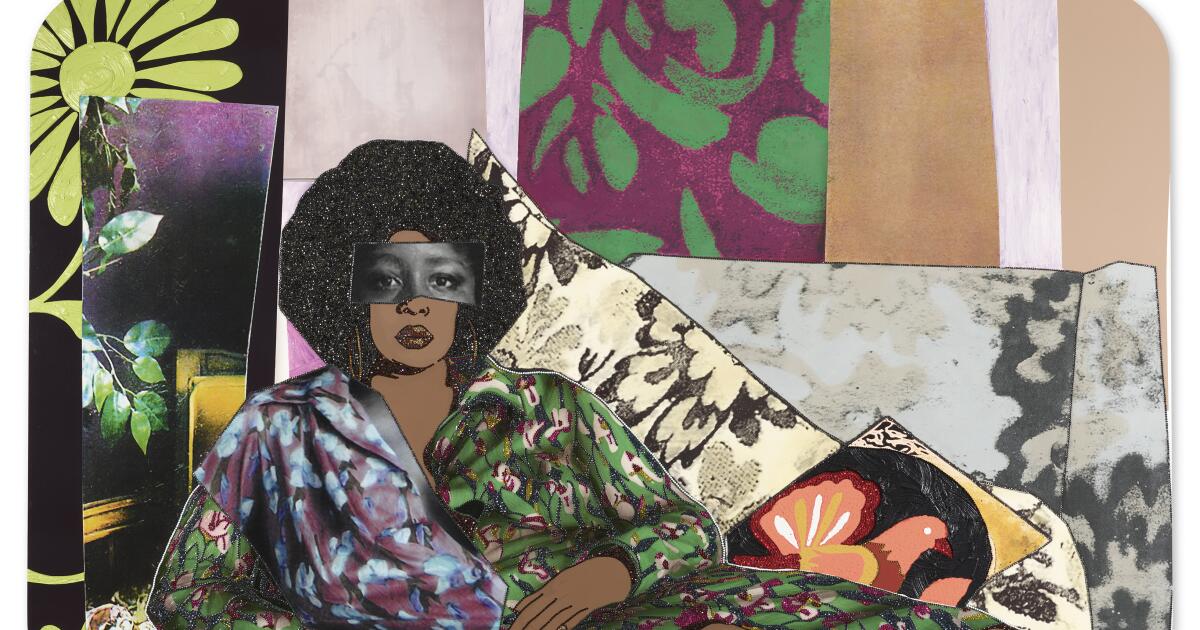
Living rooms, rec rooms and finished basements turn up as installation formats throughout the show, while the compositions in her monumental portraits tightly collage figure and ground. The self-portrait in “Afro Goddess Looking Forward” is typical: Black-and-white photographs of Thomas’ eyes, some tabletop greenery and a portion of her torso mix with abundant painted features. The entirety of the figure is part of a dynamic patchwork that incorporates furniture, pillows, wallpaper and other accoutrements of a homey interior. Thomas presents as a Gen X Matisse.
Visually, there’s no separating the artist from her domestic environment, even in the imagination, so dazzlingly exuberant are the two fabrications. The strategy is repeatedly employed in paintings of friends, lovers and family, where figures merge with ground. The union comes across not as a limiting confinement but as a refuge — a contained space of at times boisterous play in which creative exploration unfolds.
Queer artists often regard the private home as a safe place for resourceful invention, given a public realm that puts forward scant models for living a life, not to mention offering abundant danger for doing so. Thomas is no exception. In one room lined with faux-wood paneling and cherry-red ottomans, she even shows herself in each painting twice, dressed in form-fitting animal-print tights and happily engaged in wrestling matches with herself. In another, an elaborate video montage of the brilliant and outspoken singer Eartha Kitt can be viewed from comfortably upholstered furniture in a convivial living room.
Then there’s her trademark use of craft-store rhinestones, which is multipurpose. Hair, body contours and facial features are often lined with the glittery paste, sometimes multicolored. The pictures’ flatly painted skin and two-dimensional patterning in textiles and wallpaper are set into shimmering visual motion. The paintings become performers, like entertainers on TV or the stage.
Forget Hobby Lobby. This sparkly craft-store aesthetic perform a vernacular consecration of the women she paints (and she paints only women). Rather than tacky, the rhinestones are beguiling. They make you smile.
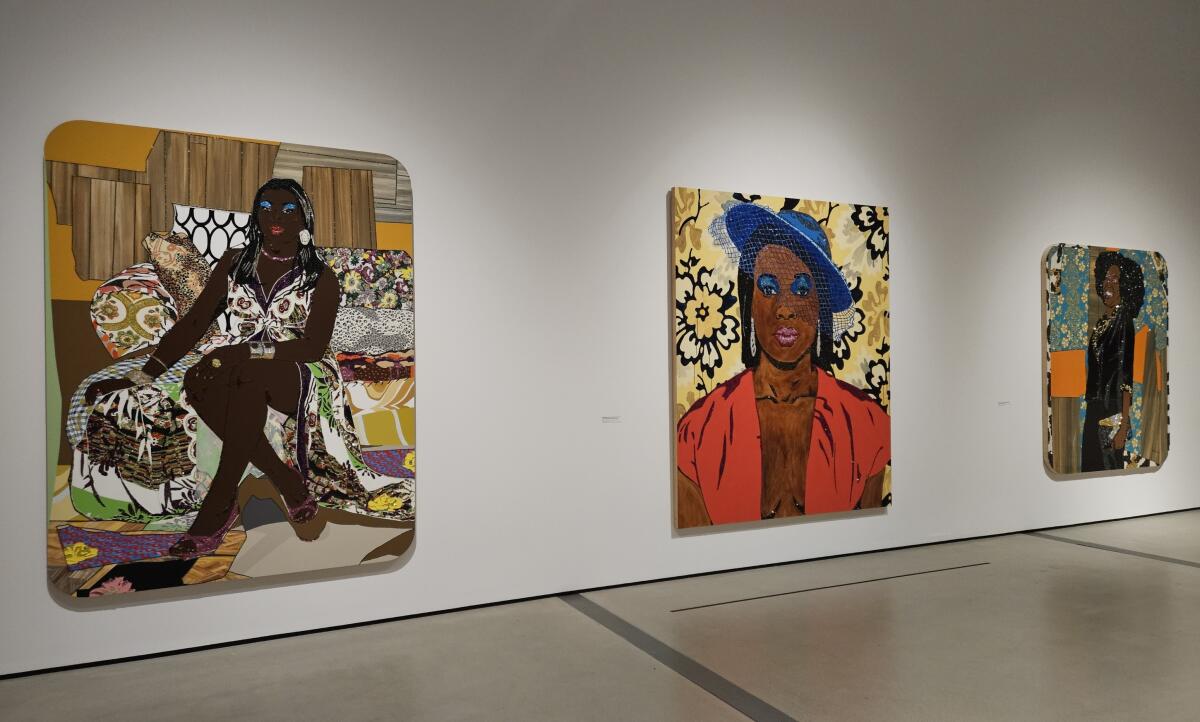
Mickalene Thomas embeds her portraits of Black women in decoarative interiors
(Christopher Knight/Los Angeles Times)
Elsewhere, Thomas incorporates queer predecessors in paintings of abstract heads. A borrowed Andy Warhol “Flower” becomes an eyepatch, while topsy-turvy eyeballs, pushed to the margins of a face, recall Jasper Johns’ borrowing of similar elements from Picasso’s “Woman in a Straw Hat.” Thomas is identifying family.
Sometimes the pictorial setting is layered into the exhibition’s physical installation. One gallery filled with potted plastic plants features collage-style paintings of pin-up nudes from Jet magazine. Thomas has installed several of them on a wall dominated by a photo-enlargement of a pointedly empty closet. Jet cheesecake photos were surely made with male subscribers in mind, but she identifies lesbian desire as a vital element within the magazine’s audience. Black diversity is real.
Over at CAAM and LACMA, “Simone Leigh” is a traveling exhibition organized by the Institute of Contemporary Art / Boston, where it was seen last year. Included are several sculptures shown in the American Pavilion at the 2022 Venice Biennale, where Leigh, now 56, represented the United States. As at the Broad, male figures are nowhere to be seen.
Leigh has said that her work represents a “creolization” of art, mixing prominent European and Black traditions. Some of what is implied by the term is evident in the remarkable “Martinique.”
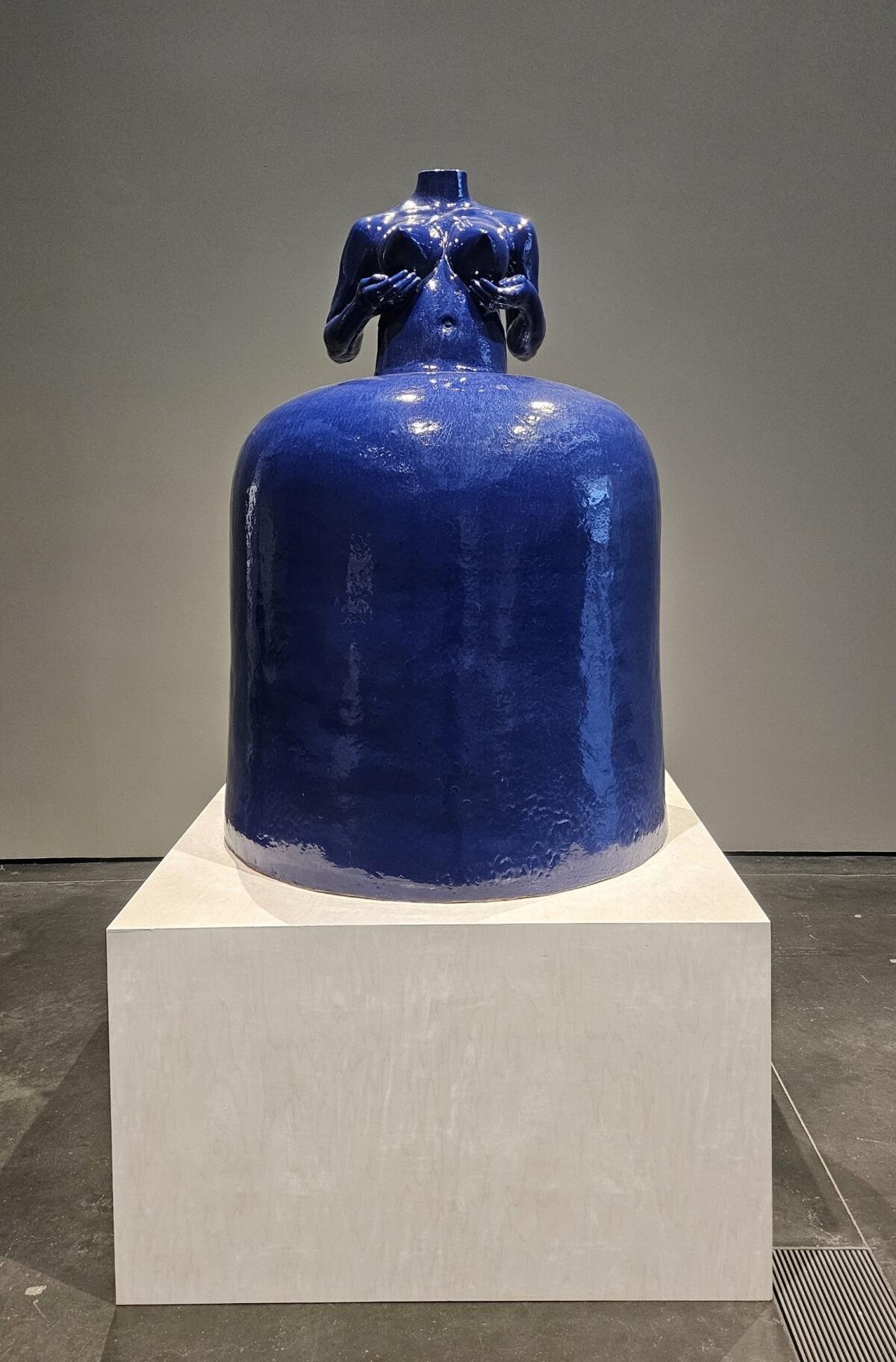
Simone Leigh, “Martinique,” 2022; stoneware
(Christopher Knight/Los Angeles Times)
Five feet tall, the cobalt blue stoneware figure of a lifesize headless women in a voluminous, bell-shaped skirt shows her cupping aggressive, bullet-like breasts in her hands. Titled for the island of Martinique, a former French colony in the Caribbean that legend held was once occupied solely by women, Leigh’s 2022 sculpture derives from a mid-19th century monument in the capitol, toppled during Black Lives Matter protests two years earlier.
The destroyed monument was a marble figure by French Salon artist Gabriel Vital Dubray that celebrated Martinique native Joséphine Bonaparte, first wife of Emperor Napoleon, who was instrumental in reviving slavery on the island despite its abolition in France. Dubray’s mediocre statue had already been beheaded three decades ago — a symbolic decapitation that couldn’t help but recall Marie-Antoinette’s actual fate at the guillotine. The sculpture stood headless in a public park until July 2020.
Think of Leigh’s subsequent sculpture as a monument to its headless-ness — at once a mockery of Joséphine’s thoughtless ignorance and a captivating salutation to the actual power of symbolic resistance. The volumetric, jug-like form of “Martinique” emphasizes clay’s eternal role as a vessel, which the artist fills with new meanings by virtue of her chosen forms and referents.
Clay is the medium most often encountered in Leigh’s art, whether in glazed form or as the raw material for works then cast in bronze. Shiny stoneware sphinxes in modulated natural hues, an 11-foot mound of raffia crowned by the feminine symbol of a cowrie shell, a suspended cluster of several dozen breast-shaped terracotta gourds with golden nipples and pierced by metal antennas — sculpture’s most ancient substance is typically made sleek and modern in her hands.
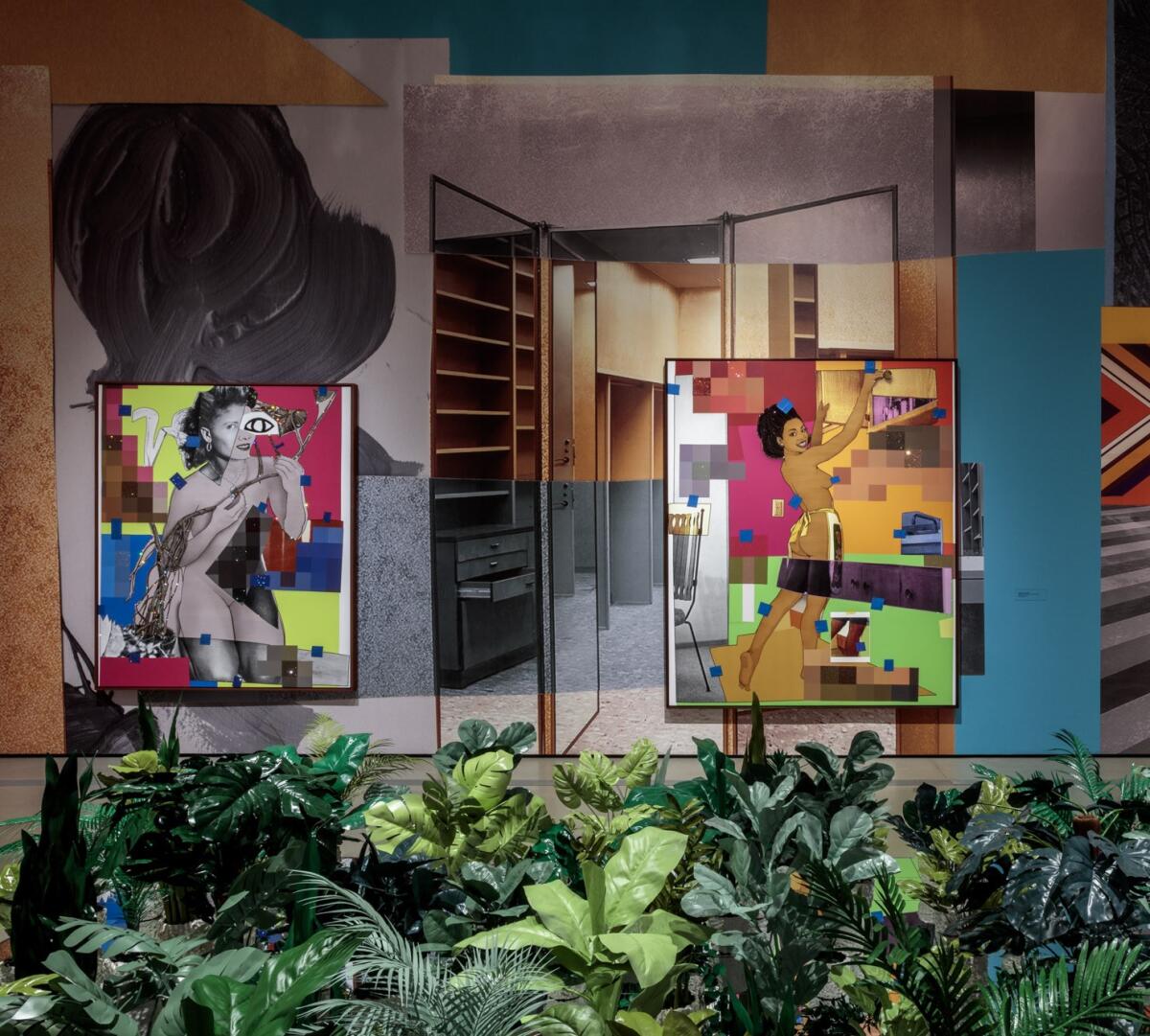
Mickalene Thomas installed pin-up paintings on a photo blow-up of an empty closet
(Joshua White)
Much of the work is a hybrid of female and architectonic forms — literally, woman as shelter.
“Herm” remakes an ancient Greek boundary marker or signpost, historically composed of a squared stone pillar with a carved male head on top. Leigh’s version employs a cruciform bust of a woman instead. A simple vertical slit is in front where a Greek phallus would protrude, and a shapely striding leg extends from the rear, together feminizing the bronze. Her signpost sculpture stands more than eight feet tall. Amazonian in scale, it insists that a viewer look up to the boundary it marks.
A bronze “Sentinel,” its surface featuring a rich black patina, transforms a traditional sphinx motif. A horizontal, corrugated body (think of the shape as a sheltering Quonset hut or nourishing grain shed) is topped at one end by a female head, its Afro hairstyle smoothed into a turban form. Incongruously, this watchful guardian’s face has no eyes, a motif common to all but one sculpture in the exhibition. The internalized, inward-looking result merges with a blank screen, onto which viewers project their own perceptions. Leigh’s best work generates a sense of intimate connection, even when its size approaches monumental.
One moving work is a wall-size, single-channel video projection of a recumbent Black torso, seen from behind, the head obscured beneath a stony pile of gray rubble. Made in tandem with Brooklyn-based artist Chitra Ganesh — when they work together, the duo goes by the name Girl — it turns the European tradition of a reclining female nude inside-out, making the gender ambiguous and burying the figure’s gaze. (A wistful musical soundtrack, all wind instruments and drums, was composed by Kaoru Watanabe.) Look closely, and the mountainous image, seemingly static, is gently breathing. Whether the barely rising and falling ribcage represents restorative sleep or a dying breath is hard to say.
In both parts of the show, a bothersome hunt is required of visitors to find object labels too discreetly printed in black typeface against dark brown walls (a phone flashlight comes in handy). The only real downside, though, is the bifurcation between two venues located across town from each other. The split diminishes the retrospective punch.
The more satisfying presentation is at CAAM, where the 13 works span two decades, allowing for some sense of artistic evolution and reverberation. At LACMA, all but four of the 17 pieces date from just the past two years; the installation is lovely, but it’s more like a contemporary gallery show than a museum survey.
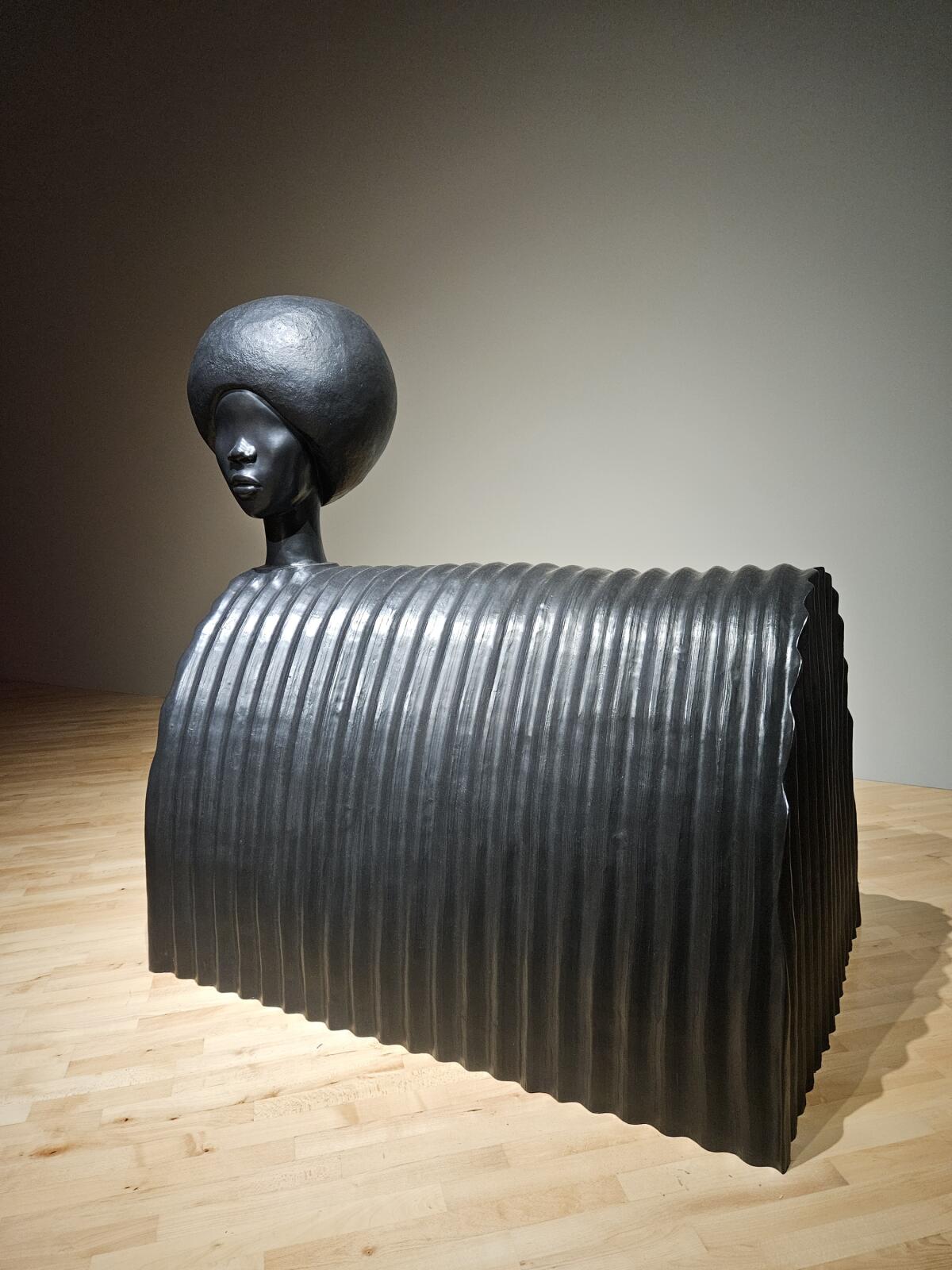
Simone Leigh, “Sentinel,” 2019; bronze
(Christopher Knight/Los Angeles Times)
The prominence of the exhibitions by Thomas and Leigh — highly accomplished, queer Black women — is crucial, however, especially as June’s Pride celebrations commence. At least 515 anti-LGBTQ bills, a record number, are pending in state legislatures across the country, representing an unspeakable mass of public hate. Misogyny, a core driver of homophobia, is deeply embedded in American life.
It has been since at least 1692. That was the year Bridget Bishop was ascertained to be a witch by frightened, conformist Puritan religious elders in the Province of Massachusetts Bay. Bishop, a thrice-married mother of four, was hauled away and lynched on Gallows Hill in Salem Village after a bizarre eight-day trial.
Three centuries later, as a criminally convicted former U.S. president bellows “witch hunt” into every available microphone, the madness endures, the cruelty continues. When Supreme Court Justice Samuel A. Alito Jr. and his cohort stripped women of bodily autonomy in overturning long-settled abortion rights two years ago, the conservative Catholic jurist resurrected the discredited opinions of British judge Matthew Hale for support. Hale, a Puritan sympathizer and later Lord Chief Justice of England, sent two women to their doom as “witches” after a trial in 1664.
Alito’s absurd citation of a notorious misogynist was widely greeted with a mix of disgust and ridicule, but not surprise. (Even though a nearly two-thirds majority of Americans say abortion should be legal in all or most cases, we live in a country where rule by a political minority is the norm.) Thomas and Leigh, judging from their generous and eloquent paintings, sculptures and videos, are unlikely to have been shocked. Saddened, for sure, and no doubt even scandalized — but not shocked.
More’s the pity. And more’s the reason for their bracing art.
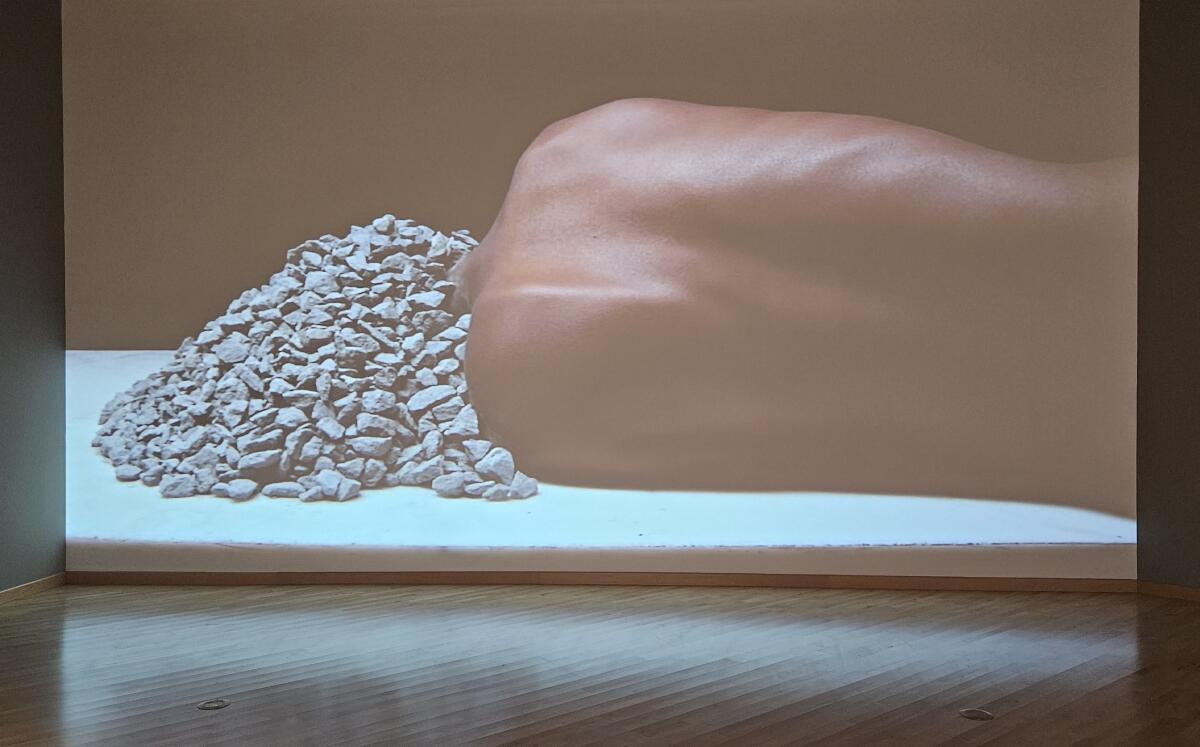
Girl (Simone Leigh and Chitra Ganesh), “my dreams, my works, must wait till after hell. . . ,” 2011; single-channel video, color, sound, 7:14 min.
(Christopher Knight/Los Angeles Times)
Mickalene Thomas and Simone Leigh
Mickalene Thomas
Through Sept. 29 (closed Mondays) at the Broad, 221 S. Grand Ave., L.A. (213) 232-6200, www.thebroad.org
Simone Leigh
Through Jan. 20 (closed Mondays) at the California African American Museum, Exposition Park, 600 State Drive, L.A., (213) 744-7432, www.caamuseum.org; and also the Los Angeles County Museum of Art, 5905 Wilshire Blvd., L.A., (323) 857-6000, www.lacma.org


In Sender, writer-director Russell Goldman’s high-anxiety debut, the filmmaker expands on his 2022 short Return to Sender, in which Allison Tolman starred as a woman who receives packages she didn’t order. That may not sound like a premise that would result in a paranoid, darkly comedic thriller, much less a feature. But in extending his story from 18 minutes to just over 90, Goldman follows a maddening scenario involving an online retailer called Smirk, a fictionalized Amazon counterpart. More significantly, he captures the frenzied mindset of his protagonist, who grapples with staying sober and several other major life changes—all compounded by a layer of justifiable paranoia brought on by the endless packages. Goldman’s tweaky style and elusive scripting create a peculiar, out-of-whack presentation that destabilizes the viewer, firmly placing us in his main character’s perspective. However, by the end, the journey through this cine-manic headspace doesn’t add up to much, and the potential character study at the center feels somewhat lost in the mechanics of the conspiracy.
Britt Lower (AppleTV’s Severance) stars as Julia, who has just lost her job and moved into a rental home to get her life on track. She is backed financially by her overbearing sister Tatiana (Anna Baryshnikov), who occasionally comes nosing around to verify that Julia doesn’t backslide. And she doesn’t. Julia attends regular Alcoholics Anonymous meetings, where she meets the steely Whitney (Rhea Seehorn), who isn’t interested in being her sponsor. But at home, Julia receives a Smirk package with her brand of lipstick. The problem? She didn’t order it. She calls customer service, and the representative doesn’t help much before telling her, “Be sure to stay alert and aware.” Wait, what? Sender is loaded with nagging, unplaceable details like this. They’re often amusing, intriguing, and exasperating in the same moment. But these pieces don’t complete a whole picture, at least not a narratively satisfying one.
The Smirk packages, delivered by the outwardly helpful, nice-guy driver Charlie (David Dastmalchian), contain a random assortment of objects, from drum kits to protein powder. The squirrelly Julia, already coming apart at the seams from her recent drama, doesn’t know what to make of it. She’s convinced there’s some plot against her, perhaps by someone at Smirk. To what end, she doesn’t know. But Goldman gives us a glimpse of the long-term consequences of her ordeal in the prologue, which features Jamie Lee Curtis (also a producer) as Lisa, a woman in circumstances similar to Julia’s. Lisa’s response to receiving a box of soil with a broken shin pad (with “Can’t Can’t Can” scrawled on it) entails an attempt to suffocate herself with the bubble wrap, only to do far worse with a sharp edge of the shin pad. To show Lisa’s fate, Goldman’s imagery becomes twisted and surreal but also cryptic.
Sender’s disorienting mood is matched by a skewed formal presentation. Cinematographer Gemma Doll-Grossman’s wide-angle lenses and arch angles might feel at home in a Ken Russell or Terry Gilliam feature such as The Devils (1971) or 12 Monkeys (1996). Julia’s half-remembered drinking binges, accented by blurry close-ups, suggest she may have slept with any number of coworkers. She can’t remember, and it embarrasses her. Her rental is dressed in simple if shabby décor, which gives way to Julia’s erratic collage-like overhaul. Melisa Myers’ stuffed production design makes the most of heightened colors and banal, cluttered rooms that lend a normality to the bizarre, ever more disturbing predicament. Nathan Ruyle’s erratic music delivers what must be described as a soundscape rather than a traditional score, with collusive sound effects and tones driving our certainty that Julia is onto something. Along with Marco Rosas’ discordant editing, Goldman’s technical approach effectively reflects Julia’s fragmented, sleep-deprived mind. But his work as a writer hasn’t done enough to justify this level of technique.
After Julia makes a revelatory discovery that small cameras have been embedded in the products from those mysterious packages, the eventual explanation about what has been happening and why strains logic and underwhelms. It also raises even more unanswered questions. Although well-made and acted—Lower and Seehorn should be on track to movie stardom—Goldman’s script could have used another draft to better work through what unfolds. Sender doesn’t give us enough of its characters’ inner lives beyond the situation at hand, so Julia, Charlie, Tatiana, and Whitney feel like devices in a scenario rather than well-drawn human beings. Even so, Goldman fills his film with deeply broken people who try to gain control of their lives by controlling others, exposing and preying on their weaknesses. Despite the material’s potential resonance, Goldman’s style is overpowering. Still, his kernel of an idea and the way he explores it demonstrate his clear skill, and for much of Sender, its sheer oddball energy earns admiration.

“Lethal Weapon” star Danny Glover has revealed he has been living with Alzheimer’s disease for years.
In an interview with NBC’s Lester Holt that aired on the “Today” show on Wednesday, the 79-year-old actor and activist opened up about living with the disease. According to People, he received his diagnosis in 2023, which was not long after he was awarded an honorary Oscar in 2022.
“I could live with it, in a sense,” Glover says of his condition, which has been affecting his movement, speech and memory. “I’m sure as it advances, things are going to be different and changing.”
A neurodegenerative disease, Alzheimer’s is a type of dementia that affects memory, thinking and behavior and worsens over time, according to the Alzheimer’s Assn. Holt reports that more than 7 million Americans over 65 are living with Alzheimer’s, with Black men suffering at a rate double the national average.
Glover and his family say the Hollywood icon is sharing his story now to “have ownership of his life” and to help remove the stigma around the disease.
“They’ve got my back,” Glover says of his family’s support.
Besides his portrayal of L.A. police Det. Roger Murtaugh in the “Lethal Weapon” film series, Glover is known for roles in movies including “Places in the Heart” (1984), “The Color Purple” (1985), “To Sleep With Anger” (1990), “Angels in the Outfield” (1994), “Dreamgirls” (2006) and “The Last Black Man in San Francisco” (2019). He’s also been a vocal advocate for social justice and humanitarian causes both in the U.S. and abroad.
He was the recipient of the Academy of Motion Picture Arts and Sciences’ Jean Hersholt Humanitarian Award in 2022.
“I don’t feel like it’s the end of my life,” he said in his interview with People about living with Alzheimer’s. “There’s work to do.”

Enter your email and we’ll send a secure one-click link to sign in.
WKRN is provided by Nexstar Media Inc., and uses the My Nexstar sign-in, which works across our media network.
Nexstar Media Inc. is a leading, diversified media company that produces and distributes engaging local and national news, sports, and entertainment content across its television and digital platforms. The My Nexstar sign-in works across the Nexstar network—including The CW, NewsNation, The Hill, and more. Learn more at nexstar.tv/privacy-policy.
-

 Georgia7 minutes ago
Georgia launches address protection program for violence, trafficking survivors
-

 Hawaii10 minutes ago
BBC Audio | Witness History | Hawaii becomes the 50th American state
-
 Idaho15 minutes ago
Idaho State Board appoints David W. Hahn as eighth president of Boise State University
-
 Illinois22 minutes ago
Illinois 250 invites every resident to help tell the state’s story | Ep. 1 of 6
-

 Indiana25 minutes ago
Submit your nature art for DNR hard card licenses
-

 Iowa30 minutes ago
Cubs Minor League Wrap: Aaron Bummer, Liam Hendriks pitch for Iowa
-

 Kansas37 minutes ago
Man pleads guilty to murder, kidnapping in estranged wife’s death in northeast Wichita
-

 Kentucky40 minutes ago
Kentucky Adds Three More International Swimmers to Women’s 2026 Recruiting Class

