Entertainment
Review: In the Olympics closing ceremony, Paris' inspired story sputters with a Hollywood ending

And so the two weeks when I become interested in athletics every four years have drawn to a close, with a ceremony to mark the occasion. There were many ceremonies along the way, of course, and the Olympic Games are themselves a sort of ceremony writ large, a ritual against which the athletes of Earth measure their worth — though obviously they are busy with international competitions in the years between games, winning medals and trophies and setting world records. But the world has agreed that this is the Big Show, as the world agrees on little else.
Since this is technically a television review, let me just say, before we get to the spectacle, that what came between the opening and the closing, as something to see, was exceptionally well presented — at least if you were watching via Peacock. (I can’t speak to NBC’s broadcast coverage, apart from the opening ceremony, where the commentary was intrusive and uninformative, and the closing, about which more below.)
It was a platform one could dive from in any direction, a well-executed interface that allowed one to follow any sport in any number of ways — everything, anytime, from before the beginning of an event until well after the end, into what I think of as the hugging round. So many hugs! All that goodwill and affection, not just among teammates but between competitors, who represented diversity among and within nations, whatever the peculiarities of their individual governments and nativist movements. It’s a world you want to live in. (The Olympic spirit: It’s not just about the gold, silver and bronze.) An illusion, perhaps, but as Marlene Dietrich said, “You can’t live without illusions, even if you must fight for them.”
One of five giant Olympic rings moves into place during the closing ceremony of the 2024 Paris Olympics at Stade de France.
(Wally Skalij / Los Angeles Times)
As for Paris, the staging of the games — and “staging” feels like the right word — in and around the central city felt inspired, somehow at once very old-fashioned and brand new. To be sure, there were parts and people of Paris that remained unseen, if not intentionally hidden. But erecting temporary open-air stadiums below the Eiffel Tower, in the Place de la Concorde and in the gardens of Versailles demonstrated that a host city might have something to show the world outside — literally outside — its big arenas, something essential to the spirit of the place. (Though, with its many parks and large public spaces, it might be better fitted to the task than any other city.) Putting swimmers in the Seine might not have been the healthiest idea, but it had a look. Races run over crooked cobblestone streets, crowded with spectators, were doubly exciting for being run over crooked cobblestone streets, crowded with spectators.
At last to the closing ceremony: It was almost by definition an anticlimax, given that the games were over — if not yet “officially” over — and every race had been run, if only just barely. (The women’s marathon winners received their medals during the ceremony.) But given artistic director Thomas Jolly’s idiosyncratic opening show, set upon the Seine, one would have expected something interesting, if not on its own explicable. If the opening was an often confusing but certainly stimulating cavalcade of images and events, the closing was presented as a single, stately, snail’s-pace theater piece — something like Robert Wilson directing the Cirque du Soleil. It was bookended by a prelude in the Tuileries — where a choral rendition of Edith Piaf’s apropos “Sous le ciel de Paris” accompanied French swimming champ Léon Marchand taking a bit of Olympic flame to pass on to us — and a Gallic version of a Super Bowl halftime show, anchored by the band Phoenix.
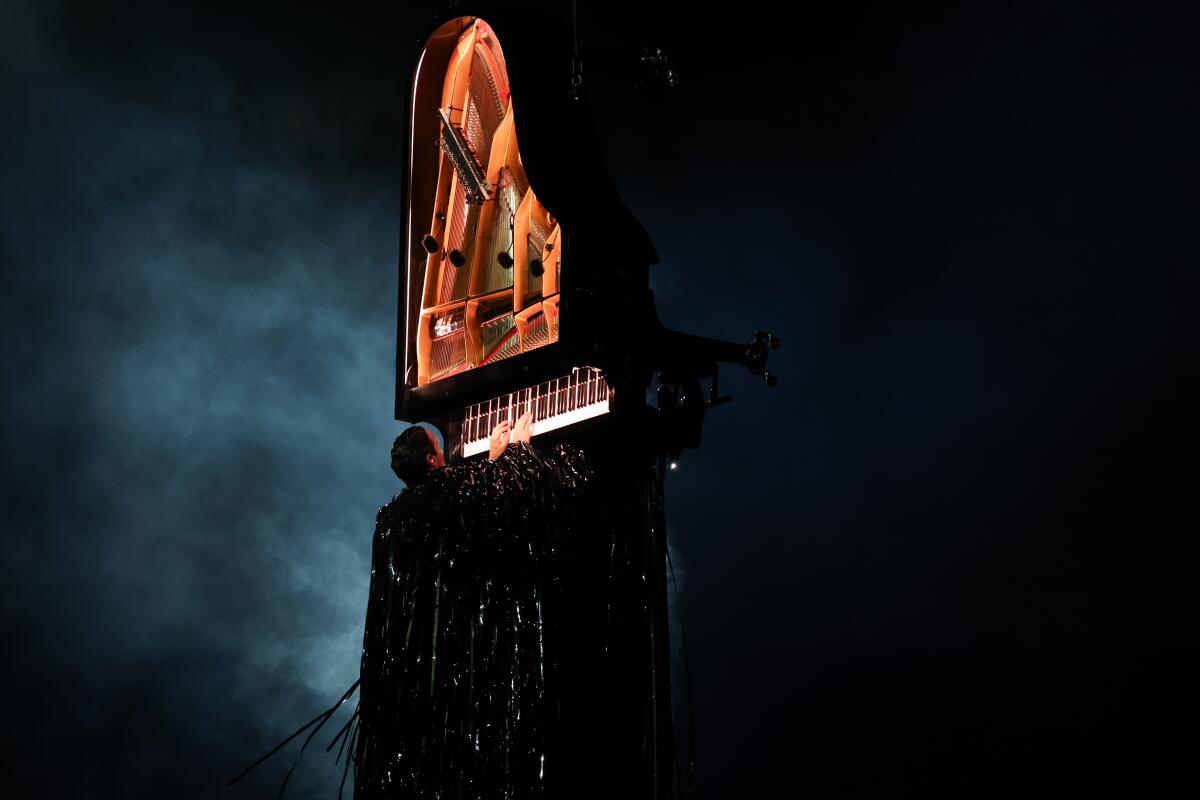
Alain Roche plays a piano hanging vertically during the closing ceremony.
(Wally Skalij / Los Angeles Times)
The central piece had to do with the founding and revival of the Olympic games, and began with a golden winged figure descending to an abstract Earth to meet, after a solo dance passage, the silvery rider and still-mysterious hooded torch-runner we saw in the opening ceremony, the latter carrying a pole from which the Greek flag unfurled. The Voyager discovered the long-lost Olympic rings. Opera singer Benjamin Bernheim, in a robe made from recycled VHS tape, sang the “Hymn to Apollo” accompanied by Alain Roche, playing a piano suspended in the air, perpendicular to the ground. Numerous gray figures exhumed giant rings, which rose into the air, one by one, while performing tricks upon their interior scaffolding. An (inflatable?) replica of the “Winged Victory of Samothrace,” as famously found in the Louvre, rose from the floor. Lights in the stands — from wristbands worn by the audience — produced giant animated athletic events as one might find painted on a Greek vase. The five airborne rings arranged themselves in the familiar Olympic pattern.
Then came pyrotechnics, the pop show and the protocol — speeches (lovely, generous), declarations, lowering the Olympic flag and turning the games over to the 2028 host. H.E.R., sporting a white Stratocaster like the one Hendrix played at Woodstock, performed “The Star-Spangled Banner,” demonstrating once again that it’s a song best handled by an R&B singer. Paris Mayor Anne Hidalgo handed the flag to L.A. Mayor Karen Bass, accompanied by America’s gymnast sweetheart Simone Biles, and the show went jarringly Hollywood.

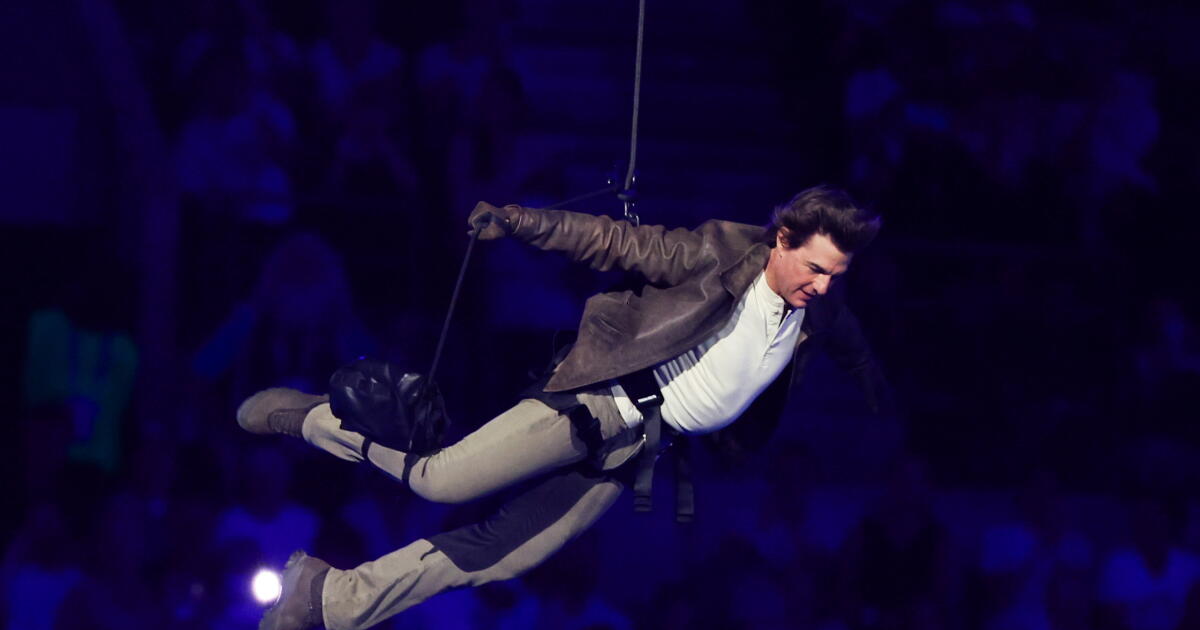
Tom Cruise takes the Olympic flag from Los Angeles Mayor Karen Bass and gymnast Simone Biles during the closing ceremony.
(Wally Skalij / Los Angeles Times)
Tom Cruise, whose status as an international superstar was enough to excuse his presence, abseiled into the stadium, took the Olympic flag from Bass and Biles and drove off with it on a motorcycle, out of the Stade de France and into a filmed piece in which he rode into a cargo plane, skydived into the Hollywood Hills and affixed three extra O’s to the Hollywood sign to create an image of the Olympic rings. He passed the flag on to a series of Olympians: first, cyclist Kate Courtney, who passed it to Olympic sprinter Michael Johnson, who passed it to skateboarder Jagger Eaton, who arrived at Venice Beach. Then the Red Hot Chili Peppers, Billie Eilish and Olympics ambassador Snoop Dogg performed in another filmed piece — recorded in Long Beach, actually — that looked like nothing so much as an MTV “Spring Break” special. (I’m pretty sure those palm trees were trucked in.) Aesthetically, it was like leaving a dark theater after a mysterious foreign film and walking to bright sunlight in a noisy American mall.
Happily, things did not end there. We returned to the darkness of the Stade de France, where the French singer Yseult performed an unusually subtle, sensitive version of “My Way,” whose English lyrics are by Paul Anka, but whose music, by Jacques Revaux, is French. (The original, “Comme d’habitude,” has lyrics by Gilles Thibaut and Claude François.) In case you wondered, why “My Way”?
The commentary was no less inessential with the addition of Jimmy Fallon, who also has a show on NBC.
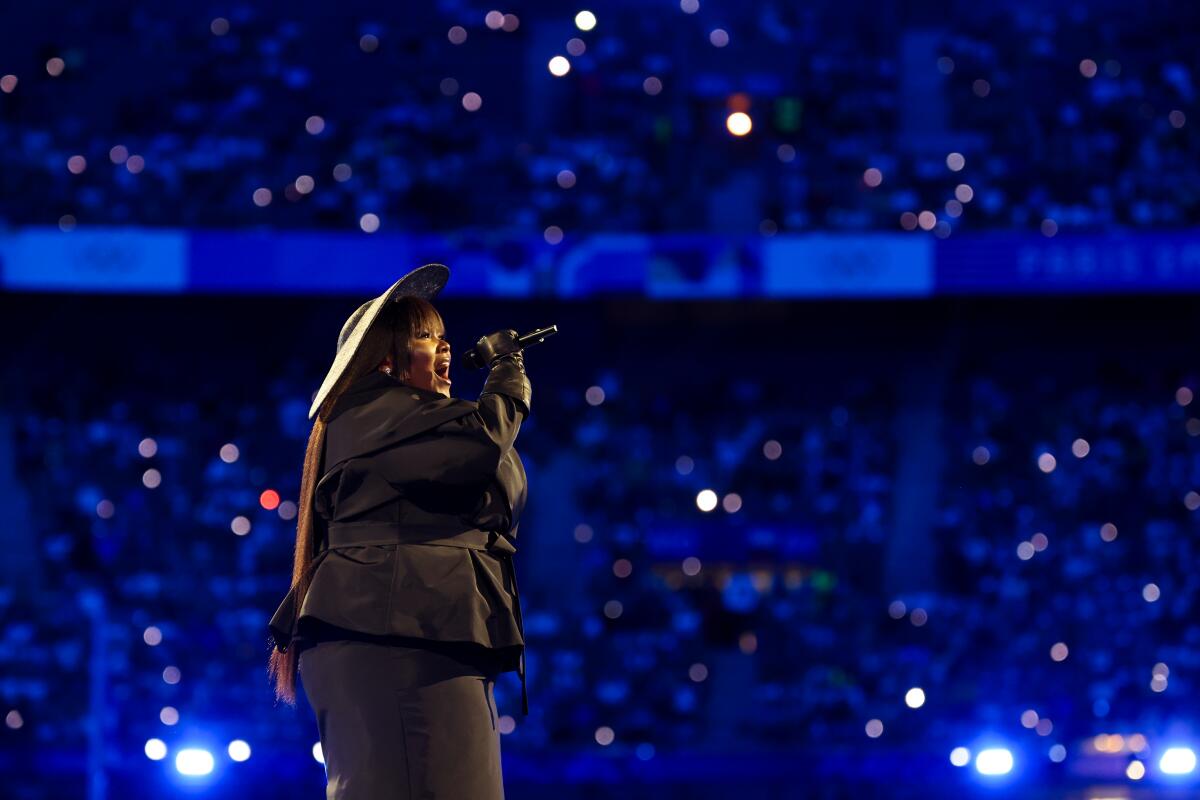
Yseult performs “My Way” during the closing ceremony.
(Wally Skalij / Los Angeles Times)


“Who lives, who dies, who tells your story?” This is one of the culminating lines from Lin-Manuel Miranda’s smash hit 2015 musical “Hamilton,” but it’s also the animating force behind Michael Sarnoski’s “The Death of Robin Hood,” starring Hugh Jackman in the title role. This legendary figure of English folklore has a specific meaning attached to his name, which is synonymous with the altruistic impulse to redistribute wealth. But in his take on the tale, focusing on the end of his life, Sarnoski suggests that perhaps Robin Hood wasn’t such a good guy, even if he was robbing from the rich to give to the poor. It all depends on who’s telling the story, right?
Sarnoski burst onto the scene in 2021 with his debut feature “Pig,” in which he outfitted Nicolas Cage with a long gray wig and sent him on a dangerous quest (to find his beloved, valuable pet). He does something similar in “The Death of Robin Hood,” outfitting Jackman in a long gray wig and sending him on a quest (to achieve some kind of salvation).
But first, Sarnoski has to establish that this Robin Hood isn’t the one we remember from the movies — he’s not the dashing cartoon Disney fox, or Errol Flynn, or Kevin Costner, or Cary Elwes, or Russell Crowe, or even Taron Egerton. No, this Robin Hood is much worse, sleeping in matted filth on the moors, reduced to a feral life of constant vigilance against murderous revenge-seekers for the years of evil deeds he’s carried out with his compatriot, Little John (Bill Skarsgård).
Now called Edward, Little John has achieved some measure of domesticity, but still, he and Robin go a-murdering once again, resulting in a yet another vengeful attack from a relative of their victims. A wounded Robin ends up in an idyllic priory on a coastal island, tended to by a healer, Brigid (Jodie Comer), learning the ropes from the local leper (Murray Bartlett). In this oasis, Robin’s identity is unknown, and he finds the space to embrace a gentler side of himself, particularly with Little John/Edward’s daughter, Little Margaret (Faith Delaney).
Set on the misty outlying islands of the North Atlantic, with its blend of bloody, brutal violence, primitive spirituality and meditative tone, “The Death of Robin Hood” is situated in the realm of films like David Lowery’s “The Green Knight” and Robert Eggers’ “The Northman.” Cinematographer Pat Scola pulls some arresting images out of the fire and fog, and the score of largely traditional Celtic music by Jim Ghedi is easily one of the best of the year. The film is a fine showcase for a different kind of performance from Jackman, and Comer is always a compelling screen presence.
But “The Death of Robin Hood” isn’t as hallucinatory or weird as it could — or should — be. Sarnoski gestures at bleakness but feints from full existential crisis; he tries and fails to be witchy. Despite all the mud and blood, nothing about this film is particularly earthy or embodied. It ends up as this profoundly dull and utterly pointless commentary on the concept of narrative and mythology. “What if Robin Hood was a bad guy?” OK, what of it? The best concept that Sarnoski presents here is the hell of living in an endless cycle of vengeance, but he allows his anti-hero to escape that all too cleanly and conveniently. This Robin Hood is just an old, tired man who ultimately finds some peace at the end of his life, even if it’s unearned.
As an audience, we’re left wondering what all of this is for, and who it’s for. Why trouble the Robin Hood myth at all, and why now? One can’t help but cynically wonder if the inspiration for this project was merely the convenience of recognizable intellectual property and available financing from Screen Ireland. This theory might be creatively pessimistic, but it is a nagging question, especially when the ones posed by the film are already so stale and tired. Expect no revelations from “The Death of Robin Hood” except the one that’s announced in the title.
‘The Death of Robin Hood’
2 stars (out of 4)
MPA rating: R (for strong bloody violence)
Running time: 2:03
How to watch: In theaters June 19
Entertainment
‘The Bear’ at closing time: Ayo Edebiri and Jeremy Allen White reflect on five seasons

Should I stay or should I go?
It’s at once a practical and existential question that plagues the two lead chefs in FX’s “The Bear.” He was the emotionally tortured and volatile chef who left behind a rising career in Michelin-starred restaurants to return to Chicago, his hometown, to run his recently deceased brother’s floundering sandwich joint. She was a Culinary Institute of America-trained chef with potential and a steady demeanor seeking mentorship and an opportunity to work with a prodigy. Together, Carmen “Carmy” Berzatto and Sydney “Syd” Adamu — played by Jeremy Allen White and Ayo Edebiri, respectively — transformed the Original Beef of Chicagoland from a hole-in-the-wall into the titular fine-dining establishment.
But now their partnership in the kitchen has come to an end.
Created by Christopher Storer, “The Bear’s” fifth and final season picks up the morning after Syd, Richie (Ebon Moss-Bachrach) and Nat (Abby Elliott) learn Carmy is quitting the food industry and leaving the restaurant in their hands at a make-or-break moment. And the pressure mounts for Syd to decide if she’ll jump ship to pursue another opportunity. The eight-episode season, now streaming in full on Hulu, largely stretches across one day as the restaurant’s debts accumulate, suppliers cut them off and an unrelenting storm floods the kitchen and threatens to upend a night of service the chefs desperately need to have one last shot at survival and one last performance as a team to deliver an improbable turnaround.
In some ways, it’s a journey that mirrors the actors’ own trajectories. Before “The Bear” became a runaway hit, White was best known for his role on Showtime’s long-running dark comedy “Shameless,” while Edebiri primarily worked as a stand-up comedian and writer. Just as their characters have evolved and gained electric momentum in their careers, so have the actors. Both garnered Emmy Awards for their performances on “The Bear,” and they have added a multitude of film and TV credits to their résumés since. Edebiri is currently starring opposite Don Cheadle in the revival of “Proof,” her Broadway debut, while White will be starring this fall as an investigative reporter in Aaron Sorkin’s “The Social Reckoning,” a companion piece to “The Social Network” that chronicles Facebook’s whistleblower scandal.
Over separate video calls from New York, Edebiri and White reflected on “The Bear’s” conclusion and what it means to leave the characters that supercharged their careers behind. Here are edited excerpts from the conversations.
Ayo Edebiri as Sydney Adamu and Jeremy Allen White as Carmen “Carmy” Berzatto in a scene from Season 5 of “The Bear.”
(FX)
After living inside these characters’ skins for so many years, what’s it like to be done playing them?
Edebiri: They keep saying that we’re done, so I guess that really is the thing of it. Obviously I know that it’s over, but even when we were finishing our first seasons, it didn’t matter how much critical acclaim we got because we’re on a show that’s a part of a network that has a deal with the streaming service — there’s all these things that are continually in flux or that you know that you have no control over. As an actor, you’re used to this state of limbo or not totally knowing or being prepared for an ending, so I think I’m not overwhelmed by it, if that makes sense.
White: I don’t know yet. We were very lucky to understand for a long time when the show was going to end and, to a degree, how the show was going to end. It was difficult to see the direction it went — I have strong feelings about Carmy and where he ends up and how his story might continue on. So much of this season, for Carmy, is about a surrender or acceptance of his place in the world and his place in the kitchen, and it’s the first time he’s really been able to get very honest with himself since we’ve met him. And, in doing so, he chooses to leave, and that was hard for me, for Jeremy. Maybe there’s a world in which he tries this and he comes back. I think I had a different understanding for a while of Carmy’s future. I want him to be happy and healed, but it felt like … I don’t know — imagining him outside of a kitchen was hard for me.
I want to unpack that a little bit more. He wants to be happy. But it was interesting to see him wrestle with how his work hinders that — is it the crutch or the salvation? Did you find yourself having an existential moment as Jeremy taking in what Carmy was wrestling with, or have you reckoned with it before?
White: He threw himself into this work, into this world, pretty young in life. And he was really good at it. But a big part of him burying himself has so much to do with his brother, with his family. I was finishing something too. And, yes, of course, I was thinking of goodbyes, and I was thinking of moving on, and new pursuits and all of these things. I was checking in with myself and what it might feel like to just make such a hard turn in life. I thought a lot about what you get back from your work, but I think ultimately, what Carmy and I don’t share is he was causing so much chaos in his work life; it wasn’t just himself that he was punishing at times. It came down to this surrender to an easier way, a softer way, which was to turn it over to Syd, to turn it over to Richie, to turn it over to Tina in the kitchen — that part, I had an easier time understanding.

“The most beautiful thing about their relationship is their true unconditional belief in one another,” says Allen about Sydney and Carmy in “The Bear.”
(David Urbanke / For The Times)
Syd was facing a crossroads: a shiny new job that could take her to the next level or sticking with this seemingly sinking ship that has taken her to the next level, but where she’s felt unappreciated or stifled at times. Ayo, what did you think of the choice she made?
Edebiri: We’re really fortunate to have such amazing writers who thought about her and her journey. [There’s] an awareness of Sydney’s womanhood and Blackness and youth, but I think [they treated] her with the full dignity of just being a human being and getting able to be a complex character in this show and giving her the dignity of being just as flawed as the other characters. [The choice she made] just made sense to me. It made sense in the architecture of the show. It was gratifying to get to build to that with everybody.
The bulk of this final season has the team dealing with this massive storm that’s created a slew of setbacks at a make–or–break moment for the restaurant. It leads to one final symphony in the kitchen together.
White: Those days were beautiful. So much of our show is shot so quickly, but then we really get to slow down with these choreographed pieces of kitchen ballet, and that’s also when we feel really strong as a group of performers, where we’re incredibly reliant on one another, not just for the emotional beats of a scene, but in this very technical aspect as well. I remember going back to Season 1 and filming Episode 7, “The Review,” which was the single-take episode, and just how much camaraderie came from that, and how much respect came from that for everyone — that feeling of real success that we could do this. It’s a really nice thing that happens sometimes on sets, where there is such a nice mirror of what’s going on with the characters and what’s going on with the cast. In this last push, and this team effort, we want these things as the characters, and we want these things as the cast. We want these people to have what they want, what they deserve, so it was really exciting shooting that last episode or two where all those things are coming into place.
Edebiri: That’s Chris’ thing — it’s like a classical piece of music or something; there’s different movements. His own challenge that he puts on himself, and that, in turn, puts on us, is that we’re still in the same piece of music, but everything just has a different feeling. He’d been talking about it since, low-key, Season 3, but definitely started talking about it a little bit more concertedly when we were filming [Season] 4. It was really starting to take shape in his brain. This challenge of having it be in this one day, and how each episode can feel different, was really exciting to him, so in turn, it became exciting to us.
Were you hoping for more runway to chart what the characters were facing?
Edebiri: No, I think it was cool. I was just like, “Yeah, let’s see what it is.” That’s kind of what everything has been with this show. Part of her emotional journey for the last season, what was on a slower track, in a way, there was something also really fun in having the pressure cooker of one day, and everything getting to ramp up and be quite immediate, which I think has been reminiscent of Seasons 1 and 2 in a fun way.

(FX)
Carmy and Sydney’s dynamic has been so fundamental to the series. These are two people who see something in each other that the other doesn’t. What do you admire about their relationship as friends and as co–workers?
White: The most beautiful thing about their relationship is their true unconditional belief in one another. They see the beautiful things in one another that the other one is not able to witness in themselves. Even though trust has been tested and trust has been broken at times, there is such a loyalty to the best in themselves. They know that they can rely on one another. In a lot of ways, they saved each other. That piece in the opening episode of Season 3, where Carmy gets the call about Mikey and serves the scallop to Syd without ever having met her — there is this invisible tether that was not witnessed by either of them, but it inspired Syd, and whether Carmy knew it or not, this thing was loved and enjoyed by someone that was birthed from this very traumatic moment. There’s just this beautiful, invisible tether that has always existed and will always exist between the two of them.
Edebiri: What I admire about it is the fact that they are able to bring out — through a lot of miscommunication and hard work, but ultimately, I think, with good intentions — the best in each other. They want to see each other be the best versions of themselves.
How is that reflected in your dynamic? Jeremy, who is Ayo as a scene partner and what has she brought out in you as a performer, and vice versa?
White: I was really so lucky to kind of witness Ayo in real time — everybody else had to wait some months to see her on the show. I remember genuinely being struck by her presence, her groundedness. It felt like, if this makes sense, wrong because she was doing it so well. She’s incredibly smart, she’s a wonderful writer, and she’s very skilled improvisationally, and so, in acting with her, there’s something that always makes you feel very in the moment. You can never like relax, in the best way. It’s like you always have to surrender yourself to each moment.
Edebiri: When we first started, I was coming from the comedy world, and he was coming from a much more dramatic world. Our approaches were so different. He has such amazing presence of being and a quiet focus and has such care for the work. He’s a really great leader. There are ideas in society of men in power, and what power held by men has to look like and feel like, and he’s very gentle — especially in the show, which can live so much in the space of chaos and anxiety, having a gentle spirit really helps with filming. He’s so good at making that very clear and helping teach me that as well … I’ve definitely learned from him, without realizing it, ways to protect yourself and protect your peace, and protect also the peace of your co-workers — you get the work done, you be serious about it, but it doesn’t have to be torture.


Edebiri on working with White: “When we first started, I was coming from the comedy world, and he was coming from a much more dramatic world. Our approaches were so different. He has such amazing presence of being and a quiet focus and has such care for the work.” (David Urbanke / For The Times)
What was it like to see them get this thing they’ve been after — not one, but two Michelin stars?
White: Reading that moment —there’s been so much pain and heartache … for years and years and years, and I was just so relieved to see this joyous moment on the page. It felt so, so close to the surface of me already. And we — Jeremy and Ayo — have shared so many insane, joyous moments in our lives since the show. So it felt familiar in the best way. I’m so glad for that moment for both of them — for Carmy and Syd.
Edebiri: We’re shooting it so fast. You always wish you just had more time, and that was one of the last scenes — I think it was the last thing that he and I shot. There’s obviously a bit of a preciousness and emotionality that you’re feeling in that moment, while also tapping into what’s happening to the characters. It’s this thing that, in the brain of myself, we’ve been building to this over five seasons. There’s obviously a somewhat meta reflection of what we’ve gone through — this is just such a crazy journey. But I think at the end of it, especially because of what we know is going to change in their relationship, that in their working proximity, that they are not going to be close, but they know that they were able to do this thing and build this thing together, I think [is] what felt very special, and felt very cool. I hope it’s something that people who have loved the show also feel.
Fans have intense feelings about their relationship, as I’m sure you know. Has it surprised you how strongly people feel about their dynamic?
White: I know that exists. I don’t have too much knowledge on how that all works. It’s funny, I’m very aware of it now because it’s become part of a conversation around the show, but it was nonexistent in our approach to the work. It wasn’t even a thought for either of us. It didn’t occur to us. But I understand it. There is an intimacy, of course, with these two characters. And there is this trust. They lean on each other and they admire each other so much. I’m not like — nobody’s crazy to feel that. There is love there, it’s just not a romantic partnership.
Edebiri: It surprised me the first two [seasons] because I don’t think that that’s what we were doing. Anytime that you say otherwise, I’ve learned [not to]. It’s been hard when doing press, it feels like we get asked specific questions to try to give a specific answer, but the point of art is we make it and we give it. If people are having a response, that’s great, and if I don’t agree with you, I don’t think I’m shutting it down or anything. We made something, then you’re picking something up — that’s the exchange.


White says he knows fans have intense feelings about the relationship between Carmy and Syd. “It’s funny, I’m very aware of it now because it’s become part of a conversation around the show, but it was nonexistent in our approach to the work. It wasn’t even a thought for either of us.” (David Urbanke / For The Times)
Carmy has a few heartfelt conversations this season, but one that really stands out is the one with his mom, played by Jamie Lee Curtis, while revisiting the family home he’s stayed away from for years. He cooks for her. She’s remorseful. Jeremy, what did you think of that moment for Carmy?
White: There’s resistance in it. People like Carmy, you can give them the answer, you can give them the sorry, you can give them the opportunity, and a lot of the times they don’t know what to do with it, or they push it away, or they push it down. What that scene was about, for Carm, was becoming available to even listen. That was the conflict of the scene and the moment. But he was able to eventually get to that acceptance to release some of the resentment, to release some of the anger. Then he is able to show up for her, which was what has been absent. He was able to take it and give her something. It’s been years, if ever, that he’s really been able to do that, to get out of his own way, and be of service in that way to his mother.
Ayo, it was really touching to see Syd naming Tina her chef de cuisine. How did you feel about what that sets up for where Syd and the Bear might be headed with these women as partners in the kitchen?
Edebiri: I loved it. I love getting to work with Liza [Colón-Zayas]. I’ve been so privileged to also be able to direct her — she’s just phenomenal. I think about these two characters, where they started Day 1; Tina was pretending not even to speak English just to stay away from the girl. It was rough from the get-go, but I think both for Liza and I, as two women of color as well, we felt so invested in their relationship and the community they built with each other. There’s something very moving about that to me. Part of the thing for Sydney, she doesn’t know — I think Carmy can see it — that one of her strengths is that they’re different types of leaders. Part of what I think makes Sydney a great leader is that she’s able to delegate and actually remove herself when she knows that she might not be the best in a situation, it might be somebody else.
I haven’t actually seen it. I can’t watch the episodes, but I know when we were filming it, it was both very sweet and very funny. I don’t know if they kept any of the improv from Liza.
You can’t watch because you’re emotional about it or because you just don’t have access?
Edebiri: No, I don’t want to. We were doing all this press and everybody was, “You were so emotional; you wanted to cry, right?” And I’m like, “No, I just don’t want to watch.” I’ll watch it later. The only season that I watched before [it aired], frankly, was 3 and 4 because I had episodes that I made in it. I love the show and I know the show is good. I don’t enjoy watching myself.
I do love that Syd’s ethos in the kitchen is borrowed from “Ratatouille.”
Edebiri: Yes, f—ing rat. It tracks for Sydney.

“I love getting to work with Liza [Colón-Zayas],” says Edebiri about her co-star, whose character is named chef de cuisine. “I’ve been so privileged to also be able to direct her — she’s just phenomenal.”
(FX)
Jeremy, what was your reaction when you read Carmy is in a suit interviewing for an internship at an architectural firm? And what he expresses there?
White: I understand and I’m proud of the courage that it takes [to do a life pivot], but also I tried to play that scene in a way where I didn’t want it to be entirely clear [what happens next]. I wanted the question to be like, “Is this guy still so f— up in the head that he’s trapped regardless of his place in this world, or place of work? Is it a romance that he’s saying goodbye to? Is it a love that he still has, and he’s not quite over yet?” Then I was like, “Do we snap out of that scene and we’re back on the clock?” What is this? I think the goal of the scene is it shouldn’t be all too clear and wrapped up.
What do you think?
White: I could see there’s obviously so much love. There’s love for the people he works with, and there’s love for the paces he’s gone through, but I didn’t know. … I didn’t know if it was a goodbye or an admittance. I think I was trying to find something between him coming clean and being like, you know what, I don’t belong anywhere else or I’m so in love with this thing, but it’s not good for me, and I think it exists somewhere in between that.
Ayo, what was your reaction to Carmy interviewing at the firm?
Edebiri: I was like, “Yeah, that makes sense. This boy’s a noodle.” He’s a fool, he’s ridiculous. It makes sense.
Where do you think he goes from here? Have you thought about it? Do you think he will ever find his way back to the kitchen?
White: I haven’t thought about it too much. I do think there’s something really honest about that direction that Carmy was moving into, but I would hope there’ll always be room for him somewhere in a kitchen.
Edebiri: Syd is like, “You can’t do anything else, brother. Like, what’s the plan?” I don’t know if he takes a break, if he comes back to help her, if he does his own thing.
What do you think happens to the Bear?
Edebiri: I think they do well. It’s not just her; it’s her and Sugar and Richie and Marcus and Tina. She got in it for Carmy, but I think she ended up finding her own voice. I think they keep going, at least for a few more years. I really do.
White: I have to believe that all the pain and suffering and trauma — not only that Carmy has gone through, but that everybody has gone through — is for some greater good. That there is a payoff. My hope is that it would be successful. They’ll have the endurance and the motivation to make it.

Lots of disturbing movies take place at summer camps. “Friday the 13th,” “Sleepaway Camp,” “Care Bears Movie II: A New Generation,” the list goes on, and it just keeps going because shoving dozens of kids into an emotional pressure cooker at the edge of civilization with minimal supervision and no escape is usually a bad idea. And that’s before you give them all bows and arrows.
Avalon Fast’s sophomore feature isn’t a typical summer camp horror movie. It’s a trippy, melancholic tragedy about healing psychic wounds, and finding out they’re already infected. Try to imagine an angsty, indie teen drama that’s parasitically burrowing its way into a Florence + The Machine music video. Now imagine it’s in theaters now and it’s called “Camp.”
“Truth or Dare” is a crappy game, even on “Love Island,” but it’s even crappier at the start of “Camp.” The halfhearted young friends of Emily (Zola Grimmer) can barely muster enough gusto to come up with a dare, and when they give up, their fallback “truth” is just asking her for her biggest regret. It may have been a haircut. It may have been the time she ran over a four-year-old with her car. Either way it’s a lousy icebreaker.
As if her night couldn’t get any worse, Emily’s best friend overdoses in her car, sending her spiraling into grief and misery. Months go by and her father arranges to get her a camp counseling gig, looking after other troubled youths at a place called only “Camp.” (I’d say the least plausible part of Fast’s film is that the domain name “camp.net” wasn’t already taken, but shut my mouth, because it really isn’t.)
The kids are non-entities, a vague distraction from her worries, but her fellow counselors are badasses. They smoke. They drink. They say things like, “I feel like doing drugs” and look, you gotta give ‘em credit, when they say they’re going to do something they do it. I can’t even take the recycling downstairs most of the time and here these girls are, saying they feel like doing drugs and then doing the damn drugs, making me feel like a lazy jerk.
There’s just one problem. Or maybe there isn’t. Emily’s new cohort, led by the alluring and oddly motherly Clara (Alice Wordsworth), begins each summer with a ritual to make their wishes come true. Nev (Lea Rose Sebastianis) wishes to have sex with their boss, Dan (Austyn Van De Camp), “really, really hard” and wouldn’t you know it, her wish was essentially a command.
Avalon Fast knows that’s wrong, but she knows her characters don’t care very much. Dan starts trudging across the camp grounds, confused and disturbed. He was saving himself for marriage, the poor guy, and looks like he’s on the verge of something terrible. But sacrificing Dan’s virginity gave Emily and her friends a taste of power, and it manifests in sparkly animated hand flourishes, which do nothing, it seems, except look cool. But it’s their power and they’re taking it, and they’ll take a lot more.
The problem with describing the plot of Fast’s “Camp” is that it places way, way too much emphasis on the plot. This movie doesn’t run from scene to scene, it gradually sinks into emotional rot. Emily thinks she’s getting better, finding friends and — in her own way — finding her spirituality. It’s just a selfish, detached spirituality and sees no value in anyone else’s feelings. Or anything else about them. What looks like a film about finding your way back from the darkness is, instead, a labyrinth that Emily probably can’t solve. She may not even want to.

“Camp” is a dreary, disturbing day dream of a movie, the kind you have when you’re all in your feels and close to getting heatstroke. It’s not about getting better, it’s about getting worse, and how that sometimes feels like getting better. You may not have worked through your baggage, you may not have processed your trauma, but at least everything looks simple. You can just while away your days with excess, abandoning all empathy, even for yourself.
It’s a sad film, “Camp,” and it’s a little tricky. Fast is working with familiar horror movie clichés, and falling into the old routine where witchcraft is initially empowering, then horrifying, and that probably doesn’t do real-life witches many favors. Then again, neither do a lot of the classic witch films — especially “The Craft,” the goth 1990s elephant in the room — and most of them aren’t as emotionally salient as Fast’s interpretation, although they’re typically more “fun.”
“Camp” isn’t a fun movie. That’s not a criticism, it’s just the way it is. Avalon Fast’s gloomy, lo-fi aesthetic occasionally segues into ornate, gorgeous imagery, proving the filmmaker — and cinematographer Eily Sprungman — are in total creative control. Fast wants us to feel Emily’s despair and the futile moral ambiguity of her distractions. It’s a cautionary tale, perhaps, about not hanging out with the wrong crowd, or taking solace in mind-altering experiences, but more than anything it’s a sympathetic mirror, and it’s pointed at anyone who ever got lost.

-

 Montana3 minutes ago
EXCLUSIVE: 2 ‘Exceptionally Rare’ Ski-In, Ski-Out Montana Mansions Head to Auction in Big Sky—and Could Sell for a Serious Steal
-

 Nebraska6 minutes ago
Today in History – June 26: University of Nebraska holds first commencement
-

 Nevada11 minutes ago
Nevada’s EV market is booming. Here’s why apartment charging could be the next challenge.
-
 New Hampshire18 minutes ago
A mom is thankful for Dismas Home – which is expanding recovery services to Rochester
-

 New Jersey21 minutes ago
New Jersey Supreme Court requires transparency for facial recognition evidence
-

 New Mexico26 minutes ago
NM PRC hears pushback on El Paso Electric rate hike that could add $40 a month
-

 North Carolina33 minutes ago
May home sales increase over 6% from last year in western North Carolina
-

 North Dakota36 minutes ago
North Dakota Supreme Court reverses dismissal of contractors’ lawsuit against city of West Fargo

