Movie Reviews
Film Reviews: At the Toronto International Film Festival — Nazi Puppet in Norway and Abortion Saga in Georgia – The Arts Fuse


By David D’Arcy
Two closely watched films in Toronto were dark dramas that couldn’t have been more different.
Gard B. Eidsvold in Quisling – The Final Days. Photo: Agnete Brun
Who outside of Norway remembers Vidkun Quisling today? Maybe historians and students of the Second World War. Quisling (1887-1945) was prime minister of Norway during the German occupation, a gruff enforcer for the Nazis whose name became synonymous with collaborator.
Quisling’s rule was harsh, just what the Nazis wanted. Norway deported a thousand Jews to camps in Poland. Not so many, compared to the horrific broader picture, but only 12 of them returned. Quisling – The Final Days, picks up the narrative when the Germans surrender in May 1945 and the puppet prime minister, who expected to be treated with the respect befitting his office, is arrested. A young Lutheran pastor, Peder Olsen (Andres Danielsen Lie), is assigned to minister to Quisling (Gard B. Eidsvold) in prison after the church’s primate refuses the task. Erik Poppe’s gripping film, adapted from diaries kept by Olsen and his wife, takes us from the traitor’s loud assertions of patriotism, to a court’s judgment, to his execution by a firing squad. It’s a grim study of denial and defeat.
“Surely there must be some civilized people left in this country,” a baffled Quisling pleads before turning himself in, “you’re calling me a criminal ….. I’ve worked so hard for this country.” So much for remorse.
Eidsvold plays the man who led occupied Norway under Hitler as smug and certain in his politics. Even when the Germans surrender, the leader who met with Hitler as late as January 1945 is shocked when he’s put in handcuffs. Locked in a prison cell before his trial, he finds his spiritual future placed in the hands of the pious young Olsen, who is sworn to secrecy about counseling the collaborator. Like any tyrant, Quisling is angry and impatient. Struggling to sleep on his cot, he asks the young guard attending to him to switch the bright light off. The guard turns it off and back on again, an everyman’s expression of the country’s loathing for the thug claiming to be a misunderstood patriot, now brought down to size.
At every step, caged and scorned, Eidsvold brings rage, but also an unexpected subtlety, to the role of his country’s official bully. Not to give too much away, but the final third of the film takes place almost entirely in the condemned man’s cell, where pride battles with a stark begrudging recognition of mortality. We watch this struggle in relentless closeups. Poppe doesn’t flinch from showing the final moments of those final days.
Norway tends to focus on the underground heroism of some brave citizens rather than the many who collaborated during the wartime Quisling years. There’s still nothing revisionist here about Quisling’s crimes. But questions arise as we watch the man try to come to terms with himself with the help of Olsen the clergyman. Attempting to get the former strong man to open up, Olsen admits that there were moments during the just-ended war when he himself was less than admirable, a confession that the self-satisfied Quisling is willing to accept. But that’s about as far as kinship goes between a minister who endured the occupation and the traitor who presided over it.
Then there is the parallel to European politics today, where reactionary extremists are applauded, not punished, and court their counterparts on the American Right.
Those autocrats are not the simple stooges of foreign enemies, except in Putin-dependent Belarus (and in Ukraine before 2014). Yet in Quisling’s claims of being persecuted and misunderstood, and in his constant lies about serving Norway while following orders from Berlin, we find the same pattern of lying in the palaver of those would-be strong men close to home today. In our case, a leader who has already threatened to punish those who stood in his way after the last election – including Jews who vote against him this time – may not need an occupying army to install him back into power.
It’s a sobering prospect to consider, after watching scenes in which a country exults in the downfall of a tyrant.
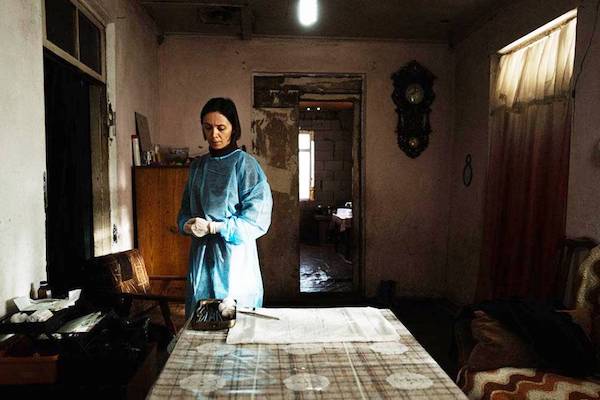
A scene from April. Photo: TIFF
The politics in Georgian director Dea Kulumbegashvili’s April lurch backward and forward through a bleak and cryptically symbolic drama that explores the risks and the stigma of abortion in rural Georgia (the former Soviet republic). And there’s a lot more than politics in this sometimes inscrutable film.
The deadpan Nina (Ia Sukhitashvili) is an obstetrician who supplements her income performing abortions in the countryside, a foreboding expanse which we encounter mostly in the dark. Think of the shadowy emptiness of a place haunted by visions worthy of Bela Tarr, and then place a pregnant patient there whose medical history is unknown and who forbids any emergency surgery. It is a recipe for things to go wrong. A baby is still-born under those conditions to a woman who refuses to have a cesarean section. Nina is forced to defend herself against accusations by the mother’s angry husband and by superiors at her daytime hospital job. Abortion may be legal in Georgia, but it is culturally taboo in much of the country.
This parable about the sufferings of women in a male-dominated culture and the plight of women who try to help them is unnerving in its fatalism. The action — if that’s the right word — moves at a creeping pace, another Tarr trademark. April can feel like a horror film without a monster. Yet Kulumbegashvili gives us a figure – a character? – thats monstrous enough. That presence is a humanoid shape with reptilian textures that slinks around – an observer of injustices, a witness of rural horrors, a victim, a conscience?
If this odd figure in cutaway shots defies explanation, other elements in this film of chilling visuals come off as clear as an anthropologist’s journal. Women stuck in village life are doomed to be pregnant most of the time, and the culture is so closed that medicine isn’t given the opportunity to help them. April will be praised for the staggering power of its images which appear like bumps in the road on which Nina drives her car in the dark. That said, the jostling arrhythmia of the director’s picaresque storytelling (plus the spectral creature) suggest that what we have here are parts of a whole that’s still in pursuit of a style. The film feels like a work in progress – imaginative and improvised — akin to the medical procedures that the film depicts with so much uneasiness. Like the patients in April, audiences who can bear the experience will be grateful to receive what help Kulumbegashvili provides.
David D’Arcy lives in New York. For years, he was a programmer for the Haifa International Film Festival in Israel. He writes about art for many publications, including the Art Newspaper. He produced and co-wrote the documentary Portrait of Wally (2012), about the fight over a Nazi-looted painting found at the Museum of Modern Art in Manhattan.

Movie Reviews
Is ‘Josie and the Pussycats’ (2001) Really Even A Rock N Roll Movie? (FILM REVIEW) – Glide Magazine

The satirical romp Josie and the Pussycats (2001) is a fun movie. But is it a great rock ‘n’ roll movie?
Eh, not so fast on that second one. Welcome back to Glide’s quest for what makes a good rock ‘n’ roll movie. Last month, we looked at Almost Famous, a great launching pad because it gets so much right. And every first Friday, we’ll take another look at a rock ‘n’ movie and ask what it means in the larger pantheon. This month, the Glide’s screening room brings you Josie and the Pussycahttps://glidemagazine.com/322100/almost-perfect-why-almost-famous-sets-the-gold-standard-for-rock-movies/ts. The film is a live-action take on the classic comic-and-cartoon property of a sugary, all-girl rock trio that exists in the world of Riverdale, a.k.a. fictional home of the iconic Archie Andrews.
But this Josie has next to nothing to do with Riverdale and is instead a satire of consumerism and ’00s boy bands. A worthy target, and a topic that has stayed worthy in the quarter-century since Josie dropped. The film was not a hit, but it has become something of a cult classic (like many movies featured in this series).
The plot is fairly simple. Wyatt Frame, an evil corporate type, is making piles of money off boy band Du Jour. They start to wise up to his evil scheme and have to be… taken care of. Frame needs a new group to front his plot, which revolves around mind control to push consumer culture. Enter Josie and the Pussycats, who are about to have a whirlwind ride to the top. And along the way, foil a plot with tentacles so far-reaching they have ensnared… Carson Daly?
Josie is a fun, clever movie, but it doesn’t have a whole lot to say about real rock ‘n’ roll, unless you want to simply accept a perspective that it’s just another cynical consumer-driven product. Even that is an argument that can be made, as long as you’re willing to ignore underground and indie scenes and passionate artists making amazing music.
And it is true that this is a theme of Josie. The band triumphs at the end via their authentic music. But it somehow doesn’t feel authentic, which makes it something of a hollow victory. Let’s consider the criteria already established for a good rock ‘n’ roll movie, and how Josie delivers on that front. The first is in the characters department. The film dodges the previously established Buckethead Paradox, which states that “The real-life rock stars are so much larger than life that you can’t make up credible fictional versions. There is no way someone like Buckethead would come out of a writer’s room and make it to a screen.”
For better or worse, Josie dodges the Paradox by essentially embracing it. The characters themselves are cartoons, and there’s no effort at realism. Given that intent is a huge part of art, it seems unfair to call these characters “cartoons” as a criticism, and it should probably be a compliment. At the same time, they aren’t particularly memorable, which is not a great quality.
And—as a bonus—Tara Reid is perfectly cast as drummer Melody Valentine. Josie was a few years after her turn in Around the Fire (1998), an unintentionally hilarious classic that plays like a jam band afterschool special from the producers of Reefer Madness (look for this amazing film in an upcoming piece).
The acting in general is good, with Rachel Leigh Cook as Josie McCoy and Rosario Dawson as bassist Valerie Brown rounding out the band. And Alan Cumming almost steals the show as sleazy corporate weasel Wyatt Frame.
The character of Wyatt is the film’s funniest riff on a rock ‘n’ roll archetype: the sleazy, corporate manager accompanied by assorted crooked accountants. From Colonel Tom Parker to Albert Grossman to The Great Rock ‘n’ Roll Swindle. It’s all about the benjamins. Which is where the music comes in. If the music is good, that’s what makes it worth it. And Josie’s music has aged particularly well. It’s well-recorded, produced and executed. The songs are particularly catchy. The vocals are by Kay Hanley of Letters to Cleo. Much of the soundtrack sounds like a lost album from The Muffs, and one wonders why Kim Shattuck wasn’t involved.
There’s an argument that power pop was never supposed to be dangerous, and that the Muffs aren’t dangerous either. Fair on the surface, but they played real punk clubs and came from a real scene. There’s not even a hint of that in Josie. So an argument that they play pop punk (which they kinda do) is really lacking the punk part.
And it was produced by Babyface, of all people. While that doesn’t seem like it should lead to great rock ‘n’ roll, sometimes preconceptions are wrong.
That said, this is a very commercial product and sound—as catchy as it is—so maybe it’s not a misconception. Maybe the right question to ask is whether it’s all too perfect? And that’s what gives this ostensibly rock ‘n’ film a smoothed-down edge? After all, the basic ingredients are there. But part of what makes good rock good is that it feels actually dangerous. Maybe there are some actual subversive messages, or a genuine counterculture scene. And Josie simply isn’t that film. The soundtrack is fondly remembered enough that Hanley appeared live and performed the songs at a screening in 2017. That appearance also included the film’s stars Cook, Dawson and Reid.
It’s worth noting that while Cook and company obviously lip sync to the songs in the film, their performances are credible. They went through instrument boot camp, so they pull off the parts.
In the end, the film is primarily a satire of consumer culture. And even more strangely, is loaded with actual product placement. Clearly, the joke was intended to “hit harder” with real products, but having Target in the film constantly makes it feel like more of what it is parodying than a parody. Where’s the joke if the viewer actually pushes to shop at Target while watching the film? And if the filmmakers actually took money (which they almost certainly did)?
And perhaps that is the lesson for this month: a great rock ‘n’ roll movie needs to have something to say about the larger meaning or culture of the music. And while Josie may have a lot to say about culture in general, and it may say it in a fun and likeable way, it’s just not very rock ‘n’ roll. There’s no grit. Now, does it have some things to say about being in a band? Yes, though they are arguably true of most collaborations.
If someone in a hundred years wanted to understand early 21st century rock, Josie and the Pussycats is a bad choice. It doesn’t show the sweat of a performance or the smell of beer. But it’s a great choice for anyone looking for a light-hearted, fun watch with a great soundtrack. We could all use some sugar in our lives these days.
Join us again next month, when we’ll look at one of the inspirations for Josie, A Hard Day’s Night, the legendary first film from The Beatles
Movie Reviews
Peaky Blinders: The Immortal Man review – Tommy Shelby returns for muddy, bloody big-screen showdown

After six TV series from 2013 to 2022, which caused a worrying surge in flat cap-wearing among well-to-do men in country pubs, Peaky Blinders is now getting a hefty standalone feature film, a muscular picture swamped in mud and blood. This is the movie version of Steven Knight’s global small-screen hit, based on the real-life gangs that swaggered through Birmingham from Victorian times until well into the 20th century. Cillian Murphy returns with his uniquely unsettling, almost sightless stare as Tommy Shelby, family chieftain of a Romani-traveller gang, a man who has converted his trauma in the trenches of the first world war into a ruthless determination to survive and rule.
As we join the story some years after the curtain last came down, it is 1940, Britain’s darkest hour and Tommy is the crime-lion in winter. He now lives in a huge, remote mansion, far from the Birmingham crime scene he did so much to create, alone except for his henchman Johnny Dogs, played by Packy Lee. Evidently wearied and sickened by it all, Tommy is haunted by his ghosts and demons: memories of his late brother, Arthur, and dead daughter, Ruby, and working on what will be his definitive autobiography. (Sadly, we don’t get any scenes of Tommy having lunch with a drawling London publisher or agent.)
But a charismatic and beautiful woman, played by Rebecca Ferguson, brings Tommy news of what we already know: his malign idiot son Erasmus Shelby, played by Barry Keoghan, is now running the Peaky Blinders, a new gen-Z-style group of flatcappers raiding government armouries for guns that should really belong to the military. And if that wasn’t disloyal and unpatriotic enough, Erasmus has accepted a secret offer from a sinister Nazi fifth-columnist called Beckett, played by Tim Roth, to help distribute counterfeit currency which will destroy the economy and make Blighty easier to invade. Doesn’t Erasmus know what Adolf Hitler is going to do to his own Romani people? (To be fair to Erasmus, a lot of the poshest and most well-connected people in the land didn’t either.)
Clearly, Tommy is going to have to come down there and sort this mess out. And we get a very ripe scene in which soft-spoken Tommy turns up in the pub full of raucous idiots who cheek him. “Who the faaaaaack is ‘Tommy Shelby’?” sneers one lairy squaddie, who gets horribly schooled on that very subject.
In this movie, Tommy Shelby is against the Nazis, and he can’t get to be more of a good guy than that. (Tommy has evidently put behind him memories of Winston Churchill from the first two series, when Churchill was dead set on clamping down on the Peaky Blinders.) The war and the Nazis are a big theme for a big-screen treatment and screenwriter Knight and director Tom Harper put it across with some gusto as a kind of homefront war film, helped by their effortlessly watchable lead. Maybe you have to be fully invested in the TV show to really like it, although this canonisation of Tommy is a sentimental treatment of what we actually know of crime gangs in the second world war. Nevertheless, it is a resoundingly confident drama.


That’s both a promise and a challenge she delivers, since what follows may rub some viewers the wrong way. Yet Gyllenhaal’s full-throttle commitment to her vision is compelling in and of itself, and she has marshalled an absolutely smashing-looking and -sounding production. The story proper begins in 1936 Chicago, which, like everything and everyplace else in the movie, has been luminously shot by cinematographer Lawrence Sher and sumptuously conjured by production designer Karen Murphy. Her involvement is appropriate given that her previous credits include Bradley Cooper’s A STAR IS BORN and Baz Luhrmann’s ELVIS, since among other things, THE BRIDE! is a nostalgic musical. Its Frankenstein (Christian Bale), who has taken the name of his maker, is obsessed with big-screen tuners, and imagines himself in elaborate song-and-dance numbers. (Considering the reception to JOKER: FOLIE À DEUX, one must applaud the daring of Warner Bros. for greenlighting another expensive film in which a tormented protagonist has that kind of fantasy life.)
THE BRIDE! may be revisionist on many levels, but its characterization of its “monster” holds true to past screen incarnations from Karloff’s to Elordi’s: His scarred appearance masks a lonely soul who desires companionship. Frankenstein has arrived in Chicago to seek out Dr. Cornelia Euphronious (Annette Bening), correctly believing she has the scientific know-how to create an appropriate mate for him. Rather than piece one together, Dr. Euphronious resurrects the corpse of Ida (Jessie Buckley), whose consorting with underworld types led to her brutal death. Previously chafing against the man’s world she inhabited in life, she becomes even more defiant and unruly as a revenant, apparently possessed by the spirit of Shelley herself, declaiming in free-associative sentences and quoting rebellious literature.
Buckley, currently an Oscar favorite for her very different literary-inspired role in HAMNET, tears into the role of the Bride (who now goes by the name Penny) with invigorating abandon that bursts off the screen. Unsure of her identity yet overflowing with self-confident bravado, she’s the opposite of the sensitive “Frank,” but they’re united by the world that stands against them. That becomes literal when a violent incident sends them on the lam, road-tripping to New York City and beyond, on a trail inspired by the films of Ronnie Reed (Jake Gyllenhaal), Frank’s favorite song-and-dance-man star.
With THE BRIDE!, Gyllenhaal has made a film that’s at once her very own and a feverish homage to all sorts of cinema past and present. It’s a horror story, a lovers-on-the-run movie, a crime thriller, a musical and more, and historical fealty be damned if it makes for a good scene (as when Penny and Frank sneak into a 3D movie over a decade before such features became popular). In-references are everywhere: It might just be a coincidence that the couple’s travels take them past Fredonia, NY (cf. “Freedonia” in the Marx Brothers’ DUCK SOUP), but it’s certainly no accident that the former Ida is targeted by a crime boss named Lupino, referencing the actress and pioneering filmmaker whose works included noirs and women’s-issues stories. Penny’s exploits lead legions of admiring women to adopt her look and anarchic attitude, echoing the first JOKER (while a headline calls them “Twisted Sisters”), and the use of one Irving Berlin song in a Frankensteinian context immediately recalls a classic comedic take on the property.
Whether the audience should be put in mind of a spoof at a key point in a film with different goals is another matter. At times like these, Gyllenhaal’s pastiche ambitions overtake emotional investment in the story. As strong as the two lead performances are (Bale is quite moving, conveying a great deal of soul from behind his extensive prosthetics), it’s easier to feel for them in individual scenes than during the entire course of the just-over-two-hour running time. The diversions can be entertaining, to be sure, but they also result in an uncertainty of tone. The dissonance continues straight through to the end, where the filmmaker’s choice of closing-credits song once again suggests we’re not supposed to take all this too seriously.
There’s nonetheless much to admire and enjoy about THE BRIDE!, and this kind of risk-taking by a major studio is always to be encouraged (especially considering that we’ll see how long that lasts at Warner Bros. once Paramount takes it over). Beyond the terrific work by the aforementioned actors, there’s fine support from Peter Sarsgaard and Penelope Cruz as detectives on Penny and Frank’s heels, with Sandy Powell’s lavish costumes and Hildur Guðnadóttir’s rich, varied score vital to fashioning this fully imagined world. Kudos also to makeup and prosthetics designer Nadia Stacey and to Chris Gallaher and Scott Stoddard, who did those honors on Frank, for their visceral, evocative work. Uneven as it may be, THE BRIDE! is also as alive! as any film you’ll likely see this year.

U.S. Postal Service could run out of money within a year

All Aboard the 67, San Francisco’s Most Delayed Bus | KQED

We don’t know why Dallas elected Amber Givens for DA either

Firefight at NW Miami-Dade warehouse enters 2nd day: ‘It burned it all up’

Poor Clares’ monastery a case study in why Boston is short on housing – The Boston Globe

Florida High School Football Rankings: Top 25 teams – Oct. 21

Cleary's 21 help Le Moyne down Central Connecticut State 69-64 in OT

How old is Bo Nix? What to know about Oregon quarterback ahead of 2024 NFL Draft

99th annual Pony Swim held in Virginia

Indiana Members Credit Union announced as new anchor tenant at Bottleworks District

DOJ continues Biden autopen probe despite former president unlikely to face charges
Fact check: Did French border guards mock influencers returning from Dubai amid Iran war?

Iran’s fight for survival / The widening war / Trump’s nebulous goals : Sources & Methods

Map: 4.9-Magnitude Earthquake Shakes Louisiana

Paxton vows he’s ‘staying in this race’ even if Trump backs Cornyn in Texas GOP clash
-

 World1 week ago
Exclusive: DeepSeek withholds latest AI model from US chipmakers including Nvidia, sources say
-

 Wisconsin4 days ago
Setting sail on iceboats across a frozen lake in Wisconsin
-

 Massachusetts1 week ago
Mother and daughter injured in Taunton house explosion
-

 Massachusetts3 days ago
Massachusetts man awaits word from family in Iran after attacks
-

 Maryland5 days ago
AM showers Sunday in Maryland
-

 Florida5 days ago
Florida man rescued after being stuck in shoulder-deep mud for days
-

 Denver, CO1 week ago
10 acres charred, 5 injured in Thornton grass fire, evacuation orders lifted
-

 Oregon7 days ago
2026 OSAA Oregon Wrestling State Championship Results And Brackets – FloWrestling