
Movie Reviews
Film Reviews: At the Toronto International Film Festival — Nazi Puppet in Norway and Abortion Saga in Georgia – The Arts Fuse
By David D’Arcy
Two closely watched films in Toronto were dark dramas that couldn’t have been more different.
Gard B. Eidsvold in Quisling – The Final Days. Photo: Agnete Brun
Who outside of Norway remembers Vidkun Quisling today? Maybe historians and students of the Second World War. Quisling (1887-1945) was prime minister of Norway during the German occupation, a gruff enforcer for the Nazis whose name became synonymous with collaborator.
Quisling’s rule was harsh, just what the Nazis wanted. Norway deported a thousand Jews to camps in Poland. Not so many, compared to the horrific broader picture, but only 12 of them returned. Quisling – The Final Days, picks up the narrative when the Germans surrender in May 1945 and the puppet prime minister, who expected to be treated with the respect befitting his office, is arrested. A young Lutheran pastor, Peder Olsen (Andres Danielsen Lie), is assigned to minister to Quisling (Gard B. Eidsvold) in prison after the church’s primate refuses the task. Erik Poppe’s gripping film, adapted from diaries kept by Olsen and his wife, takes us from the traitor’s loud assertions of patriotism, to a court’s judgment, to his execution by a firing squad. It’s a grim study of denial and defeat.
“Surely there must be some civilized people left in this country,” a baffled Quisling pleads before turning himself in, “you’re calling me a criminal ….. I’ve worked so hard for this country.” So much for remorse.
Eidsvold plays the man who led occupied Norway under Hitler as smug and certain in his politics. Even when the Germans surrender, the leader who met with Hitler as late as January 1945 is shocked when he’s put in handcuffs. Locked in a prison cell before his trial, he finds his spiritual future placed in the hands of the pious young Olsen, who is sworn to secrecy about counseling the collaborator. Like any tyrant, Quisling is angry and impatient. Struggling to sleep on his cot, he asks the young guard attending to him to switch the bright light off. The guard turns it off and back on again, an everyman’s expression of the country’s loathing for the thug claiming to be a misunderstood patriot, now brought down to size.
At every step, caged and scorned, Eidsvold brings rage, but also an unexpected subtlety, to the role of his country’s official bully. Not to give too much away, but the final third of the film takes place almost entirely in the condemned man’s cell, where pride battles with a stark begrudging recognition of mortality. We watch this struggle in relentless closeups. Poppe doesn’t flinch from showing the final moments of those final days.
Norway tends to focus on the underground heroism of some brave citizens rather than the many who collaborated during the wartime Quisling years. There’s still nothing revisionist here about Quisling’s crimes. But questions arise as we watch the man try to come to terms with himself with the help of Olsen the clergyman. Attempting to get the former strong man to open up, Olsen admits that there were moments during the just-ended war when he himself was less than admirable, a confession that the self-satisfied Quisling is willing to accept. But that’s about as far as kinship goes between a minister who endured the occupation and the traitor who presided over it.
Then there is the parallel to European politics today, where reactionary extremists are applauded, not punished, and court their counterparts on the American Right.
Those autocrats are not the simple stooges of foreign enemies, except in Putin-dependent Belarus (and in Ukraine before 2014). Yet in Quisling’s claims of being persecuted and misunderstood, and in his constant lies about serving Norway while following orders from Berlin, we find the same pattern of lying in the palaver of those would-be strong men close to home today. In our case, a leader who has already threatened to punish those who stood in his way after the last election – including Jews who vote against him this time – may not need an occupying army to install him back into power.
It’s a sobering prospect to consider, after watching scenes in which a country exults in the downfall of a tyrant.
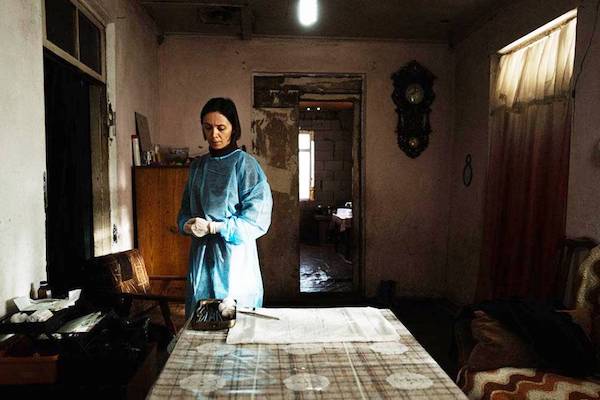
A scene from April. Photo: TIFF
The politics in Georgian director Dea Kulumbegashvili’s April lurch backward and forward through a bleak and cryptically symbolic drama that explores the risks and the stigma of abortion in rural Georgia (the former Soviet republic). And there’s a lot more than politics in this sometimes inscrutable film.
The deadpan Nina (Ia Sukhitashvili) is an obstetrician who supplements her income performing abortions in the countryside, a foreboding expanse which we encounter mostly in the dark. Think of the shadowy emptiness of a place haunted by visions worthy of Bela Tarr, and then place a pregnant patient there whose medical history is unknown and who forbids any emergency surgery. It is a recipe for things to go wrong. A baby is still-born under those conditions to a woman who refuses to have a cesarean section. Nina is forced to defend herself against accusations by the mother’s angry husband and by superiors at her daytime hospital job. Abortion may be legal in Georgia, but it is culturally taboo in much of the country.
This parable about the sufferings of women in a male-dominated culture and the plight of women who try to help them is unnerving in its fatalism. The action — if that’s the right word — moves at a creeping pace, another Tarr trademark. April can feel like a horror film without a monster. Yet Kulumbegashvili gives us a figure – a character? – thats monstrous enough. That presence is a humanoid shape with reptilian textures that slinks around – an observer of injustices, a witness of rural horrors, a victim, a conscience?
If this odd figure in cutaway shots defies explanation, other elements in this film of chilling visuals come off as clear as an anthropologist’s journal. Women stuck in village life are doomed to be pregnant most of the time, and the culture is so closed that medicine isn’t given the opportunity to help them. April will be praised for the staggering power of its images which appear like bumps in the road on which Nina drives her car in the dark. That said, the jostling arrhythmia of the director’s picaresque storytelling (plus the spectral creature) suggest that what we have here are parts of a whole that’s still in pursuit of a style. The film feels like a work in progress – imaginative and improvised — akin to the medical procedures that the film depicts with so much uneasiness. Like the patients in April, audiences who can bear the experience will be grateful to receive what help Kulumbegashvili provides.
David D’Arcy lives in New York. For years, he was a programmer for the Haifa International Film Festival in Israel. He writes about art for many publications, including the Art Newspaper. He produced and co-wrote the documentary Portrait of Wally (2012), about the fight over a Nazi-looted painting found at the Museum of Modern Art in Manhattan.
Movie Reviews
Movie Review – Desert Warrior (2026)
Desert Warrior, 2026.
Directed by Rupert Wyatt.
Starring Anthony Mackie, Aiysha Hart, Ben Kingsley, Ghassan Massoud, Sharlto Copley, Sami Bouajila, Lamis Ammar, Géza Röhrig, Numan Acar, Nabil Elouahabi, Hakeem Jomah, Ramsey Faragallah, Saïd Boumazoughe, and Soheil Bostani.
SYNOPSIS:
An honorable and mysterious rogue, known as Hanzala, makes himself an enemy of the Emperor Kisra after he helps a fugitive king and princess in the desert.
With aspirations of being a historical epic harkening back to the sword and sandal blockbusters of yesteryear, Rupert Wyatt’s seventeenth-century Arabia tale is about as generic and epically dull as one would expect from a film plainly titled Desert Warrior. Yes, there appear to be real locations here, and there are some admittedly sweeping shots of various tribes storming into battle on horseback and camels, but it’s all in service of a mess that is both miscast and questionable as the work of a filmmaking team of mostly white creatives.
The story of Emperor Kisraa (Ben Kingsley, a distracting presence even with only one or two scenes) rounding up women from other tribes to be his concubines, which inevitably became the catalyst for a revolution led by Princess Hind (Aiysha Hart), uniting all the divided clans and strategizing battle plans for flanking and poisoning, is undeniably ripe for cinematic treatment. The problem is that what’s here from Rupert Wyatt (and screenwriters Erica Beeney, Gary Ross, and David Self) is less than nothing in the primary creative process; no one seems to have a connection to Arabic heritage or culture, but they have made a flat-out boring film that is often narratively incoherent.
Following the death of her father and escaping the clutches of oppression, the honorable Princess Hind joins forces with a troubled, nameless bandit played by Anthony Mackie (he totally belongs here…), who seems to be here solely to give the movie some star power boost without running the risk of white savior accusations. Whatever the case may be, it’s jarring, but not quite as disorienting as how little screen time he has despite being billed as the lead and how little characterization he has. It is, however, equally disorienting as some of the other names that show up along the way.
As for the other factions, Princess Hind talks to them one by one, giving the film an adventure feel that fails to capitalize on using beautiful scenery in striking or visually poignant ways at almost every turn; the leaders of these tribes also often have no character. There also isn’t much of an understanding of why these tribes are at odds with one another. This movie is filled with dialogue that consistently and shockingly amounts to vague nothingness. Nevertheless, each tribe doesn’t take much convincing to begin with, meaning that not only is the film repetitive, but it’s also lifeless when characters are in conversation.
That Desert Warrior does occasionally spring to life, and a bloated 2+ running time is a small miracle. This is typically accomplished through the occasional fight scene between factions that also serves to demonstrate Princess Hind coming into her own as a warrior. When the tribes are united in a massive-scale battle, and that plan is unfolding step by step, one certainly sees why someone would want to tell this story and pull it off with such spectacle. However, this film is as dry as the desert itself.
Flickering Myth Rating – Film: ★ ★ / Movie: ★ ★
Robert Kojder
https://www.youtube.com/watch?v=embed/playlist
Movie Reviews
Movie Review: ‘Agon’ is a Somber Meditation on the Athletic Grind
Movie Reviews
FILM REVIEW: ROSE OF NEVADA – Joyzine
‘4’, the opening track on Richard D James’ (Aphex Twin) self titled 1996 album is a piece of music that beautifully balances the chaotic with the serene, the oppressive and the freeing. It’s a trick that James has pulled off multiple times throughout his career and it is a huge part of what makes him such an iconic and influential artist. Many people have laid the “next Aphex Twin” label on musicians who do things slightly different and when you actually hear their music you realise that, once again, the label is flawed and applied with a lazy attitude. Why mention this? Well, it turns out we’ve been looking for James’ heir apparent in the wrong artform. We’ve so zoned in on music that we’ve not noticed that another Celtic son of Cornwall is rewriting an art form with that highwire balancing act between chaos and beauty. That artist is writer, director and composer Mark Jenkin who over his last two feature films has announced himself as an idiosyncratic voice who is creating his very own language within the world of cinema. Jenkin’s films are often centred around coastal towns or islands and whilst they are experimental or even unsettling, there is always a big heart at the centre of the narrative. A heart that cares about family, tradition, culture, and the pull of ‘home’. Even during the horror of 2022’s brilliant Enys Men you were anchored by the vulnerability and determination of its main protagonist.
This month sees the release of Jenkin’s latest feature film, Rose of Nevada, which is set in a fractured and diminished Cornish coastal town. One day the fishing boat of the film’s title arrives back in harbour after being missing for thirty years. The boat is unoccupied. And frankly that is all the information you are going to get because to discuss any more plot would be unfair on you and disrespectful to Jenkin and the team behind the film. You the viewer should be the one who decides what it is about because thematically there are so many wonderful threads to pull on. This writer’s opinions on what it is about have ranged from a theme of sacrifice for the good of a community to the conflict within when part of you wants to run away from your roots whilst the other half longs to stay and be a lifelong part of its tapestry. Is it about Brexit? Could be. Is it about our own relationships with time and our curation of memory? Could be. Is it about both the positives and negatives of nostalgia? Could be. As a side note, anyone in their mid-40s, like me, who came of age in the 1990s will certainly find moments of warm recognition. Is the film about ghosts and how they haunt families? Could be…I think you get the point.
The elements that make the film so well balanced between chaos and calm are many. It is there in the differing performances between the brilliant two lead actors George MacKay and Callum Turner. It is there in the sound design which fluctuates from being unbearably harsh and metallic, to lulling and warm. It is there in the editing where short, sharp close ups on seemingly unimportant factors are counterbalanced with shots that are held for just that little bit too long. For a film set around the sea, it is apt that it can make you feel like you’re rolling on a stomach churning storm one minute, or a calming low tide the next. Dialogue can be front and centre or blurred and buried under static. One shot is bathed in harsh sunlight whilst the next can be drowned in interior shadows.
Rose of Nevada is Mark Jenkin’s most ambitious film to date yet he has not lost a single iota of innovation, singularity of vision or his gift for telling the most human of stories. It is a film that will tell you different things each time you see it and whilst there are moments that can confuse or beguile, there is so much empathy and love that it can leave you crying tears of emotional understanding. It is chaotic. It is beautiful. It is life……
Rose of Nevada is released on the 24th April.
Mark Jenkin Instagram | Threads
Released through the BFI – Instagram | Facebook
Review by Simon Tucker
Keep up to date with all new content on Joyzine via our
Facebook | Bluesky | Instagram | Threads | Mailing List
Related
-
Mississippi2 minutes agoWicker: Mississippi powered Artemis II – Picayune Item
-
Missouri8 minutes ago
Missouri Lottery Powerball, Pick 3 winning numbers for April 20, 2026
-
Nebraska20 minutes agoMental health by the numbers in Nebraska
-
Nevada26 minutes ago42ND ANNUAL MOTION PRO NEVADA 200
-
New Hampshire32 minutes agoMan killed after shooting police officer, NH authorities say
-
New Jersey38 minutes agoDan Levy’s new Netflix comedy ‘Big Mistakes’ was filmed at these New Jersey locations
-
New Mexico44 minutes agoWarm start to the week across New Mexico
-
North Carolina50 minutes agoNorth Carolina High School Football Program Promotes From Within
