Entertainment
In 'Squid Game' Season 3, a critique of democracy comes to the fore: 'It's like a jungle'

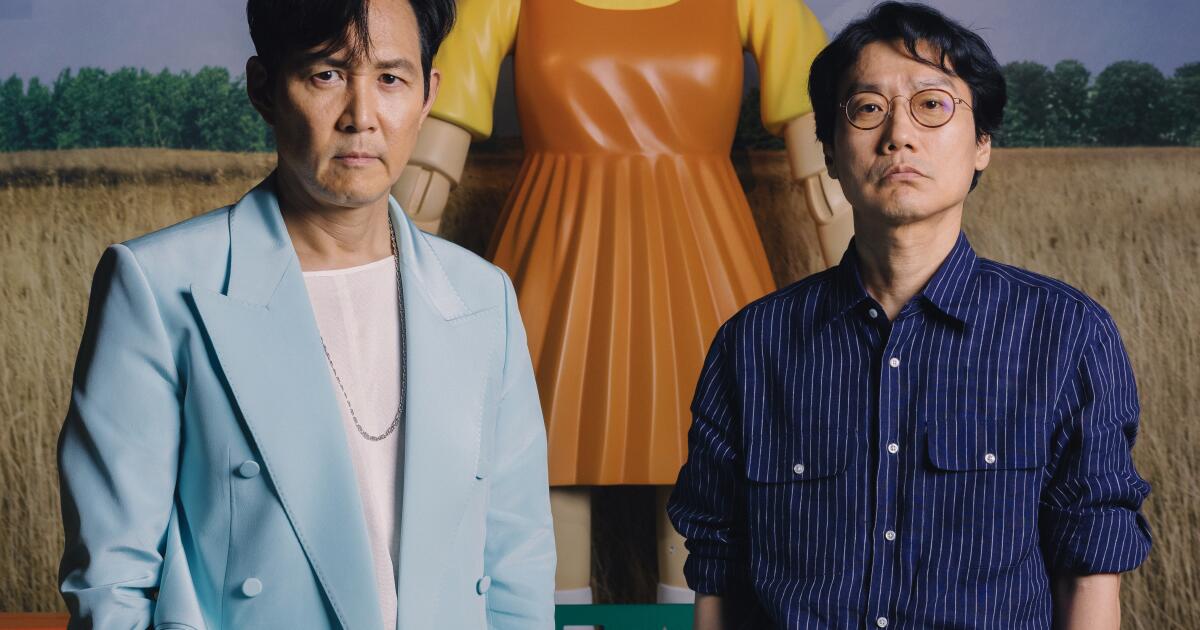
This article contains many spoilers for Season 3 of Netflix’s “Squid Game.”
“Squid Game” is a twisty, twisted thriller, with ordinary, financially stressed people playing children’s games to the death for the amusement of the hidden wealthy. Beneath that surface, creator, writer and director Hwang Dong-hyuk has been embedding sociopolitical commentary amid the shock and awe of protagonist Gi-hun’s (Lee Jung-jae) personal roller-coaster ride; the characters’ desperation as the saga ends forces those messages to poke through the slick, candy-colored exterior.
“It was a result of elevation of the themes and stories,” said Hwang of those ideas becoming more clearly voiced. They “became more upfront and intense just as a natural course of the story unfolding.”
The global phenomenon, still Netflix’s most-watched non-English show ever (its first two seasons are No. 1 and 2 on the streamer’s all-time list, with nearly 600 million views to date, according to Netflix), ends on its own terms with the release of its third and final season Friday. And what an arc everyman Gi-hun will have completed. How better to represent Hwang’s themes of end-stage, winners-and-losers capitalism, with its warping, destructive power, and how the ill-intentioned can exploit democracy’s flaws, than to depict an ordinary person buffeted by the unseen hand of pain for profit?
“You can say this is a story of those who have become losers of the game, and also those of us who are shaken to our core because of the chaotic political landscape,” said Hwang, who with Lee, spoke via an interpreter on a video call earlier this month from New York. “I wanted to focus in Season 3 on how in this world, where incessant greed is always fueled, it’s like a jungle — the strong eating the weak, where people climb higher by stepping on other people’s heads.”
Lee Jung-jae as Seong Gi-hun in final season of Netflix’s “Squid Game.”
(No Ju-han / Netflix)
Gi-hun’s hands become bloodied in the competition in Season 3, Hwang said. “That’s the first time he kills someone [in the games]. This person who symbolized goodness, the original sin is now on him because of what society has done to him,” he said. “How does he pick himself up from that? That’s the heart of Season 3. In a way, we’re all put in this situation due to the capitalist society and chaotic political situation. Gi-hun symbolizes what all of us go through these days.”
When we meet him in Season 1, Gi-hun is down and out, an inveterate gambler. Through Season 1’s horrific gantlet of murderous kids’ games, his exterior is scraped away with a rusty edge until all that’s left is a flawed but good man. Gi-hun is someone who sees what he believes with clarity, while becoming the suddenly rich champion of the games.
But after he reaches that peak, Season 2 plunges him back down the roller coaster as he becomes obsessed with vengeance against the elite voyeurs who fund the game and the Front Man (Lee Byung-hun), who oversees it. Righteous anger carries Gi-hun to the brink of his goal of destroying the games, only to see it all brutally dashed. Season 3 finds him a broken man, near catatonic with guilt. Without him to guide the less bloodthirsty players, the games will enter a fearsome phase of all-out mayhem, from which unexpectedly emerges a chance at redemption for the battered protagonist.
“All of those changes within Gi-hun are depicted in such minute detail” in Hwang’s writing, said Lee, “so nuanced and with so many layers. You’ll see Gi-hun have a change of heart. Sometimes his beliefs will be shaken. But despite all of that, he will continue to struggle to find hope and his will.
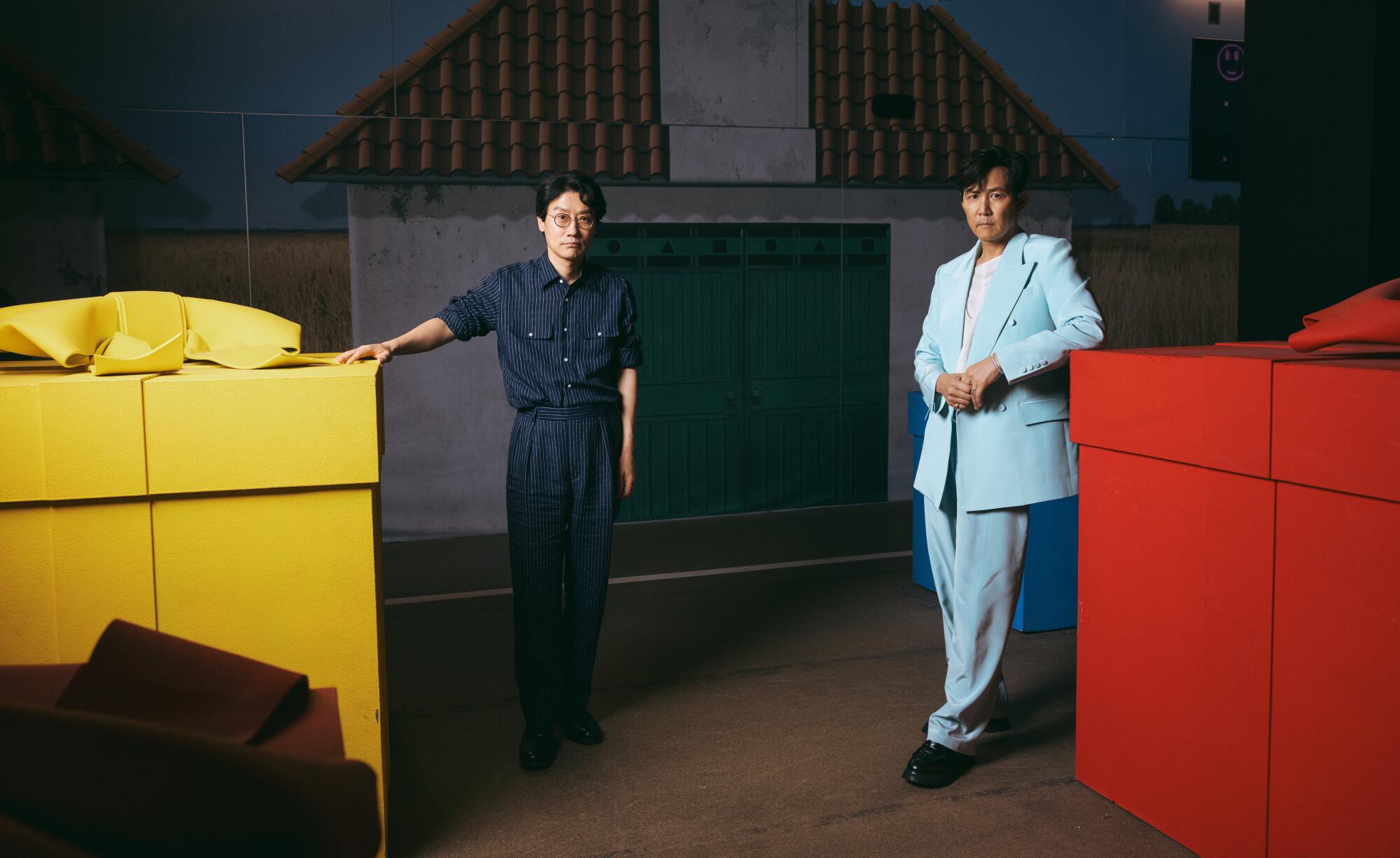
“All of those changes within Gi-hun are depicted in such minute detail, so nuanced and with so many layers,” Lee Jung-jae said of his character and Hwang Dong-hyuk’s writing.
(Justin Jun Lee / For The Times)
“All I can say is, I’m a very lucky man. You don’t come by characters like Gi-hun every day. It’s been a true honor,” he adds.
Lee’s public appearances in support of “Squid Game” have provided an almost comic contrast with Gi-hun. He’s movie-star handsome, elegant, always sharply dressed. On the show, especially as Gi-hun deteriorates in Season 3, he’s wrecked.
“Jung-jae went on this extremely harsh diet for over a year so he could really portray, externally, the pain and the brokenness, to really express how famished and barren he is, both mentally and physically,” Hwang said.
Gi-hun isn’t the only person the games destroy. Another hallmark of the show is its deft development of characters into fan favorites, coupled with its “Game of Thrones”-like willingness to unceremoniously kill them. Viewers will be sharpening their pitchforks when trans commando Hyun-ju (Park Sung-hoon), a.k.a. Player 120, dies ignominiously in Season 3. Hwang is already braced for the backlash.
“It’s not me who did it! It was 333,” he exclaimed, blaming the murderer.
Hwang said when he watched the first assembly edit of that death, “I wrote and directed and everything, I knew it’s coming, but it was still painful. It was like, ‘Oh, come on, come on.’ ”
“For some characters, I would see them go and I’d feel really sad … I would think, ‘Director Hwang is such a cruel man,’” Lee said.
1

2

1. Hyun-ju (Park Sung-hoon) in Season 3 of “Squid Game.” “I wrote and directed and everything, I knew it’s coming, but it was still painful,” Hwang Dong-hyuk said. 2. Jun-hee (Jo Yu-ri), a pregnant contestant in the games, was another casualty. (No Ju-han / Netflix)
When Hwang asks what death in particular made him feel that way, Lee doesn’t hesitate to cite another beloved character, pregnant contestant Jun-hee (Jo Yu-ri), calling that Season 3 death “heartbreaking.”
Lee’s sensitive, evolving turn as Gi-hun — deeply human amid the madness, paranoia and murder set in bright green and pink surroundings — has made the character the ideal litmus test for Hwang’s critique of an economic system designed to produce titanic winners and losers who face annihilation. He’s a living symbol of Hwang’s themes.
“I feel like Director Hwang is truly an artist,” Lee said. “I mean something akin to a concept artist. Because when he creates his visuals, not only are they extremely pleasing to the eye; he focuses on the meaning behind them. He [stacks] images on top of one another, almost as if building a Lego castle. Each little block has meaning: each dialogue, each editing flow and [each use of] the musical score.”
As Season 3 reaches a boil, some of Hwang’s symbolism becomes less subtle. In one game, contestants clutch keys suspiciously resembling crucifixes as one player leads others with fervor, for better or worse. One character’s moment of triumph occurs before a painted rainbow (rainbow flags are also associated with the LGBTQ+ community in Korea). And Hwang’s nuanced critique of democracy comes to the fore.
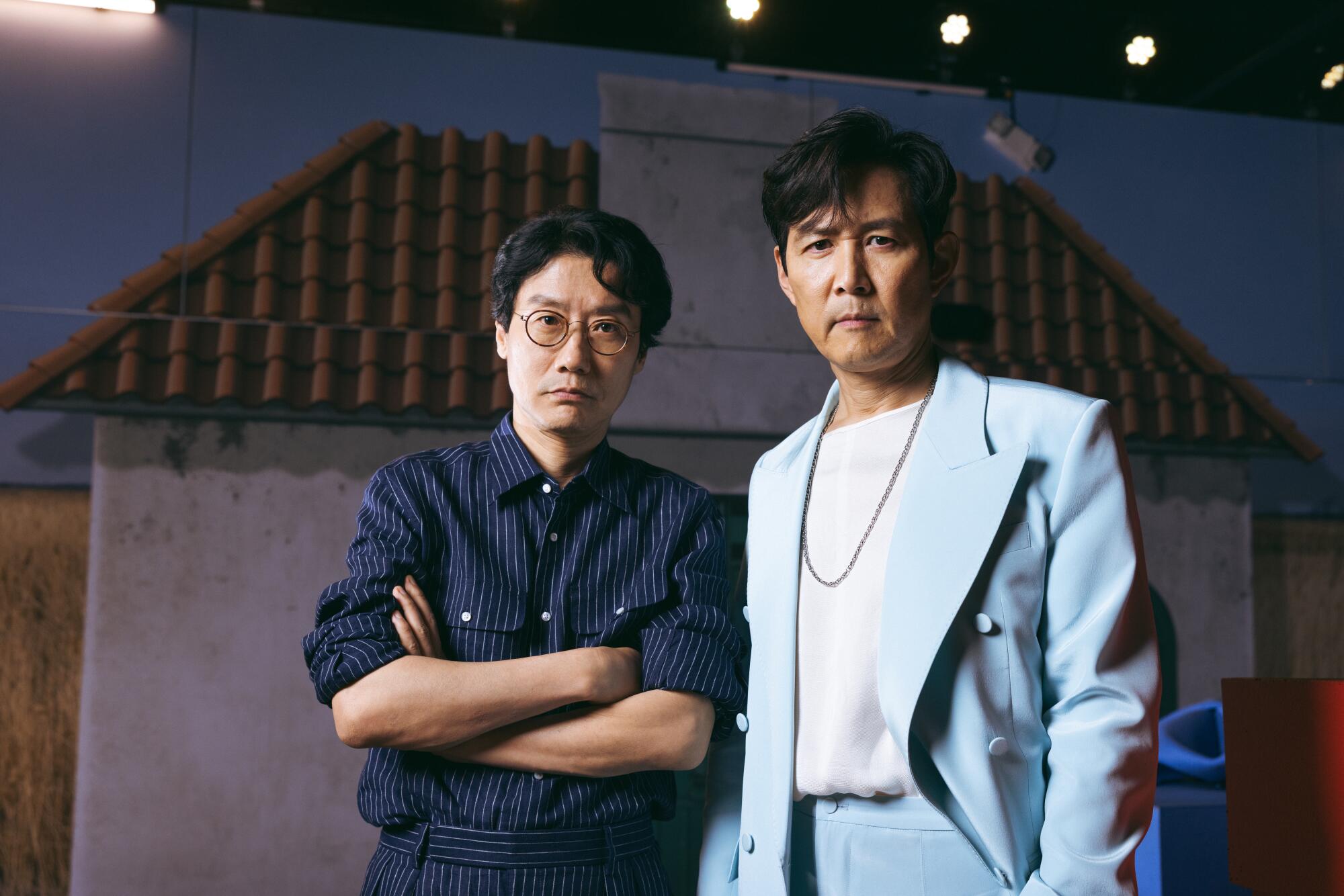
“I feel like Director Hwang is truly an artist,” said Lee Jung-jae of the show’s creator. “I mean something akin to a concept artist. Because when he creates his visuals, not only are they extremely pleasing to the eye; he focuses on the meaning behind them.
(Justin Jun Lee / For The Times)
Unlike Season 1, in which contestants had one chance to vote to end the games, in Seasons 2 and 3, votes are taken after each contest; as more players die, the pot swells larger and larger. With only a score or so of participants left, a vote to quit means all would leave alive, and with substantial cash. Voting to continue means, explicitly, they will kill to become obscenely wealthy.
“In the past, at the time of elections, despite our differences, we all came together; there was more tolerance through the process of conflict,” Hwang said. “I don’t think that is anymore the case. Rather, elections [have only driven] societies into greater divides. I wanted to explore those themes in Seasons 2 and 3; that’s why I included the voting in each round.”
Hwang loudly calls out the flaw of democracy that allows the barest of majorities to subject all to nightmarish policies — even more nightmarish for those who voted against them. The ruthless winners keep reminding the others in Season 3 it was a “free and democratic vote.”
“That is not to say that I have a different answer,” he said. “I wanted to raise the question because I believe it is time for us to try to find the answer. In Season 1, I looked at the flaws of the economic system that creates so many losers due to this unlimited competition. In Season 2, I depicted the failure of the political system.
“Coming into Season 3, because the economic system has failed us, politics have failed us, it seems like we have no hope,” Hwang added. “What hope do we have as a human race when we can no longer control our own greed? I wanted to explore that. And in particular, I wanted to [pose] that question to myself.”
And what has he found? Does he still believe in humanity?
“Well, I don’t have the answer,” Hwang said. “But I have to admit, honestly, I think I’ve become more cynical, working on ‘Squid Game.’”



Joe Carnahan was a sagacious choice to co-write and direct the engrossing and visceral survival thriller “Not Without Hope,” given Carnahan’s track record of delivering gripping and gritty actioners, including early, stylish crime thrillers such as “Narc” (2002) and “Smokin’ Aces” (2006), and the absolutely badass and bonkers Liam Neeson v Giant Wolves epic “The Grey” (2011).
Based on the non-fiction book of the same name, “Not Without Hope” plunges us into the stormy waters of the Gulf of Mexico for the majority of the film, and delivers a breathtaking and harrowing dramatic re-creation of the 2009 accident that left four friends, including two NFL players, clinging to their single-engine boat and fighting for their lives. The survival-at-sea story here is a familiar one, told in films such as “White Squall,” “The Perfect Storm,” and “Adrift,” and the screenplay by Carnahan and E. Nicholas Mariani leans into well-worn tropes and, at times, features cliché-ridden dialogue. Still, this is a well-paced and powerful work, thanks to the strong performances by the ensemble cast, some well-placed moments of character introspection, and the documentary-style, water-level camerawork by Juanmi Azpiroz.
Zachary Levi (the TV series “Chuck,” the “Shazam!” movies) is best known for comedy and light action roles. Still, he delivers solid, straightforward, and effective dramatic work as Nick Schuyler, a personal trainer who helps his friends Marquis Cooper (Quentin Plair) and Corey Smith (Terrence Terrell), two journeyman NFL players, get ready for another season. When their pal Will Bleakley (Marshall Cook) shows up at a barbecue and announces he has just been laid off from his financial firm, he’s invited to join the trio the next morning on a day-trip fishing trip from Clearwater, FL., into the Gulf of Mexico. (The casting is a bit curious, as the four lead actors are 10-20 years older than the ages of the real-life individuals they’re playing — but all four are in great shape, and we believe them as big, strong, physically and emotionally tough guys.)
We can see the longtime bond between these four in the early going, though we don’t learn much about their respective stories before the fishing trip. Kudos Carnahan and the studio for delivering a film that earns its R rating, primarily for language and intense action; the main characters are jocks and former jocks, and they speak with the casual, profanity-laced banter favored by many an athlete. (Will, describing the sandwiches he’s made for the group: “I got 20 f*cking PB&Js, and 20 f*cking turkey and cheese.”) There’s no sugarcoating the way these guys talk—and the horrors they wind up facing on the seas.
The boat is about 70 miles off the coast of Clearwater when the anchor gets stuck, and the plan to thrust the boat forward to dislodge it backfires, resulting in the vessel capsizing and the men being thrown overboard. Making matters worse, their cell phones were all sealed away in a plastic bag in the cabin, and a ferocious storm was approaching. With title cards ticking off the timeline (“13 Hours Lost at Sea,” “20 Hours Lost at Sea,” “42 Hours Lost at Sea”), we toggle back and forth between the men frantically trying to turn over the boat, keep warm, signal faraway ships, battling hunger and thirst, and the dramas unfolding on land. Floriana Lima as Nick’s fiancée, Paula, and Jessica Blackmore as Coop’s wife, Rebekah, do fine work in the obligatory Wait-by-the-Phone roles.
It’s terrific to see JoBeth Williams still lighting up the screen some 40 years after her “Big Chill” and “Poltergeist” days, delivering powerful work as Nick’s mother, Marcia, who refuses to believe her son is gone even as the odds of survival dwindle with each passing hour. Josh Duhamel also excels in the role of the real-life Captain Timothy Close, who oversaw the rescue efforts from U.S. Coast Guard Sector St. Petersburg. At one point, Close delivers a bone-chilling monologue about what happens when hypothermia sets in—“hallucinations, dementia, rage…eventually, it breaks your mind in half”—a point driven home when we see what’s happening to those men at sea. It’s savage and brutal, and heartbreaking.
Given this was such a highly publicized story that took place a decade and a half ago, it’s no spoiler to sadly note there was only one survivor of the accident, with the other three men lost to the sea. Each death is treated with unblinking honesty and with dignity, as when the natural sounds fade at one point, and we hear just the mournful score. With Malta standing in for the Gulf of Mexico and the actors giving everything they have while spending most of the movie in the water and soaked to the bone, “Not Without Hope” is a respectful and impactful dramatic interpretation that feels true to the real-life events.

There were only four days left of shooting on “Hamnet” when Chloé Zhao realized she didn’t have an ending. The filmmaker had led the cast through a week filming the pivotal climactic sequence inside the Globe Theatre, where William Shakespeare (Paul Mescal) is staging his opus “Hamlet,” but something was missing. The script had Shakespeare’s wife, Agnes (Jessie Buckley), and her brother Bartholomew (Joe Alwyn) witnessing the demise of Hamlet (Noah Jupe), a denouement that should have evoked a sense of release. But even though the moment was meant to tie Shakespeare’s masterpiece to the still-fresh death of Will and Agnes’ 11-year-old son, Hamnet (Jacobi Jupe), neither Zhao nor Buckley could feel the necessary catharsis.
“Jessie and I avoided each other for the rest of the day because we both knew we had no film,” Zhao says. “We both went home feeling completely lost.”
“We were searching for this ending,” Buckley adds. “It was a daunting idea to try and pull together all the threads of the story we’d woven prior to this moment. I felt incredibly lost and a bit untethered.”
Zhao admits that she rarely preplans the endings of her films because she doesn’t tell stories linearly. She imagines the journey of her characters unfurling in a spiral, with the story extending downward into the darkness before rising back up.
“I’ve had to wait on every single film,” she says. “But this time I was going through the ending of a relationship, so I was terrified of losing love. I was holding on to it with dear life.”
Actors Jessie Buckley and Joe Alwyn with director Chloé Zhao on the set of “Hamnet.”
(Agata Grzybowska)
The morning after they filmed the scripted ending, Buckley sent Zhao Max Richter’s “This Bitter Earth,” a reimagining of his song “On the Nature of Daylight” with lyrics. The filmmaker played it in the car on her way to the set.
“I could feel the tears and the heart opening, and then I started reaching my hand out towards the window,” Zhao remembers. “I was trying to touch the rain outside of the car. I looked at my hand and I realized that I needed to become one with something bigger than me so I would no longer be afraid of losing my love. Because love doesn’t die, it transforms. When we’re one with everything around us, it’s the illusion of separation that makes us so afraid of impermanence.”
The true culmination of “Hamnet” occurred to Zhao as she reached for the rain. If Agnes reached her hand toward the dying Hamlet, he could then rest and she could let go of her grief over losing Hamnet. And if the audience joined her, the sensation of release would be even greater.

-
Share via
“The thing I didn’t expect, the surprise of it, was the absolute communal surrender,” Buckley says. “The way the fourth wall was broken between the play and the audience, the need to reach out and touch the core of the play. Agnes’ compass has always been touch.”
Although the specifics didn’t come to life until those final days, Zhao always planned the production so the Globe scenes would be done last. Production designer Fiona Crombie re-created the historic open-air theater on the backlot at England’s Elstree Studios using real timber brought in from France. The set version, which took 14 weeks to build, is smaller than the original Globe to create a sense of intimacy.

Plans for the building of the Globe Theatre set in “Hamnet.”
(Agata Grzybowska)
“This is my version,” Crombie says. “Our footprint is a bit smaller overall, but the essential architecture of the tiers and the roofline and the shape and everything is accurate. By virtue of having real beams that are scarred and aged, it feels more realistic. We wanted the whole thing to feel completely authentic. You want to smell these sets and feel these textures off the screen.”
“I told Fiona I wanted it to feel like the inside of a tree,” Zhao says. “So, spiritually, it’s correct for this story. And the play is accurate. We didn’t change any lines.”
Historically, there would not have been a backdrop onstage. But for the thematic purposes of “Hamnet,” a backdrop was essential. “There was a whole conversation about not just the aesthetic but the importance of that motif,” Crombie says. “It’s also a wall that separates Will from Agnes.”
“Hamnet’s” Globe was constructed to have a working backstage so Mescal, Jupe and the players could move in and out of the wings. There were real prop tables and makeup stations, as well as a nod to other Shakespeare plays. “We had a horse from ‘A Midsummer Night’s Dream’ that was loaned from the real Globe,” Crombie says. “There were loads of details everywhere that honored theater.”
The actors learned significant portions of “Hamlet.” Mescal led the cast of players in rehearsals before filming. “We would rehearse later in the evenings as an ongoing part of the process,” Mescal says. “Once the camera came in, it was Chloé’s baby, but we rehearsed consistently throughout the production. It was so cool. I have a lot of sympathy for directors. What I loved about it wasn’t necessarily the act of directing. It was more so the part of the process in helping me to act. It felt weird to direct them as Paul, but I could direct them as Will.”

Paul Mescal backstage at the Globe in “Hamnet.”
(Agata Grzybowska / Focus Features)
Mescal and the players acted out 30 to 40 minutes of “Hamlet” while filming. The actor describes the feeling of being on the Globe stage as “sacred,” both because of the physical space and because of the emotional quality of the scenes.
“It felt very charged,” he says. “Up until that point we knew we had made something very special, but we were also acutely aware that this is where you had to land the plane. And that came with its own pressure. There’s something very special about playing Shakespeare and hearing Shakespeare’s words spoken in that place. The film is talking about the collision of art and humanity, and there are no greater words to communicate that feeling than the words in ‘Hamlet.’”
Zhao enlisted 300 extras to be the theater’s crowd. Each day, Zhao and Kim Gillingham, a dream coach who worked on the film, led the cast and extras in a daily meditation or dream exercise. It was unlike anything many of the actors had previously experienced.
“Everyone dropped into this very deep place of connection to themselves and to what was happening in front of them on the stage,” Alwyn says. “It was this amazing collective feeling of catharsis and connection to something bigger than ourselves.”

(Evelyn Freja / For The Times)
“The performances from some of the supporting artists are extraordinary,” Mescal adds. “And that was intentional in terms of how Chloé constructed that feeling and by having Kim there.”
After Will notices Agnes in the audience, he goes backstage and finally breaks down, experiencing a long-awaited release of grief. Mescal prepared for the scene by listening to Bon Iver’s “Speyside.” Fittingly, it was the last thing he filmed.
“The play becomes something different because it’s being witnessed by Agnes,” Mescal says. “It comes alive for the audience because of this weird alchemy. Something feels different in the air. That moment felt like such relief, like he could just let go.”
“Hamnet” ends with Agnes reaching for Hamlet. In doing so, she gives herself permission to let her son go. It was a moment that had to be discovered rather than constructed.
“The scene became a holding of collective grief in a communal space where we were allowed to let it out,” Buckley says. “It was like a tsunami. I’ll never forget it.”
In Mescal’s mind, the film’s ending is really its beginning. He imagines the relationship between Will and Agnes will go on, continuing the spiral.
“I have no idea how a relationship survives the death of a child, but I do think there is a miraculous hope and they can see each other again in that moment,” Mescal says. “They’ve abandoned each other in certain moments, but now she understands where he went. And I think they will return to each other.”

(Evelyn Freja / For The Times)
Movie Reviews
‘Black Rabbit, White Rabbit’ Review: Disqualified for the Oscars, Tajikistan Drama Is an Inviting, Meandering Meta-Narrative

Selected by Tajikistan but ultimately not accepted by the Academy to compete in the Oscar international feature category, “Black Rabbit, White Rabbit” begins ambitiously, with a famous quote from playwright Anton Chekhov about setups and payoffs — about how if a gun is established in a story, it must go off. Moments later, an inviting long take involving a young man selling an antique rifle ends in farcical tragedy, signaling an equally farcical series of events that grow stranger and stranger. The film, by Iranian director Shahram Mokri, folds in on itself in intriguing (albeit protracted) ways, warping its meta-fictional boundaries until they supersede its characters, or any underlying meaning.
Still, it’s a not-altogether-uninteresting exercise in exploring the contours of storytelling, told through numerous thematically interconnected vignettes. The opening Chekhov quote, though it might draw one’s attention to minor details that end up insignificant, ensures a heightened awareness of the movie’s artifice, until the film eventually pulls back and becomes a tale of its own making. But en route to this semi-successful postmodern flourish, its character drama is enticing enough on its own, with hints of magical realism. It begins with the tale of a badly injured upper-class woman, Sara (Hasti Mohammai), discovering that her car accident has left her with the ability to communicate with household objects.
Sara’s bandages need changing, and the stench of her ointment becomes a quick window into her relationships. Her distant husband rejects her; her boisterous stepdaughter is more frank, but ultimately accepting; her gardener and handyman stays as diplomatic as he can. However, the film soon turns the gunfire payoff in its prologue into a broader setup of its own, as a delivery man shows up at Sara’s gate, insisting that she accept delivery for an object “the deceased man” has paid for.
Mokri eventually returns to this story (through a slightly tilt-shifted lens), but not before swerving headfirst into a seemingly unrelated saga of extras on a film set and a superstitious prop master, Babak (Babak Karimi), working on a shot-for-shot remake of an Iranian classic. A mix of rapid-fire Tajik, Persian and Russian dialogue creates dilemma upon dilemma when Babak’s ID goes missing, preventing him from being able to thoroughly check the prop ammunition for an assassination scene.
Danger begins to loom — a recent Alec Baldwin case even warrants a mention on-screen — as the notion of faulty firearms yanks Chekhov’s wisdom front and center once more, transforming it from a writing tip into a phantasmagorical inevitability. In keeping with the previous story, the props even communicate with each other (through subtitles) and begin gossiping about what might come to pass.
After establishing these narrative parameters through unbroken, fluid shots filmed at a sardonic distance, Mokri soon begins playing mischievous temporal games. He finds worthwhile excuses to revisit scenes from either different angles or with a slightly altered aesthetic approach — with more proximity and intimacy — in order to highlight new elements of his mise-en-scène. What’s “real” and “fictional,” even within the movie’s visual parlance, begins to blur in surreal ways, largely pivoting around Babak simply trying to do his job. However, the more this tale engorges through melodic, snaking takes, the more it circles around a central point, rather than approaching it.
The film’s own expanse becomes philosophically limiting, even though it remains an object of curiosity. When it’s all said and done, the playfulness on display in “Black Rabbit, White Rabbit” is quite remarkable, even if the story’s contorting framework seldom amounts to much, beyond drawing attention to itself. It’s cinema about cinema in a manner that, on one hand, lives on the surface, but on the other hand, invites you to explore its texture in ways few other movies do.

New Jersey lottery player wins $1M as Powerball hits $1.1 billion

Ice hasn’t stopped trout in northern New Mexico – Alamogordo Daily News

Bids awarded for construction of Highway 85

Single-digit temps, below-zero wind chills hit central Ohio after snow

Oklahoma’s Alabama Winning Streak a Rare Accomplishment Against the Crimson Tide

Florida High School Football Rankings: Top 25 teams – Oct. 21

Cleary's 21 help Le Moyne down Central Connecticut State 69-64 in OT

How old is Bo Nix? What to know about Oregon quarterback ahead of 2024 NFL Draft

99th annual Pony Swim held in Virginia

Video: ‘It Didn’t Have to Happen This Way:’ U.Va. Faculty Call for Review of Police Response to Protests

Trump’s election win filled Hamas with ‘fear,’ hostage held like ‘slave’ for 505 days recounts

In Khartoum, exhumation of makeshift graves reawakens families’ grief

Manhunt under way for attacker after two students killed at US university

Video: At Least Two Killed in Shooting at Brown University

FBI ousts reinstated whistleblower over unauthorized media talks, ‘poor judgment’
-

 Alaska1 week ago
Howling Mat-Su winds leave thousands without power
-

 Texas1 week ago
Texas Tech football vs BYU live updates, start time, TV channel for Big 12 title
-

 Washington5 days ago
LIVE UPDATES: Mudslide, road closures across Western Washington
-

 Iowa7 days ago
Matt Campbell reportedly bringing longtime Iowa State staffer to Penn State as 1st hire
-

 Miami, FL1 week ago
Urban Meyer, Brady Quinn get in heated exchange during Alabama, Notre Dame, Miami CFP discussion
-

 Cleveland, OH7 days ago
Man shot, killed at downtown Cleveland nightclub: EMS
-
World7 days ago
Chiefs’ offensive line woes deepen as Wanya Morris exits with knee injury against Texans
-

 Iowa23 hours ago
How much snow did Iowa get? See Iowa’s latest snowfall totals

