Entertainment
How Toothless evolved for the new 'How to Train Your Dragon': 'We wanted him to feel like a big pet'


Whether soaring through the sky or sharing a playful moment with his human bestie Hiccup, Toothless, the dark-hued dragon with a friendly face and an injured tail, disarms you with his endearing nature.
It’s no surprise that he’s become the emblem of the “How to Train Your Dragon” animated movies, the first of which arrived in 2010. (There have since been two sequels, three separate TV series and five shorts.) A fan favorite among Gen-Z viewers, Toothless now returns to the big screen in a new hyper-realist iteration for the live-action remake, now in theaters.
And in an unprecedented move, Dean DeBlois, who directed all three “Dragon” animated films — as well as 2002’s original “Lilo & Stitch,” along with Chris Sanders — was asked to helm the live-action reimagining. It was his priority to preserve Toothless’ essence.
“He is our most recognizable dragon within the entire assortment,” DeBlois says on the phone. “And he has a lot of sentience and personality that comes through. And so much of it is expressed in this face that’s quite Stitch-like with the big eyes, the ear plates and the broad mouth.”
In fact, the entire live-action endeavor hinged on whether Toothless could be properly translated as a photorealistic dragon among human actors and physical sets, while retaining the charm of the animated movies.
An image from the original 2010 animated “How to Train Your Dragon.”
(DreamWorks Animation LLC)
According to Christian Manz, the new film’s visual effects supervisor, when Peter Cramer, president of Universal Pictures, initially considered the project back in 2022, he wasn’t convinced Toothless would work. His touchstone for a fantastical creature that successfully achieved believability was the Hippogriff, a winged four-legged creature seen in 2004’s “Harry Potter and the Prisoner of Azkaban.”
To test the viability of a new Toothless, DreamWorks enlisted British visual effects and computer animation outfit Framestore to spend three months trying to create a “realistic” version of Toothless. Framestore has had some popular successes to its name: Paddington Bear in the film series, Dobby from the “Harry Potter” universe and Groot and Rocket Raccoon from the Marvel movies.
“We always knew that we weren’t aiming for a real dragon, as in a ‘Game of Thrones’ dragon,” says Manz, via video call from the U.K.
Toothless’ design, particularly his facial features, presented a challenge for Manz and the team at Framestore. If they made his eyes or his mouth too small or if they tried to drastically reshape his head with more naturalism in mind, he quickly lost his personality.
“His big, expressive face with eyes that are larger than any animal in the animal kingdom, including the blue whale, had to remain because, without them, we felt like we were going to be delivering a lesser version of Toothless,” says DeBlois.
A stage show based on the first film called “How to Train Your Dragon: Live Spectacular,” which toured Australia and New Zealand in 2012, radically changed the design — to a mixed response. “Toothless was too creature-like and it just wasn’t as appealing and as charming,” says Simon Otto, head of character animation for all three animated movies, via Zoom.
While they may be too subtle for an untrained viewer to notice, certain design changes have been made that differentiate the live-action Toothless from his animated counterpart.
“He’s now bigger, his head’s smaller, his eyes are actually smaller,” says Manz. The nuanced reshaping of his head and his body was intentional: an effort to make him blend into a photorealistic world.
“The interesting thing is that when people see the live-action movie, they say, ‘Oh, it’s Toothless, like he stepped out of the animated movie,’” says DeBlois. “But in truth, if you put them side by side, you’ll see quite a few differences.”
The texture of Toothless’ body needed to be more intricate for the live-action version, so he would feel more convincingly integrated within the environments.
“In the animation, he’s quite smooth,” says Manz. “We tried very snake-like skin, but it just made him look very unfriendly. You wouldn’t want to put your hand on his forehead.”
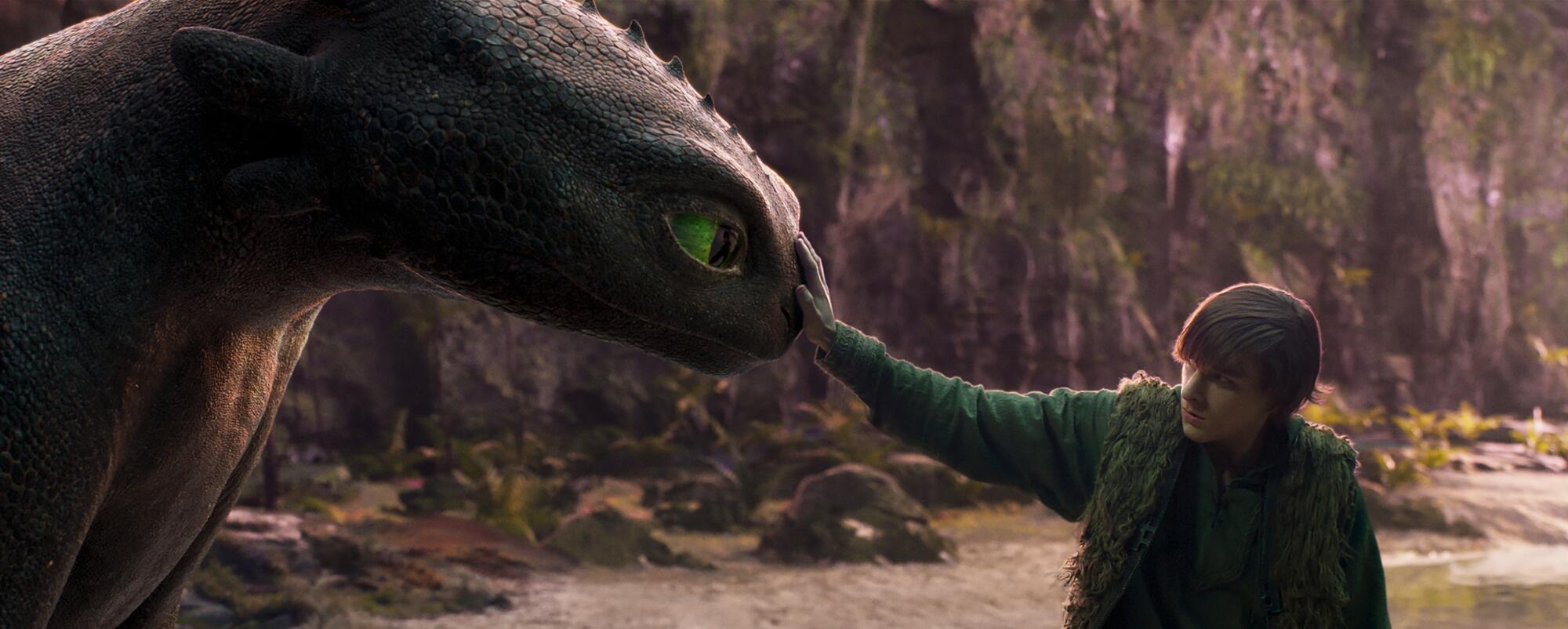
Mason Thames in “How to Train Your Dragon.”
(Universal Pictures)
Both on-screen versions of Toothless were crafted using essentially the same digital technique: computer animation. The difference here is that the one meant to share space with a flesh-and-blood world, with distinct aesthetic concerns. Even if seeking realism in creatures that only exist in our imagination might seem counterintuitive, the goal is to make them feel palpable within their made-up realm.
“One of the things I don’t like about live-action remakes is they seem to try to want to replace the animated source, and I find myself very protective of it,” says DeBlois with refreshing candor. “We tried to create a version that lives alongside it. It follows the beats of that original story, but brings new depths and expanded mythology and more immersive action moments and flying. But it’s never trying to replace the animated movie because I’m very proud of that film.”
Toothless as we now know him originated expressly for the screen. The Toothless in Cressida Cowell’s originating book series is tiny and green (a design that can be seen in the first animated movie in the form of a minuscule dragon known as Terrible Terror).
But when DeBlois and Sanders came aboard, 15 months before the 2010 release, replacing the previous directors, their first major change was to make Toothless a dragon that could be ridden.
It was the screensaver of a black panther that first inspired the look of Toothless in the animated films. Otto, one of the designers who knows Toothless best (he drew the original back in 2008), recalls his real-world animal references.
“He is a mix between a bird of prey, like a peregrine falcon, with extremely streamlined shapes — of course a feline but also a Mexican salamander called an axolotl,” Otto says. Sanders’ design for Disney superstar Stitch, namely his large almond-shaped eyes, ears and pronounced mouth, also influenced the design.
“There’s a little bit of a design influence from Stitch in Toothless’ face that makes them feel like they’re distant cousins,” says DeBlois.
He believes that making Toothless more closely resemble a mammal, rather than a reptile, and giving him pet-like qualities were the keys for him becoming so memorable.
“[We] spent a lot of time on YouTube looking at videos of dogs and cats doing funny things,” he says. “And we would try to incorporate a lot of that behavior into Toothless with the hopes that when people watched the movie, they would say, ‘That’s just like my cat’ or ‘My dog does that.’ We wanted him to feel like a big pet. Ferocious and dangerous at first, but then a big cuddly cat after.”
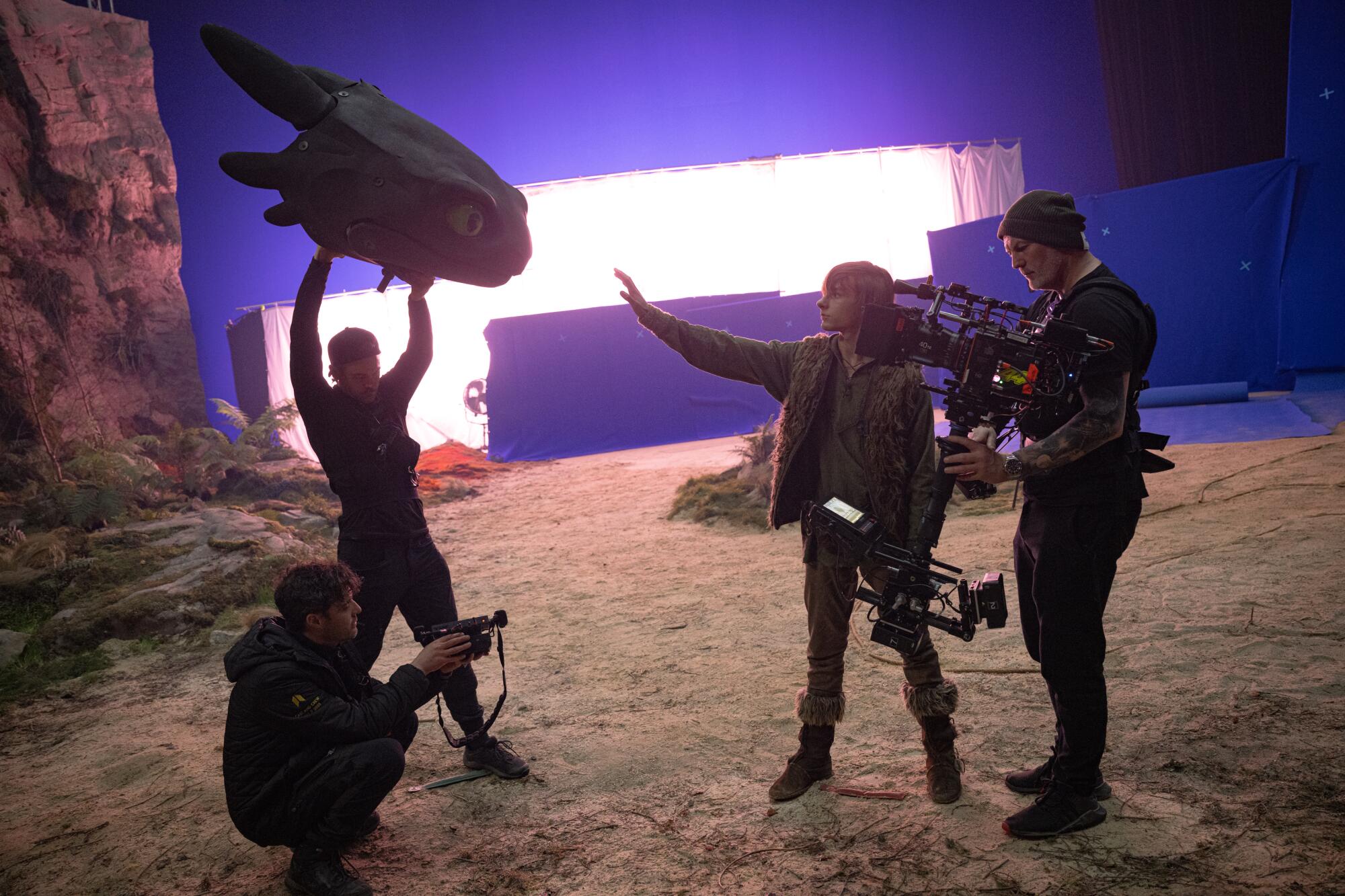
Mason Thames interacts on set with the puppet version of Toothless.
(Helen Sloan)
On the set of the live-action movie, Toothless and the other dragons existed as large puppets with simple functions, operated by a team of master puppeteers led by Tom Wilton, a performer who had worked on the “War Horse” stage play.
Using puppets was meant to provide the actors, especially Mason Thames, who plays Hiccup, a real-world scene partner. The Toothless foam puppet had an articulated jaw and articulated ear plates that allowed for a subtle, interactive performance.
“There’s a performance that Dean can direct and that Mason and the other actors could act against, so that the interaction is utterly believable,” says Manz. “[The puppets] are obviously removed from the frame in the end, but it just means you believe that connection.”
As for the impressive flight sequences, in which Hiccup rides Toothless, the production created an animatronic dragon placed on a giant gimbal that moved on six different axes to simulate the physics of flying.
“If the dragon was diving or ascending or banking and rolling, Mason would be thrown around in the saddle, like a jockey on a racehorse,” says DeBlois. “And it married him to the animal in a way that felt really authentic.”
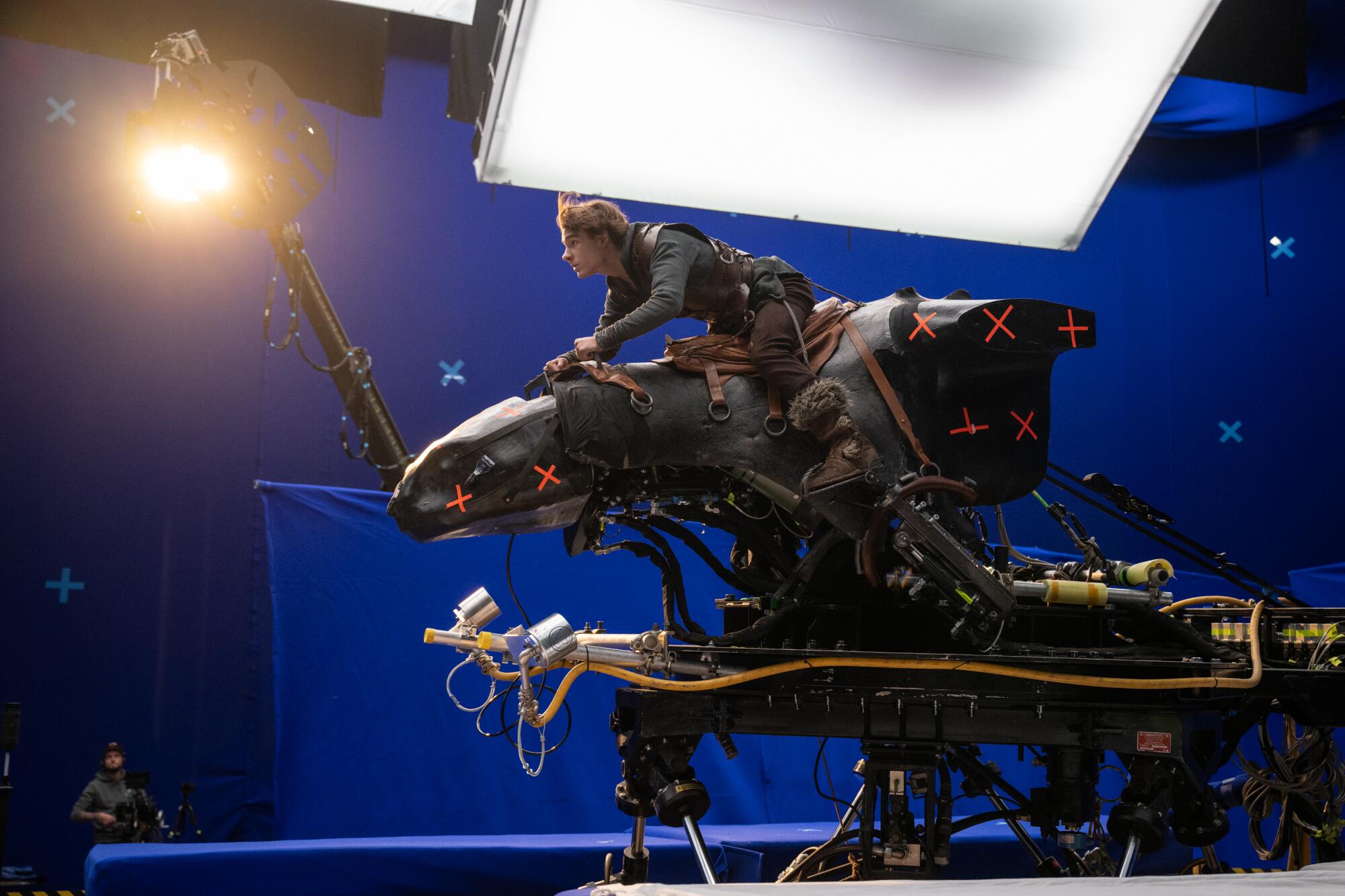
Mason Thames rides the flying Toothless on an animatronic model.
(Helen Sloan)
For all his success in the animated realm, DeBlois has never directed a live-action film until now.
“I do commend Universal for taking a risk on me knowing that I had not made a live-action film, but also recognizing that I knew where the heart and the wonder was, and I was determined to bring it to the screen,” he says.
Otto, the designer who trained Toothless before anybody else, candidly says he would have “peed his pants” if he knew the drawings he did back in 2008 would spawn a franchise and a theme-park attraction (a re-creation of the films’ Isle of Berk opened at Universal Studios Florida earlier this year).
“The most critical choice they made for the live-action was making sure the audience falls in love with Toothless,” he adds. “And that you understand that if you have a creature like that as your friend, you wouldn’t give up on it.”




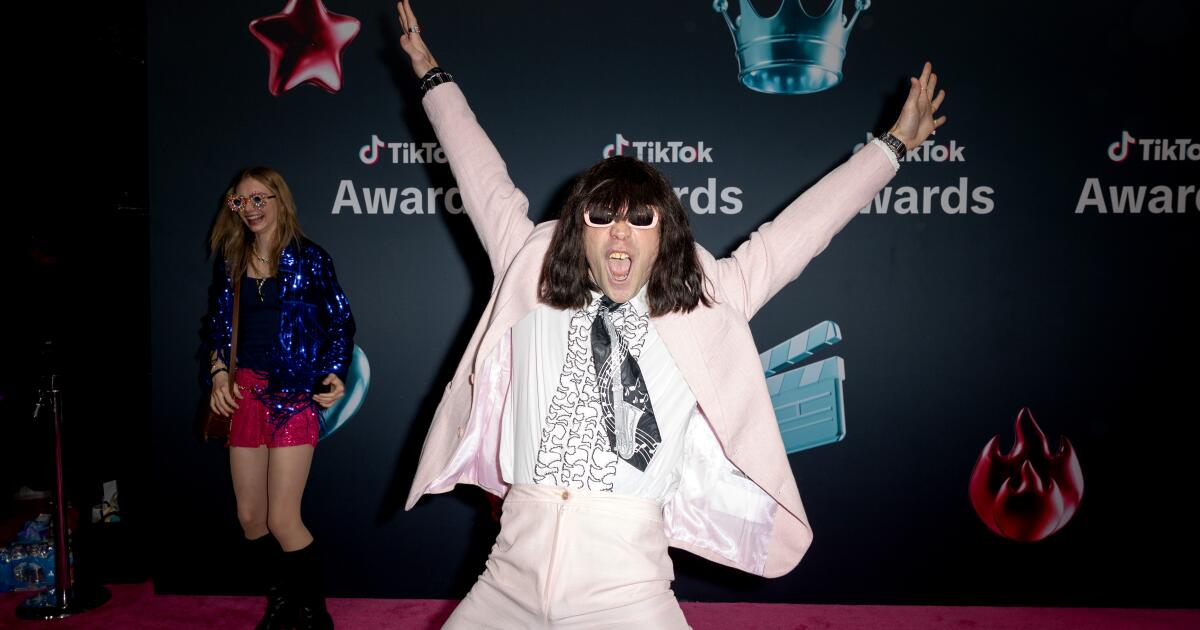
Only a few years ago, Keith Lee was a professional MMA fighter, doing food delivery and making social media videos to ease his social anxiety.
On Thursday night, however, Lee found himself under the glare of bright lights and walking the red carpet outside the historic Hollywood Palladium on Sunset Boulevard about to be recognized as TikTok’s “Creator of the Year.”
He and hundreds of other creators had gathered for TikTok’s first American awards show. And they had good reason to celebrate.
Only a few minutes before the start of the inaugural show, they got word about a deal that would allow TikTok to keep operating in the U.S. through a joint venture controlled by a group of U.S. investors that includes tech giant Oracle Corp. TikTok confirmed the deal in an email to employees and said it is expected to close next month.
“[TikTok] is the best way to reach people and I know so many people who rely on it to support their families,” said Lee, who has 17.3 million followers of his casual restaurant reviews. “For me, it’s my career now so I can’t imagine it not being around.”
Creators — many of whom are based in Southern California — rely on the app as a key source of income, while businesses and brands turn to the platform and its influencers to promote their products.
Many had worried that the app might disappear after the Supreme Court upheld a ban on the platform because of national security concerns raised by President Trump in 2020.
Trump subsequently allowed TikTok, which has offices in Culver City, to keep operating in the U.S. and in September signed an executive order outlining the new joint venture.
Comedy creator Adam W., who attended the awards show, called the news “game changing.”
With 22.6 million followers on TikTok, Adam W. has amassed a massive audience for his videos that parody pop culture trends.
In one, he’s a contestant on “The Bachelor,” surrounded by a line of lookalike blond models; in another, he’s drinking matcha lattes with Will Smith.
“That’s so good to hear,” said Adam W. of the new ownership. “So many people are able to make careers off of TikTok. There’s so many people out there who go to TikTok to get away from their reality and it means a lot to them, so I think it’s really valuable for us to have.”
TikTok said the awards show is intended to celebrate the influencers who’ve helped transform the app into a global force that has shaped the way younger Americans shop and consume entertainment.
“You represent a truly global community of over 1 billion people on TikTok,” Kim Farrell, the app’s global head of creators, said at the event. “This year, you showed the world just how much impact creators have.”
Despite the historic moment, the awards show was not without technical glitches. Screens that were intended to display clips of contestants and visuals during speeches were dark the entire night.
The two-hour show, in which creators received awards in several categories, featured a range of skits parodying TikTok cultural moments, from Jools Lebron telling the crowd to “be demure,” to Rei Ami of K-Pop Demon Hunters shooting a Labubu cannon into the crowd.
“TikTok definitely changed my life,” Lee said in an interview. “I always planned my life around food, so I’m blessed to just turn the camera on and do the same thing.”
The new ownership of TikTok should allow the app to rebound after it lost market share amid uncertainty over its future, said Max Willens, an analyst at EMarketer.
“This past year, because a lot of advertisers weren’t really sure whether TikTok was going to stay or go, it did kind of slow the momentum that we had seen on that platform,” Willens said. “We think that moving forward that is going to wind up just being a blip.”

NEW YORK (OSV News) – “Avatar: Fire and Ash” (20th Century), the third film in the always visually rich franchise that got its start in 2009, brings forward thematic elements that had previously been kept in the background and that viewers of faith will find it impossible to accept and difficult to dismiss. As a result, it requires careful evaluation by mature movie fans.
Against the recurring background of the fictional moon Pandora, the saga of the family whose fortunes were chronicled in the earlier chapters continues. The clan consists of dad Jake Sully (Sam Worthington) and his wife Neytiri (Zoe Saldaña) as well as their three surviving children, teens Lo’ak (Britain Dalton) and Kiri (Sigourney Weaver) and tyke Tuk (Trinity Jo-Li Bliss).
Rounding out the household is Jake and Neytiri’s adolescent adopted son, Spider (Jack Champion).
As veterans of the earlier outings will know, Jake was originally a human and a Marine. But, via an avatar, he eventually embraced the identity of Neytiri’s Pandoran tribe, the Na’vi. While their biological kids are to all appearances Na’vi — a towering race with blue skins and tails — Spider is human and requires a breathing mask to survive on Pandora.
Lo’ak is guilt-ridden over his role in the death of his older brother, Neteyam (Jamie Flatters), and wants to redeem himself by proving his worth as a warrior. Kiri is frustrated that, despite her evident spiritual gifts, she’s unable to connect with Eywa, the mother goddess the Na’vi worship.
For his part, Jake is worried about Spider’s future — Neteyam’s death has left the still-grieving Neytiri with a hatred of the “Sky people,” as Earthlings are known on Pandora. He also has to contend with the ongoing threat posed by his potentially deadly rivalry with his former Marine comrade, Col. Miles Quaritch (Stephen Lang), who is also Spider’s estranged father.
As if all that weren’t enough, a further challenge arises when the Metkayina, the sea-oriented Pandorans with whom Jake et al. have taken refuge, are attacked by the fierce fire-centric Mangkwan, led by Varang (Oona Chaplin), a malevolent sorceress. A three hour-plus running time is required to tie up these varied strands.
Along the way, the religion adhered to by the main characters becomes more prominent than in previous installments. Thus Eywa is both present on screen and active in the plot. Additionally, Kiri is revealed to have been the product of a virginal conception.
Director and co-writer (with Rick Jaffa and Amanda Silver) James Cameron’s extension of his blockbuster series, accordingly, not only includes material uncomfortable at best for Christians but also seems incongruent, overall, with monotheistic belief. Even well-catechized grown-ups, therefore, should approach this sprawling addition to Cameron’s epic with caution.
The film contains nonscriptural beliefs and practices, constant stylized but often intense combat violence with brief gore, scenes of torture, narcotics use, partial nudity, a couple of mild oaths, at least one rough term, numerous crude and a handful of crass expressions and an obscene gesture. The OSV News classification is L — limited adult audience, films whose problematic content many adults would find troubling. The Motion Picture Association rating is PG-13 — parents strongly cautioned. Some material may be inappropriate for children under 13.
Read More Movie & TV Reviews
Copyright © 2025 OSV News
Entertainment
‘It was by the kids, for the kids’: Chain Reaction’s former booker reflects on the O.C. club’s legacy

My name is Jon Halperin. I booked and managed Chain Reaction from 2000 to 2006. It started by accident while I was running a one-person record label. I went to the club to see the band Melee perform and the prior talent buyer for the club had just quit that day. I told owner Tim Hill I’d do it (having only booked three shows ever at a coffee shop). We slept on it, and I was hired the next day.
I joined Ron Martinez (of Final Conflict). He was booking the punk and hardcore shows. I booked the indie, ska, emo, screamo and pop punk stuff. We made a great team. Best work-wife ever.
Story time. My friend Ikey Owens (RIP) hit me up and told me that he and the guys from At the Drive In were going to be starting a new band. I’d booked Defacto (their dub project) before, and we agreed to throw them on a show and just bill it as “Defacto.” There were maybe 200 people there to see the first show for a band that would soon be known as the Mars Volta.
That wasn’t out of the ordinary. Chain Reaction had many artists grace that stage that went on to bigger things: Death Cab for Cutie, Avenged Sevenfold, Maroon 5, Fall Out Boy, Panic at the Disco, Taking Back Sunday, Pierce the Veil, My Morning Jacket. The list goes on and on.
Jon Halperin, who booked Chain Reaction from 2000 to 2006, stands in front of the club during its heyday.
(From Jon Halperin)
I used to make a deal with the kids. Buy a ticket to “X” show, and if you didn’t like the band, I’d refund you. I never had to. I knew my audience and they trusted my curation of the room. … It was by the kids, for the kids, except I was 30 at the time. I had to think like a teenager. My friend Brian once called me “Peter Pan.”
Halfway through my reign, social media became a thing. There was Friendster and a bit later MySpace. YouTube stated just a few years after. But those first few years of me at the venue, it was word of mouth. It was paper fliers dropped off at coffee shops and record stores. It was the flier in the venue window. It was Mean Street Magazine and Skratch Magazine.
I’d tease the press when they wanted to review a show. If you don’t show up with a pen and paper, you aren’t getting in (sorry, Kelli).
Most music industry went to the Los Angeles show, but smart industry came to us. Countless acts got signed following their shows. You’d often see the band meeting with a label in the parking lot near their tour van.
It was a dry room when I was there. No booze or weed whatsoever. We made only one exception to the weed rule. An artist in a band with Crohn’s disease who traveled with a nurse. Not saying bands didn’t drink backstage, on stage, in their vans (we rarely had buses), but what we didn’t see didn’t happen.

Touche Amoré performing at Chain Reaction in 2010.
(Joe Calixto)
We were often referred to as the “CBGB’s of the West,” and for a lot of bands, locals and touring acts alike, we were just that. We were the epicenter. There were other venues of course, but for some reason, we were the venue to play. Showcase Theater in Corona was edging toward its demise. Koo’s Cafe in Santa Ana was done. Back Alley in Fullerton wasn’t active. Galaxy Theater [in Santa Ana] was still, well, the Galaxy. There was no House of Blues Anaheim. Bands would drive a thousand miles to play one show at Chain Reaction. We were where the local bands started as first of four on a bill and would be headlining us within a year. We were their jumping-off point. We were where the kids came out. The real fans, many of whom started bands themselves.
Thankfully, there are other smaller venues out there today fostering the all-ages scene: Programme Skate in Fullerton, the Locker Room at Garden AMP [in Garden Grove], Toxic Toast in Long Beach, the Haven Pomona, but it’s just not the same. It was a moment in time. A time that will be forgotten in a few decades, but for today, my social media is being inundated with memories of a room that was a second home for thousands of kids.
Zero regrets. It was the best and worst times of my life. Working a day gig and then heading to the venue nearly every day of the week was rough. Relationships and friendships were hard, being that I couldn’t go out at night. I couldn’t get a pet. I was constantly tired. But I wouldn’t trade those six years for the world.
RIP, Chain Reaction.

Suspect in second Charlotte light rail stabbing ID’d as twice deported illegal immigrant with criminal history

Lions place Kerby Joseph on IR, make 2 OL moves for Steelers game

Power outage affects 20,000 households in San Francisco

Suspect dead after officer involved shooting in Mesquite

Texas A&M takeaways: Aggies offense sputters in playoff loss to Miami

Florida High School Football Rankings: Top 25 teams – Oct. 21

Cleary's 21 help Le Moyne down Central Connecticut State 69-64 in OT

How old is Bo Nix? What to know about Oregon quarterback ahead of 2024 NFL Draft

99th annual Pony Swim held in Virginia

Video: ‘It Didn’t Have to Happen This Way:’ U.Va. Faculty Call for Review of Police Response to Protests

Sen Murphy warns ‘people are going to die’ as Congress punts on expiring Obamacare subsidies

Ex-Pakistan PM Imran Khan, wife sentenced to 17 years in corruption case

U.S. launches strikes in Syria targeting Islamic State fighters after American deaths

Trump administration touts ‘most secure border in history’ as 2.5 million migrants exit US

How the reparations loan for Ukraine fell apart at the eleventh hour
-

 Iowa6 days ago
Addy Brown motivated to step up in Audi Crooks’ absence vs. UNI
-

 Iowa1 week ago
How much snow did Iowa get? See Iowa’s latest snowfall totals
-

 Maine4 days ago
Elementary-aged student killed in school bus crash in southern Maine
-

 Maryland6 days ago
Frigid temperatures to start the week in Maryland
-

 Technology1 week ago
The Game Awards are losing their luster
-

 South Dakota6 days ago
Nature: Snow in South Dakota
-

 New Mexico4 days ago
Family clarifies why they believe missing New Mexico man is dead
-

 Nebraska1 week ago
Nebraska lands commitment from DL Jayden Travers adding to early Top 5 recruiting class