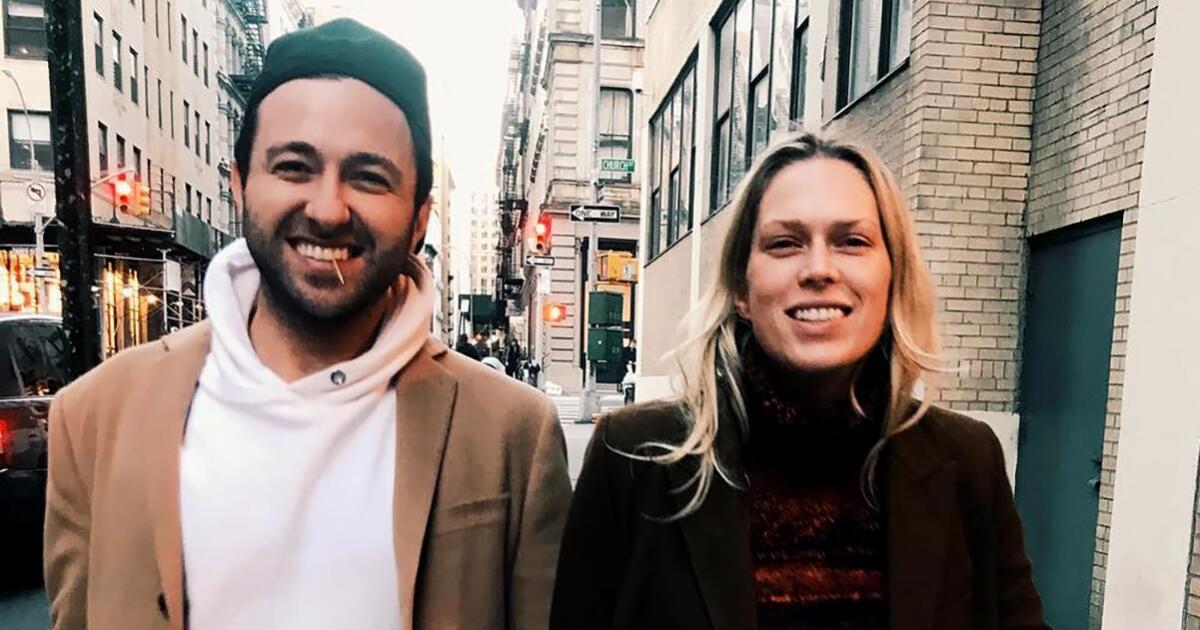
She didn’t spot any glaring red flags the first time she stalked his Instagram page. No photos of him boarding a private jet. Zero reels showing off bottle service sparklers. Nary a shirtless mirror selfie in sight.
Instead, what Erin Foster found as she scrolled through the account of the cute guy from her gym was disarmingly wholesome. Shots of him posing with his parents or playing on a local basketball team.
The photographic evidence led her to two possible conclusions: Either he was too good for her, or he was too nice — the kind of guy who’d fall all over himself trying to please her, causing her to inevitably get the ick.
Erin Foster, the creator of Netflix’s “Nobody Wants This,” at her home in West Hollywood this month.
(Christina House / Los Angeles Times)
Advertisement
Her assumptions about Simon Tikhman would end up, thankfully, being incorrect. But Foster’s early social media investigation into her new crush did not uncover a big part of his identity: He was Jewish. That didn’t matter to her — but the fact that she was a gentile mattered to him.
Tikhman mentioned it the first time they ever hung out in 2018, chatting over juice after the gym — “so L.A.,” they say in unison, rolling their eyes. “Whoever I marry, she has to be Jewish,” he’d said.
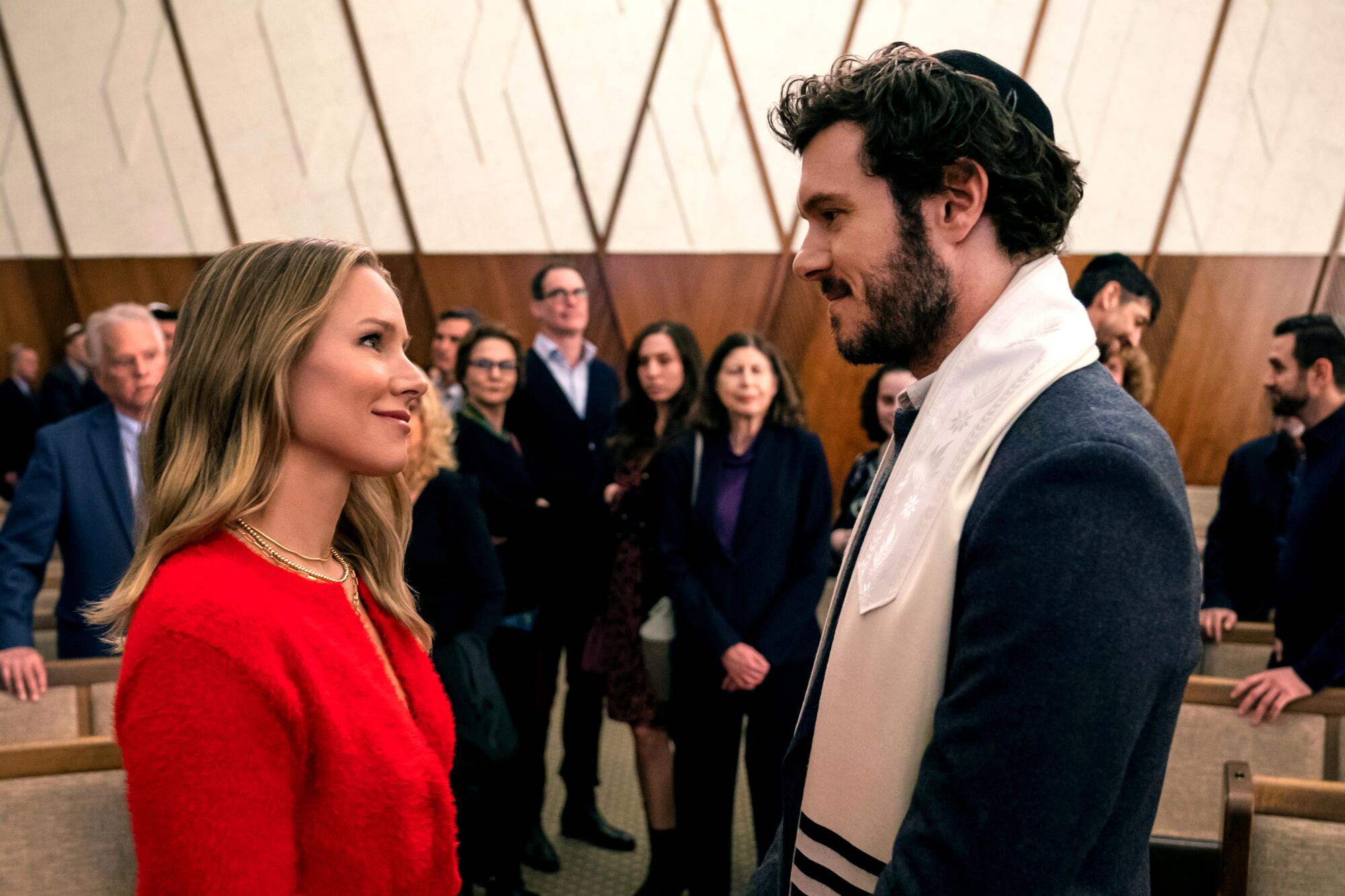
The story of how the couple fell in love while grappling with their different cultural backgrounds would go on to serve as the inspiration for Foster’s new show, “Nobody Wants This.” The series, which debuted on Netflix this week, stars Adam Brody as Noah, a rabbi who catches feelings for sex-advice podcaster Joanne, played by Kristen Bell.
Tikhman, 40, is not a spiritual leader — he co-founded a music management company. He doesn’t even consider himself particularly religious. But his parents fled the former Soviet Union in 1979 after being persecuted for being Jewish. When they settled in San Francisco, they instilled in Tikhman the notion that he had an obligation to continue the Jewish lineage.
Advertisement
“I really respect my parents and know the adversity they went through because they were Jewish,” he says. “I wouldn’t want to disappoint them.”
Foster, meanwhile, had been raised without religion in a nontraditional family. Her father, the songwriter David Foster, has been married five times — his second wife was Erin’s mom, former model Rebecca Dyer, with whom he had three of his six children. One of the men her mother dated later was Jewish, and Foster says she enjoyed going to temple during that period more than church. A decade later, she opted to attend a few classes about Judaism with a friend who was trying to delve deeper into her religion.
So the idea of converting — it didn’t scare her. Because of her “complicated family structure,” Foster found herself craving the type of tradition she never grew up with.
Kristen Bell and Adam Brody star in “Nobody Wants This,” which is loosely based on Erin Foster’s own love life.
(Stefania Rosini / Netflix)
Advertisement
“A big part of what drew me to Simon was that he was someone who was funny and cool and modern, but he had a bit of an old-fashioned feel about him,” says Foster, 42. “He’ll be like, ‘Hey, we should go check in on that person, or ‘We need to go see your grandma.’ I didn’t grow up with etiquette around those things.”
It’s early afternoon when Tikhman arrives home to the couple’s West Hollywood apartment, only a seven-minute drive from his office, which is housed in the Live Nation building. They’ve been living here for two years while the home they bought in Hancock Park is renovated. It’s a modern, new build with top-end amenities, but their floor-to-ceiling windows also overlook a grocery store parking lot.
Before coming over to kiss Foster, Tikhman peeks his head into the nursery where the couple’s 4-month-old daughter, Noa, has just woken up from a nap. The baby was born in this very apartment in May, the result of 20 grueling rounds of IVF over six years. After the birth, Foster posted pictures on Instagram of herself laboring here in an inflatable tub.
Online and on “The World’s First Podcast,” which she hosts with her sister Sara, Foster is exceptionally open about her life. When Tikhman initially accepted Foster’s Instagram friend request — he strategically, and annoyingly, waited two days to do so — he wasn’t thrilled to learn that she was a public figure.
“It wasn’t an ideal situation,” he admits to thinking. “I’m just more of a private person.”
Advertisement
It wasn’t enough to stop him from dating her. But a few years later, when she told him she’d sold a TV show idea based on their love story, he freaked out. It was one thing if Foster was in the spotlight, but he didn’t want to be. So he asked her not to move forward with writing the show.
“Simon is not sweet in a wimpy way. He has a feminist soul with a masculine energy,” Foster says of her husband.
(Courtesy of Erin Foster)
It was 2022, and she hadn’t written a word in three years. After a brief acting stint in her 20s — her biggest part was a five-episode arc on “The O.C.” — Foster made a career shift in 2012, landing a job as a staff writer on Ryan Murphy’s NBC show “The New Normal.” She and her sister Sara went on to co-create the VH1 mockumentary series “Barely Famous,” spoofing their Hollywood-adjacent lives. It lasted two seasons, and then in 2018, Foster sold a pilot called “Daddy Issues” to 20th Century Fox. She starred opposite Don Johnson as a girl whose father starts dating her best friend; it didn’t get picked up.
So Foster pivoted again. She partnered with Sara, working as creative heads for Bumble and then co-launching a fashion line, Favorite Daughter. At 35, she met Tikhman. But being in a healthy relationship wasn’t exactly a font of inspiration. She’d always written about characters who self-sabotaged, who made the same mistakes over and over without getting to the root of their issues. Without that cynical worldview, her writer’s block overwhelmed her.
Advertisement
“When I met Simon, I really felt like I might have to choose between being happy with the person I was meant to be with, or being inspired,” she says. “Because there was nothing funny about what was happening.”
“When I met Simon, I really felt like I might have to choose between being happy with the person I was meant to be with, or being inspired,” Erin Foster says.
(Christina House / Los Angeles Times)
That changed when she started going through the conversion process, which took place over 10 weeks at American Jewish University. Toward the end of the journey, she faced questions from a trio of rabbis about her intentions:
Are you sure you want to do this? It’s not easing being Jewish.
Advertisement
Are you ready to be hated by people?
If someone is being antisemitic and asks who is Jewish, are you going to stand up?
If you and your husband get divorced, will you keep being Jewish?
They were inquiries she’d never pondered before. She quickly nodded and agreed, but the quandaries stuck with her. It sparked her creativity for the first time in years, and soon she’d sold “Nobody Wants This” to Fox. (It was originally called “Shiksa,” a word that Brody’s character describes as an old Yiddish insult that “these days, just means you’re a hot, blonde non-Jew.”)
The only thing was, she never ran it past Tikhman.
Advertisement
“He was like, ‘Sorry, you sold a show about what?’” Foster recalls. “I immediately panicked. I hadn’t even considered it [being a problem]. To me, I was like, ‘Oh, my God, I’m taking our story and turning it into something cool. You’re welcome.’ And he had a different point of view.”
“I’m from a very private family,” Tikhman says, reiterating his perspective. “My mom would always tell us stories about how if you said the wrong thing in the Soviet Union as a Jew, you could be taken to jail.”
Fearful that the show could harm her relationship, Foster started trying to wish it away. She dragged her feet on a pilot script, hoping that the producers might just forget about the idea eventually. They didn’t.
But one of the EPs, Steve Levitan — the creator of “Modern Family” — had a script suggestion that helped to solve some of Foster’s problems. Noah was initially written to be a lot more like Tikhman, leaving Levitan unsure whether the stakes between a Jew and gentile who fall in love were high enough for a TV audience. A rabbi and a gentile who fall in love? Now there was some real conflict.
It also helped that Tikhman’s parents were totally on board, despite their son’s fears. She spent hours on the phone with his dad talking about potential storylines, and later during filming, she put her mother-in-law in the background of a scene shot at Sinai Temple.
Advertisement
“Also, this is what Erin’s supposed to be doing,” Tikhman says now. “She’s a writer and she’s incredible at it. I was sitting here the other day watching an episode and thinking, ‘I wish I was as good as this character.’ ”
“He was like, ‘Sorry, you sold a show about what?’’ ” Erin Foster recalls her husband, Simon Tikhman, saying. “I immediately panicked. I hadn’t even considered it [being a problem].”
(Christina House / Los Angeles Times)
The obsession with Brody’s hot rabbi will no doubt rival the early 2000s fan frenzy over Seth Cohen, his character who was a core of “The O.C.” He’s emotionally available, almost immediately telling Bell’s character that he’s interested in a serious relationship with her. He pulls out chairs, listens to her podcast to get to know her better, buys flowers for her mother. And he teaches her about Jewish traditions in a way that’s not condescending, like taking her outside to see the stars to mark the end of Shabbat.
Not all of that happened in real life, but Foster says the core of the character is true to Tikhman’s essence. She cites an example: When they’d been dating for only four months, she had a work trip booked to Dallas for 24 hours. Tikhman found out and said he’d join. Foster was confused — it was such a short trip.
Advertisement
“He goes, ‘Doesn’t your grandma live there? I’ve never met her and I need to,’ ” says Foster, who hadn’t even been planning to see her. But sure enough, Tikhman came, they all met and soon, he and grandma were talking on the phone a couple of times a week.
Foster genuinely seems to view her spouse in an exalted light — frequently referencing his “goodness” or how much “better” he is than her. Predictably, this drives him crazy.
“Simon just exudes this energy that I assumed wouldn’t match up with mine — that I’d be too negative,” she says. “In my past, if I ever chose someone who was good, they were too soft for me — too sweet or a pushover. And Simon is not sweet in a wimpy way. He has a feminist soul with a masculine energy.”
As if on cue, the couple’s new nanny walks over with Noa; the caretaker just started two days ago and speaks Russian, which they hope their daughter will eventually learn.
“This is my other girl,” Tikhman says proudly, pinching the child’s cheek.
Advertisement
The reason Foster talks so much about him — about how happy their family makes her — is that she wasn’t always sure this was in the cards for her. She did, after all, date Chad Michael Murray in her 20s.
But for a long time, she enjoyed being single. She liked flirting and reveled in her routines — drinking her morning coffee in solace in her breakfast nook. She wondered who she’d ever want to give that up for, who she could deal with in her space all the time.
“I didn’t think it was possible, and I had gotten kind of OK with that,” she says. “And now I have to stop myself from going over and sitting in his lap. I’m obsessed with Simon; he’s my muse. And this show is like a love letter to him.”
The following movie review does not contains direct spoilers for the film Michael, however general information in regards to the plot, characters, key climax points, biographical information and themes explored in the film will be heavily discussed. Please read at your own discretion, or after seeing the film in theaters.
There have been, so far, four films that aim to depict some portion of the beautifully tragic life of late pop music pioneer Michael Jackson, otherwise known to the world as The King Of Pop.
You’ve got The Jacksons: An American Dream, the near-perfect 1992 ABC miniseries that gave MJ, his brothers and verbally abusive father Joe Jackson equal screen time in order to make for a proper origin story. Then there’s Man in the Mirror: The Michael Jackson Story, an abysmal 2004 VH1 TV movie that acts as a spiritual sequel yet truly should’ve never been made. Almost a decade ago we got Michael Jackson: Searching for Neverland, the 2017 Lifetime Network attempt to cover his final years of life, told from the perspective of two bodyguards employed by him for merely two-and-a-half years.
Love TV & Film? Get more! Join the Black America Web Newsletter
We care about your data. See our privacy policy.
Today (April 24), the world finally gets to see Michael. The 2026 true-to-form biopic boasts the biggest budget compared to the previous three projects, distribution handled by the renowned Lionsgate Films, a director’s chair occupied by Antoine Fuqua (Training Day, Brooklyn’s Finest) and MJ’s own nephew, Jaafar Jackson, starring in the titular role alongside a glowing supporting cast that includes Colman Domingo (Rustin), Nia Long (Love Jones), Miles Teller (Divergent) and Larenz Tate (Menace II Society) just to name a few. Not to mention, it’s got full backing from The Jacksons family and 100% musical clearance to assure his biggest hits are heard on the big screen.
Advertisement
With all that said, you might be expecting a masterpiece that borrows the best aspects from the original and rights the wrongs of the last two. Unfortunately, that’s not the case when it comes to Michael. Thankfully though, there’s so much more to love about this film in addition to a very strong potential for more.
Yes folks, we may very well be getting the first-ever sequel to a biopic sometime in the near future.
RELATED:You, Me & Tuscany Review – Sappy, Sweet, C+ Rom-Com
Before we get ahead of ourselves by discussing a potential sequel, let’s first start off with what you get out of Michael. The film covers Joe’s formation of The Jackson 5 in 1966 and ends with MJ’s iconic 1988 Wembley Stadium stop on the Bad Tour. The filler in-between covers their Chitlin’ Circuit days, the Motown era, run-ins with Gladys Knight and The Pips, finding his voice with Off The Wall, the epic creation of Thriller, the Motown 25 NBC special and the infamous Pepsi burning incident. Each of these scenes are done with great detail and a passion from all involved to get it as close to the real-life moments. However, what’s missing stands out like a sore thumb.
Both Rebbie and Janet are nowhere to be found — they each requested their likeness not be depicted — and neither is MJ’s longtime muse, Diana Ross. It was reported that actress Kat Graham was actually casted in the part, only to later have her scenes cut completely due to legalities. Off The Wall also gets painted as his solo debut of sorts, completely ignoring the four successful solo albums that preceded it when he was just a preteen. Also, while it’s perfectly clear who the movie is about based on the title, it does feel a bit off to see the closest people in his life demoted to barely-speaking supporting characters, save for Domingo’s powerful portrayal as mean ol’ Joe, Long as the ever-caring Mrs. Katherine and longtime bodyguard Bill Bray played by KeiLyn Durrel Jones.
Advertisement
On the positive side, Michael ultimately does more good than confusion. Jaafar is simply captivating when it comes to embodying his late superstar uncle, nailing everything from those easily-recognizable voice inflections to the classic dance moves. The film ends in 1988, right before MJ invests in Neverland Ranch, so don’t expect the heavy topic of his acquitted child sexual abuse allegations from 1993 and 2003 to be brought up either — well, yet anyway.
If in fact a “Jackson” sequel is in the works, we can only hope his full story is told with care, respect and most importantly the truth. Other important aspects we’d hope to see be depicted include an honest look at his vitiligo journey, the toll he suffered mentally as a result of the trials, the marriage, the kids, the dichotomy of balancing unprecedented riches against a substantial amount of debt and, yes, the prescription drug abuse that ultimately ended his life.
Overall, for everything Michael lacks there is something just as good to love about the film, and the potential for a sequel gives us hope that the best is still yet to come.
Watch the trailer for Michael below, and see for yourselves how The King Of Pop’s story began as his latest biopic hits theaters starting today:
Choosin’ to stay home instead of trekking out to Indio for this weekend’s Stagecoach festival? Don’t worry, you’ll be able to listen to all the country music your heart desires. You can get your country heartbreak on with Ella Langley, Bailey Zimmerman and Cody Johnson, and then rock out with Counting Crows. If you prefer EDM, you can catch Diplo and Dillstradamus (Dillon Francis and Flosstradamus) as Friday’s closing acts.
The festival will be livestreamed on Amazon Music, Amazon Prime Video and Twitch beginning at 3 p.m. On Sirius XM’s The Highway (channel 56), you can listen to exclusive interviews and live performances along with a special edition of the Music Row Happy Hour. The station Y’Allternative will also be covering the festival on Friday evening.
Here are updated set times for the Stagecoach livestream Friday performances (times presented are PDT):
Forget the “video game movie” curse;The Mortuary Assistantis a bone-chilling triumph that stands entirely on its own two feet. Starring Willa Holland (Arrow) as Rebecca Owens, the film follows a newly certified mortician whose “overtime shift” quickly devolves into a grueling battle for her soul.
What Makes It Work
The film expertly balances the stomach-churning procedural work of embalming with a spiraling demonic nightmare. Alongside a mysterious mentor played by Paul Sparks (Boardwalk Empire), Rebecca is forced to confront both ancient evils and her own buried traumas. And boy, does she have a lot of them.
Thanks to a full-scale, practical River Fields Mortuary set, the film drips with realism, like you can almost smell the rot and bloat of the bodies through the screen.
The skin effects are hauntingly accurate. The way the flesh moves during surgical scenes is so visceral. I’ve seen a lot of flesh wounds in horror films and in real life, and the bodies, skin, and organs. The Mortuary Assistant (especially in the opening scene) looks so real that I skipped supper after watching it. And that’s saying something. Your girl likes to eat.
Co-written by the game’s creator, Brian Clarke, the movie dives deeper into the demonic mythology. Whether you’ve seen every ending or don’t know a scalpel from a trocar, the story is perfectly self-contained. If you’ve never played the game, or played it a hundred times, the film works equally well, which is hard to do when it comes to game adaptations.
Advertisement
Nailed It
This film does a lot of things right, but the isolation of the night shift is suffocating. Between the darkness of the hallways and the “residents” that refuse to stay still, the film delivers a relentlessly immersive experience. And thankfully, although this movie is filled with dark rooms and shadows, it’s easy to see every little thing. Don’t you hate it when a movie is so dark that you can’t see what’s happening? It’s one of my pet peeves.
The oh-so-awesome Jeremiah Kipp directs the film and has made something absolutely nightmare-inducing. Kipp recently joined us for an interview, took us inside the film, discussed its details and the game’s lore, and so much more. I urge you to check out our interview. He’s awesome!
The Verdict
This isn’t just a cash-grab; it’s a high-effort adaptation that respects the source material while elevating the horror genre. With incredible special effects and a powerhouse cast, it’s the kind of movie that will make you rethink working late ever again. Dropping on Friday the 13th, this is a must-watch for horror fans. It’s grisly, intelligent, and genuinely terrifying.