Connect with us

Entertainment

How a mural of Altadena became a symbol of resilience for one small store, through fire and flood

Published

on

How a mural of Altadena became a symbol of resilience for one small store, through fire and flood

Every time Adriana Molina drives up Lake Avenue to her retro-style women’s clothing shop Sidecca in Altadena, she sees the new outdoor mural she commissioned for the store by muralist and illustrator Annie Bolding. It gives her hope.

“I’m here to stay, and this mural solidified my decision to reopen my business,” said Molina on a recent winter day, sitting next to Bolding inside the boutique. “I grew up in Altadena. The community has motivated me this whole time, and I want them to drive by this mural and smile.”

“ALTADENA.” The word — in big white letters, set against layers of blue — appears toward the top of the mural, on the store’s brick wall facing Lake. Above are the San Gabriel Mountains, painted a deep brown, California poppies and Mariposa Street and Lake Avenue street signs. Below are green grass, a monarch butterfly and Altadena’s Christmas Tree Lane. A bright blue house is on a multicolored striped path in the middle of the mural. Next to it, on a hiking trail, a sign says, “Welcome Home Altadena… With Love, Sidecca.”

For Molina and Bolding, the mural is a personal ode to the Eaton fire-ravaged community — art as a message of optimism and healing.

A car passes by the new Altadena mural on the side of Sidecca apparel shop, which commissioned the piece after fire and floods devastated the community.

Advertisement

(Genaro Molina / Los Angeles Times)

When the fire tore through Altadena in January 2025, Sidecca and a few other stores on the north side of Mariposa Street’s bustling Mariposa Junction survived, while the other half-block of businesses burned to the ground. The fire leveled Bolding’s parents’ house off Lake and the home of one of Molina’s close relatives.

Molina staged pop-ups and sold merchandise online during months of remediation, and officially reopened Sidecca’s doors in November as part of Mariposa Junction’s larger comeback. Then the store suffered another blow: flooding and damage during rainstorms in late December. While Molina prepped to temporarily close her store yet again for renovations, Bolding began work on the mural. She started painting on the one-year anniversary of the fire and finished eight days later.

“On the day I started it, it was so cold and windy, and I was scared being up on the ladder,” said Bolding. “But getting to talk to community members while I was painting was very special. People were excited and honking as they drove by. That night, I drove up to the lot where my parents’ place was, and I stood there and all the feelings flooded back.”

Advertisement

The mural’s origin story is that of two creative women bound by strength and a desire to give back.

Molina, who has worked in the fashion industry for more than 30 years, opened Sidecca’s Altadena spot in 2023, after closing its longtime Pasadena location. Voted Pasadena’s best women’s clothing store five times by Pasadena Weekly, Sidecca sells fun vintage-inspired merchandise and clothes, from ‘50s style dresses to snazzy magnets, tote bags and sunglasses. A big rainbow zips across the top of one of the store’s walls.

A display in a clothing shop.

A display in Sidecca in 2023, two years before the Eaton fire devastated Altadena.

(Alejandro R. Jimenez)

“A few months after Sidecca opened in Altadena, my mom walked in and saw how colorful it was, and said, ‘This reminds me of my daughter,’ ” Bolding said. “With zero hesitation, my mom said to Adriana, ‘Here’s her Instagram. This is my daughter’s stuff.’ ”

Advertisement

Bolding, who goes by Disco Day Designs, calls herself “a joyful creator who loves to intentionally transform spaces.” Known for the bright murals she creates for brands and shops, Bolding gained attention on social media for a trash bin she painted with palm trees and stripes. She brought it to the 2024 Coachella Valley Music and Arts Festival as part of a contest organized by the festival’s sustainability partner, Global Inheritance.

“I fixated on the trash can,” said Molina. “I looked at Annie’s murals and was like, ‘Oh, she has to do something in here for us.’ ”

“Game recognizes game,” added Bolding, smiling.

Molina wanted to rebrand Sidecca with a new logo, bags and art, and connected with Bolding about that and a possible mural inside the store. “I wanted ‘Sidecca’ painted across a wall as an acronym that stands for style, individuality, diversity, expression, community, culture and art,” she said. “That’s who we are.”

Then came Jan. 7, 2025.

Advertisement

The store was closed all day for a holiday lunch. Then the winds picked up and the flames roared. Molina, who lives with her husband and two children on the Altadena-Pasadena, evacuated with her family to Long Beach and came back days later. She knew the store was OK because she’d seen it — intact — on the news.

“As soon as we could come up to the shop, we went,” Molina said. “There were ashes all over.”

Bolding and her husband were in Palm Springs fixing up an AirBnb they cohost when Bolding got a call from her mom about the fire in Altadena. She urged her mom, dad and younger brother to evacuate. After they did, their home burned down. Her parents now live in a Pasadena apartment.

When Molina started selling Altadena-themed merch on Sidecca’s website, Bolding donated three designs, including one with lively retro daisies. In July, she wrote an email to Molina reviving the idea of a mural, but outside versus inside, as an ode to Altadena.

“It felt like anything I could do to bring joy, let’s go,” said Molina. “And I really wanted a little house in there, and for it to say, ‘Welcome home.’ ”

Advertisement

The mural would be Bolding’s first public piece of art on a main street.

“Lake always felt like the road going home,” she said. “That rainbow road in the mural, leading to the mountains, is so symbolic. Very ‘Wizard of Oz.’ The mountains, their silhouette, have always felt majestic, safe, and why it was so heartbreaking anytime to see them burn. To me, they feel like mother.”

A woman in front of a colorful mural.

Muralist Annie Bolding stands in front of her new Altadena mural on the side of the Sidecca apparel shop. The work is Bolding’s first piece of public art on a main street.

(Genaro Molina / Los Angeles Times)

Bolding’s joyful daisies decorated the Sidecca tote bag given to customers at November’s reopening, just before December’s intense rainstorms. Water gushed through Sidecca’s ceiling. Molina and her employee Manisa Ianakiev were overwhelmed.

Advertisement

“We were like, ‘Is this really happening?’ ” said Molina. “Then people started bringing tools and towels. It was an example of community.”

Bolding planned to start painting the mural Jan. 4, during the Altadena Forever Run, but rain swept through. After Molina’s landlord installed a plywood base, Bolding started on the mural several days later.

Since then, the shop’s ceiling has been replaced, and Molina is working on trying to replace the floor — while continuing to stage pop-ups and sell merchandise online — before fully reopening the bricks-and-mortar boutique this spring.

“People say, ‘Every time I go into your store, I just get happy. I’m in a better mood,’ ” said Molina. “I get that all the time. And what Annie has done, this mural, is beautiful. It makes me happy.”

Advertisement

Entertainment

How Hollywood’s production crisis became a key issue in the L.A. mayor’s race

Published

on

How Hollywood’s production crisis became a key issue in the L.A. mayor’s race

Los Angeles City Councilmember Nithya Raman, who serves the 4th District, makes her way across an empty, unnamed backlot, presenting her case to be the city’s next mayor.

“Studio lots like this one used to be filled with people, costumers, electricians, set medics, caterers, thousands of Angelenos making a living,” she says in the video posted on social media. “Now these lots are quiet. Since 2018, shooting days in the city have fallen by half.”

After telling voters this issue is “personal” (her husband is a TV writer and producer), criticizing Mayor Karen Bass’ leadership on the matter and outlining her own plans, Raman proclaims, “I’m running for mayor to make sure Los Angeles stays the film and TV capital of the world.”

Placing the concerns of the entertainment industry at the center of the city’s mayoral race would have been unthinkable even in the last election cycle. But the production crisis, which has rocked Hollywood and pummeled its workforce, has reached a critical juncture. The state of L.A.’s signature industry is now a political flashpoint alongside affordability, crime and homelessness in the upcoming election.

A person films an interaction between mayoral candidate Spencer Pratt and another person on his cellphone during a “Community Meet and Greet” event out of a house for sale on Long Ridge Avenue in a residential neighborhood of Sherman Oaks on Saturday.

Advertisement

(Etienne Laurent/For The Times)

In campaign ads, interviews and the recent televised debate, the top three contenders: incumbent Mayor Bass, former reality TV villain Spencer Pratt and Raman, have made the ongoing production slump a pivotal topic, highlighting their plans to revitalize the industry while deploying the issue to undercut one another.

For decades, elected officials have not had to focus on the film and TV business, let alone turn it into a campaign issue. It was simply a given that local production would continue to play a dominant role in the city’s economy as it has for more than a century.

But the cumulative effects of consolidation, runaway production to tax-friendly states and countries and the end of the streaming boom has caused Los Angeles to lose billions in economic activity, shed some 57,000 jobs over the last four years and led to the closing of more than 80 film and television production service businesses across the city since 2022.

Advertisement

“For us, ‘save Hollywood’ is more than a slogan and more than headline. It is what needs to be done,” said Pamala Buzick Kim, one of the co-founders of Stay in LA, a grassroots campaign aimed at increasing film and television production in Los Angeles.

To be sure, the biggest driver of where studios and producers film are state and federal tax credits, over which the city has no control.

But Buzick Kim and others argue that “there is lots the mayor can do, hand-in-hand with the City Council.”

Mayor Karen Bass walks with Nilza Serrano during Avance's politics and tacos event

Mayor Karen Bass, center, walks with Avance Democratic Club President Nilza Serrano, to the right of Bass, during Avance’s politics and tacos event at Ernest E. Debs Regional Park in Los Angeles on Saturday.

(Christina House/Los Angeles Times)

Advertisement

For starters, say filmmakers and advocates, much can be done to tackle the city’s sclerotic bureaucracy, onerous regulations and a slow and costly permitting process that has pushed filmmakers to flee to friendlier and cheaper locales.

While steps have been put in place recently, including a pilot program offering reduced-cost filming permits for shoots that demonstrate a “low impact” to the surrounding community, many complain such steps have come too little and too late.

A man examines woodwork in a shop

Scott Niner, president and owner of Dangling Carrot Creative, checks on woodwork being produced at his shop in North Hollywood.

(Jason Armond/Los Angeles Times)

“The industry is in collapse and people have been talking about fixing things for years, but all we get are incremental little changes,” said Ed Lippman, a location manager of 34 years who lives in Sherman Oaks and has worked on such shows as “ER” and “The X-Files” and movies including “Galaxy Quest.” “And if the city is not being business-friendly, the business will go elsewhere.”

Advertisement

Compounding the problem, the Los Angeles area has more than 100 jurisdictions, many of which have their own set of rules and regulations regarding filming.

“There needs to be universal standards,” said Travis Beck, a location manager for commercials, small films and music videos. “Burbank is different from Glendale, which is different from Pasadena.”

The recent kerfuffle over filming “Baywatch,” the lifeguard reboot at Venice Beach, underscored both the efforts to bring production back to L.A. — enticed by a $21-million tax credit — and the complex, baffling red tape required to film here.

When shooting began in March, the production encountered a number of hiccups, including that it needed nearly double the parking space it had received a permit for, which was not part of the original approvals.

An anonymous crew member claimed on Facebook that government restrictions had forced production to relocate from Venice Beach. Production staff denied they had relocated. However, the incident prompted a backlash, becoming a rallying cry over L.A.’s burdensome filming bureaucracy.

Advertisement

The “Baywatch” team quickly met with city and county officials and resolved the issue, securing an agreement for a 20% parking discount from the city, and the mayoral candidates used it as an opportunity to score political points.

Pratt slammed the city’s permitting problems.

“LA turned its back on Hollywood — now the golden goose needs CPR,” he wrote on his Substack.

Bass highlighted her administration’s leadership on the matter.

“The City of Los Angeles will always clear bureaucratic barriers, making it easier and more affordable to film in the entertainment capital of the world,” she wrote on X last month.

Advertisement

On April 21, the mayor unveiled programs to offer productions 20% discounts on city-owned parking lots and other equipment, reduced filming fees at places like the Griffith Observatory and reopened the Central Library for filming. Last August, she appointed Steve Kang, president of the Los Angeles Board of Public Works, as the city’s film liaison.

Raman has pledged her support for expanding the state’s $750-million tax incentive program, streamlining permitting and lowering fees and eliminating those for small productions. She has also said she will establish a dedicated city film office with a liaison who understands production.

Nithya Raman speaks to a crowd outdoors behind Nithya for Mayor chalk message on ground

Councilmember and mayoral candidate Nithya Raman speaks to a crowd at the “Families for Nithya” event at Vineyard Recreation Center in Los Angeles on Saturday.

(Myung J. Chun/Los Angeles Times)

“Los Angeles is losing Hollywood,” Raman said in a statement. “Not because productions want to leave, but because we’ve made it too hard for them to stay.”

Advertisement

On his Substack and various podcast interviews, Pratt has promised to slash location fees in half, speed up permit approvals, reduce on-set city staff for the majority of productions and waive all fees for shoots with budgets under $2 million.

All three candidates have attacked one another over their approach to Hollywood.

Pratt and Raman have said Bass moved too slowly to address spiraling production and retain film jobs, saying she enacted measures only recently as the mayoral race was heating up.

Speaking on the Monks & Merrill podcast, Pratt criticized Bass’ moves to cut costs to film at the Griffith Observatory, saying, “Who needs that shot right now with the homeless poop all around it?”

The incumbent mayor has defended her administration’s record with the entertainment industry.

Advertisement

Bass and Pratt have taken Raman to task, calling her out for what they say is her lack of advocacy during her time on the City Council.

“She feels very strongly about it. But never offered one motion on the industry, and when motions came up on the industry she either recused herself, or got up and walked out,” said Bass during a debate this month.

Citing a potential conflict of interest over her husband’s work in television, Raman refrained from voting on several motions related to Hollywood.

Many working in the industry would like to see full-throttled support coming from the mayor’s office that will get results. They note how New York City has successfully promoted itself as a leading film destination over the years. (Kang, the city’s chief film liaison, said the city is working on a similar marketing campaign to promote filming that will launch by early fall.)

“For all the talk about, ‘We need to support and bring back filming,’ if they just did basics like lowering the fees and simplifying the process … that would actually help people and get things produced,” said Chris Fuentes, 66, who worked for 30 years as a location manager until he retired last year.

Advertisement

“We’ve heard a lot of great things, but not all things are possible in the mayor’s remit,” said Buzick Kim, noting that tax incentives are a state and federal issue.

Still, she said, “the mayor must understand that Hollywood needs to be made a priority and to find and create inspired thinking to make things easier and cheaper.”

Kang agrees, but says there are limits to what the mayor can achieve.

“We definitely can do a lot to really open up the entertainment industry, but at the same time, we recognize the larger impact needs to come from Sacramento and Washington, D.C., because L.A. just does not have the resources to compete with other jurisdictions in providing millions of dollars in tax incentives,” he said.

For most working in the industry, they just want city leadership that will execute on more than just talking points.

Advertisement

“This is the birthplace of cinema,” Beck said. “It shouldn’t be so hard to film here.”

Continue Reading

Movie Reviews

‘Hokum’ movie review: Damian McCarthy’s nasty little ghost story is undone by its own explanations 

Published

on

‘Hokum’ movie review: Damian McCarthy’s nasty little ghost story is undone by its own explanations 

A stil from ‘Hokum’
| Photo Credit: NEON

For those of you already familiar with Damian McCarthy’s work, the Irish filmmaker has spent the past few years turning cramped Irish spaces into elaborate, nerve-racking machines for dread. His 2020 debut, Caveat, trapped us inside a decaying rural house with a chained protagonist and a grotesque toy rabbit, while 2024’s Oddity transformed an isolated farmhouse into a relay system for jump scares built from negative space and the sound of somebody knocking at the wrong moment. His latest, Hokum, pushes that approach into a larger setting without sacrificing the intimate unpleasantness that makes his work so effective. 

The film takes place almost entirely inside the Bilberry Woods Hotel, a fading property buried in the Irish countryside where the final few guests arrive for a Halloween celebration. At the same time, staff members quietly prepare to shut the building down for winter. Into this atmosphere walks Ohm Bauman, played by Adam Scott, an American novelist carrying two urns containing his parents’ ashes and a personality abrasive enough to make even the resident ghouls feel hospitable.

Hokum (English)

Director: Damian McCarthy

Cast: Adam Scott, Peter Coonan, David Wilmot, Florence Ordesh, Michael Patric, Will O’Connell, Brendan Conroy, Austin Amelio

Runtime: 107 minutes

Advertisement

Storyline: When novelist Ohm Bauman retreats to a remote inn to scatter his parents’ ashes, he’s consumed by tales of a witch that haunts the honeymoon suite

McCarthy introduces Ohm through his work. The opening sequence shows him writing the conclusion to a historical adventure novel about a conquistador stranded in the desert with a dying child, and the scene initially appears disconnected from the main story until the camera pulls back to reveal that the entire episode exists inside Ohm’s manuscript.

This intro establishes the emotional logic driving the film. Ohm writes stories where people wander toward death because he has spent most of his adult life emotionally entombed inside the loss of his parents, who died shortly after honeymooning at the same Irish hotel he now visits. McCarthy avoids turning this into a tidy psychological diagnosis and attempts to reveal the damage through behaviour — Ohm humiliates a bellhop named Alby by heating a spoon over an open flame and pressing it against the young man’s hand after Alby asks him to read an aspiring manuscript.

That ugliness becomes central to Scott’s performance. Hokum strips away the comic cushioning that often softens his cynicism, especially in his recent Severance escapades. Scott keeps Ohm emotionally rigid even as the character begins to unravel inside the hotel’s sealed honeymoon suite, and the refusal to chase sympathy lends the film a sourness that works in its favour. When Ohm eventually risks himself to search for the hotel bartender Fiona, the motivation grows from guilt and loneliness over his botched suicide attempt. Fiona disappears after warning him about the suite’s resident witch, a local legend the hotel staff accepts with weary practicality, and her absence pushes Ohm deeper into the building’s sinister secrets.

A stil from ‘Hokum’

A stil from ‘Hokum’
| Photo Credit:
NEON

Cinematographer Colm Hogan lights the hotel with weak lamps, muddy greens, and heavy shadows that preserve spatial clarity even when characters crawl through near-total darkness. Production designer Til Frohlich fills the honeymoon suite with damp wallpaper, antique furniture, and cramped architectural dead ends that make it feel physically hostile before anything malicious even appears. McCarthy then uses sound with vicious precision, as ringing bells ring, creaking floorboards, and a mutated, uncanny-valley children’s TV program begin flooding the ominous silence.

The film loses some momentum once McCarthy begins unpacking the mystery behind Fiona’s disappearance and the crimes attached to the hotel’s past. Several supporting characters remain thinly drawn, particularly the hotel management, and the screenplay occasionally mistakes withholding information for complexity. The final stretch also leans too heavily on explanatory reveals and heightened confrontations, with the climactic encounter involving the witch pushing the film toward bluntness when the earlier sections had earned their power through suggestion alone.

Advertisement

Even so, Hokum succeeds because McCarthy understands the mechanical pleasures of horror filmmaking at a level many contemporary prestige directors seem embarrassed by. Though the scares land with diminishing returns this time, McCarthy still stages them with the acute understanding of just how long we will stare into a dark hallway before resenting ourselves for it. His folklore imagery still carries the grubby charm of an R.L. Stine paperback pulled from a damp school library shelf, which gives the film a pulpy nastiness that suits it well. McCarthy never fully organises many of these elements into a clean mythology. What he does create is a horror film with texture and personality, even if it barely holds up against the mastery of its predecessors.

Hokum is currently running in theatres
Continue Reading

Entertainment

Spotify doubles down on video podcasts at its Hollywood studios

Published

on

Spotify doubles down on video podcasts at its Hollywood studios

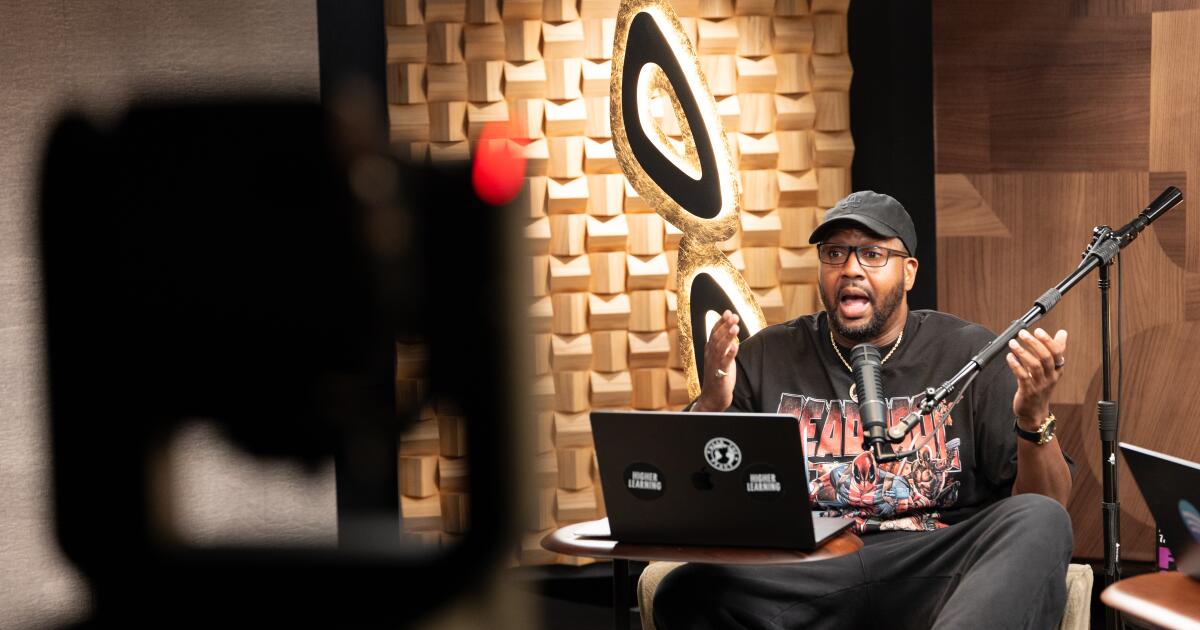
On a recent weekday morning inside a studio in the heart of Hollywood, Rachel Lindsay and Van Lathan, co-hosts of The Ringer’s “Higher Learning,” were getting ready to roll.

By the time the podcasters came into the Spotify Sycamore Studios for their show, which covers all things in Black culture and politics, the overhead lights were set, and the cameras were precisely angled. Decorative books were propped up between their seats and a big red “Higher Learning” logo stood behind them.

As soon as everyone silenced their phones, the hosts began to banter like two old friends. Lindsay complimented Lathan on his recent foray into stand-up comedy at the Netflix is Joke Fest at the Laugh Factory.

“I just have to say … basically a star is born,” said Lindsay, grinning. “I have to talk about it. Now I never doubted you.”

The pair helms one of the many shows on The Ringer podcast network, known for its roster of A-list celebrity hosts and sports and culture commentators that recently moved into Spotify’s newest podcasting studios.

Advertisement

The 11,000 square-foot space on Sycamore Avenue was designed as both a home base for The Ringer’s production and a video podcasting hub for select Spotify creators.

Since its opening earlier this year, the space has welcomed more than 25 podcasters and shows, on top of the dozens of shows that still record at Spotify’s Mateo studios in the Arts District.

The company estimates that over the last five years it has contributed more than $10 billion to the podcasting industry, including payouts to creators and investments in new content.

Podcasts are just one arm of Spotify’s business, as the audio giant has over 100 million songs and 700,000 audiobooks on its platform. But video podcasts have become an increasingly important way for the company to keep listeners tuned in — and paying for subscriptions amid growing competition from Apple Music and YouTube Music. Despite a surge in profits in the first quarter, Spotify’s share price has fallen 25% this year as investors worry about a slowdown in subscriber growth.

Van Lathan and Rachel Lindsay record their podcast, “Higher Learning with Van Lathan and Rachel Lindsay,” at Spotify’s Sycamore Studios in Hollywood on May 7. The podcast is distributed on Spotify through The Ringer.

Advertisement

(Allen J. Schaben/Los Angeles Times)

One of the main drivers behind opening the Sycamore studios was to create a central hub for The Ringer, a media company Spotify acquired for $250 million in 2020.

Geoff Chow, Spotify‘s head of podcast studios and The Ringer’s managing director, said the investment is already paying off “in terms of the productivity and the quality of the content we’re able to produce from here.”

The Ringer is one of the streamer’s most popular assets. Spotify includes nine Ringer shows in its list of the top U.S. podcasts.

Advertisement

“They’re pouring into this space and their creators,” Lathan said, before recording a new “Higher Learning” episode. “We really have the freedom to do so much.”

He and Lindsay said the studio has elevated their show by switching up their workflow and increasing in-person work.

Thanks in part to its centralized location, tucked between the offices of SiriusXM and music and sports entertainment company Roc Nation, they say guests are more eager to visit and record in person. Lathan joked that even while walking down the street, he’ll run into radio personalities like Sway Calloway, who hosts his own successful “Sway in the Morning” show on SiriusXM, and convince them to come up for a tour of the space.

Sycamore has already seen guest appearances from Snoop Dogg on “Game Over with Max Kellerman and Rich Paul,” Pennsylvania Gov. Josh Shapiro on “Higher Learning with Van Lathan and Rachel Lindsay” and “Project Hail Mary” author Andy Weir on “House of R.”

“This street is so cool,” Lindsay added. “It’s just a different energy here.”

Advertisement

The duo first started recording at Spotify’s Arts District campus, which is more focused on audio-driven programs. But as the podcasting landscape evolves and video becomes a more important element, “Higher Learning” is now able to maximize on the new studio’s video-first capabilities.

Chris Thomas, studio operator, works in the control room on the podcast, "Higher Learning."

Chris Thomas, studio operator, works in the control room on the podcast, “Higher Learning with Van Lathan and Rachel Lindsay.”

(Allen J. Schaben/Los Angeles Times)

Spotify also employs a combination of full-time employees and freelancers that staff each show, including sound engineers, lighting specialists and set designers who help keep the place running.

The Ringer, founded by media mogul Bill Simmons, exists online as a website, a podcast network and video production house, anchored in sports, pop culture and politics coverage. Some of its most popular programs include “The Bill Simmons Podcast,” “The Rewatchables” and the inaugural Golden Globe winner “Good Hang with Amy Poehler.”

Advertisement

Many of the hosts overlap within The Ringer’s podcasting ecosystem. Just between Lathan and Lindsay, they host and appear as regular guests on as many as five shows, so they work from the studio three to five times a week. By being in close quarters together, a greater sense of collaboration has enveloped The Ringer’s team. Chow said there are some days when Simmons will walk onto four shows a day, just to share his thoughts on a topic.

“This is my dream of what The Ringer is. We’re all here talking, we’re all existing together,” Lathan said. “We’re all popping in and out of different rooms all the time.”

Exterior view of Spotify's Sycamore Studios, the company's newest podcasting facility.

Exterior view of the building that houses Spotify’s new Sycamore Studios. The company takes up one floor of the facility.

(Allen J. Schaben/Los Angeles Times)

The Ringer was first founded in 2016. At the time, Simmons had recently been ousted from ESPN due to a strained relationship with higher-ups. Simmons had spearheaded the network’s Grantland sports blog, which focused on cultural commentary that is similar to what The Ringer does today. The Ringer soon established itself as one of the fastest-growing independent podcast networks.

Advertisement

The brand still keeps its roots in fandom — whether it’s through football or “Game of Thrones,” said Chow. So, to have a space that reflects the diversity of its programming often makes recording more fruitful, especially during key moments like the NFL draft or awards season.

As The Ringer continues to expand its roots in Hollywood, the network remains focused on maximizing its content.

In January, The Ringer started airing select podcasts on Netflix to reach a wider audience. Chow said the partnership is off to a promising start. Each of the five recording studios at the Sycamore site is fully equipped with live-streaming technology — making the weekly Netflix live shows possible.

“Podcasts have become like a cultural hub and curator of things that are happening in the world,” Chow said. “We always want to innovate and test. That’s something that was exciting to us to think about bringing our audience new content in different places.”

Advertisement
Continue Reading
Advertisement

Trending