Entertainment
George Lowe, voice actor known and beloved for his irreverent Space Ghost, dies at 67

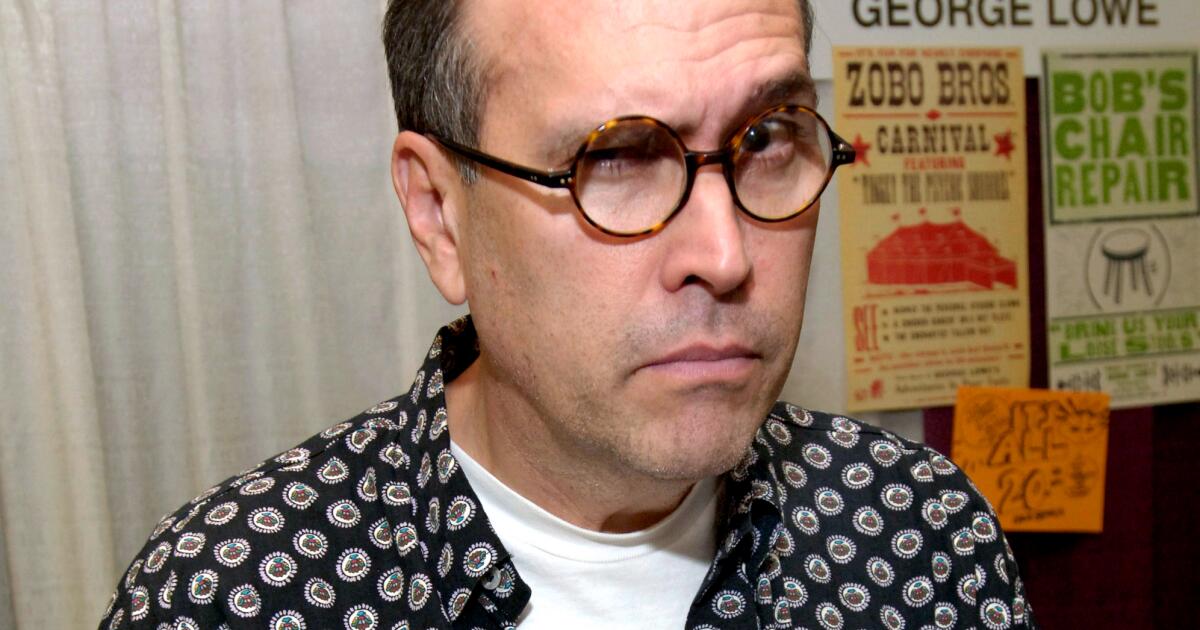
George Lowe, the voice actor best known for the long-running cult-favorite Cartoon Network and Adult Swim series “Space Ghost Coast to Coast,” died Sunday at age 67, a representative confirmed Tuesday.
The representative said a statement from the family would be forthcoming. No cause of death was given, though friend and radio host “Marvelous Marvin” Boone wrote Tuesday on social media that Lowe had died after “a long illness.”
“I’m beyond devastated,” he said on Facebook. “My Zobanian brother and best friend for over 40 years, George Lowe, has passed away after a long illness. A part of me had also died. He was a supremely talented Artist and Voice actor. A true warm-hearted Genius. Funniest man on Earth too. I’ve stolen jokes from him for decades. He stole some of mine. He was also the voice of Space Ghost and so much more.”
Casper Kelly, the writer-producer-director behind Adult Swim’s “Your Pretty Face Is Going to Hell,” remembered Lowe on X, writing, “Wonderfully kind and funny man. Brilliant improvisor. Art collector. Raconteur. Space Ghost was genius and helped usher in a new wave of oddball tv.”
Voice-over actor Billy West said Tuesday on X that Lowe “was mighty and one of the best of the best VOs ever. Very generous of spirit and very kind… and funny funny funny. He will be missed.”
“My heart is broken. George Lowe was one of the funniest people I’ve ever known and one of the nicest people to ever exist. You will be missed more than you know my friend. RIP,” Tim Frasier, an executive producer at iHeartRadio subsidiary Premiere Networks, said Tuesday on Facebook.
Michael Stipe of R.E.M. vibes with talk-show host Space Ghost — voiced by George Lowe — in an episode of “Space Ghost Coast to Coast.”
(BW)
“Incredibly heartbroken to learn that long time broadcasting buddy George Lowe (Official) has passed away,” radio host and voice-over artist Roy Hersey said, also on Facebook. “One of the most creative and funniest people I’ve ever known. We worked together at Power 99 in Atlanta before he became the voice of #spaceghostcoasttocoast on the Cartoon Network. … I visited with him just recently at his home in Lakeland, Florida. So glad I got to see him one last time. If there is a heaven, he’s got ’em in [stitches].”
Lowe was born Nov. 10, 1957, in Dunedin, Fla., and worked in radio before moving to voice acting in the 1990s. He was also a visual artist and art collector, according to the American Visionary Art Museum, ultimately amassing hundreds of works including Pop Art prints by Andy Warhol, Claes Oldenburg and others.
Space Ghost, who originated in the 1960s on CBS (courtesy of Hanna-Barbera Productions), evolved in the 1990s from a serious fighter of outer-space supervillains into an irreverent talk-show host on a show that mixed animation and live-action.
“Space Ghost Coast to Coast” was billed as the first late-night show to feature a cartoon superhero as its host, and during its run from 1994 to 1999 and off and on until 2012, it welcomed guests including Björk, Adam Carolla, Conan O’Brien, Bob Costas and Michael Stipe of R.E.M., to name a few. The guests were filmed live and inserted into the animated show.
On the premiere, diet guru Susan Powter, comic Kevin Meaney and the Bee Gees were Space Ghost’s guests, accompanied by his TV band — led by former archenemies Moltar and Zorak.
Lowe took over the Space Ghost gig from “Rowan & Martin’s Laugh-In” announcer Gary Owens, who voiced the superhero during his early, more serious stints in the 1960s and 1980s. Owens, who died in 2015, made a cameo appearance as Space Ghost replicant “Gary” in a Season 5 episode of “Coast to Coast.” In the episode, Lowe’s Space Ghost destroyed Owens’ replicant.
“The great thing about Space Ghost is that he’ll be returning at a time when heroes like X-Men and Batman are especially popular,” former Cartoon Network executive Mike Lazzo told The Times in 1994. “Here we have a hero working with his former enemies and there’s a completely loopy, nutty spin, making something for both kids and their parents.”
Lowe voiced numerous roles on Adult Swim shows including “Robot Chicken,” “The Brak Show” and “Aqua Teen Hunger Force,” and in 2024 voiced Space Ghost in the Season 3 “Space Con” episode of “Jellystone!” The voice actor spent time in recent years meeting fans at various Comic-Cons and similar gatherings.
Art by Lowe is hung at the High Museum of Art in Atlanta, the Georgia Museum in Athens, Ga., the Polk Museum in Lakeland, Fla., and the American Visionary Art Museum in Baltimore, according to the latter museum’s website.
Former Times staff writer N.F. Mendoza contributed to this post.

Movie Reviews
‘Night Nurse’ Review: A Caretaker Explores Her Kink for Elder Abuse in the Year’s Strangest Erotic Thriller

There are any number of erotic thrillers in which rich old men are robbed blind and/or left for dead, but Georgia Bernstein’s admirably bizarre “Night Nurse” might be the first movie of its kind where elder abuse is the source — and possible subject— of its erotic thrills. If there are others, I’m not sure I want to know.
But this woozy debut feature doesn’t rely on its audience being turned on by the relationship between a nubile caretaker and her dementia-addled patient. Their psychosexual bond, meanwhile, hinges on cold-calling vulnerable old people under the guise of a grandchild in financial distress. (“I’m in trouble, nana, send me $10,000 or I’ll be left to rot in jail!” That sort of thing). With its slim wisp of a premise stretched into a Strickland-esque dreamscape that substitutes kink for conflict, the film itself hardly seems convinced by its own wrinkled lust — all desperate kisses and non-touching poses of subservience. More important to Bernstein is what that lust reveals about her characters’ deepest needs, specifically how their need to care and be cared for can be as easily perverted as any other form of desire.

As moody and weightless as the noir-accented score that blows through the movie like a curlicue gust of wind in an old cartoon (credit to musicians Sam Clapp and Steven Jackson), “Night Nurse” lacks the pulse required for its stray feelings to come alive. Still, the film ambiently taps into the latent eroticism of teasing out the distance between how you see yourself and who you really are. Bernstein plays with that distance like a telephone cord wrapped around her fingers, and Eleni — played by the excellent newcomer Cemre Paksoy, powerfully helpless — only frays even more as the receiver is brought near the hook. “Everything I did before today wasn’t me,” the nurse tells co-worker Mona (Eleonore Hendricks) after starting a new job at an Illinois retirement home. “It was somebody else.”
What she did before today remains unexplored (specifically, what she did to get herself fired from her last gig), but I’m guessing she’s probably changed less than she thought. There’s a faraway flicker in her eyes the moment she catches the vibe between Mona and Douglas (a ribald and elusive Bruce McKenzie), a white-haired seventysomething who shows early signs of dementia but still commands an undiminished sexual energy. “I’m not an invalid,” he coos as Mona bathes him in the tub, to which she replies, “yes, you are,” in a supplicant tone that hints at a rich history of power games between them.
Later that same night, Douglas will force Eleni to call a stranger, pretend that she’s their granddaughter, and ask for money — he’ll wrap the phone cord around the nurse’s body as she talks and shove her against the wall as they kiss. She’s into it. So into it that he has to clarify the terms of his whole deal: “If you’re looking for a pogo stick, I’m really not your guy.” But Eleni isn’t looking for anything to bounce on. She just wants to be needed, and maybe to need someone in return. Someone who will see her for who she really is and allow her the fantasy of pretending she isn’t being herself when she cons vulnerable strangers out of their money — when she exploits how enthralled those strangers are by the care they have for their loved ones.
“Night Nurse” doesn’t belabor the psychology, as Bernstein prefers to express her story through heavy-lidded suggestion. Somnambulating from the moment it starts, the film moves through a series of beautifully arranged poses that stretch their latent meaning thin across the surface (Lidia Nikonova’s cinematography lacquers every shot with a seductive dreaminess). We see Douglas smoking in a lawn chair with Mona and Eleni curled around his feet. Eleni riding in the backseat of a convertible as the wind blows through her curls. The full staff of nurses — all of them under Douglas’ sway — stumbling around his condo in a state of zonked out bliss as they roll on the prescription drugs they’ve stolen from the residents.
Once you’ve seen one shot of this movie, you’ve practically seen them all, at least until things escalate during a rushed and unsatisfying third act that forces Eleni into an honest confrontation with herself. People will do just about anything to feel needed — they’ll give whatever degree of care allows them to receive it in return. “Night Nurse” understands that desire, but remains far too numb to treat it.
Grade: C+
The Independent Film Company will relase “Night Nurse” in theaters on Friday, July 10.
Entertainment
Lucas Museum to give free annual passes to South L.A. neighbors, host community preview day

The Lucas Museum of Narrative Art, which is moving at light speed toward its Sept. 22 opening, announced Thursday that it will give free annual passes to its South L.A. neighbors living in the 90037 ZIP Code. The 300,000-square-foot, $1-billion museum located in Exposition Park will also host a special community preview day on Sept. 13, more than a week before the general public gets to step inside.
The 90037 ZIP Code has a population of more than 65,000 and is bordered roughly by the 110 Freeway to the west, Slauson Avenue to the south, Central Avenue to the east and Martin Luther King Jr. Boulevard to the north. Residents can register for passes at lucasmuseum.org/lm37 and will be alerted in August when the program launches. Pass holders can reserve tickets for themselves and one guest.
Tickets for non-pass holders go on sale July 21. They cost $25 for adults and $21 for seniors. Kids 17 and under are free.
“Storytelling has the power to bring people together and create a sense of community,” said Lucas Museum Chief Executive Tracey Bates in a news release about the program. “Through LM37, we are inviting our South Los Angeles neighbors to make the museum part of their lives and take their own path of discovery through the art, programs and experiences that will help shape this new cultural hub for Los Angeles.”
The community preview day is designed to give local business owners, community partners, civic leaders and registered LM37 pass holders a sneak peak of the 10,000 square feet of exhibition space, as well as the expansive gardens with 11 acres of park space.
The opening programming, curated by co-founder George Lucas, features 20 inaugural exhibitions across more than 30 galleries, including one titled “Star Wars in Motion,” containing vehicle designs, high-speed racers, flying vessels, props, costumes and illustrations from the first six films in the beloved franchise.
More than 1,200 objects will be on display from Lucas’ personal collection of narrative art. Highlights include work by Norman Rockwell and Dorothea Lange, as well as a variety of manga, children’s book illustrations and comics.

Last year’s “Superman” ended with Iggy Pop singing “Because I’m a punk rocker, yes I am” — an ironic coda for a superlatively square hero. But it rings straightforwardly true for Superman’s cousin.
Milly Alcock’s Kara Zor-El, or Supergirl, sports not a spandex suit but a Blondie T-shirt. When we meet her in Craig Gillespie’s “Supergirl,” she’s been on an interstellar bender for days. She’s more Courtney Love than Clark Kent.
Nonchalant and sarcastic, Kara is also a little Han Solo-ish, you might say, given that she moves capriciously through the galaxy in her junky spaceship while getting in fights in extraterrestrial bars. She’s a welcome, jagged riff on more buttoned-up superheroes, and Alcock is terrific in the role. If only “Supergirl” was as good as she is.
While the latest DC release, and second under James Gunn’s stewardship, has its moments, “Supergirl” struggles to match Kara’s punk-rock energy with an equally spirited supporting cast and story.
Skepticism seems to have gathered for “Supergirl” ahead of its release. Many fans have argued it wasn’t the right next step for DC Universe. But I’m not so sure. Alcock’s breezy cameo in “Superman” was one of that movie’s highlights. Handing the follow-up to her, and her faithful floating dog Krypto, strikes me as an extremely natural next step. When in doubt, follow the dog.
And much of “Supergirl” is winning. It resides almost entirely in space, touching down only momentarily on Earth. In its consistently creative production design, clever needle drops and underdog story arc, “Supergirl” resides a little closer to Gunn’s “Guardians of the Galaxy” movies than other DC entries. Its outer space is filled with cosmic detritus, mean characters and cute critters. Seth Rogen as the voice of a tiny alien co-piloting a space bus is an inspired concoction, as is a shabbier sci-fi realm with rest stops along the intergalactic highway.
-

 Connecticut6 minutes ago
CBIA BizCast: Snapshot of Connecticut’s Economy » CBIA
-

 Delaware9 minutes ago
Delaware will collab with 2 Chainz, years after huge event canceled
-

 Florida14 minutes ago
Florida Airport Officially Renamed After Trump. Here’s What to Know
-

 Georgia21 minutes ago
West Nile infections starting to raise concerns in Georgia
-

 Hawaii24 minutes ago
First 5 Hawaii is a comprehensive online resource that helps families with young children find and connect to state and federal programs and services.
-
 Idaho29 minutes ago
Brush fire prompts GO NOW evacuations near Mesa in Adams County
-

 Illinois36 minutes ago
Illinois waives tax penalties for 11 counties hit by storms, including Stephenson and Winnebago
-

 Indiana39 minutes ago
Attempted murder suspect arrested in Indianapolis for Bloomington shooting

