Entertainment
Essay: ‘Love Island USA’ crowned its first Latino couple. Here's why that matters


We won! Or, at least those of us who were rooting for Amaya Espinal and Bryan Arenales to take home the prize on Season 7 of “Love Island USA.”
After a blockbuster season with its fair share of controversy, the 25-year-old nurse from New York City and the 28-year-old accountant, bartender and real estate agent from Boston, respectively, walked out of the villa $100,000 richer and became the first Latino couple to win “Love Island.” In a time when many Latinos in the U.S. are being inundated with threats to our safety and freedom, this example of a mutual, fun and respectful Latino love is an indulgent little triumph for us all.
The dating show became appointment viewing for millions of fans, including myself, with new episodes dropping almost nightly as the show airs in near real time. “Love Island” — which launched in the U.K. in 2015 and has since spawned several international versions — confines single hotties in a Fijian villa, where they must explore romantic connections and couple up with each other to remain on the show. Viewers and cast members known as “islanders” vote regularly to decide which contestants or couples must pack up their swimsuits and go home. As with most reality TV, there’s messiness, drama, silliness and sexiness that keeps viewers glued to their screens, and we clock in for our shift at the island mines with dedication.
Espinal, a self-described “Dominican Cinderella,” entered the villa as a “bombshell,” a cast addition meant to stir things up for the original couples. Meanwhile, her Prince Charming, Arenales, who is Puerto Rican and Guatemalan, came in during the Casa Amor segment of the show, when islanders are separated by gender and introduced to hot new cast members vying for their attention.
The two coupled up several episodes after meeting in Casa Amor, igniting a romance in large part over a shared understanding of their cultures. Being super hot probably didn’t hurt either, but it was seeing Arenales stand up for our sweet Amaya Papaya against a pile-on from his fellow male islanders that sealed the deal — not just for Espinal, but for the viewers, in particular Latinx ones.
Espinal’s rough start on the series reflected the cultural valleys that exist between Latinos and their non-Latino counterparts in the United States, which can generally make for a tricky dating experience. Three of the male contestants she coupled up with expressed discomfort with her personality and bold manner of expressing herself. It started with a blowup with contestant Ace Greene after he vocalized his discomfort with Espinal touching him and using terms of endearment, in particular the word “babe.”
The same issue came up when she coupled up with Austin Shepard and Zak Srakaew, who took issue with Espinal “moving too fast” by acting overly romantic (on a show called “Love Island,” mind you). This was despite her explaining that in Dominican culture terms like “mi vida,” “mi amor” and “babe” are common terms of endearment, and asking if it was OK that she use them. (Both agreed it was fine.)
Espinal certainly lost her cool — in most cases, I would argue, rightfully so — and regularly became emotional, struggling with feeling misunderstood and attacked. Still, she defended herself with confidence and strength from those who seemed intent on painting her as erratic, intense, pushy and aggressive. During a game in which islanders wrote letters to air out any grievances, she offered them a simple option: “I’m just not your cup of tea to be drinkin’, so don’t f—ing drink it.”
It was during that game in which Greene, Shepard and Srakaew went in on Espinal that Arenales stepped in to defend her, explaining what Espinal had long been saying: Those terms of endearment are common in Latino households. “You’re telling her to meet you halfway,” he said. “You gotta meet her halfway too.”
Arenales gallantly stepping up to support Espinal against a social firing squad sparked a flame between the two. Fan votes showed this moment to be a turning point for Espinal, who became a favorite. It doesn’t hurt that her nurturing personality and adorable zaniness make her very easy to root for.
Seeing Arenales voice his appreciation for who she is and understanding her background — and Espinal herself refusing to change parts of her personality that she views as the strengths of an “emotional gangsta” — made their coupling a powerful display of Latino love. Those two crazy kids just get each other!
“This is just a message to everyone out there who’s misunderstood: Nobody should be tamed and there’s always someone out there for you who’s going to love you for you and appreciate all your craziness,” Espinal told host Ariana Madix after their win was announced. “Don’t ever settle for nobody.”
This was an especially lovely and important win after this season was marred by a racism scandal in which two Latina islanders were found to have used racial slurs online and in a podcast.
As much as Espinal may have felt misunderstood, Espinal is not a difficult person. There’s no need to decipher her because it’s not that complicated, regardless of her cultural identity. From everything I saw on the show, she showed a tremendous amount of character and kindness. She just didn’t put up with B.S. from guys who were trying to diminish her, call her irrational and insinuate she was clingy. Amaya Papaya always stood on business.
I love that Espinal found someone who sees and appreciates her in Arenales. And judging by their win, she found that in innumerable people who voted for them as well. But there’s nothing anyone should struggle to understand about her.
Yes, parts of her behavior are informed by her culture — but yelling at a man who is trying to make you seem crazy is a universal experience we should all partake in.



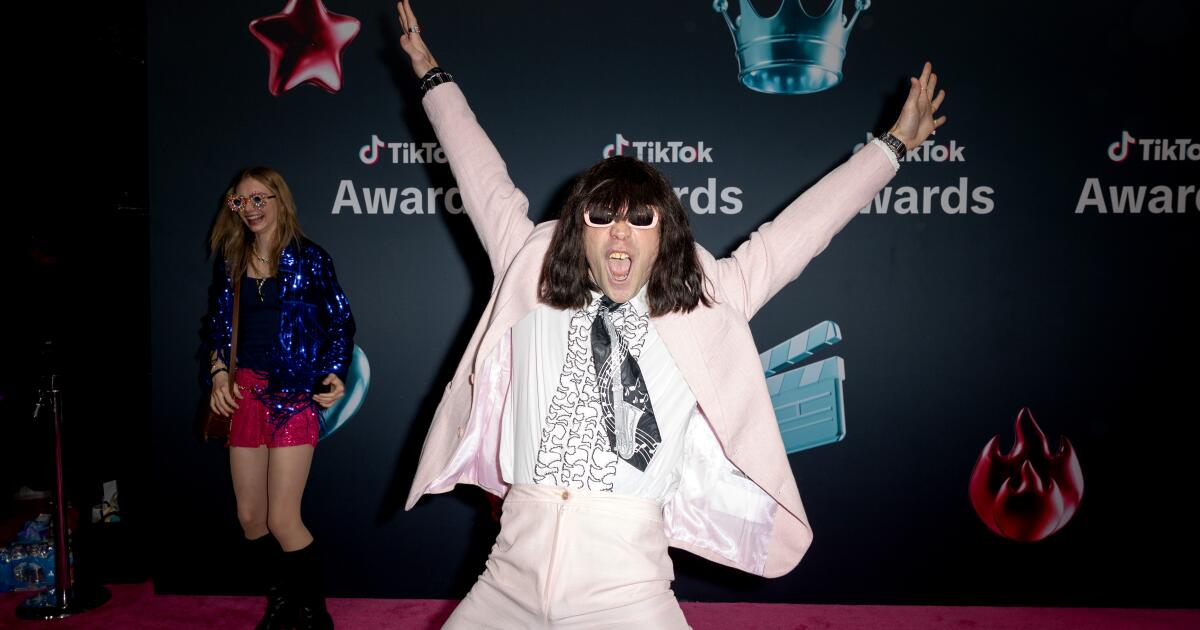
Only a few years ago, Keith Lee was a professional MMA fighter, doing food delivery and making social media videos to ease his social anxiety.
On Thursday night, however, Lee found himself under the glare of bright lights and walking the red carpet outside the historic Hollywood Palladium on Sunset Boulevard about to be recognized as TikTok’s “Creator of the Year.”
He and hundreds of other creators had gathered for TikTok’s first American awards show. And they had good reason to celebrate.
Only a few minutes before the start of the inaugural show, they got word about a deal that would allow TikTok to keep operating in the U.S. through a joint venture controlled by a group of U.S. investors that includes tech giant Oracle Corp. TikTok confirmed the deal in an email to employees and said it is expected to close next month.
“[TikTok] is the best way to reach people and I know so many people who rely on it to support their families,” said Lee, who has 17.3 million followers of his casual restaurant reviews. “For me, it’s my career now so I can’t imagine it not being around.”
Creators — many of whom are based in Southern California — rely on the app as a key source of income, while businesses and brands turn to the platform and its influencers to promote their products.
Many had worried that the app might disappear after the Supreme Court upheld a ban on the platform because of national security concerns raised by President Trump in 2020.
Trump subsequently allowed TikTok, which has offices in Culver City, to keep operating in the U.S. and in September signed an executive order outlining the new joint venture.
Comedy creator Adam W., who attended the awards show, called the news “game changing.”
With 22.6 million followers on TikTok, Adam W. has amassed a massive audience for his videos that parody pop culture trends.
In one, he’s a contestant on “The Bachelor,” surrounded by a line of lookalike blond models; in another, he’s drinking matcha lattes with Will Smith.
“That’s so good to hear,” said Adam W. of the new ownership. “So many people are able to make careers off of TikTok. There’s so many people out there who go to TikTok to get away from their reality and it means a lot to them, so I think it’s really valuable for us to have.”
TikTok said the awards show is intended to celebrate the influencers who’ve helped transform the app into a global force that has shaped the way younger Americans shop and consume entertainment.
“You represent a truly global community of over 1 billion people on TikTok,” Kim Farrell, the app’s global head of creators, said at the event. “This year, you showed the world just how much impact creators have.”
Despite the historic moment, the awards show was not without technical glitches. Screens that were intended to display clips of contestants and visuals during speeches were dark the entire night.
The two-hour show, in which creators received awards in several categories, featured a range of skits parodying TikTok cultural moments, from Jools Lebron telling the crowd to “be demure,” to Rei Ami of K-Pop Demon Hunters shooting a Labubu cannon into the crowd.
“TikTok definitely changed my life,” Lee said in an interview. “I always planned my life around food, so I’m blessed to just turn the camera on and do the same thing.”
The new ownership of TikTok should allow the app to rebound after it lost market share amid uncertainty over its future, said Max Willens, an analyst at EMarketer.
“This past year, because a lot of advertisers weren’t really sure whether TikTok was going to stay or go, it did kind of slow the momentum that we had seen on that platform,” Willens said. “We think that moving forward that is going to wind up just being a blip.”

NEW YORK (OSV News) – “Avatar: Fire and Ash” (20th Century), the third film in the always visually rich franchise that got its start in 2009, brings forward thematic elements that had previously been kept in the background and that viewers of faith will find it impossible to accept and difficult to dismiss. As a result, it requires careful evaluation by mature movie fans.
Against the recurring background of the fictional moon Pandora, the saga of the family whose fortunes were chronicled in the earlier chapters continues. The clan consists of dad Jake Sully (Sam Worthington) and his wife Neytiri (Zoe Saldaña) as well as their three surviving children, teens Lo’ak (Britain Dalton) and Kiri (Sigourney Weaver) and tyke Tuk (Trinity Jo-Li Bliss).
Rounding out the household is Jake and Neytiri’s adolescent adopted son, Spider (Jack Champion).
As veterans of the earlier outings will know, Jake was originally a human and a Marine. But, via an avatar, he eventually embraced the identity of Neytiri’s Pandoran tribe, the Na’vi. While their biological kids are to all appearances Na’vi — a towering race with blue skins and tails — Spider is human and requires a breathing mask to survive on Pandora.
Lo’ak is guilt-ridden over his role in the death of his older brother, Neteyam (Jamie Flatters), and wants to redeem himself by proving his worth as a warrior. Kiri is frustrated that, despite her evident spiritual gifts, she’s unable to connect with Eywa, the mother goddess the Na’vi worship.
For his part, Jake is worried about Spider’s future — Neteyam’s death has left the still-grieving Neytiri with a hatred of the “Sky people,” as Earthlings are known on Pandora. He also has to contend with the ongoing threat posed by his potentially deadly rivalry with his former Marine comrade, Col. Miles Quaritch (Stephen Lang), who is also Spider’s estranged father.
As if all that weren’t enough, a further challenge arises when the Metkayina, the sea-oriented Pandorans with whom Jake et al. have taken refuge, are attacked by the fierce fire-centric Mangkwan, led by Varang (Oona Chaplin), a malevolent sorceress. A three hour-plus running time is required to tie up these varied strands.
Along the way, the religion adhered to by the main characters becomes more prominent than in previous installments. Thus Eywa is both present on screen and active in the plot. Additionally, Kiri is revealed to have been the product of a virginal conception.
Director and co-writer (with Rick Jaffa and Amanda Silver) James Cameron’s extension of his blockbuster series, accordingly, not only includes material uncomfortable at best for Christians but also seems incongruent, overall, with monotheistic belief. Even well-catechized grown-ups, therefore, should approach this sprawling addition to Cameron’s epic with caution.
The film contains nonscriptural beliefs and practices, constant stylized but often intense combat violence with brief gore, scenes of torture, narcotics use, partial nudity, a couple of mild oaths, at least one rough term, numerous crude and a handful of crass expressions and an obscene gesture. The OSV News classification is L — limited adult audience, films whose problematic content many adults would find troubling. The Motion Picture Association rating is PG-13 — parents strongly cautioned. Some material may be inappropriate for children under 13.
Read More Movie & TV Reviews
Copyright © 2025 OSV News
Entertainment
‘It was by the kids, for the kids’: Chain Reaction’s former booker reflects on the O.C. club’s legacy

My name is Jon Halperin. I booked and managed Chain Reaction from 2000 to 2006. It started by accident while I was running a one-person record label. I went to the club to see the band Melee perform and the prior talent buyer for the club had just quit that day. I told owner Tim Hill I’d do it (having only booked three shows ever at a coffee shop). We slept on it, and I was hired the next day.
I joined Ron Martinez (of Final Conflict). He was booking the punk and hardcore shows. I booked the indie, ska, emo, screamo and pop punk stuff. We made a great team. Best work-wife ever.
Story time. My friend Ikey Owens (RIP) hit me up and told me that he and the guys from At the Drive In were going to be starting a new band. I’d booked Defacto (their dub project) before, and we agreed to throw them on a show and just bill it as “Defacto.” There were maybe 200 people there to see the first show for a band that would soon be known as the Mars Volta.
That wasn’t out of the ordinary. Chain Reaction had many artists grace that stage that went on to bigger things: Death Cab for Cutie, Avenged Sevenfold, Maroon 5, Fall Out Boy, Panic at the Disco, Taking Back Sunday, Pierce the Veil, My Morning Jacket. The list goes on and on.
Jon Halperin, who booked Chain Reaction from 2000 to 2006, stands in front of the club during its heyday.
(From Jon Halperin)
I used to make a deal with the kids. Buy a ticket to “X” show, and if you didn’t like the band, I’d refund you. I never had to. I knew my audience and they trusted my curation of the room. … It was by the kids, for the kids, except I was 30 at the time. I had to think like a teenager. My friend Brian once called me “Peter Pan.”
Halfway through my reign, social media became a thing. There was Friendster and a bit later MySpace. YouTube stated just a few years after. But those first few years of me at the venue, it was word of mouth. It was paper fliers dropped off at coffee shops and record stores. It was the flier in the venue window. It was Mean Street Magazine and Skratch Magazine.
I’d tease the press when they wanted to review a show. If you don’t show up with a pen and paper, you aren’t getting in (sorry, Kelli).
Most music industry went to the Los Angeles show, but smart industry came to us. Countless acts got signed following their shows. You’d often see the band meeting with a label in the parking lot near their tour van.
It was a dry room when I was there. No booze or weed whatsoever. We made only one exception to the weed rule. An artist in a band with Crohn’s disease who traveled with a nurse. Not saying bands didn’t drink backstage, on stage, in their vans (we rarely had buses), but what we didn’t see didn’t happen.

Touche Amoré performing at Chain Reaction in 2010.
(Joe Calixto)
We were often referred to as the “CBGB’s of the West,” and for a lot of bands, locals and touring acts alike, we were just that. We were the epicenter. There were other venues of course, but for some reason, we were the venue to play. Showcase Theater in Corona was edging toward its demise. Koo’s Cafe in Santa Ana was done. Back Alley in Fullerton wasn’t active. Galaxy Theater [in Santa Ana] was still, well, the Galaxy. There was no House of Blues Anaheim. Bands would drive a thousand miles to play one show at Chain Reaction. We were where the local bands started as first of four on a bill and would be headlining us within a year. We were their jumping-off point. We were where the kids came out. The real fans, many of whom started bands themselves.
Thankfully, there are other smaller venues out there today fostering the all-ages scene: Programme Skate in Fullerton, the Locker Room at Garden AMP [in Garden Grove], Toxic Toast in Long Beach, the Haven Pomona, but it’s just not the same. It was a moment in time. A time that will be forgotten in a few decades, but for today, my social media is being inundated with memories of a room that was a second home for thousands of kids.
Zero regrets. It was the best and worst times of my life. Working a day gig and then heading to the venue nearly every day of the week was rough. Relationships and friendships were hard, being that I couldn’t go out at night. I couldn’t get a pet. I was constantly tired. But I wouldn’t trade those six years for the world.
RIP, Chain Reaction.

Top 10 performers from Georgia high school football state championships

Preserving native habitat, cultural legacy of Maunawili Valley

Idaho man dies after getting thrown from vehicle – East Idaho News

I’m grateful for Illinois legalizing physician-assisted suicide | Letter

Indiana Pacers have a few trade candidates

Florida High School Football Rankings: Top 25 teams – Oct. 21

Cleary's 21 help Le Moyne down Central Connecticut State 69-64 in OT

How old is Bo Nix? What to know about Oregon quarterback ahead of 2024 NFL Draft

99th annual Pony Swim held in Virginia

Video: ‘It Didn’t Have to Happen This Way:’ U.Va. Faculty Call for Review of Police Response to Protests

Sen Murphy warns ‘people are going to die’ as Congress punts on expiring Obamacare subsidies

Ex-Pakistan PM Imran Khan, wife sentenced to 17 years in corruption case

U.S. launches strikes in Syria targeting Islamic State fighters after American deaths

Trump administration touts ‘most secure border in history’ as 2.5 million migrants exit US

How the reparations loan for Ukraine fell apart at the eleventh hour
-

 Iowa6 days ago
Addy Brown motivated to step up in Audi Crooks’ absence vs. UNI
-

 Iowa1 week ago
How much snow did Iowa get? See Iowa’s latest snowfall totals
-

 Maine4 days ago
Elementary-aged student killed in school bus crash in southern Maine
-

 Maryland6 days ago
Frigid temperatures to start the week in Maryland
-

 Technology1 week ago
The Game Awards are losing their luster
-

 South Dakota6 days ago
Nature: Snow in South Dakota
-

 New Mexico4 days ago
Family clarifies why they believe missing New Mexico man is dead
-

 Nebraska1 week ago
Nebraska lands commitment from DL Jayden Travers adding to early Top 5 recruiting class