Entertainment
Dodgers return to World Series. COVID masks are out. Mister Cartoon clown masks are in

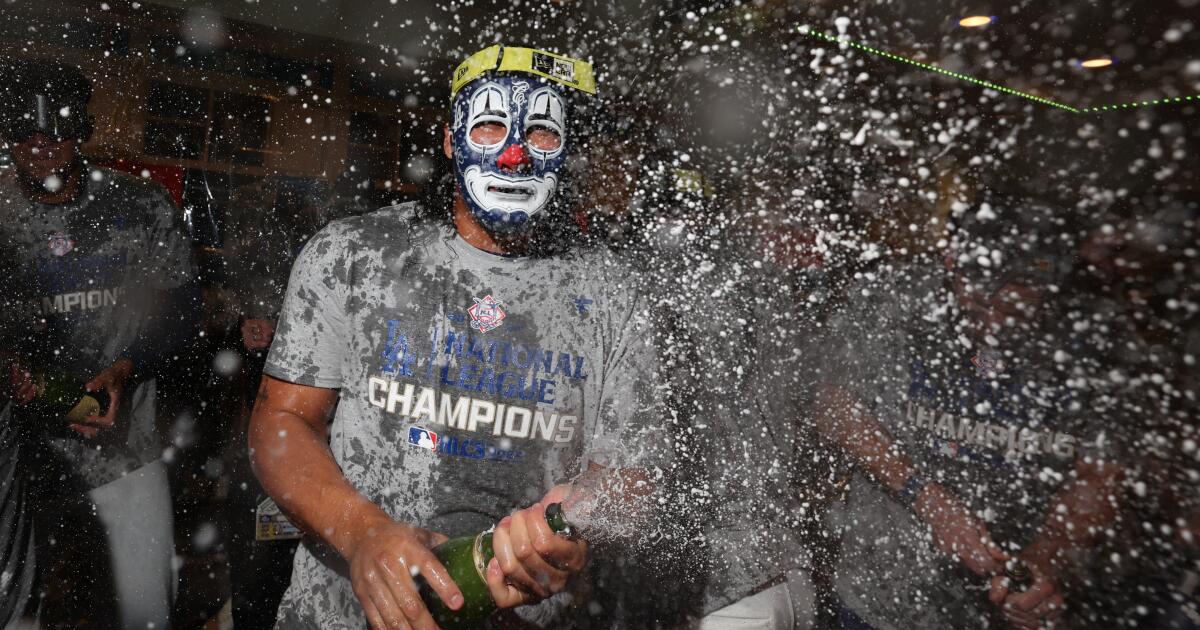
The artwork of Mister Cartoon can be seen pretty much everywhere — tattooed on celebrities, exhibited in art galleries, airbrushed on cars, painted on public walls and printed on team jerseys.
Still, the 60-year-old San Pedro native, whose real name is Mark Machado, didn’t expect to see his work covering the faces of some Dodgers players as they celebrated the team’s World Series berth in the clubhouse Sunday night.
“At first I thought I was seeing things, then I was like man that’s crazy,” Cartoon told The Times on Monday in an email. “I was watching live with my family and started to get a gang of calls and texts right when it was going down.”
The Chicano artist probably wasn’t the only person who thought he was seeing things. Millions of viewers likely weren’t expecting to see men in Dodgers-themed clown masks taking part in the wild, champagne- and beer-soaked festivities following the team’s National League Championship Series-clinching 10-5 win over the New York Mets.
But that’s how some players — including relief pitchers Anthony Banda, Alex Vesia and Brusdar Graterol — chose to mark the occasion. And Cartoon couldn’t be more thrilled, following the launch of his MLB clown mask collection earlier this month.
“A few of the fellas in the bullpen reached out during the series,” Cartoon said. “They had seen the mask on social media and loved it, so my team sent a bunch over. I had no idea they would end up part of the celebration!”
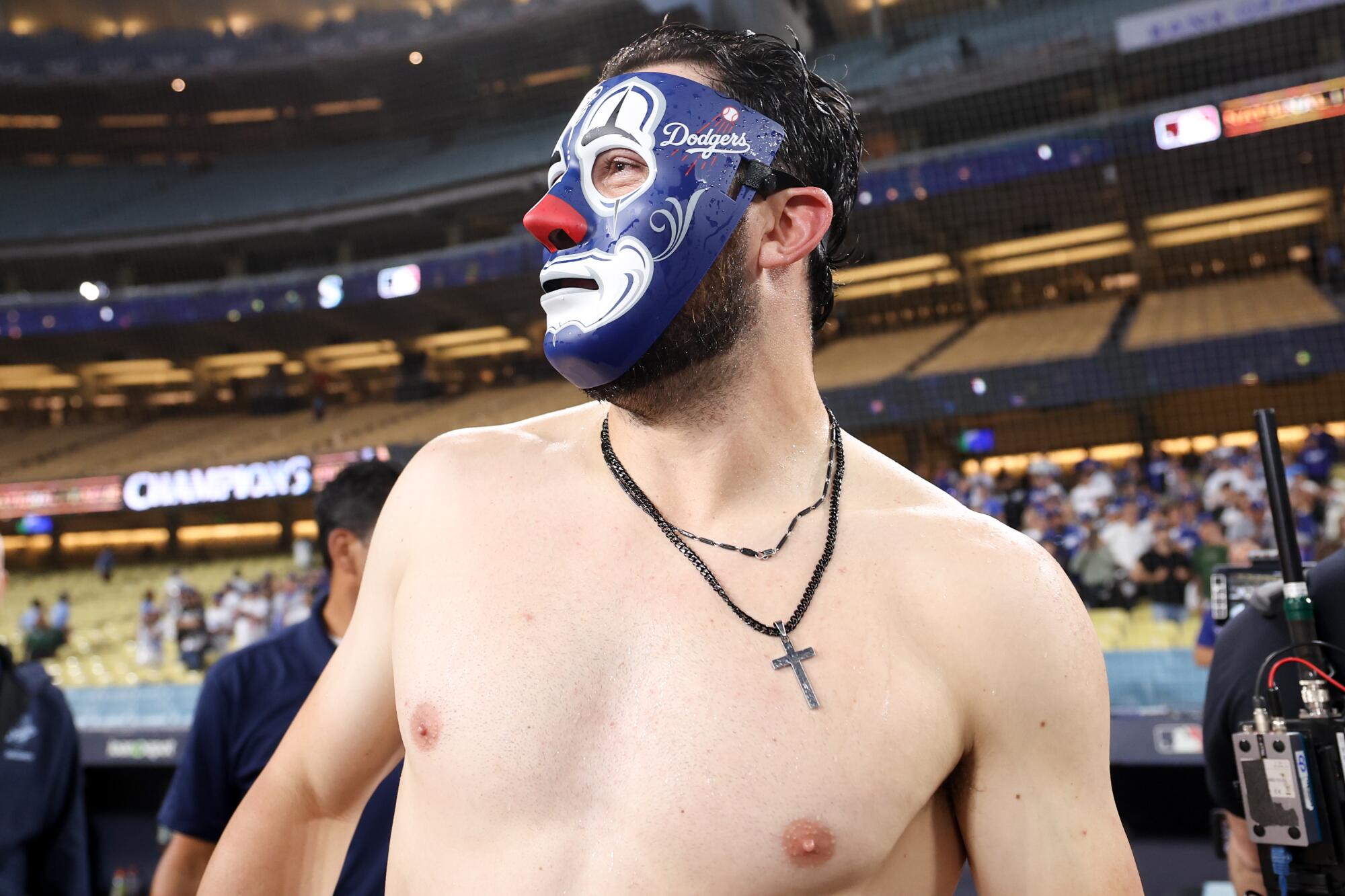
Dodgers reliever Alex Vesia wears a Mister Cartoon clown mask while celebrating the team’s 10-5 win over the Mets in Game 6 of the National League Championship Series at Dodger Stadium on Sunday.
(Wally Skalij / Los Angeles Times)
Selling for $95 each, the masks come with a removable strap for wearing and a wall mount for displaying. They are officially licensed by Major League Baseball and are available featuring the logo and colors for 21 of the league’s 30 teams, including a pinstripe pattern for the Dodgers’ World Series opponent, the New York Yankees.
The overall look is signature Mister Cartoon.
“The design is inspired by the icon I put in almost all my art, ‘the Clown,’ which I have been drawing since [I was] a kid,” Cartoon said. “Really inspired by many aspects of my life and culture, from the Soul music era of the ’60s, when ‘The Tears of a Clown’ aired on the radio and classic Chevrolet Impalas were brand new. I wanted to create a piece of art you can wear, hang and collect.”
The first time many people saw Cartoon’s mask design was after Game 6 of the NLCS, as Dodgers manager Dave Roberts was addressing his team in the clubhouse. Standing among the players — and in clear view of the Fox Sports cameras — was a shirtless, heavily tattooed clown, holding a champagne bottle in each hand.
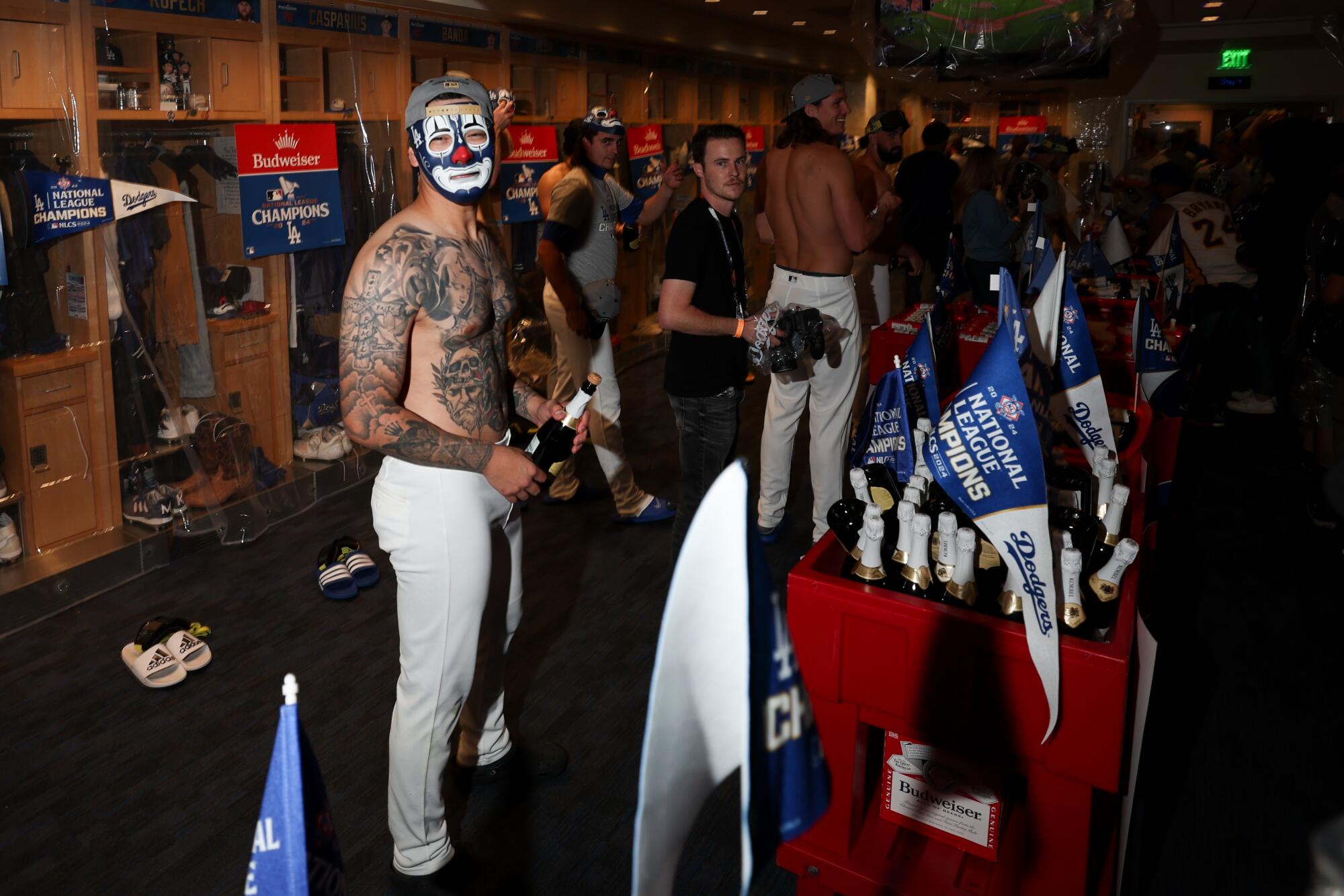
Relief pitcher Anthony Banda wears a Mister Cartoon clown mask as he waits to celebrate the Dodgers’ 10-5 win over the New York Mets.
(Robert Gauthier / Los Angeles Times)
That turned out to be Banda, who gave up one run and one hit, struck out two and walked one during 1 1/3 innings during the Dodgers’ 10-5 win. Asked if he had inked any of Banda’s tattoos, Cartoon responded: “I did not. He has clean work, but he needs to save some space for me.”
The Dodgers are back in the World Series for the first time since winning it in the COVID-19-shortened 2020 season. Instead of the protective masks that were ubiquitous during that period, perhaps clown masks will be the accessory of choice this time around.
Cartoon said the exposure has definitely been good for business.
“It’s been wild since last night, with overwhelming support,” he said. “People have been ordering and collecting.”
But, Cartoon added, it means much more than dollars and cents to him.
“I have been a Dodger fan my whole life,” he said. “This project was years in the making to get it to this point. And for it to launch right as the Dodgers make it into the World Series and have the players that fight so hard every day for the sport and the fans make it a part of the celebration, it’s a real honor, an amazing feeling for me, the art, the culture and my family.”



Despite its ubiquity in our machines and in the news, artificial intelligence remains both a mystery and a source of deep anxiety across occupations and generations. My students, my readers, my colleagues and kids: We are all bewildered by the mix of hype and hope, optimism and doomerism making up the discourse around AI. On the one hand, the quest for artificial general intelligence (AGI) and a utopian belief in the life-improving promise of these emergent technologies; on the other, new algorithmic forms of injustice, the displacement of whole work forces and the limitless sloppification of language, music, video and other aesthetic forms — to say nothing of the threat of human extinction.
The 11 books described below, all published recently, give us helpful sight lines into our turbulent AI age. Some titles are hard-hitting trade nonfiction. One is an academic critique. Others are novels, fictional accounts that imagine how our world is being reshaped (and will be further transformed) by the many technologies grouped under the term artificial intelligence: deepfakes and autonomous drones, AI-enhanced medical scans and self-driving cars.
What all these books have in common is their awareness that AI is transforming our world in ways all too easy to imagine yet nearly impossible to predict.
“Vantage Point: A Novel” by Sara Sligar
(MCD)
“Vantage Point”
By Sara Sligar
MCD: 400 pages, $29
This twisty and brilliantly written thriller about a Maine family spins a tale of ambition, trauma and privilege around the proliferation of so-called deepfakes. Those AI-generated videos play an increasing role in the spread of slanderous accusations and political disinformation in today’s public sphere. Whether the footage at the center of the plot is real or computer-generated is one of the burning questions at the heart of the novel, which plumbs the nature of reality in our age of digital disinformation and virtual selves.

“The Worlds I See: Curiosity, Exploration, and Discovery at the Dawn of AI” by Dr. Fei-Fei Li
(Flatiron Books: A Moment of Lift)
“The Worlds I See: Curiosity, Exploration, and Discovery at the Dawn of AI”
By Fei-Fei Li
Flatiron: 336 pages, $20
Though it’s been out for two years already, Li’s account of the early years of computer vision and deep learning is a refreshing break from the LLM-centric discourse dominating many discussions of AI. Li shows us the broader computational context of AI’s emergence, explaining key concepts and breakthroughs in vivid, comprehensible detail. “The Worlds I See” is also a scientific autobiography, a compelling account of Li’s personal and intellectual journey from the impoverished circumstances of a Chinese immigrant family life to a wealthy and world-leading university lab.

“Death of the Author: A Novel” by Nnedi Okorafor
(William Morrow)
“Death of the Author”
By Nnedi Okorafor
William Morrow: 448 pages, $30
“Rusted Robots” is the title of the AI-themed novel-within-a-novel that Zelu, Okorafor’s MFA-wielding protagonist, writes in the wake of a creative and professional calamity. As we encounter excerpts from the book — an Africanfuturist (Okorafor’s preferred term) narrative set in a postapocalyptic West Africa — we learn how the novel achieves phenomenal sales and success that eluded Zelu when she was writing literary fiction, even as Okorafor explores the perils of fame and new fortune. The result is a powerful meditation on the roles of disability, autonomy and privilege in the shaping of literary making in an age when art itself is increasingly threatened by machines.

“Searches: Selfhood in the Digital Age” by Vauhini Vara
(Pantheon)
“Searches: Selfhood in the Digital Age”
By Vauhini Vara
Pantheon: 352 pages, $30
Vara’s moving account of her uncanny exchanges with a chatbot about her sister’s death became a viral sensation after it appeared in the Believer in 2021, at the dawn of our LLM-obsessed age. In a series of further essays, reflections and fragments, Vara — a Pulitzer Prize finalist for her novel “The Immortal King Rao” as well as a former technology reporter for the Wall Street Journal — investigates the role of digital technologies in making us who we are, and may want to become. The book bristles with insight and originality, interspersing Vara’s more journalistic expositions with excurses and fragments curated from the author’s expansive digital life.

“Notes on Infinity: A Novel” by Austin Taylor
(Celadon)
“Notes on Infinity: A Novel”
By Austin E. Taylor
Celadon: 400 pages, $30
Though Taylor’s absorbing debut swings more biotech than AI, the novel beautifully captures the extreme techno-optimism of the multibillionaire set — in this case around the possibility of eternal human life. As Zoe, one of the protagonists, notes early on, her interest in a particular professor’s work stems from his success in “using AI neural networks to understand biological neural networks and the processes of thinking.” “Notes on Infinity” combines the traditional campus novel with the zeitgeisty tech novel, featuring Harvard students with “edge” placing “bets on the next Zuck in the dining halls.”

“Ideal Subjects: The Abstract People of AI” by Olga Goriunova
(Minnesota)
“Ideal Subjects: The Abstract People of AI”
By Olga Goriunova
Minnesota: 232 pages, $32
This deeply researched study examines how AI systems create “abstract people”: statistical confections, subject profiles and anthropomorphic personages that increasingly substitute for humans in digital environments. Goriunova, a cultural theorist and digital curator based in London, examines how these constructed figures and abstractions shape surveillance, governance and everyday life. What is a “digital person,” and why should we care? Goriunova’s answers prove as complex as they are fascinating.

“Annie Bot” by Sierra Greer
(Mariner)
“Annie Bot”
By Sierra Greer
Mariner: 240 pages, $19
The success of the two “M3gan” films suggests a never-ending fascination with human-like cyborgs — though in the case of “Annie Bot,” this fascination is laced with a prurient eroticism that Greer both exploits and cleverly frustrates in her insightful debut. Annie is a sexbot companion operating in autodidactic mode, learning her owner’s sexual proclivities in much the same way AlphaGo perfected the ancient game of Go. At the heart of novel, though, is a thoughtful and darkly humorous meditation on the politics of AI personhood and subjection comparable to Kazuo Ishiguro’s project in “Klara and the Sun,” and with equally harrowing implications.

“Empire of AI: Dreams and Nightmares in Sam Altman’s OpenAI” by Karen Hao
(Penguin Press)
“Empire of AI: Dreams and Nightmares in Sam Altman’s OpenAI”
By Karen Hao
Penguin Press: 496 pages, $32
Hao’s bestselling account of OpenAI and its neoimperial ambitions has received lots of coverage, though it deserves an even wider readership. Formerly an application engineer at a Google spinoff, Hao writes with an insider’s knowledge about the relationship between technological innovation and socioeconomic inequality around the world, from resource-guzzling data centers in Chile to ego-filled executive suites in San Francisco. Full of industry anecdotes and sobering analyses, the book is a riveting introduction to the corporate culture of artificial intelligence and its designs on all of us.

“Who Knows You by Heart: A Novel” by C.J. Farley
(William Morrow)
“Who Knows You by Heart”
By C. J. Farley
William Morrow: 288 pages, $30
Algorithmic bias and injustice are at the heart of this ingenious novel of technological innovation and corporate malfeasance. Farley’s protagonist is Octavia Crenshaw, a down-on-her-luck coder recently hired by Eustachian, an audio entertainment company exploiting new ways to bring stories to the world. After a series of mishaps and disturbing incidents at the company, Octavia teams up with another coder named Walcott to develop a bias-free AI storytelling model — only to discover the limits of her computational and political ideals. The novel is a riveting critique of Big Tech and its faux-liberal aspirations to correct the world’s wrongs.

“If Anyone Builds It, Everyone Dies: Why Superhuman AI Would Kill Us All” by Eliezer Yudkowsky and Nate Soares
(Little, Brown and Company)
“If Anyone Builds It, Everyone Dies: Why Superhuman AI Would Kill Us All”
By Eliezer Yudkowsky and Nate Soares
Little, Brown: 272 pages, $30
Earning its apocalyptic title, this doomerist manifesto by two of the leading figures in the tech world appears in an era saturated with reckless optimism and hype. The book provides a sobering look at issues such as potential misalignments between human designers and the AI systems they release into the world, systems with goals of their own that we may not understand in time to thwart their most catastrophic outcomes. The main message: Be afraid. Be very afraid. The book offers a glimmer of hope as well, albeit a faint one, and concludes with some plainspoken recommendations about proceeding with extreme caution and slowing down.

“UnWorld: A Novel” by Jason Greene
(Knopf)
“UnWorld”
By Jayson Greene
Knopf: 224 pages, $28
This deeply moving novel explores the aftermath of loss and the shape of grief in an age of avatars and algorithmically mediated emotion. When a teenager named Alex dies of mysterious causes, part of the burden of mourning falls on Aviva, an upload virtually confected out of pain. By imagining technologies that can shoulder our memories, our labor and our most shattering emotions, Greene questions whether AI risks nurturing a fantasy that code can heal what hurts in our inner lives. A timely meditation on AI’s allure as an escape hatch from the strain of modern consciousness, the novel quietly insists that any lasting tranquility must still be cultivated from within and shared between humans, with all our flaws.
Holsinger’s most recent novel is “Culpability,” an Oprah’s Book Club pick for summer 2025.


James Ransone, a character actor who played an impulsive, drug-dealing dockworker in the iconic HBO series “The Wire” and later appeared in horror films “Sinister” and “It: Chapter Two,” died in Los Angeles on Friday. He was 46.
According to the L.A. County medical examiner’s office, Ransone died by suicide.
A native of Maryland, Ransone studied theater at the Carver Center for Arts and Technology in the Baltimore County community of Towson, before breaking into television a few years later.
Ransone appeared in several prominent horror films. He portrayed Max in “The Black Phone,” a film about a teen boy who is abducted by a serial killer. The movie was based on a short story written by Joe Hill — Stephen King’s son — and starred Ethan Hawke. Ransone reprised his role in the sequel, “Black Phone II.”
Ransone appeared in another horror film with Hawke, taking on the role of Deputy in “Sinister.” The movie centers around a writer who finds snuff films in his new house. Ransone also acted alongside Bill Hader, Jessica Chastain and Bill Skarsgård in the follow-up “It: Chapter Two,” playing Eddie Kaspbrak, one of several characters being tormented by killer clown Pennywise.
While promoting the film, he defended the horror genre against those who consider it a “throwaway” category.
“To those people I’ll say, ‘Tell that to William Friedkin or Stanley Kubrick,’” Ransone said in an interview with Anthem Magazine.
He also had roles in the shows “Generation Kill,” “Treme” and “Bosch.” His final TV appearance came in the a second-season episode of Peacock’s comedy crime show “Poker Face,” which aired in June.
But he will likely be remembered most for his turn as Ziggy Sobotka in “The Wire,” a dark and uncompromising drama — hailed as one of the best TV shows of all time — that explored various aspects of Baltimore and its institutions. Ransone appeared in all 12 episodes of the show’s second season, which focused on the decimation of the city’s docks.
He played the son of a dock union leader, whose scheming charisma got him into trouble with other low-level criminals — but also endeared him to some viewers. In one notable story arc, he bought a duck, which he paraded around with a diamond necklace; the bird later died because he fed it too much alcohol.
The critically acclaimed HBO series aired from 2002 to 2008 and starred Dominic West, Michael Kenneth Williams, John Doman, Idris Elba, Wood Harris, Lance Reddick, Wendell Pierce, Frankie Faison, Lawrence Gilliard Jr. and more.
In a statement released to the Baltimore Banner news site, “Wire” creator David Simon called Ransone’s death “grievous and awful.”
“He committed not only to the work but to the camaraderie that turns every good film production into something familial and caring,” said the statement by Simon, who also cast Ransone in “Generation Kill” and “Treme.”
In an interview on MSNBC after the release of the movie “Sinister 2,” Ransone said he was proud of the work he had done on “The Wire” but called it a “real double-edged sword” in that people would forever typecast him as Ziggy. He described himself as a horror film fan and spoke of how working with filmmakers such as Simon, Sean Baker and Spike Lee had opened his eyes to many social inequities.
It wasn’t immediately clear whether Ransone was living in L.A. at the time of his death. A man with his name is listed on the California secretary of state’s website as living in the Fairfax neighborhood.
LAPD spokesperson Officer Norma Eisenman said that around 2 p.m. Friday a police squad responded to a 911 call about an undetermined death at that location. Inside, she said, officers found a man who appeared to have taken his own life.
Because foul play isn’t suspected, the case is being handled by the medical examiner’s office, Eisenman said, adding that she could not confirm that the man was Ransone or provide other details about the 911 call.
TMZ reported that Ransone was a married father of two, and wife Jamie McPhee posted a fundraiser for the National Alliance on Mental Illness in her social media profile.
In recent years, Ransone came out as a sexual abuse survivor and also spoke openly about his struggles with addiction.
In 2016, he told Interview Magazine that he had gotten sober at age 27 “after being on heroin for five years.”
“People think I got sober working on the ‘Generation Kill.’ I didn’t. I sobered up six or seven months before that,” he told the publication. “I remember going to Africa and I was going to be there for almost a year. I was number two on the call sheet and I was like, ‘I think somebody made a mistake. This is too much responsibility for me.’”
Ransone in 2021 disclosed that he had been sexually abused by a former tutor at his childhood home in Phoenix, Md. over a six-month span in 1992, according to the Baltimore Banner. He revealed the allegations on Instagram, where he shared a lengthy note that he had sent his alleged abuser, the Banner reported. A police investigation was later launched into the allegations but closed without charges being filed.
Suicide prevention and crisis counseling resources
If you or someone you know is struggling with suicidal thoughts, seek help from a professional and call 9-8-8. The United States’ first nationwide three-digit mental health crisis hotline 988 will connect callers with trained mental health counselors. Text “HOME” to 741741 in the U.S. and Canada to reach the Crisis Text Line.
Scared of AI? 11 essential books for navigating our new normal

Best of L.A. home design: The 14 most memorable rooms of 2025

CBS News correspondent accuses Bari Weiss of ‘political’ move in pulling ‘60 Minutes’ piece

Palisades starts out as City Section basketball favorite in top 10 rankings

Germany charges ex-Syrian prison guard over Assad-era abuses

Florida High School Football Rankings: Top 25 teams – Oct. 21

Cleary's 21 help Le Moyne down Central Connecticut State 69-64 in OT

How old is Bo Nix? What to know about Oregon quarterback ahead of 2024 NFL Draft

99th annual Pony Swim held in Virginia

Video: ‘It Didn’t Have to Happen This Way:’ U.Va. Faculty Call for Review of Police Response to Protests
Germany charges ex-Syrian prison guard over Assad-era abuses

Weather tracker: Further flood watches issued across California

DHS responds after reports CISA chief allegedly failed polygraph for classified intel access

EU plans to raise €90 billion in joint debt for Ukraine — here’s how

Lawmakers threaten Attorney General Bondi with contempt over incomplete Epstein files
-

 Iowa1 week ago
Addy Brown motivated to step up in Audi Crooks’ absence vs. UNI
-

 Iowa1 week ago
How much snow did Iowa get? See Iowa’s latest snowfall totals
-

 Maine6 days ago
Elementary-aged student killed in school bus crash in southern Maine
-

 Maryland1 week ago
Frigid temperatures to start the week in Maryland
-

 South Dakota1 week ago
Nature: Snow in South Dakota
-

 New Mexico5 days ago
Family clarifies why they believe missing New Mexico man is dead
-

 Detroit, MI7 days ago
‘Love being a pedo’: Metro Detroit doctor, attorney, therapist accused in web of child porn chats
-

 Maine5 days ago
Family in Maine host food pantry for deer | Hand Off