Entertainment
Diiv is a shoegaze band to believe in


Two days before they’re due to play the first date of a headlining theater tour, the members of the rock band Diiv are sitting around a picnic table in the parking lot of a Burbank rehearsal studio, reminiscing about the arena shows they opened last fall for Depeche Mode.
They talk about the glittery jackets frontman Dave Gahan wore onstage (only to slip them off after a few minutes) and the moves he’d bust every night on a catwalk; they talk about the confidence they developed by playing in front of thousands of people who hadn’t turned up to see Diiv (but who were open to being won over by the right performance).
Also: They talk about catering. “Man, I miss that,” guitarist Andrew Bailey says as though lost in a memory of endless chafing dishes.
Diiv is going without many of the borrowed perks of A-list rock stardom on the road behind its latest album, “Frog in Boiling Water.” After launching in early June, the tour stops at the Wiltern in Los Angeles — Diiv’s hometown, more or less, since three of the four members moved here from New York a few years ago — on Saturday night.
Yet the musicians, all in their mid to late 30s, seem no less eager to be out playing their new songs; indeed, they say the music reflects the fact that “we’ve committed our lives to this band,” as bassist Colin Caulfield puts it, even minus the kind of “long-term infrastructure” that might appeal to people their age. Adds Caulfield, wryly: “No one’s matching our 401(k).”
Diiv’s determination is warranted. Easily the most impressive of the group’s four LPs, “Frog in Boiling Water” is probably also the best rock record released so far this year: a dense and luxurious set of hooky post-shoegaze guitar jams that evokes a dream-pop Nirvana. With their layers of fuzz and their trippy yet propulsive grooves, songs like “Brown Paper Bag” and “Raining on Your Pillow” fit easily into the shoegaze revival that’s taken off lately on TikTok and introduced bands from the 1980s and ’90s such as My Bloody Valentine and Slowdive — noisy but sensitive types known for staring down at their effects pedals — to a new generation of young fans. Yet Diiv pairs those immersive textures with songwriting much sturdier than what you’ll find on, say, Spotify’s popular Shoegaze Now playlist.
“When it comes to music in this genre, there’s a lot of trying to emulate what’s come before,” says Jasamine White-Gluz of the Montreal band No Joy, which has toured with Diiv. “So you’re kind of just doing a ‘Loveless’ or doing a ‘Souvlaki’ — trying to fit in the box of what shoegaze is,” she adds, referring to the seminal albums by MBV and Slowdive, respectively. “Diiv doesn’t do that — they’ve got their own sound. They’re in the box but they’re making the box bigger.”
Part of what distinguishes “Frog in Boiling Water” is the political thrust of singer Zachary Cole Smith’s lyrics, which ponder the brutality of late-stage capitalism and the deceptions of the military-industrial complex — ideas he says he was drawn to after he and his wife brought their first child into the world about a year ago. (That his words about “rotating villains profit[ing] off suffering” are intelligible at all represents something of a break from a lot of shoegaze music, in which vocals serve as just one more instrumental component.)
“I think the record has a sense of hope,” Smith says, “despite all the evidence that we’re heading toward total f—ing collapse.”
Optimistic or not, the album’s focus on the outside world represents Smith’s effort to move beyond the personal demons that long defined Diiv. In 2013, Smith was arrested in New York with his then-girlfriend, singer Sky Ferreira, for possession of heroin; he exhaustively detailed his experiences with addiction and recovery on Diiv’s 2016 “Is the Is Are” and 2019 “Deceiver.” Of the latter, Smith says his hope was that it “took the trash out a little bit, so that now we can talk about other things in our music.”
Yet a recent review of “Frog in Boiling Water” in Pitchfork made him wonder if he’s attained that leeway. In a thread on X that went indie-rock viral, Smith wrote about seeing his music “met with an unwillingness to accept me as the person I’ve worked so diligently the last eight years to become”; he also lamented that his bandmates — Diiv’s fourth member is drummer Ben Newman — are “still at the mercy of a public tendency to root discussion of our band around a past that they personally suffered from as well.” (The review, which was positive, opened with a mention of Smith’s arrest.)
“These events in my life, I don’t get to decide when people stop talking about them,” Smith acknowledges in Burbank. “But not including the rest of the story or where it led me, I think that’s a damaging mind-set for people in sobriety. It makes me sad to think about somebody who’s experiencing addiction seeing that and being like, ‘Damn, I’m just always going to be this destructive force,’” he says. “People can change — profoundly.”
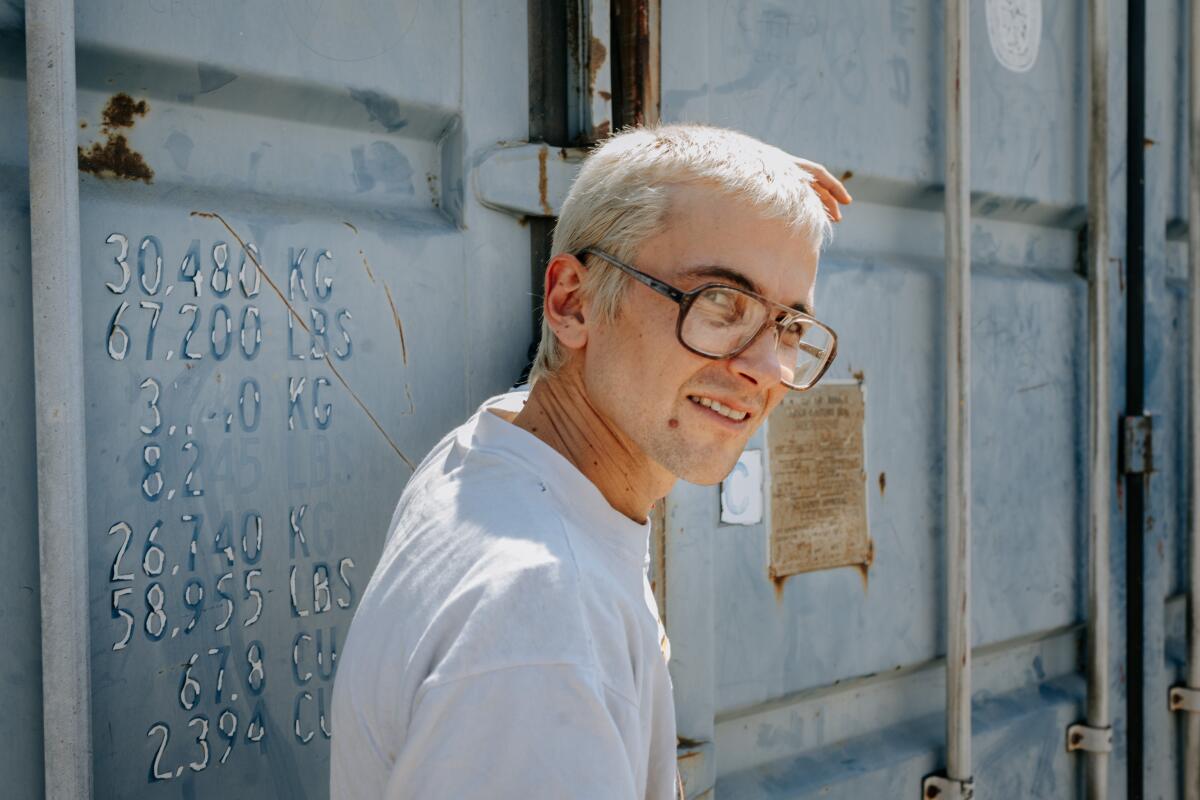
Zachary Cole Smith of Diiv
(Jason Armond / Los Angeles Times)
One effect of Smith’s change is a democratizing of Diiv’s creative process. During the band’s early days, the music was unquestionably a product of Smith’s vision, a situation he looks back at with complicated feelings: “In my active addiction I was selfish and ego-driven in a really unsustainable way,” he admits; recovery led him to “want to retreat from a leadership role” and invite more participation from his bandmates à la Sonic Youth, to name one touchstone act with more than one person in a controlling role.
“I think that choice to open it up to being everyone’s band is what made the record great,” says Chris Coady, who produced “Frog in Boiling Water” and who’s known for his work with TV on the Radio and the Yeah Yeah Yeahs. “As a producer, it was a bit of a nightmare,” he adds with a laugh, explaining that getting everyone to agree on every decision meant that the sessions at his studio in northeast L.A. weren’t brief. “But all four of them are good at all kinds of stuff, and this allowed them to come together in such a cool way.”
That shared investment in Diiv — and in the belief that together they’ve hit a new artistic peak with “Frog in Boiling Water” — has buoyed the band’s members after a long stretch of turmoil, even at a moment when making a living as a musician feels more precarious to many than it has in decades.
“All our eggs are in this basket,” Smith says as he heads back into rehearsal. “It’s scary — and thrilling.”

Movie Reviews
‘Night Nurse’ Review: A Caretaker Explores Her Kink for Elder Abuse in the Year’s Strangest Erotic Thriller

There are any number of erotic thrillers in which rich old men are robbed blind and/or left for dead, but Georgia Bernstein’s admirably bizarre “Night Nurse” might be the first movie of its kind where elder abuse is the source — and possible subject— of its erotic thrills. If there are others, I’m not sure I want to know.
But this woozy debut feature doesn’t rely on its audience being turned on by the relationship between a nubile caretaker and her dementia-addled patient. Their psychosexual bond, meanwhile, hinges on cold-calling vulnerable old people under the guise of a grandchild in financial distress. (“I’m in trouble, nana, send me $10,000 or I’ll be left to rot in jail!” That sort of thing). With its slim wisp of a premise stretched into a Strickland-esque dreamscape that substitutes kink for conflict, the film itself hardly seems convinced by its own wrinkled lust — all desperate kisses and non-touching poses of subservience. More important to Bernstein is what that lust reveals about her characters’ deepest needs, specifically how their need to care and be cared for can be as easily perverted as any other form of desire.

As moody and weightless as the noir-accented score that blows through the movie like a curlicue gust of wind in an old cartoon (credit to musicians Sam Clapp and Steven Jackson), “Night Nurse” lacks the pulse required for its stray feelings to come alive. Still, the film ambiently taps into the latent eroticism of teasing out the distance between how you see yourself and who you really are. Bernstein plays with that distance like a telephone cord wrapped around her fingers, and Eleni — played by the excellent newcomer Cemre Paksoy, powerfully helpless — only frays even more as the receiver is brought near the hook. “Everything I did before today wasn’t me,” the nurse tells co-worker Mona (Eleonore Hendricks) after starting a new job at an Illinois retirement home. “It was somebody else.”
What she did before today remains unexplored (specifically, what she did to get herself fired from her last gig), but I’m guessing she’s probably changed less than she thought. There’s a faraway flicker in her eyes the moment she catches the vibe between Mona and Douglas (a ribald and elusive Bruce McKenzie), a white-haired seventysomething who shows early signs of dementia but still commands an undiminished sexual energy. “I’m not an invalid,” he coos as Mona bathes him in the tub, to which she replies, “yes, you are,” in a supplicant tone that hints at a rich history of power games between them.
Later that same night, Douglas will force Eleni to call a stranger, pretend that she’s their granddaughter, and ask for money — he’ll wrap the phone cord around the nurse’s body as she talks and shove her against the wall as they kiss. She’s into it. So into it that he has to clarify the terms of his whole deal: “If you’re looking for a pogo stick, I’m really not your guy.” But Eleni isn’t looking for anything to bounce on. She just wants to be needed, and maybe to need someone in return. Someone who will see her for who she really is and allow her the fantasy of pretending she isn’t being herself when she cons vulnerable strangers out of their money — when she exploits how enthralled those strangers are by the care they have for their loved ones.
“Night Nurse” doesn’t belabor the psychology, as Bernstein prefers to express her story through heavy-lidded suggestion. Somnambulating from the moment it starts, the film moves through a series of beautifully arranged poses that stretch their latent meaning thin across the surface (Lidia Nikonova’s cinematography lacquers every shot with a seductive dreaminess). We see Douglas smoking in a lawn chair with Mona and Eleni curled around his feet. Eleni riding in the backseat of a convertible as the wind blows through her curls. The full staff of nurses — all of them under Douglas’ sway — stumbling around his condo in a state of zonked out bliss as they roll on the prescription drugs they’ve stolen from the residents.
Once you’ve seen one shot of this movie, you’ve practically seen them all, at least until things escalate during a rushed and unsatisfying third act that forces Eleni into an honest confrontation with herself. People will do just about anything to feel needed — they’ll give whatever degree of care allows them to receive it in return. “Night Nurse” understands that desire, but remains far too numb to treat it.
Grade: C+
The Independent Film Company will relase “Night Nurse” in theaters on Friday, July 10.
Entertainment
Lucas Museum to give free annual passes to South L.A. neighbors, host community preview day

The Lucas Museum of Narrative Art, which is moving at light speed toward its Sept. 22 opening, announced Thursday that it will give free annual passes to its South L.A. neighbors living in the 90037 ZIP Code. The 300,000-square-foot, $1-billion museum located in Exposition Park will also host a special community preview day on Sept. 13, more than a week before the general public gets to step inside.
The 90037 ZIP Code has a population of more than 65,000 and is bordered roughly by the 110 Freeway to the west, Slauson Avenue to the south, Central Avenue to the east and Martin Luther King Jr. Boulevard to the north. Residents can register for passes at lucasmuseum.org/lm37 and will be alerted in August when the program launches. Pass holders can reserve tickets for themselves and one guest.
Tickets for non-pass holders go on sale July 21. They cost $25 for adults and $21 for seniors. Kids 17 and under are free.
“Storytelling has the power to bring people together and create a sense of community,” said Lucas Museum Chief Executive Tracey Bates in a news release about the program. “Through LM37, we are inviting our South Los Angeles neighbors to make the museum part of their lives and take their own path of discovery through the art, programs and experiences that will help shape this new cultural hub for Los Angeles.”
The community preview day is designed to give local business owners, community partners, civic leaders and registered LM37 pass holders a sneak peak of the 10,000 square feet of exhibition space, as well as the expansive gardens with 11 acres of park space.
The opening programming, curated by co-founder George Lucas, features 20 inaugural exhibitions across more than 30 galleries, including one titled “Star Wars in Motion,” containing vehicle designs, high-speed racers, flying vessels, props, costumes and illustrations from the first six films in the beloved franchise.
More than 1,200 objects will be on display from Lucas’ personal collection of narrative art. Highlights include work by Norman Rockwell and Dorothea Lange, as well as a variety of manga, children’s book illustrations and comics.

Last year’s “Superman” ended with Iggy Pop singing “Because I’m a punk rocker, yes I am” — an ironic coda for a superlatively square hero. But it rings straightforwardly true for Superman’s cousin.
Milly Alcock’s Kara Zor-El, or Supergirl, sports not a spandex suit but a Blondie T-shirt. When we meet her in Craig Gillespie’s “Supergirl,” she’s been on an interstellar bender for days. She’s more Courtney Love than Clark Kent.
Nonchalant and sarcastic, Kara is also a little Han Solo-ish, you might say, given that she moves capriciously through the galaxy in her junky spaceship while getting in fights in extraterrestrial bars. She’s a welcome, jagged riff on more buttoned-up superheroes, and Alcock is terrific in the role. If only “Supergirl” was as good as she is.
While the latest DC release, and second under James Gunn’s stewardship, has its moments, “Supergirl” struggles to match Kara’s punk-rock energy with an equally spirited supporting cast and story.
Skepticism seems to have gathered for “Supergirl” ahead of its release. Many fans have argued it wasn’t the right next step for DC Universe. But I’m not so sure. Alcock’s breezy cameo in “Superman” was one of that movie’s highlights. Handing the follow-up to her, and her faithful floating dog Krypto, strikes me as an extremely natural next step. When in doubt, follow the dog.
And much of “Supergirl” is winning. It resides almost entirely in space, touching down only momentarily on Earth. In its consistently creative production design, clever needle drops and underdog story arc, “Supergirl” resides a little closer to Gunn’s “Guardians of the Galaxy” movies than other DC entries. Its outer space is filled with cosmic detritus, mean characters and cute critters. Seth Rogen as the voice of a tiny alien co-piloting a space bus is an inspired concoction, as is a shabbier sci-fi realm with rest stops along the intergalactic highway.
-

 Nevada3 minutes ago
Local artists on Northern Nevada stages, now through Labor Day weekend
-

 New Hampshire6 minutes ago
Trans athletes drop lawsuit to gain access to girls’ sports in New Hampshire after SCOTUS ruling
-

 New Jersey11 minutes ago
Family describes frantic moments delivering baby on the NJ Turnpike
-

 New Mexico18 minutes ago
Hidden gem in Cloudcroft, New Mexico has best BBQ in US
-

 North Carolina21 minutes ago
North Carolina Airport Looks to Expand Commercial Service | AirlineGeeks.com
-

 North Dakota26 minutes ago
San Francisco plots risky socialist bank modeled after controversial experiment
-

 Ohio33 minutes ago
Feeling itchy? Ohio leads nation with 6 cities on Orkin’s 2026 bed bug list
-

 Oklahoma36 minutes ago
Oklahoma’s Brent Venables named to 2026 Dodd Trophy Preseason watch list

